Stopping (Illinois legislative) time to get a sports team owner their taxpayer funded stadium package

As the Chicago White Sox and Chicago Bears argue for public money or lower taxes, I was reminded of the 1988 legislative deal that made sure taxpayers helped the White Sox stay in Chicago:

The White Sox stadium plan was resurrected seconds before midnight Friday, thanks to House Speaker Michael Madigan`s watch and an animated display of political arm-twisting by legislative leaders and Gov. James Thompson…

Minutes before House and Senate members walked into their chambers late Thursday, leaders from both parties predicted that the $150 million Sox stadium bill would fail, leaving the Sox no choice but to leave the South Side for St. Petersburg, Fla.

House Republicans left their caucuses, saying they had only five votes for the package. Their Democratic counterparts said only 50 votes could be mustered. And Senate Democrats said they had only 10 votes in favor of the deal.

But a few minutes before midnight, Senate Democrats ratified the measure by gathering 30 votes. In the House, after many observers saw their watches read past midnight, the constitutionally mandated adjournment time, the House passed the measure by a 60-55 vote. The published roll call read 12:03 a.m. Friday, which normally would mandate any bill passing by a three-fifths majority, or 71 votes…

”By my watch, it was 11:59,” Madigan said. ”I didnt know this would pass. The Republicans told me they had seven votes when we went in, but the governor and I and all the members took risks and passed this bill to keep the White Sox in Chicago. Now its up to them. We took them at their word.”

Clocks stopped, votes changing, foregoing other legislative priorities all to get a sports stadium paid for. As I have argued before, few political leaders want to be the ones who let the local major team get away. What this tends to mean is that local residents end up paying for the stadium while the team owners become even wealthier.

Another reminder: this threatened move of the White Sox to St. Petersburg, Florida led to the construction of another stadium where the Tampa Rays now play:

Who wins in these deals? The owners. For their tax monies, the fans may get to watch games in person or pay attention through local media.

When I enter an American hotel room, I think I am supposed to watch TV

Hotel rooms in the United States can look different across brands and locations. However, one feature I have noticed through recent years is consistent: there is a large television mounted in a prominent location in the room.

Photo by Pixabay on Pexels.com

The primary purpose of a hotel room is sleep. It is a place to stay when away from home. It is a bedroom. The bed or beds are usually the biggest pieces of furniture of the room and take up the most square footage.

Yet, it is hard to miss how big the TV often is in hotel rooms. There is a lot of entertainment available through this TV. When I was a kid, I remember lots of hotels advertising that they had cable or particular cable channels or particular premium movie channels. This is not the case now and you can often log into your own streaming accounts through these TVs.

The design of hotel rooms suggest Americans want to continue to do what they do plenty of at home: watch TV. Perhaps this reflects what Americans have done for decades: watch hours of TV a day. Even with ubiquitous smartphones, tablets, and laptops, Americans keep watching TV whether home or away.

(Other ways to get at this topic: what percent of Americans have a television in their bedroom and how many TVs, particularly big ones, are in Airbnbs.)

Seeing teardowns and infill homes throughout DuPage County

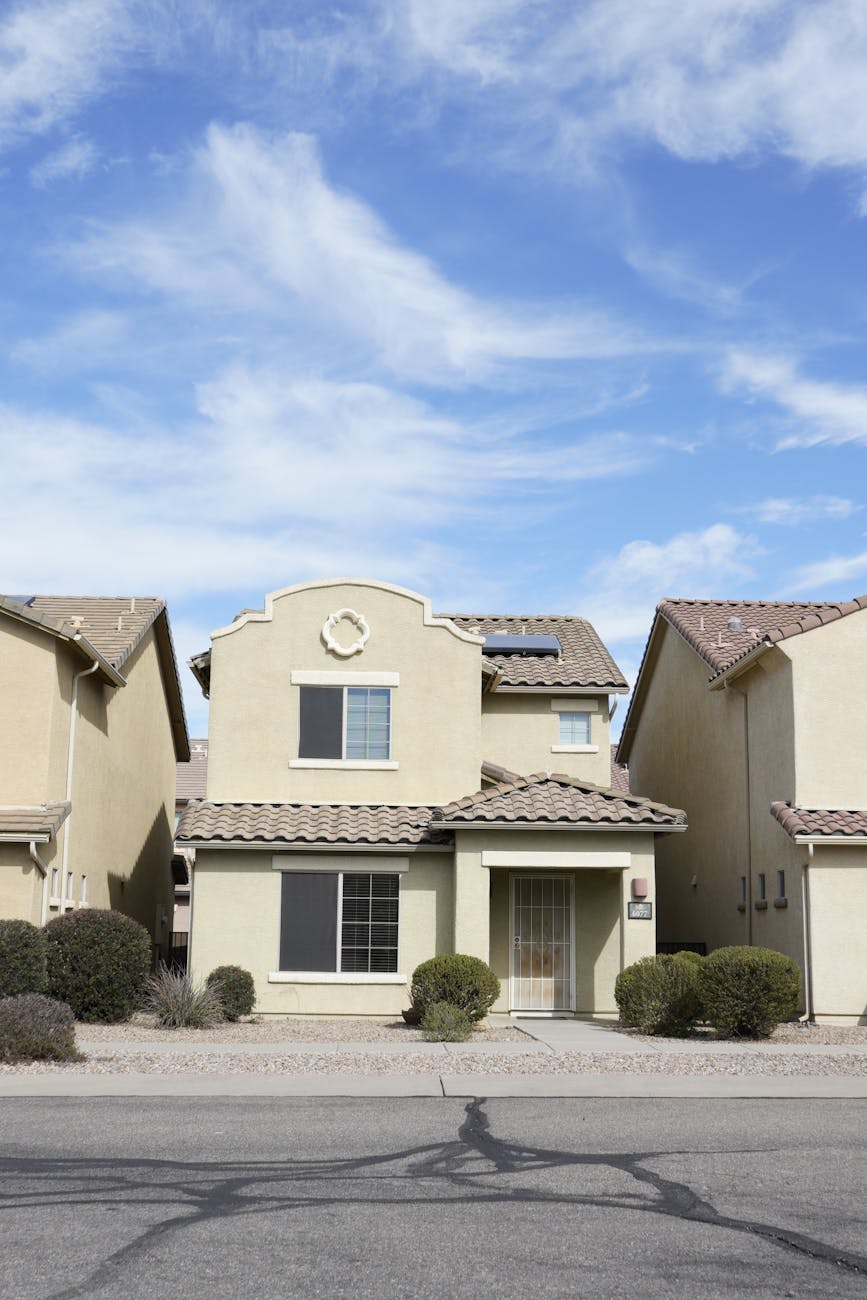
While working on a project, I noticed something while driving through a number of DuPage County communities: there are teardown homes everywhere. They are not just limited to desirable downtowns; they are spread throughout numerous residential neighborhoods. They are often easy to spot: much larger than adjacent homes and with a particular architectural style with stone or fake stone bases, lots of roof peaks, and plentiful garage space. Some could be categorized as teardown McMansions. (Some of these homes might be infill homes where homes were constructed on empty land.)

These teardowns follow some of the patterns I found in over 300 teardowns in Naperville. The architecture and design is similar. The homes are often located next to older homes, often from the postwar era, from the twentieth century.

One difference is that these teardowns are spread throughout communities. In Naperville, teardowns tended to cluster near the desirable downtown area. In some of the communities I drove through, teardowns and/or infill homes are all over the place. Some of these communities do not have downtowns like Naperville and have housing stocks of different ages. It was not unusual to see a teardown suddenly in a neighborhood on the edge of a community when in Naperville the teardowns tend to cluster in particular neighborhoods.

In a county that is largely built out and with suburbs now 50-170+ years old, there will be more opportunities for property owners, builders, and developers to tear down old homes and construct new ones. My sense is that while communities may have regulations about what can be rebuilt, the general atmosphere is in favor of these new homes as long as there is interest and resources to make it happen.

“A man’s home is his castle,” McMansions, and the “castle” that houses a McDonald’s

Let me try to put together a few ideas:

  1. Americans tend to subscribe to the phrase “a man’s home is his castle” and all that means for a private home owner.
  2. Plenty of Americans like McMansions, large homes with dubious architecture often found in sprawling neighborhoods or as much larger houses compared to their neighbors.
  3. McDonald’s is a famous American brand and helped give rise to fast food that goes well with driving and the private single-family homes of suburbia.

Put these together and you have a McDonald’s in a castle in northern Indiana:

Image from Google Street View

Only in America might someone build a gas station castle (it looks like a castle but in a McMansiony way) that contains a McDonald’s. I wonder if it attracts any more customers just because it is a castle.

(This building has apparently been around a while but I recently saw a story about it that caught my eye because I have seen other castle gas stations in other northern Indiana trips.)

Updating a water tower, painting a smiley face on a water tower

What is involved in upgrading a water tower? Here is one suburban example:

Photo by Kindel Media on Pexels.com

The project will include sandblasting the exterior and interior of the tower and applying new coatings inside and out. There also will be some landscaping work with new perimeter fencing.

The assessment also recommended foundation repairs, replacing the original valves, and installing new hatches, gaskets and a submersible mixer.

In addition to removing the tower’s outdated ladder system, workers will install new safety railing and fall protection equipment.

“We’re kind of excited for the face-lift that’s coming to the tower,” Patel said. “It does its job, but the paint job will make it more appealing for pedestrians downtown.”

Sounds good?

This did remind me of part of James Howard Kunstler’s TED Talk “The Ghastly Tragedy of Suburbia” where he discusses a unique water tower within American sprawl:

He says:

By the way, this doesn’t help. Nobody’s having a better day down here because of that.

We have at least a few water towers in the area that include the logo or motto of a suburban community. Why not use them as advertising? This is a different approach than painting a smiley face to presumably attempt to improve people’s days or help them feel better about infrastructure.

Making the sacred profane and the profane sacred at the Super Bowl

The Super Bowl itself may qualify as a religious event given all of its pageantry and symbolism. But, yesterday’s game included at least a few more explicit mentions of religion beyond the patriotism, American consumerism, and big audience already there.

Photo by Shelagh Murphy on Pexels.com

The Super Bowl advertisements from “He Gets Us.”

The ad for prayer app Hallow.

The ad from the Church of Scientology. And see their past ads here.

From Super Bowl MVP Patrick Mahomes: “I give God the glory. He challenged us to make us better. I am proud of my guys. They did awesome. Legendary.”

In early sociological work, theorists discussed the boundaries between sacred and profane. In the Super Bowl, these lines can get very blurry. Is this just an athletic event or is it about our collective lives together and supernatural forces? Can advertising for religious groups and beliefs break through the noise of food and football? Should all of these forces be mixed or is there a time and place for each?

This is not new but it does highlight the ongoing interactions in American society between religion and other spheres. Similar things can and have been said about politics. A football game is not just a football game; it is an opportunity for numerous actors to put their own stamp on what we are doing together.

Opening land for development and “subsidies for McMansions”

A proposed bill in Utah would allow development on public lands. Critics say it would open the door for McMansions.

Photo by Michael Tuszynski on Pexels.com

Rep. Ivory, R-West Jordan, sponsored HJR19, a resolution supporting a piece of federal legislation called the Helping Open Underutilized Space to Ensure Shelter (HOUSES) Act. Ivory is a manager for two real estate affiliated companies — Mission Property Management and 9615 Property Management — according to his financial disclosure form.

“We’ve learned that about 150,000 acres of federal lands are within city boundaries,” Ivory told the House Public Utilities, Energy, and Technology Committee on Thursday evening. “There’s another about 600,000 acres that are within a mile of city limits.”

The HOUSES Act, sponsored by Utah Sen. Mike Lee last year would open up certain public lands managed by the Bureau of Land Management to housing developers. Some critics of the legislation note that it doesn’t require those homes to be affordable, calling it a “McMansion Subsidy Act.”

The proposal would require that 85% of public lands sold be used for residential development and that 4 homes be built per acre. The other 15% could be used for commercial businesses or “other needs of potential communities.”

My guess is that the use of the word McMansion here refers less to a home with mixed-up or garish architectural features and more to big houses in the suburbs. More like “McMansions sprouting” or “cookie-cutter large homes” suddenly arriving in fields. The sprawl that has marked America for decades. And why should new housing opportunities go to people with resources? (See the different traits of McMansions here.)

At the same time, if these lands were opened up and they were filled with denser condos or communities of tiny homes, critics might still have concerns. Allowing the use of public land can be contentious as protected open spaces have value. If one goal is to not allow sprawl to take over everywhere, opening federal land is not a line some would want to cross.

Another question: does simply adding any housing to the housing stock help by adding to the supply? Or, is it more important that affordable housing is added? The charge of McMansions being constructed with subsidies suggests these may be houses for people who do not need help or that adding such housing might not help the housing issue.

A shopping mall left for walkers, a few stores, and future plans

I recently visited a nearly empty shopping mall in a nearby suburb. The suburb just recently bought more of the property in the hopes of redeveloping the mall into something more productive for the community. On this visit, here is part of what I saw in the mall:

On this winter day, there were at least a few people walking laps around the mall. Others sat in the empty food court. Security walked around.

The directory was about 5-6 years old. At that point, the mall still had a lot of retailers.

In the background of the image, you can see the Sears sign. Almost all of the anchor stores are long gone. Most storefronts are empty. The movie theater is shuttered.

The decline of this mall did not happen immediately. Combine online shopping, lots of shopping options in the Chicago region, and COVID-19 and you get a nearly empty mall. And it will take years to redevelop the property and incorporate the new elements into the community.

Regional banks and commercial real estate loans

As companies reduce their office footprint, what institutions hold many commercial real estate loans?

Photo by Andrea Piacquadio on Pexels.com

US banks hold about $2.7 trillion in commercial real estate loans. The majority of that, about 80%, according to Goldman Sachs economists, is held by smaller, regional banks — the ones that the US government hasn’t classified as “too big to fail.”

Much of that debt is about to mature, and, in a troubled market, regional banks might have problems collecting on those loans. More than $2.2 trillion will come due between now and the end of 2027, according to data firm Trepp.

Fears were exacerbated last week when New York Community Bancorp (NYCB) reported a surprise loss of $252 million last quarter compared to a $172 million profit in the fourth quarter of 2022. The company also reported $552 million in loan losses, a significant increase from $62 million the prior quarter. The increase was driven partly by expected losses on commercial real estate loans, it said.

Because I know little about this, this leads to several questions:

If patterns from earlier crises hold up, does this mean that when regional banks suffer difficulties they will be gobbled up by the larger banks?

What do regional banks have more of these loans – is this more of their specialty or they are more familiar with the local markets?

Who exactly decides which financial institutions are too big to fail and at what point might these regional banks qualify?

If these are the losses of just one regional bank, what might we expect throughout the entire US within the next few years?

The most important sporting event in the world will take place…in an American suburb

The World Cup final in 2026 will be played in East Rutherford, New Jersey:

Photo by Riccardo on Pexels.com

The 2026 World Cup final will be held at MetLife Stadium in East Rutherford, New Jersey, on July 19, world soccer governing body FIFA announced on Sunday…

“It’s going to be a special World Cup,” Berhalter said after the announcement was made. “To have the final in New York, New Jersey is a dream come true for me. Being from that area, and I’m sure for most people from that area, it’s an area with a rich tradition of soccer and producing players.

“To think about when I was little, going to watch the [New York] Cosmos and them selling out Giants Stadium, and now this stadium is going to host a World Cup final. It’s really special.”

MetLife Stadium is home to the New York Giants and Jets who play in suburban New Jersey. The stadium is about 9 miles northwest of Times Square and about 13 miles northwest of Wall Street. When the Super Bowl was played here in early 2014, I assume more TV shots and attention was paid to New York City rather than the New Jersey suburbs.

It might also be worth noting that the 1994 World Cup final, the only one in the United States thus far, also occurred in the suburbs:

In 1994, the United States played two of its group-stage matches at the Rose Bowl in Pasadena, California, and the other at the Silverdome in Detroit. The Rose Bowl also hosted the final that year — with Brazil topping Italy in a penalty shootout — and again in 1999 for the Women’s World Cup, when the United States beat China, also on penalties.

Set in Pasadena, the Rose Bowl is roughly 11 miles northeast of downtown Los Angeles. This region is famously sprawling – and the 2028 Summer Olympics will take advantage of the full region for all of the events.

All the talk of soccer taking off among kids in the American suburbs may find its peak in this experience.