The growth of the South required air conditioning

The South is hot during the summer – especially so this year – and architectural adaptations to deal with the heat have given way to air conditioning:

Photo by Airam Dato-on on Pexels.com

“They would build homes with transoms over the doors and over the windows,” Dr. Diaz explained. “They would build homes with the front door and the back door in complete alignment — you could basically create a wind current through the house.”

Days were structured around the heat, waking at 4 a.m. to work outside, then taking breaks and eating a big meal in the middle of the day…

The ascendance of air-conditioning was a transformative force in the South, facilitating the rise of suburbs and making the region less forbidding for companies that wanted to move in. Now, transoms and rising early have been replaced with drive-throughs and attached garages and cranking up the A.C. — for people with the means and jobs that allow it.

“People are so completely dependent on air-conditioning,” said Craig E. Colten, a professor of geography at Louisiana State University. “You run around on our campus and you see people going between classes in shorts and sweatshirts because the air-conditioning is so ramped up.”

Even as air conditioning makes inside activity more possible, it would be interesting to see how much activity during the hot months takes place inside compared to the rest of the year. If people in colder climes spend more time inside during the cold months, is the same true in the South during the summer?

And do not forget the importance of air conditioning for office work.

Instituting racial covenants for whole neighborhoods outside of Kansas City

Developer J.C. Nichols helped popularize the implementation of racial covenants for whole suburban subdivisions:

Photo by Giancarlo Rojas on Pexels.com

Also known as covenants, they’d existed for decades, typically as an agreement between a developer and buyer on a single lot, proving unpopular to Americans who didn’t want to be controlled on their own property. But Nichols sensed he could foster long-term stability, which would be profitable for him and for homeowners. He initiated restrictions on entire neighborhoods, placing them on the land before any lots were sold—a private zoning system before municipal zoning was widespread. He’s credited as the first developer to emphasize the covenants for middle-class areas and to make them self-renew after periods of 25 to 40 years unless a majority of residents objected, ensuring they’d essentially last forever. For enforcement, he set up homeowners associations.

Nichols’ restrictions started with a few sentences on neighborhood plat documents and eventually ran for a few pages. They set minimum prices for home construction, mandated single-family housing and banned apartments, required a specified amount of space on the fronts and sides of homes, and regulated routine housing elements like chimneys, trellises, windows, vestibules, and porches.

There were also racial restrictions that barred Black residents from owning or renting homes. An early billboard for Nichols’ Country Club District development described the area as “1,000 Acres Restricted.” Newspaper ads claimed that Nichols’ neighborhoods blocked “all undesirable encroachments” and promised that “complete uniformity is here assured.”…

Nobody had seen a swath of suburbia as vast his neighborhoods, which comprised the Country Club District: By the 1940s there were more than a dozen contiguous upper-class and middle-class subdivisions filled with bubbling fountains, tree-lined vistas, and cul-de-sacs, providing homes for as many as 50,000 people across two states. Many subdivisions were buffered by parks and golf courses, and they were all tied together with restrictive covenants. It was the “American’s domestic ideal,” opined a visitor from the New Republic.

Nichols wasn’t the only builder applying covenants. Their use accelerated after 1910, imposing segregation and strict land-development rules across the country. But he was their most prominent proselytizer, promoting their spread through speeches and articles and in leadership roles with national real estate organizations. Nichols’ covenants in Sunset Hill and Mission Hills, two of his poshest neighborhoods, were said by his company to have been copied in more than 50 cities.

Developers, officials, residents, and others developed and put into practice a number of measures to keep people out of white suburban subdivisions. Today, these measures tend to be more economic and zoning-based with fewer explicit references to race and ethnicity. But, as noted above, the outcomes are clear: the suburbs were segregated by race and ethnicity.

Trying to clear paths for the redevelopment of vacant urban lots

Several big cities are working to make it easier to improve vacant lots:

Photo by RIDVAN AYRIK on Pexels.com

Detroit officials want to triple property-tax rates on vacant land and reduce rates by an average of 30% for homeowners. The idea is to spur development on 30,000 neglected vacant lots held by owners who pay almost no taxes. It is a tall order. The city’s population has fallen by two-thirds since its 1950s heyday, and the Detroit land bank holds another 63,000 vacant lots. 

In Pittsburgh, the city council this month passed a measure to more easily transfer the 13,000 or so city-owned lots and vacant properties to a municipal land bank and into the hands of developers or nonprofits. The city’s population is down by more than half since its peak in the 1950s.

Chicago, whose population has fallen by about a quarter since the 1950s, has more than 10,000 city-owned vacant lots. Another 16,634 are caught in a limbo of back taxes and unpaid fees. Every other year, the county tries to unload such properties in a tax-lien auction known as the Scavenger Sale. Only about 8% of the properties in the auctions from 2007 to 2019 went to buyers who managed to obtain a clear title, the Cook County Treasurer’s office found…

A measure signed into law last week by Illinois Gov. J.B. Pritzker aims to resuscitate such properties. It cuts interest rates on overdue property taxes to 9% from 18%. It also allows Cook County to automatically acquire tax liens on delinquent properties before they reach the Scavenger Sale, reducing the time it takes to clear titles and transfer them to developers or nonprofits.

Even with reduced obstacles, it will take time for the number of vacant properties to be significantly reduced.

Once the property can be purchased and redeveloped, new questions emerge. What will be built there? What do owners, developers, and builders see as the price points that make it worth their time? How do new buildings and/or land uses fit with the existing neighborhood?

In other words, this is a multi-decade story worth paying attention. How did these properties become vacant and where did the residents go? Where do things stand now? What will they look like in the future? Specific decisions now could help alter the story to come.

More suburban sprawl = disappearing night sky

A resident of Naperville, Illinois describes one consequence of the growth of the suburb and the Chicago region:

Photo by Benjamin Suter on Pexels.com

Growing up, Carhart said he learned the intricacies of the Milky Way from his suburban backyard in Naperville. But slowly, the 64-year-old said, he watched the stars disappear. If someone were to visit his childhood home today, he said, they could count the number of stars they see on their fingers…

“The light pollution is tremendously worse. Out by Naperville we could see the glow in the nighttime sky of Chicago off in the distance, but it only went a little ways up in the sky,” he said. “Over the years we watched it get brighter and then extend overhead and all the way to the other horizon and just take over the sky.”

What can help reduce this light pollution in a large metropolitan area?

The National Park Service suggests considering whether outdoor lighting is necessary, or if reflective tape or reflective surfaces could be used instead. Other sustainable outdoor light specifications, according to the Park Service, are LEDs at 2700 Kelvin. These lights emit a warm color hue instead of blue or white. The Park Service also recommends purchasing LED bulbs that have the lowest lumens possible — the unit of measurement used to specify brightness — and ones that can accommodate motion detectors or dimmers, which it says can enhance health and safety…

Referencing a study from 2020 that found only about 20% of a city’s brightness can be linked to streetlights, Walczak said regulation or policies surrounding light pollution should be directed toward commercial businesses, such as parking lots or building facades.

The proposed solutions – and another suggested later in the article that uses special equipment to avoid certain light wavelengths – are efforts to work around the sprawl of the region. If there are over nine million people living in the Chicago region, is it possible to have a visible night sky?

This could be another argument against suburban sprawl. As Americans develop more land outside of cities, light spreads. Homes and yards have lights. Roadways have lights. Buildings have lights.

Naperville’s success – rapid population growth, vibrant downtown, lots of jobs – comes with lights. It could come with less light than it might have now . But, how many suburbanites are willing to trade lights for seeing the night sky? How many lights are for safety purposes that suburbanites care about (roadways, properties, etc.)?

It would be interesting to see some major suburban communities lead the way on this. And it would likely take significant regional efforts or numerous communities going this direction to make a visible difference.

Enron, McMansions, and unlikeable villains

The Enron scandal broke in late 2001. And it involved McMansions?

Photo by Bob Price on Pexels.com

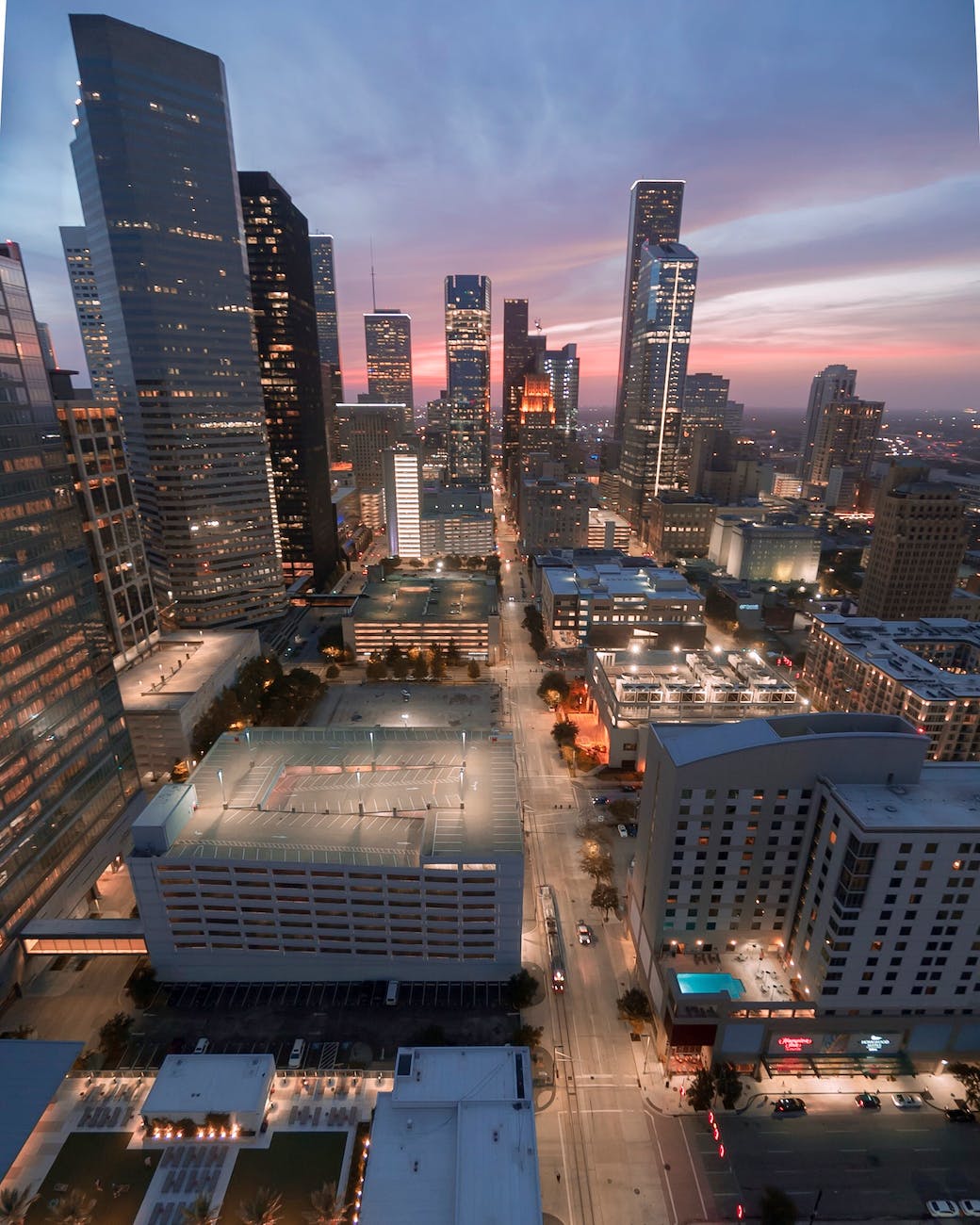
The characters in this drama were larger than life in the Texas vein, but they lacked the roguish charm of the wildcatters of old, that quality that could make you forgive all. Yes, there were motorcycle races in the desert and Porsche Carreras and River Oaks McMansions, along with ill-advised love affairs and stiletto-in-the-back corporate intrigue. But in the end the Enron villains weren’t that much fun. They were just rich. And arrogant.

According to another story, Enron executives upgraded their residences in the years prior to the scandal:

Only a few years ago, Skilling, Fastow, and Michael Kopper — Fastow’s lieutenant in the Enron scandal, according to conclusions drawn in the Powers report — all lived within walking distance of one another in the quiet upper-class neighborhood called Southampton Place, which borders Rice University. It is a nice neighborhood, with houses that go for around a half-million dollars, but all on small lots, with alley parking in the back. Skilling lived in a simple, square brick house with his wife and three children. Kopper lived a few blocks away in a cottage he eventually remodeled to have an almost Japanese-style look, the house taupe in color, with a gray roof…

And before all three men — Skilling, Fastow and Kopper — bought new properties, tore down the existing structures, and started building their dream houses. Once again, all in the same neighborhood. The neighborhood where the rich live in Houston. The neighborhood where Lay lives. River Oaks.

So now Skilling resides in a mammoth Mediterranean-style home with a tile roof, and he’s engaged to Rebecca Carter (the one known as Va Voom), who under Skilling was promoted to executive secretary to Enron’s board of directors at a salary of $600,000. Fastow is building something that looks like a country manor, almost Tudor-ish. And Kopper and his partner William Dodson opted for a postmodern abode — boxy, all white and beige and glass and hard angles. A house so close to the Lays’ luxe apartment building that the shadow practically falls across Kopper’s lawn…

Skilling’s house is decorated in a sleek, black-and-white theme, in homage to Enron’s corporate colors. But he hired the Houston-based design team of Michael Galbreth and Jack Massing — who are known as the “Art Guys” — to do his guest quarters.

Several thoughts upon reflecting on this story from the past:

  1. Texas does like its houses bigger and I found in a 2012 published article that McMansions were not treated the same way in the Dallas Morning News compared to the New York Times.
  2. Did Skilling live in a McMansion or a mansion, a home with more square feet and not a mass-produced home within a subdivision?
  3. Does calling his home a McMansion fit better with an image of a corporate villain? The term McMansion is not usually used positively and could hint at the ill-gotten rise of Skilling. Does a more garish McMansion make it easier to dislike a figure?
  4. On a “Lives of the Rich and Infamous Tour B” in the Houston area, you may see “Homes of the leaders of Enron:  Kenneth Lay (1942 – 2006) and Jeffrey Skilling.”

The (long) time it takes to develop academic arguments

One feature of summer and breaks for college faculty is the possibility of more time for writing and working on projects. While this writing time does not always happen given other responsibilities in life, time is needed to develop academic projects. And we may need numerous summers, breaks, and semesters to fully put together works. What do we need this time for?

Photo by SevenStorm JUHASZIMRUS on Pexels.com

-Writing and submitting proposals and grants.

-Developing ideas and precise research questions.

-Becoming familiar with the already-existing literature.

-Collecting data and evidence.

-Analysis.

-Crafting narratives that align with the research question, existing scholarly conversations, and the evidence we have.

-Writing and rewriting.

-Conversations with others.

-Presentations, whether to the public, academic groups, students, or others.

-Responding to reviewers and editors.

-Thinking (all throughout the process)

While the activities above are in a rough order from a beginning of a project to the end, it does not always work this way. These are also not necessarily discrete stages; they can blend together and are often recursive and connected as working on one part leads to going back to an earlier step or portion.

All of this means that a single writing project can easily take years. Some projects take longer than others. It can be hard to predict how long a project can take. What does this all add up to? Hopefully a coherent and compelling project.

If we added to publications and presentations a clock for the time involved, this could help reveal the time spent. Without letting such figures turn into a competition or a quest for efficiency, it could open conversations about processes and resources.

Can popular TV shows lure new residents to a city?

Fort Worth, Texas is growing. Is this partly because TV viewers can see it on a set of popular shows?

Photo by Bryan Dickerson on Pexels.com

Mattie Parker, the mayor of Fort Worth, Texas, says a focus on crime, homelessness, parks and reliable infrastructure has positioned the city of 950,000 as an attractive alternative to Chicago, San Francisco and New York, which have struggled with perceptions of deteriorating safety in the aftermath of Covid-19.

The 39-year-old Republican, broadly considered to be a moderate in deep-red Texas, says that Fort Worth’s pitch to lure businesses highlights its roots (the city’s slogan is “Where the West Begins”) and small-town vibes, even if its stockyards are now more of a tourist draw than a genuine agricultural enterprise. The nostalgia for cattle ranching and cowboys generated by the hit television series Yellowstone and 1923 — created by Taylor Sheridan, who partly grew up in Fort Worth — are only adding to its allure.

“Fort Worth continues to be an incredibly unique city that is very proud of our Western heritage,” Parker said in an interview at City Hall, where a display case held shovels from groundbreaking ceremonies over the years. “And the timing couldn’t be better because of this fanfare and frenzy over Yellowstone and 1923.”

In Fort Worth, it’s common to see cowboy hats and boots paired with a tailored suit. Unlike nearby Dallas, which mostly feels like any other major metropolis, Fort Worth embraces its sense of place. There’s plenty of live country music, two-step dancing and Tex-Mex cuisine.

This is a long list of reasons for growth. Additionally, Fort Worth is part of the growing Sun Belt.

How much can depictions on a TV show contribute to this growth? Here is how Wikipedia describes the connections to Fort Worth that start with the TV show 1883, the earliest prequel for Yellowstone: “The series follows the post-Civil war generation of the Dutton family as they leave Tennessee, journey to Fort Worth, Texas, and join a wagon train undertaking the arduous journey west to Oregon (the Duttons are never on the actual Oregon Trail itself), before settling in Montana to establish what would eventually become the Yellowstone Ranch.”

I would be very interested in seeing some data regarding the connection between a popular television universe and population growth in a particular city. Are these shows also causing population growth in Montana? It makes sense for a local leader to make the connection to a show people like as it is always helpful to have good press.

Humans walk, Americans drive

One feature of human beings is that they move on two legs. This bipedalism provides a primary means of locomotion. It may have given rise to rhythm and music.

“Walking Man II” by Alberto Giacometti at the Art Institute of Chicago

Many spaces in the United States privilege driving rather than walking. Driving is often faster. In the same amount of time, a driver can likely go farther than a pedestrian.

But, driving is not what humans have done throughout most of history. Driving is much faster. It requires technology to make and maintain vehicles. There needs to a lot of infrastructure to support driving. The scale changes as a vehicle is moving much faster and needs more room.

Even to see the statue above, many visitors will take a vehicle on a roadway. This enables millions to visit the museum and take in this image. Yet, they will contemplate a depiction of a human walking while primarily traveling via other modes.

Asking Americans to not drive as much or at all is a tall order. Cars are an integral part of the American way of life. Maybe reflecting on “Walking Man II” can help people remember a past and envision a different future.

Who benefits from preserving open space in the suburbs?

I was reading through some newspaper articles from the 1990s about development in my suburban county. In an article on a $75 million bond proposal for county voters to preserve 2,300 acres of open space (which voters did approve), here is one explanation why county voters should increase their property taxes for this purpose:

Photo by David Boozer on Pexels.com

Bond issue proponents have stressed that preserving open land will help everyone by making DuPage County an even more desirable place to live. Saving open space will improve wildlife habitats, help control flooding, improve stream water quality, avoid added congestion and protect property values, Oldfield said. (Lynn Van Matre, “DuPage voters to decide on open space,” Chicago Tribune, November 2, 1997)

The reasons listed for voting in favor of spending this money appear to split into two areas: (1) environmental concerns (wildlife, flooding, water) and (2) a particular quality of life marked by property values and limited traffic.

But, I wonder if the first category is a subset of the second set of concerns. Suburbanites in Chicagoland care about property values and have concerns about drug treatment centers, waste transfer facilities, religious buildings, apartments, and anything else they think threatens their financial investment.

Do suburban residents care more about environmental concerns or about what development might go into these open spaces? From the perspective of some (and this was also expressed in the article above), such land could be used for affordable housing or for community amenities. To keep it as open space means it could not be other uses that people could benefit from.

If preserving property values is the top concern regarding land development, this is the sort of decision that might be made. Such a decision does not come cheaply; local property owners pay more but they do so in order to hopefully boost their investment even more.

(See earlier posts involving questions about who benefits from open space in New Jersey and the motives behind acquisitions by forest preserves.)

Equating the population of a good sized American small town and the world’s new largest cruise ship

Americans like small towns. What if a small town was always on the water? The world’s new biggest cruise ship will carry a sizable number of people:

Photo by Shawnna Donop on Pexels.com

Royal Caribbean’s luxurious new vessel Icon of the Seas is nearing completion in the Turku shipyard on Finland’s southwestern coast, its maiden voyage scheduled for January 2024…

Resembling a village more than a ship, the mammoth vessel boasts colourful waterparks, more than 20 decks and can carry nearly 10,000 people…

Papathanassis noted that “there are obvious economic benefits” to mega-sized ships, reducing the cost of individual passengers.

With its seven pools, a park, waterslides, shopping promenades, ice skating rink and “more venues than any other ship”, larger vessels like the Icon of the Seas also offer more options for spending money on board.

Here is a breakdown of who will on the ship/floating village:

Royal Caribbean International’s Icon of the Seas is a mammoth 365 meters long (nearly 1,200 feet) and will weigh a projected 250,800 tonnes. For comparison, that’s like trying to keep two CN Towers afloat.

When it sets sail on Caribbean waters in January 2024, it will comfortably hold some 5,610 passengers and 2,350 crew.

Imagine a large American small town or a small suburb floating on the ocean around the world. What might take up several square miles on the American landscape can be packaged on one boat. The density is a lot higher and it has a lot of recreational amenities in a small space. Besides space, what else is missing?

I am reminded of the ideas of floating communities outside of international waters and/or apocalyptic scenarios where humans do not have access to land. Could a ship this sized be turned into a permanent settlement and how would this alter what is on board?