Bill and Linda Graba of Hoffman Estates are widely considered to be the godparents of pickleball in the Northwest suburbs. They picked up the game after retiring to The Villages in central Florida, where they spend their winters…
Graba said he and his wife started promoting the game locally in about 2009. They helped get indoor courts at what was then known as the Prairie Stone Sports & Wellness Center in Hoffman Estates and outdoor courts at Fabbrini Park in Hoffman Estates. For the past 10 years, they’ve organized a six-county tournament that brings in about 200 participants.
Graba said public outdoor courts are popping up throughout the suburbs, including Palatine, Schaumburg, Streamwood, Hanover Park and St. Charles.
“It’s basically all over every suburb,” Graba said. “If they haven’t had them in the past, people are asking and they will have them soon.”
This seems ripe for some analysis at the community level:
In what communities are pickleball courts showing up?
What are some of the common processes by which pickleball courts come into existence? Who is asking for courts and who is building them? For example, are park districts primarily funding these?
The space and resources for pickleball courts is coming from where? Is this about the transformation of tennis courts or are other spaces being used?
I suspect there are some patterns to who is playing, where they are playing, and how the game is spreading. As the game spreads, there could also be some change to the answers to these questions.
The Northwest suburban municipality — of Makers Wanted Bahamas Bowl fame — has inked a two-year marketing partnership with the Roush Fenway Keselowski Racing team that will enable it to affix its business marketing tagline, logo and brand to the No. 6 Ford Mustang stock car during the NASCAR Chicago Street race events next year.
The announcement was made during the ninth Made in Elk Grove Manufacturing & Technology Expo at the high school. The daylong exhibition, awards and networking event highlights businesses within the village’s sprawling industrial park — which the village has sought to promote through several unconventional marketing sponsorships. The town sponsored the college football bowl game in 2018 and 2019, plus three USA Olympic teams last year.
“Elk Grove Village is home to the largest industrial park in North America. We’re surrounded by incredible transportation options and our town works hard to make this a destination for businesses,” Johnson said in a statement. “Partnering with RFK for a marquee race allows us to reach a huge audience with a partner that shares a passion in American business and manufacturing.”
Suburbs continue to market themselves in order to stand out from the hundreds of other suburban communities with which they might be competing. Lots of suburbs could say they have industrial space, nearby transportation options, and are business friendly. Fewer might be able to say they have “the largest industrial park,” sit near O’Hare Airport, within such a busy region for railroad traffic, and right next to major highways, and offer exactly what Elk Grove Village can offer businesses. This branding effort will help highlight these distinctive features.
But, the big question is whether this broader exposure translates into increased business and development activity in the community. Will those watching Brad Keselowski zoom around a track visit makerswanted.org in large numbers or relocate their firms to the suburb? Is it enough that the suburb might have an increased status but no change in activity?
But, he said, “I’m going to tell you right now I’m not a fan of the site plan. And I hope this doesn’t blow up and ruin things for you in any way because I’m just one person sitting up here. But I have to be true to myself and true to my thoughts.”
Tinaglia, who founded his Tinaglia Architects firm in Arlington Heights in 1991, blasted the mixed-use transit-oriented development aspect of the Bears’ proposal, arguing the plans for restaurants, stores, offices, hotels, homes and more on 206 acres of the 326-acre property would detract from what is in downtown Arlington Heights.
“For a community that doesn’t have a downtown — that doesn’t have what Arlington Heights already has — that community would die to have this,” Tinaglia said. But he said he didn’t believe Arlington Heights’ current business owners could survive the competition from the kind of development being proposed.
Many suburbs would like to have a thriving downtown. Arlington Heights has one. It boosts the status of the community with its older buildings, current businesses bringing in residents and visitors, and possibly residents living downtown and also visiting local businesses and restaurants. Not all suburbs have downtowns; some never had them due to consisting of multiple suburban subdivisions joined together while others may have had a downtown that is now struggling or non-existent. The suburban downtown has had numerous challenges over the years – strip malls, shopping malls, driving and parking, big box stores, and more – so having a successful one is not something a suburb would lightly give up.
On the other hand, not every suburb has an opportunity to be home to a major sports stadium and all of the development around it. This is a new opportunity that could be worth a lot in terms of business activity and tax revenue, population growth, and status tied to being the home of an important football franchise.
It will be interesting to see if there is a compromise to be had here where both a downtown and a new mixed-use development coexist. Do they have to be in competition or can they serve different audiences?
The plans revealed Tuesday by the Bears call for a multipurpose entertainment district anchored by a stadium that could host the Super Bowl, college football playoffs and college basketball Final Four, with an adjoining commercial/retail and housing district. While cautioning that the long-term vision for the entire property is a work in progress, the team said the site could include restaurants, offices, a hotel, fitness center, parks and open spaces.
The team’s open letter provided a series of economic projections, saying the large-scale redevelopment would provide “considerable” economic benefits to Cook County, the region and state.
For instance, construction would create more than 48,000 jobs, result in $9.4 billion in economic impact in the region, and provide $3.9 billion in labor income to workers, the team said.
The development would generate $16 million in annual tax revenue for the village, $9.8 million for the county and $51.3 million for the state, according to the Bears.
Yes, a stadium is necessary for football but teams now want to develop more land and generate additional revenues adjacent to the sports playing surface. If they help generate such development and/or retain an ownership stake in the surrounding development, this can both bring in significant annual revenue and further boost the value of their franchise.
This also follows on-trend development ideas where a mixed-use property helps ensure a regular flow of activity. Instead of separating land uses in different places, putting them all together can create synergy and additional revenues.
Another way to think about it is that a lot of sports teams are in the land development business. How exactly this fits with a goal of fielding a winning team might get complicated.
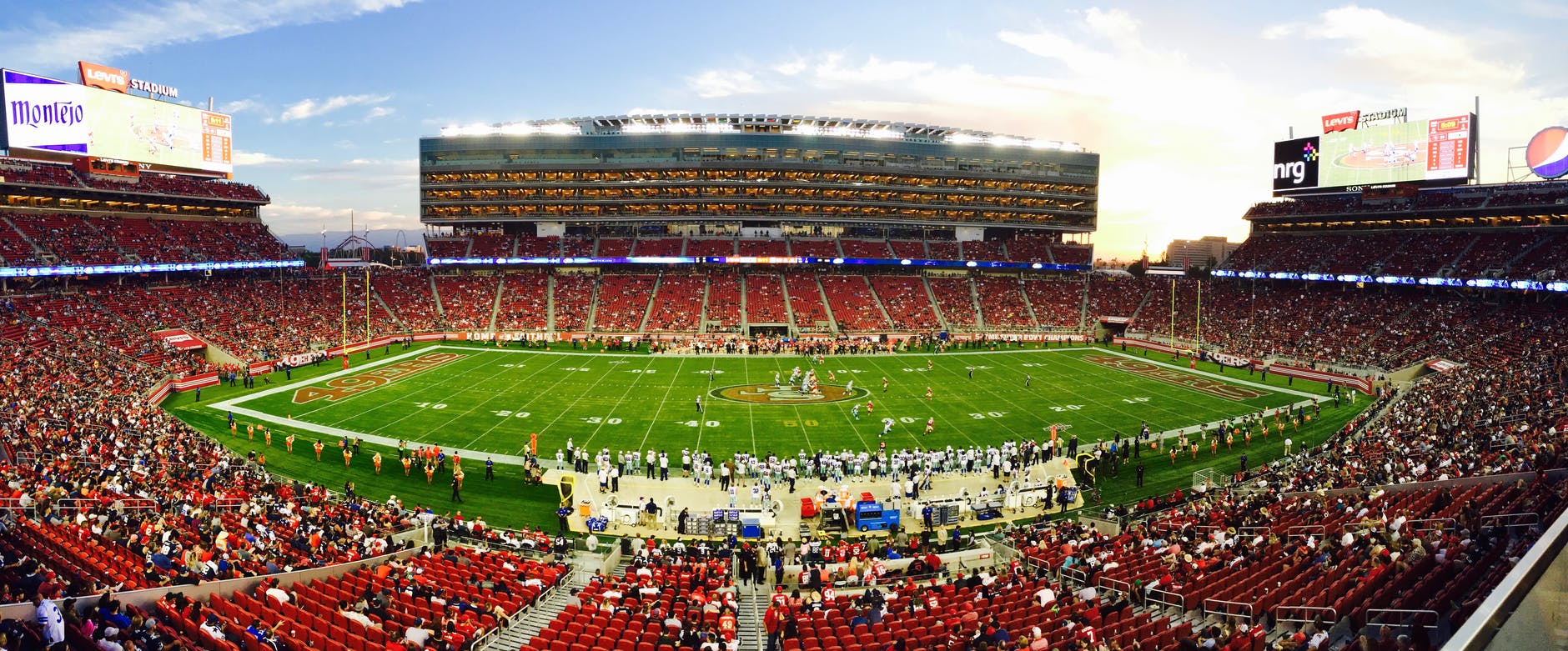
Ten NFL teams have a big city in their name but play in the stadiums located in the suburbs of that big city. Here are the 10 (sourced from here and here):
-New York Giants play in East Rutherford (New Jersey)
-New York Jets play in East Rutherford (New Jersey)
-San Francisco 49ers play in Santa Clara
-Washington Commanders play in Landover (Maryland)
Two bonus suburban teams: the Arizona Cardinals, not named after a city but a state, play in suburban Glendale and the New England Patriots, named after a region and not a city, play in suburban Foxborough.
I enjoy listening to baseball games on the radio. The pace of the game, the voices of the announcers, and the ability to do other things while listening add up to an enjoyable experience.
Except for one growing trend: the number of commercial reads throughout the game. At this point, it seems like almost every baseball event has a sponsor. Strikeouts, walks, doubles, home runs, the fifth inning, the seventh inning…you get the idea. Baseball has a lot of small events and apparently they can be attached to an advertiser for the right price.
I am aware of multiple factors behind this. Radio is a dying business. Live sports is one of the few shining spots where there are certain to be listeners (or viewers). Commercialization is alive and well. There is money to be made here.
But, I can only imagine how this might spread to all areas of life. Go beyond the Internet and social media ads tied to your browsing and shopping habits. You tie your shoes; brought to you by [blank]. You run the dishwasher; brought to you by [blank]. You read a book; brought to you by [blank].
At this point, there do not seem to be any officials guardrails against more and more of this happening. People can push back but this has consequences. If I do not like the baseball ads, I can stop listening. But, if we move to more immersive devices – Google Glass, virtual reality headsets, a house full of Internet equipped objects – this will be very hard to push against or escape.
Via Sports Business Journal, a Chicago mayoral committee will recommend that the city consider the feasibility of putting a dome over Soldier Field.
A dome, as reported by Crain’s Chicago Business, could cost between $400 million and $1.5 billion.
Other possibilities include upgrades to the stadium (including significant rebuilding of certain parts of it) and selling naming rights to generate revenue for improvements.
In the long run, it is not probably not worth it for the city and the others to spend hundreds of millions to keep the Bears. The team would benefit the most from new arrangements. The money spent on eight Bears home games a year will be spent elsewhere in the city. The team is not leaving for another market but just for the suburbs.
At the same time, losing the biggest team in town to a suburb is not a good look for leaders. The Bears have played in the city for a century. They are the most popular sports team in town. Soldier Field hosts other events but it has been the home of the Bears for decades. The loss of the Bears could be added to the narrative of losing companies and residents.
Discounting whether the offer from the city is a viable one – putting a dome on Soldier Field is no easy task – I think this is a necessary political move. The mayor and city leaders need to make a good offer to save face. The big city leader cannot let the big team leave without a fight. And ten years from now, when the Bears are playing in a suburban property that earns the team even more money and the city of Chicago has moved on, there may still be lingering blame for those who let the Bears leave no matter what offer or public statements they made.
“For any team, whether it’s in soccer or other sport, the stadium is the spiritual home,” Nashville SC chief executive officer Ian Ayre said. “If you’re renting, it’s not the same as owning, right? Of all the infrastructure and the parts we build, it’s the most important.”
The team’s coach added:
Nashville SC coach Gary Smith called the crowd “magnificent,” adding that the players felt the energy from the moment they walked onto the field for warm-ups. “The expectation and excitement that surrounded this opening game was huge,” he said after the match. “To think that the players didn’t feel that would be inhuman. The atmosphere was terrific.”…
“To have our own home is vitally important,” Smith said. “This venue now will be the place over the coming years and decades that fathers and sons will come to and look back on and say, ‘Do you remember?'”
As a sports fan, I understand this sentiment. Going to the physical home of your favorite team or to an interesting stadium or a stadium where there is clearly fan interest is exciting. It is not just watching teams play in a physical setting; there is a collective effervescence that can arise to the level similar to how people describe spiritual experiences.
On the other hand, the team benefits from this spiritual home in the terms of dollars and cents. The stadium and all it entail makes money. It is an improved property. And increasingly so these days, owners and teams develop the land around the stadium in ways to further enhance revenue. This is not a sacred place maintained for the well-being of people who visit; it is for a business.
This mixing of business and spirituality is not uncommon in the United States or elsewhere in the world. Is the spiritual homeness of the sporting event ruined because money is being made? Perhaps not for most of the fans who are there for what the trivial can produce. For some of those fans, the sports stadium is more sacred than a religious building or congregation. At the same time, a new stadium and sports in general are big business where producing spiritual homes and transcendent experiences keeps consumers coming back for more and cities eager to keep teams or introduce new teams to the local economy.
In a pair of radio interviews last week, Lightfoot poo-pooed a potential move, saying Arlington Heights can’t match the offer Chicago will make — or its tourist trade…
While the prospect of reelection is much more imminent for Lightfoot than where the Bears end up, any signs that she is relenting to Arlington Heights would be the death of her political career.
It was just a few months ago that Lightfoot was overtly dismissive of the Bears’ purchase agreement for the 326 acres at Arlington Park Racecourse — enough land for a world-class stadium plus all manner of ancillary entertainment businesses from which the team could profit…
If Lightfoot thinks she can keep the Bears at Soldier Field — even with a dome — she’s nuts. The constraints of the NFL’s smallest and oldest stadium won’t allow Soldier Field to host a Super Bowl or, as is important to the team, to allow the Bears to do what has become commonplace around the league: develop the stadium as an entertainment complex that generates more cash…
The only sure winner in this tug of war will be the football team.
The research consistently finds that team owners are the biggest winners in the battle to provide tax breaks, monies, and other benefits for sports teams who consider relocation. Yes, it would be a PR and status blow to Chicago to lose the Chicago Bears to a suburb – even a denser Arlington Heights – but people will still spend money in the city and the team will still be in the region. Do not go into taxpayer debt just to enrich a private football team.
It will be very interesting what kind of “best offer” Chicago will provide. And how public will this all get as the city tries to avoid losing the team?
By 2020, the A’s were the only team left. But they made it clear they were prepared to leave, too. Last May, majority owner John Fisher and team president Dave Kaval—resident cartoon villains of what remains of the Oakland sports scene—began threatening to follow in the Raiders’ footsteps and relocate Oakland’s last pro team to Las Vegas … unless the Oakland City Council voted to help them build a $12 billion stadium “district”—replete with condos, hotels, and apartment buildings—on a wedge of waterfront property operated by the Port of Oakland just west of Jack London Square. If approved, the project would constitute one of the largest and most transformative development deals in California state history. It would likewise require hundreds of millions of dollars in public funding to complete. Fisher, who is heir to the Gap Inc. fortune and has a net worth north of $2 billion, has committed to privately finance the construction of the stadium itself, but the project isn’t viable without a suite of infrastructure improvements to the surrounding area. These improvements are what the A’s asked the city to find ways to pay for.
It was a familiar ploy. As journalists Neil deMause and Joanna Cagan write in Field of Schemes: How the Great Stadium Swindle Turns Public Money Into Private Profit, since roughly 1984, when the Colts left Baltimore for Indianapolis, team owners across the country have worked systematically to “supplement profits by extorting money from their hometowns,” usually “under threat of moving.” Starting around last summer, Fisher and Kaval began to expand upon their means of municipal extortion. In the run-up to a series of contentious City Council meetings, Kaval took to posting videos of himself on Twitter jubilantly attending Las Vegas Knights games, as if to spur the city into supporting his proposal out of jealous insecurity. Fisher, meanwhile, enlisted MLB commissioner Rob Manfred to act as muscle. “Thinking about this as a bluff is a mistake,” Manfred told the BWAA in July 2021. “This is the decision point for Oakland as to whether they want Major League Baseball going forward.”
Oakland has been struggling to make that decision ever since. Some, like Marcus Thompson, an East Oakland native, 2021 California Sportswriter of the Year, and author of Golden: The Miraculous Rise of Steph Curry,resent Fisher and Kaval’s tactics, and say that Oakland’s political leaders “should not be caving to an owner” worth over $2 billion who has “shown zero desire to be a meaningful member of our community unless it is profitable.” Certain Oakland political leaders, such as Councilmember Carroll Fife, who represents the district in West Oakland where the A’s stadium would be built, agree. “There are so many dire issues in Oakland right now,” Fife told me in February—citing, among other things, Oakland’s crises of gentrification, affordability, and homelessness, which the United Nations has singled out as “cruel.” Fife said she doesn’t believe “a sports team is going to address” any of them. “We should use public resources toward addressing residents’ immediate needs.”
Others believe the economic benefits of a new stadium are worth pursuing in and of themselves. “Building the new A’s ballpark would be a blessing,” Mitchell Schwarzer, historian, professor, and author of Hella Town: Oakland’s History of Development and Disruption, told me in an email. It would “bring crowds to adjacent Jack London Square,” and fill “its vacant spaces with places to eat, drink and shop.” Oakland’s mayor, Libby Schaaf, agrees, calling the A’s stadium project “a world-class waterfront ballpark district” with the potential to “benefit Bay Area residents for generations to come.”
No major city or leader wants to lose a major sports team. And the Oakland case is unique with multiple teams leaving in recent years.
However, the price that is often paid to keep a team is not worth it. The costs are too big, taxpayers lose other opportunities, the money would be spent elsewhere in the city if not at sporting events, and the owners are the ones who truly win with the increasing value of their team.
The Oakland case is also different because of the way the Athletics are run. The team has a Billy Beane approach that suggests an excellent team can be created with a limited payroll and an ability to exploit market inefficiencies. The A’s have done this a few times in the last two decades…and then they sell off all of their good players and start again. They just did this going into the 2022 season and have a minimal payroll of just under $50 million, second-lowest in baseball and roughly one-fifth of the biggest spenders in the sport. In addition to the economic case for taxpayers, is this a team worth supporting?


 Legally Sociable