Amazon rediscovering department stores?

Amazon’s online empire is vast but it is also expanding its brick and mortar operations with plans to open department stores:

Photo by Artem Beliaikin on Pexels.com

What solves all of these problems—the high return rates, the cost-prohibitive last-mile freight, the logistics nightmares, the buyer frustration, and the monumental volume of consumer waste it all sends to landfills—on some level? Stores. Going to a store. In America especially, this notion was obvious for more than a century. Department stores were actually such a good idea, something that people like so much and that works so well, that the Gilded Age barons who invented them used their stores to create middle-class identity from near whole cloth and keep it going for generations.

Amazon helped kill most of those stores, but that has only created a vacuum into which more Amazon products and services are ready to be inserted. If Silicon Valley has taught us anything in the past two decades, it’s that if you have a bottomless pit of money, you can remake an industry in your image. You can acquire customers so quickly that they might not realize they don’t totally love everything you’re doing, and you can embed yourself in their lives in ways that would be tangled and inconvenient to remove, largely by snuffing out competition. Which leaves the retail industry in a precarious position: Amazon, and maybe a handful of its largest competitors, will go about deciding how you get to buy the things you need, with very little meaningful pushback. They’ll set prices, they’ll set labor conditions, and they’ll decide which things are too inefficient for you to buy online. Apparently, those things will go into a store.

Amazon and the companies like it invent the solutions to the problems they created, and you pay for them to be implemented. At least in some cases, physical stores may ultimately win out. You can try on your new pants, sit on your new couch, and leave with the thing you wanted immediately, which, it should be noted, is considerably faster than two-day delivery. Yes, you have to go to the store, but doing so will likely obviate the need for you to go to the post office—the dreaded post office—next week. Work smarter, not harder. It’s what Amazon would do.

A physical location offers certain conveniences. But, do not discount the embodied experience of shopping compared to online shopping. In a building, you can:

  1. See and possibly touch the item you want to purchase. This may matter more for some consumer goods than others.
  2. Browse and bump into things – literally. You can end up following rabbit trails online but this is different than seeing something unexpected or just look around.
  3. Be around other shoppers and enjoy the atmosphere. I wrote about this at Christmas; part of the fun is being around people and activity.
  4. Physical spaces can project status and emotions in ways that online portals cannot. The size and layout of department stores can impress and invoke particular feelings. Would you rather think about a soulless and endless Amazon warehouse or a fashionable and high-tech store?

Of course, some of these things can go awry. The item might not be in stock, you do not find what you are looking for, you have negative experiences with other patrons, and the experience is off-putting rather than exciting. But, Amazon might be at the point where they can offer compelling experiences in both realms in ways that others could not.

iBuyers look to ramp up home purchases

Several tech companies are looking to purchase more American homes:

Photo by RODNAE Productions on Pexels.com

“Our financial goal is to drive rapid growth at scale with sustained improvement in our profitability,” Opendoor, the industry pioneer, wrote in its letter to shareholders this week. After going public last year, Opendoor has now expanded into more than 40 markets and purchased 8,500 homes in the second quarter, more than any other quarter by almost 50%. The company, which is reportedly searching out a new $2 billion revolving credit facility, also announced this week that it is now willing to purchase the majority of homes in every one of its current markets.

Zillow announced similarly ambitious plans during its recent earnings call. While it bought only 3,800 homes in the second quarter, Zillow is gearing up to scale massively through the rest of 2021, saying that it expects its Homes division to bring in around $1.4-1.5 billion in revenue next quarter, roughly double what the division made this quarter…

iBuyers say that in exchange for money they offer convenience, quickly offering a number to homeowners who, if they accept, can then pick their exact move-out date, avoid showing their home, and use the money to immediately go house hunting. (Zillow says its goal is become a “housing market maker.”)…

Still, it’s difficult to deduce at this early moment whether adding high-tech firms to the real-estate market will be a net positive or negative for the typical American family, said Roberto G. Quercia, a professor of city and regional planning at the University of North Carolina at Chapel Hill. Residential real estate remains the dominant form of wealth for such families, making up roughly 70% of median household net worth, so the answer could have potentially enormous ramifications for the country.

The biggest factor seems to be the marriage of tech capabilities and money. There are other actors in the market who have plenty of cash to use. There are plenty of websites and apps for real estate. Does putting them together offer unparalleled convenience or particular knowledge through algorithms and real estate data?

There are multiple sets of consequences to figure out. As the article notes, it is not clear if these new home selling options benefit consumers. More options or more competition could be good. What do other actors like lenders, developers, and realtors think about this? Additionally, many communities might have concerns about institutional buyers who can leverage technology and scale but do not necessarily have local knowledge or concern about local markets. Could these actions drive up prices beyond what regular buyers could afford?

The Chicago Fire: a disaster to be celebrated?

The 150th anniversary of the Chicago Fire is approaching and Rick Kogan highlights how the city came to celebrate the aftermath:

Photo by Martin Alargent on Pexels.com

The city, of course, rose from this disaster. But there is a thin line between celebrating and memorializing. One hundred and fifty years is a very long time, time enough, I suppose, for the fire to be viewed dispassionately, without alarm or pain or tears. But we are almost daily reminded that fires are ferocious and deadly, a realization that comes sweeping at us on television as Western portions of our country burn and burn and burn.

Yes, 150 years is a long time and we have grown so comfortable with — even proud of — our Great Fire legends that we don’t want them revised, even if such revision proves more historically accurate. The fire is among our most cherished, because it comes wrapped with enough historical substance to have withstood time’s test.

Perhaps turning attention to rebuilding was necessary to help stop agonizing over the tragedy. Perhaps this is an instance where American boosterism, promoting the growth and status of one’s community, ran and continues to run amok. Perhaps this is just the dominant narrative that we know now; of course the third largest city in the United States and an important global city came back from a fire.

The Chicago Fire was horrific:

The fire ran and it grew, swept by a strong wind from the southwest, eating its ravenous way north and toward downtown and beyond. People ran to the lake for shelter as the city became a vast ocean of flame. After that horrible night and the equally terrifying and destructive day and night that followed, the fire finally burned itself out. The city awoke Tuesday to find more than 18,000 buildings destroyed, much of the city leveled, 90,000 people homeless and 300-some people dead.

I am having a hard time thinking of a more recent urban tragedy that has followed a similar trajectory where despair turned to celebration of rebuilding and activity. Time might help but urban disasters or crises can strike quite a blow and the effects can linger a long time.

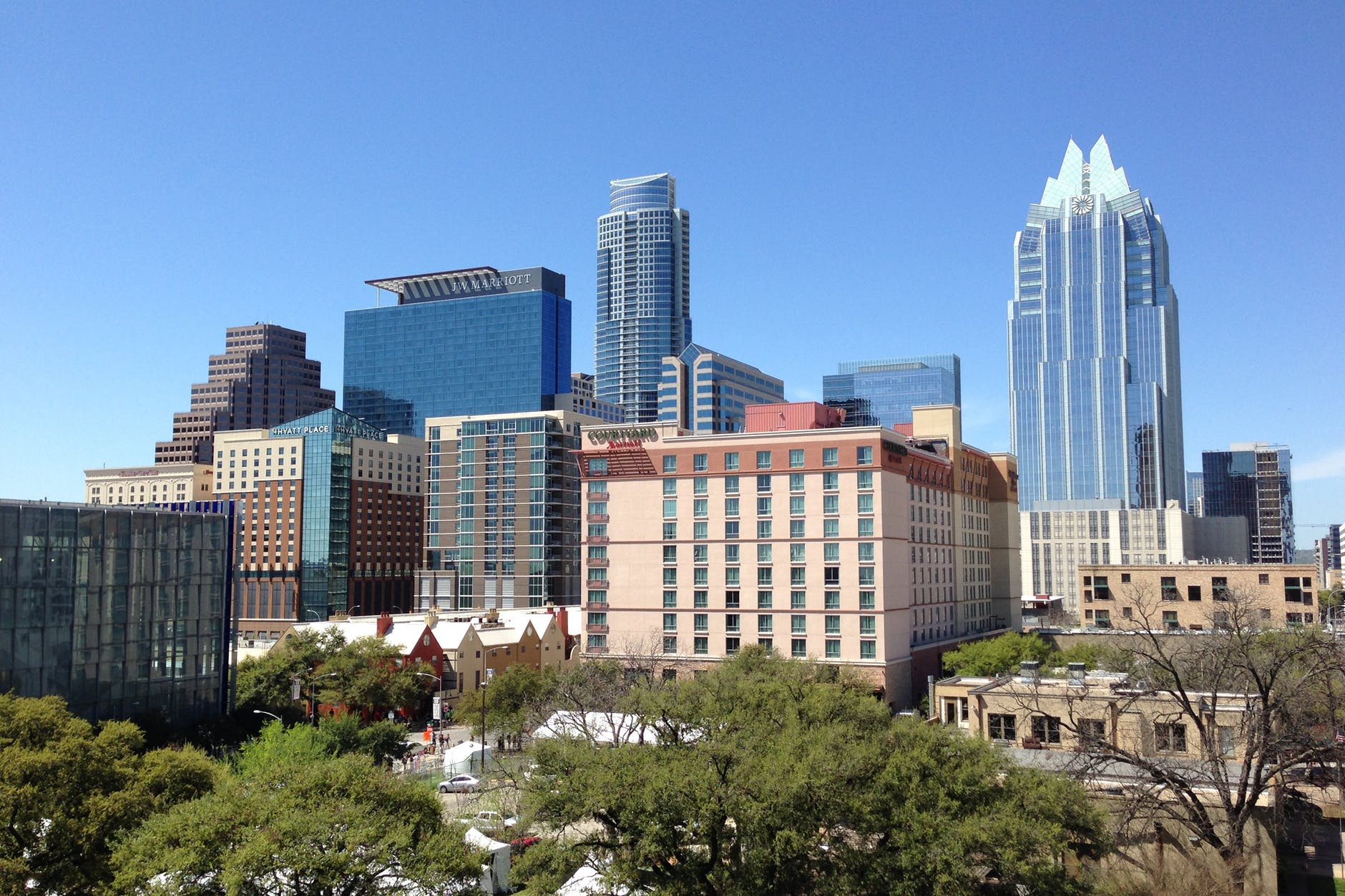
What explosive growth looks like, Austin and New Braunfels edition

It is not a coincidence to see two recent articles about effects of growth in Texas communities as this part of the country – and the Sun Belt more broadly – is growing fast. One is the story of a big city where housing is in high demand while the second is a small town that is now a booming suburb.

Photo by Pixabay on Pexels.com

First, thousands of Austin properties are going for far above list price:

Nearly 2,700 homes in the Texas capital have sold this year for $100,000 or more above their initial listing price, according to an analysis by Redfin Corp. that examined sales through Aug. 11. While a few other U.S. cities have had more properties sell at that premium to the asking price, none have experienced as big a percent rise in homes transacting at that lofty an increase, Redfin said…

The number of homes sold year-over-year for at least $100,000 over asking price has grown nearly 10-fold in Seattle, and fivefold in Oakland, according to Redfin. In Austin, that figure grew by 57 times the number for last year at this time.

The jump in these sales at six figures above the listed price shows how Austin, which has attracted young professionals for years, has become an even more competitive place to buy in recent months.

Second, the community of New Braunfels between San Antonio and Austin is going through growing pains:

Today, the cattle are gone, replaced with clusters of sleek apartments, gated communities and big-box stores. And New Braunfels, the third-fastest-growing city in America, tucked in one of the fastest-growing regions, finds itself at a crossroads…

A once quaint town known for its German roots and the Schlitterbahn water park, New Braunfels grew a whopping 56 percent over the last decade, adding about 32,500 residents…

Newer residents to New Braunfels have been drawn to the region for its affordable cost of living and by larger employers who have settled there, including several distribution centers and technology companies. Over the past decade, the median salary has jumped to $90,000 from $65,000 in Comal County, which includes much of New Braunfels, one of the highest averages in the state…

The community has also grown more noticeably diverse, with the presence of Latinos particularly evident on the city’s West Side. Residents flock to eateries like El Norteño for typical Mexican dishes, such as menudo, a spicy stew known colloquially as a hangover remedy. This week, a server took orders wearing a red T-shirt that read “Menudo Para La Cruda” or “Menudo For the Hangover.”

The emphasis on growth is a long-term pattern. When Census data is released, many like to highlight the fastest growing areas of the country. This can shine a spotlight on places that are changing but it also reinforces a consistent American narrative: growth is good for communities. Indeed, discussion of the opposite trend – losing population (or somehow not losing residents) – reinforces the notion that growth is good.

At the same time, focusing on population numbers is worth considering alongside what is happening to the character of communities with population growth or loss. These two articles highlight both phenomena. In Austin, what happens to a local housing market when so much competition drives up prices? At the least, this means some are priced out of the adjusted values, existing community members may see their property values rise, and builders, developers, and local officials respond to the changes. And the rising prices are often interpreted as a sign that Austin is a desirable place to live.

In New Braunfels, this is both a common American story – small town outside big city turns into a sprawling community in a relatively short time – and a story with particular traits as the community has a particular character. The German roots of the community now sit among a more diverse population. A quaint town is now much bigger and there is a lot of building activity. The businesses there for a long time are now joined by new ventures.

Even as population growth is usually viewed as a good thing, it comes with costs and changes. Few communities would reject growth just to avoid change but there can tension over how to respond to growth. Many cities and suburbs have struggled to match their existing character to changes and what the community will end up being once a construction boom and/or sprawling subdivision growth subsides.

Asset income across American counties, from Teton County to South Dakota

A new report finds gaps in asset income across locations in the United States:

Photo by Andrew Jensen on Pexels.com

Wyoming’s Teton County, home to Jackson Hole, has the nation’s highest per-capita income from assets, according to a study by the Economic Innovation Group. The analysis found a sharp increase in geographic concentration of asset ownership over the past decades…

It’s soared in places like New York City and the San Francisco Bay Area. Meanwhile, across Appalachia, the Deep South and much of the Midwest, it stagnated, representing a negligible source of income…

Nationwide, the county with the lowest asset income per capita is in South Dakota, home to the Pine Ridge Indian Reservation. At $2,800 per person, it’s one-third of the national average. Among the largest U.S. counties, the ones with the five lowest incomes from assets per capita are all mostly Hispanic or Black.

Only a minority of Americans holds assets beyond homes, cars and retirement savings. About 15% of households own stocks and 13% hold business equity or other residential property, according to Fed data.

First, the emphasis here on asset income is helpful compared to the more common analysis of incomes. While income may be related to assets, assets gets more at wealth or how income is converted into more long-lasting economic resources.

Second, that assets are concentrated in particular locations is not surprising but with the relatively limited number of Americans who have certain assets, this concentration is even more notable. The truly wealthy Americans have assets and utilize them in certain places, like New York City, San Francisco/Silicon Valley, and Jackson Hole, Wyoming.

With this said, how much does increasing incomes reduce the gap in wealth and assets? Or, how might efforts at local and national levels affect this gap both locally and nationally? The most exclusive locations are going to be difficult for many Americans to afford at any point, regardless of their income. While much sociological research has studied the concentration of poverty, wealth also concentrates with positive feedback loops for those who can participate.

If mathematicians addressed traffic problems

How would mathematicians solve traffic? Here are the suggestions from a 2020 book:

Photo by Life Of Pix on Pexels.com

All drivers need to be on the same navigation system. Cars can only be efficiently rerouted if instructions come from one center hub. One navigation system rerouting some drivers does not solve traffic jams.

Parking bans. Many urban roads are too narrow and cannot be physically widened. Traffic-flow models can indicate where parking spots should be turned into lanes.

Green lanes. For cities that want to increase electric car use, special lanes should be created for electric cars, providing an incentive for their use.

Digital twins. Traffic demands and available infrastructure can only be balanced with digital modeling that creates an entire “twin” of existing roadways. The software will be “an extremely useful thought tool in the hands of transport engineers.”

I have not read the book and this description is not long but it seems to depend on both understanding current and possible traffic flows through modeling. Often, Americans typically get more lanes added to roads – which then tend to fill up because there is more capacity and/or populations continue to grow.

I wonder how modeling would fit with other values underlying road and traffic decisions. A few examples:

  1. It might be better to have a centralized traffic and navigation hub. Is this technically feasible, would all car makers want to participate, and would there be privacy concerns?
  2. The politics of providing special lanes, whether for electric cars or high occupancy vehicles or bicycles, can get interesting. Americans often think the roadway should be for all users as opposed to particular users.
  3. The road system we have is the result of not just prioritizing efficiency but a whole host of actors and forces that includes privileging single-family homes (and generally keeping them away from busy roads) and highways in and out of major cities.

Is the world worse off now or do we just know more about what happens every day?

The bad news seems to keep rolling in. A pandemic. The earthquake in Haiti. Afghanistan. Tropical storms. Tyranny. And so on. This raises a question I have asked myself many times in recent years: is the world actually worse off or do we just know more about global affairs and smaller events?

Photo by Ono Kosuki on Pexels.com

Here are just some of the ways this question could be answered:

-In some macro trends, this is a great time to be alive. I’m thinking of Steven Pinker’s The Better Angels of Our Nature or Hans Rosling’s Factfulness where they argue that by multiple measures, whether the percent of deaths by warfare or indicators of public health, we are better off.

-The scale of both mass media and social media means we can know more about the world and daily occurrences than ever before. With relatively little effort, we can see the bad in the world on a small and grand scale every minute (and find commentary on it). We are flooded with information.

-The world has changed so rapidly in the last few centuries that we collectively are still trying to catch up to the new challenges and/or the new ways that challenges manifest themselves. For example, pandemics are not new in human history but the way people respond to them in the particular conditions of 2020 and 2021 is.

-We now see the world differently or expect different things compared to people of the past. The social changes of recent centuries mean more individualism and agency, the rise of the self and the diminishing of some traditional forms of authority, and expectations about standards of living.

-Certain groups might lean in to the distressing news. For example, American evangelicals for decades have played up the connection between the apocalypse and current events. Or, political actors might use negative news to criticize others or promote particular policies.

-Humans can feel losses more than equal wins. It is hard to know whether we take in more positive or negative news overall but we might feel the negative news more.

-There really is more bad than good happening in the world.

Slow housing construction in Chicago area, matching slow population growth

The release of data showing a small population increase in Chicago and the region also included data on housing construction in the Chicago region:

Photo by Pixabay on Pexels.com

The number of homes in the Chicago metro area grew by 3.9% between 2010 and 2020, census data made public Thursday shows. That was a slower growth rate than the nation overall, where the number of homes grew by 6.7%.

The slow housing growth was not surprising, as the region recovered from the 2008 housing and financial crisis…

Among Cook and the collar counties, only Kendall County added homes at a higher rate than the nation: 11.6%. It added more homes than any county in the state, likely reflecting the county’s explosive growth in population over the past decade…

The Chicago area’s population growth could be good news for the housing market, inspiring investors and developers to take a deeper interest in the city, Smith said.

Presumably, builders and developers are going to be a bit hesitant to build a lot of units when the population is not growing as quickly. If new demand is limited, why build too many units and risk having lower selling prices? Add this corollary to the growth is good idea in American communities: higher rates of housing construction is a sign of a bright future and a higher status.

I do wonder what percent of homes or residential units need to be replaced each decade. Populations in metropolitan regions expand out – as noted above in Kendall County with double-digit growth – and occupy existing homes and units that may or may not meet their needs. Teardowns are one option, usually limited to wealthier communities where a new home in place of an older one can get a hefty price, but so are denser housing developments, in-fill development, or a change of use for properties (think vacant shopping malls or office parks converted to housing).

Additionally, does this small increase in homes also help address the need for affordable housing? At what price points are these new homes going for? I would guess that at least a sizable percentage of the new homes are out of reach of many in the region.

Paint a mural over windows to obscure sizable suburban development going up next door

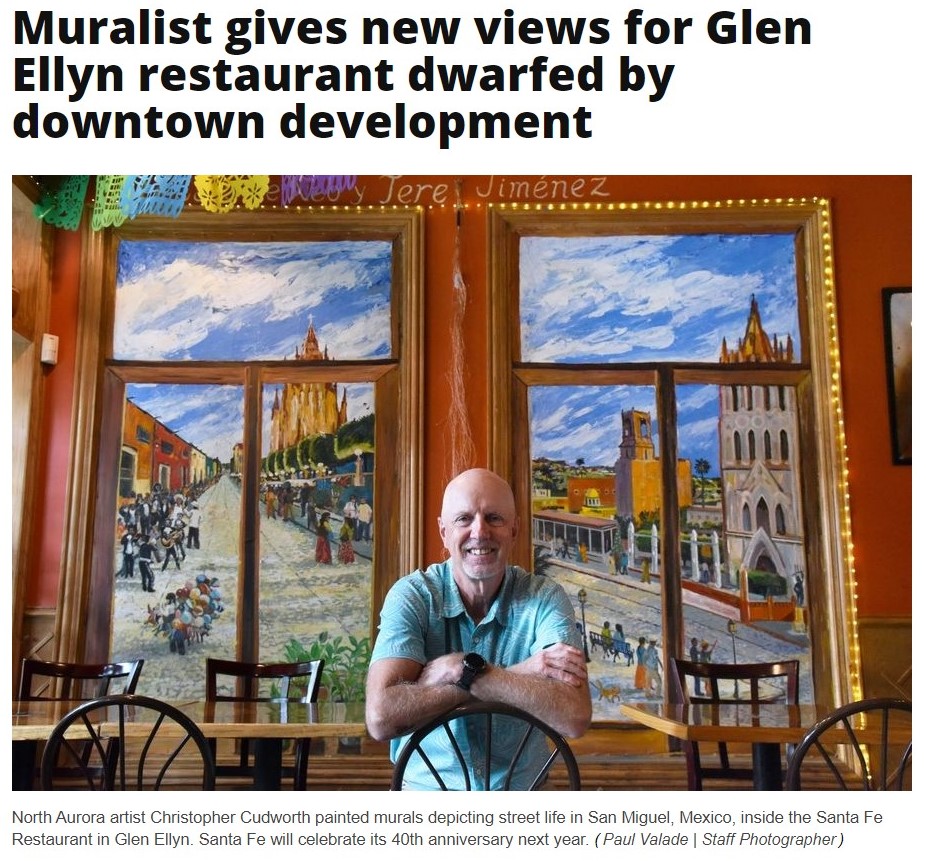
A restaurant in downtown Glen Ellyn found itself next to a large new building that obscured the view from some its windows. The solution? Paint a mural:

The Apex 400 development, a new apartment building, is rising next door to the Santa Fe Mexican Restaurant along Main Street. A parking garage that’s still under construction stands almost right up against the exterior wall of the popular dining spot, blocking its southern-facing windows.

Stuck staring out at concrete, the family owners of the restaurant — serving Glen Ellyn for nearly 40 years — sought to give their customers new views…

The mural project became a collaboration between Cudworth and the second-generation owners of Santa Fe, siblings Reyna and Olga Jiménez. Their parents, Irineo and Teresa Jimenez, opened the restaurant and raised six children…

He first expanded an existing hacienda mural in the back of the restaurant to 22 feet wide. In the front, he stretched canvas over the two boarded-up, framed windows and painted from photographs that he was given and researched of San Miguel, Mexico.

This is the fear some property owners have when a nearby property is redeveloped: the new structure will significantly alter access to sun, light, and/or loom over their existing property. Where once diners could look out the window, now sits a large wall. This may be the price to be paid for denser suburban downtowns where there is interest in denser, mixed-use properties near restaurants, cultural opportunities, and train lines to provide more “surban” spaces.

This solution of painting a mural is a clever one given the options. While this is not public art since it is inside a property, it has similar functions: to complement what the business provides, to enhance the aesthetics of the space, and involve other members of the community/area. It can be difficult to move on from the loss of natural light yet this art may obscure for future diners that windows were once here.

Getting more suburban churches to develop affordable housing

As churches in cities develop affordable housing, how about more suburban churches doing the same? First, what some Atlanta churches are doing:

Photo by Pixabay on Pexels.com

The project is one of several in Atlanta where faith leaders are investing in affordable housing for the sake of their communities. Across the country, churches with property in prime locations are turning over one block, one building, one lot at a time through movements like “Yes in God’s Backyard” in California. Atlanta-area pastor Rev. David Lewicki discusses the calling of affordable housing as a ministry.

“We are increasingly convinced that affordable housing is the foundation of beloved community,” the Presbyterian minister wrote at Faith & Leadership. “Housing is a profound and even holy good.”…

Lewicki’s church got involved in lobbying for more inclusionary zoning policies to allow for lower-priced options in their area and began to create a land trust so they could get involved in addressing the legacy of racial and economic segregation in the city…

Affordable housing and community development can seem like just business ventures—which they are—but pastors know how much these issues directly affect their congregants and stem from biblical calls for community.

Here are a few compelling reasons why suburban churches should follow this course:

  1. Affordable housing is needed throughout metropolitan regions. For example, in the Chicago region, experts suggests there is a need for tens of thousands of units. And the need is not limited to Chicago or just specific communities; it is needed in many locations.
  2. Welcoming people goes beyond Sunday morning and indicating to people that they are wanted in the community all week round. It is one thing to be part of a church community; it is another to be fully welcomed into all of the community.
  3. Housing is critical in a suburban environment as it helps in access to jobs, schools, parks, and other amenities that lead to a higher quality of life. Plus, homeownership is highly valued in suburbs so if there are opportunities for congregations to provide affordable single-family homes, this helps attendees match suburban aspirations with reality.
  4. Suburban churches have funds and local power to make this happen. It takes money to buy, develop, and maintain properties. It takes expertise and influence to work with municipalities and concerned neighbors. Congregations are often viewed as assets in communities and they often have built up goodwill over the years.

While this may not be an easy task in many suburban locations as neighbors and communities resist providing housing for residents with fewer resources, religious congregations could help lead the way.