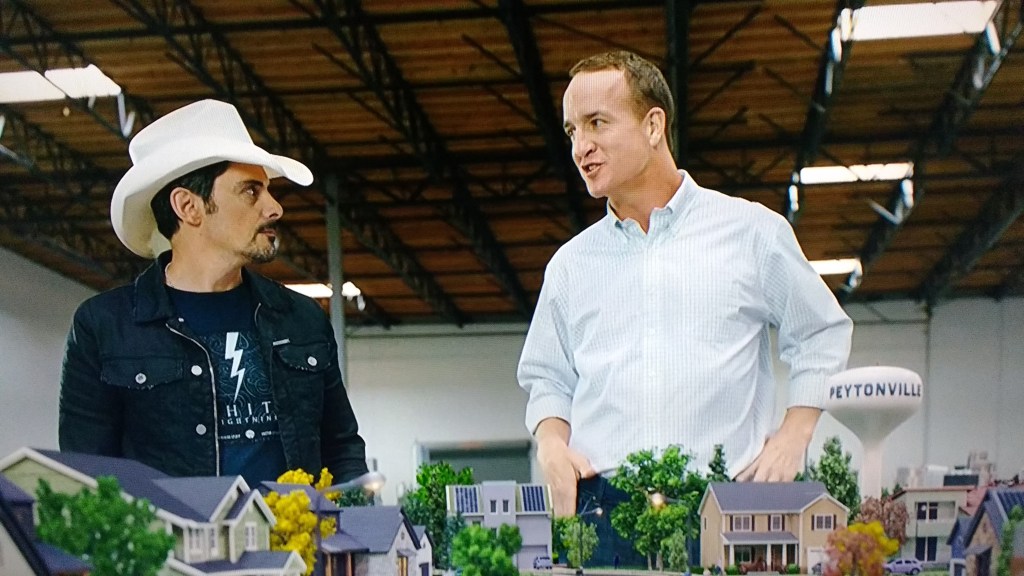
With the return to the airwaves of Peytonville ads from Nationwide, I noticed something in the commercials I had not thought about before (see Peytonville Parts 1, 2, 3, 4, and 5): the possible connection between suburbs and football. Notwithstanding a possible caveat that Nationwide might want to appeal to suburban customers, here are some ways the suburbs, football, and Peyton Manning might go together.
First, the majority of Americans live in suburbs. It is a slight majority but the percent in suburbs outnumbers the percent living in cities by a little more than 20%. Where is football played the most? Which communities have the most interest in football? The romanticized image of a football community might be a small town in the Heartland obsessing about football on fall Friday nights but much of the activity might be happening on suburban fields and on suburban television screens.
Second, the Peytonville commercials at least hint at college and pro football as well as suburban and urban life. For both college and pro football, where are the majority of fans? For college, perhaps the thousands of alumni for major football schools have largely settled in suburbs. With a college degree, people have the opportunity for higher-paying jobs and put those resources into suburban single-family homes. For pro teams, the majority of residents in a metropolitan region are suburbanites. Take Chicago as an example: there may be a lot of Bears fans in Chicago but there are over 6 million more residents in the suburbs than the city.
Third, the social and cultural life of the suburbs might lend itself to football (and other sports as well). With games on the weekend, many suburbanites are free to sit at home and watch or attend games. For kids, families have the resources to enroll them in activities and there are plenty of organizations ready to funnel kids into high school and college football.
Perhaps this is off yet certain sports are associated with certain places. Is football truly a suburban sport or does it belong to all of American places?
With suburban residents expressing concerns about a possible waste transfer station, this Daily Herald article explains how suburban garbage reaches its final destination:
The waste transfer station would allow filled garbage trucks to temporarily dump refuse on the ground. The refuse would be hauled away from the site by semi trucks to landfills, meaning no garbage would be stored at the West Chicago facility.
Suburbanites do not want to think about or smell garbage around their single-family homes. They want to be able to put out the cans, have it picked up quickly with little fuss or noise, and then taken away. All at minimal cost and inconvenience to their life.
Yet, Americans generate a lot of garbage. Packaging. Wasted food and food scraps. Plastic everything. Old clothes. Accumulated junk. The weekly garbage pick-up has to happen and the garbage has to go somewhere. Just keep it away from the nice residential neighborhoods.
Hence, the need for a waste transfer station. After making their daily rounds, the trucks need a central point where they can put their garbage. Landfills would not be acceptable near many suburban communities. The transfer station is just that: the garbage is transferred to another truck to take to the far-off landfill.
Of course, it may not always have been like this. The landfills used to be closer before the suburbs kept growing further and further out from the city. Not too far from the proposed waste transfer facility suburbanites can find old landfills now serving as parks.
Presumably, the current landfills are sufficiently far from suburban residences that the suburbanites have little knowledge of where the garbage goes and fewer people live near the new sites. All the suburbanites know is that the garbage is gone – until the next trash day.
Global videogame revenue is expected to surge 20% to $179.7 billion in 2020, according to IDC data, making the videogame industry a bigger moneymaker than the global movie and sports industries combined. The global film industry reached $100 billion in revenue for the first time in 2019, according to the Motion Picture Association, while PwC estimated global sports would bring in more than $75 billion in 2020…
The videogame industry has boomed in recent years because of the variety of ways to play games. Gone are the days when all one had to track were console sales and games sold for their respective consoles and PCs. With the rise of digital-copy game sales, mobile games, in-app purchase freemium games, cross-platform games that aren’t limited to a specific console, streaming game services like Microsoft’s Game Pass, games-as-a-subscription models, and online distribution services like Steam, along with varying levels of transparency, anyone wanting to make apples-to-apples comparisons encounters an unwieldy fruit basket.
While console sales will get a boost from new versions, that’s not the biggest chunk of the industry, nor the fastest-growing. The biggest gain is expected to come from mobile gaming, with China playing a big role in smartphone and tablet gaming revenue, Ward said. Excluding in-game ad revenue, world-wide mobile gaming revenues are expected to surge 24% from a year ago, to $87.7 billion.
The gamification of the world is well underway.
Seriously, it is interesting to compare the status of videogames compared to the two industries mentioned in the article: movies and sports. These are established industries with prominent actors around the world. They have been established for decades. Videogames, on the other hand, are more recent – only several decades in the hands of the global public – and still have negative connotations for many (too violent, a waste of time, played only by a certain segment of the population, etc.). Since videogames are big business and part of their spread is due to the smartphone, which many have, will videogames have a different status in a few years?
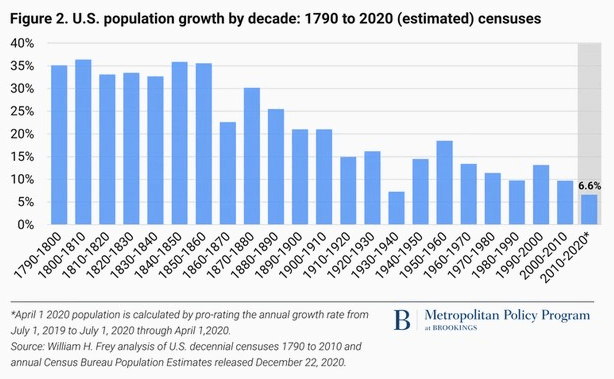
The new statistics permit an estimate of the U.S. population on Census Day (April 1, 2020) to have been 329.2 million people. If that turns out to be the case, the decade growth rate between 2010 and 2020 will be the lowest decade growth in U.S. history.
Figure 2 displays population growth rates for 10-year periods between the first U.S. census (taken in 1790) and projected results for the 2020 census (downloadable Table A). The projected growth of 6.6% between 2010 and 2020 is lower than in any previous decade, including the Great Depression years of the 1930s, when the nation registered 7.3% growth. It is roughly half the growth rate of the 1990s, a time of rising immigration and millennial-generation births.
The 2010s decade was one of fewer births, more deaths, and uneven immigration (downloadable Table C). Although immigration may have become unusually low due to recent federal restrictions that led to a decline in the noncitizen foreign-born population, low natural increase levels—fewer births, more deaths—will likely continue regardless of federal policy, as a result of the aging of the population. Some of this change can be attributed to lower fertility rates and the aging into adulthood of the last of the millennial population. However, census projections show older populations—especially those over age 65—will continue to display far higher rates of growth than youth.
In the United States, population growth is good. It implies status, expansion, success, new markets, getting bigger, being an attractive place for people from elsewhere to come. And without immigration, what would the population change be?
At this particular moment, I would guess that relatively few people are aware of such data. The Census Bureau continues to pump out information about communities and the country. The average resident may not need to be following such information. Is daily life significantly changed if the decade growth rate was 5% versus 8%? What are the effects of these different numbers on social life, politics, and the economy? Yet, in the broader view, these numbers might be more interesting.
I could imagine multiple ways leaders and the American public might take this data about growth. Is there an appetite for more population growth or an underlying assumption that America – and everything about it – will continue to grow at much higher rates? Is this slowdown in population growth taken as a sign of decline or indicative of multiple social issues? Perhaps other concerns are far more important today that basic demographics. And I suppose other might note that higher percentage population growth requires a lot more people than it did historically when the United States was much smaller.
Some cities and regions in America’s heartland are offering this sum — and more. They’re seeking to bring energy and vitality to their towns by attracting dynamic workers. With legions of people working from home during the coronavirus pandemic, these programs are getting a lot of attention as people in congested cities seek more space and affordable housing.
The city had its sights set on the growing number of “laptop workers” who can do their jobs from home — or at the local co-working space or coffee shop — when it launched the program two years ago. Since 2018, it has welcomed nearly 500 new residents, according to Stewart…
The urbanist Richard Florida has worked with both Tulsa and northwest Arkansas on their efforts to attract remote workers. And he thinks these types of campaigns will benefit small cities in the heartland. But only if they’re attractive places to live. Cash incentives won’t do the trick on their own.
This story profiles communities largely in the center of the country that want to attract residents but likely have limited population growth (perhaps due to low birth rates, low numbers of immigrants, and some younger residents moving away) and are not in the public eye. Without long-term population growth, many communities may feel they are stuck. Growth is good – and population stagnation or less is unspeakable.
But, as the story hints, these incentives have not exactly led to a flood of people moving to these locations. For how many people would a payment like this make all the difference? On one hand, people often do desire good jobs – higher pay, that provide opportunities for advancement, in exciting fields, etc. – and some may be able to go where those jobs are. On the other hand, people live where they do for more than just new opportunities or a financial incentive: they may have social and personal ties to a community, be coming from an area that has lots of options, and moving can be costly. Sometimes, people talk as if all people need is a good job or money to move somewhere new. It does not exactly work this way.
I also wonder how these incentives line up with different pressures the people being targeted by communities face. The article said communities are interested in remote workers. I also imagine these communities – and many others – are interested in young professionals. What do these workers want? A financial incentive, a cheaper cost of living, and a slower pace of life in a smaller community might be attractive. But, so might urban neighborhoods in exciting cities with lots of cultural opportunities and plenty of tech jobs and corporate entities nearby. Or, perhaps a walkable suburb is attractive with jobs and culture available via a reasonable commute. In other words, these remote workers could go anywhere they can afford. We are not at the level yet of communities acting like they do to attract major companies with tax breaks but I would not put it outside the realm of possibility in the future.
The arrival of 2021 means we’ll soon be in Construction Season Nine of a notorious project that the Illinois Department of Transportation initially said would take four and a half years to complete.
We refer of course to the glacially paced reconstruction of The Jane Byrne Construction Museum. We use that respectful moniker — always capitalize The, like The Ohio State University — for what old-time Chicagoans used to call the Jane Byrne Interchange…
Whatever the reason, drivers who didn’t abandon the interchange years ago have, in recent days, found the final four rebuilt ramps open. Museum work has shifted to the mainline Dan Ryan and Kennedy expressways — although we trust that, somewhere, IDOT also is building a museum wing to house its excuses for the years of delays and cost overruns: poor soil conditions, unhelpful rules from Chicago’s City Hall, mistakes by engineering firms, utility rerouting, the diversion of resources to emergency repair projects elsewhere, and on and on…
Surely you aren’t surprised that the cost has grown by some 48%, from $535.5 million to $794 million. Most museums recruit donors to cover their big projects. The Jane Byrne Construction Museum instead gets public dollars. Which has us wondering how many gazillion gallons of amply taxed gasoline burned into the atmosphere as all those mummified motorists sat and sat.
Highways often get greenlit for expensive work because they require engineering upgrades or significant maintenance. The projects in PIRG’s least-wanted list go beyond those basic needs. Like the group’s previous boondoggle roundups, this one calls attention to taxpayer-funded projects set to consume environmental resources, cut through existing communities, and lock in decades of new carbon emissions, for what PIRG argues is little payoff in congestion relief or economic growth. The 2020 report arrives as the ongoing pandemic clobbers state and local budgets and dramatically reshuffles travel patterns.
The largest on the list is Florida’s M-CORES project, a $10 billion, 330-mile plan to build three toll roads through rural southwest and central Florida. Dubbed the “Billionaire Boulevard” by critics who characterize the project as a handout to developers, a state task force recently found a lack of “specific need” for any of the roads, which would run through environmentally sensitive areas.
There’s also the Cincinnati Eastern Bypass, a $7.3 billion highway set to loop around the eastern side of Cincinnati. Originally proposed by a local homebuilder as a replacement (and then some) for the aging bridge that leads into downtown Cincinnati, the 75-mile, four-lane bypass is designed to divert trucks passing through the region on Interstate 75, easing congestion for local drivers, boosters claim. But the report’s authors state that the highway is projected to add thousands of new vehicle trips per day, encouraging sprawl and contradicting Cincinnati’s goals to increase “population density and transit-oriented development” and decrease fossil fuel use by 20%.
No highway policy critique would be complete without a contribution from Texas. The $1.36 billion Loop 1604 Expansion in San Antonio would add four to six additional lanes on 23 miles of an existing four-lane highway, as well as new frontage roads and a five-tier interchange with Interstate 10. Texas DOT says that the new lanes are needed to keep up with population growth, but transportation planners say that the principle of induced demand would cancel out the benefits while adding pollution. The PIRG report puts it this way: “Additional capacity causes more driving and congestion.”
These summaries of major highway projects provide good reminders of several features of such undertakings:
They often require years of planning and years to complete. From start to finish, this could cover a decade-plus. They take a lot of effort to get going across numerous agencies, governments, and actors and have their own kind of inertia as they move toward completion.
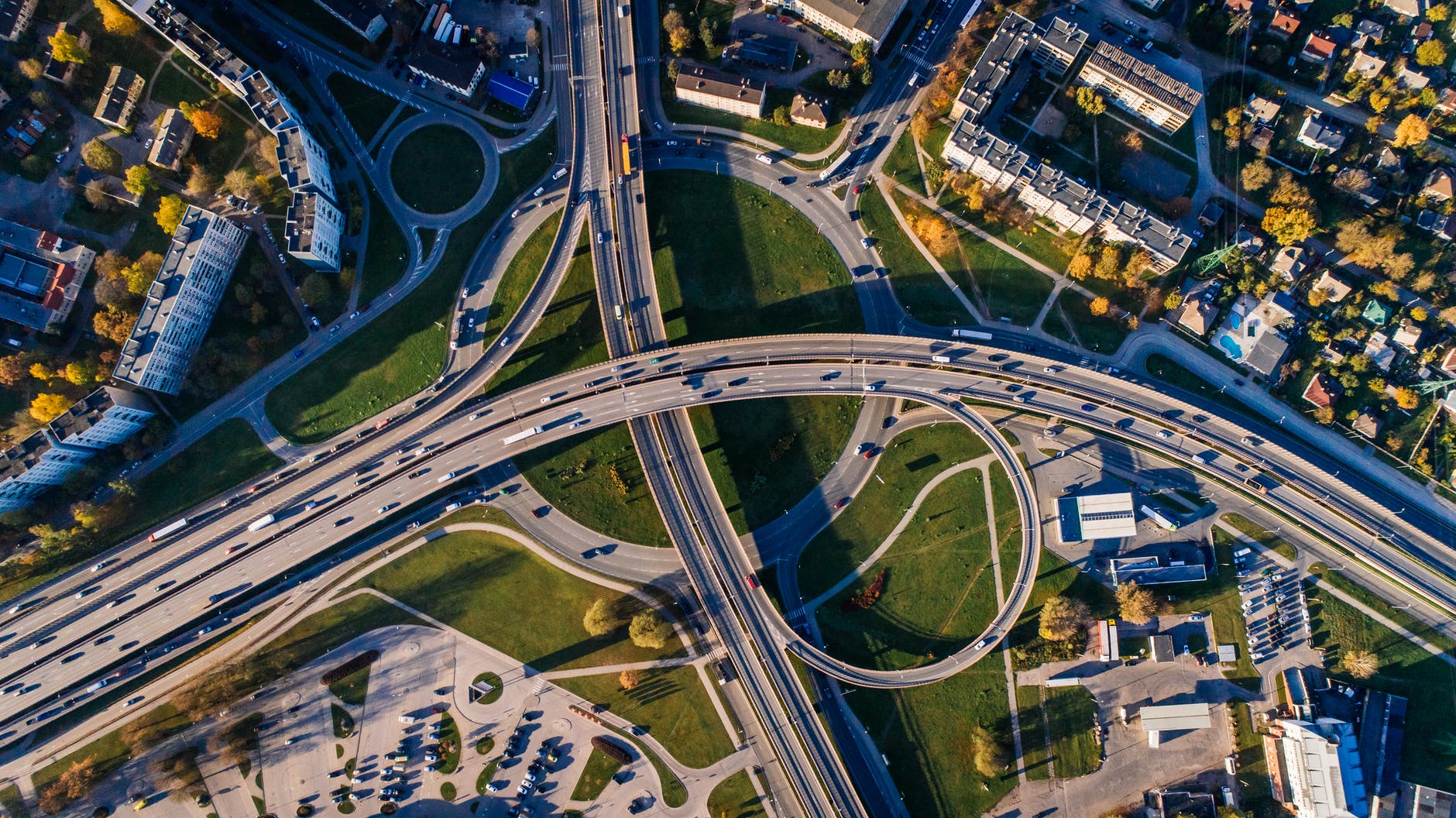
These projects are often intended to make driving easier. Adding lanes and capacity can also attract more drivers. In a country devoted to driving, these contradictory ideas can go together. And the roads and systems for driving keep expanding and evolving.
The costs are huge and the efforts required massive. Yet, the average driver may think about nothing but the congestion caused by the construction.
When completed, such roads (and other significant infrastructure projects) can be impressive in their scale. (Whether this is the best use of the land or moving people around leads to other arguments.)
While these articles do not address this, are there significant infrastructure projects that drivers and residents would be pleasantly surprised to find that had been completed during COVID-19?
After a disastrous November election for the polling industry, when the polls again underestimated President Donald Trump (who lost regardless) as well as GOP candidates down the ballot, pollsters are mostly sidelined in the run-up to the Jan. 5 Georgia elections, which most observers regard as toss-ups.
The public polls that drove so much of the news coverage ahead of November — and generated tremendous distrust afterward — have all but disappeared in Georgia, and they are set to stay that way:Some of the most prolific, best-regarded media and academic pollsters told POLITICO they have no plans to conduct pre-election surveys in Georgia…
Part of the reason public pollsters are staying away from Georgia is the awkward timing of the races. With the elections being held on Jan. 5, the final two weeks of the race are coinciding with the Christmas and New Year’s holidays — typically a time when pollsters refrain from calling Americans on the phone. The voters who would answer a telephone poll or participate in an internet survey over the holidays might be meaningfully different from those who wouldn’t, which would skew the results.
Most major public pollsters are choosing not to field surveys over that time period, but the four campaigns don’t have a choice in the matter. The closing stretch of the races represents their final chances to shift resources or make changes to the television and digital advertising — decisions that will be made using multiple data streams, including polling.
Trying to reach members of the public via telephone or text or web is already hard enough. Response rates have been dropping for years. New devices have new norms. Figuring out who will actually vote is not easy.
Imagine trying to get a good sample during the holidays. On one hand, more people are likely not working and at home. On the other hand, this is time for family, getting away from the daily grind, relaxing. How many people will want to respond to talk about politics? Add in the post-national election letdown, COVID-19 worries, and this could be an extra challenging task during December 2020.
I know answering the door is not in vogue, even before COVID-19, but I wonder how well a door-to-door strategy for polling in Georgia might work. Such an approach would require more work but the races are limited to Georgia. Given that people are likely to be at home, this could reach some people.
Part of the collective effervescence of Christmas activities involving other people is the music. If people are out shopping, eating, looking at lights, watching festivals and tree lighting and other Christmas and winter activities, they are likely to hear Christmas music. The sounds are unmistakable and are a key part of the holiday season.
At the same time, many of these locations play the same songs – and even the same versions – of Christmas songs over and over again! How many times have you been shopping and heard “Holly, Jolly Christmas,” “Rockin’ Around the Christmas Tree,” and “All I Want for Christmas is You”? Or heard the same songs on the radio? Or on TV or in movies?
Why this happens makes some sense. Many of these Christmas favorites come from an era, the 1930s to the 1950s, that induces nostalgia. Music helps bond people together. The familiar can be comforting. When people think of Christmas, the music is part of it. The ritualistic nature of the holiday where patterns repeat year after year is part of the appeal of Christmas and rituals.
As sociologists argue there is “civil religion” in the United States, perhaps these popular songs reflect what we might call “civil Christmas.” The songs are generally about good cheer, parties, happy characters like Santa and Rudolph, getting together. The songs played in more public settings tend not to refer to the religious nature of Christmas but rather elements of the holidays that could appeal to many. The songs are about a lengthy celebration…and who is opposed to at least a month of cheery music and festivities right around the darkest days of the year?
Perhaps the Christmas public music canon will expand in the future. New songs might be added here and there while others let go (see the debate over “Baby It’s Cold Outside” in recent years). There is no shortage of songs to choose from or artists and styles for familiar songs. (I say this after working for years at Wheaton College Radio where we featured over 2,000 songs in our 24-hours-a-day Christmas music rotation. Listen to a reconstituted live stream of WETN Soundtrack for Christmas.) Regardless of whether the music stays the same or we all retreat to our headphones for our personal Christmas playlists, the music will continue to matter as we prepare for and celebrate Christmas.
The city conducted a survey in the fall to gather data on commuting habits and gauge when people expect to return to work. The information will be used as the city reevaluates the Commuter Parking and Access Work Plan instituted in 2019…
A survey shows 81% of respondents are not commuting, but 75% indicated they expect to return to their “pre-pandemic schedule for commuting by Metra” by the end of 2021…
The survey shows 1,642 respondents, or 76%, said they commuted on Metra four or more days per week before the pandemic. But 37%, or 797, said they expect to continue commuting four or more days when life gets back to normal…
When people do return to a regular commute, Naperville’s parking survey showed 69% of responders would like the city to consider other payment options beyond quarterly and daily fees.
Trying to forecast commuting via multiple means – train, car, bus, subway, etc. – is going to be difficult for a while. As the article notes, a work from home option from many employers could continue. The willingness of commuters to return to mass transit and regularly proximity to others also might matter (and more of those who return to the office might choose driving which leads to other problems).
Yet, even if ridership or commuting stays low, systems still need to run and be maintained. With less revenue, how do transportation systems and municipalities keep up with costs?
This can contribute to an ongoing chicken-and-egg problem often posed in the United States. If there was better mass transit, would this lead to increased use? Or, do you have to have increased ridership or interest before building out transit systems?
The effects could be broader than just infrastructure and local budgets. Populations might shift if people change their commuting patterns for the long-term. Workplaces and offices could be very different. Suburbs, already built around private homes and lots of driving, could change in character and land use.
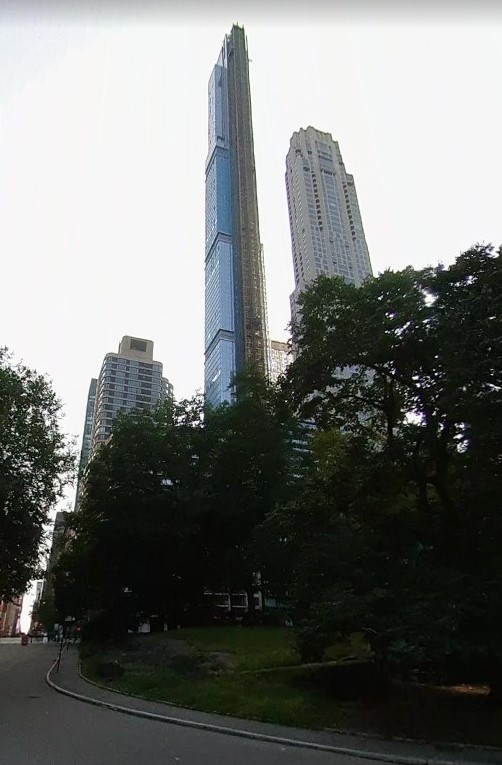
Google Street View image of 220 Central Park South(September 2020)
By the end of September, the volume of Manhattan co-op and condo sales was down 43% year over year, according to a report by Douglas Elliman, as sellers held back from listing their apartments and buyers increasingly gravitated toward the suburbs…
Of the top 10 national sales compiled by Jonathan Miller, president and chief executive officer of Miller Samuel appraisers, five were in 220 Central Park South, a new luxury tower on Central Park designed by architects at Robert A.M. Stern…
Another trend from this year, namely rich people “fleeing” New York for Florida, didn’t manage to trickle up to the highest tier. Only two of this year’s top 10 sales were in Palm Beach; last year there were three…
Even the three Los Angeles entries diverge slightly from conventional 2020 narratives. Yes, the L.A. market is one of the few urban bright lights this year, with sales soaring and inventory hard to come by. But numbers at the very top are down from last year, when it notched four entries in the top 10, totaling $463 million. This year there were three, totaling $293 million.
The actions of the wealthiest homeowners matters not only because people often have an interest in what those who have lots of money do with all that money; it matters because these are people with clout and influence. If they are continuing to purchase in New York City – it is less clear how much time the owners would necessarily spend in the city – it is a sign of the importance of the city and the prospects for future development.
The optics of 2020 might not be favorable to the list above but the project and the trends were underway far ahead of COVID-19. In a very expensive land and housing market, purchasing a residence in one of the newest buildings and in such a location within Manhattan is an object of desire for some who have the resources to purchase such places. While a figure later in the article notes that the total price for the properties on this list is lower than the price for the properties the year before, this may only allow the wealthiest to get into hot markets even more.
It may (or may not) be worth noting that five of the ten properties are in a tower in New York City while the other five properties are large homes on some land. On the whole, Americans as a whole tend to prefer or idealize single-family homes but the wealthiest in the United States and elsewhere may be more inclined to purchase large units in multi-unit buildings.







 Legally Sociable