Finding the Simpsons home in the sprawl of Las Vegas

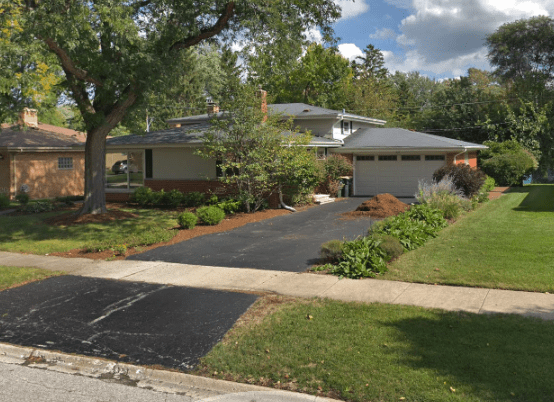
A subdivision in the Las Vegas suburb of Henderson features a home made to look like the Springfield home of The Simpsons:

SimpsonsHomeHendersonNV

Once upon a time, the house on Red Bark Lane wasn’t just another address in a sprawling suburban development: It was originally built as a nearly exact three-dimensional replica of 742 Evergreen Terrace, the Springfield residence of Homer, Marge, Bart, Lisa, and Maggie Simpson. Working on a short schedule, architects and builders de-fictionalized the home featured in The Simpsons for a 1997 giveaway that was intended to leave one lucky fan with the ultimate in cartoon memorabilia. No detail was spared, from a food dish for their cat, Snowball II, to Duff beer cans in the fridge.

But controversy soon erupted in this faux-Springfield mock-up. The homeowner’s association wasn’t keen on having a cartoon house that broke conformity requirements by being painted solar yellow. The sweepstakes winner rejected it outright. And the current owner had to learn to live with the property being a source of perpetual curiosity for fans of the show who brazenly turn her doorknobs and peer through her windows at all hours of the day and night. As it turns out, the reality of living in a fantasy can get a little complicated…

Once the project was approved, Woodley and Gonzalez pored over 100 episodes of the show and storyboards on loan from the production to try and discern a layout. “We took a floor plan we already had and did things that still had to meet building code but was reminiscent of The Simpsons,” Gonzalez says. “We never would have put in a rounded door or windows in the spots they were in.”

The team’s goal was to be 90 percent normal, with occasional lapses into cartoon continuity. Door frames were widened and lengthened to accommodate Marge’s hair and Homer’s girth. The stairs leading to the second floor were slightly steeper than normal. The downstairs floor was poured and painted concrete rather than hardwood or carpet, the better to mimic the show’s flat colors. Bart’s treehouse was erected in the backyard.

Like other homes on TV, the floor plan doesn’t exactly work. What makes this case interesting is that this is an animated show that does not have the same constraints as one with actors. With live actors, homes may not have walls or have rearranged features to allow cameras to have wide views. The proportions with live actors will also be different.

The interest from fans is understandable; TV shows offer few physical spaces where fans can connect to a show. Fans can go to studio backlot to see locations (I have toured a few and it is an interesting experience to see places that are on TV screens for seasons) or track down interior and exterior shots (for example, see a comprehensive list of locations on The Sopranos). But, many family shows revolve around the single-family home. The famous opening credits end with the family in front of the TV in the family room. The family regularly gathers in the kitchen for meals. The kids and parents talk in bedrooms upstairs. The garage, basement, and backyard are home to many scenes. The article asks why the contest winner did not accept the home and make money off tours; perhaps the better question is why someone has not recreated the house elsewhere and catered to Simpsons fans.

Finally, that the replica is located in Henderson, a fast-growing suburb in the desert outside Las Vegas is a fun contrast to the small town charm of Springfield. The show creators have famously kept Springfield’s location secret but it would difficult to imagine the home located in a neighborhood like that shown in the Google satellite image above.

A declining American belief in God, country, and family

Pollsters and sociologists find a shift away from three American values:

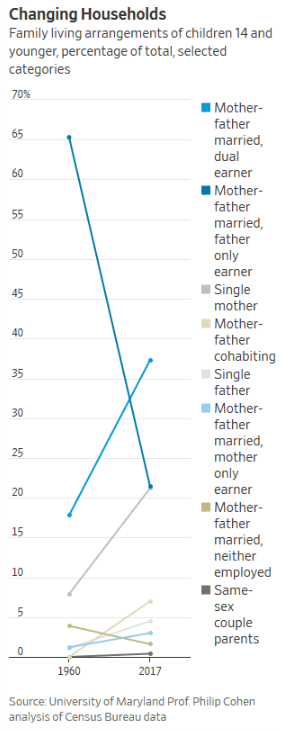
The nuclear family, religious fealty, and national pride—family, God, and country—are a holy trinity of American traditionalism. The fact that allegiance to all three is in precipitous decline tells us something important about the evolution of the American identity…

But it looks like something bigger is going on. Millennials and Gen Z are not only unlikely to call themselves Protestants and patriots, but also less likely to call themselves Democrats or Republicans. They seem most comfortable with unaffiliation, even anti-affiliation. They are less likely than preceding generations to identify as “environmentalists,” less likely to be loyal to specific brands, and less likely to trust authorities, or companies, or institutions. Less than one-third of them say they have “a lot of confidence” in unions, or Silicon Valley, or the federal government, or the news, or the justice system. And don’t even get them started on the banks...

The older working-class men in the Edin, Nelson, et al paper desperately want meaning in their lives, but they lack the social structures that have historically been the surest vehicles for meaning-making. They want to be fathers without nuclear families. They want spirituality without organized religion. They want psychic empowerment from work in an economy that has reduced their economic power. They want freedom from pain and misery at a time when the pharmaceutical solutions to those maladies are addictive and deadly. They want the same pride and esteem and belonging that people have always wanted.

The ends of Millennials and Gen-Z are similarly traditional. The NBC/WSJ poll found that, for all their institutional skepticism, this group was more likely than Gen-Xers to value “community involvement” and more likely than all older groups to prize “tolerance for others.” This is not the picture of a generation that has fallen into hopelessness, but rather a group that is focused on building solidarity with other victims of economic and social injustice. Younger generations have been the force behind equality movements like #BlackLivesMatter, #MeToo, #AbolishICE, and Medicare for All, not only because they’re liberal, and not only because they have the technological savvy to organize across the Internet, but also because their experience in this economy makes them exquisitely sensitive to institutional abuses of power, and doubly eager to correct it. What Americans young and old are abandoning is not so much the promise of family, faith, and national pride, but the trust that America’s existing institutions can be relied on to provide for them.

My first thought: I wonder if these three values have been consistent throughout American history or are more particular to the postwar era. It was in the prosperity of roughly 15-20 years after World War II that Americans became the most religious, the nuclear family became the ideal, and America saw itself as opposed to communism and the Soviet Union. Additionally, a number of societal institutions were relatively strong and well-regarded. Prior to this era, would the same values have held and/or would others have been in the top three? For example, I could imagine making a case for individualism as a core American value from the beginning. This would, to some degree, be in opposition to all three of God, country, and family which require loyalty to larger groups or beings.

My second thought: what comes next in a trinity of American values? Would something like self, community, and success work?

Marijuana sales viewed as hurting family-friendly suburbs, Naperville edition

Tuesday night the Naperville City Council voted against allowing marijuana dispensaries to locate within the suburb:

Naperville City Council members voted 6-3 Tuesday to opt out of recreational marijuana sales within city limits, and directed staff to come back with information on a potential referendum question for council consideration.

The decision to opt out of recreational pot sales came several hours after hundreds of people began packing the Naperville City Council chambers as residents and non-residents waited their turn to comment on the issue of whether to allow the retail sale of pot. The discussion on marijuana sales brought 238 people to sign up for public comment on the topic — a vast majority speaking in favor of opting out while wearing white and orange “opt out” shirts.

Over the past couple weeks, the group was organized to rally and lobby city council members to keep recreational cannabis dispensaries out of Naperville. At the same time, residents in support of retail marijuana sales have circulated a survey on the issue.

People who asked city council to opt out Tuesday night are concerned recreational pot dispensaries would lead to increased availability to children and would hurt the “family friendly” brand of Naperville.

This is not a surprise. A few weeks ago, I wrote about the likelihood that wealthier suburbs would not want to sully their brand by allowing marijuana sales. A community like Naperville has a reputation to protect: it is large, wealthy, has a vibrant downtown, highly-rated school districts, and acres upon acres of single-family homes. While marijuana sales may do little to affect behavior in a community of over 140,000 residents, this is about an image. Not too long ago, the vibrant downtown presented a similar issue: alcohol-related incidents were getting out of hand and the city responded.

At the same time, Naperville could change its mind later. Perhaps the dispensaries will not cause issue in similar communities. Perhaps the city will want the extra sales tax revenue. Perhaps the group that turned up in large numbers in front of the City Council to opt out will fade away and advocates will win the day. But, at least for now, Naperville wants to – and to be honest, does not need to look for quick money or be on the leading edge of this – protect its brand.

More broadly, how long until marijuana sales and use becomes normal fare in the American suburbs? For decades, some claimed the suburbs makes people conservative: they want to protect their families and homes. However, the political tides of suburbia have turned (including in DuPage County as well as in Naperville) and attitudes toward marijuana and other drugs have changed.

Cooking meat in a suburban backyard and resolving suburban conflicts

A recent controversy in an Australian suburb highlights two key issues in suburbia: (1) what exactly can you do in a suburban backyard and (2) how do suburbanites resolve conflict? To the details:

The Perth woman said she couldn’t enjoy her backyard in the suburb of Girrawheen, claiming her neighbours deliberately allow their barbecue meat and fish smells to waft into her yard…

After her claims were rejected by a tribunal earlier this year on lack of evidence, she applied to the Supreme Court of Western Australia for right of appeal. It was also turned down in July…

And it’s not just the smell of meat and fish that has made her furious — it’s the smell of cigarettes and the sound of children playing with basketballs…

Mr Vu said he just wanted to “keep the peace” and had removed the barbecue out of his yard and also banned his children from playing basketball…

Mr Hammond said the first step in any dispute with your neighbours was to try and resolve the matter face-to-face.

Two issues are present:

  1. Suburbanites tend to assume that backyards are for private activities. The front yard is open to the public and can be seen from the street and the sidewalk. The backyard is more hidden, particularly if the yard is fenced or cut out from view in other ways (such as through hedges and trees). But, are there limits to what can be done in backyards? What is considered infringing on others? Overly loud dogs? Trees that cross property lines? Activities found undesirable by neighbors (such as grilling and playing basketball)? Where property rights end and neighborhood disturbances and nuisances begin could be a fine line (and there are surely some local regulations to help figure this out).
  2. Suburbanites are often not great at resolving conflict. Baumgarner argued suburban community is built around avoiding open conflict and using third party actors if necessary. It is not clear from the article above how much face-to-face interaction happened between neighbors but appealing to the courts seems likely to end badly for neighborly relations: no matter who wins, the fact that this led to media coverage and court cases likely makes it more difficult to have positive relationships.

On one hand, this is a small-scale conflict. On the other hand, multiply such conflicts by just a few and the suburbs look like a place where neighbors want to be protected from each other – wait, privacy and exclusion was indeed behind the creation of suburbs

The role of disasters – such as the Great Chicago Fire – in pushing people to leave cities for suburbs

A thought experiment considering what would happen if the Chicago Fire of 1871 never happened includes this tidbit about suburban growth:

But then, after that second big fire in 1874, Chicago officials extended the restriction on wooden buildings to cover the whole city.

Elaine Lewinnek, author of the new book The Working Man’s Reward: Chicago’s Early Suburbs and the Roots of American Sprawl, says the aldermen contributed to suburban sprawl by making it cheaper to build outside the city. After they changed the law, a real estate booster reported “a brisk demand for building just outside the city limits.” (Some of those areas outside the city limits in the 1870s later became part of the city through annexations.)…

“Things were already changing, as railroad lines and industry were crowding out housing,” Keating says. “The fire made this happen more quickly but it would have happened anyways. People moved more quickly south to Prairie Avenue or out to new suburban towns like Riverside.”

“The fire pushed 27,000 humble homes out of the central city and the North Side, leading to fewer residences downtown,” Lewinnek says. “Yet suburbanization was already happening before the fire, in elite suburbs like Riverside and more humble suburbs too.”

I have not heard this argument before. At the time of the fire of 1871, suburban populations were very modest. Railroad lines had only been in present in the region for a few decades. For example, the suburb of Naperville, which had just lost out on being the county seat to Wheaton, had just over 1,700 residents in 1870 while Wheaton had 998 residents and Aurora had over 11,000 residents.

As noted by numerous scholars, by the late 1800s fewer areas surrounding Chicago were willing to be annexed into the city (unlike communities like Hyde Park). This is usually attributed to the declining status of city life compared to suburban life alongside the declining price of public infrastructure that made it possible for suburbs to have electricity and their own water supplies. But, the scholars above hint at another factor that would become a long-running feature of suburban life: cheaper housing. If Chicago required less flammable materials for homes, people would move to suburbs that did not have such regulations.

More broadly, it would be worth examining whether major disasters in urban areas push people to move to surrounding areas or even other regions. Do earthquakes in the LA area influence population patterns? How about hurricanes in the southeast? Do people leave population centers after terrorist attacks? It would take some work to separate out the effects of disasters on movement compared to other factors.

Celebrating the labor of those who build McMansions?

The construction of single-family homes employs many Americans. When demand for homes drops, such as in the late 2000s with the burst housing bubble, many are out of work until the housing market heats up again.

Critics of McMansions would argue such homes should not be built. Instead, the land could be put to better use or developers and communities should focus on building other kinds of housing units that do not suffer from the same flaws.

But, the construction of McMansions employs people. Developers may build them to make more money than they could by building starter homes and communities may approve them in order to keep property values higher. And these homes provide work. Is this the case where a job is not worth it if the outcome is an undesirable product (in the eyes of McMansion critics)?

On this Labor Day, it would be interesting to consider how those who construct McMansions might be employed constructing other buildings. For many who construct McMansions, it could be hard to turn down the work if other opportunities are not present or the job pays okay. Should part of the fight against McMansions also include efforts to address labor issues?

Building Florida’s Metropica around retail

A new development in Florida is built around a shopping mall:

Once safely inside, Kavana returned to explaining what that vision amounts to. Turns out it’s an Instagram-friendly mall that you can live in—one that happens to be smashed up against the side of an enormous swamp…

Approved for construction in 2014, the first residential tower of Metropica’s 4-million-square-foot planned community is set for move-in soon. On opening day, there will be a DJ spinning as buyers (and prospective ones) check out tennis courts and a state-of-the-art gym while enjoying gourmet popcorn. All this, Kavana said, is to showcase the conveniences and amenities that come with living inside a shopping center. He’s well aware that traditional retail is on the decline, but hopes he can buck the trend by bringing online players like Casper Mattress, which is heavily advertised by podcast hosts and Instagram influencers, to a brick-and-mortar location across from Tower One. Although Casper has yet to sign a lease, he hopes to court them and other retailers who might appeal to those millennials who hate malls but love “experiences,” as he put it…

Still, while it’s true that building your own jewelry at a Kendra Scott store is technically an experience, millennials are the most financially beleaguered generation in modern American history, and the only one to prefer urban environments to suburban and rural ones. Meanwhile, units at Metropica start in the mid six figures, and its $1.3 million penthouse overlooks two vast expanses, the juxtaposition of which defines the weirdness of South Florida’s bedroom communities. In full view is the Everglades Wildlife Management Area—facilitating regular clashes with wild animals—but also the parking lot of the BB&T Center, the arena where a different kind of wild animal, the Florida Panthers, battles visiting teams in professional hockey. With student housing, a building for active seniors, and an assisted living center also in the works, it might one day be possible to spend an entire lifetime in Metropica.

The question, however, is whether anyone will want to do that, or if the master-planned community will go the way of other Florida development boondoggles that were also advertised as utopias before falling into disrepair. Kavana is far from the first person to come to Florida and try to build something out of nothing, and perhaps as a result, the state has a long history of producing what sociologists call non-places. As the theory goes, there are three categories to describe where people spend their time in an ideal society: work, home, and a so-called third place where conversation is the main activity. In his book The Great Good Place, a guy named Ray Oldenburg said that might be a bar, a coffee shop, or the prewar concept of “Main Street”—no matter what form it takes, the third place has to be cheap (if not free), easy to get to without a car, and old enough to be embedded in the community.

Three quick thoughts:

  1. The rest of the article provides a quick overview of multiple large-scale Florida developments that did not work out as intended. At the same time, is it safe to say that development in Florida might have always been on a big scale? I remember visiting the Edison and Ford Winter Estates years ago and reading about how so few people lived on the Gulf Coast of the state then compared to now.
  2. The article does not say much about the funding for this project. As long as not much or any public money is on the line, the project going belly up may not be too harmful. (Of course, there are still environmental costs and partially developed land might be harder to develop in the long run.)
  3. It is also not clear who would move into Metropica outside of the appeal to millennials. Is this intended for Florida residents or people moving to the state? How does it compare to other developments in the area they could choose from? When I see major developments like this in urban areas that have more expensive housing, I always wonder who will move and/or invest in the property. (The Miami area is known for an interesting set of investors.)

Will there be more lawn mowing or less lawn mowing with climate change?

If the climate is changing with some places predicted to receive more rain and some to receive less rain, how will this affect lawn mowing in the United States? A few quick thoughts:

1. If droughts (such as a few years back in California) and high temperatures are more common in certain places, more people could seek alternatives to lawns (looking for less water use or greywater use plus painting lawns or replacing them). Less lawn mowing!

2. If rain is more common elsewhere, this could lead to lusher lawns, the dream of many suburban property owners. More lawn mowing!

3. Producers of grass seed, lawn mowers, and others would have to adjust. This is a sizable industry that could pursue a variety of paths. Still sell the perfect lawn concept in wetter parts of the country while also selling lawn alternatives in drier regions? Selling hardier and less water dependent seeds in drier areas? I assume they already have plans. Perhaps more lawn mowing if people still want lawns and the right products are available?

4. This could affect how Americans regard the lawn. While the nicely kept green grass lawn seems fairly widespread, perhaps it will be a strong norm in some regions with significant variation elsewhere. How much this could affect other areas of homeownership and suburban life is hard to foresee. A wash for overall lawn mowing?

5. The doomsday scenario: perhaps other problems become so pressing that few care about lawn mowing. For example, why mow the lawn when food supplies are limited?

This question came to me after several stretches this year where rain and humidity constant for a few weeks. This required more mowing then and we have not experienced the typical July/August browning of the lawn because of the rainy spells.

Closer to blanketing suburban neighborhoods with cameras (via Ring doorbells)

Police in hundreds of cities will now have access to Ring doorbell camera footage:

The doorbell-camera company Ring has quietly forged video-sharing partnerships with more than 400 police forces across the United States, granting them access to homeowners’ camera footage and a powerful role in what the company calls America’s “new neighborhood watch.”

The partnerships let police automatically request the video recorded by homeowners’ cameras within a specific time and area, helping officers see footage from the company’s millions of Internet-connected cameras installed nationwide, the company said. Officers don’t receive ongoing or live-video access, and homeowners can decline the requests, which are sent via emails that thank them for “making your neighborhood a safer place.”…

To seek out Ring video that has not yet been publicly shared, officers can use a special “Neighbors Portal” map interface to designate a time range and local area, up to half a square mile wide, and get Ring to send an automated email to all users within that range, alongside a case number and message from police.

The user can click to share their Ring videos, review them before sharing or, at the bottom of the email, unsubscribe from future footage-sharing requests. “If you would like to take direct action to make your neighborhood safer, this is a great opportunity,” an email supplied by Ring states.

See earlier posts about suburban police access to individual cameras and my own thinking about covering suburban neighborhoods with private cameras. Quoting from the latter post:

[I]f every square inch of suburban street and sidewalk (plus a lot of yards) are covered by cameras, is something lost? Is there more trust that can disappear between neighbors? Is it truly all suburbanites for themselves even as at least some of them are fairly financially, socially, and educationally secure?

At the same time, I suspect numerous suburbs would welcome this extra surveillance. Think of wealthier suburban neighborhoods or communities: wouldn’t they typically welcome more information on who is around their homes? This might not even be about crime but really about possible crimes or activity from ne’er-do-wells or even who should be around on streets and sidewalks (often delimited by race and class). Privacy concerns might be mitigated by the suggestion in the article that users still get to choose whether they share footage with police.

Maybe it will all quickly come to this: what about the resident in these communities who refuses to get a Ring doorbell or install security cameras? A small hole in the surveillance network could bring about pressure from neighbors to conform and protect the neighborhood.

Defining “blight” still matters for urban redevelopment

The term “blight” might conjure up the urban renewal of the post-World War II era where the application of the term to poorer and non-white areas could lead to redevelopment. Yet, the term is alive and well: funding for the proposed Lincoln Yards project in Chicago is tied to the concept.

But the clock also was ticking for another reason. If Emanuel and Sterling Bay had waited much longer, the development no longer would have qualified for its record-high taxpayer subsidy, a Tribune analysis has found.

To get the money, the area had to meet at least five state standards to be considered “blighted.” The city could then designate it as a tax increment financing district. At the time of the vote, the area met the bare minimum.

Less than six weeks later, new property assessments were completed. The rising values of the Lincoln Yards land meant the TIF district no longer met one of the five standards, according to the Tribune analysis of the values of hundreds of parcels…

The Tribune’s finding comes as community groups are asking a judge to reverse the City Council’s decision. They say the area is not blighted and would be redeveloped without the taxpayer assistance, given that it’s centered on the Chicago River just west of Lincoln Park.

According to an Illinois government website, “blight” is not the only word used to describe land that might be eligible for TIF districts:

Funds may be used for costs associated with the development or redevelopment of property within the TIF, allowing blighted, declining and underperforming areas to again become viable, and allowing these areas to compete with vacant land at the edge of urban areas.

Not surprisingly, this is about money: how much public money would the developers get as they went about the project? As the article notes, such use of public money is contentious. In this particular project in Chicago, the location and size of the property is particularly valuable. Does a developer need much public money when there is so much that could be made on the project? Or, thinking in terms of opportunity costs, could such public monies be used to spur development in locations that are initially less attractive to developers?

More broadly, this gets at foundational questions about development in general. Who ultimately benefits from development: local residents, the city/municipality, and/or the developer? The growth machines model suggests development benefits local business leaders working with officials and other leaders who benefit from growth (and the status and revenues that come with that). Local residents could see some improvements through new development but the developers and business leaders are the ones who truly profit financially.

(See an earlier post regarding the term blight and its application to Foxconn’s development in Wisconsin.)