Local political slates: contrast “values” and “progress”

Local government races in many suburbs and small towns are non-partisan but this does not stop opposing groups of candidates from aligning themselves with particular ideas. See this example from Lake Zurich, Illinois:

The race for three seats on the Lake Zurich village board pits two slates with fairly disparate ideas about where the village should be headed and how to get there against each other. Among the key differences between LZ Values and Lake Zurich Progress is how to spur development in the struggling downtown.

Simple names but complex ideas. Presumably, one group wants to hold on to the best of what Lake Zurich is – the LZ Values slate – while the other has ideas about positive change for the community – Lake Zurich Progress. Local voters who are looking for help in who to vote for can just latch on to these ideas rather than the candidates themselves or particular policy positions. And this might be necessary when local turnout is so low (despite how Americans tend to value local government).

Where are the people oriented suburbs?

The book Market Cities, People Cities by sociologists Michael Emerson and Kevin Smiley examines big cities in light of two ends of a spectrum: market cities follow an economic logic and people cities look out for the well-being of their residents first. In their study, Houston is the model of a market city and Copenhagen is the people city exemplar.

This got me thinking about American suburbs. Given their history and priorities, they appear to be market communities. On the whole, American suburbs emphasize single-family homes, private families, driving, and local control over resources. They are generally known as wealthier communities. Additionally, the suburbs have generated a lot of money for developers, builders, the construction industry, and communities through tax revenues. Most of this is private wealth or money that residents hope can be spent on their own lives.

So, are there suburbs that emphasize the welfare of residents over markets? If so, where might they be located? A few ideas:

  1. Inner-ring suburbs. This could be because they located near big people cities or the sets of issues facing such suburbs – often racial and ethnic diversity and more poverty – could prompt a different approach to local governance and community life.
  2. Suburbs within blue states. If this is the case, suburbs in states like New York, Illinois, California, New Jersey, Connecticut, and Washington are more likely to have people suburbs.
  3. Suburbs that have strains of political liberalism. While suburbs are traditionally associated with more conservative political stances, this has been in flux in the last few decades. With new residents in suburbia as well as new generations, some communities may view suburban life through a different lens.
  4. The rare suburb that has experienced a significant crisis – a major development gone awry, the loss of a major employer, severe budget issues – and tried to forge a new path.

If I had to guess what percent of suburbs could be considered more devoted to well-being than markets, I might venture 20% at most.

Brilliance vs. perseverance in academic writing and work

What does it take to publish academic research? Here is a recent reminder of a truism I have heard again and again and experienced myself:

Brilliance (or something close to it) is, I’d say, about 3 percent of creating a publishable article or monograph. The other 97 percent is patience and the stamina to be able to work, over and over, on something for which the end might not be in sight for a while.

This would be similar to two pieces of helpful advice I received within the first few weeks of starting a sociology Ph.D. program:

-Treat your academic work like a job: have regular hours, goals, and progress.

-Be a chipper and not a binger. Short and continuous efforts lead to better work than last-minute, long sessions to meet a deadline.

Or, we could turn to quotes or stories about Thomas Edison’s work and trying over and over again.

To me, all of this makes more and more sense as you work on research projects. The various stages of academic work – conceiving a viable idea, tracking down data and evidence, scouring the existing literature, analyzing the data, considering the implications, submitting for publication and then going through the review process – can each require a large amount of work and require time to ponder and address. Rushing to meet deadlines can be helpful for structuring time but it does not free up the same kind of mental space to ponder the question at hand. Finding the creative edge in academic work often requires more time, not less.

All of this requires working against an American cultural setting where (1) fast work and efficiency is often prized and (2) creative work is viewed as the result of individual genius. There may be grains of truth in each of these regarding academic research but they can also work against the need to persevere. For example, passing along the above information to undergraduate students can be difficult because their academic modes have prized these two qualities: be individually smart and meet relatively short deadlines. And how much is this perpetuated by college projects that may last 10 weeks at most?

All of this academic patience and stamina takes time to develop and likely exists in various degrees and expressions among academics. But, I imagine it would be hard to get far without at least some of it.

Lawns as sources of and signs of boredom

In a discussion of the development of the concept of boredom in The Tech-Wise Family, Andy Crouch explores the boredom of the lawn:

This world is lost to many of our children, and to ourselves. Even the “nature” that surrounds many of our homes is shallow in a technological way. A typical suburban lawn depends on many technological devices, each of which makes something far easier than it was for previous generations: lawn mowers, pesticides and fertilizers, highly refined seed, and automatic sprinklers. The lawn itself is a kind of outdoor technological device, composed of uniform green grass, kept crew-cut short, with little variety or difference.

A peasant family in the Middle Ages had none of this technologically uniform pleasantness. They would not have had a lawn, or possibly even a yard. Their children would have wandered out into meadows and perhaps the thin edges of forests. A meadow has countless different species of grasses and other plants, plus flowers in the spring and summer, of different heights and habits. If you pay attention, you cannot possible get bored in a meadow. It is all too easy to be bored on a lawn…

It is surely not coincidental that all the earliest citations of the word bore in the Oxford English Dictionary – from the mid-eighteenth century – come from the correspondence of aristocrats and nobility. They did not have technology, but thanks to wealth and position they had a kind of easy everywhere of their own. The first people to be bored were the people who did not do manual work, who did not cook their own food, whose lives were served by others. They were also, by the way, the very first people to have lawns. (144-145)

The common American lawn is indeed a peculiar piece of “nature.”

The connection between lawns and technology is helpful, particularly since this link is likely lost amidst all the new technology of recent decades. Yet, having a lush and short lawn requires a lot of tools and innovation that many now take for granted. I’m reminded of running into advertisements between competing grass seeds: there is a lot that goes into the components of the lawn.

It also strikes me that the lawn has become increasingly boring in recent decades. It is true that American children in the last 70 years had very different experiences with nature than Middle Age peasant children (though humans have affected nature throughout history and contexts). At the same time, children today spend less time outdoors and utilize those boring lawns even compared to just a few decades ago. Perhaps we could argue that the lawn never offered much and once the world of television, video games, and fears about safety set in, it was exposed for the boring item it really is.

Finally, the lawn continues to be a status symbol just as it once marked the properties of the wealthy. Those with lawns have pressure to keep their lawns free of weeds and leaves and can differentiate their lawn from those of others. Failing to follow these norms can lead to problems.

Forgetting the railroad tracks in downtown Chicago when they are covered up by developments

As Chicago grew at a rapid pace in the nineteenth century, the railroad lines that helped make the city largely converged in one place: the south bank of the Chicago River alongside Lake Michigan where goods could be loaded and unloaded for the city or for ships. A 1948 image on the Maggie Daley Park website gives some indication of the scene:

Later development of land, such as Millennium Park, helped eliminate and then cover up more of the tracks. And a new proposed development south of Grant Park may cover up more:

Even as city officials weigh other proposed megadevelopment deals in and near downtown, a Wisconsin developer who played a key role in building Ford Field in Detroit and rebuilding Lambeau Field in Green Bay is pitching another: a multibillion-dollar plan to deck over Metra Electric rail tracks west of Soldier Field to build a mix of residential, office and retail space.

Several sources close to the matter say a partnership headed by Wisconsin executive Bob Dunn has briefed City Hall and other officials on plans, set to be officially unveiled next month, to build over 34 acres of Metra Electric tracks and storage facilities just west of South Lake Shore Drive, from McFetridge Drive south to roughly 20th Street.

Air rights to build over the tracks were acquired more than 20 years ago by developer Gerald Fogelson, who built the huge Central Station residential complex just to the north, south and east of Roosevelt Road and Michigan Avenue. Fogelson had hoped to develop the adjacent air-rights property himself as a sort of a Central Station 2.0, and as late as 2015 he was looking for a partner, describing then a $3 billion long-term plan with 3,000 apartments and 500 hotel rooms.

But Fogelson’s plans never jelled, and a new group named Landmark Development has emerged, with Fogelson still involved but Dunn, who is president of Milwaukee-based Hammes, now serving as lead developer.

Few would argue that the railroad tracks downtown and along the lakefront contributed to a beautiful aesthetic. Between the noise and the sights, most residents and leaders would prefer to see buildings, parks, and water than tracks. But, I wonder if the continued covering of tracks and building on the air rights might help lead Chicagoans to forget both the historical and current importance of the railroads to Chicago.

As Chicago grew, the railroads helped Chicago become the center of the Midwest as commodities came in from north, west, and south and were turned around for the Chicago market or markets out East. (See Nature’s Metropolis for all the details.) Today, Chicago is still a railroad center with numerous important railroad lines and a lot of freight traffic. The move in recent years to relieve accidents, ensure on-time trains, and traffic congestion is to move more and more of the railroad traffic to the outskirts of the region.

It might be easy today in a world of smartphones to forget the basic railroad infrastructure that helps undergird Chicago and the country. Chicago itself has shifted away from a commodity based economy and joined the ranks of finance and corporate capitals (and done so successfully). Yet, the railroad will continue to be important for Chicago even if it is no longer visible in some of the city’s most iconic locations.

The United States in its second prolonged period of immigration?

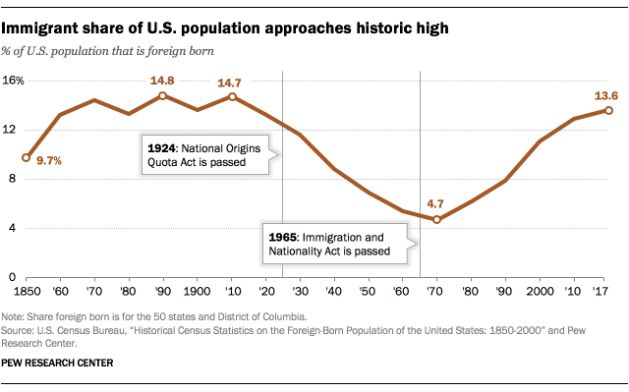
Many know that the decades at the end of the nineteenth century and early twentieth century were a period of significant immigration to the United States. This is regularly taught in history classes and often celebrated. While it can be difficult to understand larger patterns as they are happening, a recent Pew report provides evidence that a second long immigration period is happening now in the United States:

Nearly 14% of the U.S. population was born in another country, numbering more than 44 million people in 2017, according to a Pew Research Center analysis of the U.S. Census Bureau’s American Community Survey.

Pew_19.01.31_ForeignBornShare_ImmigrantshareofUS_2

This was the highest share of foreign-born people in the United States since 1910, when immigrants accounted for 14.7% of the American population. The record share was 14.8% in 1890, when 9.2 million immigrants lived in the United States.

Whether the trend line goes up, down, or plateaus remains to be seen (and immigration is a controversial topic at the moment). Still, even if it dropped in the coming years, now would still be part of a longer trend that people and scholars will look back at.

Putting the figures in international context might prove helpful as well:

Even though the U.S. has more immigrants than any other country, the foreign-born share of its population is far from the highest in the world. In 2017, 25 countries and territories had higher shares of foreign-born people than the U.S., according to United Nations data

Worldwide, most people do not move across international borders. In all, only 3.4% of the world’s population lives in a country they were not born in, according to data from the UN. This share has ticked up over time, but marginally so: In 1990, 2.9% of the world’s population did not live in their country of birth.

A number of countries could claim to be a “nation of immigrants” – a common refrain in the United States – though how all of that came to be would certainly differ as would how the immigrants were and are understood.

Building amenity-filled suburban apartments to encourage community

Some suburbanites may not just expect more amenities in apartments; the larger push may be toward creating community rather than just rental units.

Tony Rossi, president of M&R Development, the company behind the Wilmette and Itasca properties, agrees that the “explosion of amenities” seen downtown is starting to take hold in the suburbs as well. He said rent in the suburbs is usually two-thirds of rent in the city, but newer buildings with extra features will have a higher price tag. Martin pays about $1,925 a month for her one-bedroom and underground parking…

Greenberg developed the project with more than 20 years of hospitality experience and considers design a key factor in changing the vibe and perception of suburban rental living. For example, adding color and art to corridors in apartment buildings, as hotels do, makes all the difference, he said.

And while some suburban developers merge residential and retail in the same physical structure — think storefronts at street level and housing on top — Greenberg said 444 Social is unique because the apartment building is new and located near (but not connected to) existing commercial facilities, like Regal Cinemas next door. It also has natural elements, like forests and a lake, nearby.

“This goes to part of the DNA of this place,” Greenberg said. “If you want to be happy, if you want to live a healthy life, if you want to stay active, you got to be social. … That is what is missing in apartments where it’s downtown or in the suburbs where you just go to a place and hole up. Here we’re actually creating a community, so it’s pushing that experience.”

Four quick thoughts:

  1. Building apartments in certain ways does not guarantee that community will develop. Certain features of units, buildings, and the grounds could help encourage social interaction but it does not necessarily mean that it will happen.
  2. Apartments with more amenities and higher prices are likely to attract certain kinds of residents. Might it be easier or harder to create community among groups with more resources?
  3. I wonder how many residents in such apartments are interested in developing more community as opposed to enjoying a higher level of luxury or feeling that such apartments fit their cultural tastes (with connections to their social class).
  4. Are developers interested more in profits they can obtain through more amenities and higher rents or creating community?

More broadly, see an earlier post on “surban” places.

Scrambling to fill empty suburban HQs

Chicago looks at development efforts involving several large suburban corporate campuses that lost their famous tenants to the big city:

For many of these suburbs, the solution isn’t to replace one corporate behemoth with another. Instead, they’re dicing up the land for different uses and radically changing the face of suburbia for decades to come — just as the mammoth corporate enclaves and shopping malls once did. In Oak Brook, for example, an unexpected entity pursued the 34 undeveloped acres at McDonald’s. “As soon as we found out they were leaving, we asked if they wanted to donate it,” says Laure Kosey, executive director of the Oak Brook Park District. “They said, ‘Good idea, but we’re going to put it up for sale.’ ”

So the park district bought it. Residents of Oak Brook, a village that levies no property tax, took the unusual step of taxing themselves by voting for a bond referendum that covers the $15.8 million price tag, with $2 million left over for creating soccer fields and spaces for other recreational activities. The deal closed in December with the promise that the land won’t turn into anything other than a park.

A separate McDonald’s property a few miles from the main campus, next to the Oakbrook Center mall, was sold to Houston-based developer Hines last summer. It will likely become a mix of apartment buildings, office space, and shops — what the developer has called a “new village center.” It’s a similar tack to the one Schaumburg is taking after it was rattled in 2016 by the loss of Motorola Solutions’ headquarters, which moved to the West Loop. Chicago-based UrbanStreet Group bought 225 of the site’s 322 acres and intends to remake the parcel into a mini community with houses and apartments, a retirement home, a driving range, a park, and sidewalk cafés…

Nearby Hoffman Estates has already lost one giant — AT&T, which began vacating its 150-acre satellite campus in 2014 for several smaller sites in Chicago and other suburbs — and doesn’t exactly have a sure thing in another: the hobbled Sears Holdings Corporation, which is fighting to stave off liquidation. New Jersey–based Somerset Development is turning the AT&T site into what it calls an indoor downtown, essentially a 21st-century Bio-Dome that packs offices, restaurants, entertainment spots, conference centers, and hotels under a massive roof. It’s possible a Montessori school, public library, and other communal spaces will be weaved into the site, just as the developer did in New Jersey, where it revamped the huge Bell Labs property…

State representative Fred Crespo, a Democrat from the village, is floating a so-called Big Empties bill, which is being redrafted after it was introduced during the last session of the General Assembly. It would provide hefty incentives, including relief on up to half of the property taxes, for developers that make over old HQs larger than one million square feet.

The redevelopment plans sound like they have promise. The goal is to reduce the ways that headquarters are often set apart from the surrounding land by reincorporating the properties into the fabric of the suburb as well as introduce a variety of uses that will generate more around-the-clock activity. Big office campuses and/or buildings can be impressive displays but they may not contribute much to local community and social life.

On the other hand, I wonder how to weigh these changes against the loss of status that can come with the move of major companies out of the community. Particularly for edge cities, suburbs with millions of square feet of retail and office space and often located near major highways (like Oak Brook, Schaumburg, and Hoffman Estates), a Fortune 500 company helps establish the suburb’s reputation. New mixed-use neighborhoods may be attractive but they don’t have the same oomph as saying the suburb is home to Sears or McDonald’s or Mondelez.

I, for one, will be very interested to see how this all plays out within twenty years. These properties offer unique opportunities for established wealthier suburbs to do something unique. However, the redevelopment plans could go awry or the what is constructed may not be that interesting or the suburb’s status may never quite recover.

Consequences of an auto loan bubble

With more financing options available for purchasing cars, American driving is up:

By increasing access to cars, lax financing standards also appear to be contributing to a national rise in driving, and with it, declining public transit ridership. In the latest edition of its biennial survey of who’s riding buses and trains in U.S. cities, Transit Center, a public transportation research and advocacy group out of New York, notes that the share of households without vehicles fell 30 percent between 2000 and 2015, with foreign-born residents, who are more likely to earn lower incomes and ride transit, posting even sharper declines.

In the survey, respondents who reported decreasing their bus and train use overwhelmingly replaced transit with private cars. And almost half of respondents who said they’d purchased a car over the past two years received a loan to finance it. Of those, 56 percent said that getting a loan “was easier than they had expected.”

Of course, improved car access among lower-income groups might look to be a positive trend on its face, since a personal vehicle can equate opportunity. So strong is the historic link between car ownership and household income that a trio of transportation equity scholars recently called for subsidizing access to wheels for poor Americans. But fewer rides made by public transportation and more by private automobile is a trend with consequences that transcend the U.S. economy: It feeds the planet’s existential problem of rising carbon emissions, especially since SUV and truck sales have become particularly popular during this auto-loan boom. “The rise in auto debt is evidence that we’re dependent on cars in an unsustainable way,” said Cross.

The new high-water line of defaulted auto loans also suggests that personal vehicles aren’t always golden tickets. Instead, for Americans living paycheck to paycheck, they’re a catch-22: If you don’t have the money and can’t buy a car, you’ll struggle to make ends meet. And if you don’t have the money, but still buy a car, you’re liable to fall even further behind. Vehicles may be the table stakes for playing in the U.S. economy, but in so many ways, it’s getting harder to win.

As noted by many, just as homeownership came within the reach of more people in the 2000s due to creative lending options and subprime options, the same is true of the auto industry. Does this mean that a burst bubble in car loans – due to many people being behind on their vehicle payments – would cause Americans to rethink driving and the reliance on personal vehicles?

I would guess no. At this point in American history, the country is too far in on its dependence on driving. It is not just about driving to work; driving offers opportunities to access cheaper housing, independence for drivers compared to utilizing mass transit which works on consistent schedules and requires being around other people, and a host of consumer and recreational opportunities primarily accessible through driving (think big box stores, shopping malls, fast food places, road trips, etc.). This list does not even account for the auto industry and the construction industry which have huge stakes in more driving.

At the same time, while Americans have resisted public housing, would they be more amenable toward government help in obtaining or paying for cars? Few communities or government agencies have provided cars or money towards cars but it may be necessary in a society heavily dependent on getting around via a car.