The joint spread of McMansions and apartments in Charlotte

Rarely are the evils of McMansions and apartment complexes joined together but one observer in Charlotte suggests this is exactly the case:

As a 20-year resident of Charlotte, I’ve long observed that shoehorning apartment complexes and oversized homes in and around uptown does not prevent sprawl. Apartment complexes and McMansions are popping up like mushrooms in our historic uptown neighborhoods, yet sprawl has accelerated.

I strongly suspect we’re being sold a bill of goods by elected officials who are firmly under the thumbs of developers. Developers need us to believe they’re doing something for the greater good so we’ll allow them to destroy the character and design of our historic neighborhoods.

At first glance, these are two very different kinds of development. Apartments bring density and certain kinds of residents (whether lower-status residents in the eyes of neighbors or wealthy renters who are gentrifying places). They may include tall buildings or a lot of buildings. In contrast, McMansions are large ostentatious homes that may be teardowns (replacing smaller, older homes). They may not loom over surrounding area like apartments and generally McMansion residents are well off but the change in housing unit may be just as stark.

What appears to be the common thread of concern from this one resident is that both kinds of development are different than what is currently there. If I had to guess, these “historic uptown neighborhoods” are filled with well-kept, single-family homes with decent sized lots built decades ago. Both the McMansions and apartments, in their own ways, present very different kinds of structures. The same concerns might be leveled against an ultra-modernist home or a block of row houses: they are not like what is already in the neighborhood.

Often, McMansions or apartments are restricted to areas of similar structures. This is typically the purpose of zoning: keeping single-family homes away from land uses that residents fear might disturb the neighborhood’s character, and, ultimately, their property values. When developers or local officials start mixing uses, particularly in established areas, this may not go well at the beginning.

Speculating on why sociology is less relevant to the media and public than economics

In calling for more sociological insight into economics, a journalist who attended the recent ASA meetings in Philadelphia provides two reasons why sociology lags behind economics in public attention:

Economists, you see, put draft versions of their papers online seemingly as soon as they’ve finished typing. Attend their big annual meeting, as I have several times, and virtually every paper discussed is available beforehand for download and perusal. In fact, they’re available even if you don’t go to the meeting. I wrote a column two years ago arguing that this openness had given economists a big leg up over the other social sciences in media attention and political influence, and noting that a few sociologists agreed and were trying to nudge their discipline — which disseminates its research mainly through paywalled academic journals and university-press books — in that direction with a new open repository for papers called SocArxiv. Now that I’ve experienced the ASA annual meeting for the first time, I can report that (1) things haven’t progressed much since 2016, and (2) I have a bit more sympathy for sociologists’ reticence to act like economists, although I continue to think it’s holding them back.

SocArxiv’s collection of open-access papers is growing steadily if not spectacularly, and Sociological Science, an open-access journal founded in 2014, is carving out a respected role as, among other things, a place to quickly publish articles of public interest. “Unions and Nonunion Pay in the United States, 1977-2015” by Patrick Denice of the University of Western Ontario and Jake Rosenfeld of Washington University in St. Louis, for example, was submitted June 12, accepted July 10 and published on Wednesday, the day after it was presented at the ASA meeting. These dissemination tools are used by only a small minority of sociologists, though, and the most sparsely attended session I attended in three-plus days at their annual meeting was the one on “Open Scholarship in Sociology” organized by the University of Maryland’s Philip Cohen, the founder of SocArxiv and one of the discipline’s most prominent social-media voices. This despite the fact that it was great, featuring compelling presentations by Cohen, Sociological Review deputy editor Kim Weeden of Cornell University and higher-education expert Elizabeth Popp Berman of the State University of New York at Albany, and free SocArxiv pens for all.

As I made the rounds of other sessions, I did come to a better understanding of why sociologists might be more reticent than economists to put their drafts online. The ASA welcomes journalists to its annual meeting and says they can attend all sessions where research is presented, but few reporters show up and it’s clear that most of those presenting research don’t consider themselves to be speaking in public. The most dramatic example of this in Philadelphia came about halfway through a presentation involving a particular corporation. The speaker paused, then asked the 50-plus people in the room not to mention the name of said corporation to anybody because she was about to return to an undercover job there. That was a bit ridiculous, given that there were sociologists live-tweeting some of the sessions. But there was something charming and probably healthy about the willingness of the sociologists at the ASA meeting to discuss still-far-from-complete work with their peers. When a paper is presented at an economics conference, many of the discussant’s comments and audience questions are attempts to poke holes in the reasoning or methodology. At the ASA meeting, it was usually, “This is great. Have you thought about adding …?” Also charming and probably healthy was the high number of graduate students presenting research alongside the professors, which you don’t see so much at the economists’ equivalent gathering.

All in all — and I’m sure there are sociological terms to describe this, but I’m not familiar with them — sociology seems more focused on internal cohesion than economics is. This may be partly because it’s what Popp Berman calls a “low-consensus discipline,” with lots of different methodological approaches and greatly varying standards of quality and rigor. Economists can be mean to each other in public yet still present a semi-united face to the world because they use a widely shared set of tools to arrive at answers. Sociologists may feel that they don’t have that luxury.

Disciplinary differences can be mystifying at times.

I wonder about a third possible difference in addition to the two provided: different conceptions in sociology and economics about what constitutes good arguments and data (hinted at above with the idea of “lots of different methodological approaches and greatly varying standards of quality and rigor.”) Both disciplines do aspire to the idea of social science where empirical data is used to test hypotheses about human behavior, usually in collectives, works. But, this is tricky to do as there are numerous pitfalls along the way. For example, accurate measurement is difficult even when a researcher has clearly identified a concept. Additionally, it is my sense that sociologists as a whole may be more open to qualitative and quantitative data (even with occasional flare-ups between researchers studying the same topic yet falling in different methodological camps). With these methodological questions, sociologists may feel they need more time to connect their methods to a convincing causal and scientific argument

A fourth possible reason behind the differences (also hinted at above with the idea of economists having a “semi-united face” to present): sociology has a reputation as a more left-leaning discipline. Some researchers may prefer to have all their ducks in a row before they expose their work to full public scrutiny. The work of economists is more generally accepted by the public and some leaders while sociology regularly has to work against some backlash. (As an example, see conservative leaders complain about sociology excusing poor behavior when the job of the discipline is to explain human behavior.) Why expose your work to a less welcoming public earlier when you could take a little more time to polish the argument?

Shipping via truck and railroad in a strong economy

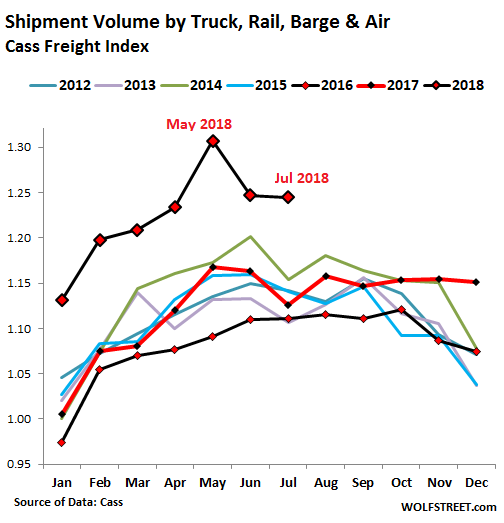
If the economy is going well, the trucking and railroad industries have plenty of work to do:

The dynamics in the transportation sector are “clearly signaling that the US economy, at least for now, is ignoring all of the angst coming out of Washington D.C. about the trade wars,” the report by Cass said.

The Cass Shipments Index does not include shipments of bulk commodities, such as grains or chemicals. But shipments of commodities were strong too, according to the Association of American Railroads. Excluding the carload category of coal, which is facing a structural decline in the US, carloads rose by 6.7% year-over-year, including grain, up 14.7%; petroleum & petroleum products, up 27%; and chemicals, up 4.6%. Of the 20 commodity carload categories, only five showed declines, including nonmetallic minerals, metallic ores, and the biggie, coal.

And intermodal traffic – shipments of containers and trailers via a combination of rail and truck – surged 6.9% in July compared to July last year, the AAR reported.

At the least, this is just a reminder of how goods make their way to stores and eventually buyer’s residences. Those trucks and trains may be a nuisance when you want to get where you want to go but this is how it works in our society.

A few other thoughts:

  1. It is hard to imagine drones could make up for all or even many of the goods shipped by trucks and trains. Or, imagine drones like swarms of locusts.
  2. The shipping industry is another one highly affected by economic swings. Like the construction and housing industries, when times are good, there is a lot of need for goods to be moved around. When a recession hits, all that equipment and all those employees are not needed.
  3. Of course, there is an international component to all of this where goods have to enter or leave countries. That all happens on a consistent even with all the rhetoric regarding trade wars and trade agreements. I remember going past some of the shipping yards in Hong Kong and being amazed at the size of the facilities: cargo containers in huge piles for as far as one could see.

Convicted mobster and his supposed “Sopranos-style McMansion”

As part of his sentencing, a New York mobster has to sell his large home. One media source claims it is a “Sopranos-style McMansion”:

During his sentencing on Aug. 15 in U.S. District Court in Brooklyn, Giallanzo was ordered to serve 14 years behind bars, pay $268,000 in restitution to his victims, forfeit $1.25 million in assets and sell his mansion in Howard Beach.

Federal prosecutors said that Giallanzo used proceeds from his racketeering ring to transform his home from a humble ranch into a two-story palazzo that could have rivaled Tony Soprano’s digs on “The Sopranos.” The mob captain reported spent more than $1 million to reconstruct and furnish the home, which features five bedrooms, five bathrooms, radiant heated floors, luxury appliances, three kitchens and a salt water pool with a waterfall.

https://qns.com/story/2018/08/16/howard-beach-mobster-must-spend-14-years-federal-pen-sell-sopranos-style-mcmansion/

This is certainly now a large home and has an interesting exterior. While it would meet the definition of a McMansion (in at least two ways), it is quite different from the McMansion of the Soprano family.

Let’s start with the McMansion definition. The picture of the home as it stood at least a few years ago (according to Google Street View) is helpful. It was once a ranch home on a corner lot. Not very big, in a residential neighborhood, and in a tight corner lot that offered little opportunity for a backyard. The new home is a teardown. The house is now two stories. On a small lot, the home even pushes closer to the edges. This is a teardown McMansion.

Additionally, the home has a mix of architectural features. It has a consistent brick facade (at least on the two sides facing the street). It has a round turret on the corner; given the placement of the windows, this could be a staircase. The front entrance includes a entry with a roof and columns and numerous windows of different shapes. The roof has multiple gables on the front. On the whole, the design of the home is too busy. Definitely a McMansion with its mishmash of architectural styles.

The comparison to the Soprano home on The Sopranos would seem to make sense: the owner of the home above was in the mob, he lives in a large house, and he was able to live there because of his ill-gotten gains. But, the home above is very different from the Soprano home. Here are just a few differences: a corner lot in a more urban neighborhood versus a big suburban lot with the home set back from the street and at the top of a longish driveway; whatever style the teardown is built in versus the French styling of the Sopranos home; and current interior features (three kitchens! radiant floors!) versus the 1990s McMansions of the Sopranos home (mostly about size, lots of room, and certain decor).

While these homes might both fit the general category of McMansion, they are quite different. Arguably, the Sopranos home is more tasteful or at least stands out less from its surroundings (because most of the nearby homes are similar).

(See an earlier post about the McMansion features of the main residence on The Sopranos.)

Cities, animals, and intelligence

Research regarding the effect of cities and urban areas on wildlife can be fascinating. See the discussion about how cities could affect the intelligence of different animals:

One of the great mysteries of urban adaptation is what, if anything, living in cities does to animal minds. Research on urban wildlife has already shown that cities can have jaw-dropping effects on animals’ behavior. Gehrt’s coyotes have not only learned where it’s safest to cross roads, but have also learned to avoid traffic based on its speed and volume. Do behavioral shifts like this reflect deeper changes in how urban animals think? In what urban animals are?

These questions vex the small subset of wildlife ecologists that is wading into the murky waters of urban-animal intelligence. In several metropolitan areas, researchers have devised simple puzzles—usually difficult-to-open boxes of food—in order to compare the problem-solving abilities of city-dwelling creatures with those of their wild relatives. The results have been tantalizing: Urban animals as varied as Canadian raccoons and Barbadian bullfinches can outperform their rural counterparts. While it pays to be cunning in almost any setting, some scientists propose that foreign, volatile environments like cities demand an especially broad range of cognitive abilities. Eventually, the thinking goes, cities may bend evolution enough to make whole populations of animals within them smarter—if, of course, the animals can survive city life in the first place.

This is a controversial theory. Even researchers who back it are quick to warn that intelligence is complicated. No one is suggesting that new situations are the only driver of animal smarts: The ways animals interact, how they learn from one another, and the nature of their physical surroundings are all thought to influence how individual animals behave and how their brains take shape over generations, no matter where they live…

But studying animals in new environments may help scientists develop a definition of intelligence that applies across species. Along with others in her field, Benson-Amram has zeroed in on flexibility, long considered an essential criterion for intelligence. “When the environment is changing, you’re able to change your behavioral response, and you don’t perseverate on old responses that used to work but no longer do,” Benson-Amram says. This way of defining intelligence—which researchers also call “behavioral plasticity”—is notably distinct from what could be considered an animal’s specific intelligence. A scrub jay that hides away thousands of seeds and remembers the location of each one certainly has a particular kind of acuity, Benson-Amram notes. But an animal needs a diverse, general set of mental skills—perceptiveness, resourcefulness, foresight, and so on—to tackle the foreign obstacles of cities, she posits.

A simplistic popular approach to these questions might say this: cities and urban development is simply bad for animals and nature. Because such development takes up land and subjects it to particularly harmful uses (pollution, poor water run-off, etc.), humans should limit their development and its effects.

On the other hand, this research and others suggests human-wildlife interaction can be quite complicated. And could it even possible lead to positive change for some animals? I’m also thinking of the book Subirdia which suggests some bird species do well in urban environment even if others do not.

Humans may have the upper hand here and have done some pretty destructive things regarding the environment in recent years. Yet, in the long run, both humans and wildlife adapt to each other.

West Chicago in the news for the wrong reasons

Few of the scores of Chicago area suburbs receive national attention. Even more rarely is the spotlight turned on West Chicago, a more working-class, diverse, and railroad-based suburb roughly 30 miles west of the city. The local suburban headlines tell the story:

WestChicagoHeadlineAug1718DailyHerald

And even the DrudgeReport took note (middle column, sixth headline down):

WestChicagoHeadlineAug1718

This is not what any suburb wants. Tales of suburban violence go against everything suburbs supposedly stand for: good places to own a home and raise a family. Such a horrific headline might be easier to accept if it came from the big city but not a suburb.

Additionally, West Chicago has other issues in its past to overcome. Its distance from the city and an interest in attracting firms prompted city leaders in the late 1800s to change the name of the community from Turner to West Chicago. (This gets at the DrudgeReport headline above: West Chicago may be in Chicagoland but it would be a huge stretch to link the suburban violence with criticism of the city of Chicago and mayor Rahm Emanuel’s efforts regarding violence.) A long-time industrial firm ended up creating a Superfund site spread throughout the suburb and hundreds of properties needed remediation from radioactive elements in the late twentieth century (see my published piece “Not All Suburbs Are the Same.”) Tension between white residents and Mexican immigrants occasionally flared with discussions of English-only ordinances and changes to bilingual education options in the local schools.

Put this all together with a negative reputation in DuPage County and the surrounding area as a community that is poorer and less attractive that others and it may be hard to find good news in the media about West Chicago. This has not stopped numerous civic leaders and residents from doing good things in the community. Yet, it can be hard for a suburb to develop a positive wider reputation.

Manufactured housing to be more popular with fancier features?

Those seeking cheaper housing options may like both the price of manufactured housing and the features they can purchase:

The hope is that more Americans will see the factory units not only as a more-affordable alternative to a traditional single-family house, but also an appealing one, without the old trailer-park stigma. It helps that they’ve been getting fancier.

Scott Richards, a salesman for Rona Homes in Pataskala, Ohio, said that when shoppers come to his lot, he can dazzle them with customization options like hickory cabinets, rainforest showers and built-in entertainment systems coupled with electric fireplaces.

“We’ve got linoleum floors that look just like hardwood floors,” said Richards, who got back into selling factory-made houses after leaving the industry in 2012. “You don’t think about solid granite being in a manufactured home, but we have that as well.”…

The company sells what most people probably picture when they think of manufactured homes — single- and double-wide houses wholly built on a chassis in a factory — as well as modular homes, which are factory-built in sections that are assembled on a lot. While a single- or double-wide is often much cheaper than a modular home, both offer cost advantages that come with putting construction on an assembly line.

The article goes on to talk about some regulations involving the federal government and lenders that could be altered to make manufactured housing more available to house buyers. Theoretically, these changes could open the floodgates to cheaper housing for many.

Yet, I would suggest there is then another hurdle to overcome that might prove even more difficult. This housing may be cheaper than other options and it could even be attractive inside and out. This does not mean that it will be easily accepted by numerous communities, particularly those with higher qualities of life. In many of those places, manufactured housing implies all sorts of things that those communities work hard to keep out through formal and informal means. It will take time to reverse the common image of such housing.

The same issue faces tiny houses. Even if they look nice and are attractive inside, they are not easily accepted in places with more expensive single-family homes. Tiny houses are affordable – though significantly smaller than the manufactured housing options discussed in this article – but not necessarily that popular, either to consumers or neighbors.

Fighting for suburban votes in the Illinois gubernatorial race

Like many state and national political races, the path to being elected governor of Illinois runs through suburbia:

In 2014, Rauner defeated former Democratic Gov. Pat Quinn with a big assist from DuPage, Kane, Lake, McHenry and Will counties. The Chicago region contributed 62 percent of statewide votes for governor in 2014. Without Chicago, the suburbs generated 44 percent of ballots cast in Illinois…

Reason No. 1 “is the raw number of independent/swing voters in the collar counties,” Morris said…

Another lure for Pritzker and Rauner is that collar county turnout is typically higher compared to elsewhere during nonpresidential election years, analysts say…

A final reason for the suburban surge is bragging rights. With the future of the presidency looming large, both candidates want their coattails to decide the fate of congressional seats in play like the 6th District.

With over 50% of Americans living in suburbs and consistent patterns of urban residents voting for Democrats and rural voters going for Republicans, this is the truly purple part of America. And, we can probably be even more specific about which suburban voters by geography are up for grabs: those living in inner-ring suburbs and closer to the big city lean Democratic and those farther out and on the exurban fringe lean Republican. These patterns are replicated in Illinois: Chicago will deliver big votes for Pritzker, downstate/more rural Illinois will deliver votes for Rauner, and the winner will be decided by suburbanites who often can be swayed.

It would be fascinating to see the suburban microtargeting data of both Illinois candidates. Does Pritzker think there are enough working-class suburbanites? Does Rauner think generally favorable economic conditions in the conditions lifted the boats of enough suburbanites to vote Republican? Who targets which suburban racial and ethnic groups? While the article suggests both candidates are making numerous suburban campaign stops, it might be worth keeping track of which suburbs and which groups receive attention.

The best ASA talk I heard: Hampton and Wellman on moral panics and “persistent-pervasive” community

Internet and community scholars presented a paper on Sunday at the ASA meetings that addressed the widespread social concerns – or moral panic – over the loss of community and relationships due to smartphones, social media, and the Internet. They argue this particular argument is nothing new. For at least a century, Westerners and sociologists have argued various technological and social changes have harmed traditional notions of community. I’ll do my best to summarize the argument and they explained it should be in a published piece soon.

At the beginning of the discipline of sociology, leading figures lamented the loss of close-knit communities. Often based in villages or small cities, these societies were marked by close ties, shared cultural values, and limited interaction with the outside world. Tönnies called this gemeinscahft and Durkheim labeled it mechanical solidarity. The development of capitalism, industrialization, and megacities upended these traditional ways of life with increased mobility, moving away from relatives, and the fragmentation of collective values. Tönnies called this gesellschaft and Durkheim termed this organic solidarity. Marx also responded to these major social changes by arguing workers experienced alienation as they were now cogs in a capitalistic machine rather than free individuals. Writing specifically about cities, Simmel worried that dense population centers would lead to overstimulated minds and cause mental distress.

But, the changes kept coming. Urbanization took off – and is still happening at amazing rates in many parts of the world – and was later supplanted by suburbanization in the United States (and a few other countries). Critics also claimed suburbanization ruined community. Whereas urban residents interacted with numerous neighbors and often lived in ethnic enclaves, suburbs moved people to private single-family homes, encouraged individual interests, and produced conformity. Numerous critics inside and outside sociology argued suburbs limits civil society.

The Internet, smartphones, and social media then disrupted suburban communities with a move away from the limits of proximity and geography. Now, users could interact with other users unconstrained by time and space. Close ties could be abandoned in favor of ties based on common interests. Users had little reason to contribute to civil society based on geography. As Jean Twenge argued in The Atlantic, the introduction of the iPhone marks a turning point toward a host of negative individual and collective outcomes.

Hampton and Wellman make this point: all of these technological and social changes and their effects on communities afforded both new opportunities and limitations. In a shift from close-knit communities to post-industrial community to what they now call “persistent-pervasive community,” people gained things and lost others. The new form of community offers two primary strengths: the ability to engage in long-term relationships that in the past would have disappeared as people moved geographically and socially as well as a new awareness of information, people, and the world around them. Going back to earlier stages of community, a world of closer face-to-face bonds or geographically-bounded relationships, might lead to negative outcomes like repression, conformity, hierarchy, constraints, and a lack of awareness of important causes like social justice and equality.

In the end, should a moral panic push Americans back toward an earlier form of community or should we recognize that the persistent-pervasive community of today contains both opportunities and threats?

(Three reasons why I resonated with this talk. First, it combines two areas of research in which I engage: suburban communities and social network site use. Both are communities and institutions yet they are typically treated as separate spheres. Additionally, both are relatively ignored by mainstream sociology even as more than 50% of Americans live in suburbs and the vast majority of Americans are affected by the Internet and social media. Second, a balanced approach where social change is recognized as having both positive and negative consequences fits my personality as well as my research findings. Sometimes, the negative consequences of social change are easy to identify but often the change happens because groups and institutions believe there is something to be gained by changes. Third, while there is always a danger in simplified explanations of large-scale social change, I think sociologists can contribute much by explaining broad changes over time.)

“One Naperville” sticker, more diverse suburb

While recently at a rest stop in Indiana, I saw a minivan with an Illinois license plate and this sticker on the back:

No automatic alt text available.

Given the uniqueness of the sticker and my scholarly interest in Naperville, I almost snapped a picture of the vehicle but did not feel so inclined with its passengers standing not too far away. Instead, I found the image on the Internet. I do not know if there are ongoing “One Naperville” efforts but I found an event from September 11, 2016 commemorating 9/11 put on by the Naperville Interfaith Leadership Alliance. The similarities in style to the “Coexist” bumper stickers are due to the makers of this sticker (see bottom right). The peacemonger.org people are the same ones behind the original “Coexist” design.

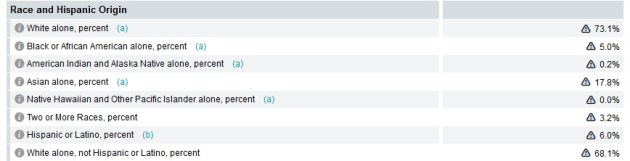
Naperville is known for a number of features including its wealth, its high ranking in a number of listings of quality places (examples here, here, and here), its fast-growing population at the end of the twentieth century, its vibrant downtown, its office space along I-88, and, more recently, its diversity. According to QuickFacts from the U.S. Census Bureau:

NapervilleQuickFacts

That this large and wealthy suburb is only 68.1% white alone is notable. The diversity is noticeable in different retail establishments, those using the city’s Riverwalk, the local government naming liaisons to minority groups, and the presence of different religious groups (including mosques).

However, Naperville was not always this way.