CREATE plan slowly moves to address Chicago area railroad congestion

An expensive and sizable project aims to solve the train congestion in the Chicago region:

CREATE takes an incremental approach to fixing rail gridlock in the suburbs and Chicago, the nation’s busiest rail hub.

One overpass here, two extra tracks there, and eventually freight trains will be chugging along instead of noisily idling in your neighborhood while emitting diesel fumes.

The downside is the cost — a staggering $4.4 billion to fix the region’s outdated rail infrastructure.

Despite funding challenges, 29 out of 70 CREATE projects in the region have been completed with $1 billion spent, Association of American Railroads Chief Engineer for CREATE William Thompson explained during a recent tour…

The Chicago region handles a whopping 25 percent of freight traffic in the U.S. That means almost 500 freight trains and 760 Metra and Amtrak trains pass through the region daily. Completing the Chicago Region Environmental and Transportation Efficiency Program that builds bridges and new track will mean the metro area can host 50,000 more freight trains a year by 2051.

The Chicago area is a critical railroad hub for the entire nation. Yet, given the amount of development in the region, making significant changes is difficult. For example, construction at O’Hare Airport is held up by a dispute over railroad land adjacent to the busy facility. Or, suburban residents and communities do not like it when freight traffic is increased near them even if benefits the region as a whole. Or, getting rid of the many at-grade crossings is a slow process. This is another good illustration of how foresight – addressing these issues decades ago as the region was growing at a face pace – could have cut off numerous later issues.

Also, I am intrigued by the last line from the article quoted above. I assume most of the region’s residents would assume that the amount of time and money poured into this project would eventually mean that they would encounter fewer trains. And this might be the case if more bridges, underpasses, and routes around the outskirts of the region limit the vehicular contact with trains. Yet, increasing the number of freight trains by 50,000 means more noise and possibly more traffic issues at the points in the transportation grid where trains and vehicles still come in contact. Would the majority of residents want 50,000 new trains? I would guess no even if it is essential to their day-to-day lives (delivering goods and food, etc.).
 

What it costs to maintain dozens of pieces of public art in Naperville

Naperville’s Riverwalk and downtown features dozens of works of art. However, it takes resources to keep that art nice and to keep adding new pieces:

In 2016, the city started to set aside about $50,000 a year for maintenance of public art from its food and beverage tax revenue, which is pooled into a fund named for the activities it supports — Special Events and Cultural Amenities.

Since its founding in 1996, Century Walk has installed works at 48 locations, some of which involve several pieces by large numbers of artists, and others that involve intricate or large-scale works by individual talents…

Others on the council agree, but some say there should be a stronger focus on planning for the future of Naperville’s outdoor art, setting aside money for maintenance or requiring future projects to come with some sort of endowment for their long-term care. Century Walk Chairman Brand Bobosky, for his part, wants the city’s maintenance fund increased and coupled with money for new art creation, to the tune of $200,000 a year…

In the past three years, Mondero has repaired the broken tiles on the bench damaged by skateboards, rebuilt a wall called “Man’s Search for Knowledge Through the Ages” that was damaged by a vehicle, repainted two murals, bolted the arm of a sculpted man to hold it in place and cleaned several plaques.

Not all suburbs would be willing to (1) initiate public art in the first place and then (2) invest city resources into it. Yet, Naperville clearly sees it as part of the package it offers to residents and visitors: come to the Riverwalk, enjoy the vibrant suburban downtown, and take in the public art that often commemorates the suburb’s past. The art is not exactly edgy; Naperville is not going after street art or modern art (see the example of the Bart Simpson image that popped up a few years ago). The art that Naperville does have is intended to help tell the community’s story and present interesting visual displays for visitors.

Whether the public art can come first and help create a vibrant suburban area is debatable. Plenty of suburban communities want mixed-use areas that bring in visitors and generate revenue and art is often viewed as part of that package. But, it is unlikely that public art alone could create such a setting. The suburb would already need a confluence of enough residents, resources to apply to such an area, and a good plan for development or redevelopment.

Multiple factors behind why younger Americans may purchase fewer homes in their lifetime

A report on the real estate market in the Chicago region hints at a possible trend to watch: Americans will buy fewer homes in their lifetime.

Many first-time buyers share the Joshis’ perspective that it’s smarter to find the right house to grow into than to get a toehold in the market with a starter house, only to see much of that early equity sapped by transaction costs a few years later when moving up to a larger house.

“When we started looking, I had in mind a starter house, but it was so exhausting to look that we thought, no, one and done,” says Vrushank Joshi.

There are numerous societal changes that contribute to this:

  1. People are getting married later and going to school longer. This means they are not buying a home in early adulthood as often and are waiting longer to purchase their first place.
  2. With more education, increasing student loans means it takes longer for potential owners to save money for a down payment.
  3. Fewer starter homes have been constructed in recent years.
  4. Mobility is down in recent years as Americans seem interested in staying in places for longer.
  5. The specter of the late 2000s housing bubble haunts possible buyers.

A system that used to rely on people starting with a smaller product and then working their way up over a lifetime may have to make some major adjustments if Americans buy fewer and different homes compared to before.

Building and buying larger homes leads to “McMansion envy”?

Here is the full Bankrate.com headline of the story I discussed yesterday about Americans buying larger homes:

McMansion envy spreads as Americans demand more bedrooms, baths

What is “McMansion envy”? The common sense interpretation seems clear: people see and desire McMansions. Yet, this gets complicated fairly quickly for a number of reasons.

  1. The data then presented in the story does indeed tell a tale of Americans buying larger homes. But, not all large homes are McMansions.
  2. There is no other mention of the term McMansion. While the term seems to be a stand-in for large homes in general, there are also references in the story to homes with more and flashier features (including more bedrooms and bathrooms as well as higher-end finishes, though this last part is difficult to defend with Census data).
  3. McMansion is a pejorative term and few real estate listings or homeowners proudly use the term to describe their homes. Instead, the term typically refers to tacky or garish large homes (see McMansion Hell for an example).
  4. Indeed, the exact definition of a McMansion is more complicated than just a big home or a poorly-designed home. I argue McMansions have four possible traits.

I do not expect this concept of “McMansion envy” to spread except for critics of larger homes and McMansions who want to describe some sort of sickness from which Americans suffer.


Suburban culture and voters summed up by Furbys, soccer moms, and two minivans

Alexandria Ocasio-Cortez made recent comments about who Democratic House members are and who are they are trying to appeal to. Her argument about these leaders being stuck in “90s politics” included this bit:

Their heyday was in the ’90s when kids had, like, Furbys, and soccer moms had, like, two vans. That’s not America anymore!

While a number of suburbanites and right-wing commentators have suggested her comments are off-base and are attacking a suburban way of life, she is both right and wrong:

  1. The American suburbs have changed. They are more non-white and poorer than they were in the 1990s. Ocasio-Cortez’s own life story is a testament to these changes. The suburbs today are much more diverse.
  2. She cites several material markers of suburban culture from the 1990s: Furbys and minivans. These were indeed real and to some degree are not as popular today. However, replace the minivan with the hipper SUV and there is little difference. (Additionally, she could have strengthened her case by adding McMansions to the 1990s mix since they arose as a term in this decade.)
  3. The “soccer moms” claim is the most interesting one to me. On one hand, it was political shorthand from the 1990s to describe a group that both parties wanted to target: women in the suburbs who drove their kids to soccer games and other activities. Those people still exist and, if anything, the number of suburban activities kids normally pursue has probably only increased. On the other hand, rarely do political candidates or prognosticators talk about soccer moms even as the current battleground is the middle suburbs. While Ocasio-Cortez has to think about her own potential constituents, there are still plenty of suburbanites who would be turned off by talk claiming that their time is over. Even if soccer moms is not a valid category (nor is NASCAR dads), suburban voters in their multiple strata are still worth courting.

To sum up, the majority of Americans still live in suburbs. Suburban communities and culture may have changed but the interests of suburbanites still matter in local, state, and national races.

“Americans demand more bedrooms, baths”

I argued a few days ago that the American system is set up to encourage people to purchase bigger homes. Look, the system is working! Americans continue to build and buy bigger homes.

The latest numbers from the U.S. Census Bureau show newly-constructed homes in 2017 are 4 percent larger on average than a decade ago. And they come with a larger price tag — the average price of a new home jumped 23 percent from $313,600 in 2007 to $384,900 last year. Meanwhile, the average family size in the U.S. continues to shrink, from 3.33 persons in 1960, to 2.54 in 2017…

Below are some takeaways from the Survey of Construction data released in June. Based on the most common features, the most popular home built in 2017 was a two-story, two-garage home with more than four bedrooms and three bathrooms.

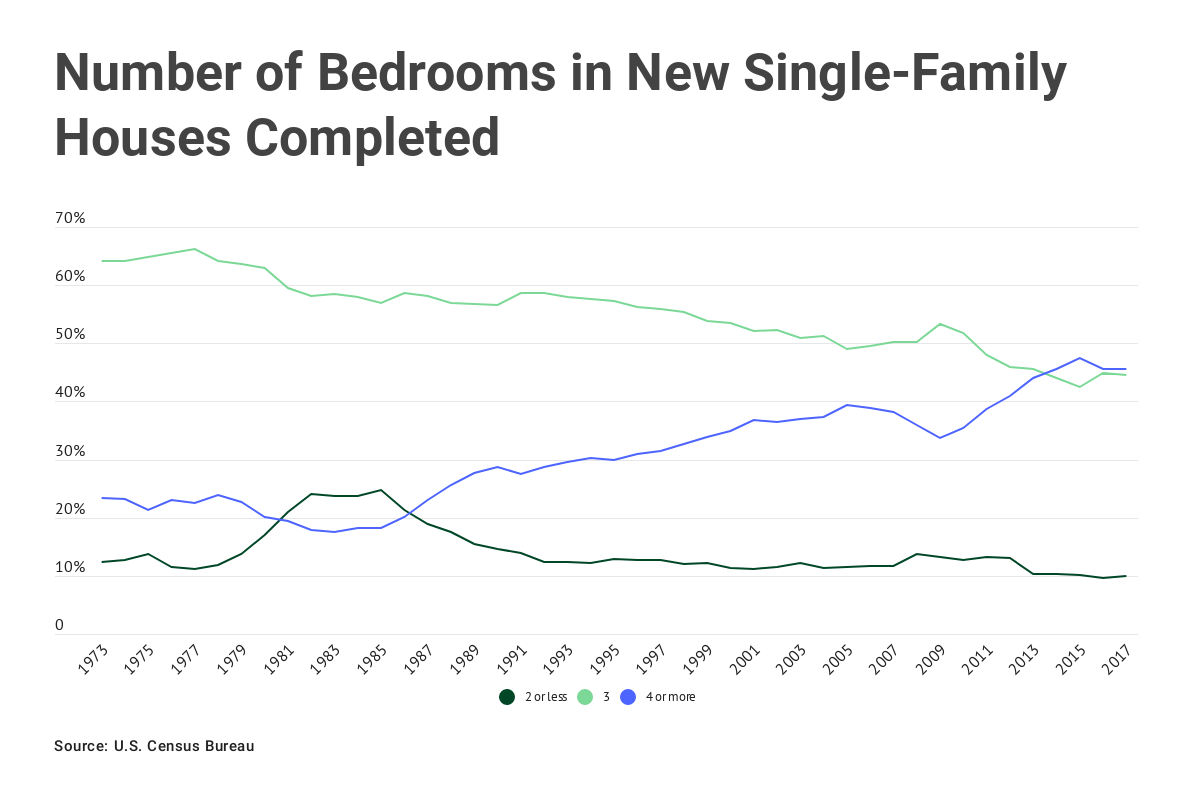
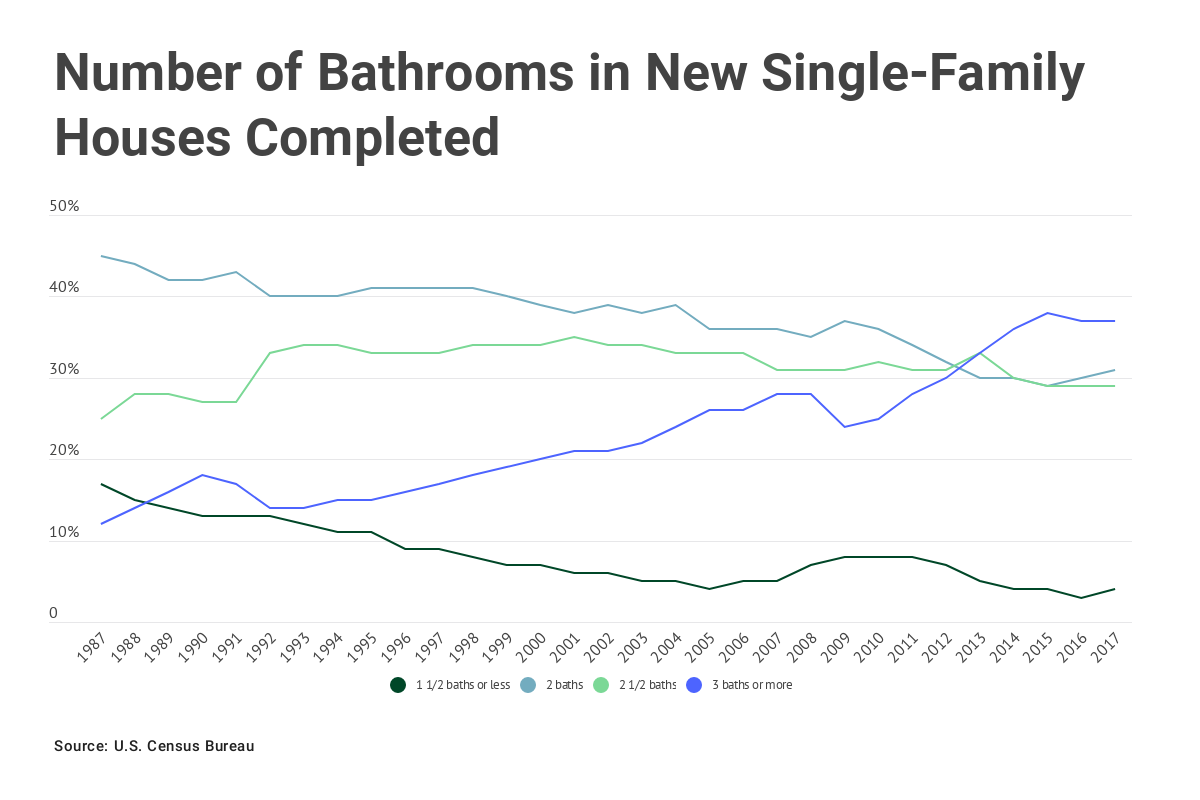
Several graphs highlight the proliferation of bedrooms and bathrooms in recent years:

Chart: Number of bedrooms in new single-family houses completed

Chart: Number of bathrooms in new single-family houses completed

Even with plenty of critics, American builders and buyers still seem to want larger homes. Perhaps the market is primarily open these days to wealthier buyers and builders may not be interested in constructing starter homes but this is not an isolated blip in the data: for decades, Americans have sought larger homes.


Census income figures misreported based on gender norms

The Census measures numerous important features of American life. Yet, accurate measurement is difficult. A new report suggests reported income can not be the most truthful when women make more money than their husbands:

Researchers found that when wives are the bigger breadwinners, husbands report making an average of 2.9 percent more than what’s in their tax filings. Meanwhile, women who make more than their husbands report earning 1.5 percent less than their actual income…

So why does this phenomenon happen? Researchers say they suspect societal expectations about the roles each person plays in a marriage could be a main factor.

“When married couples . . . violate the norm that husbands outearn their wives, the survey respondents reporting the couples’ earnings appear to minimize the violation by inflating the earnings of the lower-earning husbands and deflating the earnings of the higher-earning wives,” researchers wrote in their findings.

If the misreporting is due to gender norms, might we expect this to go away as more women earn more money? Already, “In about one out of four couples surveyed, wives made more money than their husbands.” Give this a few decades and this misreporting might disappear.

On the other hand, social norms can be last a long time even after society has changed quite a bit from when the social norm arose. If the misreporting continues or even increases, it would be interesting to see how the Census and other surveyors adjust their figures.

If one survey option receives the most votes (18%), can the item with the least votes (2%) be declared the least favorite?

The media can have difficulty interpreting survey results. Here is one recent example involving a YouGov survey that asked about the most attractive regional accents in the United States:

Internet-based data analytics and market research firm YouGov released a study earlier this month that asked 1,216 Americans over the age of 18 about their accent preferences. The firm provided nine options, ranging from regions to well-known dialects in cities. Among other questions, YouGov asked, “Which American region/city do you think has the most attractive accent?”

The winner was clear. The Southeastern accent, bless its heart, took the winning spot, with the dialect receiving 18 percent of the vote from the study’s participants. Texas wasn’t too far behind, nabbing the second-most attractive accent at 12 percent of the vote…

The least attractive? Chicago rolls in dead last, with just 2 percent of “da” vote.

John Kass did not like the results and consulted a linguist:

I called on an expert: the eminent theoretical linguist Jerry Sadock, professor emeritus of linguistics from the University of Chicago…

“The YouGov survey that CBS based this slander on does not support the conclusion. The survey asked only what the most attractive dialect was, the winner being — get this — Texan,” Sadock wrote in an email.

“Louie Gohmert? Really? The fact that very few respondents found the Chicago accent the most attractive, does not mean that it is the least attractive,” said Sadock. “I prefer to think that would have been rated as the second most attractive accent, if the survey had asked for rankings.”

In the original YouGov survey, respondents were asked: “Which American region/city do you think has the most attractive accent?” Respondents could select one option. The Chicago accent did receive the least number of selections.

However, Sadock has a point. Respondents could only select one option. If they had the opportunity to rank them, would the Chicago accent move up as a non-favorite but still-liked accent? It could happen.

Additionally, the responses were fairly diverse across the respondents. The original “winner” Southeastern accent was only selected by 18% of those surveyed. This means that over 80% of the respondents did not select the leading response. Is it fair to call this the favorite accent of Americans when fewer than one-fifth of respondents selected it?

Communicating the nuances of survey results can be difficult. Yet, journalists and other should resist the urge to immediately identify “favorites” and “losers” in such situations where the data does not show an overwhelming favorite respondents did not have the opportunity to rate all of the possible responses.

Americans are conditioned and enabled to buy large homes

Findings regarding how Americans use the space in their homes may show they do not use all the space equally but evidence may not matter much. Americans want larger homes and the society and system is set up to push them towards this. Some of the factors involved:

-A consumption heavy culture where people enjoy shopping and buying items to signal their worth and for their own enjoyment. People want bigger homes like McMansions to impress others. Owners want a bigger home for all their stuff (and not necessarily for larger families).

-A lending industry that often requires relatively small down payments and repayments of a mortgage over three decades. Even if borrowers pay more in interest over time, they can afford a bigger home up front. Mortgages are socialized.

-A building industry that can make more money per house on selling a larger house. Building starter homes – a smaller house a couple might start with – or smaller single-family homes is a minor part of the industry.

-An emphasis on private family space as opposed to thriving public life on streets, urban public spaces, or third spaces. Additionally, Americans like their personal space.

An emphasis on suburban culture and spread-out settlement.

With these conditions, making a choice to have a smaller home is going against the grain. Perhaps this is why the tiny house movement is small.


The missing microwaves and countertop kitchen appliances on HGTV

In watching a recent episode of something or other on HGTV, I realized something: very few of the renovated homes featured on the channel have visible microwaves or other kitchen appliances on surfaces.

I suspect this is similar to the clean, open concept kitchen that has no mess: the aesthetic is modern and minimalist. Appliances beyond the stove, refrigerator, and dishwasher (which are often emphasized in discussions and visual shots because of their size and finishes) should be out of sight and avoid cluttering the beautiful surfaces. To some degree, this is common when showing houses that are for sale: the thinking is that people do not want to see the clutter of everyday life.

Yet, I would guess that most American kitchens have plenty of countertop appliances that they regularly use. How many home cooks can survive without a toaster or toaster oven, blender, food processor, mixer, coffee makers, crockpot, and so on? And that does not even include the microwave, an indispensable tool for decades.

I suspect that clearing the countertops for the final reveal of homes is akin to the sketchy before and after shots provided by weight loss products. The difference might look substantial but the image is misleading. Is a clear surface that few people can actually live with really desirable versus a kitchen that displays where people can keep some of the stuff they regularly use? The countertops should not be full of junk but a well-placed appliance can both recognize the realities of most American kitchens and hint to the viewer what is possible in the kitchen.