High housing prices lead to housing pod innovation (?) in California

With the high prices of housing in California these days, one company is offering 3.5 by 4 foot pods:

Photo by Heloisa Vecchio on Pexels.com

With locations in Palo Alto, San Francisco and Bakersfield, Brownstone Shared Housing has converted two homes and an office space into dwellings for dozens of people, with rents ranging from $500 to $900 per month.

The basic pods are a very cozy 3.5 feet wide and 4 feet tall, just big enough to fit a twin mattress. They feature amenities such as charging stations, LED lights and individual climate control systems.

Residents share bathrooms and utilize storage lockers for their belongings, most of which won’t fit into the pods.

And even though $500 to $900 may sound like a lot for such limited space, the rates are far cheaper than most alternatives on the traditional rental market.

In Bakersfield, the median studio apartment rents for $995, according to Zillow. In San Francisco, the figure is $2,200. And in Palo Alto, the median studio rents for $2,300.

Several thoughts in response:

  1. I suspect this kind of housing would appeal to particular audiences and not others.
  2. Is it possible to scale this up? At some point, these might appear to be close to single room occupancy that used to be more common in many cities.
  3. How does zoning work within local municipalities? Would the density levels be acceptable to local officials and residents?
  4. While this might be an innovative way to address the cost of housing, how does this fit with or help spur larger-scale changes that would make affordable housing available to more people?

“August 2023 will become the worst month for housing affordability this century”

Housing in the United States is becoming less affordable than at any point in recent years:

Photo by Ketut Subiyanto on Pexels.com

On Monday, the average 30-year fixed mortgage rate reached 7.48%, marking the highest level since the year 2000. Even prior to this recent surge in mortgage rates, housing affordability, as monitored by the Atlanta Fed, had already deteriorated beyond the levels seen at the housing bubble’s peak in 2006. Once this latest mortgage rate surge is factored in, August 2023 will become the worst month for housing affordability this century.

The journey to this predicament can be traced back to last year’s sharp rise in mortgage rates, which escalated from 3% to over 7%. That rate surge, coupled with the Pandemic Housing Boom pushing U.S. home prices up over 40% in just over two years, deteriorated housing affordability across the nation…

While the current lack of housing affordability echoes the affordability conditions leading up to the 2008 housing crash, there are distinct differences that set the two periods apart. Unlike the years preceding the 2008 crash, the nation is not grappling with an excessive surplus of existing homes for sale. In fact, housing inventory levels are hovering at historic lows, with July 2023 witnessing a staggering 47% decline in homes available for sale compared to July 2019.

Furthermore, the U.S. housing market in 2023 is not plagued by the risky mortgage products that contributed to the 2008 bust. In fact, the Pandemic Housing Boom was the opposite of the boom in the aughts: This boom was primarily led by households with high incomes, who because of low mortgage rates and remote-work policies were seeking out a new home.

I am a little surprised there are not more leaders proposing solutions or calling for addressing this issue. Housing is often the biggest expense in a household budget. People may not be able to find stable, quality housing. They will not be able to develop wealth. It is difficult to move. People will pay more in interest. People can experience anxiety about housing. And so on.

There might be a temptation to sit back and say people should wait for interest rates to stabilize and/or decline. Or, the housing market will have more inventory at some point.

Yet, housing is a complicated issue and there are multiple ways to address it. How can more housing at lower price points be built? How can existing homeowners rally for the need for cheaper housing costs (even as they might benefit from rising home values)? What incentives or sticks are needed to get various actors in the housing industry moving on providing more options?

A wealthier suburb debates who affordable housing is for

The Chicago suburb of Glen Ellyn has a proposal in front of it regarding transforming vacant hotels into affordable housing. Who might live in the affordable housing?

Photo by Pixabay on Pexels.com

Affordable housing advocates say the hotel site “checks all the boxes.” It’s accessible to public transit, schools and health care. It’s across the street from a park and within a quarter-mile of three grocery stores…

Exorbitant housing prices in Glen Ellyn keep entry-level teachers, police officers and health care workers from living in the town they serve, advocates say. Parents of young adults with disabilities say their children should be able to stay in their community as they gain independence, but affordable, supportive housing options are scarce…

But Glen Ellyn’s median home value was $465,200 in 2020 — nearly $150,000 higher than the county median. Smaller, more affordable homes are being demolished and replaced with larger ones as Glen Ellyn becomes more affluent…

Full Circle partners with other organizations to provide on-site supportive services. The Elgin complex offers transportation assistance, health and wellness programs, and case management. In Glen Ellyn, Full Circle would build units for people with disabilities and a range of incomes.

Affordable housing is not a concept some suburbanites want near them. They might see such housing as a threat to their property values and/or the local quality of life.

Of those who advocate for more affordable housing in wealthier suburbs, who might might live in such residential units? Is it people who cannot afford housing in the community, surrounding area, or region? Is it lower-income residents or lower-wage workers? Or, is it intended for public servants like firefighters and teachers? Or, is it needed for people with disabilities? Or is it for those who are older and downsizing and want to stay in the community? Or, is it for young professionals who want to start out in the community?

In the public discussions I have seen in wealthier suburbs (see an example here), the latter sets of people tend to attract more support regarding affordable housing. What these discussions can signal is who is more welcome or not in a community.

The different lists of the Best Places to Live vs. the Best Affordable Places to Live

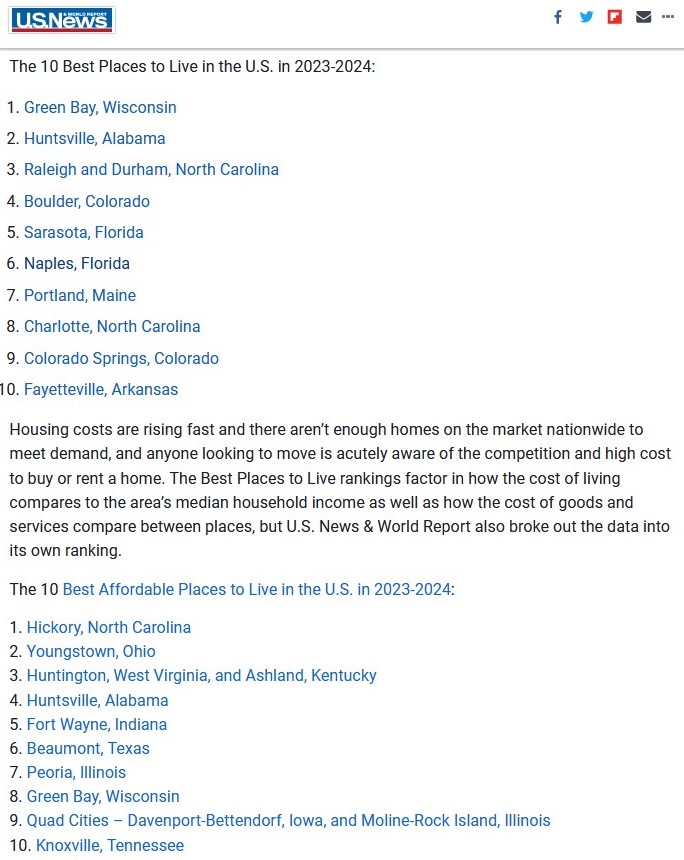
U.S. News & World Report just named Green Bay as the best city in the United States to live. One of the factors they account for is housing affordability. But, compare these lists:

There is not a lot of overlap in these top ten lists. Indeed, Green Bay is the only one on both. These lists tend to factor in affordability, but it is not the only factor that matters. Americans do not just move to places that are the most affordable.

US News uses these four categories in their methodology to find the Best Places to Live. This includes value/affordability but also reflects that people desire a certain set of economic and community opportunities:

Quality of Life Index – 36%

The Quality of Life Index measures how satisfied residents are with their daily lives in each ranked metro area, along with how affected the specific metro area is to life-impacting factors. To calculate Quality of Life scores, we evaluated multiple aspects of life in each metro area using a weighted average. To determine the weightings, we surveyed people across the U.S. to see the importance they place on each aspect evaluated in the index. The Quality of Life Index takes into account:…

Value Index – 23%

The Value Index measures how comfortably the average resident of each metro area can afford to live within their means. To accomplish this, we compared the median annual household income with the housing cost in each metro area (the Housing Affordability Index), along with a regional Price Parity Index created through data from the Bureau of Economic Analysis (BEA). The Value Index is determined by:…

Desirability Index – 22%

The Desirability Index measures whether people want to live in a given metro area. To determine this, we asked people from all over the U.S. where they’d prefer to live…

Job Market Index – 19%

The Job Market Index measures the strength of each metro area’s job market. To do this, we assessed the following two factors to determine how likely residents are to find employment in each metro area and their earning potential there:

Americans and/or those that regularly put together these lists like some level of affordability but their most desirable places have a particular status and quality of life.

Encourage more and more building in cities – and get more and more luxury apartments

Efforts to encourage more housing in big American cities can often lead to more units for the wealthy:

Photo by Kozymeii Kong on Pexels.com

Academics, developers and people in their 20s and 30s—particularly those most active on social media—have reached an unusual level of consensus. Their solution, supported by a wealth of scholarly research, is simple and elegant: Loosen regulations, such as zoning, and build more homes of any kind—cheap, modest and palatial…

Inconveniently for the Yimbys, Austin, like other cities, is still way more expensive than it was years ago, even though it’s built so many apartments. As a result, a small group of academics is starting to question the free-market path. These critics note that the market leads developers to build luxury housing on scarce and sought-after property to maximize the return on their investment. “Yimbys say, ‘We have to let the market build,’ ” says Benjamin Teresa, an urban planning scholar at Virginia Commonwealth University. “But what kind of housing are you building, and for whom?”…

But the very popularity of these places with the affluent drives up housing costs, making it harder for companies to find workers and pushing firms to relocate elsewhere. The Austin metro area, one of the fastest-growing in the US, with a population exceeding 2 million, has benefited from corporations fleeing the high cost of housing elsewhere, particularly on the east and west coasts of the US. Home of the University of Texas’ flagship campus, it’s lured Elon Musk’s Tesla, along with Oracle, from Silicon Valley. JPMorgan Chase and Charles Schwab are expanding there, too...

Frustration over rising rents has led cities to consider government interventions that were once deemed discredited. Boston, Orlando and Kingston, New York, have taken fresh looks at rent control, which had been blamed for distorting the market and raising the cost of other apartments.

If a builder or developer gets the green light to build housing, why would they choose to build cheaper units if they can build more expensive units and make more money?

As the article notes, perhaps this requires cities to see housing as not just a market good or something subject to market fluctuations. If housing is just another commodity that requires a big return on investment, why not go big in asking for expensive rates? Rent control or publicly subsidized housing may require more intervention, but they could also be necessary to provide any housing within the reach of residents with fewer resources.

Which cities are able to successfully buck these trends will be interesting to see. If policies become more explicit about affordable housing units, will developers push back publicly? Will an important city then see a downturn in building and investment?

Long Island resistance to a denser suburbia

Plans from New York’s governor to bring more housing to the suburbs is not being greeted with joy by some Long Island leaders and residents:

Photo by Thirdman on Pexels.com

In New York, one such proposal from Democratic Gov. Kathy Hochul has run into howls of opposition in one of the birthplaces of the American suburb. Critics on Long Island, a sprawling expanse of communities home to 2.9 million people, are denouncing provisions that would set growth targets, drive denser development near train stations and sometimes let state officials override local zoning decisions.

“Her plan would flood YOUR neighborhood with THOUSANDS of new apartments” reads one opposition mailing. Others warn Long Island would become New York City’s “sixth borough.” Critics, many of them Republican officials, claim it would strip away local control…

If municipalities don’t meet targets, developers could pursue a process in which the state could allow projects to go forward. Another provision would require localities to rezone areas within a half-mile of commuter rail stations unless the area already meets density requirements…

A counter proposal from the Senate’s Democratic conference included a more incentive-heavy housing plan that excludes mandatory requirements and overrides of local zoning.

Hochul and legislative Democrats were trying to resolve their differences in negotiations over the budget, which was due April 1. That deadline has been extended into at least next week. The governor has described housing costs as a “core issue” that needs to be addressed.

Affordable housing is badly needed in the New York City region, as well as many metropolitan regions throughout the United States. How to encourage or mandate housing construction is under consideration in multiple states. When suburbanites move to the suburbs in part because of local government and control, how much can a state override local zoning and land use decisions?

Even without state level mandates, there is at least some interest in denser suburbs. Some want “surban” places that combine suburban and city life. Thriving suburban downtowns can bring in money and boost a community’s status.

So what really is at threat here is the sanctity of the single-family home neighborhood and its housing values. This might be the most sacred of suburban settings.

Take Levittown as one example. If Levittown’s density significantly increases, it will mark another stage in the evolution of the paradigmatic suburb. It started with the mass construction of a limited number of floor plans, the community changed over time as residents added to and changed the residences, and the homes became more valuable. Could the Levittown of 50 years from now be marked by significant amounts of multifamily housing?

Trying to build more affordable housing, Hawaii edition

The housing situation in Hawaii has gotten worse:

Photo by Jess Loiterton on Pexels.com

The median price of a single-family home topped $1 million in most areas of Hawaii during the coronavirus pandemic and has declined only modestly since. The state has the fourth-highest per capita rate of homelessness in the nation after California, Vermont and Oregon. On Thursday, new data showed the islands experienced net population loss five of the last six years. In 2022, U.S. census data showed more Native Hawaiians live outside Hawaii than within.

Some of the action taken thus far:

In one of his first moves after taking office in January, Democratic Gov. Josh Green created a new housing czar to oversee the effort. One thing Chief Housing Officer Nani Medeiros is focused on is identifying roadblocks and redundant permitting at local and state levels that can hold up construction. The administration also wants to pour $1 billion into housing programs, including $450 million to subsidize the construction of affordable dwellings.

Lawmakers have sponsored bills to trim bureaucracy, fund public housing renovations and encourage construction of dense housing on state land next to Honolulu’s planned rail line…

Some moves to shore up affordable housing by easing development regulations are being met with trepidation by conservationists, who warn that going too far in that direction could endanger the islands’ world-famous ecosystems and farmland…

Currently, housing construction is not keeping up with demand. Only 1,000 to 2,000 new housing units are being built in Hawaii each year. Those numbers are dwarfed by the 50,000 new units a 2019 state-commissioned study estimated would be needed by 2025.

This sounds similar to addressing affordable housing in numerous United States locations: high prices, limited land, long wait times to approve projects and carry out construction, and concerns about expanding development. It sounds like there are concerns particular to Hawaii as well.

In the bigger picture, the United States would benefit from states, metropolitan regions, and/or cities that can solve some of these affordable housing issues. What is the best path forward, particularly in balancing the interests of property owners, those who want to preserve green space and habitats, and the needs for more cheaper housing? A successful blueprint, or even several, could go a long way.

Midwest leads the way in homes selling for under $250k in February

In a larger story about home prices falling in February, this graphic shows the percent of homes in each region sold in different price categories:

Only in the Midwest region are close to 50% of the homes sold at $250,000 or under. The Northeast is roughly at 33%, the South is roughly at 26%, and the West is roughly at 6%.

So does this mean there are more starter homes in the Midwest? Not necessarily. Perhaps this is linked to incomes in the region and less household wealth for people to spend on homes. Perhaps the housing stock of the homes is older and the homes need more rehab. Perhaps there is less demand for the homes due to slower population growth.

Still, the differences are stark. Could Midwestern states and communities advertise that they have cheaper housing? (Of course, an influx of residents could push housing prices up as has happened in certain locations throughout the United States.)

Who wants to fight “a holy war on sprawl”?

Multiple states are proposing ways to circumvent local control regarding land, zoning, and housing:

Photo by Mikhail Nilov on Pexels.com

In New York, the governor wants the state to mandate housing production from local governments and to take over control of their land use if they fail to meet the targets. In California, a bill introduced to the state Assembly on Thursday would require approval of multifamily housing developments in walkable, transit-accessible and centrally located areas.

On Wednesday, the Oregon Legislature passed a package of bills that would require cities to set housing development goals and appropriate $200 million for affordable housing development. Earlier this month, the Washington state Legislature approved a bill legalizing accessory dwelling units, also known as “granny flats,” like an apartment made from a garage or basement. And the Washington state House of Representatives passed a bill last Tuesday that would allow multifamily housing units to be built anywhere in larger cities and near bus stops in smaller towns.

The trend is not just happening in blue states. Montana’s Republican Gov. Greg Gianforte has proposed legalizing duplexes and triplexes all across the state and legalizing apartment buildings in all commercial areas. And the Oregon and Washington measures have drawn broad bipartisan support.

What does this add up to?

“We’re basically declaring a holy war on sprawl,” Matthew Lewis, communications director of California YIMBY, a pro-housing advocacy group that is backing the bill, told Yahoo News.

Such a declaration is unlikely to ease the minds of conservatives who fear efforts to limit local and individual control or increase density.

Is it possible to discuss sprawl and its effects in a civil manner? I suspect this is hard to do. It invokes passion on multiple sides. Is sprawl about having a piece of private land and achieving the American Dream? Is it a waste of resources and destroyer of natural ecosystems? Is it a unique feature of American life to accommodate single-family homes and cars?

As the article hints, there are likely long fights over such efforts. Where exactly is the line between local control and the broader interest of the public? Particularly in communities with money and political voice, the fight may drag on.

DuPage County Board to consider affordable housing

The DuPage County Board has plans to address affordable housing needs:

The creation of an ad hoc affordable housing committee was announced during Tuesday’s county board meeting and comes two weeks after the county board set aside $2.5 million to start an affordable housing solutions program.

“If you work in DuPage County, you should be able to live in DuPage County,” said Deborah Conroy, county board chairwoman, after announcing the committee…

The cost of land, officials said, often hinders affordable housing developments…

From 2018 to 2022, some 862 affordable rental units were built in DuPage County, Illinois Housing Development Authority Executive Director Kristin Faust told board members Tuesday. During that same time, 996 homebuyers purchased a home with a mortgage assisted by the housing authority, Faust said.

DuPage County is a relatively wealthy county. According to the Census Bureau, the median household income is $100,292, the poverty rate is 6.9%, and the median value of owner-occupied housing is $324,900.

Additionally, the County and the municipalities within it do not have a great history of pursuing affordable housing. In the postwar era, DuPage County did not build much public housing when it had funds to do so. Municipalities largely pursued housing aimed at white, middle-class and above residents. Affordable housing has been raised as an issue in the county since at least the 1970s. Newer efforts still aim their efforts at relatively well-off residents.

By not having sufficient affordable housing in DuPage County (or in the Chicago region as a whole), the County may struggle to grow, attract workers, and continue the quality of life that residents expect.