Local political slates: contrast “values” and “progress”

Local government races in many suburbs and small towns are non-partisan but this does not stop opposing groups of candidates from aligning themselves with particular ideas. See this example from Lake Zurich, Illinois:

The race for three seats on the Lake Zurich village board pits two slates with fairly disparate ideas about where the village should be headed and how to get there against each other. Among the key differences between LZ Values and Lake Zurich Progress is how to spur development in the struggling downtown.

Simple names but complex ideas. Presumably, one group wants to hold on to the best of what Lake Zurich is – the LZ Values slate – while the other has ideas about positive change for the community – Lake Zurich Progress. Local voters who are looking for help in who to vote for can just latch on to these ideas rather than the candidates themselves or particular policy positions. And this might be necessary when local turnout is so low (despite how Americans tend to value local government).

When the landlord for a single-family home is an institutional investor…

Alana Semuels explores what happens when you rent a house from an institutional investor:

I talked with tenants from 24 households who lived or still live in homes owned by single-family rental companies. I also reviewed 21 lawsuits against three such companies in Gwinnett County, a suburb of Atlanta devastated by the housing crash. The tenants claim that, far from bringing efficiency and ease to the rental market, their corporate landlords are focusing on short-term profits in order to please shareholders, at the expense of tenant happiness and even safety. Many of the families I spoke with feel stuck in homes they don’t own, while pleading with faraway companies to complete much-needed repairs—and wondering how they once again ended up on the losing end of a Wall Street real estate gamble…

As the industry started to grow, the major players all described their desire to standardize and improve the business of being a landlord. But even to the companies’ employees, the effort to become more efficient started to look more like craven attempts to squeeze tenants. “It shouldn’t be just about making money, but that’s what it turned into,” Shanell Hanson, who was a property administrator for Colony American Homes in an Atlanta suburb from 2014 to 2016, told me. Hanson said the company had six maintenance workers for 2,100 homes in the area she managed. Residents would frequently call with substantial problems: Sewage was overflowing, or the house was full of mold. But with such a small staff, Hanson could rarely deal with the problems quickly. And the law was on the corporations’ side: If tenants want to seek financial remedy for a landlord not keeping the property in adequate condition, under Georgia law, they have to take the landlord to court, a costly and lengthy process. “It’s almost impossible to do without an attorney,” Lindsey Siegel, an attorney at Atlanta Legal Aid who works on housing issues, told me…

Many other single-family landlord companies were cutting corners on maintenance and repairs. “As the corporation got bigger, it just got worse, in terms of what we had to work with and how we had to deal with problems,” a former Los Angeles leasing agent who worked for Waypoint between 2015 and 2017 told me. (She spoke on the condition of anonymity because she still works in real estate.) Regional teams received bonuses for keeping costs low, she said, which incentivized them to skimp on spending. Instead of responding to tenants personally, supervisors would send calls for maintenance to out-of-town call centers—which would in turn assign maintenance workers dozens of repairs in a day, not realizing that Los Angeles traffic could mean that relatively short distances could take hours to traverse…

Tenants also say that rather than taking advantage of economies of scale, the rental companies are taking advantage of their clients, pumping them for fines and fees at every turn. This impression is backed up by the financial reports of the companies themselves. American Homes 4 Rent increased the amount of money it collected from “tenant charge-backs” (essentially billing tenants for repairs after they move out) by more than 1000 percent between 2014 and 2018, according to company earnings reports, though it only grew the number of homes it owned by 70 percent over that period. In some states, Invitation Homes keeps the utilities in its name, and charges tenants a monthly $10.99 “utility service fee,” which is in addition to the cost of water, gas, and electricity. The company increased its “other property income”—the amount it collected from resident reimbursement for utilities, service charges, and other fees—by 114 percent between the first nine months of 2017 and the first nine months of 2018, despite only growing the number of homes it owned by 71 percent. On an earnings call in 2017, Invitation Homes’ then-CEO John Bartling said that “automated charges to residents” drove profits in the quarter, leading to a 22 percent increase in “other income.”

I wonder how much of these issues are due to overwhelming emphasis in the United States on homeownership rather than renting. Do large companies think they can do this to renters because the long-term goal is to sell the property for a large sum to a homeowner (or another investor)? Similarly, do renters put up with this for a longer period of time because they expect to leave the rental market? Or, perhaps in markets where renting is more common and more rental units are available, renters would leave these situations sooner and institutional investors would have to do more to keep renters?

I would also be interested in more information on the profitability of such companies. How lucrative is it to purchase thousands of homes? While Americans historically are opposed to government involvement in housing (unless it is subsidizing suburban single-family homes), stories like these seem like they could be used to justify more government intervention in regulating housing. But, what if regulations cut into profits? The housing industry is a large and profitable one.

Another angle to take here would be to examine how these institutional investors do or do not contribute to local communities. One justification of homeownership in the United States was that it gave owners a stake in their local community and government. Yet, much capital in the world today is global and real estate decisions made thousands of miles away could heavily influence smaller communities that look like – they are full of single-family homes – they are constructed to emphasize local control.

Deciding at which social level to counter a social problem

Once groups of Americans agree that an issue in society needs to be addressed, they encounter an important question: at what social level should we target our efforts? There are numerous options for many important issues. For example, see an earlier post about how efforts to fight smog in Los Angeles did not seriously address driving but rather pushed Detroit to create more efficient vehicles.

Two social institutions regularly come to mind when I think about how many Americans want to address social problems: schools and the federal government. Even as different sides might not agree which problems they think schools or the federal government should, the country has regular debates about how these institutions should be doing something different.

Start with schools. Because attendance is compulsory, children spend so much time there, learning may be the universally recognized need in a knowledge economy, and what is learned as a child can carry through a full lifetime, they seem like they are great places to address issues.

For similar reasons, it may appear prudent to operate at the level of the federal government Because it has broad oversight over the United States, it has the potential to shape numerous lives. Certain issues are so big and/or affect so many people that the federal government may seem to be the only way to adequately address a concern.

Both institutions are important in our society yet enacting change at these larger levels can be very difficult. Change brings a lot of attention. Politicians on all sides get involved. Those opposed to large-scale government action can be energized. Crafting one-size-fits-all policies is difficult.

What, then, are alternatives? Here are three common ways Americans go if they do not want to go large-scale:

Work through local or national voluntary associations. This can range from the local Rotary to religious congregations and a group of neighbors who get together to do something. With de Toqueville’s oft-repeated quote about the zeal with which Americans joined such groups, this option could offer hope (even as Americans are not participating in these like they did before – see Bowling Alone).

Voluntary associations benefit from the eagerness of their members to participate but Americans can also work through local governments which are always present. Americans tend to like smaller-scale government activity and oversight. Why get the federal government or the state involved when a city or community, township, or county could try to address the matter? For some issues, this social level may be too local – larger issues are hard to deal with one community at a time. At the same time, these smaller governments could try a variety of options and this can provide information on what might work at larger levels.

Finally, Americans can work through individual action. There is a reason that we celebrate certain notable individuals who worked tirelessly and successfully to fight for their convictions: it is rare to see such individual level success (and often, these famous figures benefited from organizations and support behind them). The actions of one person may typically not accomplish much but the aggregate actions of thousands or millions of people can add up or passionate individuals can help start movements.

All together, it is not easy to figure out which option might be the most effective in order to address important social problems. For many issues, it is likely that people are trying to find solutions at all of these levels: schools, the federal government, voluntary associations, local governments, and individual action. Actions at these various levels can occasionally intersect and enrich each other, helping provide energy for a broader movement or consensus. Indeed, truly finding solutions to social concerns likely requires broad action, even if the efforts began at just one of these social levels.

What it takes to run for local government positions in the Chicago suburbs

Getting elected to local suburban office may not require many votes but how do you become a candidate in the first place? A look at some of the steps in the Chicago suburbs:

Most suburbs — as well as school boards, library boards, fire district boards and park boards — require nominating papers to be filed from Dec. 10 to Dec. 17. A few towns like Elgin, Aurora and Naperville had early filing periods…

The number of signatures required to get on the ballot varies by race, the state board of elections says. For example, for library districts it’s at least 2 percent of the votes cast in the last election for library trustees, or 50, whichever is less. For nonpartisan village board positions it’s at least 1 percent, and for nonpartisan city council positions it’s a minimum of 5 percent of votes cast in the last election for those offices.

Candidates must file a statement of candidacy and a receipt showing they filed a statement of economic interest with the appropriate office (most will be with the county clerk’s office), Meyer said. The latter can be done online, but Meyer recommended first-time candidates do it in person. They can also sign a voluntary oath to the state constitution, he said…

Money is the biggest obstacle to running for office, said Audra Wilson, executive director of the League of Women Voters of Illinois. She estimated a strong campaign for a contested suburban city council or village board position could require close to $30,000. Direct mailers are the most significant cost, followed by hiring a campaign staff, she said.

File nominating papers, get signatures from local residents, file a statement of candidacy, gather money, and then run a winning campaign. And with the article suggesting “Just 31 percent of local races were contested in 2017 in Cook, DuPage, Kane and Lake counties,” it may be enough to just get on the ballot.

Based on these steps and numbers, does this suggest there are too many local government offices to fill? Even as Americans like local suburban governments, it may not be as effective if few suburbanites actually want to participate. Consolidating local government units – such as the push in Illinois to limit new governments and consider eliminating other units, albeit at a slow pace and some governments defend their existence – could address the issue but many wealthier suburbanites are probably unwilling to hand over control of their own communities to others.

The size, number, and color of disturbing McMansions in Napa Valley

New large homes in Napa Valley are causing some concerns for a variety of reasons:

“As though rising amid the St. Helena vineyards like a megalith” is how Zillow describes one home. It is 6,700 square feet and has 17 rooms, with such outdoor features as a pavilion, pool and tennis court.

Napa County Supervisor Diane Dillon said an area west of Highway 29 south of Rutherford pretty much looks like a subdivision of McMansions. Plus, the 5- to 10-acre parcels have the potential to be covered in patios and outdoor lights…

“The biggest threat to the valley isn’t wineries; it is the proliferation of mansions,” the APAC report stated…

One thing supervisors want to move quickly on is the color of large structures. Several noted that when the county demands earth tones, the result can be structures colored white – “white whales,” Dillon said some of her constituents call them.

Given the concerns here, I wonder why the County does not just make such guidelines for property that would not allow large homes. Instead, they are talking about various guidelines – how much of a property can be devoted to a home, the color of the home – to try to make the more palatable. If large homes are problems, why allow them?

There could be multiple reasons for this approach:

1. Looking extremely heavy-handed as a local government may not be desirable. In trying to find a balance between property rights and community goals or character, these local officials may not want to encroach too far on property owners.

2. It may be desirable to have wealthy residents on large properties. Perhaps this leads to more property tax revenues. Perhaps wealthy residents help enhance the status of the community. Perhaps big houses may have some problems but they are certainly preferable to small-lot subdivisions or multifamily units.

In the end, it sounds like the McMansions or mansions need to meet certain guidelines but limiting the total number of them might be the largest issue.

Township argument: don’t disband us because we only take a little of your money

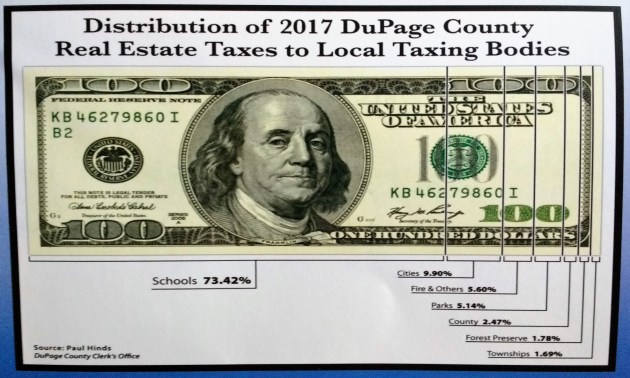
Continuing with local governments making interesting appeals to suburbanites, I received a newsletter from our township earlier this week. Illinois and DuPage County have had discussions about limiting taxing bodies and dissolving townships because of the state’s large number of taxing bodies. In response, the township put this graphic on the first page of the newsletter:

TownshipGraphic

While other parts of the newsletter described what the township does and how residents benefit, this graphic makes one argument: the township does not really ask for much so leave us alone.

In relative terms, this is a good argument: townships ask for the least amount of money. Even the Forest Preserve, a rather large one, asks for more money. On the other hand, given property values in the township, even 1.69% can add up to some decent money over the years. Plus, how does the money for townships compare to what residents get from the other taxing bodies?

On the whole, the quick appeal to property taxes hints at how suburbanites think: they do not want to pay more in taxes and want to be able to see how the money is being spent. I’m guessing relatively few DuPage County residents could detail what the townships do (compared to other taxing bodies) or connect the township activities to their property values.

The possible problems when governments buy dying or dead shopping malls

According to the Wall Street Journal, some local governments are purchasing shopping malls. With plenty of malls in trouble across the United States, this could be an opportunity for many municipalities. Yet, some problems could lie ahead:

  1. Some of this depends on the resources of the municipality. How many resources do they have to purchase the land and develop it? Does it require taking on debt? Would this debt outweigh the negative consequences of leaving the property vacant or leaving it in private hands? Communities with more resources to draw on have a leg-up in this process.
  2. Finding an acceptable use of the land can be a tricky process since the surrounding properties likely were developed under the assumption that the land would be a shopping center for a long time. Working out the zoning issues, particularly if residences are nearby, could prove tricky.
  3. Developing a plan for these sites is not necessarily easy and part of the reasons the malls are dying or dead is because of the attractiveness of the surrounding area to developers. Swapping out a mall for another thriving commercial use – such as entertainment – may be hard to do.
  4. Could this put communities on the hook for properties that are very hard to develop? It could be useful for local leaders to push the blame on developers or outsiders but it may not be so pleasant if the government is viewed as the reason the property is not improved. Such large properties could become albatrosses for local governments.
  5. Perhaps the simplest route for local governments would be to use the buildings or land for government purposes: park districts, schools, and other taxing bodies that do not always have easy access to large parcels. There might still be zoning issues to deal with and the loss of revenue could be tough. However, repurposing the retail space into space that the broader community could utilize could be a winner.

On the whole, there is a lot of potential for innovation when it comes to local governments and shopping malls. Yet, there are numerous ways this could go poorly for local governments, particularly those with limited resources.

Would limiting big money in city mayoral races help address low turnout?

An article at Citylab details efforts by some large American cities to limit big money in local mayoral races:

Several localities—including Portland, Denver, and Baltimore—have initiatives in motion to overhaul the system either by driving down the dollar amounts each person can give or solicit, piloting public financing projects that make each donated dollar go further, or both. The overarching goal is to keep big money and its influence out of local politics, and to give all candidates a fair shot.

In Denver, voters will decide on an expansive reform package, including a contribution cap and a generous matching fund. Baltimore’s city council has unanimously passed a charter amendment that would create a similar small-dollar matching system, if Mayor Catherine Pugh approves it and passes it along to the fall ballot. And before Portland, Oregon, phases in its own public financing measure in 2020, voters will decide on a strict local contribution cap this November…

Large political donors recognize that local races have national implications, and are willing to fund mayoral or city council candidates to build party power strategically. “At the state and local level, races historically have been far less expensive than federal races,” said Joanna Zdanys, counsel for the Brennan Center’s Democracy Program. But that also means, she says, “given the low cost of state and local races, a big expenditure by a deep-pocketed, special-interest spender has the potential to really overwhelm a candidate.”

And potential city leaders, in turn, are hiring national media consultants who recommend large budgets and high spending. Local campaigns have become more professional, with sleek campaign mailers and digital or TV ad spots.

I wonder how this goal of making mayoral races more open fits with limited turnout for local elections in many American communities.

The 2015 mayoral election in Denver had a total of 94,525 votes cast. The total population is near 700,000.

The 2016 mayoral election in Portland had a total of 193,083 votes cast. The total population is over 600,000.

The 2016 mayoral election in Baltimore had a total of 222,593 votes cast. In contrast, the 2011 mayoral election had a total of 46,223 votes cast. The total population is over 610,000.

Does big money suppress voter turnout? I could see how a case would be made for this: the introduction of big money behind one candidate makes it appear as if the outcome is a slam dunk.

Or, is the issue of voter turnout one that will continue to linger even if money is more evenly distributed across candidates? For a variety of reasons, many municipal officials are elected to office with a relatively low level of support from all of the voter-eligible citizens. Considering the influence big-city mayors can have, this seems strange, particularly since Americans tend to favor local government.

Living in, working in, and guiding Naperville for over 70 years

Long-time Naperville mayor George Pradel’s work in the suburb spanned tremendous change in the suburb:

When Naperville was a mid-sized suburb, beginning to outgrow its small-town roots but maintaining a family-friendly feel, Pradel was a police officer. He joined the force in 1966 and made his top priority children, teaching them to stay safe and letting them know someone was watching out for them. His actions made him Officer Friendly before he even took on the title as his nickname.

When Naperville was a growing city, expanding as developers turned farm fields into sprawling subdivisions, Pradel was a mayor. An unlikely mayor at that — the faithful, cheerful cop never intended to take on the role…

He became mayor because a handful of residents asked him to seek the seat, and Pradel never did master the art of tactfully saying “no.” With only a concession speech prepared, he won his first election in 1995, defeating a two-term city council member who worked in human resources for DuPage County. The newly minted mayor took office that spring. His hometown pride never ceased.

Born in Hyde Park on Sept. 5, 1937, as one of six children, Pradel was 2 when his family moved to a small house on Van Buren Avenue in Naperville. He always called it home.

When Pradel’s family first moved to Naperville in 1939, the community had just over 5,000 residents. When he joined the police force in 1966, the population was still short of 20,000. As a new mayor, the population was around 100,000. When his mayoral tenure ended, the city had over 142,000 residents. This is tremendous population change over one lifetime.

I wonder if a vocal and enthusiastic figure like Pradel helped ease the transition from small town to large suburb. Significant growth can change how residents feel about the community and their neighbors. Who are these newcomers? Do we have to build so many new schools? Where are all the locally-owned businesses? Why is the traffic so bad as I try to get across town? Naperville still tries to claim to be a small-town at heart and having a central popular figure to focus on could help.

How much influence mayors have in sizable communities is difficult to pin down exactly. Pradel will certainly be remembered for the length of his service as well as his efforts to boost the community. Might someone of a different temperament accomplished other things? Was Naperville already well on its way to what it is today when Pradel took office? How much did spending his formative years in the small town affect his later efforts? Regardless of the answers, it is hard to imagine there are many small children in Naperville today who will stay in the community for just as long or many who will see such change as Pradel witnessed.

Why Americans love suburbs #6: local government, local control

One of the unique features of the government of the United States is a federal system that distributes power between the federal government and more local bodies. Even if the federal government has grown dramatically in the last century, the suburbs offer residents a relatively small and responsive local government. Americans claim to prefer small town life and in such communities the distance between average resident and local leaders is reduced.

If the suburbs at their heart are about single-family homes and family life, a small local government can help protect the quality of life in the community. Local governments can exclude certain kinds of development. This then affects what kinds of residents can live in suburbs. See exclusionary zoning cases in DuPage County and Westchester County, two notoriously wealthy suburban counties, or more recent cases of religious groups facing opposition such as Muslims and Orthodox Jews in New Jersey. Homeowners can directly see and respond to how their tax dollars are spent. They may not like high property taxes (whether in the 1970s in southern California or more recently in northern Virginia) or decisions about TIF funds or but at least that money is spent in the community rather than shipped off to other centers of power. They may fight with each other about whether to raise local taxes for schools or fund regional transit initiatives or support affordable housing but at least they may know those they are arguing with and everyone does want their community to be attractive. Suburbanites are resistant to outsiders telling them what they should be doing, whether they are concerned about the federal government pushing denser housing (and perhaps even the UN) or state or court mandates about affordable housing (such as requirements passed in 2004 in Illinois or requirements in New Jersey due to the Mt. Laurel decisions).

While suburbanites may believe they have more access to suburban governments, these elected and appointed officials can have a significant impact on suburban development. The growth machine theory suggests local officials and business people push and pursue development because there is money to be made. Suburban growth is good because it can generate profits and it adds prestige. The growth has to end at some point (see cases like Naperville and Aurora) but officials, with some input from residents, can push suburbs in certain directions. Not all suburbs will make the same decisions about what to do with open land or with their downtowns but local leaders get to make these decisions that then influence residents decades later.

Local control then means that suburban communities can have distinct characters. While critics may suggest suburbia is an endless sprawling mass with very porous boundaries, local governments and development decisions alongside public involvement and civic projects can lead to long-standing and fiercely defended local understandings. The most typical image of an American suburb – bedroom community with postwar subdivisions filled with similar-looking homes – may not actually fit many suburbs in terms of appearance or perceived experience.

How exactly local decision-makers and suburban officials come into office can differ across locales. Voter turnout is low in many local elections so it may not take much effort to become a local official. On the other hand, local politics can sometimes turn very contentious because of particular significant issues or long-standing political factions. Americans tend to be more optimistic about their local conditions than about the country as a whole so suburban officials who do a decent job can retain their positions for a long time. Furthermore, suburbanites may be less interested in efficiencies across local governments, such as combining small police departments, compared to having their own local bodies.

Another aspect of this local control involves less democracy: the rise of homeowner’s associations. A good number of suburbanites are willing to turn over some decisions about their property and neighborhood to a board or management company that will ensure certain standards are upheld. Again, the distance between the average HOA homeowner and board is small; boards often need more people to volunteer to serve and neighborhood meetings allow homeowners to express concerns.

Of course, there are problems among suburban local government. They may not have the resources or expertise to deal with complicated issues (such as providing social services to address suburban poverty). There can be too many smaller units that have their own bureaucracies and abilities to tax residents (see Illinois as an example with numerous taxing bodies and debates about eliminating townships). Local officials can be corrupt (Cicero), incompetent (Harvey), or follow their own paths while remaining impervious to other opinions (Rosemont). Yet, many Americans might argue that even these problematic aspects of suburban governments are relatively easy to deal with compared to the behemoth in Washington.