Offices along I-88 helped Naperville become a boomburb; current mayor says they are ripe for redevelopment

What might the parts of Naperville along I-88 look like in the future? The current mayor has some thoughts:

Photo by Markus Spiske on Pexels.com

“There is no doubt that the I-88 corridor will be the largest and most significant redevelopment opportunity in our city’s history,” Wehrli said.

A new study calls the corridor the only “opportunity area” of its scale left in the city. Much of the corridor in Naperville — once known as its “Innovation Corridor” — was developed with single-use, low-density office space and is underused and “underperforming relative to its potential,” according to the report by AECOM, a consultant hired by the Naperville Development Partnership.

“Nearly half of the city’s existing jobs are located in the corridor, which the report noted was an ideal location for certain high-growth industries,” Wehrli said. “Sectors like: ag and food tech, biotech, pharma, life science, energy, fintech, quantum and advanced computing, tourism, sports and hospitality.”…

Among its recommendations, the study suggests developing a new corridor brand identity and creating a special zoning district along I-88 that would allow for a more dense, mixed-use, pedestrian- and transit-friendly environment.

“The study sets aspirational goals that add 15,000 high-paying jobs in the corridor by 2045 if we target these industries,” Wehrli told a business-friendly audience.

Three features of this report strike me:

  1. The emphasis on quality jobs is not a surprise. The jobs that came in the 1960s with Bell Labs and then other companies helped provide Naperville with a solid jobs base and a higher status. For a community that is used to having these jobs, it sounds like they want more of the same.
  2. The mention of mixed-use development is intriguing. Naperville has limited the amount of housing in this corridor in the past. How much housing would they allow? What residents are they hoping to attract? How many large-scale mixed-use developments do they think the corridor can handle?
  3. There is mention of zoning and branding unity that would be more “pedestrian- and transit-friendly.” Could this become a kind of linear neighborhood linked by mass transit and walking/biking paths? For decades the corridor was marked by proximity to a busy interstate that grew from two lanes in each direction in the late 1950s to four or more lanes each direction today. Could these new developments have significant connections to each other that go beyond cars and driving?

Suburb without a traditional downtown to replace shopping mall with mixed-use development

A Chicago area suburb with a dying shopping mall and no traditional downtown hopes to convert the mall into a thriving mixed-use space:

Photo by Life Of Pix on Pexels.com

Golf Mill Shopping Center opened in 1960 as an open-air mall. Later, it was enclosed, and the iconic Mill Run Playhouse was built on the grounds. The theater, before it closed in 1984, hosted acts such as Chicago native Shecky Greene and Frank Sinatra.

Today, the mall has more than 1 million square feet of leasable space in addition to a nine-story office tower. Target and JCPenney are two of its biggest anchors, alongside AMC Theatres, Ulta, Burlington and Ross…

Alpogianis and other city officials see the future of the 80-acre site as “live, work, play” — an increasingly popular phrase for mixed-use developments that have virtually everything a resident could need on site. The Golf Mill Shopping Center redevelopment — to be called Golf Mill Town Center — will aim to be one of Niles’ premier destinations in the absence of a traditional downtown.

The first phase of redevelopment will include an overhaul of the mall’s retail, along with new luxury apartments and restaurants, Alpogianis said.

He said the project will be 70% retail and entertainment and 30% residential and other uses — the latter of which includes the “very good” possibility of a hotel and office, depending on market conditions.

The shopping mall redevelopment described here is common these days: add housing, restaurants, and different retail options to what was a mall with declining activity and revenue. The goal is more of a 24 hour a day place where a combination of residential, commercial, and recreational activity makes it more like a lively neighborhood.

What struck me here was the idea that such a redevelopment could help address a different issue in the suburb: no traditional downtown. In the Chicago area, such a downtown would typically be located along a railroad line connecting suburbs to downtown. Niles is more of in-between two railroad lines and the community had a small population until a population explosion in the 1950s (over 400% growth).

While the shopping mall is often viewed as a postwar substitute for public space, could all of these mall redevelopments lead to new suburban downtowns? The mixed-use developments are often intended to be more walkable, at least to the new residents who live there, and provide social spaces. Whether this actually happens is another matter; will the redeveloped malls be connected to a larger walkable grid in suburbia? Will people still need to drive to the redevelopment? Once people are living on site, how many will regularly make use of the nearby amenities as opposed to driving elsewhere?

The shopping mall may come and go in many suburbs but the quest for something like a downtown may continue.

Build it – the residential and commercial development around a suburban football stadium – and they will profit?

What if the new football stadium is less of a draw in the long run than the development right around the stadium? Here is one report about what has changed in Glendale, Arizona, home to today’s Super Bowl, where the stadium opened in 2006:

Photo by Pixabay on Pexels.com

Far out? The site of Sunday’s Super Bowl is about 13 miles northwest of downtown Phoenix. Arlington Heights is about 30 miles northwest of downtown Chicago.

The distance is less of an issue than it was when State Farm Stadium was built, said Kevin Phelps, Glendale’s city manager. Some projections show that two out of three newcomers to the Phoenix area will live in the West Valley…

The last time Glendale hosted a Super Bowl, it had about 800 hotel rooms near the stadium. By next year, that number will be 3,000. The city has found that most people spend money on dinner and shopping within two miles of their hotel. But a new development has to deliver.

“You have to have a ‘there’ there,” Phelps said. “I don’t care how good your advertising is. If we told everyone to come to Glendale and they got here and there was an ice cream shop and a Denny’s and that’s all there is, you’d never get them back again.”

Just having a superb stadium experience is not enough. The stadium can anchor a larger entertainment district where people come for a variety of events, enjoy food and other experiences, and are willing to spend a few nights or a long day. The real activity and money is in the year-round potential of the property that at the center has a recognizable stadium but also has enough to attract people when there is not a big game.

Still, the more important question is this: who benefits from the new development? Does the suburb of Glendale? Do its residents? Or, does this primarily enrich the team owners who see the value of their franchise increase?

Sports teams want the state-of-the-art stadium – and all of the nearby mixed-use development – to profit

The conceptual plans released earlier this week from the Chicago Bears about what they might construct in Arlington Heights follows a recent trend: sports teams are interested in stadiums and all the other development around those facilities.

Photo by Mikael Blomkvist on Pexels.com

The plans revealed Tuesday by the Bears call for a multipurpose entertainment district anchored by a stadium that could host the Super Bowl, college football playoffs and college basketball Final Four, with an adjoining commercial/retail and housing district. While cautioning that the long-term vision for the entire property is a work in progress, the team said the site could include restaurants, offices, a hotel, fitness center, parks and open spaces.

The team’s open letter provided a series of economic projections, saying the large-scale redevelopment would provide “considerable” economic benefits to Cook County, the region and state.

For instance, construction would create more than 48,000 jobs, result in $9.4 billion in economic impact in the region, and provide $3.9 billion in labor income to workers, the team said.

The development would generate $16 million in annual tax revenue for the village, $9.8 million for the county and $51.3 million for the state, according to the Bears.

Yes, a stadium is necessary for football but teams now want to develop more land and generate additional revenues adjacent to the sports playing surface. If they help generate such development and/or retain an ownership stake in the surrounding development, this can both bring in significant annual revenue and further boost the value of their franchise.

This also follows on-trend development ideas where a mixed-use property helps ensure a regular flow of activity. Instead of separating land uses in different places, putting them all together can create synergy and additional revenues.

Another way to think about it is that a lot of sports teams are in the land development business. How exactly this fits with a goal of fielding a winning team might get complicated.

McMansions as part of or outside of a changing suburbia?

This description of the changing American suburbs includes McMansions:

Photo by Jeswin Thomas on Pexels.com

The demand for something like urban living is real. Even at the outer edges of growing metro areas, mixed-use walkable developments pop up alongside familiar subdivisions and McMansions. “Mixed-use centers—often in suburban locations—continue to be built from the ground up in many communities across the US,” wrote the Congress for the New Urbanism in 2019.

As more immigrants and millennials become suburbanites, and as Covid and remote work give the suburbs another growth spurt, they are evolving into something different. Between 2019 and 2020, the share of millennials who live in suburbs increased by 4 percentage points; and in 2014, more than 60 percent of immigrants lived in suburbs, up from just over half in 2000.

Many communities that were once white, exclusionary, and car-dependent are today diverse and evolving places, still distinct from the big city but just as distinct from their own “first draft” more than a half-century ago…

If a “second draft” of the suburbs is now being written — at least in some of America’s growing and expensive metro areas — what might it actually look like?

This is part of the complex suburbia we have today. Where do McMansions fit into this? The selection above suggests “mixed-use walkable developments” are near McMansions. But, what happens to the McMansions in the long run? Here are a few options:

  1. The McMansions continue in their neighborhoods for those that want them. Even amid proclamations that McMansions are dead, there are some homebuyers and suburbanites that want such homes.
  2. McMansions themselves are altered in ways to fit the new landscape. Perhaps they are subdivided into multiple units for more affordable housing. They could be added to. Their properties could host accessory dwelling units.
  3. McMansions are demolished and replaced with something else. This could be because the quality of the homes does not stand the test of time or the land is more valuable used another way (some of the teardowns become teardowns).
  4. Some McMansions live on through historic preservation marking a particular era of housing and American life.

For some, McMansions represent the peak of an undesirable suburban sprawl and excess. For others, they are homes that provide a lot for a decent price. Their long-term fate is to be determined both by those who like them and those who detest them as the suburbs continue to change.

How many suburbs will be willing to replace suburban office parks with denser housing?

If the golden age of the suburban office park has passed, what will some of the empty properties be used for? One option is denser housing:

Photo by Pixabay on Pexels.com

It will mean taking land long zoned for offices, and allowing townhomes to be built among them, or permitting apartments or industrial-scale warehouses for the first time. Amid a nationwide housing crisis, many obsolete office parks could be ideal sites for denser housing.

However, this is a very pertinent issue:

The problem for some suburban officials: “It’ll be, ‘Oh, what do you mean we can’t just zone for single-family homes and offices? That’s our thing. That’s why we exist,’” said Tracy Hadden Loh, a researcher at the Brookings Institution. “So now it’s like an existential crisis.”

This is an issue that comes up for numerous kinds of large suburban properties, whether they are shopping malls, golf courses, or grocery stores: how to convert a vacant property into a useful long-term use? The number one goal is probably to generate significant property tax and sales tax revenue. In other words, to keep it at its original as approved by the community years before.

But, if that is not possible – and communities might go years trying to fulfill this vision – then the discussions get interesting. Expensive single-family homes, fitting with the upscale suburban character of some suburbs, would fit in. Zoning protects single-family homes for a reason: suburbanites and suburban communities prefer these homes and their lifestyle.

However, single-family homes can bring more children to local schools and add to the loads of local services. They do not necessarily produce the revenues that offices and retail do. Denser housing is even less desirable because it adds even more residents, which can add to community services and traffic, and some suburbanites are concerned with apartment dwellers.

My guess is that mixed-use redevelopment will be a popular path a number of these communities will try to pursue. Replace that office park with a “metroburb.” But, it remains to be seen how many such developments are viable and how eager suburban leaders and residents are to pursue them.

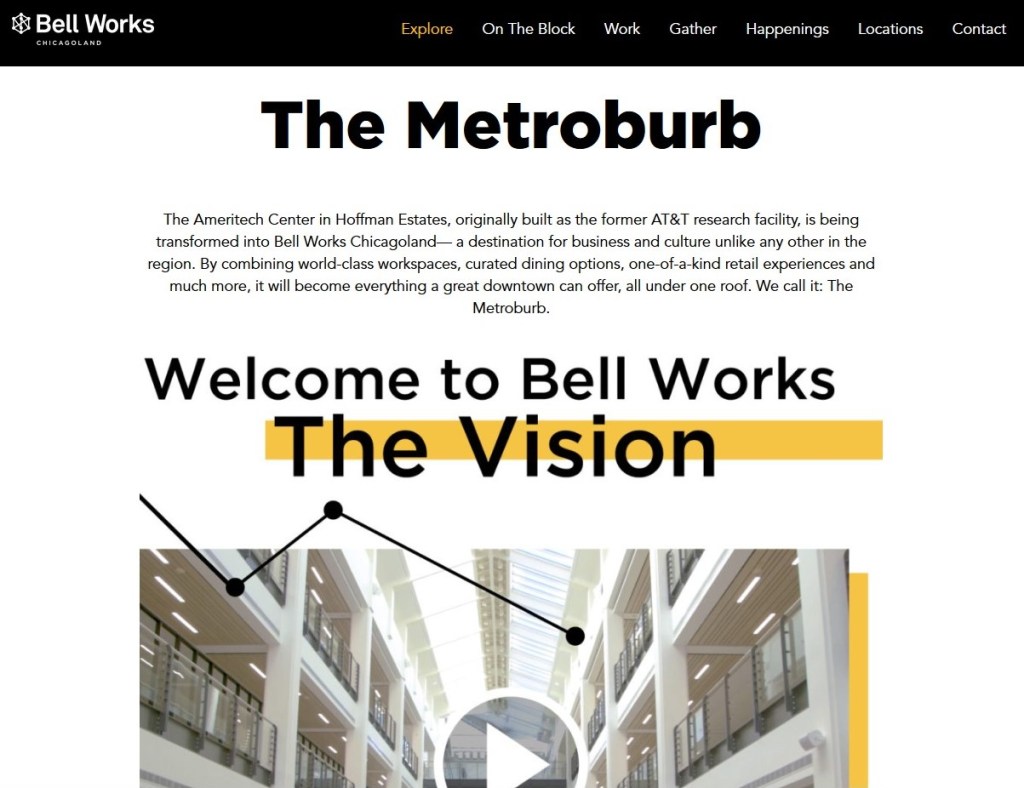
“Welcome to the Metroburb” in the NW Chicago suburbs

This week I heard a radio ad saying “Welcome to the Metroburb.” Here is more on this new development outside of Chicago:

Chicago area suburbs advertising their communities is not unusual; see examples here and here. Far less common are new suburban developments making broad appeals in mass media. This project has been in the works for a while now – see an earlier post – and it is on an intriguing site as Bell Labs was important for the Chicago region (read more about the effects on local development of their Naperville facility) and the country as a whole.

If you ran a business or were searching for a residence or wanted to be part of an interesting scene, would this ad or website persuade you? This is a unique development and a large one. Suburbs around the United States are looking to fill empty suburban headquarters, denser suburban areas are popular, and standing out in a crowded suburban landscape can be difficult.

Interestingly, there is also a partner project involving the former Bell Labs facility in Holmdel, New Jersey.

Facebook proposing sizable mixed use development for itself and the public near its HQ

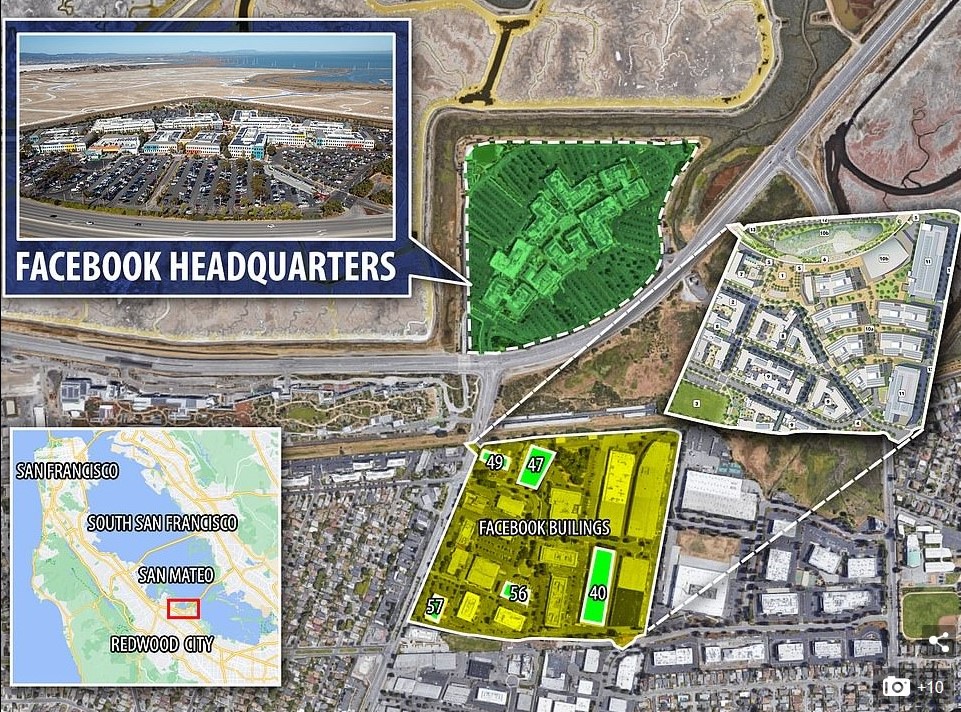
Next to its big headquarters, Facebook wants to construct over 1,700 apartments, 200,000 feet of retail space, and over 1 million square feet of office space:

The most recent plans, which were updated in May, show the development will be built where a single-use industrial and warehouse complex currently stands…

It will feature 1,729 apartments, including about 320 that will be affordable housing and up to 120 units designated for senior housing…

The plans for the new city also feature a supermarket, pharmacy, cafes and restaurants and a 193-room hotel.

The 200,000 square feet of planned retail space will be built around a 1.5-acre town square.

Separate to the town square will be a four-acre public park, a two-acre elevated park similar to New York City’s High Line and other public open spaces.

In addition to the housing and retail spaces, Facebook also plans to have 1.25 million square feet of new office, meeting and conference room space for the social media company.

There are multiple interesting elements of this proposal:

  1. This has numerous benefits for Facebook. It will have new office space built to its specifications. It will have some housing space for workers. It worked with the municipality to make changes.
  2. All of this happening in the aftermath of COVID-19 where it is not entirely clear how many workers will return to the office. Adding this amount of office space suggests Facebook thinks it – or some other firm – can use the space.
  3. This kind of mixed-use development is popular in many places. For example, New Urbanists promote such developments for their numerous advantages. Is Facebook explicitly building on this line of reasoning or does it have other reasons for this kind of development?
  4. Once the land is developed in this way, what role will Facebook play moving forward in overseeing the space? This will be an ongoing tension between the company, residents, and the municipality.
  5. This is an expensive area in which to develop land. Facebook has the resources to pull this off when others could not. In the long run, will this viewed as a net gain for the larger community or is it best for the company?

Since the project is under review by Menlo Park, it will be interesting to see how this continues to play out.

Baseball teams going with smaller stadiums, more mixed-use development

As fewer fans may be willing to go to baseball games, teams are moving toward focusing on development around the stadium:

The Atlanta Braves and Texas Rangers, leaning significantly on public funding that came without taxpayer referendums, ditched parks built in the 1990s for smaller digs framed by the game’s new revenue engine – mixed-use developments at least partially controlled by the team. The Braves are in their third season at SunTrust Park (capacity, 41,000, replacing Turner Field’s 53,000) while the Rangers in 2020 will open Globe Life Field, a retractable-roof facility that will seat 40,000 compared to its predecessor’s 49,000-seat capacity…

For the Diamondbacks, A’s and perhaps a significant number of clubs that may replace – or revamp – their Camden Yards-era parks, finding the sweet spot of atmosphere, accessibility and inclusion will be paramount in a sport with an aging and occasionally alienated fan base.

The primary focus of the article is on how teams are trying to attract more fans to altered ballparks that offer a more exciting in-game experience. But, I find the passage above more interesting: as fans become fickle regarding attendance, the big long-term money may just be in the real estate surrounding the park. Even at high levels of attendance, a sports stadium only generates revenue a certain number of dates a year. Baseball has a lot more dates than football but the stadium still sits empty for more than 75% of the year.

Many teams and park owners have already shifted toward stadiums as concert venues as well as homes to other sports in the off-season. But, imagine the sports stadium more like an exciting shopping mall where people come to hang out in an exciting and safe space and they consume. Just like the shopping mall that features food, entertainment, and retail, the stadium could become a year-round home for entertainment, food, and shopping that has a great draw at the center: a professional sports team that happens to play there for part of the year.

One piece that may be missing from a number of ballparks as well as shopping malls: adding residential units near the facility could help boost the customer base and create a neighborhood feel. A number of stadiums are surrounded by parking lots. At least a few are located right next to other stadiums of professional teams so the stadiums can share parking lots. Instead, imagine apartments and condos right near stadiums: some residents would be excited to live right near the energy of a stadium and these residents also would partake of local businesses. This does not have to look like the neighborhood around Wrigley Field but there is certainly a lot of room for more neighborhoods to generate revenues for tams long after the games are over.

And then there can be conversations about whether public money should be used to finance real estate development in addition to sports stadiums. Do communities benefit from mixed-use developments around stadiums or does the money line the pockets of owners?

Rethink Rezoning, Save Main responses share similar concerns – Part One

The suburb in which I live and the neighboring suburb both have proposed redevelopment ideas and each has attracted opposition from residents. Both sets of opposition have yard signs to voice their displeasure and residents have spoken at public meetings.

Part One of this analysis involves the basics of the proposed projects and how this fits into what suburbs generally try to do.

The Rethink Rezoning group is responding to a study commissioned by the city of Wheaton to improve development along the busy Roosevelt Road corridor that runs east-west through the center of the suburb. From the Daily Herald:

Wheaton’s East Roosevelt Road corridor has a hodgepodge of businesses and housing, obsolete office space and no consistent sidewalk network that encourages pedestrians to walk from one end of the nearly 2-mile stretch to the other…

Consultants propose a “Horizontal Mixed-Use Zone” from Carlton Avenue to West Street/Warrenville Road, currently a mix of low-intensity offices, houses and residential structures adapted into offices. In that subdistrict, the city should expand the palette of permitted land uses, including limited retail and “personal service establishments,” the report states.

Farther east, a “Commercial Core Zone” between West and President streets could concentrate new development of significant size — greater than anywhere else along the corridor — taking advantaging of proximity to the downtown and the Mariano’s grocery store. The Mariano’s intersection has traffic congestion when cars queuing up in the west turn-lane from Naperville Road to Roosevelt.

A “Mixed-Use Flexible Zone” from President to Lorraine Road “should encourage a broad range of uses, including retail, service, office and multifamily residential,” according to the report.

See a more complete draft report from earlier this year.

The Save Main group is opposed to a mixed-use five-story building to be built on the southern edge of Glen Ellyn’s downtown. Here is a 2018 description from the Daily Herald:

A new redevelopment plan for an old shoe store in downtown Glen Ellyn would replace the long-vacant building with an apartment complex that would rise above neighboring restaurants and shops…

Larry Debb and John Kosich are the two principals for the project that would demolish the Giesche store to make room for a five-story apartment building with about 5,360 square feet of first-floor commercial space. The footprint would include what is now the village-owned Main Street parking lot…

But in a letter to village planners, Kosich and Debb said they’re proposing a “condo quality” building with 107 rental units. A two-level parking garage would provide 147 public parking stalls on the first floor, with access off Main Street, Hillside Avenue and Glenwood Avenue. The garage’s second floor — reserved for apartment residents — would contain 142 stalls…

Such a mixed-use development with parking would align with the village’s 2001 comprehensive plan and 2009 downtown strategic plan, Hulseberg said. The latter recommends the village add at least 450 new residential units downtown.

Neither of these projects are unusual for suburban communities. Indeed, they both attempt to take advantage of unique traits already in the suburb.

In Wheaton, the Roosevelt Road corridor has been an area of interest for the city for decades. With tens of thousands of cars passing through each day, it presents an opportunity, particularly since it is just south of the downtown (and traffic does not necessarily turn off Roosevelt to go downtown) and north of the other major shopping area at Danada (along the busy Butterfield Road corridor). But, Wheaton has generally been conservative about what development they allow along this stretch. Compared to Glen Ellyn to the east or the Ogden Avenue corridor in northwest Naperville, the Roosevelt Road stretch in Wheaton is relatively void of strip malls, fast food restaurants, car repair places, and rundown facilities. Again: this has been an intentional effort to maintain a certain level of quality.

The proposed changes would build on this by updating some uses (most suburbs utilize single-use zoning but this can be restrictive in certain areas) and try to encourage some cohesiveness across stretches. What is now a hodgepodge of offices, some older houses, some more recent office buildings, could have a more uniform character and present a more pleasing aesthetic. I don’t know how many people will walk along such a busy road but it certainly does not lend itself to that now. All of this could help improve aesthetics and bring in more revenue from taxes in a revitalized district. Having a more uniform plan could help bring in more money for the city which then helps relieve local tax burdens.

In Glen Ellyn, such a project both fits with the village’s own goals and echoes what numerous suburbs in the Chicago region have tried to do: encourage mixed-use buildings in downtown areas near train stations and existing restaurants and shops. This new project would add to a fairly lively restaurant and retail scene while also adding more residents (and probably wealthier ones – this is not about suburban “affordable housing”) to a suburb that has little greenfield or infill development available. The new residents would patronize local businesses, utilize the train, and contribute to a density that could make the downtown even livelier. Again, one of the benefits would be increased tax revenues: the vacant property would have a more profitable use, the first-floor businesses would add sales tax monies, and the new residents who probably have limited numbers of children would bring in tax dollars.

If these projects are in line with suburban plans – let alone the long-term plans for each community – what are the residents objecting to? More on that in Part Two tomorrow.