Chicago to test ADUs: coach houses, attic and basement apartments

With housing issues in the city and region, Chicago is testing out several ways property owners can convert parts of their property into residences:

Photo by Anna Shvets on Pexels.com

Coach houses – stand-alone housing structures sometimes built above garages and sometimes referred to as “granny flats” – were once prevalent in Chicago, but changes in zoning and parking requirements caused their construction to be banned in 1957. In December, the Chicago City Council re-legalized coach houses and apartment units in basements and attics, passing the Affordable Dwelling Units Ordinance. The ordinance took effect May 1, and the city is now accepting applications.

The five pilot areas cover much of the city, with zones in the north, northwest, west, south, and southeast areas of Chicago. After a three-year evaluation period in these pilot zones, the city will decide whether to make the ordinance citywide policy…

For properties planning to construct two or more additional dwelling units, every other unit must be affordable housing.

This opens up new opportunities both for property owners and those searching for housing. For landlords, they can gain more income, house family members, or create new space on their property that people could live in later. For those needing housing, these are likely smaller spaces that could provide dwellings in residential neighborhoods and possibly help keep such housing more affordable with more units available.

But, how many of these units will be created? Property owners might not like the idea of someone living so close to them. It takes money to create these units. The density of residential neighborhoods is important to many single-family home owners; they often want more space. Does this create more demand for parking and vehicles? Could this lead to tension on a block if some want to add units and neighbors are not as bullish on the prospects?

Furthermore, do these efforts continue to concentrate wealth and opportunities in the hands of particular land owners who can afford to create and rent units? Will this truly lead to more cheap housing or will certain neighborhoods have more of these units at higher prices?

Touring the most expensive American homes on YouTube

There is an appetite for seeing the homes of the rich and famous. See the popularity of showing these homes on YouTube:

Photo by Pixabay on Pexels.com

Mr. Yilmazer, 31, isn’t a wealthy buyer, nor is he currently a real-estate agent. Rather, he is one of a handful of real-estate YouTubers, amateur video hosts and producers, who are bringing regular people, via their laptops or cellphones, inside the mansions of the megarich. With more than 820,000 subscribers on his YouTube channel, Mr. Yilmazer’s videos rack up millions of views and inspire tens of thousands of comments…

In some ways, real-estate YouTubers like Mr. Yilmazer are providing today’s answer to the MTV Cribs phenomenon of the early 2000s, offering the masses a rare glimpse at how the 0.1% really live. But rather than getting a peak through the eyes of a movie star or a suave celebrity real-estate agent, like on shows such as Bravo’s “Million Dollar Listing,” they’re seeing these houses through the eyes of a regular guy just like them…

Mr. Yilmazer said he is bringing in between $50,000 and $100,000 a month in revenue from his YouTube channel in ad revenue alone, putting him on track to bring in more than $1 million this year if the growth of his channel continues at its current pace. Those are just the revenues provided by YouTube for allowing their automated ads to stream on the channel without any effort from Mr. Yilmazer’s own small team. On top of that, he and his team can make money from dedicated sponsorships—Mr. Yilmazer will personally feature a particular company’s brand in his videos for a fee that runs in the tens of thousands of dollars—and the money real-estate agents offer him to feature their listings on his channel. He said he often won’t charge if a property is particularly spectacular and will drive viewership to his channel. If a property is less impressive, he charges a fee, which typically runs into the five figures…

Still, not everyone is sold on letting YouTubers have free rein in their properties, since some agents believe that prospective buyers would prefer that their future homes not be splashed all over the internet.

It is the Internet, expensive real estate, and making money all in one. What could more American than that in 2021?

The money angle is very interesting to consider. The owner of the big expensive home could benefit from more exposure (though the article notes that not all big home owners think the YouTube views benefits them). YouTube gets original content that plenty of viewers want and they can monetize the content through advertising. The presenter can develop a brand and bring in a good income. Does anyone lose here?

One potential downside: how Americans view homes. If people consistently see large luxurious homes on television, as sociologist Juliet Schor argues in The Overspent American, or on social media, does this ratchet up their expectations about what they should be able to acquire? The biggest homes are out of the reach of almost everyone yet some of the individual pieces or features might find their way to a more attainable range.

Looking to “produce, preserve, and retrofit” American homes for the future

What will happen to American homes in the coming homes, particularly all the suburban tract homes and McMansions? One path forward is to provide resources to fix up and improve existing homes. According to plans from the White House:

Photo by Rodolfo Quiru00f3s on Pexels.com

Build, preserve, and retrofit more than two million homes and commercial buildings, modernize our nation’s schools and child care facilities, and upgrade veterans’ hospitals and federal buildings. President Biden’s plan will create good jobs building, rehabilitating, and retrofitting affordable, accessible, energy efficient, and resilient housing, commercial buildings, schools, and child care facilities all over the country, while also vastly improving our nation’s federal facilities, especially those that serve veterans.

As housing ages, issues pop up. They need maintenance. Standards change regarding efficiency, local codes, and what residents desire. The community around houses and housing can change in terms of demographics and development, affecting the reputation of the neighborhood.

This plan emphasizes retrofitting homes, among other options. Energy efficiency is one reason as features like new windows, better furnaces and air conditioners, insulation, and more can cut down on energy use and utility bills. Retrofitting can also help maintain the appeal of homes; instead of falling into disrepair or failing to keep up with the times, retrofitting can spruce up houses that have been around for a while.

Some of this has been available through various means for a while. The concept does stand in contrast to another approach Americans have taken: just build new homes in sprawling suburbs or as teardowns and leave the older homes and their issues to others. Retrofitting single-family homes could be quite a project in the long-term with the emphasis on the United States on single-family homes in the suburbs. Does every suburban home require or deserve retrofitting at some point?

How a fictional psychiatrist turned radio host lives in a swanky Seattle condo

Television residents do not always match reality. One writer set out to find how Frasier Crane lived in such a large and well-appointed residence in Seattle:

Photo by Chait Goli on Pexels.com

While characters living in unrealistically spacious apartments is a sitcom mainstay, the extravagance of Frasier’s apartment is central to the show, rather than an incidental. Frasier, ever class-conscious, takes great pride in furnishing his condo in the Elliott Bay Towers because it’s how he expresses his refined sensibilities. What better way to show off his yuppie bona fides than an Eames chair and a Wassily, a Le Corbusier lamp, a Chihuly vase, many questionable global artifacts, and, as he brags in the pilot, a couch that is “an exact replica of the one Coco Chanel had in her Paris atelier”? As a 1994 Chicago Tribune article points out, the decor choices were extremely deliberate—and extremely pricey…

From the available numbers, I learned that in 1989, the average salary for a psychiatrist was $117,700. Though Frasier likely would have made less starting out and more by the end of his tenure, for the sake of simplifying things, let’s say he worked that job at that salary from 1983 through 1993. If he saved the recommended 20% of his income during this period, he would have $235,400 stashed away at the end of that 10-year period—of course, this is before taxes…

“We talked about, ‘If anybody wonders how he can afford this it’s because Frasier has an investment income,’” Keenan told me. “He made a fair amount of money in Boston as a private therapist and he lectured and he wrote articles and he just invested very well. And at one point somebody said, ‘He’s from Seattle, maybe he got in on the ground floor of Microsoft.’ Little dividends arrived to augment what he was making in the station.”…

Keenan also pointed out that Frasier wouldn’t have seemed as wealthy compared to Niles, who lived in a “preposterously baronial house” thanks to Maris’s money. Plus, to an unfamiliar audience, “radio host” would have probably seemed like a pretty impressive and well-paying job.

In other words, the viewer should not ask so many questions. Just enjoy the show.

Seriously though, I could imagine a few additional points of explanation:

  1. Perhaps there was some unusual circumstance around the acquisition of the condo. Given the strange circumstances Frasier could get himself into, this is not hard to imagine. A short sale. Some gift or reduced price from a thankful client. He used his dad’s pension money from working as a cop. There could be lots of ways to explain this given the hijinks of the show.
  2. Frasier might have saved some money from good investments or had some extra earnings. At the same time, his character is not exactly one who makes wise long-term decisions. Was he smart enough to employ a good investment fund manager? Did he fall into some money (such as Microsoft stock as hinted above)?
  3. Frasier needs this condo as part of who he is. The expensive items, the preening tastes, the haughtiness are all tied to a pattern of conspicuous consumption. He likes to show off and does so with what he owns, including his residence. And the running gag with his father’s old chair does not work without everything attesting to Frasier’s acquisition habits.
  4. What other residence would suit Frasier? A single-family home in the suburbs? A tacky show of impressiveness like the home of his brother? A smaller city bachelor pad?

In a land of driving, both a bifurcated housing market and car buying market

Americans like to drive and have structured much of daily life around driving. This means many people need a reliable car to get to a decent job, which then enables them to buy a decent home in a place they want to live. But, what if both the house and car buying markets do not provide a lot of good options at lower prices? From the auto industry:

Photo by Pixabay on Pexels.com

Yet that increase was nothing next to what happened in the used market. The average price of a used vehicle surged nearly 14% — roughly 10 times the rate of inflation — to over $23,000. It was among the fastest such increases in decades, said Ivan Drury, a senior manager of insights for Edmunds.com.

The main reason for the exploding prices is a simple one of economics: Too few vehicles available for sale during the pandemic and too many buyers. The price hikes come at a terrible time for buyers, many of whom are struggling financially or looking for vehicles to avoid public transit or ride hailing because the virus. And dealers and analysts say the elevated prices could endure or rise even further for months or years, with new vehicle inventories tight and fewer trade-ins coming onto dealers’ lots…

Charlie Chesbrough, senior economist for Cox Automotive, predicted a tight used-vehicle market with high prices for several more years…

In recent years, automakers had set the stage for higher prices by scrubbing many lower-priced new vehicles that had only thin profit margins. Starting five years ago, Ford, GM and Fiat Chrysler (now Stellantis) stopped selling many sedans and hatchbacks in the United States. Likewise, Honda and Toyota have canceled U.S. sales of lower-priced subcompacts. Their SUV replacements have higher sticker prices.

On the housing side, builders and developers have devoted less attention to starter homes. It can be difficult for some workers to find housing near where they work. The ideal of the suburban single-family home is not attainable for all.

On the driving side, cars are not cheap to operate and maintain. Moving to the suburbs and many American communities requires a commitment to driving to work. A reliable car at a reasonable price could go a long ways to keeping transportation costs down and freeing up household money for other items.

These issues require longer-term planning and attention: how can people with fewer resources still obtain decent housing and decent transportation options? COVID-19 may have exacerbated these issues but the article about the auto industry suggests these trends were already underway; car prices were on the upswing. Trying to tackle density issues or providing more mass transit are difficult to address in many communities and regions. A conversion to electric cars in the next decade or two sounds good but imposes new costs on drivers.

In the meantime, those with resources can likely pick up better options for both cars and homes. These choices can then have positive cascading effects on future spending and outcomes.

A strange housing market: limited supply, less construction, rent prices diverging from home prices…

According to experts, the housing market right now is a strange one with COVID-19 and other factors coming together in odd ways:

Photo by PhotoMIX Company on Pexels.com

Today, if you’re looking for one, you’re likely to see only about half as many homes for sale as were available last winter, according to data from Altos Research, a firm that tracks the market nationwide. That’s a record-shattering decline in inventory, following years of steady erosion…

There are lots of steps along the “property ladder,” as Professor Keys put it, that are hard to imagine people taking mid-pandemic: Who would move into an assisted living facility or nursing home right now (freeing up a longtime family home)? Who would commit to a “forever home” (freeing up their starter house) when it’s unclear what remote work will look like in six months?…

For more than a decade, less housing has been built relative to historical averages. The housing crash decimated the home building industry and pushed many construction workers into other jobs. Local building restrictions and neighbor objections have slowed new construction. President Trump’s strict immigration policies further restricted the labor supply in the industry, and his tariffs pushed up the price of building materials…

Right now, in a number of metro areas, home prices and rents aren’t just drifting apart; they’re moving in opposite directions. Prices are rising while rents are falling.

The article ends on a note of uncertainty: where might the housing market go from here? But, I wonder if it is worth digging more into the past to think about how we got here. Several things come to mind:

  1. COVID-19 is a very unique situation. As the article notes, this seems to have affected rental and home prices in different ways as suddenly people were interested in homes in particular areas and not so interested in rental properties in other areas. Figuring out the long-term effects of this will take time; will people return back to work in big offices, whether in the city or suburban office parks? Is this a significant change or will markets return back to earlier patterns with more time removed from COVID-19?
  2. Are we really removed from the housing bubble and crash of the late 2000s? This affected the market in profound ways – are we still feeling the consequences? For example, are builders and developers more committed than ever toward building more profitable homes rather than affordable or starting-level properties?
  3. How #1 and #2 fit with longer-term patterns in American life – such as a preference for single-family suburban homes and government support for homeownership – is interesting to consider. How do recent market shifts fit with long-term cultural and social preferences and practices? Does a shift to homes as investments fundamentally shake up this dynamic and alter future patterns?

In other words, keep watching the broader housing markets through the next few years.

How searching for houses online became sexy

With SNL poking fun at the ways people in their late 30s use Zillow to look at housing, what makes online home shopping such a current phenomena? I thought of the numerous factors that had to come together – here is an incomplete list:

SNL “Zillow”
  1. The rise of online real estate sites and apps. These have been around for years but between Zillow.com, Redfin.com. Realtor.com, Trulia.com, and more, potential sellers and buyers have a lot of easily accessible platforms. These options are now ubiquitous: people can search at any time from any location for any length of time. And now that some online listings have video tours and/or 3D models, viewers can get a good sense of what a property is like without ever getting near it.
  2. COVID-19 adds much to existing patterns. With some people interested in moving out of cities and health risks making it more difficult to see homes, online viewing may be the primary option.
  3. The SNL spoof targeted a particular age group – people in their late-30s – who might be in the middle of a housing dilemma. By this age, those interested in settling down somewhere may or may not have the resources (think school loans, unstable employment during COVID-19 and the last economic crisis in the late 2000s) to buy in the places they want. But, the browsing is free and all sorts of homes in all sorts of locations are available.
  4. The single-family home has always been an important part of the American Dream. Today, this is true and in new ways. The home is a respite away from COVID-19 and political polarization. It is an important investment as buying the right home is not just about enjoying day-to-day life; it should pay off in the future when the homeowner wants to sell and housing values have continued to rise.
  5. Americans also like to consume and compare their social status or possessions to others. With homes occupying such an important part of American mythology, these larger patterns carry over to these sectors. Browsing homes online allows for window shopping and comparisons on one of the most expensive investments. And homes are not just dwellings; they offer windows into lifestyles and neighborhoods.

Put all of these together and you get an SNL reflection on how home searching and purchasing happens today.

Homes as investments in continually increasing national median home values

The national median house value kept going up through November 2020:

Photo by Karolina Grabowska on Pexels.com

Despite a global pandemic and an economic downturn, U.S. home prices pushed new boundaries last year: The national median sale price for existing homes hit $310,800 in November, marking 105 straight months of year-over-year gains, according to data from the National Association of Realtors.

This could reinforce the now common viewpoint that homes are investments. Increasing median values for over eight suggests reinforces the idea that homes generally go up in value. Except for big economic crises – think the burst housing bubble of the late 2000s – houses accrue value over time. Even COVID-19 could not derail this.

This is often viewed as a good thing. Homeowners like that their homes are increasing in value because they can make more money when they sell. Communities take this as a marker of status. Realtors and others in the housing industry benefit. No one wants a drop in housing values across the board. (Of course, this is the median so the values can differ a lot by location.)

The commodification changes how owners, developers, and communities think about houses. They are not just the private spaces to escape the outside world – an established idea in the American Dream – but goods to profit from. An increasing value must be good and steps in other areas should be taken to protect home values.

This has numerous effects. It encourages Americans to invest resources in buying housing when that money could be put to use elsewhere. It contributes to single-use zoning where homes are protected from any other possible uses. It can exacerbate the inequality gap between those who can buy homes and those who cannot or between those with homes in places where the values keep going up versus those with homes in places with stagnant values.

Tearing down a nine year old house to construct an even bigger one

Teardowns often involve demolishing an older home and replacing it with a larger, updated new home. Such development can draw the ire of neighbors. However, teardowns can sometimes involve newer homes. Here is one example from the Chicago suburbs:

The proposed project in Elmhurst, however, involves demolishing an even newer home. Jim Bowen, CEO of Wheaton-based exchange-traded fund sponsor First Trust Portfolios, and his wife, Marisa, plan to knock down a house built in 2012 to create a larger lot for a new house they will build.

In early 2013, Marisa Bowen paid $1 million to buy the newly built, 4,044-square-foot house from its builder. Then, in 2017, the couple paid $440,000 for a vintage, 1,683-square-foot house next door that they subsequently demolished.

In August, the couple received Elmhurst City Council approval for yard setback requirements for a new house they plan to construct on the combined, 0.45-acre property. Elmhurst officials recently told Elite Street the couple has sought a demolition permit for the nine-year-old house. City documents show their plan is to construct a new home with a 5,012-square-foot footprint.

Teardowns require some resources as the purchaser needs to buy the existing home, pay to tear down the home, and then construct a new home. In particular locations, a new, larger home can pay off in significant profits.

This case is a different in several key ways. First, it involves one relatively new home. Teardowns are intended to provide more space and newer features compared to the residence previously on the property. The nine-year old home would appear to have some desirable features: according to several real estate websites, it has roughly 4,000 square feet, it has a three car garage, and is worth more than a million dollars. The proposed new home is even bigger and may have different features.

Second, the teardown involves combining two lots and demolishing an older house in addition to the newer home. This process can sometimes go the other direction: someone takes a larger property, subdivides it, and makes even more money by selling multiple homes. Here, the older home is relatively small by today’s standards: over 1,600 square feet with 3 bedrooms and 2 baths. By tearing down two homes, the new larger house will have more space to fit on a larger corner lot.

Because this involves a newer home and two lots, this is going to take some money. Teardowns require some resources as the purchaser needs to buy the existing home(s), pay to tear down the home(s), and then construct a new home. The payoff can be high, either in resale value compared to what was there before or in a more desirable home for the current owner.

The “world’s most expensive home” – $340 million! – about to go on sale

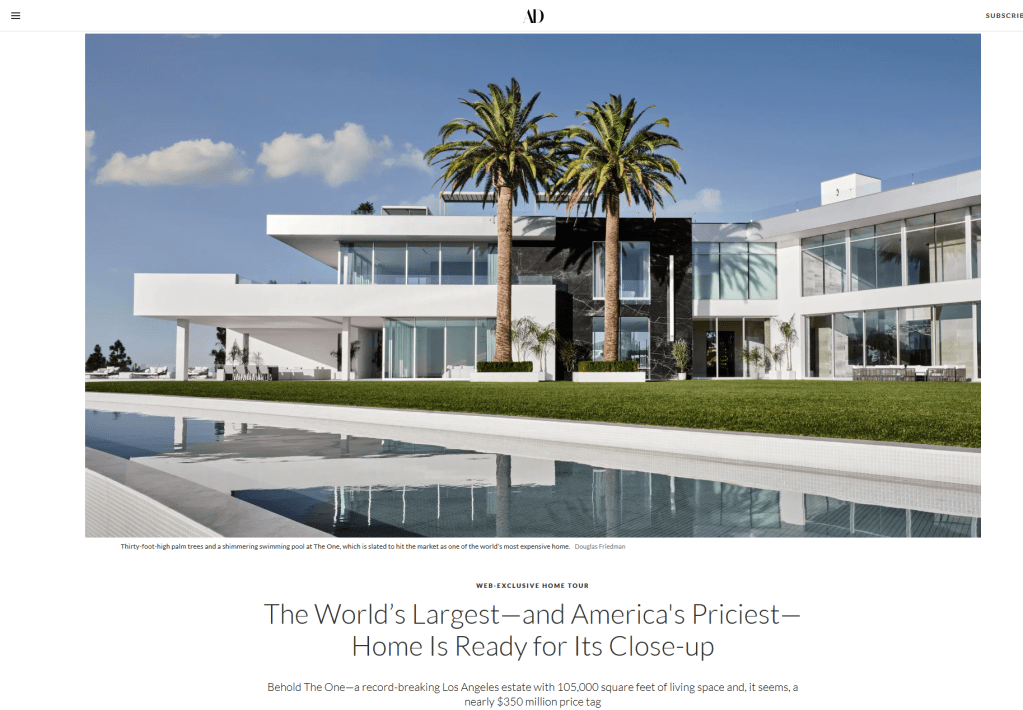
Architectural Digest displays and summarizes the features of what is a very expensive property in Los Angeles:

After nearly a decade of design and development work, what is being billed as “the world’s most expensive home” is finally ready for its close-up. Set on a five-acre parcel in the posh Los Angeles enclave of Bel Air—and aptly named The One—the 105,000-square-foot property’s interiors have remained a closely guarded secret. Until now. AD has been an exclusive look at what’s inside this record-setting property—and the design and aesthetic minds that made it happen.

Surrounded on three sides by a moat and a 400-foot-long jogging track, the estate appears to float above the city. Completed over eight years—and requiring 600 works to build—the home was designed by architect Paul McClean, who was enlisted by owner and developer Nile Niami to help it live up to its reported $340 million price tag…

Beyond the eye-catching design are the home’s equally jaw-dropping stats. There are 42 bathrooms, 21 bedrooms, a 5,500-square-foot master suite, a 30-car garage gallery with two car-display turntables, a four-lane bowling alley, a spa level, a 30-seat movie theater, a “philanthropy wing (with a capacity of 200) for charity galas with floating pods overlooking Los Angeles, a 10,000-square-foot sky deck, and five swimming pools…

Due to recently approved city ordinances, a house of this magnitude will never again be built in Los Angeles, which means The One will truly remain one of a kind. “This project has been such a long and educational journey for us all,” McClean notes. “It was approached with excitement and was thrilling to create, but I don’t think any of us realized just how much effort and time it would take to complete the project.”

What a house – and at a particular time. With concerns about mansionization in Los Angeles plus COVID-19 and its effects exacerbating inequality in capital and housing and shedding light on how much space people have, here is an incredibly large and expensive home. Given the limited pool of actors with the resources to purchase this home, these larger patterns might not matter much.

Down the road, because of its size and price alone does this become a local or international landmark? Or, because it is a single-family home in an exclusive location, will this house rarely be seen? Some of this might depend on who the owner is. The next step in the news coverage is to figure out who purchases the home and what they do with it and then the legacy of the property will come later.

It would be interesting to compare this home to previous properties that claimed to be the most expensive or the largest. I recall an effort in Florida to construct a 75,000 foot home; a documentary about the home detailed some of the process and issues that arose.