Despite a global pandemic and an economic downturn, U.S. home prices pushed new boundaries last year: The national median sale price for existing homes hit $310,800 in November, marking 105 straight months of year-over-year gains, according to data from the National Association of Realtors.
This could reinforce the now common viewpoint that homes are investments. Increasing median values for over eight suggests reinforces the idea that homes generally go up in value. Except for big economic crises – think the burst housing bubble of the late 2000s – houses accrue value over time. Even COVID-19 could not derail this.
This is often viewed as a good thing. Homeowners like that their homes are increasing in value because they can make more money when they sell. Communities take this as a marker of status. Realtors and others in the housing industry benefit. No one wants a drop in housing values across the board. (Of course, this is the median so the values can differ a lot by location.)
The commodification changes how owners, developers, and communities think about houses. They are not just the private spaces to escape the outside world – an established idea in the American Dream – but goods to profit from. An increasing value must be good and steps in other areas should be taken to protect home values.
This has numerous effects. It encourages Americans to invest resources in buying housing when that money could be put to use elsewhere. It contributes to single-use zoning where homes are protected from any other possible uses. It can exacerbate the inequality gap between those who can buy homes and those who cannot or between those with homes in places where the values keep going up versus those with homes in places with stagnant values.
The proposed project in Elmhurst, however, involves demolishing an even newer home. Jim Bowen, CEO of Wheaton-based exchange-traded fund sponsor First Trust Portfolios, and his wife, Marisa, plan to knock down a house built in 2012 to create a larger lot for a new house they will build.
In early 2013, Marisa Bowen paid $1 million to buy the newly built, 4,044-square-foot house from its builder. Then, in 2017, the couple paid $440,000 for a vintage, 1,683-square-foot house next door that they subsequently demolished.
In August, the couple received Elmhurst City Council approval for yard setback requirements for a new house they plan to construct on the combined, 0.45-acre property. Elmhurst officials recently told Elite Street the couple has sought a demolition permit for the nine-year-old house. City documents show their plan is to construct a new home with a 5,012-square-foot footprint.
Teardowns require some resources as the purchaser needs to buy the existing home, pay to tear down the home, and then construct a new home. In particular locations, a new, larger home can pay off in significant profits.
This case is a different in several key ways. First, it involves one relatively new home. Teardowns are intended to provide more space and newer features compared to the residence previously on the property. The nine-year old home would appear to have some desirable features: according to several real estate websites, it has roughly 4,000 square feet, it has a three car garage, and is worth more than a million dollars. The proposed new home is even bigger and may have different features.
Second, the teardown involves combining two lots and demolishing an older house in addition to the newer home. This process can sometimes go the other direction: someone takes a larger property, subdivides it, and makes even more money by selling multiple homes. Here, the older home is relatively small by today’s standards: over 1,600 square feet with 3 bedrooms and 2 baths. By tearing down two homes, the new larger house will have more space to fit on a larger corner lot.
Because this involves a newer home and two lots, this is going to take some money. Teardowns require some resources as the purchaser needs to buy the existing home(s), pay to tear down the home(s), and then construct a new home. The payoff can be high, either in resale value compared to what was there before or in a more desirable home for the current owner.
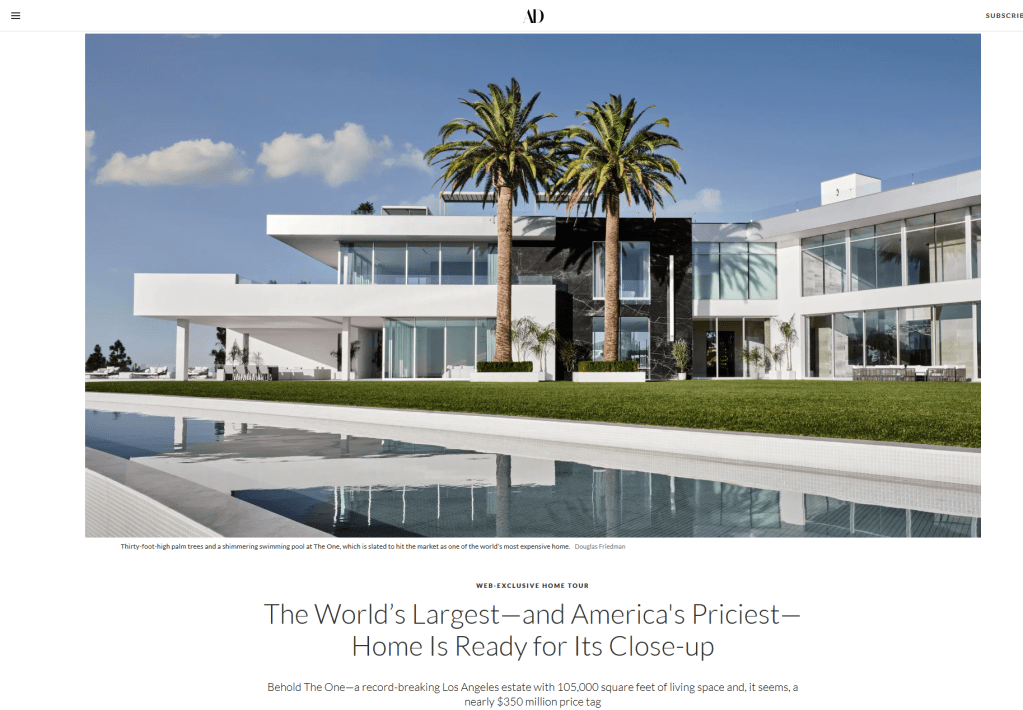
After nearly a decade of design and development work, what is being billed as “the world’s most expensive home” is finally ready for its close-up. Set on a five-acre parcel in the posh Los Angeles enclave of Bel Air—and aptly named The One—the 105,000-square-foot property’s interiors have remained a closely guarded secret. Until now. AD has been an exclusive look at what’s inside this record-setting property—and the design and aesthetic minds that made it happen.
Surrounded on three sides by a moat and a 400-foot-long jogging track, the estate appears to float above the city. Completed over eight years—and requiring 600 works to build—the home was designed by architect Paul McClean, who was enlisted by owner and developer Nile Niami to help it live up to its reported $340 million price tag…
Beyond the eye-catching design are the home’s equally jaw-dropping stats. There are 42 bathrooms, 21 bedrooms, a 5,500-square-foot master suite, a 30-car garage gallery with two car-display turntables, a four-lane bowling alley, a spa level, a 30-seat movie theater, a “philanthropy wing (with a capacity of 200) for charity galas with floating pods overlooking Los Angeles, a 10,000-square-foot sky deck, and five swimming pools…
Due to recently approved city ordinances, a house of this magnitude will never again be built in Los Angeles, which means The One will truly remain one of a kind. “This project has been such a long and educational journey for us all,” McClean notes. “It was approached with excitement and was thrilling to create, but I don’t think any of us realized just how much effort and time it would take to complete the project.”
Down the road, because of its size and price alone does this become a local or international landmark? Or, because it is a single-family home in an exclusive location, will this house rarely be seen? Some of this might depend on who the owner is. The next step in the news coverage is to figure out who purchases the home and what they do with it and then the legacy of the property will come later.
It would be interesting to compare this home to previous properties that claimed to be the most expensive or the largest. I recall an effort in Florida to construct a 75,000 foot home; a documentary about the home detailed some of the process and issues that arose.
Nearing the ninth month of COVID-19 restrictions in our area, I remembered again this weekend that I have done one regular activity a lot less than normal in that time: driving. While this may be true for many Americans, this is particularly unusual in the suburbs. When a whole space where more than 50% of Americans live is organized around cars, driving significantly less makes for noticeable change.
Americans like suburbs, in part, because they are organized around cars and driving. Single-family homes often features garages and driveways. Private lots are often located beyond walking distance of key destinations including schools, grocery stores, parks, and jobs. Commuting by car is required in the absence of other transportation options and the suburb-to-suburb trip is common.
To start, making fewer car trips during COVID-19 means I have more time in life. I do not have a long commute but with an average commute time of just under twenty-seven minutes, less driving and/or working from home means many suburbanites have more time during the week. Those who have had to continue to drive to work regularly encounter less traffic on the road and can arrive more quickly. And I have driven less to other locations as well. (Of course, others might have driven more during COVID-19, particularly delivery drivers of all sorts.)
Second, I have had to do less maintenance on my car and pay for less gas. Cars are expensive to own and maintain. It is not only about the frequency of trips; we have put off longer trips to visit family or take vacations. Suburbanites may be used to driving trips to the city or vacation spots but tourist activity is down during COVID-19. The time between oil changes and regular maintenance has increased, likely lengthening the life of our vehicles. (At the same time, COVID-19 might make owning a car more necessary when public transportation is not as attractive.)
Finally, driving less means more suburbanites are spending more time at home. The private single-family home in suburbia may look more attractive during COVID-19 as it often offers space and distance from others. Particularly in wealthier suburbs, residents can work from home, have plenty of entertainment and leisure options, and have things delivered to them.
While COVID-19 has affected driving and time use in suburbs, it is less clear how attractive this is to suburbanites. Americans in general like to combine driving and homes but during COVID-19 they may have seen more of their homes and less of the road. Since driving is connected to many social and economic activities in suburbs, this is not just about accessing opportunities; it is about living out a particular style of life. Will suburban COVID-19 experiences help push residents and leaders toward a new kind of suburbs or will people be overjoyed to return to typical driving patterns?
The great thing about rowhouses — that is, narrow, long, tall houses built connected to one another, sometimes called townhomes — is that they have most of the stuff Americans say they want in a home in a dense, efficient format. Typically they are single-family homes between two and four stories (though they can be built or split into apartments easily enough), with a front and back yard. The yards are small, but big enough for most purposes — you don’t need a McMansion-style soccer field to have some friends over for drinks and burgers, or let the dog run around, or simply get some fresh air and sunshine.
Then because the houses are connected to each other and on tiny lots, they are vastly more efficient. Instead of construction crews working on separate detached projects one after the other, they can build an entire block all at once. Shared walls means smaller bills for heating and cooling. Perhaps most importantly, the high density they enable allows for walkable neighborhoods with lots of shops and workable public transit. South Philly, which is almost entirely rowhouses, has about 24,000 people per square mile — which is not as dense as Brooklyn, but more than five times as dense as Phoenix and easily enough to support a subway line.
Rowhouses do have somewhat less privacy, of course. (I occasionally hear my neighbors even through the foot-thick brick walls, and I’m sure they hear me on occasion.) But even this has its upside — most obviously in a more vibrant neighborhood culture. When the sun is shining the folks on my block like to sit on the porch, chat with each other, smoke some meat, keep an eye on the neighborhood kids playing on the sidewalk, and so on. It feels like a friendly, alive place much more than the silent suburban cul-de-sacs I have visited in my life. And besides, who really wants to mow a three-acre yard all summer? Occasional weeding is more than enough work for me…
But rowhouses make a perfect middling addition to the American urban housing toolkit. Wherever a location is near to an urban center but not quite suitable for high-rises, slapping down a quick set of rowhouses ought to be the default option whenever land is freed up. By the same token, many American cities are also desperately short of moderately large apartment buildings, in the 3-8 story range, at somewhat more valuable locations like directly adjacent to transit stops.
The advantages and disadvantages to single-family homes amid American sprawl are clearly laid out here. The advantages include a lower price, efficiency in construction and heating and cooling, a smaller yard to maintain, and a lively, denser street. The disadvantages mirror these advantages: less space, less privacy. At the least, rowhouses in cities and denser suburbs provides opportunities for homeowners.
I have three further questions about rowhouses. First, what about rowhouses constructed for wealthier homeowners? In this piece, part of the appeal of rowhouses is a cheaper price point. Yet, rowhouses can be constructed with plenty of space and a lot of features for wealthier buyers. These homes might even give the appearance of being denser but are then trapped in small spots in cities or in suburban subdivisions far from anything walkable. Zoning is indeed an issue in certain places but I am guessing that is matters less in wealthier neighborhoods or communities or rowhouses are not viewed as a threat but rather as an intriguing change of pace.
Second, the importance of privacy may be understated. Americans like suburban single-family homes in part because they want to be separate from others (for privacy, because of race and class, to have their own property). Some homeowners want density and vibrant neighborhood life; others do not. If given the choice between a single-family home, a rowhouse, a condo, a townhouse, and an apartment (and controlling for particular neighborhood characteristics), what would most Americans choose?
Third, how much of these chooses about development depend on regional approaches to housing? As noted in the story, rowhouses are common in some places like Brooklyn and Philadelphia. They are not common in many other places. Having lived in one such development in the suburbs of the Midwest, it was an unusual choice among the typical options. And when that community and other nearby ones have been given choices about what to build since, they have largely eschewed rowhouses (except for more expensive ones). Getting communities to change up these options, particularly if there are worries about property values, is not an easy task.
If people gather for Thanksgiving, experts are advising they meet and eat outside. Here is one example:
How much safer is an outdoor meal than an indoor meal?
Much, much safer. Almost all transmission of this virus happens indoors.
Even if people are close together?
Eating outdoors doesn’t mean you’re invincible. Still try to stay six feet apart. If you huddle together around a cramped table and have close, face-to-face conversations with the people next to you, you could absolutely infect them.
This is time for the patio or lawn, found in millions of single-family homes and in many suburbs, to shine. The lawn does not just have to be a status symbol; it can confer health benefits by allowing people to spread out.
This is not the first time that the suburban lawn was said to boost health. In the gathering urbanization of the nineteenth century, suburban lawns provided space away from polluted and noisy cities. Listening to the radio the other day, I again heard mentioned how River Forest, Illinois was intentionally built with features meant to highlight nature.
Before COVID-19, the suburban lawn was also said to aid good health. It helps people get outside to work and move around (canceled out by the use of gas-powered equipment?). It encourages kids to play in a safe space. Depending on the season and/or weather, the patio and yard can act as an outdoor extension of private living space.
Now, the lawn and patio can be a private spot away from COVID-19. Outsiders are not welcome. The fresh air, breeze, and distance can limit transmission. Nature, or “nature” in many suburban settings, can serve as an oasis. All that lawn and patio maintenance can be put to use. And, hopefully, people can stay COVID free.
David Latimer of New Frontier Design is creating tiny homes that are more luxurious and more expensive than most you’d find on the market today. His most recent model, the Escher, starts at $180,000 and is designed to fit a family of six full time. Latimer calls this “the future family home.”…
The Escher is unlike most tiny homes, nearing $200,000 and including high-end features. But Latimer said that doesn’t make this model any less of a tiny house.
“Minimalism means different things for different people,” Latimer said. “The bottom line is that downsizing is a tremendous life adjustment and sacrifice for anybody. This tiny house is still a minimalistic lifestyle. It’s still a tiny home.”…
“I believe micro-housing is going to be a substantial part of the future of residential housing,” Latimer said. “Millenials and Gen Z are going to live this way. I would bet my life on this. Micro housing will allow people to live out the American dream.”
I am not surprised there is a perceived market for more expensive tiny houses. At a basic level, perhaps this is just selling the same products to different parts of the market: some people want to pay less for a tiny house, others will pay more. Indeed, from what I can gather about who moves into or at least talks publicly about moving into tiny houses, it looks like there are some educated people with some resources who want tiny houses with upgrades.
More broadly, I am not sure how a more expensive house fits into “the tiny house movement.” Downsizing and having a cheaper home are often connected to anti-consumerist motives and behavior. Some people make the choice to acquire a tiny house in order to move away from having too many items or fixating on a large home or being so financially committed. Does a luxury tiny house try to have it both ways?
If this kind of tiny house – small but still nearly $200,000 – is going to become part of the American Dream, the definition of the American Dream may need to change. For decades now, the American Dream involves owning a single-family home, probably in the suburbs. The Escher could indeed technically fulfill this – provide a single-family home in the suburbs – but it is very different in substance. If anything motivates people to make this the embodiment of the American Dream, it may be financial realities rather than aspirations for a simpler, downsized American Dream. In other words, expensive housing markets and debt may push people toward more luxurious tiny homes rather than a true desire to ditch the big showy house for a high-status small house.
The ways in which COVID-19 has pushed more real estate activity online – virtual tours, making offers without physically seeing a home – doubles down on the private dimensions of residences in the United States. Here is my argument:
Putting homes for sale on the Internet just further reduces the community or neighborhood element of a residence. If you look at enough real estate pictures, you see some patterns: lots of interior shots but limited images of how the residence interacts with surrounding spaces or what may be just down the street. For example, you may get a shot of a backyard but it is often facing the rear of the house, not out into the neighborhood. Or, you might get a pleasant image of the downtown of a community or a local park or a common room within an apartment building without much sense of how those spaces are used.
This is similar to how HGTV often shows homes. There may be sweeping shots of a neighborhood or location but the focus is always on the single housing unit. The interior and its features are the focus. The neighborhood or surroundings do not matter unless it has to do with proximity to work or family or to note the character of surrounding buildings (which is often connected to property values and the perceived niceness of the location).
There are some tools that could help potential homebuyers check out the neighborhood and community. A virtual house tour could be followed by a Google Street View drive through the nearby blocks. Instead of just relying on walkability and school scores on real estate websites, a potential buyer could go to local websites or message boards to try to get a sense of community life. Yet, any of these Internet attempts pale to talking to people in the community and experiencing the surrounding area. People should make some efforts to get to know their community before they consider moving there.
Seeing homes and residences as commodities that can be evaluated solely through the Internet downplays civic life or at least pushes it into the background. Divorcing a home from its surroundings can be done but it is impoverishing in the long run for property owners and communities. When we emerge from a COVID-19 pandemic, I hope the online aspect of real estate does not hamper efforts to rebuild community and social life when such work is sorely needed.
I try to pay attention to housing changes in the suburban community in which I live. Here are some questions I ask as I observe both existing and new homes:
What existed here before this current residence?
What motivated the property owners to tear down the existing home and build these homes (and in these particular styles)?
How do existing and new homes interact with their surroundings?
What does the inside of the home look and feel like? The outside provides some clues but interiors can be quite different from house to house.
What happened at the community level (decisions, regulations, proposals, discussions, etc.) for these homes to exist in this form?
In the long run, will these changes be viewed positively in the community or negatively?
Who are the people who live in these homes (who is this housing for)? Are they the same or different kinds of people who are in the community?
We can measure features of old and new homes and look at the aggregate data. For example, we could try to look at the “average” home largely based on standardized traits. These figures are helpful but they also leave out other important traits of homes: what is their character? How are they experienced by the owners and the neighborhood and how do they shape social actors? How do they contribute to community life? What do they say about the priorities of the occupants and the community?
In sum, homes are not just part of the housing stock. Each house has the potential to shape and be shaped by people who interact with its material and symbolic presence. And when the housing changes, it can alter existing understandings.
Homebuyers now realize that although space is important, it’s not necessarily the most important feature to have. To have enough space to be comfortable, today’s average American home measures about 2,400 square feet. This is definitely up from the 1973 average of about 1,500 square feet for a single-family home, but it’s down quite a bit from the 4,000-plus-square-foot McMansion…
People like finished basements, a home office, a large master bedroom, a big (we’re talking the size of a child’s bedroom), customized walk-in closet with organizer features, and a tricked-out ensuite master bathroom — think of one with spa-like amenities, such as a linen closet, a separate shower stall and tub, a double vanity, and a private toilet room…
Even when you adjust for inflation, you’ll find today’s median home price has increased 900% from 1973, but incomes have increased only 600%. Americans have become used to spending more of their paychecks to get the American dream of homeownership…
“Live, work, play” became the motto of the day as people grew weary of being car-dependent. Being able to walk to shops, restaurants, bars, and entertainment has become just as important as the home itself to many homebuyers.
This description appears to draw off two sources of data: Census data that regularly provides numbers on square footage, numbers of bedrooms and bathrooms, and prices (among other things) as well as real estate knowledge of recent trends.
Whether this gets us to what “the average American home of 2020 looks like” is a tricky question. At first glance, several things seem to be missing from the description. What does this typical home look like? It is somewhere between more traditional pre-World War II styles, postwar styles like ranches and split-levels, and more recent options like McMansions? How old is this typical home? While newer homes and features receive a lot of attention, many homes are at least a few decades old. And while the factor of the neighborhood is mentioned, where are people buying homes and then what is happening to these homes in terms of renovations and alterations?
Much of this also depends on local context. Given regional architecture plus the variation in housing markets as well as communities, finding the modal American house might just be near impossible. Perhaps there could be a set of typical American homes that could encompass some of the common variation.