Fashion in roof colors vs. what is best for cooling

Here is an update on fashion in residential roofs:
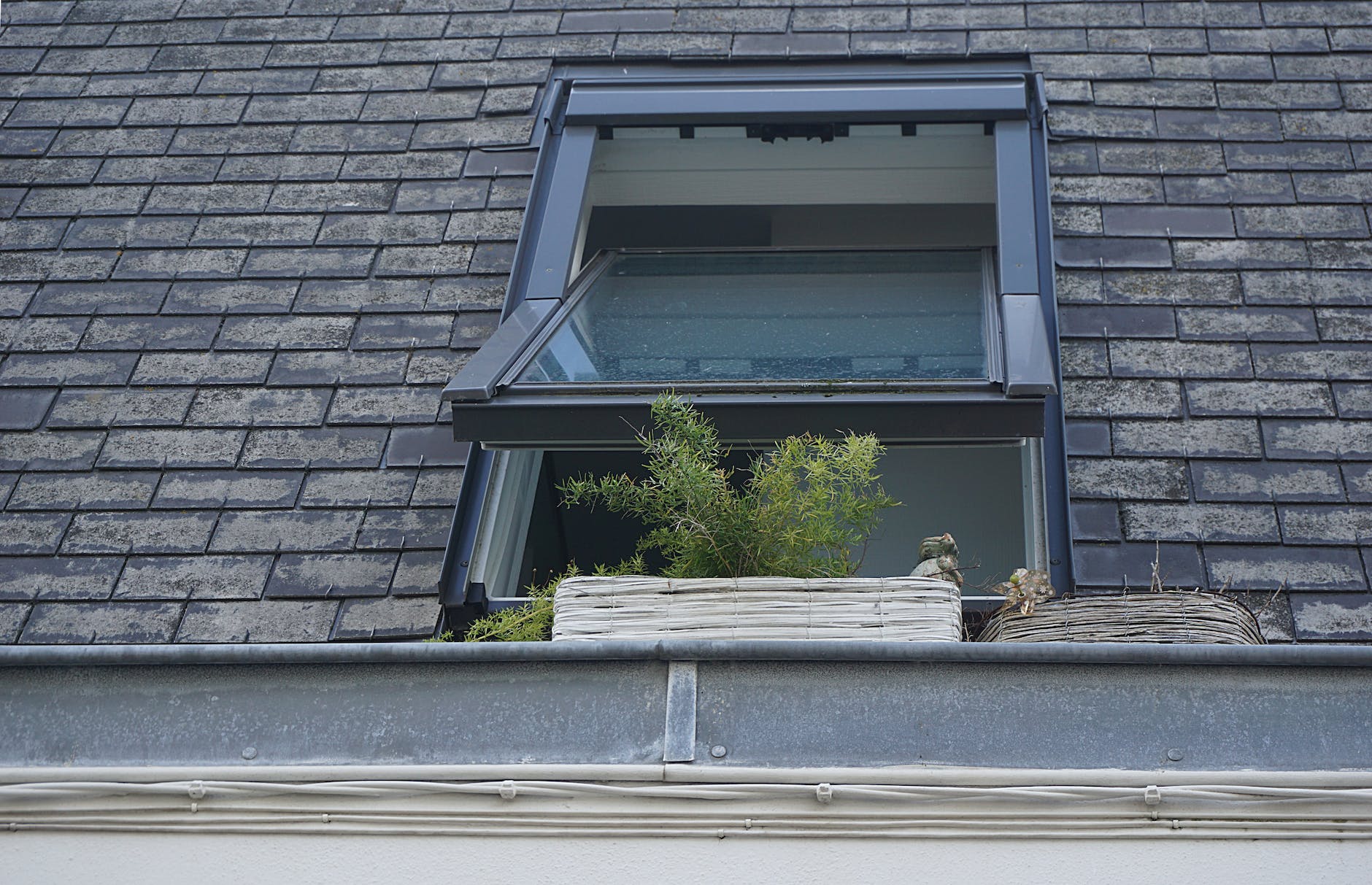
Photo by hermaion on Pexels.com

Hagen sees a persistent “undertow of people wanting contrast, a dark roof with light siding”—the prevailing fashion. I suspect we can blame anxiety over property values; call it Zillow syndrome. With inflated home prices composing larger shares of owners’ net worth, who wants to take a chance? This is the sort of thinking that has supported water-sucking green lawns in places like Arizona, not to mention racist exclusionary covenants across the country.

The roofing industry itself encourages it. The website of Apple Roofing, which has offices from Florida to South Dakota, credited dark shades with “significantly improving curb appeal.” (Sometime after I spoke with an executive there, this reference was removed.) Its blog argues that the choice between dark and light shingles “should really be about your color preference and curb-appeal over cooling costs … You can rest easy knowing proper ventilation and insulation will ensure the color has no effect on heating costs!” For roofers and manufacturers, such reassurances represent the path of least resistance—or, less graciously, pandering to consumers. And, because light shingles generally cost more to produce (the rock granules embedded in the asphalt base need an extra kiln-fired coating), dark shingles let companies charge higher margins or offer customers lower prices.

But, this prevailing fashion comes with downsides:

All this despite the fact that light shingles tend to last longer than dark ones; they stretch, contract, and crack less in the heat. Factor in energy costs and they’re a bargain: A study by Lawrence Berkeley National Laboratory found that white roofs cost considerably less over their lifetime than both black and sustainability-flaunting grassy “green roofs,” which have other environmental benefits but cost more to install and, contrary to popular belief, don’t do much to counter global warming. Researchers at Australia’s University of New South Wales, another hotbed of cool-roof research, determined that such roofs reduced indoor temperatures by up to 7 degrees Fahrenheit.

This can save lives as well as pocketbooks: Researchers found that living on the top floor under a black roof was “a major risk factor in mortality” in Chicago’s July 1995 heat wave. Cooler roofs and whiter walls may explain why fewer people die in heat waves in Greece and North Africa than in France, Russia, and other countries to the north; all that whitewash isn’t just for scenic effect.

Where are the home roofing influencers who can tilt roofing fashion in a different direction? I say this partly in jest, but the piece goes on to briefly discuss the limited involvement of governments in regulating cool roofs for residences.

The fashion for roofs will probably change at some point; home styles come and go based on a variety of factors. If it can be tilted in a direction that helps limit energy bills, limits indoor overheating, and generally is positive for the environment, this could be helpful.

The trick here might be to link cooling roofing to property values. Homeowners are very interested in increasing their property values. Having the correct style helps but style is not everything. Do cooler roofing options provide a better return on investment in the long-run? Wouldn’t not replacing a roof as often be a good thing? When do green options for homes become a very important factor in deciding property values?

Paying California property owners to tear up their grass lawns

A good number of property owners in California can receive money to remove grass:

Photo by Muhammed Zahid Bulut on Pexels.com

The largest district in the state, the Metropolitan Water District serving 19 million people in Southern California, is paying $2 per square foot of grass pulled out. Water district customer cities and agencies can add more…

The Metropolitan Water District told CNN the number of requests for grass removal rebates jumped four times in July, to 1,172 applications…

The horrific drought led Larry Romanoff to combat climate change by ripping out his grass and replacing it with cactuses and decorative stones. Romanoff will collect $10,500, a whopping $6 per square foot of lawn removed from his desert home…

The Coachella Valley Water District and its customer, the city of Rancho Mirage, are each paying Romanoff $3 per square foot of lawn torn out…

The Public Policy Institute of California’s Water Policy Center estimated for CNN nearly 50% of the 409 water agencies in California are offering some sort of turf removal rebate, both residential and commercial.

Paying property owners now will presumably pay off in the long run as it reduces water use.

Given the water shortages facing California and other Western states, how much money will be allocated to such programs and how many homeowners will go for this? Getting rid of the grass lawn may lead to fewer maintenance needs. But, the grass lawn is such a key part of both the image and the mystique of the single-family home. It might be harder for many to envision a property of rocks and cacti or more native and drought-resistance plants.

Linking “newness” in a home with particular materials, styles

The impression of “newness” in a home is connected to particular updates and items:

Photo by Curtis Adams on Pexels.com

But not simply any new floors and counters will create the desired effect. The feeling of newness is largely relative, and the only real key to creating it is banishing the things that people expect to see in a dwelling built decades ago—“landlord beige” walls, all-white appliances, dingy carpet, laminate counters, wood so warm-toned it’s practically orange. Gray floors and all of their comorbid design phenomena are cool and crisp and modern by comparison, even if they’re also crushingly boring and totally character-free and really limit a space’s potential capacity to feel warm and alive and like a home.

And the purpose of these changes is to sell properties:

In theory, the things that make up the interior of your home should be either beautiful or useful; if you’re lucky, they’ll be both. And surely some people do lose their mind for gray laminate or subway tile or barn doors, and not just because there’s no accounting for taste. Once a particular design element becomes a shorthand for newness and freshness and successful domesticity, people come around to it precisely because they want their home to reflect those qualities. But that’s a different phenomenon than appreciation for the thing itself—for how nice it is to look at, or how much more functional it makes a space. In the hands of flippers and landlords, these choices are generally made not by people who want to fill the world with the best, safest, most comfortable homes possible but by those looking for a return on the bets they’ve made on the place where you’ll start your family or play with your future grandkids. They’ve chosen these things just as much for what they aren’t as for what they are—inoffensive, inexpensive, innocuous. These houses aren’t necessarily designed to be lived in. They’re designed to go into contract.

I wonder if this process mirrors that of the fashion industry and other culture industries. The production, sale, and popularity of created works and objects moves in waves and trends. Not too long ago, homes featured granite countertops and stainless steel appliances; now it is subway tile and grey floors; shortly it will be something else. Or, formal living rooms were a thing to open concept to providing smaller spaces to enable working from home. The key for those who want to make and sell properties is to appear on trend or close to it.

A related argument: homeowners and sellers exhibit their investment, emotional and economically, in a property by updating it to more recent trends. They show that they care about the home fitting in a new era rather than being left behind. It can suit a new family just as well as it did its original occupants.

Would it be possible to signal newness in different ways? A particular smell? How the occupants use the space? Altered infrastructure (ranging from new furnaces or electrical systems to greener options)? Integrating the Internet, screens, and sounds?

Rising property values and “passive income, which is the real American dream”

Why do so many homeowners care about protecting their property values? While recently reading about social class and Hollywood, I found this observation:

Photo by Karolina Grabowska on Pexels.com

That passive income, which is the real American dream, is no longer something that the actual artists—not just actors but writers and directors and everyone else who ever made a dime off of residuals—involved in the entertainment business get to enjoy.

The context here involves the actors and others involved with long-popular television shows that could reap the financial benefits for decades.

Isn’t this passive income also what American homeowners in the early 21st century expect when they purchase a residence? Scholars have noted the shift to Americans viewing their homes as a positive investment. Instead of needing a home for shelter and enjoying that residence while there, homes and residences are now supposed to make money for their owners. In this arrangement, property owners are not expected to be completely passive; they should maintain their property or possibly even improve it. In return, their property values go up and they can cash out in the future. A loss is very undesirable and even staying roughly at the same value over time is not much help given expenses. A nice profit requires a decent uptick in value. Such a profit can help owners climb the economic ladder, have a comfortable retirement, and pass along wealth and advantages to children and family.

This can help explain why so many homeowners fight against perceived threats to their property values. People want to change the use of land or alter the neighborhood in ways that might limit the rise of property values. It is a threat to passive income. (Whether those changes to the neighborhood and/or community actually lower property values is another story.)

Is it about the home or the location of the home?

I recently saw this:

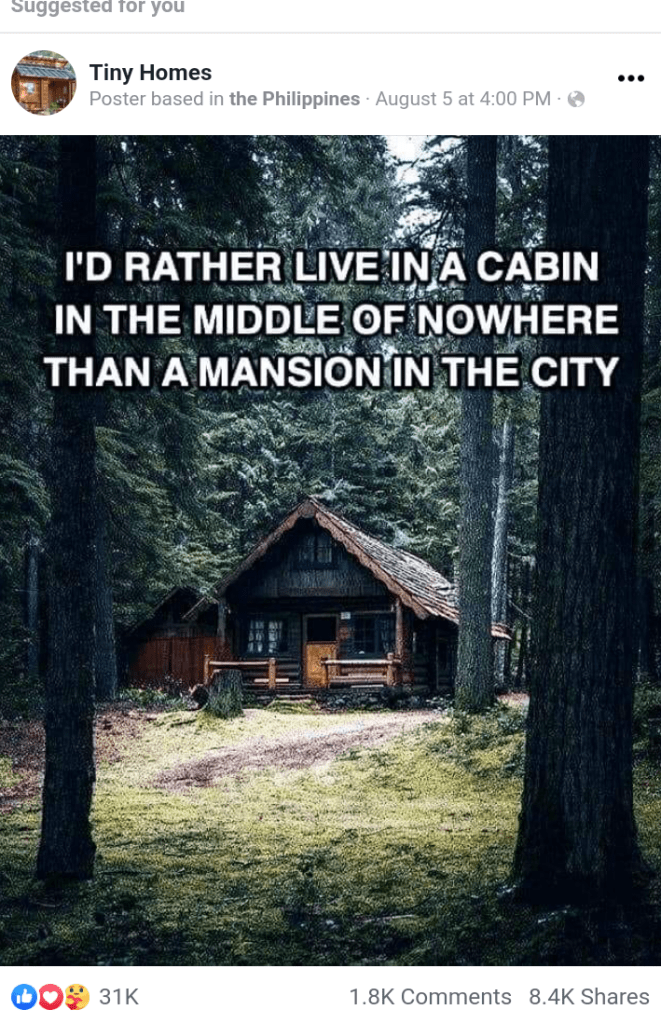
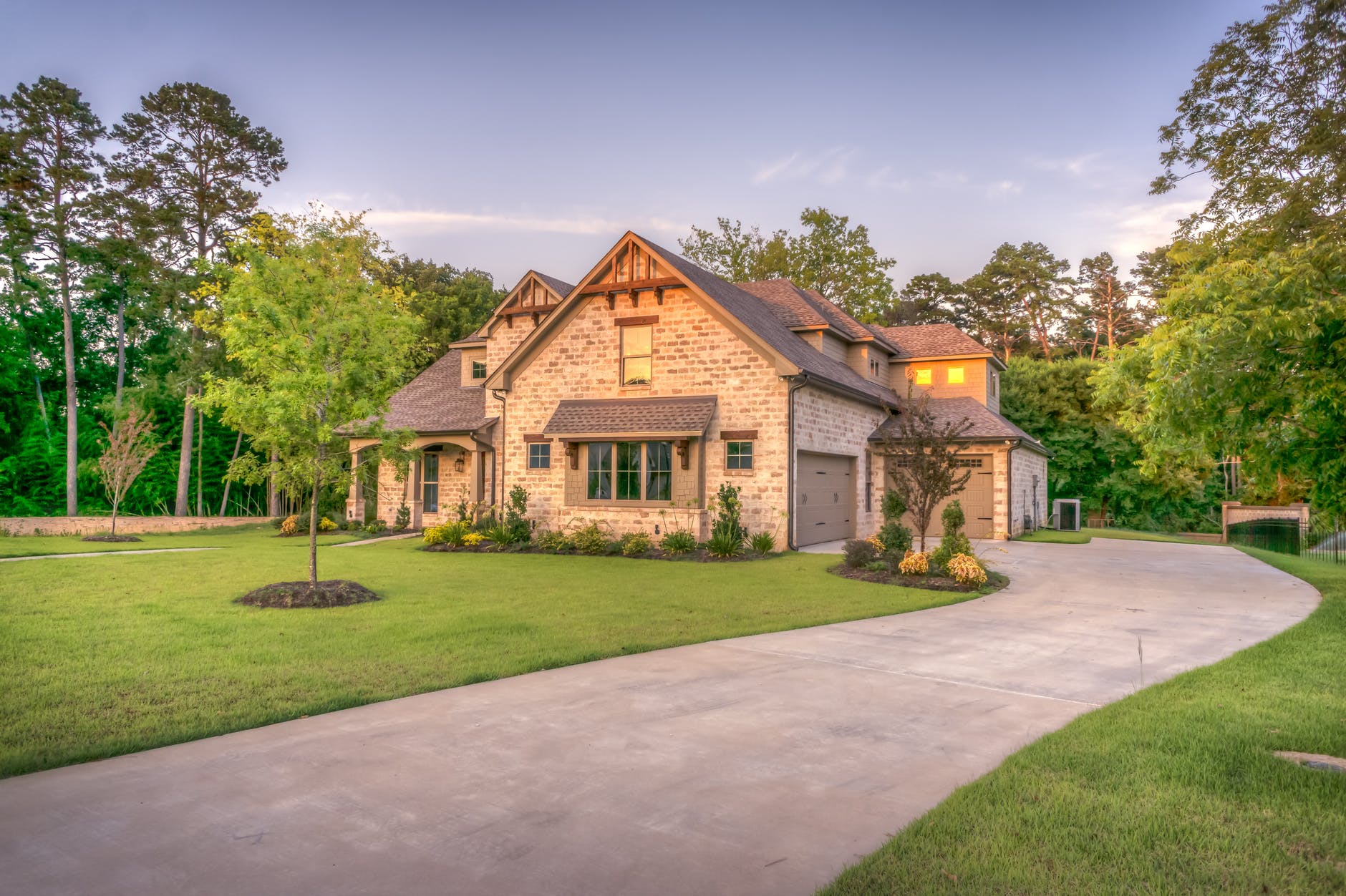
I think this is promoting living in the country as the person making the statement would be okay with a cabin rather than a mansion. The cabin looks like it is in decent shape, but it is no mansion.

However, this gets at a question I wonder about a lot: what exactly is it that motivates many people to select where they live? Here are several of the major factors:

-How many resources they have? What can they afford?

-What kind of neighborhood or community do they want to live in?

-Proximity to work.

-Quality of schools.

-Proximity to family.

-Preferences for kind and style of residence.

If you choose to live in a cabin in the country, you are elevating some of these factors as more important than others. But, is the choice primarily about the country and nature, the relative lack of people, the different kind of house, or something else? Reducing it to a binary choice of cabin/country versus city/mansion is simple but the decision might be much more complicated.

54% of my block flew an American flag today and what this means

On a quick walk on this July 4th morning, I counted the number of residences on our block with an American flag on display. In roughly a quarter-mile of houses, 22 of 41 residences had a flag. What might this all mean? Several ideas:

Photo by David Dibert on Pexels.com
  1. The July 4th holiday tends to bring out the flags to symbolize the United States of America. Yet, is the number of homes with a flag displayed different than displays for other holidays? I would guess the numbers are not that different on this block regarding those who put something up for Christmas or for Halloween, the two primary holidays for decorations. I do not know if some people are celebrating all of the holidays or if different people are celebrating different holidays but this number of flags does not seem out of the ordinary.
  2. I have read online in multiple places that Americans are enthusiastic in displaying their flag compared to residents of other countries. Connected to #1 above, perhaps the real test of this is to see how many residents display flags when there is not a patriotic holiday? (At the same time, they might be frequenting other places that have a flag including schools, civic buildings, and churches.)
  3. YouGov recently released data on how Americans regard flags. Even with declining patriotism and less regard for the flag from younger Americans, 77% had a “very positive” or “somewhat positive” view of the American flag. This is quite a bit higher than any other flag asked about. The more popular a flag is, the more likely it is for homeowners to display it?

The use of flags in suburban settings and among single-family homes with their connection to the American Dream could make for a fascinating study, if it has not been done already.

Roots versus mobility: living a whole life in one suburban house

Offered money for her suburban home for a new industrial project, an 86-year-old woman responded this way:

Photo by Pixabay on Pexels.com

“She said, ‘Where will I go?’ How do you start your life again when you’ve lived your whole life in one house?” Kristie Purner said.

What I found interesting in this comment is comparing it to the more regular mobility of Americans in the suburban era. The US government has tracked this since 1947. For several decades after World War Two, the percent of Americans who moved each year hovered around 20%. During mass suburbanization and relatively prosperity, more people moved regularly. Many metropolitan regions, including the Chicago area, boomed during this time. Some of this suburbanization and prosperity was present before the Great Depression as well.

Given all of this, how many Americans can say they lived same place for decades? How many suburbanites stayed in one home? My guess is that it is a relatively small number of people.

Perhaps this might change in the coming decades with decreased levels of mobility among Americans. At the same time, it is hard to imagine a suburbia that is marked by permanence rather than continued growth and change.

What children learn from HGTV #3: Houses are symbols of success and making it

In watching HGTV with children and studying suburbs and housing, I have several ideas of what kids learn while watching the network’s programming.

Photo by David McBee on Pexels.com

Put together the ideas in the previous two posts – homes involve emotionally satisfying arcs and they pay off financially in the end – and add decades-long American ideology and houses are symbols of success and making it. The house, typically a single-family home on HGTV, is a visible, tangible monument that the owner is successful. Residents and show hosts talk about how the house symbolizes all of the struggle and work of a family. They talk about passing down a legacy to kids. They usually do not come out an say it but the home and its exterior provide a positive impression to neighbors and those passing by about the status of the residents.

Homeownership is celebrated on HGTV. An attractive house that meets the needs of the residents and broadcasts a message of success to others is the ideal. Almost no one wants to rent or live long-term with family or friends. Almost everyone is trying to move up to a better and/or more attractive home. The goal is to acquire one’s own home which provides well-being and financial security.

Ultimately, HGTV helps perpetuate homeownership and its link with the American Dream in the way it presents houses and what they are for. The people on the network find success in acquiring and improving homes and almost nothing else is discussed. Kids watching HGTV see that people need to acquire and/or improve a house to be a successful adult.

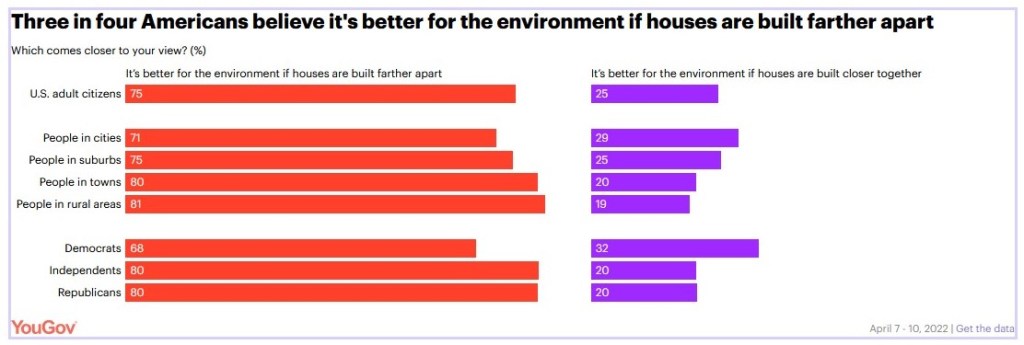
A significant majority of Americans “believe it is better for the environment if houses are built further apart”

In April, YouGov reported on a survey with a series of questions on how Americans thought about high-density places. Here is how people responded when asked about the relationship between the environment and building homes:

Three in four Americans say it’s better for the environment if houses are built farther apart, while one in four say it’s better for houses to be built closer together. While Americans who live in cities are somewhat more likely than Americans who don’t to say that high density is more environmental, the vast majority of city-dwellers still believe that it’s more eco-friendly to build out rather than up. While Republicans and Independents are aligned on this issue, Democrats are somewhat more likely to say high-density living is environmental, though again, the majority still say it is worse for the environment than building farther apart.  https://datawrapper.dwcdn.net/w0YWs/3/

It would be fascinating to follow up on these survey results with interviews or open-ended questions for the respondents: “Please explain why you answered this way.”

Knowing what I know about American preferences for single-family homes and wanting to be closer to nature in the suburbs, here are some factors that could be at work:

-Americans do not know what is best for the environment.

-Proximity to nature matters for how people assess whether the environment is better off. In higher density places, there is less open space or the natural areas have to be planned and protected. If the houses are further apart leaving more room for grass and local creatures, is this better for the environment?

-People really like homes built away from other homes, even if this might not be optimal for the environment.

-It is interesting that the biggest gap in opinions is between political parties and not where people live. Even then, two-thirds of Democrats agree with this. This might suggest anyone promoting density as a solution to environmental issues will run into some opposition.

Many goods come via truck, few want to encounter those trucks on a suburban road

Trucking is essential to the American economy. However, it is not desirable to encounter many trucks on local roads. Here is how one Chicago area county wants to address the issue:

Photo by Craig Adderley on Pexels.com

“The key is really getting trucks onto the interstate as safely and efficiently as possible,” said Patricia Mangano, senior transportation planner with the Chicago Metropolitan Agency for Planning.

As the county grows and the region continues to be an important national transportation hub, the study recommends strategies to minimize the negative impact of freight traffic to residents and the environment…

The report says that high volumes of truck traffic have led to safety and congestion concerns, especially in sensitive areas such as historic districts, neighborhoods or environmentally protected areas. The study notes western Will County’s natural and cultural assets, such as Midewin National Tallgrass Prairie, Abraham Lincoln National Cemetery and the Kankakee River, could be negatively affected by new development and traffic…

“We are the proverbial crossroads of America,” he said, noting residents just want to ensure they can get from work to home to their children’s activities without being caught in traffic.

In recent decades, Will County has become home to an increasing number of warehouses and intermodal facilities. This could be viewed as a positive for economic activity and growth which then leads to more tax revenues, jobs, and prestige.

Yet, certain industries do not necessarily mesh well with the suburban single-family home ideal. Trucks are related to a number of concerns residents have about all sorts of land uses: noise, traffic, lights, threats to the residential ideal they hope for.

I see the point of routing truck traffic along particular roads. This also has the effect of altering those roads. I can think of several major thoroughfares near here that are full of truck traffic during the day. Driving on these roads can be quite different than driving on other main roads. And because the way many suburban communities are laid out, there are often not good alternative routes since traffic in general is funneled from smaller residential streets to larger volume roads.

An impractical suggestion that might please suburban residents: have truck only roads that lead from industrial and commercial properties straight to highways. In many locations, this might work as warehouses and distribution centers are clustered together as are big box stores and shopping malls. On suburban roads without big trucks, suburbanites might occasionally find the opportunity to drive like people do in car commercials: on the open road.