Utilizing the front porch during COVID-19

With social life changed to COVID-19, front porches offer a unique opportunities for social interaction:

Photo by Thgusstavo Santana on Pexels.com

Thanks to the pandemic, the front porch is enjoying a new golden age. Like their near cousins, stoops, steps, even fire escapes, porches offer a semipublic setting where we can meet friends and neighbors face-to-face—even if those faces are masked. In the words of Claude Stephens, founder of a tongue-in-cheek group called Professional Porch Sitters Union Local 1339, a porch is “the only place where you can feel like you are outside and inside at the same time; out with all of the neighbors and alone reading a book.”…

“The front porch was an escape from the heat of the wood-burning kitchen stove,” explains historian Donald Empson, the author of “The Street Where You Live,” an architectural guide to St. Paul, Minn. “On the porch, in the cool of the evening, the family could gather to discuss the day’s events and exchange the latest news with neighbors strolling by.” Porches offered neighbors a place to exchange gossip, to spin sagas and sing songs, to flirt and court and air political views. The front porch at the turn of the century was Starbucks, flash mob, church social and Facebook rolled into one…

We no longer need front porches to broadcast our political agendas or to keep cool, as our grandparents once did. But we still need them, perhaps now more than ever. Porches give us a physical space to safely host friends, neighbors and passersby for the small talk and deep conversations otherwise difficult to foster in the middle of a pandemic.

If you’re yearning to add a porch, a 300-square-foot version will set you back an average of $21,000. One study shows you can recoup 90% or more of that investment at resale. But you can’t place a dollar value on the intangible elements of a porch—a social lubricant, a casual meeting place, an eye on the world, a place that’s a little bit yours and a little bit theirs.

Architects, urban planners, and others have argued for decades that front porches and the social life associated with them would help improve community. By spending time in a zone connected to the single-family home yet open to people passing by, residents open themselves up to interactions in a way that is not possible with the common holing up inside to watch TV or driving in and out of the garage at the beginning and end of each day.

It would be interesting to see how exactly front porches are being used right now. There is a time period of home construction lasting at least a few decades in the postwar era when front porches were not common. Older homes may have home as might some newer homes, though these newer porches can be fairly small or more cosmetic than usable. Do people in neighborhoods where front porches are more common report higher levels of social interaction during COVID-19?

In addition to the new opportunities for social interaction during COVID, the front porch can also function as a work or social space separate from inside life yet still connected to the home. With many working from home or students going to school remotely, the front porch offers a covered yet open-to-nature space. Just make sure the Wifi works well…
Addressing COVID-19 and public noise issues at the same time with “library rules for America”

While Derek Thompson suggests less or no talking in public would help limit the spread of COVID-19, his solution would also address concerns people have about noise in public:

Photo by Inga Seliverstova on Pexels.com

Here’s one solution: Library rules for America. Every time you walked into a school, a medical clinic, a drug store, a barbershop, an office, an airplane, a train, or a government building, you should see a sign that read: Hush for Your Health; or Make Good Choices, Lower Your Voices!; or Keep Quiet and Carry On. “In terms of the science, I am convinced that something like this library rule would reduce all modes of viral transmission,” Jimenez told me.

Thompson also hints at a persistent noise issue:

If Americans imported Japan’s subway rules to our public life, we might be able to accelerate our return to a more muted form of normalcy. Several times in the past few weeks, I’ve heard people talking loudly on their cellphones in grocery stores and pharmacies, sometimes with their masks pushed aside from their mouths to improve the clarity of their diction. Such behavior displays a total failure to understand how the disease spreads.

These loud conversations in public, whether the user is on speakerphone or talking loudly to someone nearby, are an annoyance to many. Some noise in public is to be expected: vehicles go by, people are around, airplanes fly overhead, etc. But, having people around you who are carrying on loud, conversations can be frustrating.

On the user end, it can be easy to end up yelling into your phone without being aware of it. You get caught up in talking, there is noise around, the phone call audio quality may not be great, and you sound like a lunatic to passerby even though you think you are just having a normal conversation. Or, a regular social interaction could be fun or maddening, leading to increased volume.

I wonder if this solitude attributed to libraries would match what they aspire to be these days. When people need public spaces and resources, libraries can be gathering places. The days of hushed shelves of books may be gone and replaced by tool and gadget rentals, computer labs, meeting rooms, and interactive areas.

More broadly, Americans are known for their loud conversations and convivial spirit. The friendliness or public conversation plus the volume can rankle some. Asking Americans to act like they are in a library might be a lot to ask. Imagine: “If I want to talk loud in public, that is my right!” A quiet American soundscape, particularly in certain settings, might be jarring.

Perhaps the bigger question is how far Americans would go to slow or eliminate COVID-19. Is not having loud conversations in public too much to ask? Now, if COVID-19 and noise guidelines could speak to the loud playing of music…

The current social contract: we get along by leaving each other alone

A Washington D.C. resident says he is leaving the city because social order has broken down. Here is how he describes what made city life work:

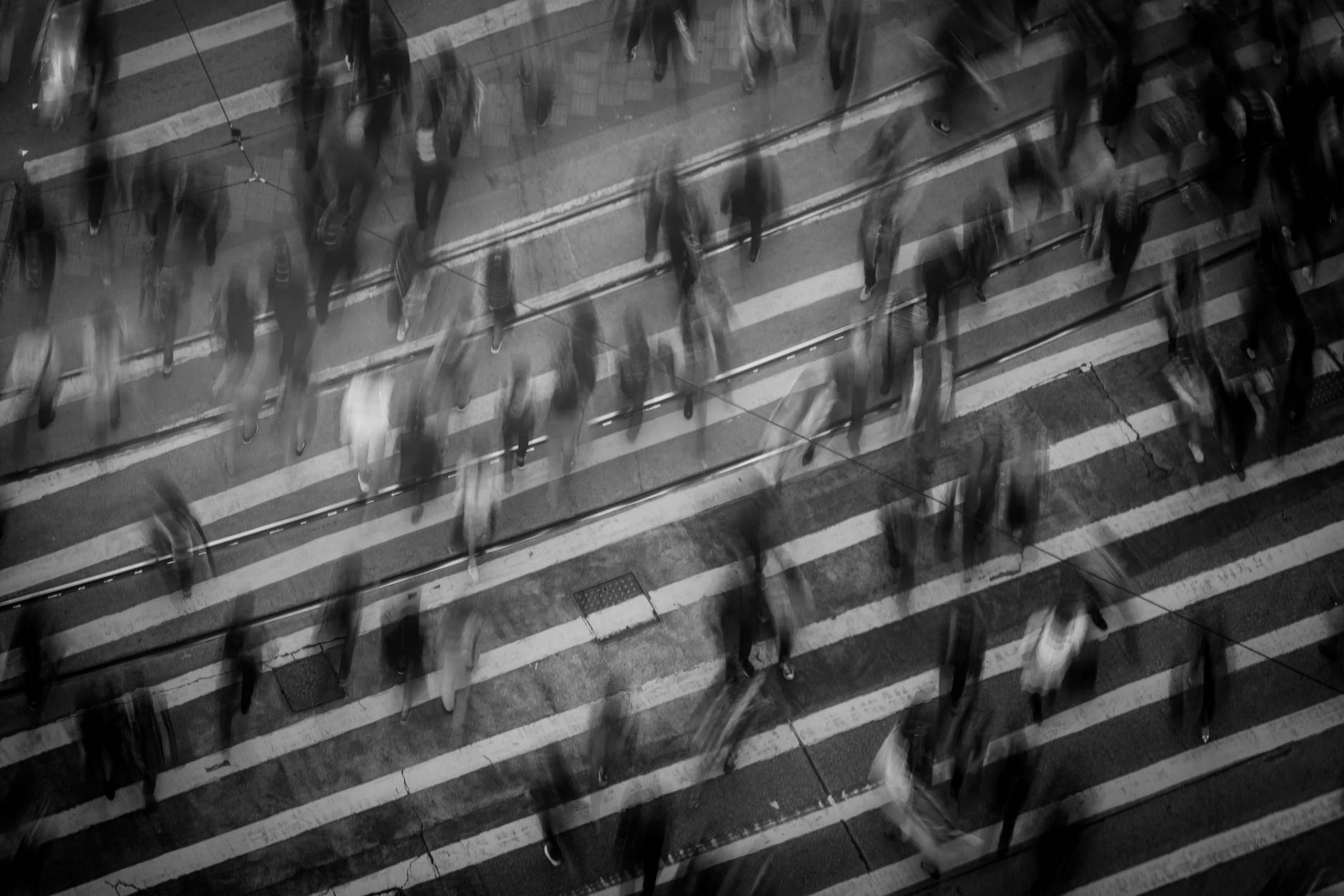
time lapse photography of people walking on pedestrian lane

Photo by Mike Chai on Pexels.com

All I asked in return was relative safety and to be left alone to enjoy the city. City-living in America, for decades, meant tolerating mild inconveniences so that you could be left alone, alongside millions of others. That was the tacit pact…

Gay? Black? Trans? No offense, but, so what? We are city people: we have seen it all—literally, all—our entire lives. You are our neighbors, our friends, the president of our HOAs, our coworkers. The great beauty of the city is that we come from all walks of life and we get along. We accomplish this by leaving each other alone.

This sounds similar to how sociologist M. P. Baumgartner described the “moral minimalism” pervasive in suburban social life:

A kind of moral minimalism pervades the suburbs, in which people prefer the least extreme reactions to offenses and are reluctant to exercise any social control against one another at all. (3)

suburbia is a model of social order. The order is not born, however, of conditions widely perceived to generate social harmony. It does not arise from intimacy and connectedness, but rather from some of the very things more often presumed to bring about conflict and violence – transiency, fragmentation, isolation, atomization, and indifference among people. The suburbs lack social cohesion but they are free of strife. They are, so to speak, disorganized and orderly at the same time. (134)

In both descriptions, residents want to be left alone. They want to live life as they see fit without interference or social control exerted by others. This does not necessarily mean there is no social interaction or residents dislike the local environment; the Washington, D.C. resident describes partaking in and enjoying urban culture and interacting with neighbors. In Baumgartner’s study, suburbanites might know each other or interact; they just do not get too deeply involved or try to pressure others.

At the root of this seems to be a deep seated individualism that provides space for people to make their own choices. Every space or community provides some constraints on what people can do (or can imagine doing) yet Americans often imagine themselves as solitary units. The strains of this are everywhere: as long as it does not hurt other people, people should be free to do it; what people do on their own time or in their own dwelling is none of my business; a man’s home is his castle; you do you and I’ll do me; and so on.

Even though this idea is widespread, it also has limits. If individuals are masters of their own fate and this should not be interfered with, it can be tough to rally people around particular causes that require collective effort. Indeed, I think a good argument could be made that some of our current political conflict is due to the fact that different groups would like to introduce ideas/values/legislation for others to consider and/or follow while wanting to claim that they also support individualism.

More broadly, this is an odd social contract to have considering the sweep of human history and societies. Much of what humans experienced took place in relatively small groups with strong bonds. Today, more of our world is organized around people with whom we have chosen to interact with more tenuous ties to traditional bonding agents like extended family, religious groups, and specific geographic locations and the communities there.

I do not know if this social contract will last. The individualism of the last few centuries has changed much. Yet, it is helpful to keep in mind as we consider how to do anything together.

Moral minimalism and addressing social issues

In the 1989 study The Moral Order of a Suburb, sociologist M. P. Baumgartner argued that suburban order rested on what she called “moral minimalism”:

A kind of moral minimalism pervades the suburbs, in which people prefer the least extreme reactions to offenses and are reluctant to exercise any social control against one another at all. (3)

In a later description of moral minimalism, she writes:

Moral minimalism entails a considerable degree of indifference to the wrongdoing of others…If people in such places cannot be bothered to take action against those who offend them or to engage in conflicts, neither can they be bothered to help those in need. (131)

Most residents do not want to involve third parties when conflict arises (unless it involves strangers) – it would be better to do nothing at all.

The pervasive moral minimalism found in the suburbs contrasts sharply with claims that American society is particularly violent or litigious. However true such characterizations may be for other settings, they do not reflect suburban reality. Residents of suburbs like Hampton rarely aggress against one another physically, and for them, law remains primarily a theoretical option for handling grievances that arise in their everyday lives. They are happy to have police at as their champions in preventing and resolving trouble that unknown persons might cause, but beyond this, they have very little use for law. When problems occur, most people do not seriously consider recourse to legal officials, and, in fact, they generally act as if law did not exist at all. In this sense, suburbia is a king of limited anarchy. (127)

In conclusion:

suburbia is a model of social order. The order is not born, however, of conditions widely perceived to generate social harmony. It does not arise from intimacy and connectedness, but rather from some of the very things more often presumed to bring about conflict and violence – transiency, fragmentation, isolation, atomization, and indifference among people. The suburbs lack social cohesion but they are free of strife. They are, so to speak, disorganized and orderly at the same time. (134)

All of this does not lend itself to addressing social issues or community problems. If people are used to leaving each other alone and avoiding conflict, what happens when legitimate structural issues arise? Or, what happens when others make the case that addressing a structural issue is necessary or helpful? Or, if there is need, how do people used to moral minimalism respond? Convincing suburbanites to move on from moral minimalism, particularly when it seems to “work” in wealthier, whiter communities where people have the resources and agency to generally do what they want (having a single-family home, a good life for their kids, etc.), is a difficult task.

Internet shaming vs. shaming with silent disgust

Internet shaming is popular but is it effective? One writer suggests private shame is a better route:

apps business cellphone cellular telephone

Photo by Pixabay on Pexels.com

Internet-based outrage nearly always gives way, like most mob action, to what the sociologist Randall Collins calls “forward panic”—a mad dash in which individual shamers efface their own identity in the rush to attack a single individual. Last night, the object of this rush was a white woman who, in a short video clip, appeared to be threatening an innocent black bird-watcher while inadvertently strangling her own cocker spaniel. If the goal was to make her pay for her misdeeds with her reputation, her guardianship of the cocker spaniel, and perhaps her job, it was accomplished within the first 60,000 retweets; for her detractors, the subsequent 100,000 (and counting) have been pure gravy. But other tools are available—precision tools that save us from the indignity of the pile-on and allow us to spread the outrage more effectively.

Silent disgust: Have you tried it recently? The effect is potent. In his 2010 book, The Honor Code: How Moral Revolutions Happen, the philosopher Kwame Anthony Appiah describes a two-step process by which historic moral changes swept over societies. The first is to decide that some practice (dueling, say, or foot-binding) is wrong. But that is not enough. Practices that are wrong can be honorable. Dueling, for example, was widely considered murder—but an honorable form of murder—until the real moral revolution happened and English gentlemen decided that it was wrong but also dishonorable, and the practice ended in the 18th century…

The nature of silent disgust is that you don’t hear about it. There are no viral videos of people not accepting invitations to a cookout. The lack of public shaming may seem like a disadvantage, but it is in fact an advantage—and more so now, in the era of trolling, than before. A troll is someone who gets a thrill from provoking a mob, and who prefers to provoke a mob by violating a rule that the mob holds dear. In fact, the dearer the better: that is the diseased psychology of much of public life now. Private shaming removes the transgressive joy that the troll seeks. All the confrontation happens in muttered comments, in invitations that never come, in expulsion from society without the courtesy of a notice.

And the troll, having failed, has a chance to repent, if the shaming is private. Eventually the offender notices the embarrassment of former friends—and because the disgust is silent, she can hold out hope for an equally silent restoration of social status. One day she shows up at the grocery store with a tasteful homemade mask. Or the neighbor who went to the Ozarks announces casually that he is quarantining for a couple of weeks, just to be on the safe side.

As a sociologist, the first thing that sticks out to me about the description of private shaming above is that it relies on social interactions between people who know each other or within specific communities. Internet shaming allows people far and wide to weigh in. Private shaming takes place within existing social bonds. People today may have fewer social bonds or communities but they still have some and are not just people floating around social media or the Internet without anchors to other people.

A second sociological feature of above: there is an opportunity to repent or restore those social bonds. The surrounding people or community register the disgust and then the actor has an opportunity to respond. They may still disagree with the shame they received but since it is done within existing bonds, it may be harder to completely sever the relationship.

Two other quick thoughts:

1. Shame these days is complicated. In some instances, we would not want to provoke shame, such as within children. In other instances, promoting shame is seen by many as good to prompt change.

2. If you want to read more about the earlier days of Internet and social media shaming, I recommend Jon Ronson’s 2015 book So You’ve Been Publicly Shamed.

The start to social distancing summer

As the weather warms up, people want to get back to summer activities: going to the beach, taking vacations, outdoor gatherings with family and friends, barbequing, outdoor festivals and performances, and more. How much of this is possible? A few thoughts connected to recent posts:

  1. If consumption is indeed down, this will be disastrous for many communities. Already, local finances are in trouble but without infusions of cash from tourists, many places will struggle.
  2. Americans like to drive; is the summer road trip possible in many parts of the United States?
  3. Certain outdoor activities will be okay in many places. But, this is reliant on either having large spaces where people can spread out or in private spaces with fewer people. Large beaches will be okay, smaller settings (thinking of some of Chicago’s smaller beaches) may be more problematic. Having a cookout in a backyard is fine while having a bunch of people in a confined space for a concert will cause more issues. Walking and biking are made easier with warmer weather.
  1. Does warmer weather increase sociability? This is when physical distancing might be a more appropriate term than social distancing as people seek to be outside more and inevitably interact with more people.
  2. With disparities in COVID-19 cases across locations and groups, will some groups have a more typical summer while others will face heavier restrictions?
  3. A summer without sports is hard to imagine. How will people get around this or seek alternatives?

With Memorial Day almost here, we will see what happens.

Making the case for the return to an office

As employers and employees embrace working at home, how hard will it be to convince people to return to an open office? There are physical solutions as well as a larger underlying issue:

There’s a deeper question that needs to be solved at the heart of this effort to virus-proof the open office. What, exactly, is so valuable about working together in the same physical space? If the goal is to again nurture in-person collaboration, office design will have to find ways of making such face-to-face interactions feel safe and comfortable again.

The article has a lot of interesting suggestions about how the spaces can be altered to space people out or separate people. But, I think the larger question is more important: what will be appealing about the open office going forward that employees need a good answer for? If they can be productive from home, why do they need to go to the office?

There is a good argument to be made here for physical space. Social interaction builds up trust and familiarity. People talking with each other in informal settings can exchange ideas and spur creative thinking. Managers and companies may be better able to see what employees are doing and provide help and resources when needed. In general, good spaces matter.

It will be interesting to see how different organizations and sectors tackle this. I would imagine those that already have a looser corporate culture or different expectations pre-COVID-19 – think creative industries, some white-collar places, high concentrations of younger workers – will be more open to avoiding the office. Public health and perceptions of it will also play a role as employees and employers consider the risks of traveling, congregating in one place, and anxieties about all of that.

The difficulties for public institutions and spaces after COVID-19

Reopening and repopulating public spaces during and after COVID-19 might provide difficult:

Yet can you reopen a society — particularly a republic built on openness and public interaction — without its physical institutions at full capacity, without public spaces available for congregation?…

Something else unites these places. In each, the woman on the next bench, the man ahead in the checkout line, the family down the pew are suddenly potential vectors — or potential victims. So we’re assessing the public realm in the way we assess a salad bar when we walk into a restaurant…

“Democracy depends to a surprising extent on the availability of physical, public space, even in our allegedly digital world,” John R. Parkinson writes in “Democracy and Public Space: The Physical Sites of Democratic Performance.”

“How do you define the ‘public realm’ when an enormous percentage of the American public spends the majority of its day in its pajamas?” Stilgoe says.

This piece raises great questions for a COVID-19 world. The emphasis on how architecture and design shapes public behavior as well as how others in those spaces can be trusted or not is right on. At the same time, there are several elements I would add to this analysis:

1. The definitions of “institution” and “spaces” are pretty broad. Some of the listed locations, like shopping malls, colleges, and grocery stores, are not public spaces. They are owned by private groups that can and do dictate how the space can be used. Some of the other locations, like parks and squares, are public spaces. Government buildings are generally more open to all. Americans privilege private space even though we need some of the private spaces – grocery stores, workplaces – to survive. But, the same rules or expectations do not apply in each of these spaces. We saw this in the Occupy Wall Street protests where gatherings in what looked like public spaces could be ended when they spaces were actually owned by private groups or the government pushed people out. We actually do not have that many public spaces where people regularly gather; many of our “public spaces” are actually privately owned and this matters. The private public spaces require both private groups and the public to cooperate – and they may not always do so.

2. Even before COVID-19, it is not clear that many Americans value public spaces or use them regularly. As noted in #1, Americans like their private spaces. Homes may be less attractive when you are trapped in them but we have a society where success is owning your own suburban single-family home. Add to this declining trust in numerous institutions and it may be hard to make the case that we should put more resources and effort into creating and maintaining public spaces.

3. More broadly, many would argue a thriving society and democracy depends on regular interaction between people. And face-to-face interaction provides benefits that online communication does not regarding communicating clearly and building relationships. Yet, again, this has been on a decline for a while now. Twitter is not a good approximation of public conversation nor a good medium (at least as currently constructed or experienced) for public conversation. Telecommuting may provide efficiencies and allow people more private lives but something will be lost. See my earlier thoughts on sociologist Eric Klinenberg’s Palaces for the People where he takes up these issues (Part One, Part Two, Part Three, Part Four).

Shifting to “physical distancing” and “social solidarity”

Sociologist Eric Klinenberg follows up his New York Times op-ed with comments in the Chicago Tribune explaining why “physical distancing” is a better term than “social distancing”:

“A lot depends on us making this change,” Klinenberg said when I reached him by phone Friday at his home in New York. “To ask for ‘social distancing’ implies that we should go home and close our doors and turn our back on the people around us. That’s precisely wrong. We need social connections, social solidarity, more than ever before. It’s feeling social solidarity that leads us to lend a hand to the most vulnerable people around us – the elderly, the homeless and those who are doing what we now call essential work, who are at enormous risk.

“Of course we need physical distancing to prevent the virus from spreading,” Klinenberg said. “It’s transmitted through physical contact. It’s not transmitted through social bonds. And it’s social closeness that will help us help each other through this and help us rebuild. So if we stigmatize social life through our terminology, if we praise individualism and just taking care of ourselves, we run the risk of making the problem even worse.”

Perhaps there are two ways to approach this. First, changing the term could indeed matter. Second, with or without a changed term, the appeal to individualism and private action in staying away from others could be a powerful one in a country that celebrates individualism.

At the least, Klinenberg’s call could push some people to pay more attention to their social interactions in a time when typical social interactions are discouraged and dangerous. Klinenberg’s earlier work suggests that social bonds are already tenuous in a number of communities. In normal times, it is relatively easy to engage in patterns that do not require much thought. When that normalcy is disrupted, continuing those regular patterns requires flexibility and new ideas.

And, it remains to be seen how social bonds continue after the time of COVID-19. Will normal social interaction occur? Will there be new precautions (such as no or limited handshakes)? Will some who sheltered in place for a long period continue in those patterns? The length of the new policies, interactions during COVID-19, and hard-to-predict social changes (spanning economics, politics, and social life) could all influence future interactions (including the possibility that social bonds will be strengthened significantly after COVID-19 recedes).

Pictures of empty urban public spaces are jarring – but cannot compare with being there and feeling the emptiness

The Associated Press ran a series of photos of empty urban public spaces around the world. They are stark photos, recognizable sites in major centers that are typically full of residents and visitors. From the end of the accompanying text:

These are places meant for people, though. And the people will — we suspect, we think, we hope — return before too long.

But when?

Yet, the photos can only reveal so much. What makes these spaces – as well as many other urban spaces around the world – unique is the mix of people, the sounds of voices, the walking paths of people among a crowd with some getting to home or work or leisure while others linger, the collective activity. Times Square can look like a spectacle even without people but it is not the same. The Eiffel Tower looms over the surrounding space but is less interesting without the people around it. The structures can still impress but they are missing something when the people are gone. These spaces and settings are what can make cities so distinctive and alluring.

And, this activity is not confined to well-known or tourist spaces. Jane Jacobs famously discussed the lively street life in Greenwich Village, New York. Many urban neighborhoods around the world have a level of pedestrian and street activity that is lively, or at least consistent. People are coming and going, there are eyes on the street, stuff is happening.

With people confined inside, that outside life – even if it is just anonymous passing by others doing their own thing – disappears. Pictures show the lack of people but cannot easily capture the lost social interaction and activity.