What explosive growth looks like, Austin and New Braunfels edition

It is not a coincidence to see two recent articles about effects of growth in Texas communities as this part of the country – and the Sun Belt more broadly – is growing fast. One is the story of a big city where housing is in high demand while the second is a small town that is now a booming suburb.

Photo by Pixabay on Pexels.com

First, thousands of Austin properties are going for far above list price:

Nearly 2,700 homes in the Texas capital have sold this year for $100,000 or more above their initial listing price, according to an analysis by Redfin Corp. that examined sales through Aug. 11. While a few other U.S. cities have had more properties sell at that premium to the asking price, none have experienced as big a percent rise in homes transacting at that lofty an increase, Redfin said…

The number of homes sold year-over-year for at least $100,000 over asking price has grown nearly 10-fold in Seattle, and fivefold in Oakland, according to Redfin. In Austin, that figure grew by 57 times the number for last year at this time.

The jump in these sales at six figures above the listed price shows how Austin, which has attracted young professionals for years, has become an even more competitive place to buy in recent months.

Second, the community of New Braunfels between San Antonio and Austin is going through growing pains:

Today, the cattle are gone, replaced with clusters of sleek apartments, gated communities and big-box stores. And New Braunfels, the third-fastest-growing city in America, tucked in one of the fastest-growing regions, finds itself at a crossroads…

A once quaint town known for its German roots and the Schlitterbahn water park, New Braunfels grew a whopping 56 percent over the last decade, adding about 32,500 residents…

Newer residents to New Braunfels have been drawn to the region for its affordable cost of living and by larger employers who have settled there, including several distribution centers and technology companies. Over the past decade, the median salary has jumped to $90,000 from $65,000 in Comal County, which includes much of New Braunfels, one of the highest averages in the state…

The community has also grown more noticeably diverse, with the presence of Latinos particularly evident on the city’s West Side. Residents flock to eateries like El Norteño for typical Mexican dishes, such as menudo, a spicy stew known colloquially as a hangover remedy. This week, a server took orders wearing a red T-shirt that read “Menudo Para La Cruda” or “Menudo For the Hangover.”

The emphasis on growth is a long-term pattern. When Census data is released, many like to highlight the fastest growing areas of the country. This can shine a spotlight on places that are changing but it also reinforces a consistent American narrative: growth is good for communities. Indeed, discussion of the opposite trend – losing population (or somehow not losing residents) – reinforces the notion that growth is good.

At the same time, focusing on population numbers is worth considering alongside what is happening to the character of communities with population growth or loss. These two articles highlight both phenomena. In Austin, what happens to a local housing market when so much competition drives up prices? At the least, this means some are priced out of the adjusted values, existing community members may see their property values rise, and builders, developers, and local officials respond to the changes. And the rising prices are often interpreted as a sign that Austin is a desirable place to live.

In New Braunfels, this is both a common American story – small town outside big city turns into a sprawling community in a relatively short time – and a story with particular traits as the community has a particular character. The German roots of the community now sit among a more diverse population. A quaint town is now much bigger and there is a lot of building activity. The businesses there for a long time are now joined by new ventures.

Even as population growth is usually viewed as a good thing, it comes with costs and changes. Few communities would reject growth just to avoid change but there can tension over how to respond to growth. Many cities and suburbs have struggled to match their existing character to changes and what the community will end up being once a construction boom and/or sprawling subdivision growth subsides.


Getting more suburban churches to develop affordable housing

As churches in cities develop affordable housing, how about more suburban churches doing the same? First, what some Atlanta churches are doing:

Photo by Pixabay on Pexels.com

The project is one of several in Atlanta where faith leaders are investing in affordable housing for the sake of their communities. Across the country, churches with property in prime locations are turning over one block, one building, one lot at a time through movements like “Yes in God’s Backyard” in California. Atlanta-area pastor Rev. David Lewicki discusses the calling of affordable housing as a ministry.

“We are increasingly convinced that affordable housing is the foundation of beloved community,” the Presbyterian minister wrote at Faith & Leadership. “Housing is a profound and even holy good.”…

Lewicki’s church got involved in lobbying for more inclusionary zoning policies to allow for lower-priced options in their area and began to create a land trust so they could get involved in addressing the legacy of racial and economic segregation in the city…

Affordable housing and community development can seem like just business ventures—which they are—but pastors know how much these issues directly affect their congregants and stem from biblical calls for community.

Here are a few compelling reasons why suburban churches should follow this course:

  1. Affordable housing is needed throughout metropolitan regions. For example, in the Chicago region, experts suggests there is a need for tens of thousands of units. And the need is not limited to Chicago or just specific communities; it is needed in many locations.
  2. Welcoming people goes beyond Sunday morning and indicating to people that they are wanted in the community all week round. It is one thing to be part of a church community; it is another to be fully welcomed into all of the community.
  3. Housing is critical in a suburban environment as it helps in access to jobs, schools, parks, and other amenities that lead to a higher quality of life. Plus, homeownership is highly valued in suburbs so if there are opportunities for congregations to provide affordable single-family homes, this helps attendees match suburban aspirations with reality.
  4. Suburban churches have funds and local power to make this happen. It takes money to buy, develop, and maintain properties. It takes expertise and influence to work with municipalities and concerned neighbors. Congregations are often viewed as assets in communities and they often have built up goodwill over the years.

While this may not be an easy task in many suburban locations as neighbors and communities resist providing housing for residents with fewer resources, religious congregations could help lead the way.

Walking to go somewhere or interact with people in contrast to walking suburban loops for exercise

Several months ago, I heard Andrew Peterson discuss “The Mystery of Making.” As he talked about places and suburbs, he mentioned something about walking: suburbanites walk in loops instead of having walks that go somewhere or involve interacting with people.

Photo by Daniel Reche on Pexels.com

As a suburbanite who walks both for exercise and in order to get to places, this is a thing. This could occur for multiple reasons:

  1. The design of suburbs limits walking options. Because of the emphasis on single-family homes and separating them from other uses, suburbanites may not be able to access many places as pedestrians. Can they get to schools, libraries, stores, workplaces?
  2. Perhaps suburbanites do not want to interact with many people. Suburbanites want to avoid conflict and interaction happens when people want it, not necessarily because of proximity or an orientation toward the community. Add headphones/earbuds/smartphones to this and pedestrians can be in their own waking cocoon.
  3. This sounds like a focus on walking as exercise as opposed to walking as a means to accomplish other worthwhile goals. Such a focus sounds like it would fit with American emphases on efficiency or productivity.
  4. If you really need to get somewhere, Americans often opt for a car, even when the route is walkable.

Having more walkable places would likely help here but it does not necessarily guarantee sociability or walking as transportation.

Ghost town, suburban O’Hare industrial property edition

Ghost towns in the American West are well-known. Recognized less frequently are suburban communities or neighborhoods that disappear. A neighborhood of over 100 homes in Bensenville will be demolished to expand industrial facilities near O’Hare Airport:

Photo by KoolShooters on Pexels.com

The 106 houses where people had raised families since 1956 will be gone.

Rising in their place will be 1.2 million square feet of top-of-the-line industrial space in four buildings…

By knocking down the houses, the new owners will have a 68-acre site in a very hot O’Hare International Airport industrial real-estate submarket…

When the project was proposed, “I thought about what happened to Bensenville with the O’Hare project,” DeSimone said. He means the loss of about 600 homes and businesses near York and Irving Park roads in 2009 when Chicago bought the properties to expand the airport.

The area surrounding O’Hare Airport is desirable because of the amount of passenger and freight traffic that goes through the airport each year. Because of its particular location, the airport is near all sorts of land uses, including residences. This has caused noise problems over the years and this agreement seems to be a mixed bag: the residents got a lot of money for their money and they were not forced into the change but an established neighborhood of 65 years will be gone and the suburb of Bensenville continues to lose residents.

How will the neighborhood be remembered? Will it be commemorated in any physical way beyond the memories of the residents who used to live there? This is the opposite of what many assume will happen with suburbs and American communities. The expectation is for continual growth while population stagnation or loss is seen as undesirable. To have a neighborhood with its homes, families, and activity disappear is not a thought many would want to dwell on.

Adding social norms and social pressure to seeing lawns as “a window into your soul”

Do lawns say something about a homeowner?

Photo by FOX on Pexels.com

To our neighbors, our lawn was just another suburban expanse of green. But to my dad, like millions of other yard-having homeowners, it was a canvas, a psychologist’s couch, a playpen, a physical manifestation of his deepest fears and greatest joys. Our lawn was one of the few places in my father’s world where he could impose his will. Plus, it was a respite from his three children. It was a miracle he ever came inside.

Watching my dad out there year after year taught me this: A lawn can tell you an awful lot about its owner.

This fits with the American idea that things you own, ranging from a home to a car to your smartphone, say something important about you. They are not just items to use or enjoy; they reflect your personal brand, even as millions of others may have the same things.

People might also do this with lawns. If people keep up their lawn, they assume the homeowner cares about their property and home. Americans generally like this. Those who do not keep up their home and lawn are less trustworthy as are people who do not own homes.

At the same time, lawns are also the product of social norms. What do the neighbors do with the lawn? How might a messy lawn be perceived by neighbors? Are nicer lawns connected to higher property values? How do different brands sell grass seed and other lawn products? I have argued before that a well manicured and clear lawn is connected to social class. Communities have expectations about what lawns should look like and can exercise both formal and informal sanctions, whether mowing lawns for residents and sending them the bill if the grass is too long to dirty looks.

More broadly, the idea of a green and lush lawn is tied to the American suburban dream. The nice single-family home surrounded by an oasis of green hints at private property, nature, and an attentive homeowner. A neighborhood with such lawns is a sign of care and neighbors who value their community.

Trying to attract suburban voters by fighting Critical Race Theory

The ongoing struggle for suburban voters now extends to Critical Race Theory:

Photo by RODNAE Productions on Pexels.com

“In suburban areas, the number one cultural issue is critical race theory. The suburbs are on fire with anger,” said Corry Bliss, a Republican strategist who works on congressional races. “We are at the beginning of this issue, not the end.”…

While critical race theory is animating the party’s base, Republican operatives say the issue will have wider appeal than other cultural wedge issues because some parents see it as having a direct impact on their children’s education.

Republicans are zeroing in on winning back the white college-educated, suburban voters that abandoned them during former President Donald Trump’s tenure. A new study from Pew Research Center found that Biden won suburban voters by 11 percentage points in the 2020 election after Trump won them by two points in the 2016 election.

“Parents all over the country have been mobilized because they do not want their children being taught they are automatically racist because of their skin color. I fully expect Democrats’ support for this controversial theory to be at the center of 2022 campaigns,” National Republican Congressional Committee Chairman Tom Emmer said in a statement to McClatchy. “The most compelling electoral issues are those that focus on the issue of fairness, and that’s why critical race theory will be incredibly damaging to every vulnerable Democrat.”

While it remains to be seen how effective this will be, multiple aspects of suburban life and history may fit:

  1. Many suburbs were built on exclusion where whites worked to keep particular racial and ethnic groups out. Even as suburbs overall have become more diverse in recent decades, this has not necessarily occurred in all suburban communities.
  2. Suburbanites are often viewed as individualistic and emphasizing meritocracy. They feel they made it there by their own success and then want to live in their private spaces (usually single-family homes).
  3. While suburbanites in regular social life might want to avoid confrontation with neighbors, the emphasis on local control in suburbs means that national issues can spark conflict at the local level.

As the article asks, will this issue that touches on what suburbs are crowd out other common election issues like the economy or taxes?

An ongoing American antagonism toward big cities

As noted in a recent opinion in the New York Times, the divide between cities and other kinds of communities in the United States has a long history.

From the beginning, Americans have differed on whether to uphold as ideal the urban life or the rural life. Should the model be New York, Boston, or Philadelphia or the plot of land in the country? These differences became more pronounced as urbanization picked up in the 1800s. With the majority of Americans now in the suburbs, the issue still is ongoing as many Americans say they prefer small towns (the suburbs?) while enjoying proximity to urban centers (jobs, cultural opportunities, transportation, etc.).

This is not just a geographic distinction or a set of preferences that some people have compared to others. These choices and systems that push people one way or another (with a lot of social actors and forces involved in encouraging uburbanization) also include a moral dimensions or a set of values and meanings. These are not just spaces; Americans have processes of meaning-making in all of these contexts.

With that in mind, there are several ways one could think about this ongoing contrast:

  1. A binary between city and country. This encourages each side to praise the traits of their option and denounce the other. Very black and white, one is better and one is worse.
  2. The suburbs are an attempted solution to this ongoing binary: some of the country, some of the city (or, as critics of the suburbs might say, none of either).
  3. Connected to different political battles. In the early days, this was part of the issues between Jefferson and Hamilton. Today, this is an issue between Republicans and Democrats. This is also about local/state/regional politics where urban interests go against those of other locations.
  4. A superfluous debate for a long time as we should think about regions with cities as anchors for wide territories where economic, social, and political activity is all intertwined. Think of Boston in the Northeast.
  5. A reaction to the rapid urbanization of the last two centuries that has upset much of human history where most people lived in small communities. Perhaps we are still figuring out how everything works with megacities where so much – population, economic activity, political power, globalized activity – is so concentrated.

In short, this divide is probably not going away soon. Hopefully, the conversation is more productive than denigrating other kinds of communities but rather seeking ways of working together since many of the issues Americans care about would benefit from cooperation across geographies.

The foresight of old railway viaducts

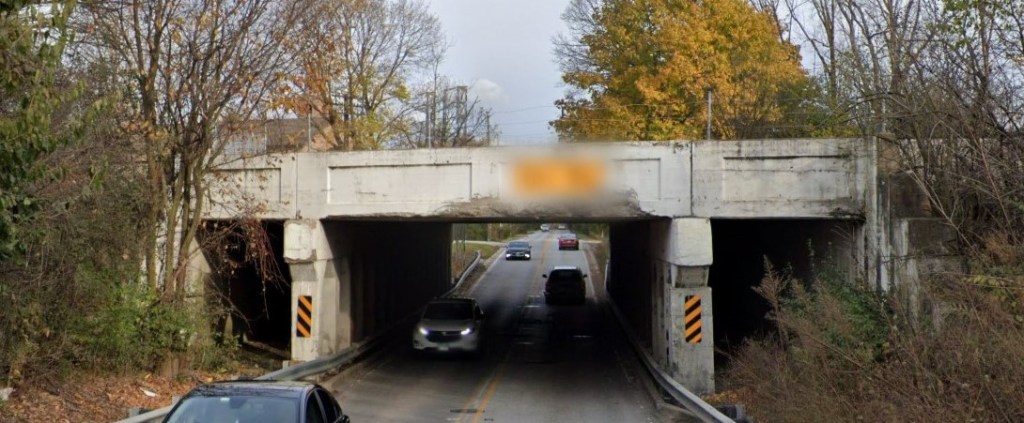
In regions like Chicagoland where there are numerous railroad lines and at-grade railroad crossings, old viaducts exhibit a measure of foresight that benefits today’s residents:

Google Street View image of Vollmer Road viaduct

That factory still operates as Chicago Heights Steel, and the cobblestone portion of Main Street is mostly a driveway leading to it. But just past the factory is a secret passageway of sorts, an ancient viaduct just wide enough to allow one vehicle to pass under the old Elgin, Joliet & Eastern railroad tracks…

There are areas, though, where there are no ways around it, and if you get stopped, you just have to abide. I’ve lived in those areas, but I don’t anymore. The main train line by me is above grade and it’s great. The old Illinois Central tracks, which include what’s now known as the Metra Electric District commuter line, traverse the area atop a big berm as unobstructed motorists cruise underneath through a series of viaducts from Sauk Trail all the way into the heart of Chicago.

According to Metra, the grade separation was a direct result of Chicago hosting the 1893 World’s Columbian Exhibition — city leaders didn’t want messy train deaths to tarnish the event’s image. In the years after those initial express trains from downtown to Jackson Park for the World’s Fair, commuter trains made their way to the suburbs, with Flossmoor getting service in 1900 and Matteson by 1912. The raised platforms, tracks and viaducts followed with the entire line being above grade by the 1920s…

Viaducts are harder to come by these days than they were in the golden age of railroads, and I only know of a few that have been constructed in my lifetime. Despite the hassles that can come along with them, motorists, and likely train engineers too, are happy we have the ones that are here.

Even as railroad lines help put many suburban communities on the map and still provide access to big cities, many local residents just see them as a hassle for the traffic and noise they create. With the automobile dominating suburban travel, trains are nuisance when they block vehicle flow.

I am familiar with numerous railroad viaducts in suburban communities in addition to the ones mentioned above in the south suburbs of Chicago. They were ahead of their time as they allowed access under the railroad tracks, sometimes even before cars were around. Local leaders and officials they foresaw the problems that might arise between ground-level traffic and trains and therefore separated the two flows to let each move on their own. This helps avoid safety issues that still plague communities today.

At the same time, not all of these viaducts have been treated well. As the article notes elsewhere, they can have drainage issues. Their original size is often an issue as today’s vehicles and/or traffic flow is larger, meaning that old viaducts need to be expanded. Letting one car through at a time is better than nothing but many communities would benefit from two lanes each way being able to go under the tracks. Foresight in infrastructure is helpful but it needs consistent attention to keep up with repairs and expanded suburban populations.

The power of local politics to shape national outcomes

A deep look at the changing political tides in suburban Oakland County, Michigan ends with this:

Photo by cottonbro on Pexels.com

Such a post-mortem would likely reveal that the party’s disinterest in holding onto the suburbs prevents the rise of new Pattersonian Republicans with their own identities separate from Trumpism and that this will have long-term historical consequences.

“There are dozens, if not hundreds of these local or regional-level political power brokers who shape the outcomes of how our cities and regions function in ways that just aren’t visible to most people,” says Delmont, the Dartmouth historian. “We spend so much time talking about who’s in the White House or even who’s in Congress. But it might be the L. Brooks Pattersons of the world who actually determine, like: Do we have affordable housing? Do we have segregated cities? Do we have police forces that are militarized? The people who actually operate the levers of power are probably much more positioned like a Brooks Patterson than a President Trump or President Biden.”

National politics are indeed often built on smaller units of government. While a lot of attention goes to presidential elections (and this article also focuses on Donald Trump and how this connects to local politics), there is a lot of work that happens at the Congressional, state, and other levels that undergird the larger outcomes. A candidate or political party is going to struggle without grassroots, lower-level support.

This reminds me of my blog post Thursday about addressing housing issues municipality by municipality. We often look at particular issues at a national level. How to provide affordable housing? How to explain the rise and fall of Donald Trump? There are multiple levels of analysis possible and needed. In this post and on Thursday, the reminder is that the local level matters. Does Oakland County and all the local machinations about county seats and redestricting determine who will be president or which political party will control Congress? No, but add up a lot of counties in important areas – particularly with suburban voters who can be swayed election to election – and this can start to matter.

Another side to this is how American residents approach local government. Particularly in suburban areas, they like the idea of local control. Yet, local voting can be very low with turnout around 15-20%. If elections for county boards in places like suburban Detroit matter for national outcomes, shouldn’t suburbanites pay more attention local elections?

Large actors in the US housing market and building more homes

Derek Thompson argues those interested in more housing in the United States should be more concerned with local NIMBY activity than private investment firms buying up homes to rent:

Photo by Lady Emillia on Pexels.com

Far worse than corporations taking a few thousand units off the market for owners are the governments and noisy NIMBYish residents taking millions of units off the market for owners and renters alike—by blocking construction projects in the past few decades. (California alone has an estimated shortage of 3 million housing units.) From New York to California, deep-blue cities and states have amassed a pitiful record of blocking housing construction and failing to meet rising demand with adequate supply. Many of the people tweeting about BlackRock are represented by city councils and state governments, or are surrounded by zoning laws and local ordinances that make home construction something between onerous and impossible.

One of the issues at play here is a numbers one: who exactly is acting within the US housing market and how much sway do they have. Concerns about corporations and housing can be placed in the larger context of how many housing units there are and how many are being built. Here are the numbers Thompson provides:

The U.S. has roughly 140 million housing units, a broad category that includes mansions, tiny townhouses, and apartments of all sizes. Of those 140 million units, about 80 million are stand-alone single-family homes. Of those 80 million, about 15 million are rental properties. Of those 15 million single-family rentals, institutional investors own about 300,000; most of the rest are owned by individual landlords. Of that 300,000, BlackRock—largely through its investment in the real-estate rental company Invitation Homes—owns about 80,000. (To clear up a common confusion: The investment firm Blackstone established Invitation Homes, in which BlackRock, a separate investment firm, is now an investor. Don’t yell at me; I didn’t name them.)

If I am calculating correctly, institutional investors currently own 2% of the single-family rentals. Of course, this number could grow if these firms find this to be a good investment.

Also of interest is the number of new homes being constructed. Thompson links to figures from the National Association of Home Builders that shows 6.8 million new single-family units were created in the 2010s. So, concerns about big investors buying homes could be considered alongside housing construction: if the investors are buying more quickly than new homes are being built, this could be an issue.

Thompson settles on local actors – governments and residents – as holding back housing construction. In this numbers game, restrictions on a local level collectively are holding back the construction of single-family housing. If these restrictions were lifted or lessened, concerns about institutional investors would presumably diminish because there is a larger supply of houses to choose from.

One problem I see with this among the larger numbers: while local actors might in the aggregate have oversight over millions of units, they individually have control over relatively few units. Let’s say a particular suburb in the Bay Area (and this NIMBY argument often comes back to California) is against building new single-family homes. Depending on the size of the community and the availability of land, this might affect just a few homes to several thousand. This is not many. Zoom out to the whole region and many suburbs doing this adds up to tens of thousands of potential homes. Do this across all of California’s metro areas and the numbers add up. Similarly, you could do this across all the metro areas in the United States.

However, convincing all these municipalities to act in the interests of the region, state, or country as a whole regarding housing is a difficult task. Housing is local and this makes legislation at the state or federal level very difficult. California’s recent efforts with SB 50 did not go through. Illinois just recently gave some teeth – but not all the teeth – to affordable housing guidelines for communities set almost two decades ago. Federal guidelines are met with the suggestions that the suburbs are going to be abolished. One reason Americans like suburbs in the first place is that local government, presumably more responsive to the needs of residents, has the power to exclude (particularly on race and social class) and protect the existing single-family homes.

All of this does not necessarily mean Thompson is wrong. Yet, to get to the numbers of new homes constructed that would make a significant difference – whether in reducing the need many metro areas have for more affordable housing or outweighing the actions of investment firms – would require a lot of change across many communities. State or federal legislation may or may not be successful and would be unpopular in many places without a significant public groundswell of support that this is an issue that all or even most communities need to address.

Together, municipal changes regarding zoning and NIMBY could add up. But, changes would need to come across communities to make a big difference.