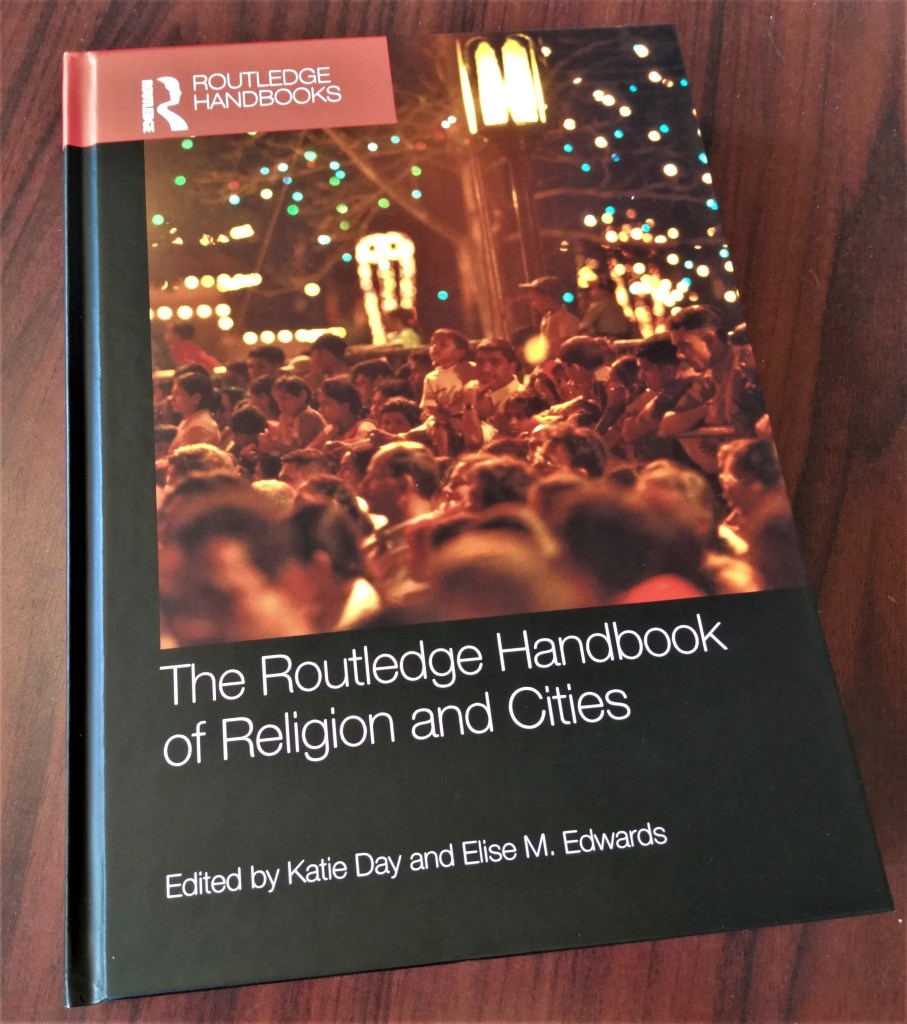
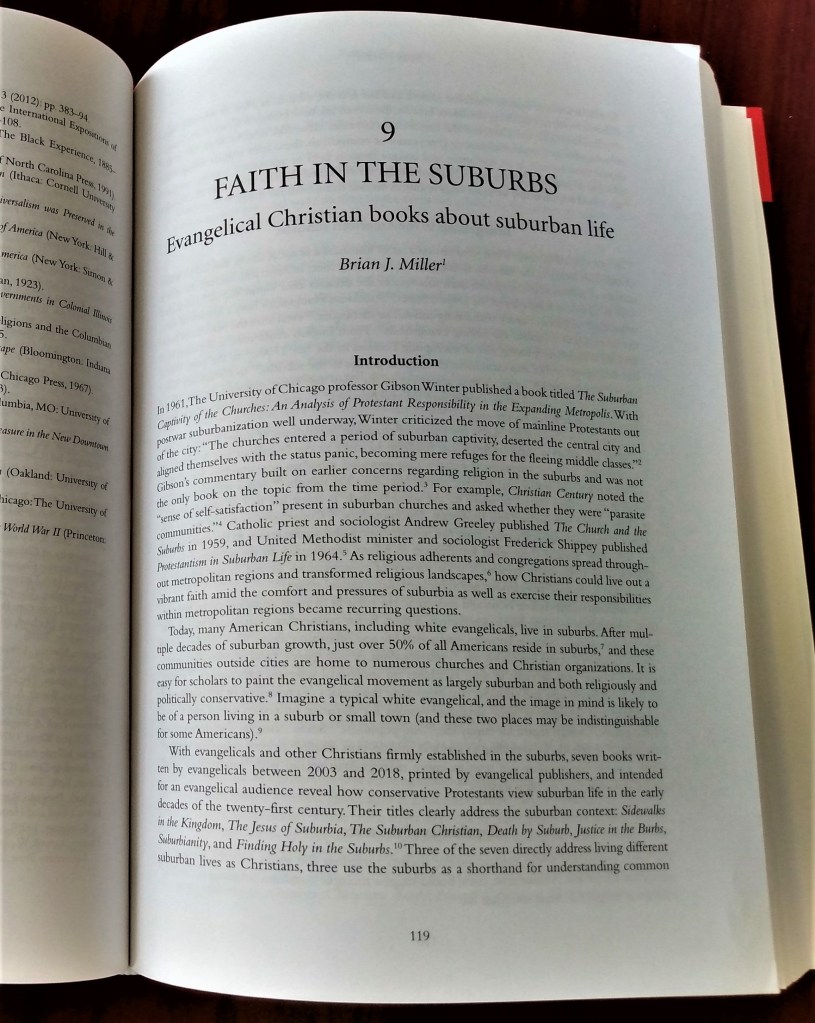
This chapter began in reading several books written over the last two decades where evangelicals considered how to live as a Christian in the suburbs. I slowly collected these books, purchasing some myself and even having one gifted to me by our college’s president. With Americans firmly established in the suburbs at the beginning of the twenty-first century (over 50% of Americans living in suburbs), from different angles the books ask some common questions: do the suburbs present particular opportunities or challenges regarding religious faith? Should Christians live in the suburbs or elsewhere? The chapter I wrote considers common patterns in these books as well as several areas they do not consider.
This chapter is not only about these books; I think these texts also hint at a larger sociological question. How do different spatial environments affect religious faith? Evangelicals do not always consider this; faith is often considered portable, truths are consistent across a variety of contexts, and churches are more about the collections of people rather than buildings and places. Other religious traditions take places more seriously. In the American suburban context with voluntaristic religion, congregations meeting in all kinds of structures, an emphasis on individualism and private property, and geographic mobility, how could a suburban environment not affect religious faith?
With the announcement that Arlington Park will be for sale, ideas are swirling about how the land could be used. I have heard a few times already the possibility of the Chicago Bears constructing a new stadium there. Here is one example:
The Loop from the North End of Soldier Field
Now it is urgently incumbent upon regional politicians and civic planners to begin a campaign to get a global-class Chicago Bears stadium built as a profitable symbol of the rebirth of the 326-acre site.
Fulfillment of such a bold and visioned plan would bring about a marriage of an NFL team and a suburb that was first discussed between “Papa Bear” George Halas and then-AP empress Marje Everett in 1968…
The question of “How?” can only be answered if there is an enormously creative and concerted joint effort put forth by such potential game changers as Bears chairman George McCaskey, Arlington Heights Mayor Tom Hayes and Gov. J.B. Pritzker…
Said Mayor Butts: “From my experience — and I’m talking about my suburb, which is 52 percent Hispanic, 47 percent Black and 1 percent ‘other’ — if you have an inspired plan, proper financing that does not put the host municipality at risk and a resolute ‘will-get-done’ attitude, toss in hard work and you can make a great thing happen.”
On one hand, this is a unique opportunity. It is rare for parcels of land this large to open up in suburbs developed decades ago. Filling a large parcel can be difficult; what can add to the existing community without threatening the current character? This particular location provides easy access to highways, easing travel for thousands of fans. The surrounding area is already used to sporting events on the sites. A suburb could become home to a major sports stadium.
How to balance these competing perspectives? Many suburbs would jump at the opportunity as growth is good, having a pro sports teams is an important status symbol, and hearing the Bears are playing in Arlington Heights could be part of a branding strategy. But, I would recommend leaving the taxpayers out of this: they will likely not benefit economically from a new stadium.
Adding to the pressure has been the migration back to city centers of a segment of the country’s affluent people. But David Simon, son of the company’s founder and CEO, said on a conference call with Wall Street analysts Monday evening that trend had been overblown.
“All of the urbanization two, three, four years ago, the question was, Why are the suburbs going to exist? Everybody is going to live in urban environments, yada, yada, yada,” Simon said. “I’m telling you the suburbs are going to be hot, and our quality real estate is going to be where the action is.”
Putting aside data proving the rebirth of city centers over the last 20 years, even if there is a boom in the suburbs that are home to Simon malls, the bigger question is whether the developer can reinvent those properties adequately given retail’s changed landscape…
For now, Simon seems to be holding its own. After a difficult spring in which many of its tenants, notably Gap Inc., withheld rent while stores were closed for weeks on end, Simon has collected 90% of billed rent for the past three quarters. The company reported today that it has given tenants about $400 million in rent abatements and another $310 million in deferments.
It will be interesting to see how this plays out. Multiple issues need to be resolved:
Can the retail market steady or rebound? Will the problems of COVID-19 keep going or permanently push shoppers to online platforms?
Can malls both shift their focus from retail to other uses, including food, entertainment, community spaces, and residences, quickly enough even as they search for the magic formulas that will keep people coming in?
Will many malls face big problems while some in wealthier areas and with deeper pocketbooks survive?
Might a growing suburban population boost the chances of all malls?
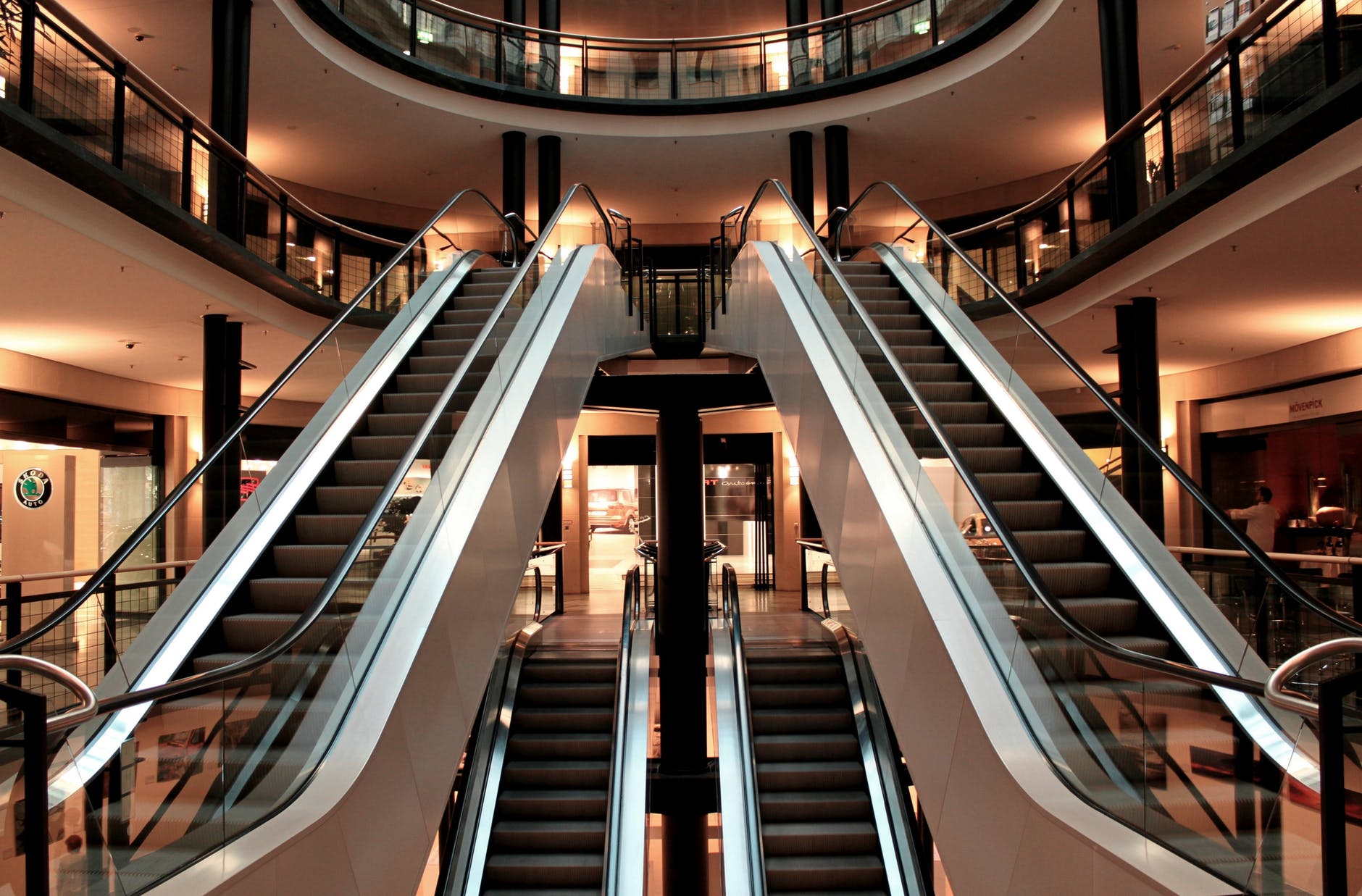
Is the shopping mall a destination of the past? For a few decades they were an exciting place but now no longer have the same buzz.
Given all of this, I would not be so optimistic. Perhaps Simon has a big plan and thinks it can revive their malls. If people are interested in the suburbs again, there might be a glimmer of hope: make some strategic changes at certain malls, become a destination in a way that single-use suburban properties cannot easily match, and try to capitalize on land that could be valuable because of its location.
“Our democratic heritage goes back to ancient Greece, and so it stands to reason that when America was born, so to speak, in the late 18th century, municipal buildings referred to the Greco-Roman architecture, with the pillars and pediments and cornices,” he says. But as the country matured, different forms of architecture began to emerge. “Then it becomes, ‘Do we still embrace the neoclassical style architecture, or do we start embracing our own time?’” he adds. (That argument more recently played out at the federal level, when former President Donald Trump tried to make neoclassical architecture the default style for all national buildings in his controversial “Making Federal Buildings Beautiful Again” effort.)…
In many of these examples, governments used their city halls to express civic pride, and to be “at the forefront of progressive building technologies and changing architectural styles,” architectural historian Thomas Mellins writes at the beginning of Drooker’s book…
Regardless of the architecture, there is a recognition among mayors and architects that municipal buildings are ultimately places for the people, and that the designs need to convey a message of approachability. In San Jose’s new city hall, which opened in 2005, Richard Meier’s postmodern design made extensive use of glass, making a statement about government transparency as well as energy efficiency. The building’s unusual three-part structure emphasized that theme: There’s the rotunda and the city council chamber, and in between them at the heart of the complex is an open plaza that then-mayor Ron Gonzales and his administration wanted toserve as the “people’s living room.”
Public or civic buildings present a unique opportunity to highlight particular values and create public space to be used and enjoyed. This can be done in a variety of architectural styles or forms, affected by trends in architecture, regional differences, the size of the community, the resources available, and more.
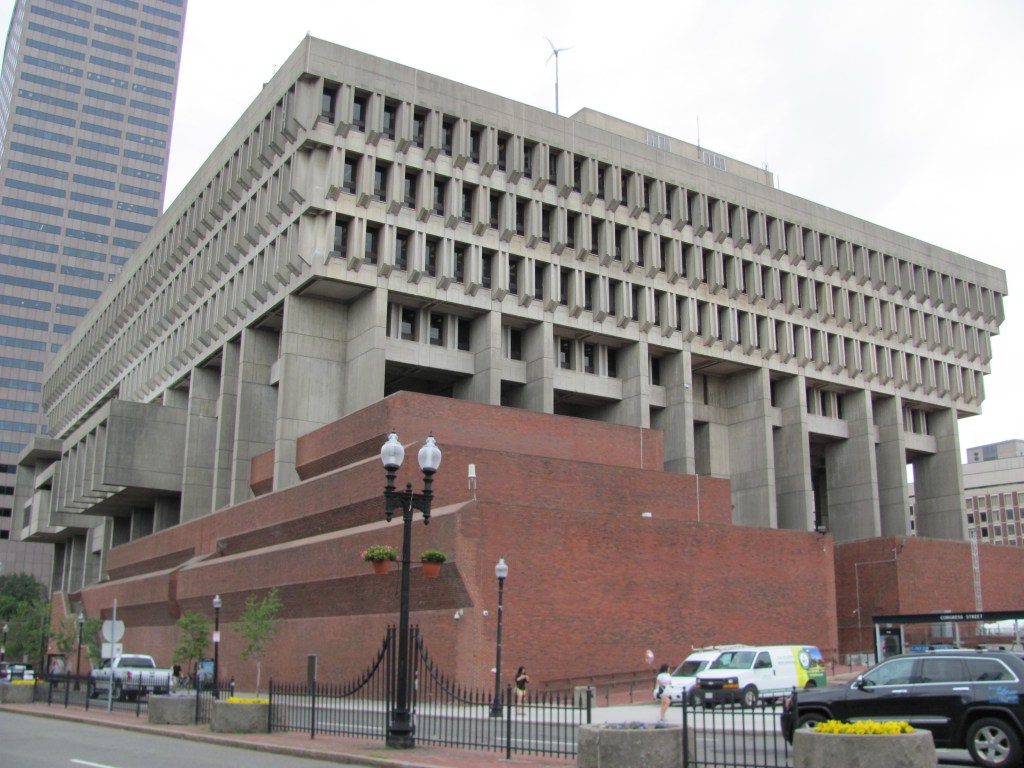
This reminds me of James Howard Kunstler’s critique of Boston’s City Hall, a building designed by noted architect I. M. Pei. Kunstler argues that the space is not inviting and not a worthy public space. The Brutalist architecture does not necessarily invoke warm fuzzies about local government.
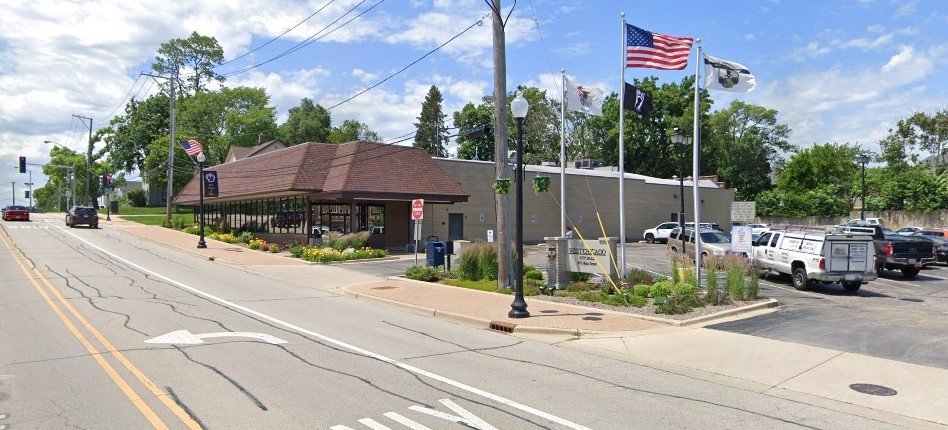
In contrast, many suburban communities opt for modest city halls in either more traditional styles or simpler postwar forms. Many suburbanites like the idea of smaller local governments and the suburban structures can highlight tradition and/or efficiency.
West Chicago City Hall depicted on Google Street View.
Part of the approachability of these a city hall or civic building involves how well they fit with the surrounding landscape. A Brutalist building could be more approachable with lush greenery around it. A plain suburban city hall could be more inviting if it did not sit behind a large parking lot. More broadly, American communities would benefit from inviting public spaces that are connected to civic buildings.
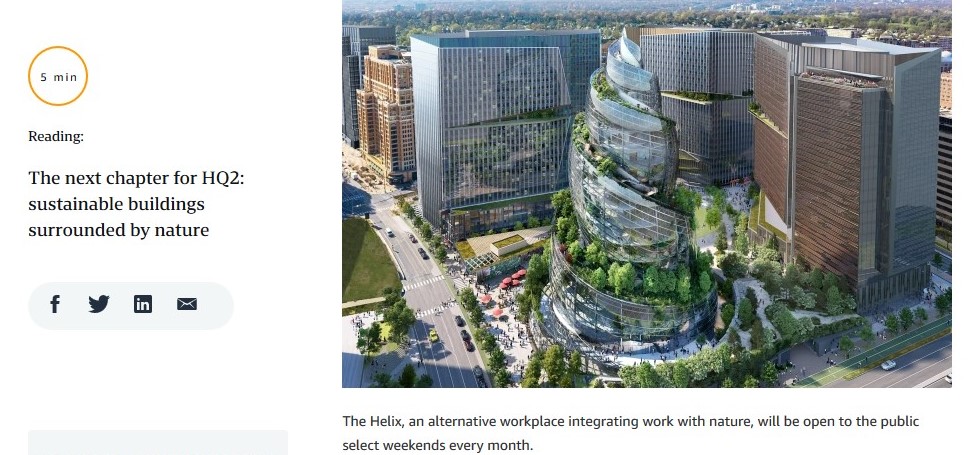
The centerpiece will be the site’s fourth and tallest tower, a 350-foot structure dubbed the Helix because it will feature two spiraling outdoor walkways with trees and plants from Virginia that twist to the building’s top…
Amazon’s new campus is the latest in a growing line of outdoorsy office projects, as companies try harder to offer a pleasant work environment and appeal to eco-conscious employees.
The Helix “will be an opportunity for people to literally go on a hike in the city,” said Dale Alberda, a principal at architecture firm NBBJ, which is designing the development across the river from Washington, D.C.
Plans for inside of the building also call for plenty of greenery, along with meeting space, offices and studios for artist residency programs. “You feel like you’re in a lush garden in the middle of winter in D.C.,” Mr. Alberda said of the interior design.
As someone who teaches Urban Sociology, this is right on trend in multiple ways.
It is just outside the central city of the region but within a business district. (The Washington D.C. region has some unique features due to the government buildings at the center but the multinode region is found throughout the United States.)
The building has numerous green features, both visible (such as lots of trees) and invisible (planning for efficiency).
The design is more whimsical and playful compared to the more common glass and steel box. The structure will certainly stand out and attract visitors just to see it.
The architects and the company say it is designed with people and well-being in mind, not just efficiency or costs.
Perhaps the only trend missing is a mixed-use component where the office space is combined with residential and commercial space.
All of this is for a tech company – perhaps the tech company right now – within an industry that hundreds of American communities would love to attract. Does this building work in the same way if it is built by an insurance company or as a municipal structure?
It will also be interesting to see how this interacts with surrounding buildings – including the other planned Amazon towers – and the broader community. Amazon says the grounds will be open to the public yet how many community members will be able to take advantage.
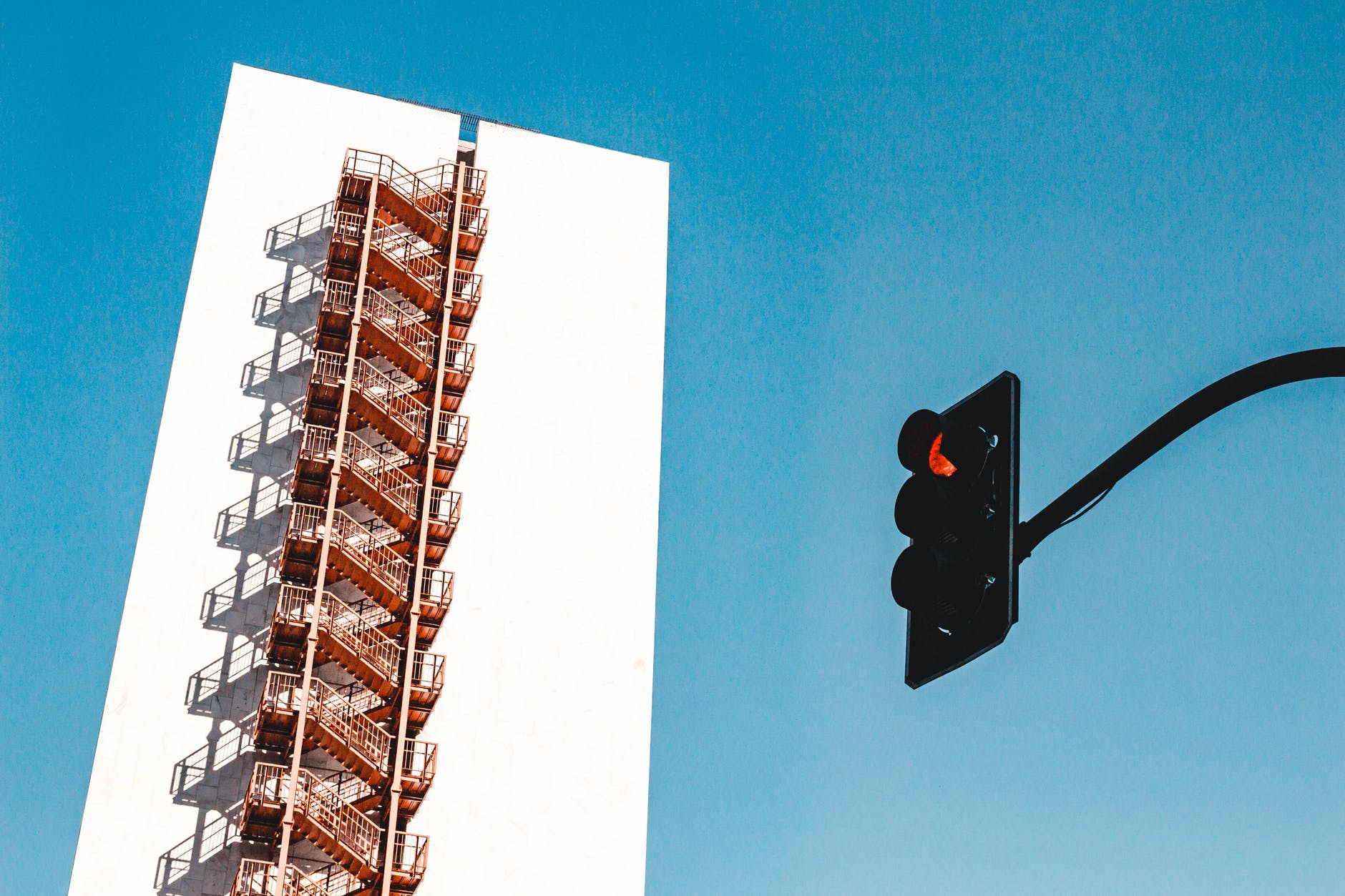
Synchronizing traffic lights. Los Angeles did this a few years ago to help traffic flow. As a kid, I recall sitting in the car in Chicago and hearing tell of how Clark Street on Chicago’s North Side was set up this way: follow the speed limit and a driver should hit multiple greens in a row. This could be harder to accomplish across a range of municipalities and the various traffic volumes intersecting with the main road. Additionally, this might not help much if there is just too much traffic on the road.
Providing more lanes, more driving options. Americans tend to like this strategy: more lanes, more roads equals more space for vehicles, right? Research suggests otherwise: if you add road capacity, drivers will tend to fill that up. Americans like driving in the suburbs and this is not a long-term solution. In fact, road diets may be more helpful: reduce capacity and it pushes drivers toward other options. Furthermore, expanding roads in an already developed suburban area can get quite expensive and may be controversial.
Encouraging more mass transit use, more walking and bicycling, and less driving. If there are simply too many cars, limiting trips would help ensure smoother driving experiences. All of these options are tough sells in the suburbs. It is hard to provide mass transit in a decentralized landscape and wealthier residents are unlikely to use it. Residential neighborhoods might be set up for biking and walking but connecting to other uses – grocery stores, schools, businesses – is often not possible or is dangerous.
This suggests that there may be some short-term solutions but the bigger issue would take more time and effort: American suburbs are built around driving.
I occasionally drive on major local suburban roadways. Think four lanes, direct north/south or east/west routes, speed limits of 35-45 mph, and lined with strip malls, fast food restaurants, gas stations, big box stores, and various other uses. Because of all of the traffic that wants to get on and off the road and because there are regulations about how to do this safely, such roads have regular traffic lights.
In the suburban road logic, these motorways are necessary to move larger volumes of traffic. Off these major roads are endless residential streets lined with single-family homes or small multi-family housing units. Traffic could cut through some of these neighborhoods but they have lower speed limits, narrower streets, and plenty of stop signs.
Occasionally, by finding the right time of day or the right position within the flow of traffic or finding the communities that have timed their traffic lights well, you can drive down such roads for ten-plus minutes without hitting a red light. It is smooth sailing. It is a slower but local highway. You can improve your gas mileage.
But, this is rare. During busier times, there may be too much traffic to get through each light. Late at night, the side streets might have sensors that turn their direction to green when just one car arrives. The drive becomes a series of stops and starts. Up to 40 mph, stop again, back up to 35 mpg, stop again.
Thus, when in the middle of a magical moment without stoplights impeding your path, enjoy it. Hear a few songs in a row while moving. Look at the communities as you go by. Marvel at the ground that can be covered when moving at the speed limit for more than a few minutes. Soon you will be back at a traffic light, waiting to get started again.
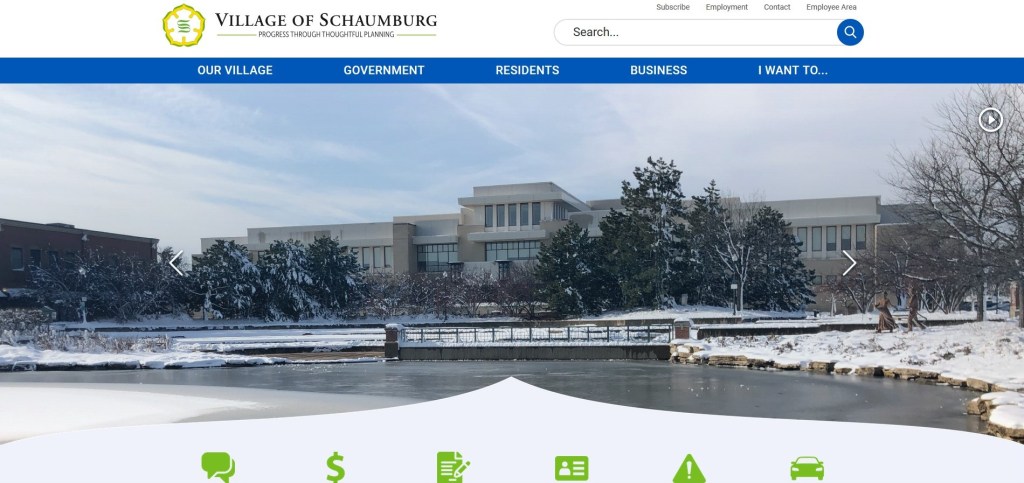
Schaumburg, Illinois, nearly 30 miles northwest of downtown Chicago, is a prototypical edge city. Home to Woodfield Mall, hundreds of thousands of square feet of office space, and over 70,000 residents plus located at the convergence of I-290, I-90, and IL-390, journalist Joel Garreau mentioned Schaumburg in his 1991 book Edge City: Life on the New Frontier. When I heard Schaumburg advertising on the radio, I wondered: is this an aggressive or a desperate move in these particular times? Where does Schaumburg fit among other Chicago suburbs also trying to get their name out there (examples here and here)? A few thoughts on this.
-Woodfield Shopping Mall is one of the largest in the United States. Even with numerous shopping malls struggling plus the problems of brick and mortar retailers, Woodfield will probably survive due to its size, location, and status. It may need to transform significantly – can it still support hundreds of stores? – but it is likely in good shape compared to numerous other Chicago area malls that are exploring new paths (other examples here, here, and here).
–Growth is important to American communities. Like many edge cities, Schaumburg experienced explosive growth early in its history: it had 986 residents in 1960, in 1980 had over 53,000 residents, and peaked in 2000 at over 75,000 residents. Where does it go from here? Population loss and/or the loss of businesses would not be a good image for the community as it tries to chart a bright future.
Compared to other Chicago suburbs, Schaumburg is likely in good shape. At the same time, the growth and status of the past and present does not have to continue amid new social pressures and internal decisions. If Schaumburg is advertising in order to attract businesses, perhaps this hints at broader issues across suburbs: can they all succeed in what may be a challenging several year period?
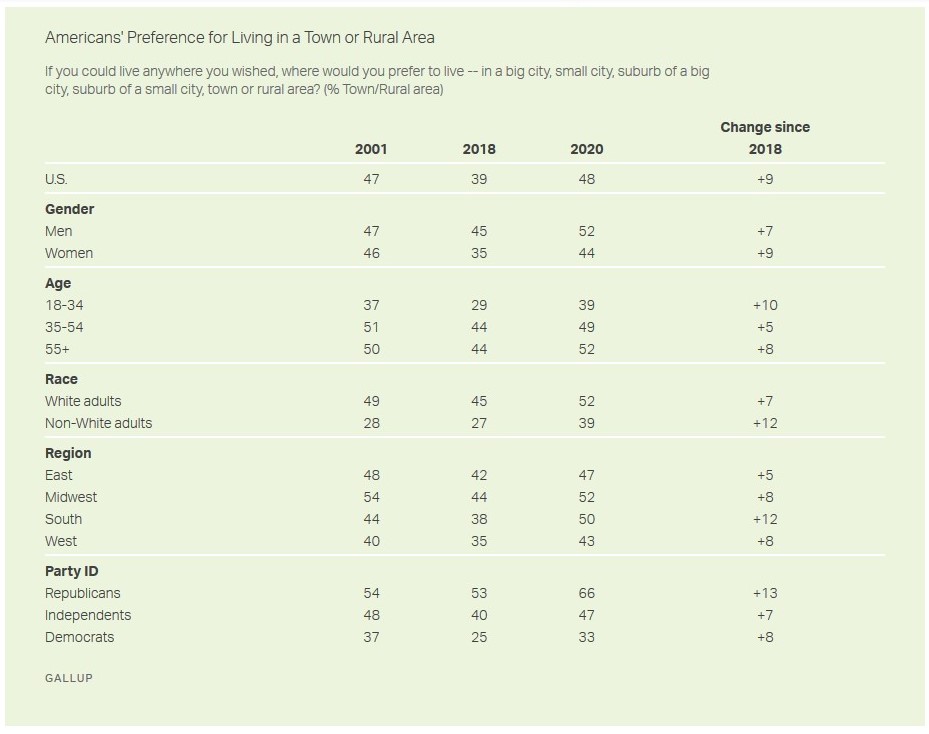
About half of Americans (48%) at the end of 2020 said that, if able to live anywhere they wished, they would choose a town (17%) or rural area (31%) rather than a city or suburb. This is a shift from 2018, when 39% thought a town or rural area would be ideal.
The recent increase in Americans’ penchant for country living — those choosing a town or rural area — has been accompanied by a decline in those preferring to live in a suburb, down six percentage points to 25%. The percentage favoring cities has been steadier, with 27% today — close to the 29% in 2018 — saying they would prefer living in a big (11%) or small (16%) city.
Current attitudes are similar to those recorded in October 2001, the only other time Gallup has asked Americans this question. That reading, like today’s but unlike the 2018 one, was taken during a time of great national upheaval — shortly after the 9/11 terrorist attacks, when the public was still on edge about the potential for more terrorism occurring in densely populated areas…
The preference for cities is greatest among non-White Americans (34%), adults 18 to 34 (33%), residents of the West (32%) and Democrats (36%).
There is a lot to consider here and it is too bad Gallup has only asked this three times. Here are some thoughts as someone who studies suburbs, cities, and places:
The shift from 2018 to 2020 is very interesting to consider in light of the shift in preferences away from small towns and rural locations between 2001 and 2018. What happened between 2018 and 2020? The analysis concludes by citing COVID-19 which likely plays a role. But, there could be other forces at work here including police brutality, protests, and depictions of particular locations or different factors could be at work with different groups who had larger shifts between 2018 and 2020.
One reminder: this is about preferences, not about where people choose to live when they have options.
The distinction in the categories in the question – big city, small city, suburb of a big city, suburb of a small city, town, or rural area – may not be as clear-cut as implied. From a researcher’s point of view, these are mutually exclusive categories of places. On the ground, some of these might blend together, particularly the distinction between suburbs and small towns. More toward the edge of metropolitan regions, do people think they live in the suburbs or a small town? Or, how many residents and leaders describe their suburb as a small town or as having small town charm (I have heard this in a suburb of over 140,000 people)? Can a small but exclusive suburb with big lots and quiet streets (say less than 5,000 people and median household incomes over $120,000) think of itself as a small town rather than a suburb? I say more about this in a 2016 article looking at how surveys involving religion measure place and a July 2020 post looking at responses when people were asked what kind of community they lived in.
To go back to the beginning, how does Gill conclude her study of poetry and the suburbs? Here is the final paragraph:
Postwar suburbia has been understood and depicted as a place where little of significance can be said, where there is a profound absence of meaning, where communication is stylized, superficial, muted almost into silence. Yet as the poems discussed in this study indicate, suburbia is replete with meaning. Its poetry is bold, innovative, and engaging – both formally and thematically – in its evocation of this space and time. Indeed, the suburbs we know are known to us, in part, because of the ways in which poetry has constituted and mediated them. In turn, this poetry shows the signs of its own discursive, spatial, and historical contexts. As Doreen Massey has argued, “Social space is not an empty arena within which we conduct our lives; rather it is something we construct and which others construct about us” (49). For Roger Silverstone, suburbia is a “geographical, an architectural and a social space,” but it should also be understood as “an idea and ideology, as form and content of texts and images and as product of a multitude of social and cultural practices” (ix). Poetry, as this book has demonstrated, plays a vital – if until now overlooked – role in these processes. It offers a startling lens through which to view suburban landscape and architecture and to understand the nuances of the suburban everyday, and it demands of us that we read it with acuity and sensitivity. In its diversity and frequent ambiguity, poetry breaks the stranglehold of polarized thinking or, what Robert Beuka calls, “our continued cultural reliance on a restrictive binary system in defining the suburban milieu” (10). The Poetics of the American Suburbs has argued that the poetry of this time and place is critical, interrogative, evocative, expansive, and suggestive in turn. Most importantly, it is a poetry that is often skilful, occasionally luminous, always intriguing. The song it sings is sometimes familiar, sometimes subtle, sometimes discordant. As I hope this book has demosntrated, it deserves a hearing, and rewards attentive listening. (Gills 2013: 181)
This is a good description of what Gills does throughout the book, analyzing both popular and more literary poetry, showing how the constraints and possibilities of poetry help lead to insights about the suburbs, and how poetry reacted to and was shaped by suburbia. I recommend the book for those interested in studying the interaction of cultural works and the suburbs.
As I reviewed this academic work, it led to a few more thoughts on patterns within the work:
One idea that emerges from a number of these texts: understanding the suburbs requires analyzing what they mean and how narratives about them develop. Cultural narratives are influential and these cultural works contribute to an ongoing conversation about what the suburbs are and how they are to be regarded. For sociologists, both the facts about the suburbs – how did they arise, how are they changing, what social forces affect life there – and the interpretation of the suburbs – what are the processes of meaning-making around them – matter.
The academic literature addresses both works that praise or celebrate suburbia and works that critique suburbia. There are many works in this latter category, particularly in more recent years.
This is truly an interdisciplinary endeavor with scholars across a number of disciplines – Communications, English, Geography, Sociology, History, and more – contributing. These different perspectives help illuminate varied aspects of the cultural works and what they mean.
Related to #2, much of the work I have seen in this employs close readings or case studies of particular works or collections of works. There is less work that takes a quantitative approach to such cultural works.
In sum, I am grateful for all of this good academic work. It has helped me think more comprehensively about the suburbs and be more aware of how cultural works contribute to and/or challenge my and our perceptions of the suburbs. I am sure the academic conversation – and the public conversation about suburbs as well – will continue as suburbs change, new cultural works are produced, and the larger social context evolves.



 Legally Sociable