The never-ending summer hum of lawn mowers, construction, ACs, pressure washers, and more

As soon as the weather started turning warmer, the summer drone began. Not crickets or the sounds of children playing baseball or swimming at the pool. Rather, it was the background noise of summer that seems unavoidable for months: in a suburban subdivision with numerous nearby subdivisions, there is always someone within a relatively short distance using a lawnmower, a weedwacker, a pressure washer, or construction equipment. The noise starts as early as 7:30 AM and stops around 8 PM.

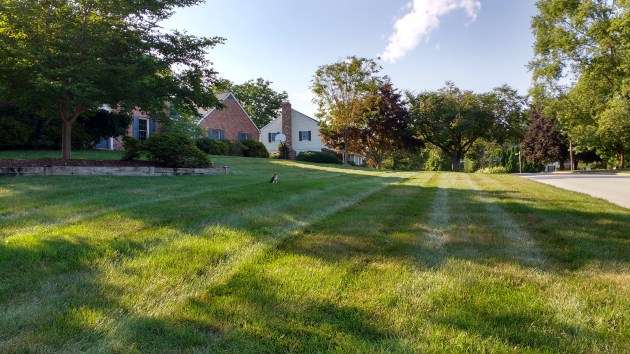
The typical idyllic summer looks something like this with green lawns, sunshine, and peaceful looking homes:

Lawn

But, this image fails to include the background noise that is ever present. That noise is often less than idyllic, particularly if it is close and/or persistent.

I know the expectation of having quiet is one that is not possible in many settings, particularly in urban areas. Many American residents have little exposure to true quiet (and may even find it unnerving). But, the early suburban ideal of the mid 1800s was to help urban residents get back to nature (or an altered environment that fit certain standards of “nature). That quiet of nature – rustling trees, bird calls, insects, stillness – is simply not possible in most suburban settings today either. Some of this is due to location and the need to locate near major roads or other land uses (such as commercial or industrial properties). Some is due to the rise of air conditioning which made development possible in certain climates. Yet, it also comes from all the maintenance required for single-family homes and their environment. Home upkeep to typical standards, such as a good looking lawn, is aided by noisy tools.

I thought recently about having noise free days in suburban neighborhoods. Could everyone in a certain portion of a community schedule their outdoor maintenance for two or three days a week? This would make it more difficult to schedule things but the trade-off could be less noise for everyone. This could work with homeowner’s associations since they already contract for regular lawn service that typically happens on the same day each week. Imagine residents could have at least one weekday in which they knew the only noise outside would be from vehicles – would it be a better experience?

Redeveloping golf courses and incurring the wrath of neighbors

Turning land from a golf course to a housing development could be a bumpy process:

Consider that the average 18-hole golf course is 150 acres. At standard densities, that means that your average golf course can host at least 600 new single-family detached homes. Mix in townhouses and apartments, and a single shuttered course could provide housing for thousands of new residential units. This is land in desirable communities: Golf-centric subdivisions built in the 1990s and 2000s feature courses threaded among affluent McMansion-style developments, meaning that the new housing could go in areas with access to high-quality schools and work opportunities…

But the main variable blocking new housing on old golf courses might be old-fashioned NIMBYism. Golf courses, after all, are often interpreted as high-status amenities that raises the value of neighboring homes, despite evidence to the contrary. If golf courses are gone and not coming back, residents often ask, why can’t they turn into permanent parks? Indeed, converting former greens into open space, wetlands, and natural preserves is happening nationwide in places where local land trusts have been able to purchase the tracts.

This can be a more appealing option for neighbors—often much higher income than the average resident of their region—who push to block permits and rezonings that might allow for infill housing redevelopment on idle greens. Earlier this year, voters in Lynnfield, Massachusetts, an outer suburb of Boston with a six-figure median income, voted down a zoning change that would have allowed for a 154-unit senior housing facility on part of the struggling Sagamore Spring Golf Club. Voters in the Rochester suburb of Penfield, New York, meanwhile, recently passed a $3.65 million bond to buy out the golf course and turn it into a park…

Golf probably isn’t coming back, at least not at the kind of scale it once boasted. Whether or not this bust can be a boon or a wash for suburbs and cities will likely be decided by hundreds of small zoning fights like these over the next decade. If recent pushes to downzone and preserve golf courses are any indication, it will take some effort and forethought on the part of planners and policymakers to get former greens productively redeveloped. Once the physical embodiment of tony upper-crust seclusion, these silent driving ranges and ghostly sand traps can be an effective way for more people to find housing in exclusive suburbs—or another means of keeping newcomers out.

There are few things suburban homeowners like less than finding out that the open, green, or park land they moved next to is now going to be a new development. Sometimes this anger is misplaced: if you move into a new subdivision recently created out of farmland and it is next to more farmland, you can probably expect that more farmland is going to be developed. Parks, forest preserves, or land trusts appear to offer more certainty: a private group or local government has committed to that green space and it would take a lot to choose otherwise. It seems like a golf course then falls in between these two options as it looks like green space but it dependent on a steady stream of users. If the golf course does not have enough customers, it cannot remain a golf course forever.

Also taking into account the social class and status of those who might locate on or near a golf course, I imagine communities that try to convert golf courses to new development will have a significant fight on their hands.


Production housing in the suburbs and what Americans want out of homes

An architect describes how production housing helps build the American suburbs:

Its scale is enormous. During the building boom before 2008, production housing—the name for builder-constructed residential developments—accounted for the vast majority of single-family homes. During that time, 1.8 million homes were started in a single month nationwide. Recent figures for January 2018, though down from prerecession highs, indicate 886,000 new starts. By some accounts, architects are responsible for designing no more than 2 percent of those homes. As the architect Duo Dickinson has observed, this means that the profession has largely ceded the best opportunity to be relevant and useful to ordinary people.

Not only does production housing dominate the market; consumers also like its products. The major appeal is affordability, with the housing industry producing a range of prices from modest to high-end. A family of four with a moderate middle-class income can put down $8,120, plus closing costs, to buy a home for $232,000 with three to four bedrooms, two bathrooms, a garage, and a piece of ground for a front and backyard. At the high end, buyers spending over $1 million—who could afford an architect if they wanted one—instead often choose big, builder-designed homes they see as bargains preferable to custom designs.

A second attraction is the quality of housing stock. People sometimes think of production homes as “builder-grade,” made carelessly and on the cheap. But American housing is better built now than ever before, a result of market competition, stricter building codes, and better materials. Basic construction is more solid, but the housing industry also is constantly upgrading the technology and sustainability of its products. As soon as the industry could see that producing energy-efficient homes had marketing advantages, green building started becoming increasingly widespread. These homes are not the ultimate in energy efficiency, but they are continuously improving. And because of the wide reach of production homes, those improvements impact many people.

A third appeal is that the housing industry answers consumers’ needs. Through its trade organizations, research institutes, and publications, it conducts constant research between buyer and seller. The feedback loop includes marketing, professional magazines, and trade shows. For instance, canvasing of consumers indicated that a living room adjacent to the front door, a holdover of the Victorian parlor, was far less important than having more space in a great room. Without reconfiguring the outline of the building—changing slab designs is costly—the front parlor was transformed into a smaller office or guest bedroom. This design makes sense, as the front door is typically not used for entry these days, but as a marker of domesticity. With marketing information at hand, builders can make immediate adjustments to their offerings. The expansion of walk-in closets, great spaces, and open kitchens correlate directly with consumers’ desires.

This list of positives sounds impressive: large-scale production of suburban housing means many homes can be built in many parts of the country at reasonable costs, at decent quality levels, and all while providing what buyers want. Relying on architects and others to design and build homes might push costs up, create more variability, and take more time. If efficiency and predictably for the homeowner is what Americans want, production building seems to be the way to go.

The rest of the article then goes on to discuss various critiques that could be leveled at suburban housing and development. Of course, efficiency and predictability have downsides both for individual homeowners and communities. And more broadly, we could ask about cultural values surrounding houses in the United States: what ends should they serve?

  1. Broadly accessible to the majority of Americans in settings that have broad appeal. This is what production building offers.
  2. Customized to the needs of individual owners and families rather than the limited number of models in #1.
  3. The design and size of homes should be subservient to community goals for land use and social life.
  4. Houses should provide significant return on investment.

Number three may just be the hardest sell as it places a house within a larger context and suggests it (and its owners) need to be part of what others are doing. Number two has the advantage of appealing to the individuality many Americans desire but this likely comes at some cost. Holding the goal of making suburban housing as available to as many people as possible (and you can make a good argument that this has been an American policy goal for roughly 100 years with ongoing socialized mortgages) leads to number one.

Number four is perhaps the most recent idea as it developed in recent decades with rising housing values amid financial uncertainties. This might fit best with number one: if Americans can get a good deal on a home, they can then expect more in return when they sell.

Repealing a suburb’s English language resolution amid demographic change

The Chicago suburb of Carpentersville passed a resolution in 2007 saying English was the official language. The suburb continued to change and now officials have repealed the resolution:

Local officials say the English resolution caused nothing but controversy, and that progress came instead from targeting troublemakers, not Spanish speakers. Now, as one of the most diverse communities in the Chicago area, leaders hope to put the controversy behind them.

There’s also the demographic and political reality that Hispanics now account for slightly more than 50 percent of Carpentersville’s population of about 38,000, up from about 40 percent when the language measure was passed. Whites now make up about a third of the local populace, with most of the rest African- or Asian-American…

Still, it’s a touchy subject. When asked about the change in local law, Village President John Skillman, a lifelong resident, downplayed it. He said village documents and meetings will continue to be in English, and emphasized that the resolution made no concrete changes in the first place…

At the same time, efforts have been made to reach across ethnic boundaries. Last year, in addition to its Fourth of July fireworks, the village held a Mexican Independence Day celebration, and this year, its first Cinco de Mayo festival.

It is a relatively quick turnaround from a set of white candidates running for office and getting enough votes to join the Village Board and passing this resolution (and other measures aimed at undocumented immigrants) to repealing that same resolution eleven years later. At the least, it could suggest there is power of being part of local government: in a suburb of roughly 38,000 people, it may not take much to run for local office and campaign for particular issues. Regardless of what side of a political issue a resident is on, running for local office can make a difference.

The rest of the article hints at ways the suburb has come to terms with an increasing Latino population: Latino businesses in town, addressing gang activity, local festivals, and whether residents experienced discrimination. But, there is a lot more that could be addressed here. Did such a resolution significantly change day to day life? (The article suggests no.) How much do white, Latino, and black residents interact and participate in each other’s social networks? How does this play out in certain civic institutions like schools, religious groups, and community organizations? Resolutions or ordinances can certainly have a symbolic effect but there are a number of layers to community life and interactions in a suburb like Carpentersville.

(Side note: this is an apropos follow-up to yesterday’s post about how many Americans speak a language other than English at home. This affects more than just home life.)

As shopping malls suffer, suburbs experience consequences

The slow death of many shopping malls is well documented and it does not just affect retailers and developers; it has consequences for suburbs.

When anchor stores close, it can be hard to find businesses to replace them, because they occupy the multistory buildings at mall entrances that are often at least 100,000 square feet. If no replacement tenant is found, the loss could trigger a decadeslong downward spiral for the shopping mall and surrounding communities.

“The communities wither away, and they never come back,” said Howard Davidowitz, chairman of Davidowitz & Associates, a national retail consulting and investment banking firm headquartered in New York City…

The process of a shopping mall shutting down is slow, often over the course of a decade or more. As stores are boarded up one by one, shopper traffic slows and crime in the area tends to spike, Davidowitz says.

“Malls are big, big contributors to city and state taxes, jobs, and everything,” Davidowitz said. “Once they close, they are a blight on the community for a very long time.”

There are a number of options for suburbs to consider when renovating or replacing malls: try to fill vacant retail space, creating more experiences such as interesting architecture, introducing more mixed uses, and just demolishing the mall and starting over.

But, all of these require time for change to occur, foresight and flexibility on the part of local officials and residents to think about what might be more appropriate in these spaces (as well as how they might diversify their local economy and tax base to offset the loss of tax dollars from a dying mall), and interest in developers and business interests in doing something new. Indeed, a suburb could work really hard to develop new ideas but without an infusion of capital, it may not happen. Or, it may take years for plans to come together and the requisite partners to feel comfortable and meanwhile vacant spaces are just sitting there.

More broadly, the lack of shopping malls hints at a changing way of life in suburbs. Whereas the new postwar suburbs were marked by driving, new shopping malls, and prosperity that allowed people the time and resources to make purchases, suburbs today might be known more for struggling to find retailers, driving to different kinds of places (and less celebration of driving in general), and pockets of prosperity in some places (where malls might still thrive) and then pockets of scarcity elsewhere (where retailers are in short supply or only certain kinds of retailers are available).

The well-cultivated lawns of Levittown

The history of environmentalism in the suburbs Crabgrass Crucible includes this description of how Levittown encouraged good looking lawns:

Abraham Levitt, among others, remained keenly aware of the additional work and expense suburban horticulture demanded, as well as the collective benefits that could follow if all Levittowners took the time and trouble to cooperate. However well-chosen and planted, all their grass, shrubs, and trees would die, and the chickweed prevail, if new owners’ commitments and skills were not also fortified. Through a gardening column in the Levittown newspaper, Abraham opened up a weekly line of communication to bring home to Levittowners how “lawns, like all living things, require care.” He “used to come around in a chauffeur driven car” to check on his homeowners’ floral upkeep. If lawns went unmowed or unweeded, he sent his own landscapers to do the job and followed up with a bill in the mail. Most developers at the lower end, like the Romano brothers, were far less solicitous, especially once their homes had been sold.

As lawn cultivation was taken up by new as well as longtime homeowners, its collective benefits, reinforced by the pressure of neighbors’ peeled eyes, helped make it the most ubiquitous of horticultural practices on Long Island. Whether these residents were white or black, however, their memories downplayed the landscaping contributions of builders and developers. Early Levittowners recalled a “sea of dirt” or mud that surged with rain, an uneven respreading of the topsoil, and scrawny, “inexpensive” shrubbery and trees. Residents later remarked little about any lawn damage from roaming children or dogs, or the neglect of lawn care by a neighbor next door. Instead, whether they were Levittowners or lived in African American Ronek Park, their recollections revolved around a joint if rival pursuit of horticultural handiwork. “Everyone” took up the mowing and watering and often the fertilizing and weed killing. As with Levittowners, Eugene Burnett remember “a kind of competition goin’ with that” that made Ronek Park yards into “some of the most beautiful lawns I’ve ever seen anywhere.” Caught up in the lawn-making enthusiasm, even Robert Murphy tried to plant one outside his Crystal Brook home. Yet for large lot owners, the dynamic was less intensely communal – the Murphy’s lawn was not even visible from the road. For denizens of Old Field, but also for smaller lots of horticultural hobbyists, lawns drew less investment of emotion or energy than other vegetation they cared about. (77)

Three pieces of this stand out to me:

  1. The pressure to maintain a nice lawn was present in the early post-war mass suburbs. It may have been present in earlier suburbs but fewer Americans could access those communities.
  2. It appears some of this pressure was promulgated by Abraham Levitt, part of the company that founded the community. At the same time, the developers of Ronek Park did less to landscape new homes there and the pressure to have a nice lawn also was present there.
  3. There are some hints that social class matters here regarding lawns. Was the lawn an essential part of purchasing a single-family home which offered access to the middle class American Dream? Could a poor lawn reduce or invalidate the success of the new suburban homeowner?

It is hard to imagine images of postwar suburban homes, whether in magazines, film, or television shows, without lush green lawns.

Walkable + suburban = desirable “surban” places

Homebuyers may still desire to live in the suburbs but they now may want a different kind of suburbia: a walkable, denser, vibrant place.

No longer are McMansions, white picket fences and sprawling square footage topping suburban buyers’ most-wanted list. Instead, proximity to a suburb’s downtown and easy access to restaurants, schools and parks are priorities. For many, walkable suburbs reign supreme…

The shift toward more walkable suburbs started over the past two decades, thanks to planning efforts concentrated on creating mini-downtowns to revive traditional suburban centers, said Kheir Al-Kodmany, a professor at the University of Illinois at Chicago’s College of Urban Planning and Public Affairs…

A 2017 study by the National Association of Realtors found that walkers span the generations. Sixty-two percent of millennials and 55 percent of those born before 1944 prefer walkable communities and brief commutes, even if it means living in an apartment or town home. And 53 percent of Americans would give up a home with a large yard in exchange for a home with a smaller yard that’s within walking distance of the community’s amenities, according to the study. That figure is up from 48 percent in 2015…

A 2016 study from realty site Redfin seems to support Dunne’s point. The study took into account more than 1 million home sales between January 2014 and April 2016 and found that homes with higher walk scores tend to have higher sales prices than comparable homes in less walkable areas. One walk score point can increase a home’s price by an average of $3,250. In Chicago, the study found an increase of one walk score point can bump a home’s price by $2,437.

I intentionally cited the broader data from the article (and not just the anecdotes from buyers, realtors, and local suburbs) because there should be an open question involved with this article: do we have a certified trend toward more walkable suburbs? Do we have clear population data showing people moving to walkable suburbs rather than other places? For a variety of reasons, including enhancing local tax bases and environmental concerns, this has indeed been an emphasis in a number of suburbs across the United States in recent decades. But, I would also guess that it is primarily in suburbs that have more traditional downtowns and mass transit options. In the Chicago region, this means the “surban” experience is easier to create in communities founded before World War II and along the major passenger railroad lines.

This possible shift also does not fit easily into the common narrative that suburbs and cities are locked in mortal combat and there are clear winners and losers. What if in the long term Americans want some of both city and suburban life: a little less density, a single-family home with a yard, a smaller town or city where they feel they can influence local government or organizations if need be, and also walkable and not just a bedroom suburb? Arguably, this tension has been behind the American suburbs for over a century: Americans want a mix of urban and country life. A denser suburbia may just be the newest manifestation of this ongoing balance.

We can now look back at “vintage suburbia”

The Daily Herald introduced a new feature this week to examine “vintage suburbia”:

DailyHeraldVintageSuburbia.png

While the article discusses why they called it “Through the Film Magnifier,” I find the word choice “vintage” more interesting. This usually refers to an older item of higher quality. I suspect this would be contentious among critics of the suburbs. Are we really to look to the postwar suburbs as places that are worth celebrating? Communities marked by tract housing, auto dependency, and lifestyles only available to some should be commemorated? Yet, these postwar suburbs did offer new opportunities for millions of Americans to own a home and it was the only home known to millions more born and raised there. And those problematic suburbs continued to grow over the decades, even as the problems of suburbia became clear both to outside observers and many residents.

There are few words that could capture this nuanced past. “Vintage” strikes a more positive tone but other words like “historic” or “storied” or “complicated” may be too drab.

Plopping a New Urbanist metroburb into the middle of sprawling suburbia

I recently discussed plans for a “metroburb” to replace a sizable AT&T office campus in Hoffman Estates. Reading more about the proposal, I wondered: does it really work to put a New Urbanist development right in the middle of suburbia?

Under Zucker’s plan, which would rename the former campus City Works, the four-level, 1.3 million-square-foot main building would house offices of varying sizes and shops. About 175 townhouses and 375 multifamily rental units would be constructed on the edges of the property. The estimated total cost is about $250 million. Unlike a typical suburban subdivision, the town homes would line straight streets and have alleys…

Zucker, 57, is a devotee of the New Urbanism, the urban planning movement that seeks to replace the car-oriented monotony of suburban sprawl with lively, mixed-use streetscapes that encourage walking and the formation of community.

Chicago suburbs like Arlington Heights have put New Urbanist thinking to use in greenlighting high-rise housing near train stations. That approach is called transit-oriented development, or TOD. Under Zucker’s plan, Hoffman Estates, which doesn’t have its own train station, would do a variation of transit-oriented development.

“Taking the TOD (elements) and putting them inside a building is really the novel part of this,” said Jim Norris, the suburb’s village manager.

While this may be a clever use of what is a large facility, the overall fit between the redevelopment and the surrounding area could be less than ideal. Here is why:

  1. They want to include transit-oriented development elements even though there is no mass transit nearby. Indeed, this office corridor owes much to roads and Interstate. This could represent an opportunity to push for mass transit to the area: rapid buses along major roads? light rail?
  2. It seems like much of the redevelopment is focused on orienting residents, customers, and workers to the original large facility. While this may be a good use of the existing space, how many people from outside of this development will come in? Will this just be a self-contained area?
  3. The new tissue intended to connect the redeveloped area – walkable streets, alleys, interesting places to go – may or may not connect with anything beyond this development. This happens sometimes with suburban New Urbanist developments; they look and feel great on the inside but then have little interaction with the terrain that surrounds them. In other words, it requires requires a car to get to these interesting New Urbanist areas.

In the long run, a redevelopment that has a more permeable edge as well as is situated in a community that truly wants more New Urbanist development overall rather than in just an isolated location could lead to better outcomes.

The number of dandelions in the yard as an indicator of social class

It is the time of year around here when dandelions are sprouting now that we have some warmer weather and rain. If you walk, bike, or drive around, it is not hard to spot stark differences between yards with no dandelions and those with a lot of dandelions. Here are some quick connections between the number of dandelions and social class:

  1. There are certain expectations in the United States, particularly in suburbs, about lawns. Americans are obsessed with lawns: it must be green (even under drought conditions), of a certain height (lest you violate local ordinances), and free of weeds. It is big business to help Americans keep their lawn looking good. Residents experience pressure from neighbors to keep their lawn nice. Even senators can be attacked for not keeping their lawn in a way that pleases the neighbors.
  2. Those with more money can more easily (a) pay for lawn care and treatments as well as (b) pay for lawn care products that they apply themselves. It is not necessarily cheap to keep a pristine lawn. It is not just a matter of avoiding dandelions but having lush greenery all around, consistency in the kind of grass, and a regularly manicured height.
  3. A nicer and larger lawn is connected to wealth and social class. It is a signal of the homeowner’s ability to tame and maintain nature. It supposedly shows they care about their property. It suggests they want to present a tidy image, which is always connected to property values.
  4. As a test of numbers 1-3 above, imagine trying to sell a decent priced house in a major metropolitan area where the yard is just covered in dandelions. Even if the house is in good shape, wouldn’t all those dandelions harm the image of the home? How many realtors would want to present an image of a lawn filled with dandelions to prospective buyers?
  5. Homeowner’s associations for townhouses, condos, apartments, and houses tend to do a good job of keeping dandelions in check. I assume this has to do with keeping up a positive appearance for the community. Fewer dandelions means a better image, more exclusivity, and higher rents or prices.
  6. The landscaping on our campus tends to look really good around graduation time when plenty of families and visitors are in town. The dandelions are largely in check.

In sum, I would suggest that the dandelion-free yard is yet another American status symbol. Just as people passing by might infer the social class of residents based on the size of the dwelling and the exterior appearance and the cars in the driveway, the number of dandelions may be used as a marker of social class.

(There certainly could additional factors that influence the number of dandelions in the yard. In addition to resources as noted above, addressing the dandelions requires time and physical ability which could be in short supply for a variety of reasons.)