Explaining why traffic deaths are up 46% since 2009

In 2016, 5,987 American pedestrians were killed. Why so many?

Distraction behind the wheel, texting while walking and even marijuana legalization have all been tagged as potential culprits in past research.

In addition, a new study released Tuesday by the Insurance Institute for Highway Safety shows an 81% increase in single-vehicle pedestrian fatalities involving SUVs between 2009 and 2016, based on federal records…

The USA Today Network is investigating the phenomenon of rising pedestrian fatalities, an urban problem primarily plaguing either cities with high poverty rates or warm-weather spots such as Florida and Arizona. Our analysis so far has found that African Americans are killed at a disproportionate rate compared with their population nationwide.

Nationally, more pedestrians die in collisions when they are jaywalking along busy arterial roads. More of those fatalities also occur at night and involve males. Many of these crashes also involve alcohol, though federal safety researchers say that does not explain the increase. In 2016, pedestrians accounted for 16% of traffic deaths; in 2007, that figure was just 11%, according to NHTSA.

I am a little surprised to see that increased driving is not cited here. While driving dipped during the economic crisis, it is up to record levels in recent years.

While the emphasis here is on the upward trend in recent years, the numbers overall are a reminder of the consequences of such a strong emphasis on driving in American society. Roadways are built primarily for cars. Even when there is infrastructure for pedestrians and other non motor vehicles, it can be daunting to not be a car. Countering this could require extensive marketing campaigns; this article discusses efforts in several large cities. But, a significant change in favor of non-vehicles would truly require not just publicity but redesign and the reshaping of lifestyles.
 

Could Americans be convinced to use buses by new technology?

Technological advances to buses might make them more attractive…or they might not. Here are the five new features:

Electrification

Autonomy

Minibus/trackless train

Seamless payment

Accessbility

Two things stand out to me from the argument:

  1. Newer technology tends to make things more attractive in society. This does appear to be a general pattern though I am not sure technology alone could overcome misgivings wealthier Americans have about buses.
  2. The shifts described here tend to reduce some of the features that might be less attractive about buses: they would not be as large and they would be less tied to particular routes. This makes them less like traditional buses and more like large vans that have flexibility.

One aspect of mass transit to which I’m surprised there is not more discussion of in this argument is whether these smaller and more flexible buses would be faster for users. If so, this could be a tremendous plus. One of the promises of self-driving vehicles is that traffic flow could be better coordinated and would not be affected by drivers slowing things down.

Testing play streets in Los Angeles

The city of Los Angeles, known for its highways and roads, is trying to turn some of its streets into areas for fun and community activity:

There are roughly 7,500 miles of streets in Los Angeles, and Fickett Street is only one of them. But in this predominantly Latino neighborhood where parks are scarce, residents and activists have begun a design intervention to reclaim streets for civic life, kibitzing and play. From London to Los Angeles, the play street concept, known as “playing out” in England, has become an international movement of sorts, especially in low-income communities that lack green space and other amenities.

The efforts in Boyle Heights, a 6 ½-mile area bisected by six freeways, is a collaboration between Union de Vecinos, a group of neighborhood leaders, and the Kounkuey Design Initiative, or KDI, a nonprofit public interest design firm that helps underserved communities realize ideas for productive public spaces.

The Los Angeles Department of Transportation has invested $300,000 on 15 KDI-designed pilot play streets this year in Boyle Heights and Koreatown, another heavily trafficked neighborhood. Seleta Reynolds, the general manager of the LADOT, first became aware of the concept while visiting Copenhagen…

On a recent Sunday, Kounkuey unveiled its “playground in a box.” Shade structures stretched across Fickett Street, affixed to loquat trees and no-parking signs, and the plastic “wobbles” created by KDI doubled as Tilt-a-Whirls, BarcaLoungers, and formidable hurdles for teenage skateboarders. Nine-year-old Amanda Alvarado built a McMansion. “Ava, lookit!” she exclaimed to her 4-year-old sidekick in pink pom-pom slippers.

This is a clever idea for two reasons. First, it transforms what is typically a thoroughfare for cars into a space for community life. Many American neighborhoods and communities are full of roads and planning that emphasizes the efficiency of getting vehicles from Point A to Point B. Even if the effort is temporary, the transformation can be a powerful symbol. Second, it does not require long-term investments into new spaces or architecture. The road already exists. Bringing in the equipment takes some work but it is portable and can also be used elsewhere.

At the same time, this seems like an incomplete concept. It feels like a small band-aid for larger issues. As the article goes on to talk about, in a neighborhood bisected by highways, lacking green space, and pushing back against gentrification, couldn’t more be done? How about permanent parks?

Five variables to determine “The Best Cities for Living the American Dream”

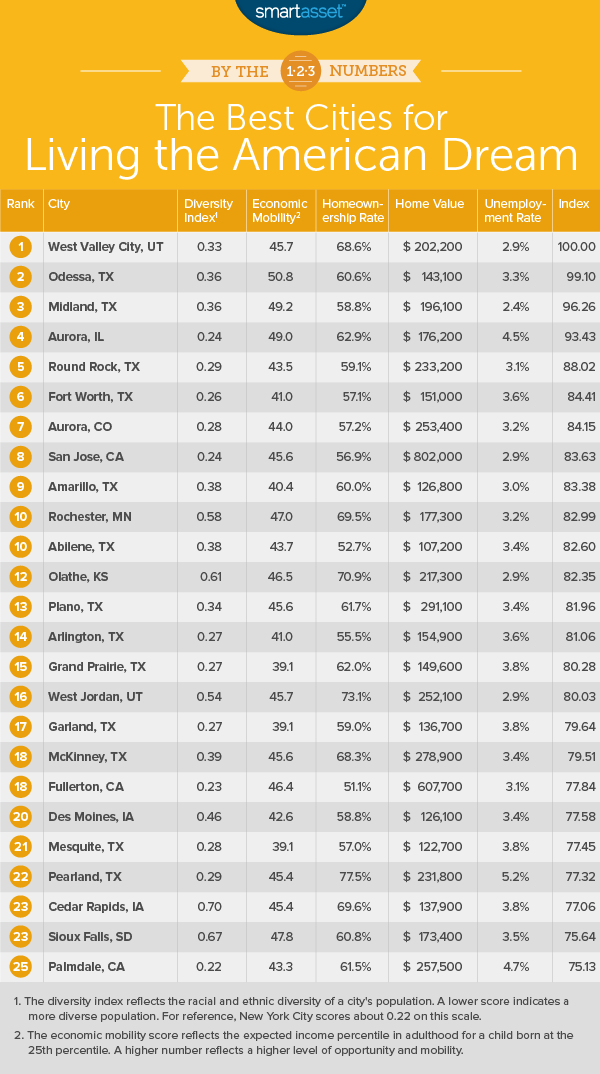
SmartAsset released their 2018 rankings for “The Best Cities for Living the American Dream.” Here are the top cities and the factors they used to develop the rankings:

Best Cities for Living the American Dream

Diversity score. To create this statistic, we looked at the population percentage of different racial and ethnic groups in each city. A lower number represents more diversity. Data comes from the U.S. Census Bureau’s 2016 1-year American Community Survey.

Economic mobility. This metric looks at generational change in economic position for families. A higher number shows greater mobility. Data comes from The Equality of Opportunity Project.

Homeownership rate. This is the percent of households who own their home. Data comes from the Census Bureau’s 2016 1-year American Community Survey.

Home value. This is the median home value in every city. For this study, a lower home value is considered better as we use it as a measure of affordability. Data comes from the Census Bureau’s 1-year American Community Survey.

Unemployment rate. This is the unemployment rate by county. Data comes from the Bureau of Labor Statistics and is for January 2018.

Several quick thoughts:

  1. The five measures seem to make sense. You could quibble with different aspects, such as measuring the unemployment rate at the county level rather than the city or metropolitan region.
  2. What would make sense to add to this list of five measures? There is no measure of educational achievement on this list and it might be interesting to consider the foreign-born population in each place (particularly since the foreign-born population is at a high in American history). Do lower taxes matter?
  3. The list is skewed away from two areas: (a) the East and West coasts and (b) the biggest American cities. I would imagine the coastal cities have difficulty with home values. However, it is less obvious to me why the biggest cities, particularly those in the South and Midwest, do not make the top of these rankings.
  4. How many Americans would give up where they currently live to move to one of these places that supposedly offers a better chance at finding the American Dream? Some experts suggest Americans should simply go where there are opportunities, whether these are jobs, cheaper housing, or less taxes. Yet, it is not necessarily easy to just pick and go, particularly to places like these that might not be very well known. (And, it could also be the case that a large influx of people to each of these top-ranked locations would influence these places.)

The number of dandelions in the yard as an indicator of social class

It is the time of year around here when dandelions are sprouting now that we have some warmer weather and rain. If you walk, bike, or drive around, it is not hard to spot stark differences between yards with no dandelions and those with a lot of dandelions. Here are some quick connections between the number of dandelions and social class:

  1. There are certain expectations in the United States, particularly in suburbs, about lawns. Americans are obsessed with lawns: it must be green (even under drought conditions), of a certain height (lest you violate local ordinances), and free of weeds. It is big business to help Americans keep their lawn looking good. Residents experience pressure from neighbors to keep their lawn nice. Even senators can be attacked for not keeping their lawn in a way that pleases the neighbors.
  2. Those with more money can more easily (a) pay for lawn care and treatments as well as (b) pay for lawn care products that they apply themselves. It is not necessarily cheap to keep a pristine lawn. It is not just a matter of avoiding dandelions but having lush greenery all around, consistency in the kind of grass, and a regularly manicured height.
  3. A nicer and larger lawn is connected to wealth and social class. It is a signal of the homeowner’s ability to tame and maintain nature. It supposedly shows they care about their property. It suggests they want to present a tidy image, which is always connected to property values.
  4. As a test of numbers 1-3 above, imagine trying to sell a decent priced house in a major metropolitan area where the yard is just covered in dandelions. Even if the house is in good shape, wouldn’t all those dandelions harm the image of the home? How many realtors would want to present an image of a lawn filled with dandelions to prospective buyers?
  5. Homeowner’s associations for townhouses, condos, apartments, and houses tend to do a good job of keeping dandelions in check. I assume this has to do with keeping up a positive appearance for the community. Fewer dandelions means a better image, more exclusivity, and higher rents or prices.
  6. The landscaping on our campus tends to look really good around graduation time when plenty of families and visitors are in town. The dandelions are largely in check.

In sum, I would suggest that the dandelion-free yard is yet another American status symbol. Just as people passing by might infer the social class of residents based on the size of the dwelling and the exterior appearance and the cars in the driveway, the number of dandelions may be used as a marker of social class.

(There certainly could additional factors that influence the number of dandelions in the yard. In addition to resources as noted above, addressing the dandelions requires time and physical ability which could be in short supply for a variety of reasons.)

“10 anti-McMansion design commandments”

Looking to avoid constructing or buying a McMansion? Here are four of “10 anti-McMansion design commandments”:

1. Thou shalt not build a house with turrets, as it is unlikely to be attacked by hostiles or provide shelter for a damsel in distress…

3. Thou shalt not build a house with a three-car garage as the dominant street-facing feature…

7. Thou shalt not build a house with seven gables when two would be more than enough.

8. Thou shalt not build a big, big house on a small, small lot.

There are two related themes in each of these commandments that goes beyond just avoiding features that are now associated with McMansions. Many of these commandments address two key issues: (1) proportionality and (2) unnecessary features. Regarding the first, specific features – windows, gables, garages – should not appear oversized compared to other features. (I supposed you could have a house where everything is outsized but then it could be criticized as cartoonish compared to normal-sized homes.) Additionally, certain features are not required such as turrets, tall columns, and expansive foyers.

The proposed solution to these McMansion sins is this: “good housing design really means keeping it simple, be the house big or small.” If this is followed to the letter, the simple counter to McMansions would be modernist houses or ranch homes. From the outside, these are simply boxes with limited ornamentation. But, for many, these homes may be too simple. They do not invoke traditional styles. Or, these simpler designs may be viewed as lacking character. They were built in large numbers during the postwar era and came to be associated with suburban sprawl. While McMansions are derided for their construction in more traditional neighborhoods, imagine a typical ranch plopped down in a neighborhood of Victorian homes or a modernist home within the typical suburban subdivision. Even with more reasonable sizes compared to McMansions, I would guess the neighbors would still have concerns.

Turning a large suburban office campus into a “metroburb”

There are plans in the works to transform the former 150-acre campus of AT&T in Hoffman Estates into a “metroburb”:

Village officials announced in mid-April that they were in talks with representatives of Somerset, who had recognized an opportunity to apply the lessons learned on their conversion of the 2 million-square-foot former Bell Labs building in Holmdel, New Jersey, into the mixed-use Bell Works project to the 1.6 million-square-foot AT&T buildings.

The key similarity apart from their overall sizes is the large central atriums both properties have, Somerset Development President Ralph Zucker said.

“All of our retail is facing that center court,” he said of Bell Works. “It’s really a vibrant street scene … literally a small downtown.”

Somerset’s concept plan proposes using the existing AT&T buildings for 1.2 million square feet of offices, 60,000 square feet of retail shops and 80,000 square feet of conference space, while new construction would add 375 apartments, 175 townhouse units and possibly a 200-room hotel.

Zucker said the term he coined for this concept at Bell Works — “Metroburb” — is one he hopes will become generally used among other developers.

Successful redevelopment of sizable properties is crucial to both cities and suburbs. Once companies make decisions to move away from existing properties, communities have two goals in mind. First, they need to find ways to make that land attractive to other users. Even a nice facility may not meet the needs of many other users or it may be sized wrong. Second, they often hope to turn the property into something that can generate more for the local tax base. At the least, property taxes are helpful but if retail can be incorporated into the property, sales tax revenue can be generated. The redevelopment proposed above seems to tackle both of these issues: it splits up the space into multiple desirable uses (and there are not that many single firms that need 1.6 million square feet) and has multiple uses (business, retail, and residential). This might have the bonus holy grail of redevelopment: the potential for a mixed-use property that could become a vibrant community on its own.

Given the initial use of this campus, it would be fun to see the AT&T history incorporated into the redevelopment. Bell Labs has an important research and development legacy in the United States and featuring its accomplishments could help set this redevelopment apart from other suburban palces that have less character or history.

City vs. suburbs in Nashville transit vote

An ambitious transit plan in the Nashville metropolitan area was roundly defeated by voters:

Had it passed, Let’s Move Nashville—the boldest municipal transit plan in recent memory—would have launched five light-rail lines, one downtown tunnel, four bus rapid transit lines, four new crosstown buses, and more than a dozen transit centers around the city. Depending on how you do the math, the scheme would have cost $5.4 billion or more like $9 billion, funded by a raft of boosted local taxes. More than 44,000 voters across Metro Nashville’s Davidson County came out in favor of the referendum, with more than 79,000 voting against it…

That’s a simplified version of the city’s politics, of course; while the vote fell broadly along urbanite versus suburbanite lines, a map reflecting the vote tally, and not just the vote result, would look more purplish. But not all that purplish. In the end, a vision for transforming transit in Nashville could not transform the politics of the city.

“There were a host of reasons [the proposal failed], like the cost ($9 billion), the scale (20 plus miles of light rail), the funding source (sales tax increase) and the financing structure (a decade of interest-only payments),” writes Emily Evans, managing director for healthcare policy for Hedgeye Potomac Research, in an email. Evans previously worked as a municipal financial analyst and served on the Nashville City Council for nine years.

A complicated plan like this has a lot of moving parts that voters could either support or vote against. At the same time, it can be a difficult sell for those outside the city core or in the suburbs to support mass transit plans that (1) they feel are not as necessary since they are able to drive where they need to go and (2) that might bring new people to their neighborhoods. When given a choice and their own personal resources, many Americans would prefer not to use mass transit, particularly if they would have to pay more for something they do not perceive helping them.

I would suggest this gets back to larger issues of whether regions really want to work together. Can cities and suburbs both thrive due to joint projects and shared resources? Or, is this a zero-sum game where resources can taken from one area and given to another in the same region is seen as a loss? The voters of Nashville remain to be convinced that mass transit is a big enough boon for themselves, let alone everyone.

McMansion ad campaign aimed at McDonald’s

Burger King has a new advertising campaign that shows off one particular feature of the purported McMansion backyards of McDonald’s executives:

Each of the company’s newest print ads, designed by an agency called DAVID Miami, claims to show what was once the lavish backyard of a real McDonald’s executive, the kicker being that each yard also appears to contain a grill.

“Flame grilling is hard to resist,” read the words printed over each grilling apparatus, the suggestion being that McDonald’s executives themselves preferred a flame-grilled patty…

AdAge reports that some of the photos were taken from real estate listings, meaning these particular grills may not have necessarily belonged to the “retired McDonald’s director” or “retired McDonald’s president” who may have used those backyards.

The primary emphasis is on the grill, a staple of many an American backyard. American homes and summer has long been associated with a male homeowner taking raw meat to the backyard and cooking it on the grill as the family plays and gathers around.

Of course, these are not just any grills or any homes. The news story includes three ad images. The grills look rather long – so they likely have more than four burners – and they have a stainless steel exterior. (In one image, there appears to be a Green Egg next to the stainless steel grill.) Given that these are grills supposedly owned by executives plus they are located at large homes, these are likely expensive grills.

Beyond tying McDonald’s executives to expensive grills, this also connects them to undesirable homes: McMansions. While the purpose of the ads is the grills, these grills are in front of expensive and large homes. But, they are not just mansions – they are McMansions. I’m not sure if there is a larger message here or not: should McDonald’s feel shame about having derided homes named after their restaurants (the Mc- prefix)? (Compared to the fast food of Burger King, this seems like a better pitch for places like Five Guys or Smashburger that would claim to have a more premium burger.) Does this suggest their executives have bad taste? Does this mean Burger King executives have nicer homes?


When sidewalks and paths are in bad shape

I was reminded by seeing Blair Kamin’s complaints about a path at Northerly Island in Chicago that the condition of sidewalks and paths can matter a lot for those who want to use them. A few thoughts about my experiences with local sidewalks and paths:

  1. On one hand, I grew up near and am still located near a tremendous bike path system: the Prairie Path. Originally an electric interurban line that closed for good in the late 1950s, local residents and officials started converting it into a recreational asset in the 1960s. The path is generally wide, covers dozens of miles with connections of other trails, and offers access to a number of communities and parks. On the other hand, riding a bike on the path can be frustrating at times, particularly in sections with more roads and tracks that need to be crossed (and there are other parts where one can ride much longer without interruption) as well as more pedestrians who are less speedy and often take up more of the path. Additionally, the path offers access between communities but one can often be stuck with limited options with roadways and sidewalks as soon as they leave the path.
  2. Nearly all suburban roads are built for cars. People like to drive fast. Not all roads, particularly in older parts of town, offer adequate space for pedestrians or bikes. Many drivers do not look for bikes or pedestrians.
  3. Sidewalks are sometimes present and sometimes not. I know this is often dependent on the regulations when the road was built but it can be confusing how sidewalks suddenly appear and disappear.
  4. Sidewalks that do exist are often in various states of repair. Some are really narrow. Cracks are common as are different angles and difficult ramps on and off streets. This may be something I am more aware of because I have a road bike that can be harmed by these imperfections as well as young children who can more easily trip on uneven surfaces. Hence, I would almost always rather ride in the road because the condition of the street is usually much better than the sidewalk.

In other words, life for non-vehicles in the suburbs can be difficult, particularly when the infrastructure provided for them is less than ideal. I get it; the suburbs are about cars. At the same time, without adequate opportunities for walking and biking, people will likely simply not try them as much. And this likely continues to fuel a car-driving, suburban society.

(If one wanted to go further, the New Urbanists place a lot of emphasis on street life and allowing residents to get to important places within a reasonable walk. They are usually referring to mixed-use neighborhoods where people are consistently on the sidewalks. Some newer subdivisions are full of walking and bike paths, though these may have few connections to anything outside the neighborhood. In other words, there are some people arguing sidewalks and paths are important – particularly those interested in vibrant street life or interested in boosting property values – but this has not trickled down to all suburban places.)