Cities that rise from the dead

With Easter today and Atlanta in the news, I was thinking of American cities that claim to have risen from the dead. The phoenix has been the symbol for Atlanta for over a century:
Photo by Josh Sorenson on Pexels.com

Like the Phoenix, Atlanta had risen from its own ashes following its destruction in 1864. Many times during the city’s history, Atlanta has redefined and reinvented itself, rising again as the city slogan, Resurgens, suggests. The “Atlanta Spirit” is another oft-referenced slogan describing an entrepreneurial and ambitious attitude that has shaped the city’s historical identity.

After the Great Chicago Fire of 1871, boosters and others were eager to rebuild:

On October 11, 1871, three days after the fire started that devastated the city, Bross’s Tribune proclaimed, “CHEER UP. In the midst of a calamity without parallel in the world’s history, looking upon the ashes of thirty years’ accumulations, the people of this once beautiful city have resolved that CHICAGO SHALL RISE AGAIN.”

Bross, who was an avid promoter of the city, predicted that Chicago would be rebuilt in five years and would reach a population of 1 million by the turn of the century, as Donald Miller reports in City of the Century.

There is an accepted narrative that the fire created a blank slate upon which Chicago was quickly rebuilt. That blank slate allowed it to become a dynamic city of innovative architecture with a fresh skyline dotted with a brand-new building called the skyscraper.

“The great legend of Chicago is that it’s a ‘phoenix city’ – it almost instantly rebuilt itself bigger and better from the ashes. And to a certain and significant extent, that’s true,” said Carl Smith, professor emeritus of English at Northwestern University and author of Chicago’s Great Fire: The Destruction and Resurrection of an Iconic American City.

And the city of Phoenix draws on the presence of people hundreds of years before:

Those former residents were industrious, enterprising and imaginative. They built an irrigation system, consisting mostly of some 135 miles of canals, and the land became fertile. The ultimate fate of this ancient society, however, is a mystery. The accepted belief is that it was destroyed by a prolonged drought. Roving Indians, observing the Pueblo Grande ruins and the vast canal system these people left behind, gave them the name “Ho Ho Kam” — the people who have gone…

By 1868, a small colony had formed approximately four miles east of the present city. Swilling’s Mill became the new name of the area. It was then changed to Helling Mill, after which it became Mill City, and years later, East Phoenix. Swilling, having been a confederate soldier, wanted to name the new settlement Stonewall after Stonewall Jackson. Others suggested the name Salina, but neither name suited the inhabitants. It was Darrell Duppa who suggested the name Phoenix, inasmuch as the new town would spring from the ruins of a former civilization. That is the accepted derivation of our name.

Many cities have faced crises, disasters, or unusual starts. Local histories and narratives can also emphasize positive moments (and downplay negative moments). The rising from the ashes, overcoming great obstacles, coming back to life, these are all powerful narratives for big cities. They imply success, progress, and hopefully growth.

What these narratives mean now may be harder to ascertain. What does the aftermath of the Chicago Fire mean for Chicago today? Is Phoenix still rebuilding a great civilization? More than 150 years after the Civil War, is Atlanta continuing to reinvent itself? A city rising from the dead once is impressive but it may be harder to pull off over decades of change.
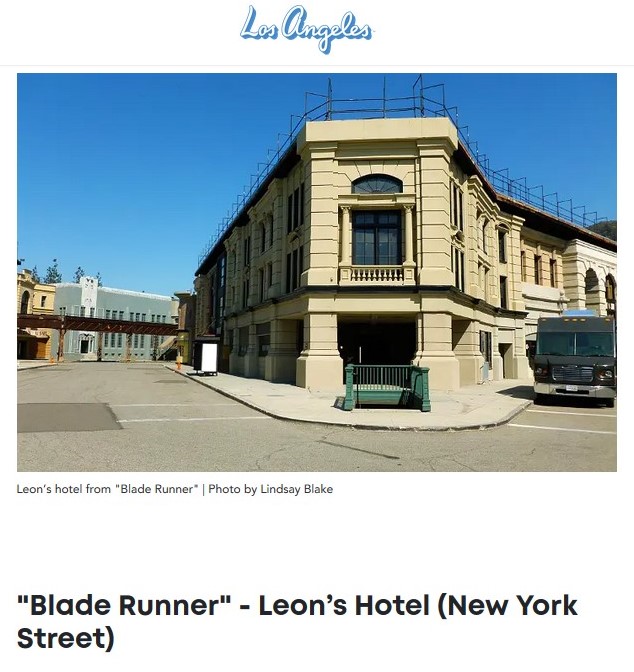
Have I have seen that building before…on a studio backlot?

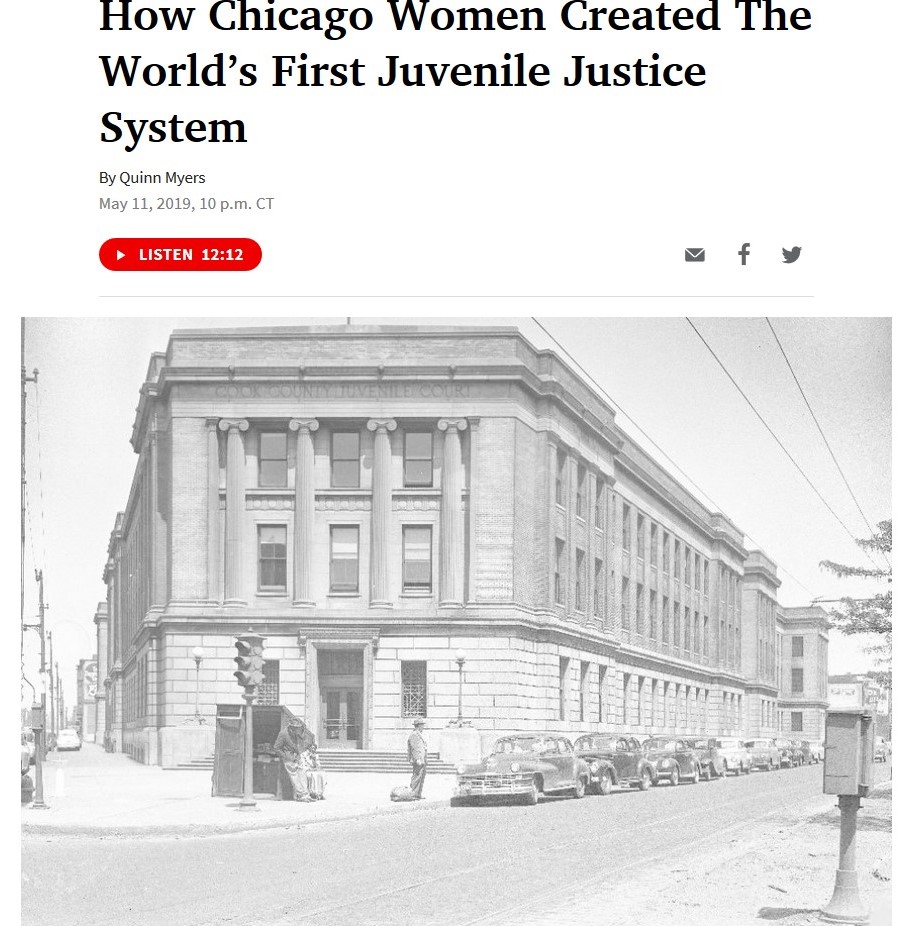
A recent WBEZ story highlighted the country’s first juvenile institution in Chicago. Here is the front of the building:

As soon as I saw this image, it reminded me of something I had seen on a tour years ago of the Warner Brothers backlot. Here is what I saw:

These buildings are not the same. But, their spirit is similar. They sit at an oddly-angled corner that gives the front entrance of the building a unique look. There are columns or pillars at the front. The buildings have a similar shape and set of materials even though they are slightly different. The backlot building has a subway entrance (from New York?) in front.

My experience with these structures hints at two larger processes at work:

  1. My memory is not quite perfect yet it is grouping similar buildings together. How many buildings in major American cities have this kind of look on this kind of corner?
  2. Linking to some of my research, how much do television and film depictions of place interact with our corporeal understandings of places? I can see a building on a screen, experience that same place or a similar place, and our brain and understandings then interact. Or, perhaps we may only know of a place through screen depictions and this backlot building in various forms stands in for all sorts of real settings.

I will keep looking for the Warner Brothers building on screen and continue to think through what it means for my understanding of Chicago, New York, and other places.

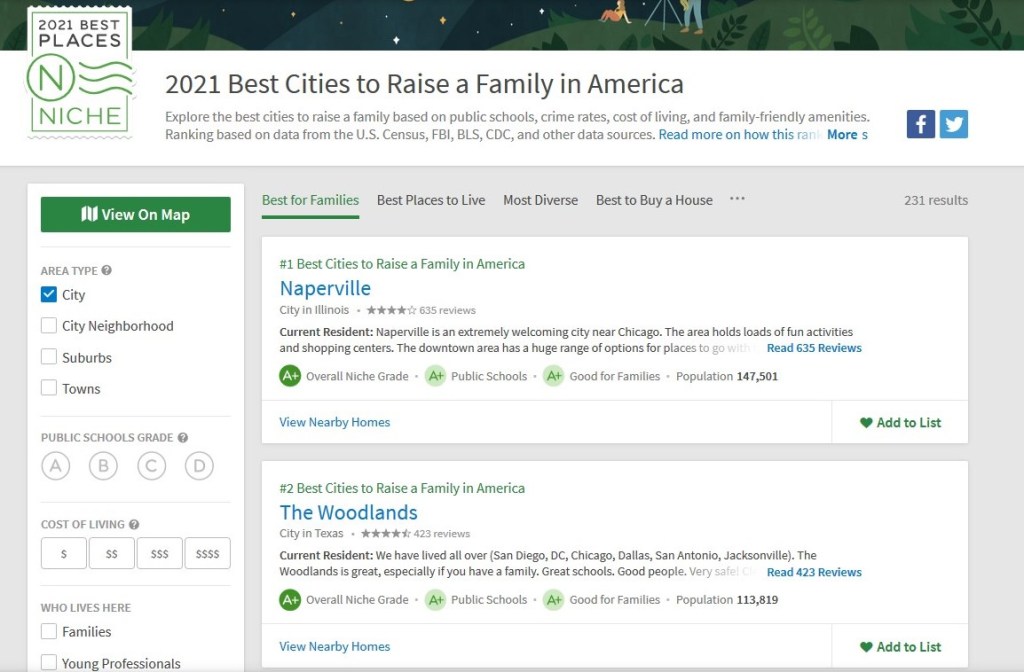
Naperville at #1 on several Niche.com Best Cities lists

Naperville adds to its rankings accolades with the new 2021 Niche.com lists:

Naperville was also ranked #1 for Cities with the Best Public Schools and #3 for Best Cities to Live in America. See previous posts about Naperville’s rankings: “wealthiest city in the Midwest” and “safest city over 100,000 residents.”

This ongoing praise for Naperville makes sense both for knowing the suburb as well as what sorts of communities make it to the top of these kinds of lists. Naperville grew tremendously in the final decades of the twentieth century but it also developed a high quality of life: vibrant downtown, highly-rated schools, local recreation opportunities, wealthy, and safe. The accolades have changed to some degree because the size of the community changed; for example, Naperville is the list of “cities” for Niche.com while the Best Places to Live in America tend to be smaller communities.

If you browse the Niche.com rankings just a little bit, you see wealthy suburbs from certain metro areas in the United States. That the same communities keep popping up on these lists year after year suggests they have an ongoing high quality of life but also it hints at what Americans – and people who make these rankings – think are desirable communities. Is the goal of American life to ascend to one of these well-off communities, most of them relatively white and wealthy suburbs?

The beauty of and danger to California’s Highway One

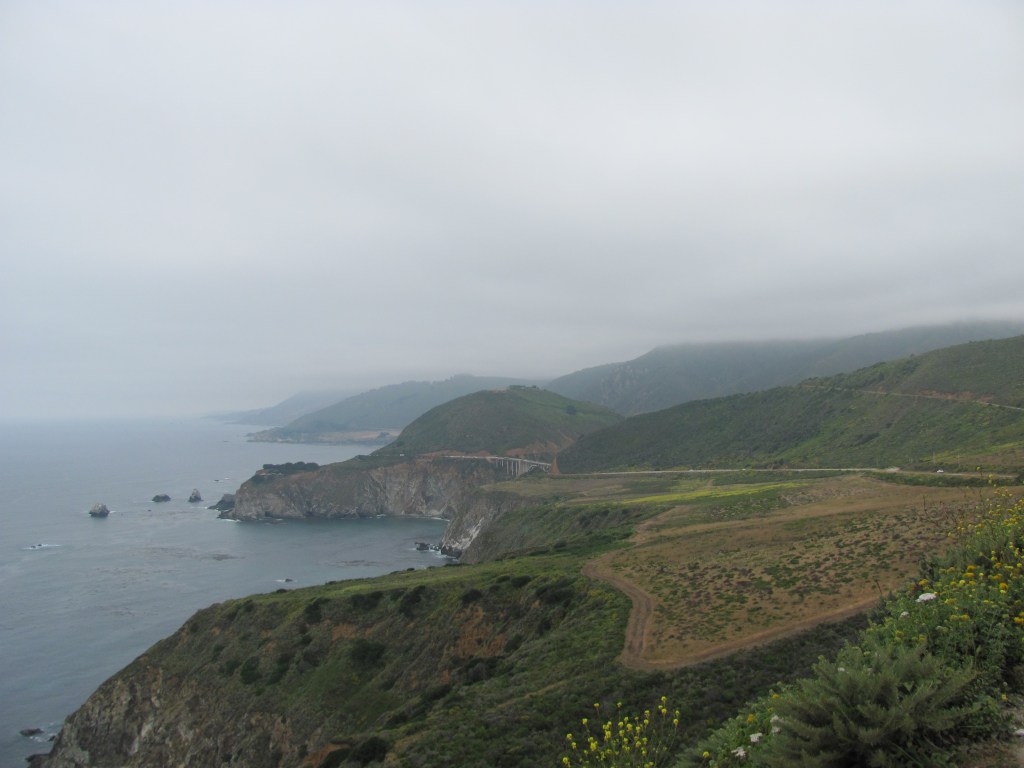
Over a decade ago, we planned a vacation that involved driving Highway One from San Francisco down the California coast. I had visited California several times before but had never driven this famous road. While our drive was relatively quick as we spent more time in urban centers, we enjoyed the scenery and the contrast of the roadway to typical straight Midwest roads.

With the recent washout in Big Sur, the need for constant reconstruction – and why – is interesting:

Highway 1 is a California spectacle, a Depression-era monument to the state’s quixotic ambitions and stunning beauty. It runs from the Orange County surf haven of Dana Point in the south into cannabis-cultivating Mendocino County, carrying heavy traffic over the Golden Gate Bridge and under the bluffs of Santa Monica, where it is better known as the Pacific Coast Highway, on its 650-mile route…

The engineering folly of a road built on sheer cliffs has meant that closures are annual events — the “whens,” not “ifs” — for the people and the economy it supports.

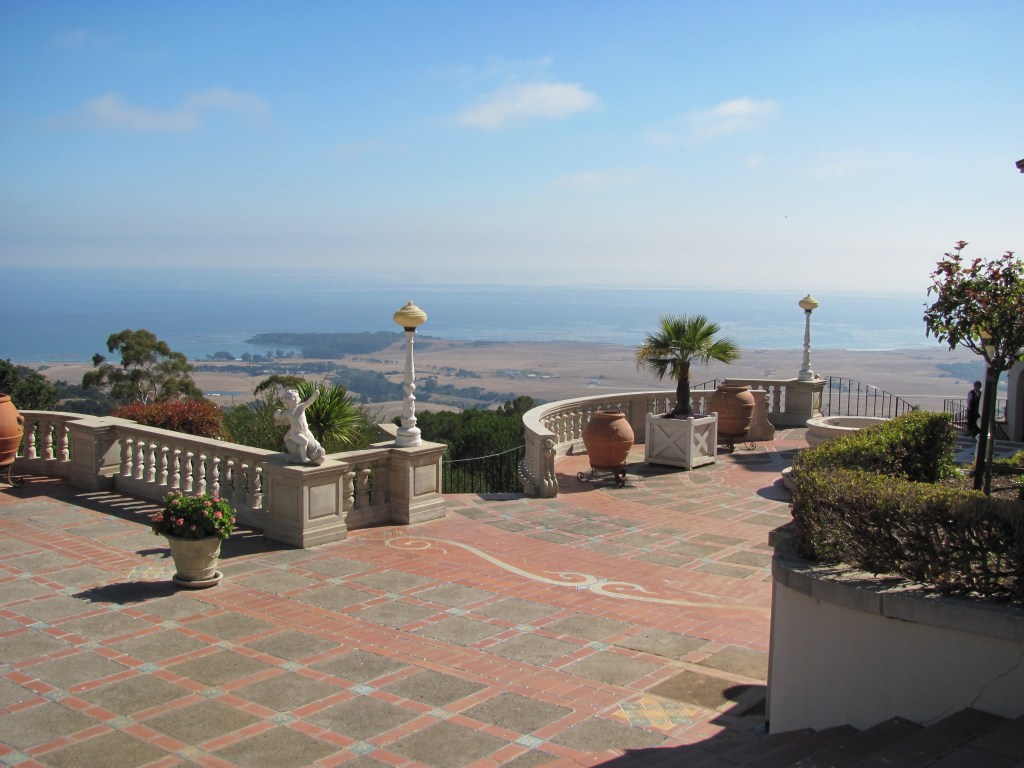
But the wild card now is the increasing frequency of wildfire along a roughly 100-mile stretch from William Randolph Hearst’s hilltop castle at San Simeon to Carmel, which is stripping fragile hillsides of stabilizing vegetation and causing more slides and more serious washouts across a region known broadly as Big Sur…

An even larger stretch of Highway 1 reopened in 2018 after a 14-month closure at Mud Creek about 20 miles south of here. The road was buried — not washed away, as in Rat Creek’s case — when the rocky ground above it gave way in hard rains.

This is one of the few times in my life where the road itself was a destination – and it was worth it. Keeping this corridor open is important even as it is a difficult stretch to maintain.

Bears stadium at Arlington Park? Just keep the taxpayers out of it

With the announcement that Arlington Park will be for sale, ideas are swirling about how the land could be used. I have heard a few times already the possibility of the Chicago Bears constructing a new stadium there. Here is one example:

The Loop from the North End of Soldier Field

Now it is urgently incumbent upon regional politicians and civic planners to begin a campaign to get a global-class Chicago Bears stadium built as a profitable symbol of the rebirth of the 326-acre site.

Fulfillment of such a bold and visioned plan would bring about a marriage of an NFL team and a suburb that was first discussed between “Papa Bear” George Halas and then-AP empress Marje Everett in 1968…

The question of “How?” can only be answered if there is an enormously creative and concerted joint effort put forth by such potential game changers as Bears chairman George McCaskey, Arlington Heights Mayor Tom Hayes and Gov. J.B. Pritzker…

Said Mayor Butts: “From my experience — and I’m talking about my suburb, which is 52 percent Hispanic, 47 percent Black and 1 percent ‘other’ — if you have an inspired plan, proper financing that does not put the host municipality at risk and a resolute ‘will-get-done’ attitude, toss in hard work and you can make a great thing happen.”

On one hand, this is a unique opportunity. It is rare for parcels of land this large to open up in suburbs developed decades ago. Filling a large parcel can be difficult; what can add to the existing community without threatening the current character? This particular location provides easy access to highways, easing travel for thousands of fans. The surrounding area is already used to sporting events on the sites. A suburb could become home to a major sports stadium.

On the other hand, the “creative and concerted joint effort” required to pull this off could become an albatross to taxpayers who often fund large stadiums for wealthy team owners. This is a tax break of massive proportions for a feature economists argue does not necessarily bring added economic benefits to a community. The stadium may provide status to a suburb but this does not always translate into financial gains. And Illinois has a history of this already: just see the state deal where taxes are still funding the White Sox stadium.

How to balance these competing perspectives? Many suburbs would jump at the opportunity as growth is good, having a pro sports teams is an important status symbol, and hearing the Bears are playing in Arlington Heights could be part of a branding strategy. But, I would recommend leaving the taxpayers out of this: they will likely not benefit economically from a new stadium.

Monopoly, racism in Atlantic City, and ongoing effects

The board game Monopoly papered over racism and residential segregation in the city and its legacy in that city and in New Jersey is ongoing:

Photo by Anete Lusina on Pexels.com

For white Americans, “Atlantic City, like all mass resorts, manufactured and sold an easily consumed and widely shared fantasy,” Bryant Simon, a history professor at Temple University and the author of Boardwalk of Dreams: Atlantic City and the Fate of Urban America, told me. “Southernness is used to sell that fantasy in the North,” he explained, pointing to marketing that focused on the stereotypically white, southern luxury of hiring Black laborers to shuttle visitors around in rolling chairs, wait on their tables, or otherwise serve them. Jim Crow, Simon said, existed everywhere. Around the time that Monopoly was taking hold in Atlantic City, ballots there were marked “W” for white voters and “C” for “colored” voters, Simon said. It would take countless demonstrations and protests and a long struggle by the city’s Black residents to secure their civil rights, but the Monopoly board records a world of ubiquitous racism.

Although Black residents and tourists could work at hotels such as the Claridge, between Park Place and Indiana Avenue, they were not permitted to dine or lodge there. Some hotels even offered white guests the option of having only white workers wait on them. Black employment was largely limited to the tourist industry, as political and municipal jobs were reserved for white residents.

Atlantic City’s Boardwalk staged minstrel shows, but Black people were largely barred from attending any form of entertainment on the famed Steel Pier. Schools in the area were segregated, clerks at many hotels did not check in Black tourists, and what antidiscrimination laws were on the books were not enforced, Simon said. If Black residents were found to be on a beach that wasn’t designated for Black patrons only, “it wasn’t just like they were run off,” Simon said. “They would be arrested. The police enforced segregation in the city.”…

The impact of the decisions made during Monopoly’s heyday is still felt today. Atlantic City is a “redlined epicenter” of the state, according to the New Jersey Institute for Social Justice, and it leads the state in foreclosures. The rate of white homeownership in New Jersey stands at 77 percent, but Black homeownership is scarcely half of that, at 41 percent. A typical Black family in New Jersey has less than two cents for every dollar of wealth held by a typical white family.

Monopoly is meant to be fun. Until it is not quite the same when we know more about the city behind the game. The game ignores the racial and housing discrimination elements of real life while the winner is a good capitalist who rode real estate luck and development to the top. Few, if any, games deal with this dimension of social life even as the patterns are long-established.

Similarly, the effects of these past actions are long-reaching. The wealth gap in the United States as a whole between white and Black households is roughly 9-10 to 1 so this larger gap in New Jersey is even more troubling. The state also has a long legacy of limited affordable housing as well as racial tension, illustrated in the Mount Laurel case and ongoing clashes in suburbia (see examples here and here).

Creating the antidote to Monopoly may only be able to go so far to remedy the historical record and improve conditions in New Jersey. Yet, at least knowing that there is more behind the story of Atlantic City and those who were not intended to be included in the game can help us remember which narratives carry the day – and which others could.

When new residents to an area bring a lot more money to spend on housing

A piece in the New York Times highlights what happens when residents from one part of the United States move to another. One aspect of this: the new residents can bring a lot of money with which to purchase a home.

Photo by Karolina Grabowska on Pexels.com

According to a recent study by Redfin, the national real estate brokerage, the budget for out-of-town home buyers moving to Boise is 50 percent higher than locals’ — $738,000 versus $494,000. In Nashville, out-of-towners also have a budget that is 50 percent higher than locals. In Austin it’s 32 percent, Denver 26 percent and Phoenix 23 percent.

As the commentary goes on to note, this means that prices in certain housing markets can then go up. New residents with resources compete with existing residents who may or may not be able to keep up. Several thoughts arise:

-Imagine current NIMBY practices at a national level instead of just at a local or regional level. The piece hints that people in multiple locations might want to restrict migration from California. Mass movements of people in the United States are not heard of and restrictions have been applied before.

-This presents an interesting conundrum for local officials and local planners. Growth is usually good. Until it is not the kind of growth local residents want or it is growth driven by outside forces. If communities want to grow and attract wealthier residents, are they also willing to accept the changes that might come?

-Just as some communities have requirements that developers of big projects pay fees or provide affordable housing, is there some way for a community to “tax” newcomers to help provide funds to offset changes?

-Do these patterns eventually lead to from a perpetual search for the new hot, lower cost of living location? Once Boise, Austin, and Nashville are different, what places come next – Omaha, Billings, Baton Rouge? This would take quite a while to work out but I do wonder how many attractive lower cost of living places there can be at any one time.

Selling Schaumburg, Illinois

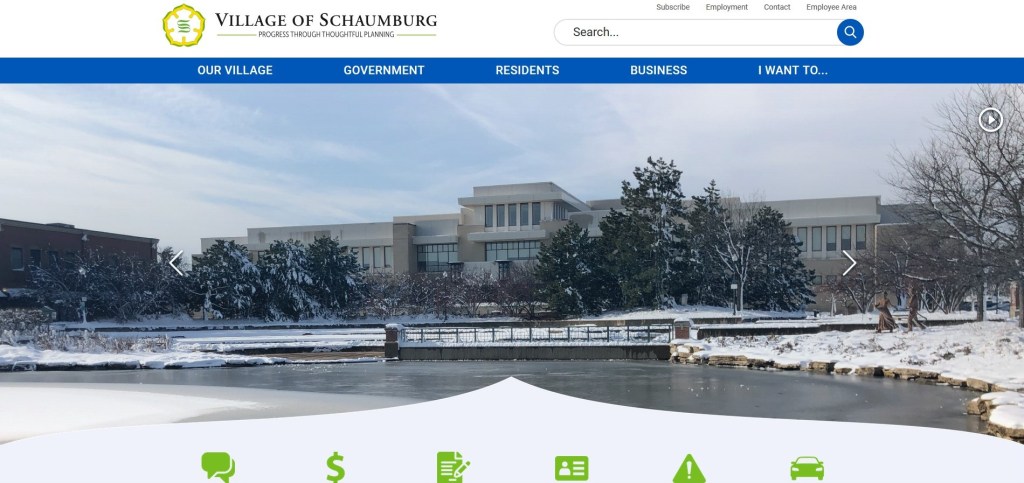
Schaumburg, Illinois, nearly 30 miles northwest of downtown Chicago, is a prototypical edge city. Home to Woodfield Mall, hundreds of thousands of square feet of office space, and over 70,000 residents plus located at the convergence of I-290, I-90, and IL-390, journalist Joel Garreau mentioned Schaumburg in his 1991 book Edge City: Life on the New Frontier. When I heard Schaumburg advertising on the radio, I wondered: is this an aggressive or a desperate move in these particular times? Where does Schaumburg fit among other Chicago suburbs also trying to get their name out there (examples here and here)? A few thoughts on this.

https://www.villageofschaumburg.com/

-Woodfield Shopping Mall is one of the largest in the United States. Even with numerous shopping malls struggling plus the problems of brick and mortar retailers, Woodfield will probably survive due to its size, location, and status. It may need to transform significantly – can it still support hundreds of stores? – but it is likely in good shape compared to numerous other Chicago area malls that are exploring new paths (other examples here, here, and here).

-Office space may be hard to fill. Schaumburg is not in a city; other suburban office parks have become less desirable in recent years with firms looking to appeal to young workers. Add the complications of COVID-19 when more workers are not going to the office. At the same time, many workers going to Schaumburg are doing so via car and they may be coming from relatively well-off suburban areas.

Growth is important to American communities. Like many edge cities, Schaumburg experienced explosive growth early in its history: it had 986 residents in 1960, in 1980 had over 53,000 residents, and peaked in 2000 at over 75,000 residents. Where does it go from here? Population loss and/or the loss of businesses would not be a good image for the community as it tries to chart a bright future.

Compared to other Chicago suburbs, Schaumburg is likely in good shape. At the same time, the growth and status of the past and present does not have to continue amid new social pressures and internal decisions. If Schaumburg is advertising in order to attract businesses, perhaps this hints at broader issues across suburbs: can they all succeed in what may be a challenging several year period?

“NYC isn’t dead”…for the wealthiest

A look at the ten most expensive properties sold in the United States in 2020 highlights the presence of New York City properties on the list:

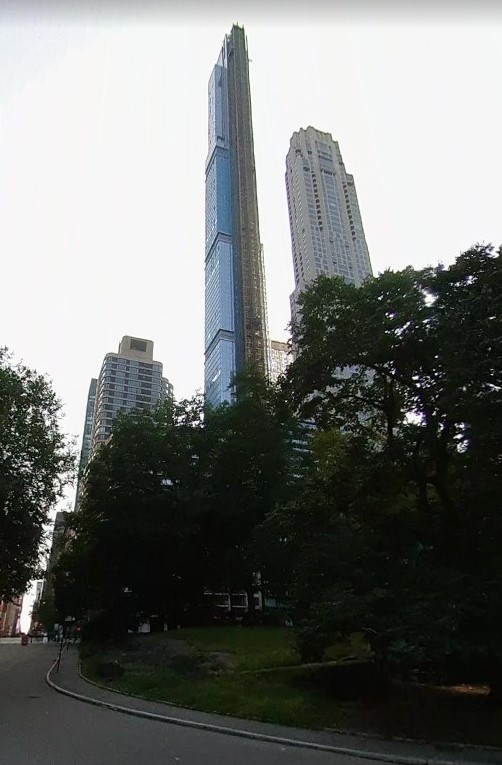
Google Street View image of 220 Central Park South (September 2020)

By the end of September, the volume of Manhattan co-op and condo sales was down 43% year over year, according to a report by Douglas Elliman, as sellers held back from listing their apartments and buyers increasingly gravitated toward the suburbs

Of the top 10 national sales compiled by Jonathan Miller, president and chief executive officer of Miller Samuel appraisers, five were in 220 Central Park South, a new luxury tower on Central Park designed by architects at Robert A.M. Stern

Another trend from this year, namely rich people “fleeing” New York for Florida, didn’t manage to trickle up to the highest tier. Only two of this year’s top 10 sales were in Palm Beach; last year there were three…

Even the three Los Angeles entries diverge slightly from conventional 2020 narratives. Yes, the L.A. market is one of the few urban bright lights this year, with sales soaring and inventory hard to come by. But numbers at the very top are down from last year, when it notched four entries in the top 10, totaling $463 million. This year there were three, totaling $293 million.

The actions of the wealthiest homeowners matters not only because people often have an interest in what those who have lots of money do with all that money; it matters because these are people with clout and influence. If they are continuing to purchase in New York City – it is less clear how much time the owners would necessarily spend in the city – it is a sign of the importance of the city and the prospects for future development.

The optics of 2020 might not be favorable to the list above but the project and the trends were underway far ahead of COVID-19. In a very expensive land and housing market, purchasing a residence in one of the newest buildings and in such a location within Manhattan is an object of desire for some who have the resources to purchase such places. While a figure later in the article notes that the total price for the properties on this list is lower than the price for the properties the year before, this may only allow the wealthiest to get into hot markets even more.

It may (or may not) be worth noting that five of the ten properties are in a tower in New York City while the other five properties are large homes on some land. On the whole, Americans as a whole tend to prefer or idealize single-family homes but the wealthiest in the United States and elsewhere may be more inclined to purchase large units in multi-unit buildings.

The new residential skyscrapers in Chicago continue to highlight capital flows and disparities

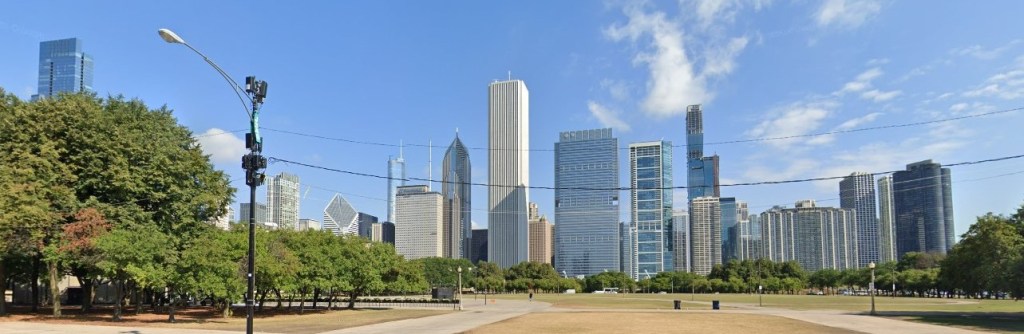
While reading reporting about skyscrapers going up in Chicago even during COVID-19, I continue to wonder: who is purchasing all of the residential units in times like these? Here is one example involving Chicago’s new third-tallest building.

Part of the Chicago skyline from East Jackson Drive – Google Maps

Located on a multilevel riverfront site at 363 E. Wacker Drive that belongs to the same Lakeshore East development as Aqua, Vista will house a 191-room hotel and 393 condominiums once it’s complete in the third quarter of next year.

For now, as COVID-19 rages and office cubicles remain empty, the tower sends the upbeat message that downtown has a future, and it’s not just for the 1%. Vista’s ground-level amenities will benefit ordinary citizens as well as those who can afford the tower’s condos, which start at around $1 million.

The entry point of $1 million means that the clientele for such a building is pretty restricted. The Chicago area is not a superheated real estate market like San Francisco or Manhattan or several other coastal cities yet tall residential buildings are meant for a select few.

On the other hand, another skyscraper project in Chicago might move to make their residential units available for rent rather than purchase:

The biggest Chicago skyscraper to have construction halted by the coronavirus pandemic could be revived in 2021 — as apartments instead of condos.

Unit layouts are being redesigned at 1000M, the Helmut Jahn-designed condo tower on South Michigan Avenue, in an effort to refinance the project and resume construction next year, “primarily as a rental project.”…

It was the largest condo development by unit count, at 421 units, launched in Chicago since the Great Recession all but shut down construction of condos in the city for several years. At 832 feet, it also would be the tallest Jahn-designed building in Chicago, where the German-born architect is based.

With rentals being in demand, this makes some sense in order to help get the project started again. At the same time, these rental units will not come cheap.

All of this residential construction suggests there is a lot of capital continuing to flow for prestigious building projects in desirable locations. COVID-19 might be a bit of a speed bump – whose impact will continue to be determined by its length – but big lenders, developers, and buyers still have an appetite for these prestigious residential units.

Focusing on the construction of these units can both help the public pay attention to where the money is really going as well as continue to highlight the disparities in development money by location. It is hard not to report on these new tall structures; they require a lot of effort and resources and will be part of a celebrated skyline for decades. Yet, within Chicago, as the skyscrapers continue to rise for the corporations and residents with plenty of resources, needs for housing and other development are very present elsewhere.