Bringing the cool parts of suburban life to urban settings

Can the suburban life be imported to residential units in the heart of the biggest American cities?

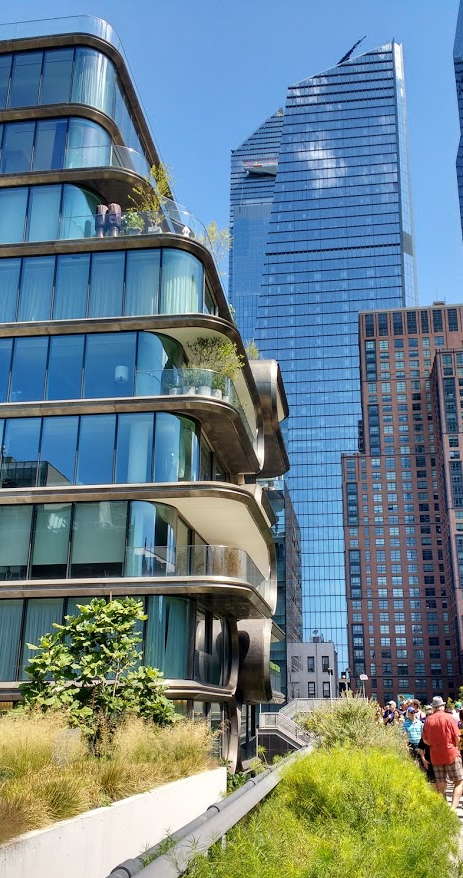
Your own slice of suburbia within city limits is a concept that developers and retailers across the country have been pitching a lot recently, subtly or not. The pendulum swings of socio-economic and demographic changes over the past two decades in some thriving cities are partly behind this shift…

The dividing line between urban and suburban limits has always been a little murky in most cities, many of which have their own vast stretches of single-family homes with attached garages. But the general idea was that the suburbs offered comfort and personal space, private backyards and a bedroom for each kid. City living was more exciting and offered culture and a more diverse mix of everything, but required some sacrifice. Apartments were smaller, parking a headache and a backyard unimaginable…

One of the Dahlia’s biggest selling points? It has its own parking garage. “You can pull in with your S.U.V., unload and take your things in a private manner,” said Shlomi Reuveni, the president of the company that is handling sales for the building. “That’s very appealing.” And very suburban.

In some high-end buildings, architects are giving apartments the feel of single-family homes by replicating the layouts of suburban houses. At the Quay Tower, which overlooks Brooklyn Bridge Park, there are just five condos on each floor, two of which have private elevator access. Inside, the larger units have something you see a lot of on HGTV suburban house renovation shows: large mudrooms off the back door with locker-like cubbies and sturdy ceramic-tile floors.

As the article goes on to note, more suburban features like mall food courts and white people are headed to cities.

On one head, the melding of lifestyles is not too surprising. In the suburbs, a “surban” lifestyle helps developers and residents differentiate their product and life from the typical suburban lifestyle. Both producers and consumers can seek out new niches.

On the other hand, that the suburban lifestyle may be a selling point is kind of funny because of all the flak the suburban life takes. I thought the suburbs were about exclusion, homogeneity, wastefulness, and individualism? It is not just that some of these features of suburban life have urban analogues. After all, they are both situated within American culture. The idea that certain suburban features, such as garages or mudrooms, will be replicated in cities flies against the claims about tacky suburban life. Suburban consumer goods and lifestyle markers are now cool?

Americans consume more media, sit more

A recent study shows Americans are sitting more and connects this to increased media usage:

That’s what Yin Cao and an international group of colleagues wanted to find out in their latest study published in JAMA. While studies on sitting behavior in specific groups of people — such as children or working adults with desk jobs — have recorded how sedentary people are, there is little data on how drastically sitting habits have changed over time. “We don’t know how these patterns have or have not changed in the past 15 years,” says Cao, an assistant professor in public health sciences at the Washington University School of Medicine.

The researchers used data collected from 2001 to 2016 by the National Health and Nutrition Examination Survey (NHANES), which asked a representative sample of Americans ages five and older how many hours they spent watching TV or videos daily in the past month, and how many hours they spent using a computer outside of work or school. The team analyzed responses from nearly 52,000 people and also calculated trends in the total time people spent sitting from 2007 to 2016. Overall, teens and adults in 2016 spent an average of an hour more each day sitting than they did in 2007. And most people devoted that time parked in front of the TV or videos: in 2016, about 62% of children ages five to 11 spent two or more hours watching TV or videos every day, while 59% of teens and 65% of adults did so. Across all age groups, people also spent more time in 2016 using computers when they were not at work or school compared to 2003. This type of screen time increased from 43% to 56% among children, from 53% to 57% among adolescents and from 29% to 50% among adults…

The increase in total sitting time is likely largely driven by the surge in time spent in front of a computer. As eye-opening as the trend data are, they may even underestimate the amount of time Americans spend sedentary, since the questions did not specifically address time spent on smartphones. While some of this time might have been captured by the data on time spent watching TV or videos, most people spend additional time browsing social media and interacting with friends via texts and video chats — much of it while sitting.

Does this mean the Holy Grail of media is screentime that requires standing and/or walking around to avoid sitting too much? Imagine a device that requires some movement to work. This does not have to be a pedal powered gaming console or smartphone but perhaps just a smartphone that needs to move 100 feet every five minutes to continue. (Then imagine the workarounds, such as motorized scooter while watching a screen a la Wall-E.)

Of course, the answer might be to just consume less media content on screens. This might prove difficult. Nielsen reports American adults consume 11 hours of media a day. Even as critics have assailed television, films, and Internet and social media content, Americans still choose (and are pushed as well) to watch more.

Coldwell Banker’s map of Chicago area locations missing parts of Chicago

A Coldwell Banker insert in the Chicago Tribune included a map and listing of all their Chicago area locations (zoomed in portion below):

ColdwellBankerChicagoMap060219.jpg

It is easy to see all of the suburban locations, particularly in the north and west suburbs. In contrast, check out the city map. From my count, there are seven Chicago Coldwell Banker agencies. Five of these are on the north side. Two are not: one in the West Loop and one in Hyde Park.

But, the Chicago map does not just show disparate locations. It is not an accurate map. The city is oddly shaped. Let me count the ways:

  1. It has an oddly drawn western edge that happens to make the south side much smaller.
  2. The west and south sides do not exist in their full form compared to the north side which looks like it has the biggest area.
  3. The West Loop location should be roughly in the center of the city – it is not. The size of the south side is diminished.
  4. The locations in Chicago have a weird relation to each other. Why are the West Loop and Hyde Park locations so close to each other? According to Google Maps, they are an over 8 mile drive away from each other. Yet, Google Maps suggests the West Loop and Lincoln Park locations are roughly 3 miles apart.

Perhaps this is a function of making a map with labels (the text all has to fit). Or, this may be about marketing: Coldwell Banker has particular clients and they want to highlight their proximity to those potential customers.

Yet, the map severely distorts Chicago. As noted above, the west and south sides do not fully exist. Recent Chicago maps aimed at particular audiences have done this before. This map also hints at the relationship between real estate practices and decades-long discrepancies in where people in the region live. Real estate professionals are not passive bystanders in residential segregation; they were active participants working alongside lenders and governments. Homeownership today is still not completely a free market and is more available to some Americans than others. Coldwell Banker does not have locations in certain places and this likely has ties to race, ethnicity, and class as well as practices and patterns developed over decades.

I am not asking that Coldwell Banker open locations in certain places. I am asking for an accurate map that clearly shows where Coldwell Banker is and where it is not.

(And for those who think I am reading too much into this, my starting position is this: I assume race is a causal factor in American social life until shown otherwise, not vice versa.)

The rise of beach McMansions in New Jersey, Florida

Large homes are not just for suburban locations. Two recent pieces highlighted their role in changing beach communities. First, from New Jersey:

Decades ago, when I was a teenager, I rented a surf shack in the then-humble town of Beach Haven on the New Jersey shore. Four of us crammed into a squat cinder-block hut tucked behind a bungalow. We worked as lifeguards for $2.50 an hour. Still, our rent was only $187.50 each for the summer. We had a place to sleep, shower, and create memories. We didn’t need more…

But there is another less visible cost that rarely gets mentioned when Americans talk about coastal development and risks. Since the modern coast emerged after the Second World War, a series of land bubbles have wildly inflated land values, to the point that many ordinary families can no longer afford to live at the coast, or even afford a weekly summer rental. On Long Beach Island, a popular resort in Ocean County, where I worked as a lifeguard, $15 billion worth of property now crowds a narrow, 18-mile-long shoreline. The average price of a new home is about $1.1 million, with many costing millions more. Rentals run as high as $5,000 a week. Yet, paradoxically, the island was conceived by Morris Shapiro and other developers as an enclave for middle-class and blue-collar families – teachers, plumbers, electricians, and so forth…

I suppose it is unsurprising there are few, if any, surf shacks left. Most beach towns have been supersized. But unanticipated costs have come with that growth. High school and college students have few places to live and the labor pool for lifeguards, waitresses, hotel workers, amusement-ride operators, and so on has shrunk dramatically. Many shore towns now rely on a special federal visa program to supply summer help. Workers come from Eastern Europe, Ireland, even Australia. Even so, some businesses have been forced to cut hours or even close.

The change over multiple decades is drastic.

And from the Gulf Coast of Florida:

Anna Maria Island may be largely built-out, but that hasn’t stopped developers from buying older existing homes, tearing them down and replacing them with new high-end homes…

Officials in the cities of Anna Maria, Holmes Beach and Bradenton Beach say it is a worrisome long-term trend and that they are doing their best to maintain the island’s unique character and sense of place…

Stephen Gilbert, building official for the city of Bradenton Beach, said the land is often much more valuable than the existing older home that sits on the lot.

Of the new homes built in the last decade in Bradenton Beach, only a couple were intended as homes for the owners. The others were intended as investments to be quickly turned over for more cash, he said.

While the change here has come more recently, it sounds like a similar process: people with money and/or an interest in investments come in, tear down older homes, and construct beach McMansions. This has happens over a sustained period of time and the feel of neighborhoods and communities changes.

These changes certainly have local effects on hundreds of beach communities across the United States but there are larger processes at work. Are the big homes the cause or the symptom of bigger issues? The nature of real estate capital today plus the rapid rise in real estate values puts even small communities at the mercy of global markets. Communities can respond but turning down big amounts of new money is not easy and often requires significant opposition from local residents and leaders.

Predatory contracts took $3-4 billion from blacks in Chicago

A recent study looked at the financial cost of contract buying for two decades for black homeowners in Chicago:

Black families in Chicago lost between $3 billion and $4 billion in wealth because of predatory housing contracts during the 1950s and 1960s, according to a new report released Thursday.

The Samuel DuBois Cook Center on Social Equity at Duke University and the Nathalie P. Voorhees Center at the University of Illinois-Chicago sought to calculate the amount of money extracted from black homeowners on the city’s South and West sides from home contract sales. The report is titled “The Plunder of Black Wealth in Chicago: New Findings on the Lasting Toll of Predatory Housing Contracts.”

Contract buying worked like this: A buyer put down a large down payment for a home and made monthly installments at high interest rates. But the buyer never gained ownership until the contract was paid in full and all conditions were met. Meanwhile, the contract seller held the deed and could evict the buyer. Contract buyers also accumulated no equity in their homes. No laws or regulations protected them.

Home contract sales were a ruthlessly exploitive means of extracting capital from African Americans with no better alternatives in their pursuit of homeownership, the report said. Contract loans were rampant all over the West Side — in East Garfield Park, West Garfield Park and North Lawndale — but also in Englewood on the South Side.

The key here is that wealth generated through homeownership is the sort of asset that gets passed down over time and helps build intergenerational wealth. Many Americans today rely on this same logic: owning a home is a significant investment to draw on later in life. That wealth then enables other possibilities, such as education or moving or acquiring other goods. This long-term wealth goes far beyond the benefits a homeownership has while living in that home; the wealth enables possibilities for future generations.

As one study puts it:

If public policy successfully eliminated racial disparities in homeownership rates, so that Blacks and Latinos were as likely as white households to own their homes, median Black wealth would grow $32,113 and the wealth gap between Black and white households would shrink 31 percent. Median Latino wealth would grow $29,213 and the wealth gap with white households would shrink 28 percent.

Earlier public policy decisions and social practices can have long-term consequences, even decades later.

Mutant statistic: marketing, health, and 10,000 steps a day

A recent study suggests the 10,000 steps a day for better health advice may not be based in research:

I-Min Lee, a professor of epidemiology at the Harvard University T. H. Chan School of Public Health and the lead author of a new study published this week in the Journal of the American Medical Association, began looking into the step rule because she was curious about where it came from. “It turns out the original basis for this 10,000-step guideline was really a marketing strategy,” she explains. “In 1965, a Japanese company was selling pedometers, and they gave it a name that, in Japanese, means ‘the 10,000-step meter.’”

Based on conversations she’s had with Japanese researchers, Lee believes that name was chosen for the product because the character for “10,000” looks sort of like a man walking. As far as she knows, the actual health merits of that number have never been validated by research.

Scientific or not, this bit of branding ingenuity transmogrified into a pearl of wisdom that traveled around the globe over the next half century, and eventually found its way onto the wrists and into the pockets of millions of Americans. In her research, Lee put it to the test by observing the step totals and mortality rates of more than 16,000 elderly American women. The study’s results paint a more nuanced picture of the value of physical activity.

“The basic finding was that at 4,400 steps per day, these women had significantly lower mortality rates compared to the least active women,” Lee explains. If they did more, their mortality rates continued to drop, until they reached about 7,500 steps, at which point the rates leveled out. Ultimately, increasing daily physical activity by as little as 2,000 steps—less than a mile of walking—was associated with positive health outcomes for the elderly women.

This sounds like a “mutant statistic” like sociologist Joel Best describes. The study suggests the figure originally arose for marketing purposes and was less about the actual numeric quantity and more about a particular cultural reference. From there, the figure spread until it became a normal part of cultural life and organizational behavior as people and groups aimed to walk 10,000 steps. Few people likely stopped to think about whether 10,000 was an accurate figure or an empirical finding. As a marketing ploy, it seems to have worked.

This should raise larger questions about how many other publicly known figures are more fabrication than empirically based. Do these figures tend to pop up in health statistics more than in other fields? Does countering the figures with an academic study stem the tide of their usage?


When growing rural communities are reclassified as urban communities

James Fallows points to a Washington Post piece that discusses the reclassification issue facing numerous rural communities:


A few years after every census, counties like Bracken are reclassified, and rural or “nonmetropolitan” America shrinks and metropolitan America grows. At least on paper. The character of a place doesn’t necessarily change the moment a city crosses the 50,000-resident mark…

The sprawling, diverse segment of the United States that has changed from rural to urban since 1950 is the fastest-growing segment of the country. Culturally, newly urban areas often have more in common with persistently rural places than with the biggest cities. Most notably, in 2016, Hillary Clinton would have won only the counties defined as urban when the metropolitan classification began in 1950, while Donald Trump would have won every group of counties added to metropolitan after the initial round….

About 6 in 10 U.S. adults who consider themselves “rural” live in an area classified as metropolitan by standards similar to those used above, according to a Washington Post-Kaiser Family Foundation poll conducted in 2017. And 3 in 4 of the adults who say they live in a “small town”? They’re also in a metro area…

If rural Americans complain of being left behind, it might be because they literally are. In government statistics, and in popular conception, rural is defined as what’s left after you have staked out all the cities and their satellites.

This is a measurement issue. What exactly counts as an urban, suburban, or rural area? This is a question I frequently field from students but it is more complicated than it looks.

My short answer: everything in between larger central cities and rural areas is a suburb.

My longer answer: metropolitan regions (encompassing the suburban areas around central cities) are drawn with county boundaries, not municipal boundaries. This means an entire county might be part of a metropolitan region but significant portions of the county are still rural.

My longer longer answer: the official boundaries do not truly capture a suburban way of life. This could be mimicked in numerous urban neighborhoods that contain single-family homes, yards, and families as well as more rural communities.

All of this may help explain why Americans tend to say they like or live in small towns even when these communities are not, by certain measures, not small towns.

The last quoted paragraph above is also intriguing: is rural truly whatever is leftover outside of metropolitan areas? At the start of the twentieth century, the vast majority of Americans lived outside cities and suburbs. As urban and suburban populations swelled, so did their geographic area. It is hard not to think that we still have not quite caught up with these major changes in spaces and communities a little over one hundred years later.

What suburbs want when they say they want a second downtown

After reading several recent stories about suburbs desiring or planning a second downtown, I wanted to summarize what exactly they mean by a “second downtown.” Here are a few of the patterns at work:

1. Downtown in this case tends to imply a sort of walkable, cozy, family-oriented place full of small businesses and eateries. There is an atmosphere invoked here that is the opposite of shopping malls surrounded by parking lots or mile after mile of strip malls. Still, since this is the second downtown and likely to be located some distance away from an original and/or historic downtown, this new downtown will not look like the old downtown.

2. This second downtown location is intended to be a center of commerce, and, perhaps more importantly, a second major center of revenue for the community. This goes beyond just property taxes as the suburb often desires sales tax revenue.

3. Simply creating a second downtown and all that implies is not easy. A typical formula is a sort of walkable outdoor shopping area where someone could park in one location and then walk among stores and other interesting places. A fuller vision might include mixed uses where new enterprises and new residences help create a kind of neighborhood synergy. A second downtown is often very intentionally planned though not easy to pull off.

4. The location of an intentional second downtown is less likely to be in the middle of a suburb – the suburb can often grow around an original downtown – and more likely to be located at the intersection of several major roads. This may be good for access and trying to divert heavy flows of traffic but it may not be conducive to promoting walkability and a more permeable membrane with nearby residential areas.

Perhaps the planned second downtown in a suburb can work but it is not an easy space to develop.

Just how many church-to-residences conversions are taking place?

If churches and other religious buildings present attractive opportunities for redevelopment in urban neighborhoods, how often does this happen?

I hope someone is tracking all of these switches from religious structures to residences. The impetus to collect this data could come from multiple sources. An organization might want to look at changes in a neighborhood or geographic area. An organization of developers or architects might see this as a business opportunity. A researcher could be interested in housing changes, particularly from an unusual source like unused religious buildings. Presumably, this kind of housing does not go for cheap and could exacerbate existing issues in urban areas. Communities themselves might want to know how many religious buildings are being converted. This could affect tax rolls – moving property from non-taxpaying religious groups to residents brings in more tax money – and nearby residents could be affected.

From what I can gather, these conversions are happening at a regular pace. Yet, it is hard to track the scale from the occasional article. My own research on long-standing church buildings in the Chicago area did not find many churches that became residences. Indeed, former churches could fill a range of uses: the most common was a religious buildings for another religious group but churches could also be reused as daycare facilities, community centers, and offices.

Based on this, I would guess there are not that many churches being turned into residences in terms of sheer numbers. At the same time, of the religious buildings that are sold, I would guess a good number are converted into residences when located in more desirable neighborhoods (though I am sure some buildings are also demolished to make way for new residential buildings).

Forces behind church-into-residences conversions

The conversion of religious buildings into residences continues in many American cities. This is the result of at least three larger forces:

  1. The decline of numerous religious groups which means religious buildings are no longer used for worship. This decline has been going on for decades in a number of denominations, freeing up numerous churches and other structures.
  2. The demand for housing in many urban neighborhoods. While the converted residences are not often cheap, they are often in desirable neighborhoods and locations. The same reasons religious groups chose particular locations also can make them attractive for residents. (The flip side is that religious buildings in less desirable neighborhoods can languish.)
  3. The unique architectural features a religious building can provide including tall vaulted ceilings, stained glass windows, and brick and stone work. These features can be incorporated into new dwellings and provide very different options compared to new construction.

For example, a recent Chicago Tribune piece about a former church in Logan Square highlights these issues:

The historic Episcopal Church of the Advent was built in 1926 by renowned architect Elmer C. Jensen, who designed and engineered more than two dozen of the city’s early skyscrapers. The church closed in 2016 due to dwindling membership.

In preparation for its second life, the building interior was mostly gutted, and the space was subdivided. Stained glass art windows, ornate chandeliers, decorative millwork, and stone arches and columns are among the retained features. In one apartment, a stone altar acts as the base for a kitchen island. In another, wainscoting was installed to complement the existing millwork. The church exterior was preserved in entirety…

All nine apartments in the converted church are one of a kind and configured with either two or three bedrooms. Three apartments are on the main level of the church, and three apartments are on the garden level. Three more are stacked within the former attached rectory behind the church. The first residents arrived in April…

“People can say it’s a really cool building, but if it doesn’t have closet space or if it doesn’t have a washer and dryer or room for their couch, it’s not going to work for them,” he said.

A recently closed church and sold building plus a desirable neighborhood plus interesting building details equals a redevelopment opportunity.

But, just how many of these conversions of religious buildings are taking place? This is the subject of tomorrow’s post.