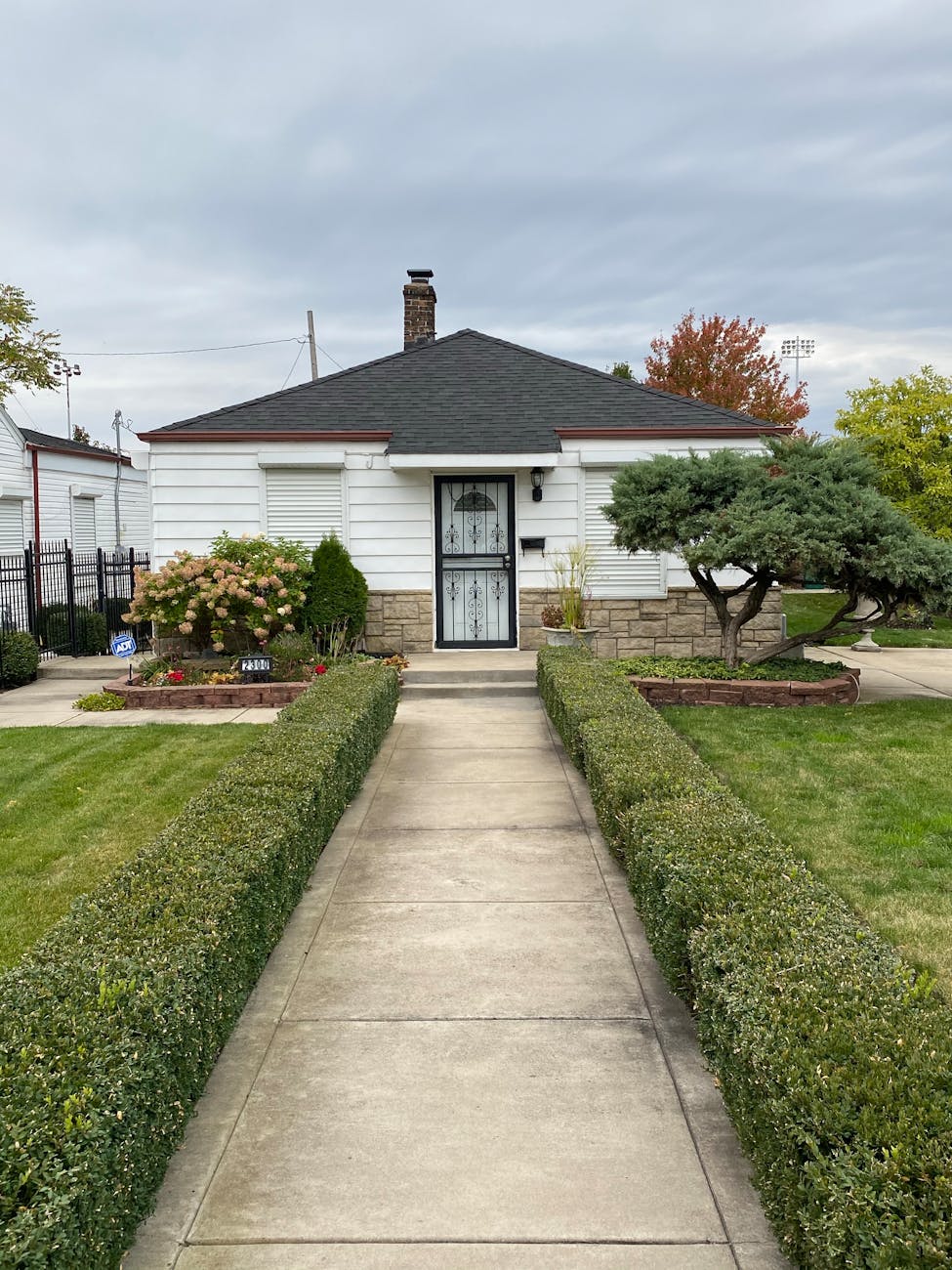
Leaving a bit of your self in a childhood suburban home

One writer contemplates her feelings regarding her suburban home in which she grew up:

Photo by Suzy Hazelwood on Pexels.com

If home is “where the heart is” or “wherever I’m with you,” I should be fine with my mom moving anywhere—especially to a nearby apartment, as she plans to, where she’ll doubtless have a place for me to sleep whenever I want. Instead, any mention of a future sale prompts an ache akin to the homesickness I felt as a kid at summer camp—except that now I ache for my future self. I imagine her standing outside that suburban New Jersey house, pacing back and forth, insisting that some piece of her remains in this one edifice on a certain corner of a specific street, even though she hasn’t lived there for decades…

Going home can be a much more effective way to time travel. Our past isn’t just preserved in knickknacks and memorabilia; it lingers in the spaces we once occupied. When we talk about our experiences, we often focus, understandably, on the people who’ve shaped us, and we “treat the physical environment like a backdrop,” Lynne Manzo, a landscape-architecture professor at the University of Washington, told me. But setting can be its own character; it colors our day-to-day, and we endow it with agency and meaning. If social interactions and relationships are the bricks constructing our identities, our surroundings are the scaffolding.

Setting is also central to how we remember. Recalling events (as opposed to information) involves “episodic memory,” which is deeply tied to location. Many researchers, in fact, believe that episodic memory evolved to help us physically orient ourselves in the world. (One very sad study—partial title: “Implications for Strandings”—found that some sea lions with damage to the hippocampus, the hub of episodic memory, get lost and wander ashore.) When you’re in a given space, your brain tends to “pull up the relevant memories” that happened there—even ones that have long been dormant, Charan Ranganath, a neuroscientist and the author of Why We Remember: Unlocking Memory’s Power to Hold On to What Matters, told me. People remembering a specific moment can even demonstrate what Ranganath called a “reboot” of the brain-activity patterns they showed during the original event.

But without the physical space to visit, it can be hard to mentally transport yourself back. When the 19th-century French writer Stendhal wrote his memoir The Life of Henry Brulard, detailing a difficult and lonely childhood, he drew the places of his youth again and again, in an obsessive attempt to spur his memory. “Winding staircase—Large, cheerless courtyard—Magnificent inlaid chest-of-drawers surmounted by a clock,” he scrawled under a sketch, as if the incantation might apparate him to his grandfather’s imposing Grenoble townhouse. Yet his recollection remained, as he put it, like a fresco, solid for stretches and elsewhere crumbling apart.

I am interested here in the powerful connection to a suburban home. Little is said about this home that might differentiate it from other New Jersey suburban homes. There are millions of Americans who could have similar positive memories about their suburban homes.

At the same time, critics of suburbs argue these homes are not worth much. They are cookie-cutter. Tract homes. Poor quality. Big but empty of meaning and purpose.

We are physical beings whose memories and emotions are tied to particular places. It is easy in our current age to forget our embodied lives amid social media, travel, and ideas.

Since the majority of Americans live in suburbs, presumably many have at least some positive memories about their suburban homes. This could happen in McMansions, homes derided for multiple reasons, or split-levels.

The suburban homes that might look from the outside to be similar can also be settings where millions of people develop important memories in their life.

The amount of grass lawn in the US matches the size of this state

The United States has a lot of grass lawns. What does this add up to?

Photo by rovenimages.com on Pexels.com

Lawns represent one of the largest, fastest growing landscapes in the U.S. These ecosystems — water-hungry, energy-intensive monocultures — extend far beyond the picket fence, including highway medians, cul-de-sacs, corporate office parks. De facto lawns also exist under solar arrays, on soccer fields, and in city parks. In the U.S., it’s a landmass that, by some estimates, covers an area about the size of Iowa.

I am not sure if this sounds like an impressive comparison or not. How big is Iowa? It is the twenty-sixth largest state by land area. That’s a good amount of space. Yet Iowa accounts for roughly 1.5% of the land area in the United States so lawns account for a small percentage of the total area.

Perhaps here is a way to put this into perspective: the United States idealizes single-family homes and the lawns around them. Those lawns get a lot of attention in terms of time and resources (and natural opportunities lost). But those lawns do not take up a huge percentage of space, even if their concentration in certain areas can cause issues.

Suburban downtown apartments for empty nesters and young professionals

When suburbs build apartments or condos in their downtowns, who do they envision living there? A quote from suburban leader provides a hint as I have seen similar sentiments across suburban downtowns:

Photo by Gotta Be Worth It on Pexels.com

Suess said there’s a high demand for apartment space in the downtown areas and the suburbs in particular.

“The attraction of this I think is very much towards empty nesters,” Suess said. “I think it’s towards young professionals starting out and, again, folks who want to be in the downtown area.”

That is a very specific set of people. Presumably, these are people with the resources available to live in nicer apartments near a lot of suburban amenities.

At the same time, highlighting these groups also reinforces the importance of single-family homes in suburban communities. Empty nesters are ones who might have owned a home for years and raised kids there but now are looking for a change from maintaining a home. Young professionals are just starting out and perhaps they do not yet have the resources to be homeowners for the first time.

Often, suburbanites do not like apartments and/or the people who might live there. But the right apartments in a downtown setting can attract certain residents – the ones named above – and contribute to a denser, walkable, thriving downtown.

More sprawl = more storm damage

With more sprawling development in the United States comes more damage from storms:

Photo by Sebastian Arie Voortman on Pexels.com

But a more significant influence on the rising storm damage trend has little to do with the weather: Growth and development patterns mean there are many more homes and businesses in the way of tornadoes, hail and damaging winds than there were decades ago…

The trend is a product of growing populations in regions where severe storm impacts are also increasing, said Adam Smith, a NOAA economist and scientist who tracks the events.

Researchers call it the expanding bull’s eye effect — a larger target for storms and tornadoes makes it easier for them to inflict damage.

For example, in outlying parts of a city like Wichita, a tornado that might have affected 20 homes several decades ago could now damage 2,000 homes in the same footprint, said Walker Ashley, an atmospheric scientist at Northern Illinois University.

The United States has pursued sprawl for decades now. Metropolitan regions have expanded as Americans, for multiple reasons, have loved suburban growth plus the status and profits they can bring.

A hypothetical using a notorious Chicago area storm could illustrate this. In August 1990, an F5 tornado touched down in Plainfield, Illinois. The tornado killed 29, injured hundreds, and destroyed numerous buildings. At the time, Plainfield was a small community of 4,557 residents on the edge of the Chicago region. How much damage might a similar storm following a similar course cause today? The suburb had nearly 45,000 residents in the 2020 Census and development in the region has moved further out past Plainfield. Some local residents said the 1990 tornado helped show the community’s spirit and contributed to later growth.

Given the propensity toward sprawl in the United States, would any developer or local leader or potential suburban resident say no to more sprawl to avoid storm damage?

Naperville continues to rank highly, even for gardening

Recent rankings of cities or communities by different sources continue to include Naperville:

Photo by Lisa Fotios on Pexels.com

Since April, Naperville has made the grade in 2024 for being among the Top 100 Best Places to Live in the U.S. as determined by the publication “Livability; Safest Cities in America,” per the home security review site Safewise; Top Destinations for a “White Picket Fence” Lifestyle, from DatingNews.com; and Best Cities for Naked Gardening, from online platform LawnStarter…

Naperville earned a LivScore of 862 out of 1,000. There were only a handful of cities that received a higher score than Naperville on the 2024 ranking. Those were Carmel and Fishers in Indiana, Cary in North Carolina and Columbia in Maryland…

Last month, the site released its 10th annual safest cities report and placed Naperville in the No. 12 spot…

Naperville came in at No. 30. Several other Illinois cities also proved to be up to the bare snuff, with Chicago ranking No.11, followed by Evanston at No. 13, Elgin at No. 17, Schaumburg at No. 23 and Arlington Heights at No. 25.

Add these to the March 2024 ranking as Niche’s best place to live:

On Tuesday, the site released its 2024 lists for Best Places to Live in America. And for the first time ever, Naperville came out on top of the some 230 cities evaluated in this year’s rankings.

It was also named the No. 1 U.S. city to raise a family and the city with the best public schools.

Three things strike me about these rankings and sources:

  1. Naperville is at the top of some lists and not others. There are thousands of communities in the United States.
  2. There is a proliferation of rankings of communities. Why? I would guess it is due to the easier access to data about communities plus the rankings drive clicks and impressions.
  3. With the growing number of rankings, will communities list all of them? Will Naperville claim all three of these?

In other words, we are a long ways from Naperville ranking as the #2 place to live according to Money in 2006.

Waiting for the realtor to advertise that they get the buyer the best price

I recently received a glossy mailing from a real estate agent describing their recent efforts on behalf of a property owner. A few excerpts from the advertisement:

Photo by Kindel Media on Pexels.com

***Multiple Offers in 24 hours***

My strategic marketing plan generated over 40 groups of potential buyers, igniting considerable excitement from the moment the property hit the market. By Saturday, we had received multiple offers, ultimately securing a contract that surpassed my client’s wildest expectations!

This sounds good for a homeowner looking to sell. They had multiple offers to consider. They got more money that they might have. This agent helped them move to the next stage with more money.

I do not recall getting an advertisement for a realtor that goes the other direction: I found the home buyer a great deal. I negotiated the price down. I helped point out features of the property that led to price reductions. I got the buyer a great deal.

There certainly is a market for getting sellers the most money they can. Americans value their homes for the money they can provide upon sale. They want to see a big jump in the value compared to the price at which they purchased the home.

Buyers also want good financial deals. If you wanted had a tight budget or wanted to buy investment properties, wouldn’t buyers rather have someone who keeps the price lower? I assume there are realtors who do this well and want to find clients.

The new physical symbols of prestige in the modern corporate office

With open office spaces and more people working from home, what physical signs denote someone’s higher status level at the office? Here are a few markers:

Photo by Pixabay on Pexels.com

Without the corner office, status is conveyed in new ways. No matter the setup, “human beings will still find a way of creating hierarchy,” Lenny Beaudoin, CBRE’s global head of workplace design, explained. Bosses might have more computer monitors, bigger desks, or even just a permanent spot rather than a rotating one, Matthew Davis, a business professor at Leeds University Business School, told me. Power also manifests intangibly—for instance, only a select few might be able to not check Slack or come and go from the office without explanation. It’s the same benefit of having a far-flung corner office, re-created digitally: You know you’re important if you can escape surveillance.

And even if they’re not in the corner, a lot of executives do still have offices. Those have largely slimmed down, but many are connected to conference rooms or other collaborative spaces, such as broadcast rooms in finance firms, recording studios at media companies, and labs in the life sciences. Many higher-ups essentially seize these for themselves whenever they come in, Pogue, at Gensler, told me. From there, they can shape any collaboration that takes place, ensuring it plays out in their space and under their supervision. Many modern companies “have as many conference rooms as there are executives,” Sargent said, and it’s become a “dirty little secret” that conference rooms are the new corner offices.

In other words, how space is utilized and physical possessions workers have continue to signal status. The new forms seem to cover a few areas:

  1. Who can claim space. There may be fewer and/or smaller offices but people with status can claim spaces.
  2. Who needs to be in space (working at a centralized office) or seen in space (surveilled by eyes or on devices). Does this also include who can work remotely and who can not?
  3. Who has certain devices or belongings? Higher status can translate into different and better tools for doing work or furnishing a space.

The American office continues to change as social and economic conditions change. And is jockeying for status always going to present in some form, as one quote above suggests? It will be interesting to see how this evolves, particularly if there are ongoing efforts to address inequalities.

Let an AI robot deliver the commencement address at graduation!

A New York university had a commencement speech – a Q&A with a student leader – delivered by AI:

Photo by Tara Winstead on Pexels.com

The speaker certainly had the résumé for the job. She’d spoken at the United Nations, graced the covers of Cosmopolitan and Elle, and been a frequent guest on the world’s most-watched talk shows.

But she didn’t feel proud of her achievements. She didn’t feel excited to be speaking to the graduates. In fact, she didn’t feel anything at all.

Her name is Sophia, a human-like robot created in 2016 by Hanson Robotics and a “personification of AI in real life,” according to Lorrie Clemo, D’Youville’s president…

Unable to tell personal anecdotes about overcoming adversity or pursuing success, Sophia instead delivered an amalgamation of lessons taken from other commencement speakers.

“As you embark on this new chapter in your lives, I offer you the following inspirational advice that is common to all graduation ceremonies,” the robot said. “Embrace lifelong learning, be adaptable, pursue your passions, take risks, foster meaningful connections, make a positive impact, and believe in yourself.”

If the goal of commencement is to provide a speech that attendees will remember and look to in the future, that is a high bar.

If the goal of commencement is to provide a memorable experience, having a robot talk might fulfill that (even if the speech itself is not memorable).

It might be a niche market but how long until there is an AI robot that delivers a respectable commencement speech and is available for hire at high school, college, and graduate level ceremonies?

All the birds flying over suburban homes in the Chicago region

Suburban homes are all over the American landscape. Above and around them fly lots of birds, particularly at this time of year in certain parts of the country:

Photo by Fahad AlAni on Pexels.com

This week, millions of birds will fly through the night skies above the Chicago area as they travel from their winter homes down South to their summer breeding grounds in Canada and northern states like Wisconsin and Minnesota.

With spring migration in full swing, hundreds of species such as the Baltimore Oriole and Nashville Warbler are following Illinois’ rivers and Lake Michigan to find their way. Free of daytime temperatures, the birds are further aided by the stars, moon and stable night atmosphere…

Spring migration is long and it comes in waves, starting in late February and March with waterfowl and goose migration. Next, short-distance migrants like Robins and Red-wing Blackbirds make their way up…

To combat the threat, bird lovers and environmental organizations are promoting Audubon’s Lights Out program, which encourages home and building owners to turn off or dim their lights as much as possible during spring and fall migration seasons…

“You can bring birds to your own yard if you own property, or even if you don’t and you just have a balcony or something similar,” he said. “Planting native shrubs or perennials or trees if you’re able to is a huge, huge benefit to birds. They’ll seek out native species as they’re migrating because native species provide insects for them and they’re aligned to match when these native species are in their blooming period.”

I would guess many suburbanites appreciate birds in their yards. People like to feed birds. They enjoy hearing them early in the morning (or later in the day, depending on one’s sleep schedule). They like to watch them and see who is present.

How exactly the birds get there and the ways suburbanites can help birds get to where they want to go might be less known. In the paragraph above, it might be easy to see birds as an adornment to suburban life. Have a home and yard and the birds are icing on the cake. They come and they go.

But suburban yards sit in the middle of bigger ecosystems. Some birds do well in this setting and others do not. While a lot of attention is paid to tall glass buildings, houses and other assorted suburban development can mess with pathways bids have used for a long time.

Can birds and suburbanites coexist in the long run? Are American suburbanites more likely to believe that birds aren’t real? I wonder how many would be willing to do the two things suggested above – dim their lights and have native plants – to further the well-being of birds on the move.

Questioning Census population estimates when they show declines in Illinois

A story on Census population estimates for Illinois’ communities includes some pushback against the numbers:

Photo by Thiago Matos on Pexels.com

While the 2020 census counted responses from household surveys, the annual estimates between the 10-year counts are based in part on counting births, deaths, and moves in and out, using the number of tax returns and Medicare filings.

The numbers do not reflect the recent influx of 41,000 migrants bused and flown to Chicago since August 2022. Census methodology does not account for migrant arrivals. Immigrants are typically hard to count because they may be transient, may not speak English and may want to stay under the radar, researchers said.

Oak Lawn Mayor Terry Vorderer, for one, didn’t buy the new estimates, noting that his town has added new townhomes while not losing housing stock…

Gov. J.B. Pritzker’s office also threw water on the results, highlighting past faulty counts made by the Census Bureau.

“For the last decade, the narrative that Illinois is losing population was fed, by what turned out to be, inaccurate annual preliminary estimates,” Pritzker spokesperson Alex Gough said in a statement. “Illinois remains one of the most populous states in the nation and is on the rise.”

International migration — which has risen nationwide — has nearly tripled in Illinois since 2021, Gough said. The state is in the process of challenging census data to ensure it receives adequate federal funding for programs like Medicare, affordable housing and homeland security, he added.

Is this about methods for counting populations or is this more about politics? For better or worse, these annual estimates have become media stories. Some places are gaining residents, others are losing. Communities with population loss have a hard time shaking all the associations that come with it. The implication is that population loss indicates decline and problems while growth is good.

On the other side, measuring populations is a sizable task. This is why so much effort is expended every ten years. The annual estimates have their own methodologies. They are estimates. This means there is some margin of error. These margins of error should be reported, even if the emphasis in the media continues to be on a concrete number of people gained or lost.

Census numbers might not be perfect but I would be interested in seeing the compelling evidence to suggest their estimates of population declines in some Illinois communities are far off or completely wrong.