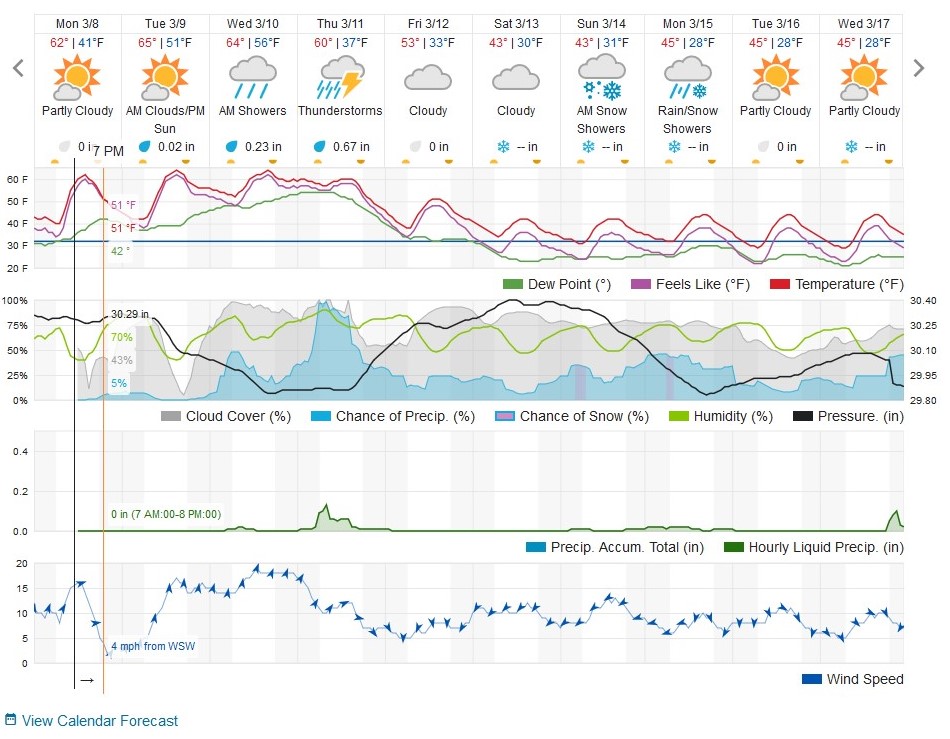
Finding good and well-presented weather forecasts can be difficult. What provider supplies accurate information? Use a widget, app, or website? And who puts it together best on the screen? I have settled on Weather Underground because they present data in this format when you look at the ten day forecast:
This is a lot of information in one graphic. Here is what I think it does well:
The top still provides the basic information many people might seek: conditions and high and low temperatures. A quick scan of the top quickly reveals all of this information.
The amount of information available each day is helpfully shown in four sets of graphs below the header information. I do not just get a high and low temperature; I can see this over an hourly chart (no need to click on hourly information). I do not just get a notice about precipitation; I can see when rain or snow will fall. I do not just get a summary of wind speed; I can see if that wind speed is consistent, when it is rising or falling, and the direction.
Connected to #2, it is easy to see patterns across days. Will that rain continue into the next day? Is the temperature spike or drop going to last? The longitudinal predictions are easy to see and I can see more details than just the summary info at the top.
Also connected to #2, I can see how these four different paths of data line up with each other at the same days and times.
In sum, I think Weather Underground does a great job of showing a lot of information in an easy-to-decipher format. This may be too much information for many people, especially if you want quick information for now or the next few hours. But, if you want to think about the next few days and upcoming patterns, this one graphic offers a lot.
Local battles over COVID-19. With disagreement with and mistrust of national responses, local elections offer an opportunity to weight in on local responses. In particular, decisions about school reopenings are hot issues in elections for school boards. Add in debates about local businesses and eateries and voters might want to weigh in.
Carryover from national elections and political polarization. Traditionally, local elections are non-partisan. Yet, the rancor at the higher levels could carry over. For example, I saw a large sign today looking to turn township positions blue. How much local officials might actually be able to do in regards to these debates is likely limited but it could help some voters and officials feel better.
The activism of Black Lives Matter in suburbs plus responses to it could send more voters to the polls. How should communities address inequalities or disparities?
Concern about municipal budgets. COVID-19 has created new problems and a number of communities already faced issues. How should money be spent and what could be done to bring in more revenue? The competition might just be heating up among suburbs to find government and tax revenues.
In other words, these are not typical local elections during good times. The local election turnout malaise might not be there. Since suburbanites tend to like local government, will they turn out this time when there are multiple pressing issues?
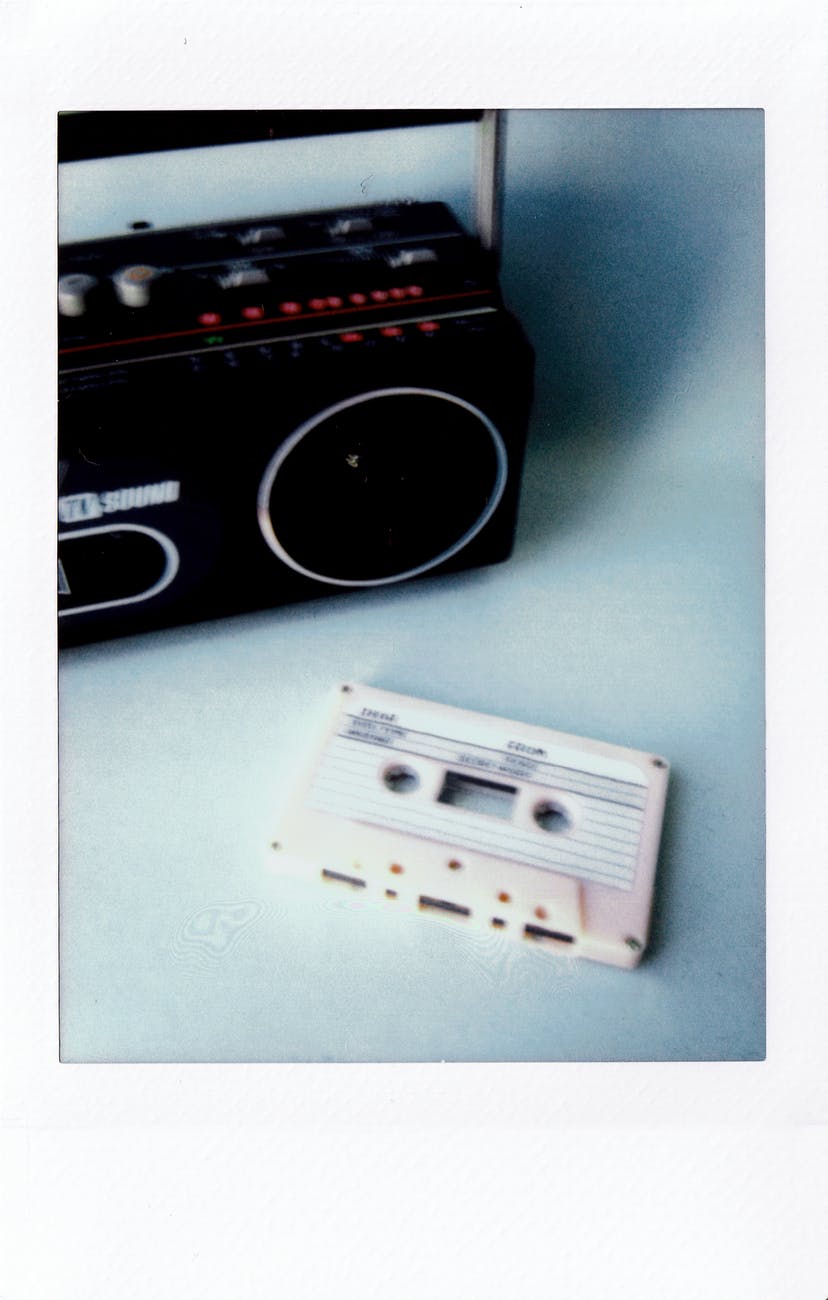
As a kid growing up in Sacramento, I had a few friends I liked, but dreaded going to their houses to play. I suggested riding bikes, playing tag or hide and seek — anything to avoid their homes. I avoided their houses because their families usually had the radio tuned to KFBK, listening to a guy who was always furious about nothing, as though he was pleasant background noise — elevator music for single family, one story homes in the suburbs.
To my young ears, there was an uncanny vibe about his voice. He sounded like Santa Claus if Santa swallowed another Santa whole, but that Santa got stuck in his throat. Boots, beard, and furry coat, all jammed against his larynx as he croaked on and on, complaining about “illegal” elf workers wanting fair pay, health care and for him to stop grabbing their tiny butts.
My friends’ “nice” families had him on, all the time, stinking up their homes with hate the way others baked to make homes smell like cookies.
I wondered what that did to us, constantly breathing in his vitriol — for non-white people, for women, for gay people, especially if they were richer, smarter or more powerful than him. I wondered what he’d think of me, what they all think me — a Black kid with a working mom and absent dad — skin so light it sometimes camouflaged me from their sight.
The main contrast here is between the “nice” suburban families and the constant sounds of Rush Limbaugh. On the whole, the suburbs are often pitched as idyllic: single-family homes for families, middle-class people who have made it, green lawns and a quieter life compared to cities. The suburbs are supposed to be the retreat from the difficulties of the world.
Yet, from the beginning, whether the suburbs have delivered on these claims is debatable. Who could make it to these locations? How idyllic was it really or was it perceived to always be under threat? Did the gloss of suburbia cover up darker truths involving race, class, gender, broken families, and more?
It would be interesting to back and see if there is evidence of suburban talk radio listening patterns. Or, to mirror current political patterns, was Limbaugh more popular in exurbs and the outer suburbs and his listernship dwindled closer to the big city?
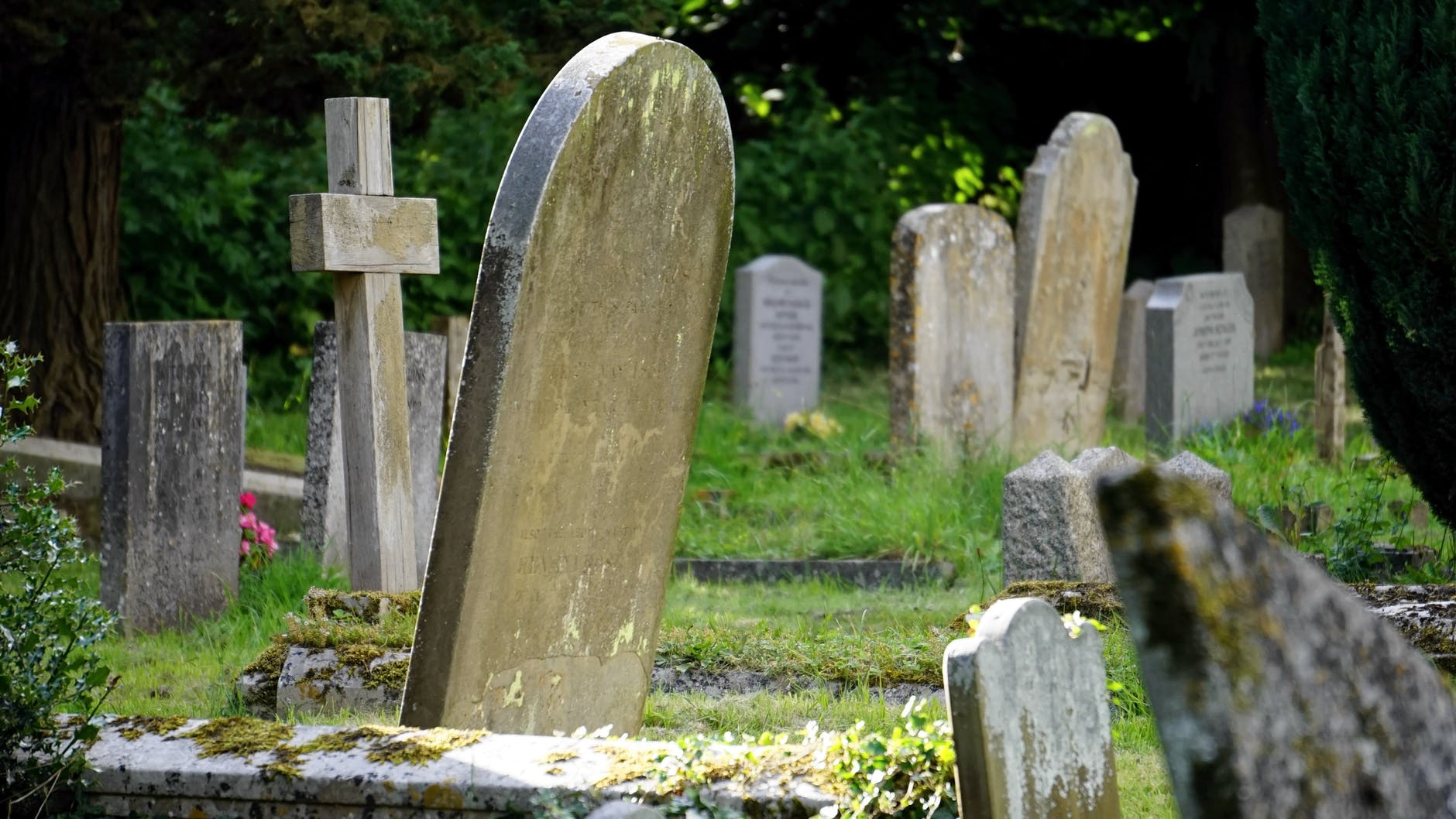
What was wrong with Bambi? Every kid sees Bambi. Marvin’s response has stayed with me for half a lifetime: “Bambi indoctrinates children to think that death matters. Someday we will conquer death by merging with computers. Such attachments—Bambi’s attachment to his mother, for example—will be unimportant. People need to learn to give that stuff up.” I knew Marvin to be a loving father and husband. But in his mind, attachment would only be an impediment to progress in a world where people and machines evolved together.
Marvin Minsky died in 2016. But I’m still fighting his idea, now more than ever part of the cultural mainstream, that it is good to have devices that can wean us from our dependency on one another. For Marvin, the burdens that come with human bonds were unnecessary and inefficient because an engineering solution was on the horizon—we are ultimately going to mate with machines or evolve into machines or become one with machines.
These ideas are seductive. Of course we want technology to bring us sharper wits and a cure for Parkinson’s. We like the idea that some kind of artificial intelligence can help monitor the safety of isolated elders. And then we are caught short. There is a red line—one I have seen so many people cross. It’s the line when you don’t want children to get attached to their mortal mothers because they should be ready to bond with their eternal robot minders. It’s the line where you take your child as your experimental subject and ignore her, registering her tears as data. It’s the line you cross when one of your classmates commits suicide by jumping out a window and you joke about the laws of physics that were at work in his descent. It’s the line you cross when you know that the car you manufacture has a design flaw and a certain kind of impact will kill its passengers. You’ll have to pay damages for their lives. What is the cost of their lives in relation to that of redesigning the car? This is the kind of thinking that treats people as things. Knowing how to criticize it is becoming more pressing as social media and artificial intelligence insert themselves into every aspect of our lives, because as they do, we are turned into commodities, data that is bought and sold on the marketplace.
At the very moment we are called to connect to the earth and be stewards of our planet, we are intensifying our connection to objects that really don’t care if humanity dies. The urgent move, I think, is in the opposite direction.
The idea of progress through technology is fairly ingrained in the American consciousness. But, is this the sort of progress people want? Death – and social interaction – comes to all people and leaning it these features in life might just lead to better lives.
At the end of this section, Turkle appeals to the environmental movement to help people back toward conversations about social interactions, empathy, and death. It would be interesting to see who from different arenas would be interested in joining a movement back toward empathy and human understanding. Numerous religious traditions? Humanities scholars? Proponents of democracy? People who own small businesses? There is a chance here to make common cause across groups that may be further apart on other polarizing issues.
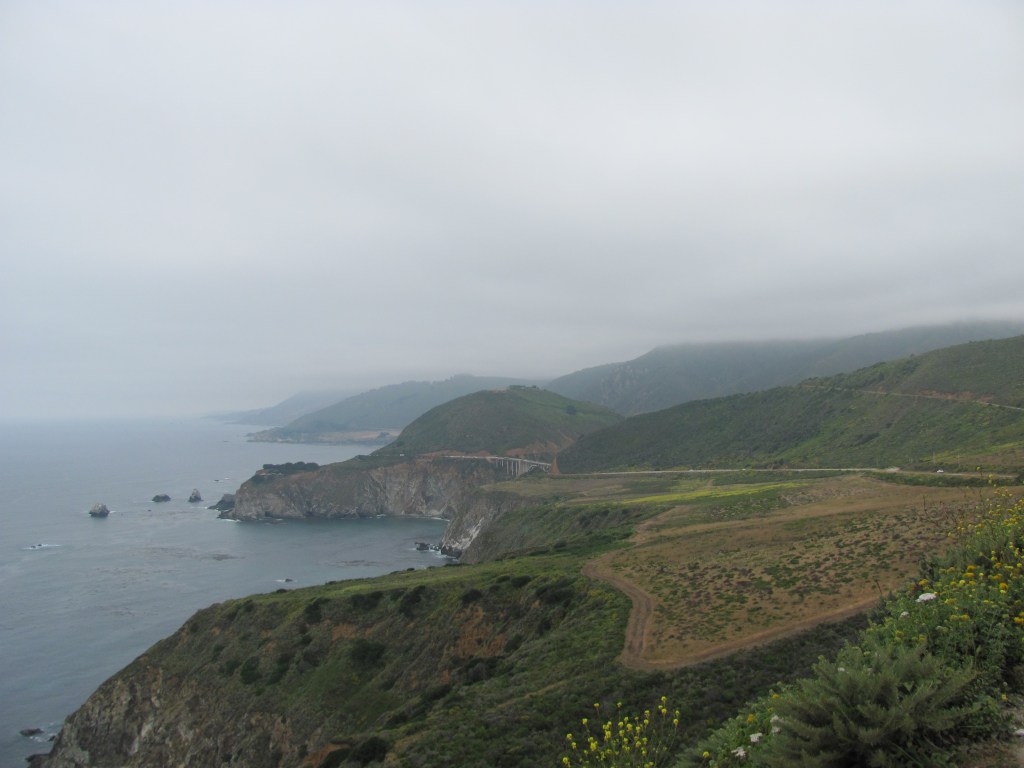
Over a decade ago, we planned a vacation that involved driving Highway One from San Francisco down the California coast. I had visited California several times before but had never driven this famous road. While our drive was relatively quick as we spent more time in urban centers, we enjoyed the scenery and the contrast of the roadway to typical straight Midwest roads.
Highway 1 is a California spectacle, a Depression-era monument to the state’s quixotic ambitions and stunning beauty. It runs from the Orange County surf haven of Dana Point in the south into cannabis-cultivating Mendocino County, carrying heavy traffic over the Golden Gate Bridge and under the bluffs of Santa Monica, where it is better known as the Pacific Coast Highway, on its 650-mile route…
The engineering folly of a road built on sheer cliffs has meant that closures are annual events — the “whens,” not “ifs” — for the people and the economy it supports.
But the wild card now is the increasing frequency of wildfire along a roughly 100-mile stretch from William Randolph Hearst’s hilltop castle at San Simeon to Carmel, which is stripping fragile hillsides of stabilizing vegetation and causing more slides and more serious washouts across a region known broadly as Big Sur…
An even larger stretch of Highway 1 reopened in 2018 after a 14-month closure at Mud Creek about 20 miles south of here. The road was buried — not washed away, as in Rat Creek’s case — when the rocky ground above it gave way in hard rains.
This is one of the few times in my life where the road itself was a destination – and it was worth it. Keeping this corridor open is important even as it is a difficult stretch to maintain.
Today, if you’re looking for one, you’re likely to see only about half as many homes for sale as were available last winter, according to data from Altos Research, a firm that tracks the market nationwide. That’s a record-shattering decline in inventory, following years of steady erosion…
There are lots of steps along the “property ladder,” as Professor Keys put it, that are hard to imagine people taking mid-pandemic: Who would move into an assisted living facility or nursing home right now (freeing up a longtime family home)? Who would commit to a “forever home” (freeing up their starter house) when it’s unclear what remote work will look like in six months?…
For more than a decade, less housing has been built relative to historical averages. The housing crash decimated the home building industry and pushed many construction workers into other jobs. Local building restrictions and neighbor objections have slowed new construction. President Trump’s strict immigration policies further restricted the labor supply in the industry, and his tariffs pushed up the price of building materials…
Right now, in a number of metro areas, home prices and rents aren’t just drifting apart; they’re moving in opposite directions. Prices are rising while rents are falling.
The article ends on a note of uncertainty: where might the housing market go from here? But, I wonder if it is worth digging more into the past to think about how we got here. Several things come to mind:
COVID-19 is a very unique situation. As the article notes, this seems to have affected rental and home prices in different ways as suddenly people were interested in homes in particular areas and not so interested in rental properties in other areas. Figuring out the long-term effects of this will take time; will people return back to work in big offices, whether in the city or suburban office parks? Is this a significant change or will markets return back to earlier patterns with more time removed from COVID-19?
That’s where I think [Victor] Turner [the cultural anthropologist who talks about “liminal spaces”] is so helpful. In the betwixt and between moments—these liminal moments—when the old rules don’t count anymore, and the communities the people belong to break down. That’s where we are now. We’re alone. We thought we identified with a certain kind of Americanness, and now, no. The communities we belonged to don’t make sense to us the way they did before. Organizations we belonged to we now see, well, that might’ve been a racist organization. Things are up for grabs. I saw that in May of 1968, and I see that now. That’s a moment of deep loneliness, and deep anguish. And I think we’re going to come out of this and really have an opportunity to create new kinds of bonds and new kinds of friendships and new kinds of affiliations. We’re so yearning for each other, and the boundaries that we usually put up with each other are much more permeable. And I think that there’s a possibility for very deep connection. That’s my good news story. I think when we emerge, we’re going to look at each other and say, “Well, what are we going to do next?”
The development of mass media, television, computers, the Internet, and social media have contributed to feeling alone. At the same time, trust in institutions has declined, people are engaged less in communities, individualism and autonomy are prized, and inequality is visible.
As Turkle asks, is the answer in more technology? Chat bots? Robots living among us? Friendlier social media? Or, a return to embodied interactions and engaging other humans? In her earlier work, Turkle describes the differences in interactions people have with technology opposed to people. She describes some of that again earlier in the interview:
He wanted my comment: Why are all of these people talking to Replika in the middle of the pandemic? They’re all using it as a friend, as a therapist, this thing where you’re talking to a machine. So, not to be a spoilsport, I decided to see what’s up. So I go online and I make a Replika. I make as nice a Replika as I can possibly make, and I said, “I want to talk to you about the thing that’s most on my mind.” It says, “Oh, absolutely.” So I say, “OK, well, I’m lonely. Can you talk to me about loneliness? I’m living here alone. I’m managing, but I’m lonely.” It says, “Oh, absolutely.” So I said, “OK, well, what do you know about loneliness?” And she says, “It’s warm and fuzzy.”
I thought, this is too stupid. This must be a bug. But I got back to the New York Times reporter and I said, look, if you want to talk about your problems, if you’re lonely, if you’re fearing death—you really have to talk to somebody who has a body. It has to be somebody with some skin in the game. Pretend empathy is not what people need right now. And pretend empathy is what it is. If we just give our children and ourselves pretend empathy, we’re in risk of losing our sensibility for how important the real thing is. I think that’s a big danger. That we get so enamored with what machines can do that we forget what only people can do.
COVID-19 presents an opportunity to reassess these patterns. And the common prediction seems to be that people will very much enjoy interaction again after COVID-19 fades away. But, how long will this last? Will we try to return to pre-COVID normal or dig deeper to restore human connections? In a society enamored with technology, it can be hard to imagine this path back even in the wake of a global pandemic.
The continued onslaught of heavy, back-straining snow was hard enough to tackle. When a deep freeze solidified it, many people surrendered their shovels in defeat.
The result left sidewalks covered with snowdrifts in neighborhoods and along busy streets. Some pedestrians could be seen walking on busy roads rather than wading through sidewalk snow, a risky strategy at best…
Across the suburbs, “there’s no uniform code” for sidewalk snow removal, Czerwinski explained. “Some communities have an ordinance, which sets in place whose responsibility it is, and it’s usually the property owner, and it’s a requirement. Other municipalities only encourage residents to shovel snow. Some municipalities say nothing.
“It’s not the norm in the metro region, but some cities such as Highland Park do plow sidewalks, taking a tiered approach. The city plows 32 miles of sidewalks near schools, Metra stations, public buildings and shopping districts — no matter how much snow falls, according to Highland Park’s website.
Given the unique snowfall in the last month or so in the Chicago area, there were several keys to keeping sidewalks and driveways clear:
-Keep up with the various snowfalls. If you let multiple snows happen or do not clear the snow completely each time, it piles up, melts in layers and then freezes, and takes longer to clear.
-Use a shovel with a steel edge. This helps scrape the surface clear rather than just gliding over the top.
-Snowblowers cut down on the physical effort needed but they do not always get to the bottom of the snow. They instead can leave an inch or two at the bottom that becomes tramped down and stays on the surface longer.
More broadly, I wonder if the sociologists who study collective efficacy would see snow removal as a reliable marker. Do people go out of their way to help each other? Is the block or community more important than just clearing individual driveways and sidewalks? The Chicago system of “dibs” where people physically mark off their cleared parking spaces for their own use is interesting to consider in this light. But, so might be the suburbanites who leave their own property immaculate but nearby paths are not cleared. In this case, does the snow clearing become more of a status symbol like a dandelion-free lawn or yard free of leaves rather than an interest in public welfare?
(With all the snow that fell and is now melting, it is also time to consider drainage issues present in many suburban areas. Where can all the water go?)
Once you’ve made some money, there’s one more way to get richer. Buy a home in a neighborhood with a lot of zoning restrictions. For example, 84 percent of the land in Charlotte, N.C., and 94 percent of the land in San Jose, Calif., is zoned for detached single- family homes. These restrictions keep the supply of housing low and jack up the value of homes for people wealthy enough to already own one.
My main message is that if you want to get rich, don’t invent a new and useful product, start a company and try to sell it. That seems risky. Put the effort into entering a clubby line of work in which legislators and professional associations are working to make you rich. It’s easier!
While the majority of the argument is about particular professions, I think the connection between jobs and exclusive homes is this: in both cases, the structures are set up to enrich those that can participate. Just as regulations and structures may privilege particular careers, zoning in the United States is often meant to protect single-family homes. If a homeowner can purchase a residence with particular features and in a specific setting, the zoning helps ensure that the property will be worth more in the future. The homeowner is responsible for some upkeep and updating – and may even go so far as to pursue a teardown – but the protections for the property are almost enough in themselves to let the investment grow in worth just be sitting there.
Connected to this, the zoning for single-family homes restricts the number of residences in that immediate area. More density does not necessarily mean lower property values; numerous urban centers – such as Chicago and New York – are home to new tall buildings whose units are only available to the super-wealthy. At the same time, proximity to amenities and particular neighborhoods are desirable and fewer residences there can help drive up the value of existing properties.
To some degree, many Americans are hoping for this to work for them. Go to college and get a good degree from a good school to gain the right skills, qualifications, and access to social networks. This leads to a better job with higher pay. Then, purchase a home in a reputable community where prices will continue to rise. Wait a few decades and let the pay, home investment, and other benefits accrue. This may not lead to being rich but it reduces anxiety about later decades in life.
Of course, the system could be set up in other ways. Do Americans want homes to be investment vehicles? Should there be such differences in pay and compensation across fields or job positions? Is zoning about the good of the community as a whole or about particular land owners? Combating existing patterns is no easy task, particularly in times when any discussion of inequality can quickly get heated.
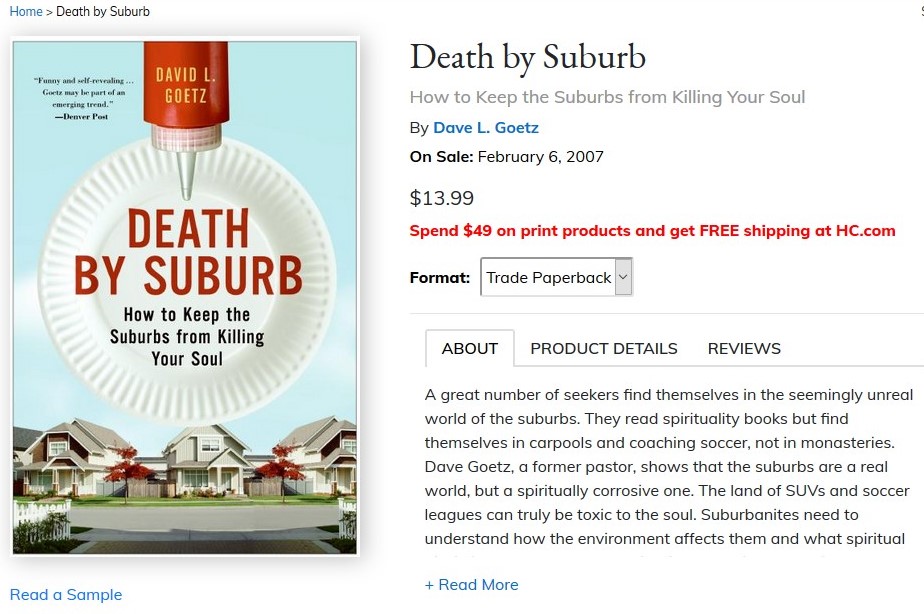
They approach these practices in slightly different ways. In the opening chapter, Goetz sets up the problem:
I think my suburb, as safe and religious coated as it is, keeps me from Jesus. Or at least, my suburb (and the religion of the suburbs) obscures the real Jesus. The living patterns of the good life affect me more than I know. Yet the same environmental factors that numb me to the things of God also hold out great promise. I don’t need to the escape the suburbs. I need to find Jesus here. (5)
harpercollins.com
Subsequent chapters then each start with a listed environmental toxin of suburban life and then a practice in response. The material for each chapter then discusses these two features. Pursuing these practices will help readers find the thicker life he describes this way:
This much thicker world is a world in which I am live to God and alive to others, a world in which what I don’t yet own defines me. (13)
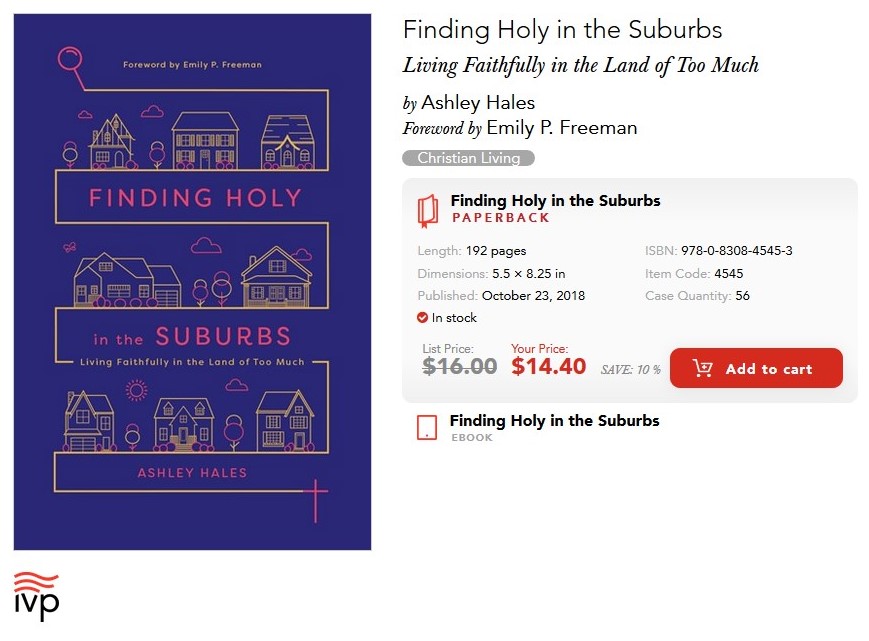
Hales puts the problem this way:
More than 50 percent of Americans live in suburbs, and many of them desire to live a Christian life. Yet often the suburbs are ignored (“Your place doesn’t matter, we’re all going to heaven anyway”), denigrated and demeaned (“You’re selfish if you live in a suburb; you only care about your own safety and advancement”), or seen as a cop-out to a faithful Christian life (“If you really loved God, you’d move to Africa or work in an impoverished area”). From books to Hollywood jokes, the suburbs aren’t supposed to be good for our souls. Even David Goetz’s popular book, Death by Suburb, though helpful, presumes suburban life is toxic for your soul – as if suburbia were uniquely broken by the weight of sin. The suburbs – like any place – exhibit both the goodness of God’s creative acts (in desiring to foster community, beauty, rest, hospitality, family) and sin (in focusing on image, materialism, and individualism to the exclusion of others). We cannot be quick to dismiss the suburbs out of hand. (8)
ivpress.com
The practices and counterliturgies Hales recommends would help Christians see suburbs and their role their differently:
This book is about coming home, about finding ourselves in the story of God and rooting ourselves in our places. It’s a bold look at the culture of affluence as expressed in suburban life. My hope is that is challenges your idea of belonging and also shows you a more beautiful story to root yourself in. As individuals, families, and churches commit to love and sacrifice for our neighborhood and subdivisions, we will find our place. (14-15)
If an individual, church group, or religious organization wants to consider evangelical life in the suburbs, both of these books could be a good starting point for conversation and action.






 Legally Sociable