At least two McMansions on the list of “26 most Iconic TV Interiors”

Architectural Digest has a list of the “26 most Iconic TV Interiors” and it includes at least two McMansions:

The Sopranos memorialized early-2000s New Jersey in all its gritty glory. Perhaps most memorable among fans was the Soprano family kitchen, with its light wood palette, where Tony was often seen in his robe, rummaging for cold cuts. But the show’s production designer Bob Shaw has said he found the office of Tony’s therapist Dr. Melfi the most interesting, because it was round. For a mobster confronting his own mind, there was nowhere to hide…

The rich and beautiful but down-to-earth Cohen family was the family every O.C. fan wished would adopt them—but only Ryan was so lucky! The Italianate McMansion in Newport Beach, California, was actually built on a soundstage—so, that breathtaking ocean view from Ryan’s poolhouse? That was a photo backdrop made by production designer Thomas Fichter, who was also responsible for all the “weather” you ever saw on the show.

I have a lot to say about the Soprano McMansions here.

The home from The O.C. has some similarities to the Soprano’s McMansion: it is in the suburbs and was built (and aired) in the same time period. Yet, the inhabitants of Orange County on the show faced more conventional suburban problems – teenagers stuck in a world of largely successful adults with big houses – compared to the twist of a gangster family living in a well-kept New Jersey McMansion.

Two other thoughts on this list:

-There are at least a few outright  mansions on here, including the impressive setting for Downtown Abbey.

-The brief descriptions do not provide that many insights as the list contains mostly very popular shows. Did the interesting setting help make the shows popular or did the settings become interesting because the shows took off? The list does not really have any failed shows though I imagine some short-lived television shows had some very interesting interiors.

Emily Post, pretense, and McMansions

A look at Emily Post’s etiquette connects her advice then and McMansions today:

Many of her admonitions are still relevant today. Thank-you notes were a sign of good character, Post argued. She also recommended ignoring “elephants at large in the garden,” otherwise known as wealthy know-it-alls: “Why a man, because he has millions, should assume they confer omniscience in all branches of knowledge, it something which may be left to the psychologist to answer.”

Above all, however, one must avoid pretense! Hence her indictment of the tastelessness of what today might be called a “McMansion”: “But the ‘mansion’ with coarse lace… and the bell answered at eleven in the morning by a butler in an ill-fitting dress suit and wearing a mustache, might as well be placarded: ‘Here lives a vulgarian who has never had an opportunity to acquire cultivation.’”

These two passages cited above suggest that those with wealth and resources should not flaunt their advantages by either acting like they know everything or having possessions that indicate status but not refinement. Hence, a McMansion might be an issue because the owner is purchasing a relatively expensive and large house and making a statement with its architecture and design. Instead of a more understated or traditional looking or older wealthy home, the McMansion is often said to be a plea for attention by those with new money to burn.

At the same time, this hints at some broader issues Americans have with wealth and dwellings. Is it more acceptable to have a more subtle but truly grand big home as opposed to garish McMansion? Both dwellings might contribute to inequality. Both could discourage social interaction. Both are larger than the average home and arguably waste a lot of space. Both show that the homeowners have money.

In American society, there have long been certain ways wealthy people should try to downplay their wealth. Because has more democratic and meritocratic ideals than some places, having certain possessions – the ultimate or unusual luxury goods – are truly markers of having a lot more than others. McMansions are not these luxury goods; they are too common and are within the reach of relatively more Americans. The big mansions of Hollywood, in the wealthiest suburbs and urban neighborhoods, and home to the 1% are the ultimate mansions and indicators of wealth.

Paraphrased future: “Love or hate McMansions, the ones in Chicago deserve to be recognized”

Brutalist architecture may have few admirers but this does not stop people from suggesting the style is worth examining or saving. Here is a recent headline from Curbed Chicago: “13 Brutalist masterpieces that every Chicagoan should know; Love or hate the style, Chicago’s concrete buildings deserve to be recognized.” And this is the argument made about why these buildings are worth looking at:

Popular during the 1960s and 70s, Brutalism should not be overlooked for its historical importance. Though Chicago lost a few Brutalist buildings—most famously Bertrand Goldberg’s Prentice Women’s Hospital, which was demolished in 2014—the style might even be poised for a comeback.

“In many cases, concrete buildings captured the aspirations of the city at critical times,” Chicago-based architect Iker Gil said in a statement last year. “As we shape the future of Chicago, it is worth trying to learn from the lessons and opportunities represented by these remarkable buildings.”

If this argument is successful, then it is a short step toward a similar argument for all kinds of architectural styles and buildings. In particular, the same case could be made for McMansions. Even though many critiqued such homes, what buildings better capture the consumeristic exuberance and grandiosity of the 1990s and 2000s? What buildings better illustrate the sprawling of America and a dedication to private single-family homes that flaunt the status of the homeowners? Why not preserve at least a few McMansions for future generations to remember and learn from?

Somehow, I suspect the calls for preserving McMansions will be more muted or absent. Brutalism seems to attract the attention of enough elite or leading proponents that some of its most interesting buildings will survive. Few leading architects, critics, or designers will stand up for McMansions. Still, I would suspect enough of them will last 50+ years and the legions of McMansion buyers and builders may just come together to make sure some survive much longer.

Maybe modernist houses will appeal to millennials – in certain circumstances

Architects and cultural critics often like modernist homes even as Americans largely do not prefer them. But, perhaps millennials will select modernist homes:

“For a while people were just tearing them down, but people are seeking them out now — they’re the anti-McMansion,” says Ellen Hilburg, co-founder of the real estate resource Mid Century Modern Hudson Valley. “For some people, it’s a nostalgia factor. But Millennials are discovering them, too. It’s an aesthetic that appeals to people who are aware and environmentally conscious.”

There are a number of pieces of this story that suggest preferences for modernist homes are tied to particular traits of the homeowner or observer:

1. A higher social class.

2. Higher levels of education.

3. Rejection of consumerism and the implied materialism and conformity that goes with it.

4. An interest in the “cool” factor of a home.

5. Living in a community – such as a wealthy, middle to upper-class suburb – where modernist homes are present and accepted.

Putting these categories together, there may indeed be a slice of Americans who prefer modernist homes. But, this also sounds like a taste connected to cultural capital, to invoke Bourdieu. In other words, expressing a preference for modernist design is connected to social class and education that not all Americans have access to.

Recurring issues with teardown McMansions

What if a suburban community continues to face the same issue of teardown McMansions angering neighbors? The case of Arlington Heights, Illinois:

Elgas called the home dimension differences “a form of gentrification” and asked the board to consider changing the building codes to prevent the number of larger homes being erected in Arlington Heights…

“This is not the first time it has come up as a phenomenon in Arlington Heights,” said Mayor Tom Hayes. “It’s probably 10 to 15 years ago this phenomenon first showed itself, not just in the village of Arlington Heights, many neighboring municipalities experienced the same issue with tear downs. We were sensitive to the issue at the time; we did a number of different things from legal, building, zoning and design, we addressed it at that point.”…

Charles Perkins, director of planning and community development, said the village had a task force that studied this issue with members from the Zoning Board of Appeals, the Plan Commission and village trustees. The leaders took bus tours around neighborhoods to view the tear downs and changes. As a result, he said, there were a number of changes made to village codes.

“We reduced the number of square footage you could put on a home, minimized impervious surface, and in the R3 district, which is this particular neighborhood, there was a 10 percent reduction on the ability of square footage of a home built on the lot,” Perkins said. “Those in single-story neighborhoods, typically go to the design commission for the architectural component of the home as well.”

This is not an issue facing just Arlington Heights: wealthier suburbs with older housing stocks can often be attractive to residents who have the means and desire to tear down older homes and construct new and often larger homes. And the teardowns can move in cycles, depending on changes in the housing market, what neighborhoods or communities are desirable, and how communities – including local leaders and neighbors – respond to such moves.

Three additional thoughts:

  1. The term McMansion is not used the article but this is the sort of home that is at issue here. A teardown home with a large footprint constructed in a neighborhood of smaller homes fits clearly within an understanding of McMansions.
  2. The community has some guidelines for new teardowns but not all neighbors think these go far enough. This is a common point of tension: should the property owners have say over their plot of land or should the community and neighbors be able to put in significant restrictions? Who gets more say can become a long local political process with the possibility for long-term bitterness.
  3. While neighbors might generally not like this development, this could be taken as a sign by leaders of a community that their community is desirable. Particularly in communities with limited opportunities for greenfield development, teardowns and infill development can represent a significant portion of change.

What a McMansion looks like to an insurer

I find McMansions to be fascinating but rarely have I thought how an insurer might view a Large Tract Home (LTH):

While they might look grand, LTHs are different from high value homes in a few key ways. Their location and design is similar across an entire subdivision, the construction materials are lower in quality, LTH construction practices are focused on efficiency, and other LTH construction costs are more predictable and less expensive. Despite those differences, insurers can run into problems when assessing the reconstruction bill for an LTH.

“A lot of times, the sheer size of them [means] a lot of carriers classify them with a much higher reconstruction cost when it comes time to rebuild,” said Benjamin Abbott, product manager for CoreLogic Insurance Solutions group, adding that the latest RCT Express release “allows carriers to visually see whether a home is classified as a large tract home or not. And if it is, then we turn down the reconstruction costs a little bit with our assumptions and allow the tool to more accurately price [the property].”

The valuation distinctions between McMansions and high value properties becomes important as natural catastrophes bear down on many parts of the US, at the same time as a lot of new homes are being built in the LTH model…

“It’s important for the insurance carriers to accurately value the reconstruction costs of any property they have because their client, the homeowner, is going to see the impact of that reconstruction cost directly in the premiums that they pay,” Abbott told Insurance Business. “Prior to this update and with other tools out there, they are potentially over-insuring, meaning that premiums may be inflated, which hurts the homeowners directly.”

Interesting assessment: the size of McMansions would lead to a higher reconstruction cost until the insurer considers the quality of the construction and the reconstruction cost drops. I assume this then means it could be cheaper to insure a McMansion than a different kind of home of a similar size?

More broadly, I wonder if insurance companies could provide data on McMansions:

  1. Just how many McMansions/Large Tract Homes are there in the United States?
  2. What is the worth of all such homes?
  3. How many and/or what percent of McMansions are located in areas more prone to natural catastrophes (such as coastal areas where beachfront McMansions can be popular)?
  4. Because of the lower-quality construction of McMansions (as noted above), do McMansions have an above average number of claims on the home insurance over time? The lower-quality construction claim is a common one but we have not necessarily had enough years pass before we can easily see more issues with the longevity of McMansions.

At least 12 reasons Americans have the biggest houses in the world

Why do Americans have the largest houses in the world? A lengthy list of reasons:

  1. Americans like private homes. This often means they desire detached single-family homes in the suburbs. So why not have a lot of private space? Similarly, Americans place a lower priority on pleasant public spaces or spending time in public.
  2. The trend toward larger homes really took off in the postwar suburban era. At the time, this could be linked to growing family size with the Baby Boomer generation. (Interestingly, as household sizes decreased in recent years, homes continued to get bigger.)
  3. Americans like to consume. With relatively large amounts of disposable income, Americans need space to store their stuff, ranging from clothes to media to new technological devices to cars. The answer is not to get rid of stuff but rather to have a big house to store bulk goods. Garages are important parts of homes since driving is so important.
  4. Americans have increasingly viewed housing as an investment rather than just a place to live and enjoy. If the goal is to get a big financial windfall later in selling the home, it could pay off now to buy as much as possible.
  5. Compared to some countries, Americans have a lot of land to build and sprawl. Americans have also made different land use decisions to prioritize lower densities and sprawl.
  6. There are regional differences regarding large homes. McMansions are everywhere in the United States but more culturally acceptable in Dallas than in New York City. Many metropolitan regions have housing prices that make having a big house possible (compared to New York, San Francisco, LA, and Seattle).
  7. Developers and builders are less interested in constructing starter houses as there are more profits in bigger homes.
  8. A number of communities will only allow homes of a certain size in order to maintain their character and status.
  9. The government has provided funding and support for mortgages, suburbanization, and driving over the last century.
  10. Americans have a bigger is better mentality as well as believe that growth is good. This applies to population growth and also applies to houses.
  11. McMansions are popular with some but America has plenty of large homes that would not qualify as McMansions. From large urban condos and homes to large rural properties, Americans can find plenty of big homes to purchase.
  12. The space in homes does not have to be used to be desirable. For some owners, the space itself is just worth having.

(This post was inspired by this recent article. Also, see this earlier post “Explaining why Americans desire larger homes.”)

Rebuilding beachfront McMansions

A journalist argues the construction and reconstruction of large homes near Atlantic beaches is a losing proposition in the long run:

Through federally funded flood insurance, huge appropriations for beach nourishment projects, and generous, well-intended relief aid, government policy allows developers and wealthy investors to build huge houses and hotels on beachfronts and low-lying barrier islands at high risk from coastal flooding as well as hurricanes. Uncle Sam’s generosity makes it all possible…

Writing just as the extensive damage from Hurricane Florence became apparent, Gaul covers the waterfront, so to speak — from Hurricane Katrina to South Florida, to the halls of Congress. In North Carolina, he stops Down East in Columbia, Creswell and other towns of North Carolina’s “Inner Banks,” where rising water levels and flooding are washing away entire communities…

According to Gaul, things began to tip in the 1980s, when multistory “McMansions” began to supplant the simple Cape Cods. (A similar trend has transpired on the north end of our state’s Outer Banks). Disasters such as the Ash Wednesday flood of 1962 did little to discourage development. On the contrary, real estate dealers saw storms as “clearing the market,” blowing down older, ramshackle structures and making way for the new, bigger units that buyers seemed to want.

Real estate prices went up, and increasingly retirees and residents with modest incomes were squeezed out. But there were always more customers in line for resort property.

I wonder if the primary objection is that big homes are being built and someone is profiting from the government money or should there be no homes on these properties? If the goal is to protect the beach and taxpayer dollars, less development in these areas is better. If the problem is profiting with the government’s money, there could be restrictions on the size of the new home or how the money is used.

It would be an interesting thought experiment to consider what this would look like without any government intervention. The argument here is that the government’s funding for rebuilding simply encourages the cycle of building larger and larger homes. If there were no regulations, what would the market bear? Or, as the author seems to suggest, would different regulations be better for the long-term fate of the beach and tese communities?

Celebrating the labor of those who build McMansions?

The construction of single-family homes employs many Americans. When demand for homes drops, such as in the late 2000s with the burst housing bubble, many are out of work until the housing market heats up again.

Critics of McMansions would argue such homes should not be built. Instead, the land could be put to better use or developers and communities should focus on building other kinds of housing units that do not suffer from the same flaws.

But, the construction of McMansions employs people. Developers may build them to make more money than they could by building starter homes and communities may approve them in order to keep property values higher. And these homes provide work. Is this the case where a job is not worth it if the outcome is an undesirable product (in the eyes of McMansion critics)?

On this Labor Day, it would be interesting to consider how those who construct McMansions might be employed constructing other buildings. For many who construct McMansions, it could be hard to turn down the work if other opportunities are not present or the job pays okay. Should part of the fight against McMansions also include efforts to address labor issues?

Quick Review: “Square-Footed Monster” episode of King of the Hill

Few television episodes tackle the topic of McMansions. Thus, here is a review of Season 13 Episode 3 of King of the Hill titled “Square-Footed Monster.”

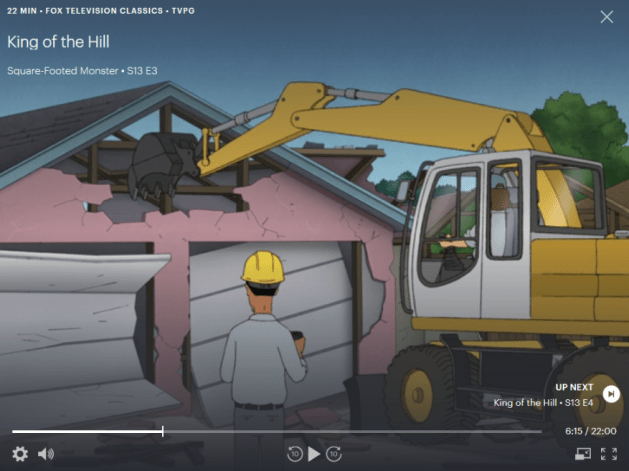
First, a quick synopsis of the plot and relevant dialogue from the main characters. The issues begin when an older neighbor lady dies and her nephew comes to fix up the ranch home to sell it. The men, led by Hank, help fix up the house. It sells in one day. The next day, the house is torn down by a large excavator and the local developer says he is breaking ground on a “dream home.”
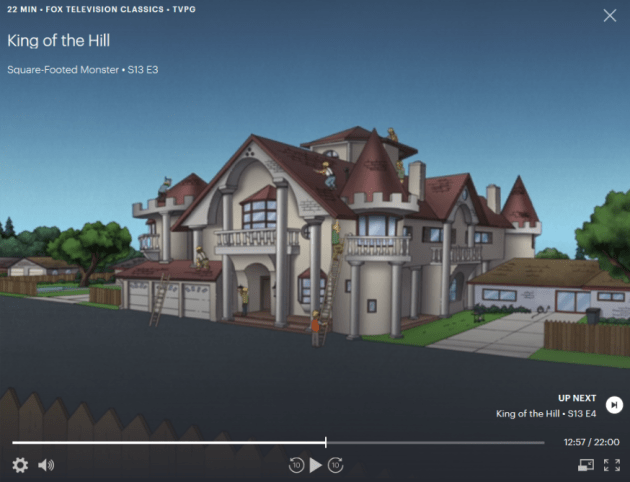
SquareFootedMonster1Amid scenes of constructing a large balloon frame, the builder brings the guys peach chardonnay (clearly indicating his different status) and shows them a rendering of the new home. Hank’s response: “Looks like a bank. No, a church. Wait, A casino? I don’t know what the hell I’m looking at.” The developer says it is a speculation house.

SquareFootedMonster2

Hank and the guys decide to fight back. They go to City Hall and show images of the modest homes in their neighborhood compared to the new home with “4,600 square feet of obnoxiousness” (Hank’s description). The leaders say the home is by the books so construction continues. The guys consult the local legal loophole expert as Hank says, “someone is building a jackass McMansion that’s going to destroy our neighborhood.” There are no loopholes to help them.
SquareFootedMonster3

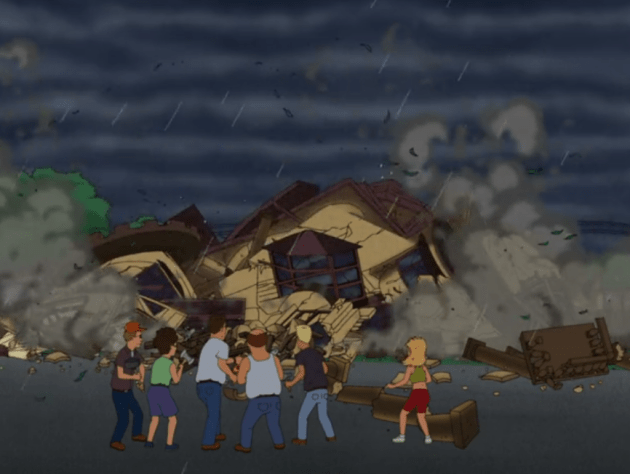
The next scenes show a massive McMansion blocking out the sun and going right up to its property lines. Hank notes, “Ted’s using cheap building materials too. It’s all spackle and chicken-wire.” In the subsequent big wind, the house starts falling apart. Wanting to protect their own homes, the neighbors take chainsaws, axes, and other implements to help the home collapse.
SquareFootedMonster4edit

The next day, the developer looks at the damage done by the neighbors and accuses them taking down the home. Hank responds: “We don’t have anything to hide. The only one who did something wrong here was you. Your shoddy McMansion was going to destroy our homes. We only took it down in self-defense.”

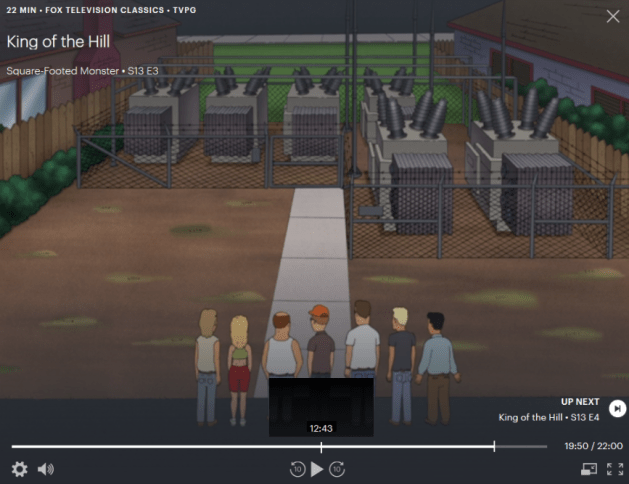
The case goes in front of a local judge who with some prompting by the local legal loophole expert rules in favor of the neighbors. The developer tries to get the last laugh by selling the property to the city to use as a power substation.
SquareFootedMonster5

After lamenting the new land use, the men construct a fake house around the substation. Hank says, “I’ll take a fake house over a big ugly one any day.”
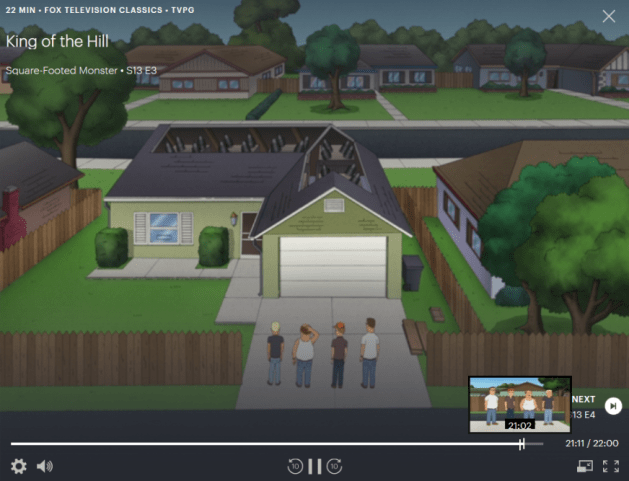
SquareFootedMonster6

This episode contains several themes common to narratives about McMansions:

  1. The developer simply wants to make money without regard for the existing character of the community.
  2. A teardown McMansion can be very invasive: it looks out of place compared to nearby homes, it encroaches on lot lines and the street, it blocks the sun, and its construction is disruptive to neighbors.
  3. The new large home is poorly constructed – it starts falling apart in heavy winds – and has dubious architectural features including turrets, pillars, and balconies.
  4. Neighbors resent the intrusion of the new home but there is little they can do to stop it (hence the need to find obscure legal loopholes and attack the homes themselves). There is one neighbor who appreciates the new home for what it could bring to the neighborhood but he is in the minority.

In the end, the neighbors do win out: instead of a dilapidated ranch home next door, they have a substation that looks like a well-maintained ranch home.

In twenty-two minutes, this is a decent summary of how teardown McMansions could go. The episode does not provide much perspective from the view of the developer of the home or local officials outside of quick references to making money and an interest in large new homes. Some lingering questions remain including why construct such a large new home on a street of ranch homes of working-class residents. The neighborhood may have been saved but the episode also hints at how fragile a set of homes and the associated community might be if just one property falls into the hands of a developer.

(All screenshots of the episode are from Hulu.)