Graphic options for illustrating where Americans moved during COVID-19

I appreciate the effort at CityLab to take all of the data regarding where Americans moved during the COVID-19 pandemic and put it into graphs and charts. Good graphs and charts should help illustrate relationships between variables and help readers see patterns. Here are several choices that I thought succeeded.

First, start with patterns in metro areas across the United States.
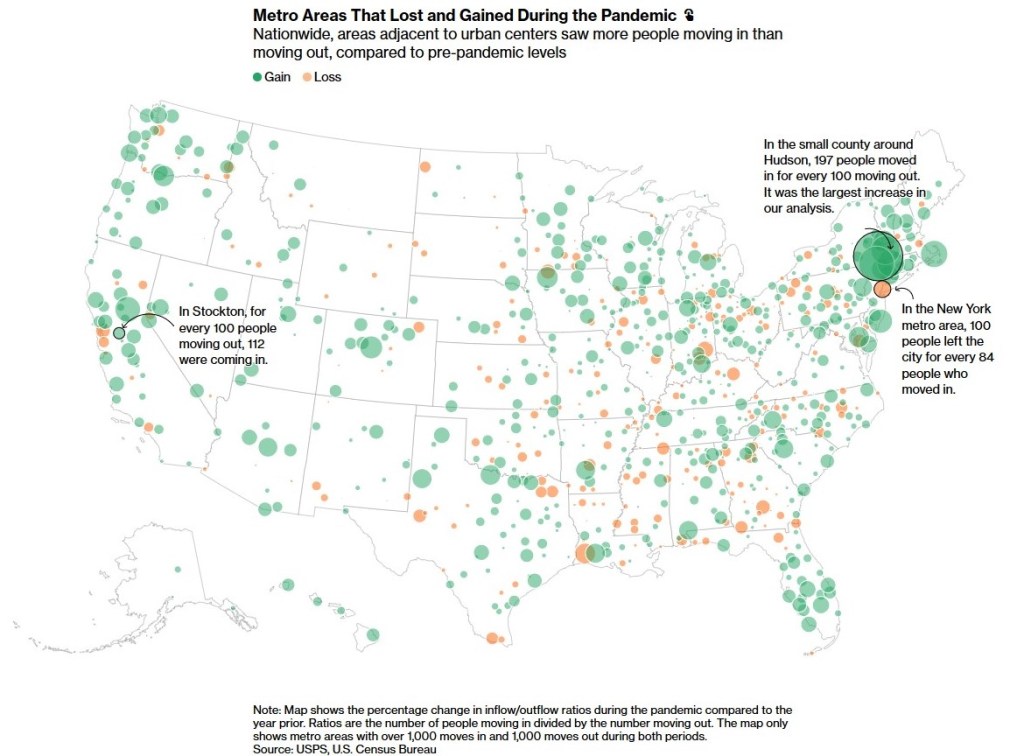
The two colors plus the size of the circle show the percentage change in population. The percentage is a nice touch yet the comparison to the previous year might slip past some viewers.

Second, another way to look at metro areas on the whole regarding population changes.
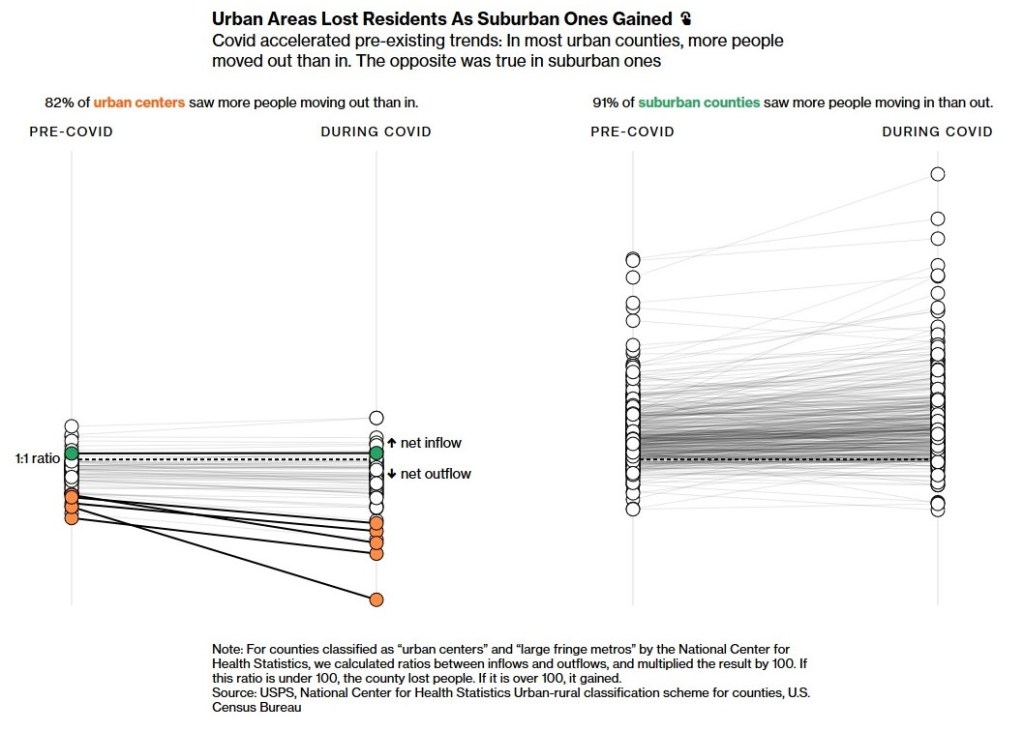
The side-by-side of central cities and suburbs quickly shows several differences: lower ratios for cities, more variability among suburban counties, more losses for cities during COVID. The patterns among suburban counties are a little hard to pick up; there are a number of counties that lost people even as the general trend might have been up.

Third, where did all those people moving from New York City, specifically Manhattan go?
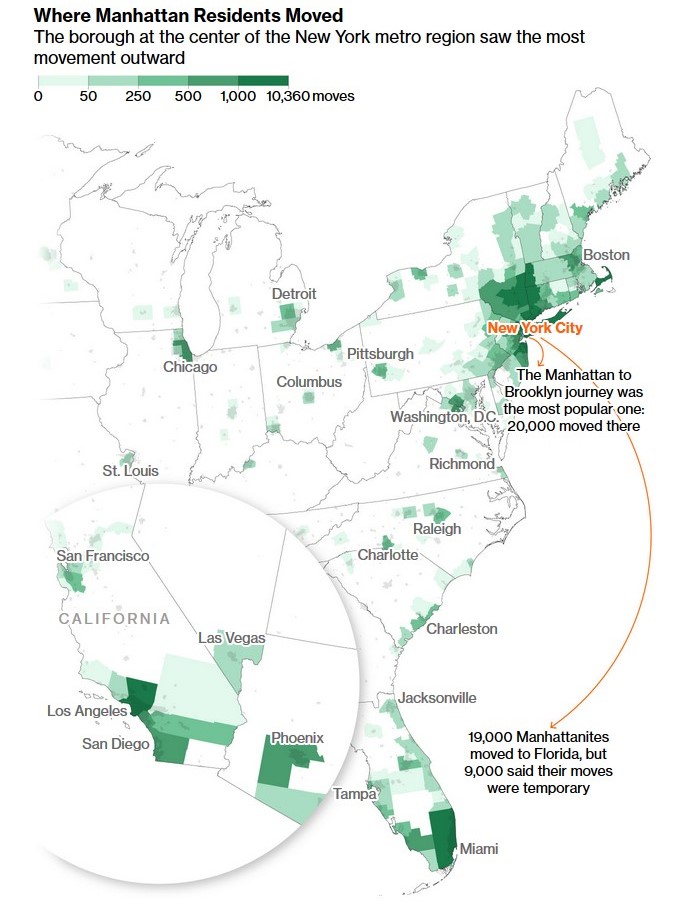
In absolute numbers, there are patterns this map displays nicely: a lot of moves in New York City and in the region plus moves to other metro areas (including Miami, Los Angeles, Chicago, and more). The inset of the Southwest at the bottom left is a nice touch…presumably New Yorkers did not move in large numbers to anywhere roughly between Nashville and Seattle.

Fourth, which New Yorkers moved?
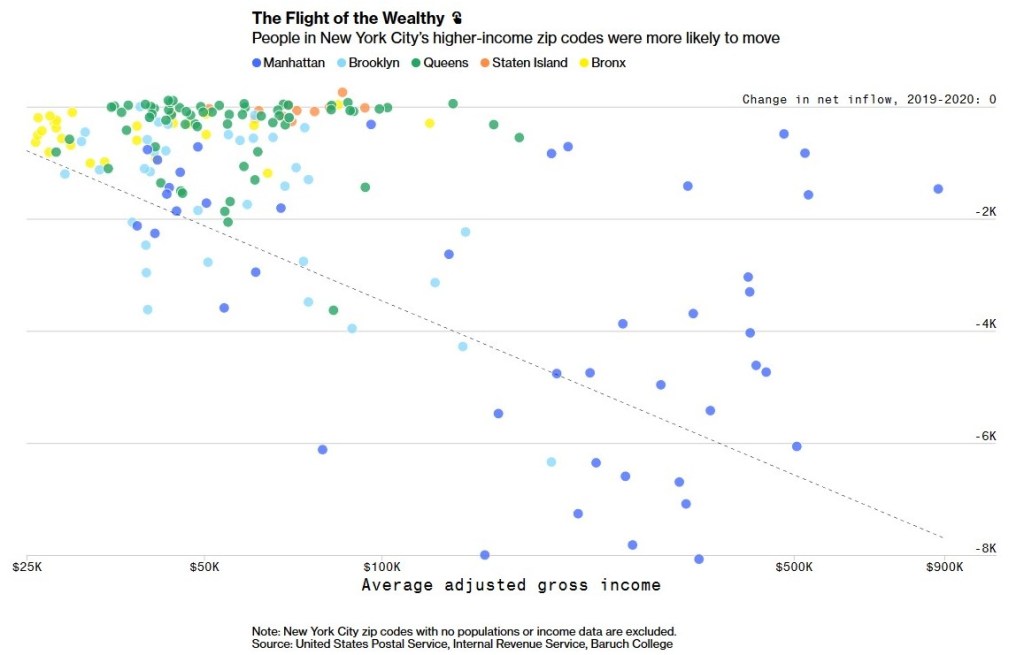
Looking at zip codes, neighborhoods with higher incomes had more people moving while the numerous neighborhoods with lower incomes had smaller changes in inflow.

All together, this is more than just a series of pretty graphics. These choices – first about what data to use and second about how to present one variable in light of another – help clarify what happened in the last year. Each choice could have been a little different; emphasize a different part of the data or another variable, choose another graphic option. Yet, while there is certainly more to untangle about mobility, cities and suburbs, and COVID-19, these images help us start making sense of complex phenomena.
USPS address change data for COVID-19 sheds light on urban migration

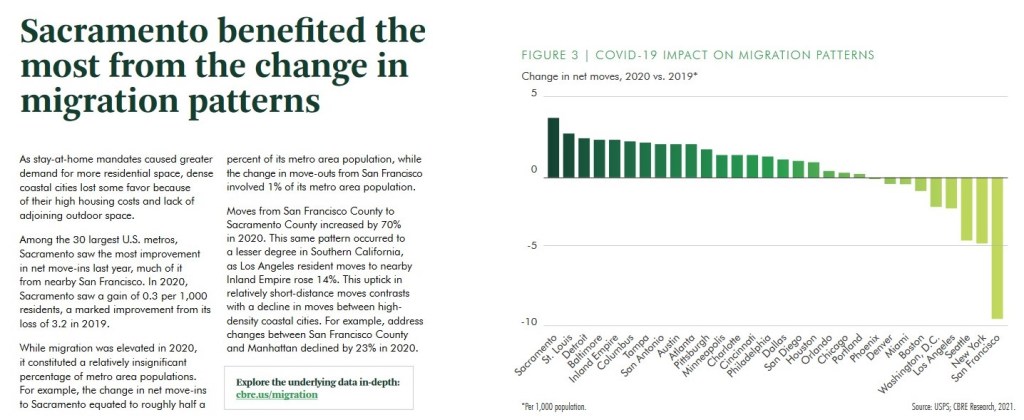
Hard data has been hard to come by regarding people leaving cities during COVID-19. Did 500,000 flee Manhattan? Did San Francisco empty out? Here is data from the CBRE report:

In this comparison of 2020 and 2019 migration data, several big cities fared the worst: San Francisco, New York, Seattle, Los Angeles, and Washington, D.C. Sacramento did well because of spillover effects from the Bay Area.

In terms of actual numbers for cities, here is a summary of the same data for New York City:

By analysing US Postal Service address changes over the last 12 months, the study reveals the greatest out-migration of people is, as expected, from Manhattan, with nine of the 10 zip codes with the largest outflows of residents in the city located in the borough…

In terms of hard numbers, the four zip codes in Manhattan from the Hudson to the East River between 42nd Street and 59th Street lost more than 12,000 residents in 2020. In 2019 that figure was less than 3,000…

The streets may have felt even emptier than the data implies, as the study only looked at permanent address changes – the total number of those who left the city for significant portions of the pandemic is likely much higher. Many more people temporarily left to stay with family or at seasonal rentals…

Talk of an exodus from New York may be a little exaggerated as 41 per cent of Manhattan residents who moved in 2020 stayed in the borough, presumably taking advantage of cheaper rents to upgrade their living space. Prior to Covid, this figure was just below 50 per cent.

The last part quoted above is important: the number of permanent address changes was smaller than it may have appeared. Plenty of people left Manhattan and other urban locations but they did not necessarily give up on their property and may return when COVID-19 fades away. Similarly, the impact on suburbs that took in new residents during COVID-19 may then also see population shifts after COVID-19 as people return to urban neighborhoods.

“NYC isn’t dead”…for the wealthiest

A look at the ten most expensive properties sold in the United States in 2020 highlights the presence of New York City properties on the list:

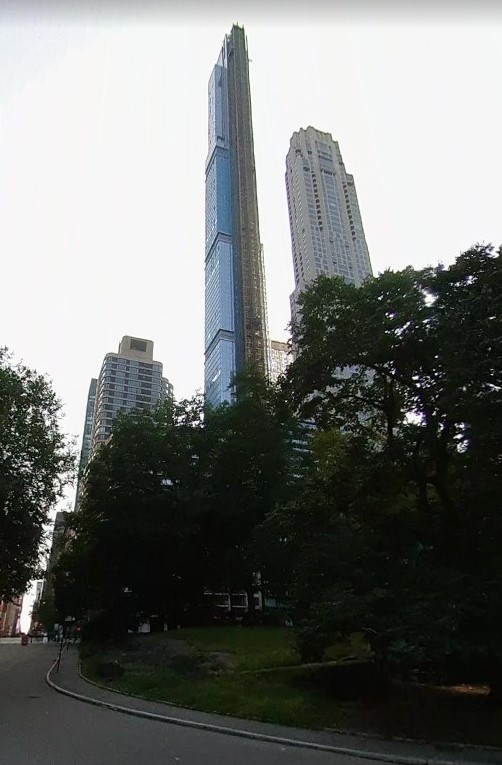
Google Street View image of 220 Central Park South (September 2020)

By the end of September, the volume of Manhattan co-op and condo sales was down 43% year over year, according to a report by Douglas Elliman, as sellers held back from listing their apartments and buyers increasingly gravitated toward the suburbs

Of the top 10 national sales compiled by Jonathan Miller, president and chief executive officer of Miller Samuel appraisers, five were in 220 Central Park South, a new luxury tower on Central Park designed by architects at Robert A.M. Stern

Another trend from this year, namely rich people “fleeing” New York for Florida, didn’t manage to trickle up to the highest tier. Only two of this year’s top 10 sales were in Palm Beach; last year there were three…

Even the three Los Angeles entries diverge slightly from conventional 2020 narratives. Yes, the L.A. market is one of the few urban bright lights this year, with sales soaring and inventory hard to come by. But numbers at the very top are down from last year, when it notched four entries in the top 10, totaling $463 million. This year there were three, totaling $293 million.

The actions of the wealthiest homeowners matters not only because people often have an interest in what those who have lots of money do with all that money; it matters because these are people with clout and influence. If they are continuing to purchase in New York City – it is less clear how much time the owners would necessarily spend in the city – it is a sign of the importance of the city and the prospects for future development.

The optics of 2020 might not be favorable to the list above but the project and the trends were underway far ahead of COVID-19. In a very expensive land and housing market, purchasing a residence in one of the newest buildings and in such a location within Manhattan is an object of desire for some who have the resources to purchase such places. While a figure later in the article notes that the total price for the properties on this list is lower than the price for the properties the year before, this may only allow the wealthiest to get into hot markets even more.

It may (or may not) be worth noting that five of the ten properties are in a tower in New York City while the other five properties are large homes on some land. On the whole, Americans as a whole tend to prefer or idealize single-family homes but the wealthiest in the United States and elsewhere may be more inclined to purchase large units in multi-unit buildings.

How far might rent drop in Manhattan and other cities and who will benefit?

As some people reconsider living in Manhattan and other cities with high housing costs amid COVID-19, how far might rents drop?

According to StreetEasy, the median rent has fallen below $3,000. That is the lowest price since 2011.

The third quarter of 2020 also marked the first time since 2010 that Manhattan, Brooklyn and Queens all recorded year-over-year rent declines.

StreetEasy says renters are no longer willing to pay the so-called “commute premium” of living in Manhattan, because so many people are working from home.

Any rent drop in Manhattan or in New York could provide opportunities for people who even just a short time ago had little chance to live there.

At the same time, dropping below $3,000 for the median suggests that rent is still pretty high. Who can take advantage of this drop? Those with resources to do so, not necessarily people who need affordable or cheap housing. Indeed, if these lower rents quickly induce a number of people to take advantage, then rents could stabilize and head back up.

Perhaps there is little that could actually move rents and housing prices in certain housing markets to a point where many more residents could take advantage. A pandemic is unlikely to lead to the production of more housing and struggles with employment, among other factors, will limit who would move to big cities with temporarily lower prices. At the same time, COVID-19 could help nudge conversations about housing in a productive direction.

Survey data on wealthy New York City residents thinking about leaving the city

New survey data looks at what New York City residents making more than $100,000 think about leaving the city:

We found that 44% of high-income New Yorkers say that they have considered relocating outside the city in the past four months, with cost of living cited as the biggest reason. More than half of high-income New Yorkers are working entirely from home, and nearly two-thirds believe that this will be the new normal for the city…

Of those considering leaving New York City, 30% say that the possibility of working remotely makes it more likely that they will move. Of New York City residents who earn $100,000 or more annually, 44% have considered moving out of the city in the past four months (see Figure 4). Looking ahead, 37% say that it is at least somewhat likely that they will not be living in the city within the next two years…

The cost of living, more than any other factor, contributes to the likelihood of leaving New York City (see Figure 5). A total of 69% of respondents cite cost of living as a reason to leave the city; that figure is even higher among black (77%) and Hispanic (79%) respondents. Other reasons cited by respondents considering leaving New York City include crime (47%), desire for a nonurban lifestyle (46%), and the ability to work from home (30%)…

Only 38% of New Yorkers surveyed said that the quality of life now was excellent or good, a drop by half, from 79% before the pandemic (see Figure 2). Most believe that the city has a long road to recovery: 69% say that it “will take longer than a year” for quality of life to return to normal.

Finally some data on New Yorkers leaving the city! (Of course, this is more about attitudes than actual behavior.)

If I am interpreting the data above correctly, it sounds like COVID-19 has brought some other issues to light. This includes:

(1) If I can work remotely, do I value city life enough to stay there even though I do not need to be close to work?

(2) If the city is not what it was – and it is not clear when it might return to normal – because of decreased social activity due to COVID, the cost of living may not be justifiable.

Ultimately, is it worth living in a global city – with all that comes with it for high earners including jobs, cultural amenities, and a high cost of living – when the positive features of this city are muted during a pandemic?

Carmageddon in Los Angeles vs. Carmageddon in New York City

Remember Carmageddon and Carmageddon II in Los Angeles? Now, Carmageddon has come to New York City:

In Chicago and in other cities with robust transit systems, people who have never owned cars before are suddenly buying them. In New York City, some are calling it “carmaggedon,” as residents there registered 40,000 new cars in July, the highest monthly total in years. Meanwhile, NYC subway ridership is still down more than 75% from last year.

pexels-photo-1116244.jpeg

Photo by Jack Gittoes on Pexels.com

The difference in what leads to carmageddon in each city is striking. In Los Angeles, closing a section of a major highway is a problem for the entire system. Because of the emphasis on driving and the various chokepoints in the road system, a single closure has ripple effects. In New York City, the opposite is the case: high mass transit use, particularly in Manhattan and denser parts of the city, is necessary. If something threatens the mass transit lines – here, it is an unwillingness to use mass transit when there is a pandemic – then too many cars may be on roads that cannot handle the increased volume.

Fortunately for Los Angeles and unfortunately for New York, the length of Carmageddon matters. Closing a major highway for just a few days is survivable. Indeed, Los Angeles got out ahead of the problem and enough drivers were able to make alternate plans. Decreased mass transit use due to COVID-19 is another story. How long will the virus be around? Will there be a point where residents return to mass transit even with the threat of the virus present? Carmageddon in New York might prove more lengthy and much more difficult to remedy.

Treating suburban communities as another consumer good to choose among, Part One

A recent New York Times article made the case for why prospective suburbanites might choose to live in specific desirable communities in the region. Many suburbs have particular characters and ways they differentiate themselves from other suburbs.

family doing shopping in the grocery store

Photo by Gustavo Fring on Pexels.com

Yet, this is an consumeristic approach to suburban communities. Does the typical suburbanite look at all the possible options and then select one that meets specific criteria? I doubt it. Here are a few of the factors that likely come into play:

1. Resources. How much money do they have for housing? This is a key sorting mechanism.

2. Information from social networks. What do people they know say about a community?

3. Quality of local schools and other local amenities and features (parks, crime, noise, density, family-friendly aspects, etc.).

4. Distance to work/commuting distance. The average commute is just under half an hour so staying within a particular radius and avoiding traffic congestion for held or potential jobs matters.

5. The status of the community. Which ones are known favorably (and not)? If you were moving to the New York City region and knew little about the suburban options, which communities would emerge?

6. Proximity to family if present in the area. Why move to Montclair if family members all live in New Canaan?

Even with all of these factors, it may take time of living in a suburb before a resident gets a sense of what is unique, different, and/or desirable.

Tomorrow, I will consider what this approach of searching for the best suburb could lead to.

Poor Census response rate in neighborhoods with fleeing New Yorkers

Here is another consequence of city residents leaving for other places during COVID-19: absent New York residents are not filling out Census 2020 forms at a good rate.

chart close up data desk

Photo by Lukas on Pexels.com

Only 46 percent of Upper East Side households have filled out their census forms, according to a June 25 report circulated by the Department of City Planning’s chief demographer, Joseph J. Salvo — well below the neighborhood’s final response rate in 2010, and short of the current citywide rate of almost 53 percent…

Even if New Yorkers have asked the Postal Service to forward mail to their second homes, census forms are addressed to the household, not the individual, which — unless New Yorkers pay for premium forwarding — prevents the post office from including them with the forwarded mail…

Officials hope that many of the coronavirus evacuees will return by the end of October, the new extended deadline for final responses to the census. But with Manhattan parents now enrolling children in schools outside the city, it is not clear that the evacuees will return to New York City in time…

The pandemic has prompted census outreach workers to adjust their tactics, especially in trying to reach undocumented immigrants and residents in illegal housing, who may be fearful of sharing information with the government. In the heavily immigrant neighborhoods of North Corona and East Elmhurst, outreach workers have approached New Yorkers while they wait in lines at food distribution sites, for example.

A lot of effort goes into conducting the decennial census and the data collected is helpful to many. Trying to boost response rates to surveys in a world awash in data collection is a difficult task without a global pandemic. But, I imagine this might lead to some interesting lessons about data collection. Researchers need to have some flexibility in all cases as circumstances can change and plans may go awry. This could be a helpful story about how a large organization adapted in a difficult situation and maybe even made future data collection more robust.

While the article mentions the potential consequences for New York City, there is another consequence of the movement of people: would these wealthy New Yorkers boost the Census numbers elsewhere, provided that they fill out the forms about residing in other locations? Granted, they would still have to fill out a Census form but others might do that for them (if they are living with others) or they might fill out a form once they are more settled in.

Do we know that 500,000 people have fled NYC since the start of COVID-19?

On the heels of much discussion of residents leaving New York City, San Francisco, and other major cities because of COVID-19, the Daily Mail suggests 500,000 people have left New York City:

vehicles on road between high rise buildings

Photo by Craig Adderley on Pexels.com

Parts of Manhattan, famously the ‘city that never sleeps’, have begun to resemble a ghost town since 500,000 mostly wealthy and middle-class residents fled when Covid-19 struck in March.

The number is also part of the headline.

But, how do we know this number is accurate? If there was ever a figure that required some serious triangulation, this could be it. Most of the news stories I have seen on people fleeing cities rely on real estate agents and movers who have close contact with people going from one place to another. Those articles rarely mention figures, settling for vaguer pronouncements about trends or patterns. Better data could come from sources like utility companies (presumably there would be a drop in the consumption of electricity and water), the post office (how many people have changed addresses), and more systematic analyses of real estate records.

A further point about the supposed figure: even if it is accurate, it does not reveal much about long-term trends. Again, the stories on this phenomenon have hinted that some of those people who left will never return while some do want to get back. We will not know until some time has gone by after the COVID-19 pandemic slows down or disappears. Particularly for those with resources, will they sell their New York property or will they sit on it for a while to give themselves options or in order to make sure they get a decent return on it? This may be a shocking figure now but it could turn out in a year or two to mean very little if many of those same people return to the city.

In other words, I would wait to see if this number is trustworthy and if so, what exactly it means in the future. As sociologist Joel Best cautions around numbers that seem shocking, it helps to ask good questions about where the data comes from, how accurate it is, and what it means.

Another claim that COVID-19 will push people to the suburbs

I have seen a version of this argument several times already and here is the most recent one: according to the New York Times, more New Yorkers are moving to the suburbs.

Cooped up and concerned about the post-Covid future, renters and owners are making moves to leave the city, not for short-term stays in weekend houses, as was common when the pandemic first arrived, but more permanently in the suburbs.

While some of the fresh transplants are accelerating plans that had been simmering on the back burner, others are doing what once seemed unthinkable, opting for a split-level on a cul-de-sac after decades of apartment living. Others seem to have acquired a taste for country life after sheltering with parents in places with big lawns or in log cabins.

But there’s also a sense that in today’s era of social distancing, one-person-at-a-time elevator rides to get home and looping routes to avoid passers-by on city streets has fundamentally changed New York City…

For starters, people seem to be packing their bags. Between March 15 and April 28, moves from New York to Connecticut increased 74 percent over the period a year ago, according to FlatRate Moving. Moves to New Jersey saw a 38 percent jump, while Long Island was up 48 percent.

Also, suburban towns not really known for their rental stock have had huge spikes in activity, which is being driven in part by escaping New Yorkers, according to brokers in those areas.

There is both a short-term and long-term view of this possible trend:

1. COVID-19 might lead to a sudden change in New York City and possibly other locations that are very dense (which does not necessarily apply to Los Angeles). For example, one report suggests denser cities and places with lower levels of educational attainment will struggle to recover.

2. The population of the big three cities – New York, Los Angeles, and Chicago – had already plateaued or started decreasing. COVID-19 may just be accelerating what was already happening.

Only time will tell which is more correct. In moments like these, it is easy to suggest cities will decline or people will have long-term fears – and I have seen these pieces as well – but Americans have preferred suburbs for decades. In the meantime, it is probably safe to say that life in cities has changed. What is often attractive in cities is the street life, the culture, the opportunities all within a short distance. COVID-19 is a unique problem in that it limits social interaction, the lifeblood of numerous city neighborhoods and gathering places. In contrast, the suburbs prize private spaces like homes and privilege driving. When people need to isolate, they are already used to it to some degree in suburbs.

A third option might end up being closer to reality: New York City, with all of its COVID-19 cases and its unique features, might suffer more from the pandemic than anywhere else in the United States. At the same time, this leading city will still have a lot going for it after COVID-19 fades and it will continue to be attractive to many.