Is my 45 year old suburban home worth preserving?

I realized recently that my suburban home of nearly two years is 45 years old. While there are no major problems with the home, it made me think: how long could the house last? And, how much effort and money should be expended to keep it going?

The home has some nice features but I don’t think there is much that distinguishes it from millions of other suburban homes. Its architecture is bland if not McMansion like and the lot has a good location.

As the postwar housing stock ages, many homes like ours may face more issues and newer housing units in a variety of places provide new competition. Complicating matters is that many of these older suburban homes command a decent price. When located in more desirable communities, these dwellings will likely prove attractive for some time.

But, when will the tide turn? When will the repair costs become extensive? Are older suburban neighborhoods destined for teardowns or complete redevelopment, not just in the wealthiest areas? Will populations shift away from postwar suburban neighborhoods?

I have little idea of how many years I should predict my suburban home will stand. Twenty-five more years? Seventy-five? One hundred? The builders and developers of postwar suburbs probably spent little time considering what their neighborhoods of tract homes would look like in a century but we are not too far from that. Future generations will decide whether homes like mine are worth investing in or no longer the trouble.
When the landlord for a single-family home is an institutional investor…

Alana Semuels explores what happens when you rent a house from an institutional investor:

I talked with tenants from 24 households who lived or still live in homes owned by single-family rental companies. I also reviewed 21 lawsuits against three such companies in Gwinnett County, a suburb of Atlanta devastated by the housing crash. The tenants claim that, far from bringing efficiency and ease to the rental market, their corporate landlords are focusing on short-term profits in order to please shareholders, at the expense of tenant happiness and even safety. Many of the families I spoke with feel stuck in homes they don’t own, while pleading with faraway companies to complete much-needed repairs—and wondering how they once again ended up on the losing end of a Wall Street real estate gamble…

As the industry started to grow, the major players all described their desire to standardize and improve the business of being a landlord. But even to the companies’ employees, the effort to become more efficient started to look more like craven attempts to squeeze tenants. “It shouldn’t be just about making money, but that’s what it turned into,” Shanell Hanson, who was a property administrator for Colony American Homes in an Atlanta suburb from 2014 to 2016, told me. Hanson said the company had six maintenance workers for 2,100 homes in the area she managed. Residents would frequently call with substantial problems: Sewage was overflowing, or the house was full of mold. But with such a small staff, Hanson could rarely deal with the problems quickly. And the law was on the corporations’ side: If tenants want to seek financial remedy for a landlord not keeping the property in adequate condition, under Georgia law, they have to take the landlord to court, a costly and lengthy process. “It’s almost impossible to do without an attorney,” Lindsey Siegel, an attorney at Atlanta Legal Aid who works on housing issues, told me…

Many other single-family landlord companies were cutting corners on maintenance and repairs. “As the corporation got bigger, it just got worse, in terms of what we had to work with and how we had to deal with problems,” a former Los Angeles leasing agent who worked for Waypoint between 2015 and 2017 told me. (She spoke on the condition of anonymity because she still works in real estate.) Regional teams received bonuses for keeping costs low, she said, which incentivized them to skimp on spending. Instead of responding to tenants personally, supervisors would send calls for maintenance to out-of-town call centers—which would in turn assign maintenance workers dozens of repairs in a day, not realizing that Los Angeles traffic could mean that relatively short distances could take hours to traverse…

Tenants also say that rather than taking advantage of economies of scale, the rental companies are taking advantage of their clients, pumping them for fines and fees at every turn. This impression is backed up by the financial reports of the companies themselves. American Homes 4 Rent increased the amount of money it collected from “tenant charge-backs” (essentially billing tenants for repairs after they move out) by more than 1000 percent between 2014 and 2018, according to company earnings reports, though it only grew the number of homes it owned by 70 percent over that period. In some states, Invitation Homes keeps the utilities in its name, and charges tenants a monthly $10.99 “utility service fee,” which is in addition to the cost of water, gas, and electricity. The company increased its “other property income”—the amount it collected from resident reimbursement for utilities, service charges, and other fees—by 114 percent between the first nine months of 2017 and the first nine months of 2018, despite only growing the number of homes it owned by 71 percent. On an earnings call in 2017, Invitation Homes’ then-CEO John Bartling said that “automated charges to residents” drove profits in the quarter, leading to a 22 percent increase in “other income.”

I wonder how much of these issues are due to overwhelming emphasis in the United States on homeownership rather than renting. Do large companies think they can do this to renters because the long-term goal is to sell the property for a large sum to a homeowner (or another investor)? Similarly, do renters put up with this for a longer period of time because they expect to leave the rental market? Or, perhaps in markets where renting is more common and more rental units are available, renters would leave these situations sooner and institutional investors would have to do more to keep renters?

I would also be interested in more information on the profitability of such companies. How lucrative is it to purchase thousands of homes? While Americans historically are opposed to government involvement in housing (unless it is subsidizing suburban single-family homes), stories like these seem like they could be used to justify more government intervention in regulating housing. But, what if regulations cut into profits? The housing industry is a large and profitable one.

Another angle to take here would be to examine how these institutional investors do or do not contribute to local communities. One justification of homeownership in the United States was that it gave owners a stake in their local community and government. Yet, much capital in the world today is global and real estate decisions made thousands of miles away could heavily influence smaller communities that look like – they are full of single-family homes – they are constructed to emphasize local control.

Of course Tidying Up with Marie Kondo starts in Lakewood, CA

In watching one of the popular new TV shows, Tidying Up with Marie Kondo, I was not surprised to see the first episode take place in Lakewood, California. Here are several reasons this makes sense:

  1. Lakewood is a paradigmatic suburb. It does not quite receive the amount of attention as Levittown but it is known as an important post-World War II suburb of Los Angeles. Read more about the suburb’s unique history on the city’s website.
  2. The home depicted is relatively small compared to many of the suburban homes constructed today. This is part of the tidying issues the family faces: the American pattern is to accumulate more stuff over a lifetime (partly to express a certain status) and one solution for adjusting to this stuff is simply to purchase a larger home.
  3. The family is depicted as living an ideal family lifestyle: they have been married five years (if I remember correctly), have two small kids, and live in a suburban single-family home. This family/single-family home connection is strong in the suburban psyche.
  4. The emphasis of the episode is on the private life of the family inside the home. Even with the show focused on the belongings inside the home, there is very little connection to the outside world, whether neighbors, or the larger suburb, metropolitan region, or nation. All these privately-held goods and familial relationships look like they are in a small bubble that the participants prefer to stay in.

Given the suburban emphases on single-family homes and consumption, perhaps it makes all the sense in the world to start such a show in a well-known suburb.

Kotkin argues both political parties want to destroy single-family home suburbia

The single-family home may be the bedrock of the American suburbs and Joel Kotkin suggests both political parties ignore this at their own peril:

However much they might detest Trump , suburbanites are not likely to rally long-term to a party that seeks to wipe out their way of life. The assault on suburbia, both from the ultra-capitalist right and socialist-minded left, neglects the very reasons—space and privacy—people of all ethnicities move to suburbia. Just as Republicans can ignore the unintended consequences of ultra-free market policies, Democrats ignore the aspirations of their own voters.

More important still, the anti-single-family campaign undermines the foundation of our democracy. The essence of American civilization has been the pursuit of a better life for oneself and one’s family. Take away the ability to own one’s home and we are well on our road to a neo-feudal society where the masses will need to rely on the state not only for housing but, without meaningful assets, to finance their retirement.

The clamor to restrict single-family homes and thus push the American dream further out of many Americans’ reach, represents an assault on what both parties once espoused. An America without widespread homeownership is no longer an aspirational country, but a place where people remain imprisoned by their class and unable to pursue what they perceive as a better quality of life.

Kotkin’s argument seems to go like this:

  1. The suburbs are the way they are because the American people wanted to live in suburbia. Both political parties supported this mission for much of the 20th century through monies and programs.
  2. Unless Democrats and Republicans cater to suburban voters, they will have a difficult future as political parties.

But, this seems to assume that this suburban way of life based around a home and emphasis on family will always continue this way. To some degree, Americans did desire land and privacy from the beginning yet the suburban experience was really made available to the masses first around the turn of the twentieth century and then even more so after World War II. Younger or future Americans could decide they would prefer cities and denser areas or even rural areas and the political parties could help lead them in that direction.

All that to say, I think Kotkin is right in that a majority of Americans continue to profess interest in living in suburbia. At the same time, this could change in the future and one or both of the political parties could start leading in that direction. Not all Americans want to be suburbanites so there is political room to suggest alternatives.

Defining the suburban aspects of the movie “Eighth Grade”

Defining the suburbs, whether considering geography or social life, can be complex. So when the film Eighth Grade claims to depict “the tidal wave of contemporary suburban adolescence,” how is suburbia depicted? Here are some key traits according to the film:

  1. People live in single-family homes. Kayla is shown going from house to house and acts as if her bedroom is a personal sanctuary from the outside world.
  2. The story revolves around the lives of children, a key emphasis of suburban life. When not in a home, Kayla is at school. Her social life revolves around school. Family life is critical as the primary relationship Kayla has is with her father who tries at various points to encourage her.
  3. A land of plenty. No one in the film lacks for anything and all the teenagers apparently have phones and devices to connect with each other and broadcast their lives. Some people in the film have more than others but consumer goods are not an issue in the suburbs depicted. Everyone is middle class or above even though we see little of what people do for work.
  4. The shopping mall is part of a key scene, one of the iconic places where teenagers can interact and consume.
  5. There is a good amount of driving required to get from home to home or to the shopping mall.
  6. The teenagers and families depicted are mostly white.

On one hand, the movie depicts a fairly typical residential suburban place. Many of the features of the suburbs listed above are on my list of Why Americans Love Suburbs.

On the other hand, the film does a lot with Kayla engrossed with her phone and social media. Could this take place anywhere? Or, is the film suggesting the particular combination of suburbs and social media leads to a negative outcome (too much online immersion) or positive (the values or features of suburbia help give her a broader perspective about live)?

Furthermore, the film primarily works within a well-worn depiction of suburbia: largely white, middle-class and above, revolving around teenagers, school, and families. Thinking like a sociologist in terms of variables, would it have been too much to situate a similar story in a more complex suburbia with more racial/ethnic and class diversity and a different physical landscape?

Looking for the HGTV show that prioritizes fit and well-being, not budget and square footage

Reflecting on yesterday’s post on the dissonance of watching Marie Kondo in a McMansion, I wondered: where are the television shows that prioritize finding a home based on the social and psychological needs of the owners and their long-term health rather than emphasizing running up against the budget and maximizing the size of the home?

The easy answer is that these are not the homes or stories that Americans want to see. People want to get as much as they can within their budget. The overall price of the home and the size makes for interesting viewing across different locales.

Yet, I imagine there is some sort of viewership market for those who would rather emphasize how a home would fit their lifestyle. This occasionally comes through on HGTV but tends to be subsumed under concerns about budget and the size. Where are the people buying smaller homes and or cheaper homes because they appreciate the aesthetics of a particular home or because a smaller home is easier to clean and maintain or that cheaper and smaller home is near friends and family which are more important than their private home? Or, perhaps there could be a show about how relatively normal people purchase homes and then tweak them to fit their particular needs or interests.

If more homeowners are truly interested in long-term well-being, evidenced by interest in decluttering or options like the Not So Big House, it may be a while before they see this reflected on TV. Too many current shows are limited by budget and square feet to truly consider the well-being of the owners.

Every house should come with pictures of the land before houses were built

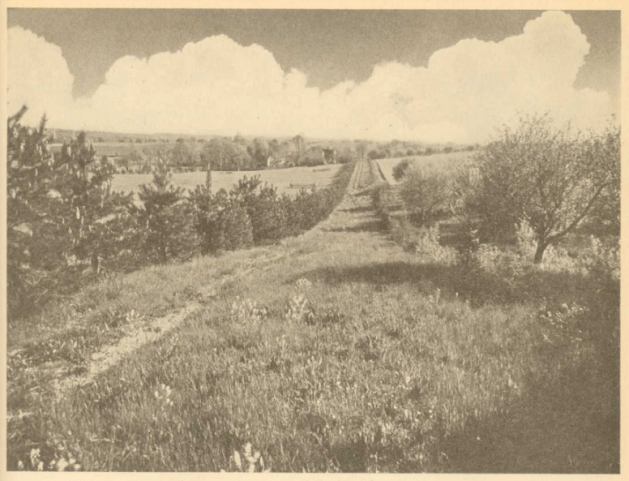
While recently working on a research project, I found 1930s pictures of the place where my in-laws live. Later the home to a master-planned suburban community, the picture presents quite an alternative vision:

SuburbanFields

Having such images could help give current suburbanites a better sense of what came before their home as well as some insight into how their home fits into an altered landscape. There would be some continuity between then and now – similar natural elements including wildlife, foliage, and topography – and notable differences such as the presence of modern roads and buildings.

Tracking down these images is often not easy. Many communities have historical societies or museums that keep such images. To see them, a community member or researcher would have to go ask for them. (And there is no guarantee they have pictures of every property; they are likely to have pictures of the more famous buildings in town.) Searching online can reveal some old maps and images of places but much of the material of local historical groups is not kept online.

Would suburban neighbors rather live next to a McMansion or a home made from shipping containers?

A couple in St. Charles, Illinois has built a 3,200 square foot home constructed out of four shipping containers. What did the neighbors think?

“In the beginning, people just didn’t understand it, and no one 100 percent supported it. But as it progressed, a lot of those people who were hesitant about it started to come on board and see it for what it was, and not just an extravagant trash can,” said Stephanie, the mother of two…

“It’s a custom home. These aren’t cookie-cutter homes. So even if we build another one next week, it will not be the same, and no one else has this home. Even though there are people that say, ‘I don’t know if I’d ever live in one,’ they say, ‘I like what you’ve done.’”…

Clark said his wife didn’t want to mask the unique aesthetics of the containers. The city and the Evans went back and forth with suggestions, requests and recommendations until they arrived at the current design…

One hang-up: Not all associations and subdivisions allow container homes, according to Clark. But the couple hopes that the more common alternative housing becomes, the better received container homes will be.

The home as depicted in the Chicago Tribune:

https://www.chicagotribune.com/classified/realestate/ct-re-alternative-home-styles-20181129-story.html

The home is certainly unique. The article leads with this idea: “Goodbye cookie-cutter. So long McMansion. Out with formulaic, in with customization.”

Teardown McMansions are often criticized for not fitting in with the architecture of the neighborhood in which they are built. This container home also does not fit with what is visible of the surrounding architecture. Would the typical suburbanite rather live next to an oversized and architecturally dubious teardown McMansion or an architecturally unique home made of shipping containers?

I would guess the McMansion would be more palatable to a number of suburban residents. Even though McMansions may not match the architecture of the styles they are trying to imitate or they may be a mishmash of styles, they are often (not always) built in somewhat traditional styles. The container home goes for a modern look: boxy, clean lines, different colors, a completely different shape than many suburban homes. Some uniqueness in suburban homes might be okay but this is something totally different. I have argued before Americans prefer McMansions to modernist homes. Perhaps the fact that this modernist home is built of recycled shipping containers helps since the home can be considered greener.

I do not think this housing design is one that will spread like wildfire through suburban residential neighborhoods.

Building a Sears mail-order home

The Chicago Tribune offers a summary of Sears mail-order homes from the first half of the twentieth century:

From the early 1900s until 1942, Sears, Roebuck and Co., more commonly known as Sears, sold thousands of mail-order kit homes, which buyers could pick from a catalog. The Barrington, for example, cost $2,606 and came with everything from trim, windows, millwork and flooring — some 30,000 pre-cut and numbered parts shipped by rail for assembly by owner or a local contractor. Housing styles were in the hundreds, floor plans customizable and prices from around $100

Ohio has the largest number of Sears kit homes, followed closely by Illinois, according to Solonickne, who started researching the topic seven years ago thanks to her daughter’s school project. Because many of the original sales records weren’t easily accessible, Solonickne decided to take on the task herself…

As of late summer, Solonickne counts 213 Sears homes in Elgin, 149 in Carlinville, 146 in Rockford and 69 in Downers Grove…

A number of companies — such as Aladdin Co. of Bay City, Mich., and Chicago-based firms Montgomery Ward and Harris Brothers — produced and sold mail-order homes. Each of these companies, including Sears, offered large luxury models (around 10 rooms) as well as two- and three-room vacation cottages, said Hunter.

Perhaps the most interesting part of this to me is the number of people who might live in such homes without knowing it. When you purchase a home, you actually do not find out much about the past of the home unless the seller goes out of their way to provide that information (and if they do, they are likely to doing so to justify a higher selling price).

It is also a bit strange to me that Sears itself would not have kept records (or those records did not survive) of to whom they sold home kits. Given the size of the order, wouldn’t Sears keep track of this information?

If Amazon is a direct descendant of Sears, we can expect Amazon to at some point sell homes or kits. Perhaps they would sell you all the materials and then offer an Amazon Expert to build it for you.

Shrinking new homes, fewer McMansions in Australia

A few years back, Australia passed the United States for largest new homes in the world. Now, new homes in Australia are trending smaller, Australian new are firmly the second largest in the world, and fewer McMansions are under construction:

Australian homes have shrunk to 22-year lows as the “McMansion” fades in popularity and more apartments are built, Australian Bureau of Statistics data reveals.

The average floor size of a new home is now 186.3 square metres, down 1.6 per cent over the past 12 months and the smallest since 1996, according to CommSec’s Home Size Trends Report released on Monday.

More on the longer trends:

The average size of freestanding houses peaked in 2011-12 and has stabilised over the past five years. The average house is 8 per cent bigger than 20 years ago and nearly 30 per cent bigger than 30 years ago in 1987-88.

The standard fit-out is also superior, with higher quality kitchens, bathrooms, floor coverings and inclusions such as air-conditioners.

It is good to have a reminder that new homes can both increase and decrease in size over time. On one hand, smaller new homes would be praised by some as a good move. On the other hand, the long-term shift is still toward larger homes with more expensive features.

It is tempting to consider whether a similar shift could take place in the United States. Could the ever-growing new home in the United States start shrinking as smaller kinds of new housing increase in number? This could happen either two ways: fewer large homes are constructed or more smaller units are constructed (in comparison to each other). I am skeptical this would happen for multiple reasons. Americans still seem to believe in the virtues of having more space and are still willing, to some degree, to tackle the issues that can come with larger houses (i.e., longer commutes, higher taxes, higher maintenance and upkeep costs). Smaller units may be popular in some circles but reasonably-priced apartments, tiny houses, and accessory dwelling units have yet to take off in large numbers. This, of course, could change as households and communities change over the decades, but I do not envision a major reduction in the size new American homes in the near future.