The arguments for and against banning zoning for only single-family homes

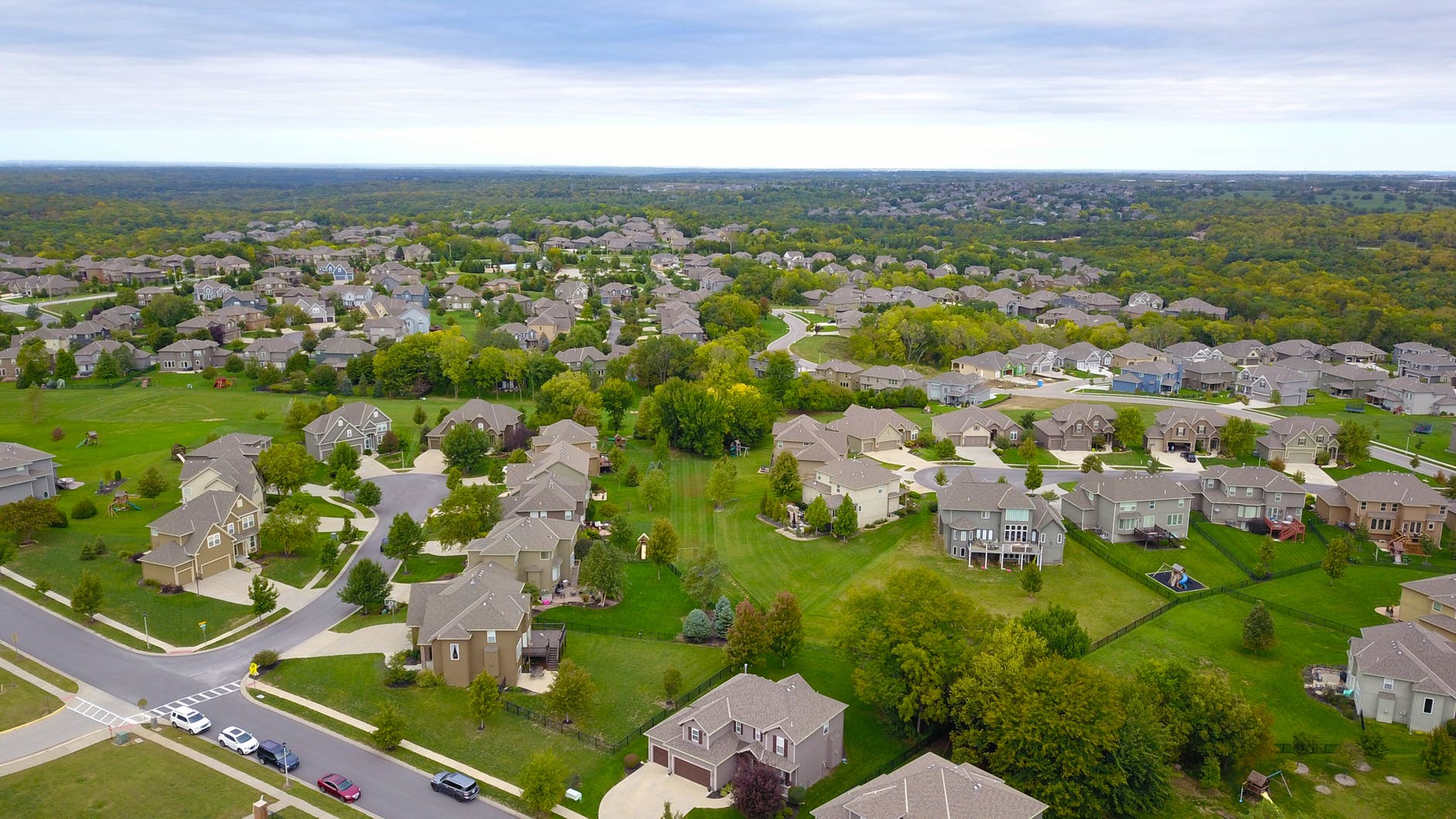
The single-family home is very important in the United States and this is enshrined in land use policy and zoning. Because of this, there is a move in multiple communities to ban single-family home zoning and this has prompted debate over the change:

Photo by David McBee on Pexels.com

Originally introduced in Berkeley, Calif., in 1916 as a means of preventing a black-owned dance hall from opening, single-family zoning became increasingly popular — though divorced from its explicitly racist origins — as more Amercans moved to sprawling suburban cities across the country. Today, many of the country’s major urban areas reserve 75 percent or more of their residential land exclusively for stand-alone, one-family homes.

Recently, lawmakers in blue states and cities have moved to roll back zoning rules in hopes of spurring more development. Minneapolis became the first major city to ban single-family zoning in 2019. That same year, Oregon passed a similar law statewide. Perhaps the most significant change came in California where the median home price is estimated to exceed $800,000. A new law that eliminates single-family zoning across the entire state went into effect on Jan. 1. None of these reforms make it illegal or even more difficult to build a stand-alone house, they simply remove barriers that prevent any other type of dwelling from being built.

Advocates for eliminating single-family zoning say it’s the most important step toward addressing the housing shortage, since any other programs to spur more development would be moot if there’s no land to legally build on. Supporters say eliminating what they often refer to exclusionary zoning would have wide-ranging benefits beyond just creating more housing stock, including reducing racial segregation and closing the racial wealth gap, boosting job opportunities in urban areas and reducing climate impacts created by suburban sprawl.

Many conservative opponents of these reforms, including former President Donald Trump, have portrayed them as a “war on the suburbs” that would bring big-city problems to quiet communities while doing little to address the underlying causes of the housing shortage. Some argue that financial incentives, not coercive new laws, are the best way to spur development.

A lot of pro-housing advocates also have doubts about how much of an impact zoning reforms on their own will make. They argue that most of the new laws are riddled with exceptions that limit their scope and few also address the long list of other ways that local governments can prevent dense housing from being built — like minimum lot sizes and parking requirements. Some on the left make the case that the only way to increase housing supply at the pace that’s necessary is through strict mandates that require cities to build a certain number of housing units and impose heavy financial penalties on those that don’t.

This would be a hard change to make and capitalize on in many communities. Housing policy in the United States is difficult to change and is rooted in a long history, cultural narratives about success, exclusionary practices, and local governments and other government actors. Yet, even discussion of such a change at least highlights the need in many places to think more about housing and how it could be more accessible to many.

As about any policy possibilities in the United States, I now wonder if what would work best in this situation is for several different kinds of communities across the country to ban single-family zoning and see what happens. What changes in the community? How do residents and newcomers experience it? How does it affect housing values? Does it significantly alter the character of the community? And if there are success stories – which could range from limited noticeable change (that it does not lead to negative outcomes or the end of the suburbs might be good enough) to positive outcomes – then other communities could observe and consider the option.

Suburban voters and the French presidential election

Residents of the American suburbs may hold the keys to major political outcomes. Is the same true in France?

Photo by Matt Hardy on Pexels.com

ON THE FRINGES of greater Paris, where urban concrete meets farmed fields, lies the suburb of Saint-Brice-sous-Forêt. Gently curved streets of two-storey houses, each with a parking space and garage, cover what were once apple and pear orchards. The narrow high street has just one café, and a “Cheesy Pizza” takeaway joint; but there is a drive-in Burger King on the outskirts. This is what the mayor, Nicolas Leleux, calls “the border of two universes”: city and countryside. It captures the worries and hopes of middle France, and exemplifies a crucial electoral battleground for April’s presidential poll.

Shy of extremes, the suburb tilts to the centre-right. In 2017 Saint-Brice-sous-Forêt preferred the centre-right presidential candidate, François Fillon, in the first round, but backed the centrist Emmanuel Macron against the nationalist Marine Le Pen in the second. In 2020 it replaced a centre-right mayor with Mr Leleux, a former navy submariner who belongs to Mr Macron’s party. Locals, in other words, may be torn at the presidential poll this time between a vote for Mr Macron, assuming he runs for re-election, and his centre-right rival, Valérie Pécresse. A well-known figure locally, she is the president of the Ile-de-France region, which encompasses the city of Paris itself and Saint-Brice-sous-Forêt, 17 kilometres (11 miles) away…

What comes into sharpest relief in Saint-Brice is the collision between the needs of daily life, notably the car, and the desire for a greener future. A place of quiet middle-of-the-road aspiration, it evokes what Mr Leleux calls the “French dream”. “People have left the city to come here, not to live in a tower block, but in a house with a little garden, with neighbours, and a place to barbecue.” Nearly 88% of households own at least one car. His task, he explains, is to reconcile that dream with the need to reduce car usage. Few can afford an electric vehicle. Mr Leleux is planning cycle lanes and building a bike shelter at the railway station, on a direct line to Paris. Yet on a cold day in January there are no cycles to be seen on the streets…

Fashionable Parisian talk of the ideal “15-minute city” is all very well, says Mr Leleux. The reality is that to buy a baguette in under 15 minutes without a car is not possible in much of suburbia. If anybody has learned this, it ought to be Mr Macron, who won a huge majority of the vote in big cities in 2017, but later faced months of gilets jaunes protests. For now, insists the mayor, locals credit the president nonetheless with having been a “good captain” in difficult times. In April, it is on the streets of middle France, not the parquet-floored salons of Paris or its tenements, that such a claim will be tested.

The focus in this analysis is on cars as a divisive political issue. Can suburbanites afford electric cars? If they cannot, what does this mean for suburban life? I could imagine a similar question in the United States with numerous manufacturers moving to electric vehicles

But, I wonder if the electric car is just a symptom of deeper differences based on how the car factors into the fabric of suburban life. In the United States, I have argued that homes, cars, and a way of life are all connected in suburbia. It is not just that a new kind of car is expensive; any disruption to driving changes suburban life. Cars help enable larger yards, private space, and separated land uses. People want amenities to be within a 15 minute drive and this significantly widens their travel radius compared to walking.

Perhaps the other possible suburban disruption on this scale would be to threaten single-family homes and yards. I put the single-family home as the #1 feature of suburbs that Americans love. (Cars and driving is at #5.) Yet, it is hard to imagine suburbs today without homes and cars together.

In the meantime, I will keep an eye out for more analysis from France to see if the suburbs matter in elections in the same way as they have mattered in recent American election cycles.

Making clear where HGTV shows are filmed

Some HGTV shows are very clear about where they are located. As two examples, Chip and Joanna Gaines are based in Waco and have built a local empire through Fixer Upper while House Hunters shows multiple shots of the local community and region.

Photo by RODNAE Productions on Pexels.com

But, other shows say less about their filming location. One such show is Love It or List It. While this is old news to regular viewers, this article discusses the switch in filming locations:

Like Renovation Island, Love It or List It actually began as a Canadian series, and filming took place in Ontario. Despite where it was shot, the home renovation series became a popular franchise on HGTV in the United States. As such, in 2014, after filming in Ontario for six years, hosts Hilary Farr and David Visentin, along with the crew, picked up and headed to North Carolina to start fresh in a new city…

And, if in doing so you find that you love the area as much as the homes being showcased, know that you can experience it for yourself by booking a trip to the Tar Heel state — specifically the Triangle and greater Raleigh-Durham area.

One could argue this does not matter: the real show involves Hilary, David, and the interior of individual properties. The show tends to provide a few aerial views of the properties in question and there might be some discussion of the location of the home in relation to workplaces or destinations. Does it matter if the homes are in Ontario or in North Carolina? Most of the action and filming takes place inside.

On the other hand, the community context matters a lot. Even if the show focuses on individual properties, the place matters for at least a few reasons:

  1. House architecture and style depends on what happens in particular places. The design of homes in North Carolina is quite different from Ontario. Different builders and developers operate in each place.
  2. Different logics apply in different places regarding where people want to locate. Do people in older Toronto and suburban neighborhoods see locations in the same way as Americans in sprawling contexts? Maybe, maybe not.
  3. What looks like normal life differs by place. In years of showing the same kinds of places on a TV show, do viewers accept it as how life works? Any TV show can project stability with consistent characters and story lines. But, see enough single-family homes in tree-lined neighborhoods only accessible by cars – and this is the primary dwelling on HGTV – and it can appear to be the default.

While not all HGTV shows ignore the community or region, I would be interested in more of their shows seriously incorporating place into their narratives about homes.

Adjusting housing for single-person households?

With the increase of single-person households in the United States, it raises questions about housing:

Photo by cottonbro on Pexels.com

The difficulties of living alone tend to lie more on a societal level, outside the realm of personal decision making. For one thing, having a partner makes big and small expenditures much more affordable, whether it’s a down payment on a house, rent, day care, utility bills, or other overhead costs of daily life. One recent study estimated that, for a couple, living separately is about 28 percent more expensive than living together.

These efficiencies are an inherent feature of sharing costs with other people, but the barriers to living alone, for those who want to, would be much lower if housing (and health care, and education) weren’t so expensive. Moreover, the types of housing that are most commonly available for one person typically privilege privacy over togetherness, but the two don’t need to be mutually exclusive. DePaulo has studied communities where single residents have their own spaces, but also plentiful shared areas with “the possibility of running into other people.” If you need to, say, move heavy furniture or get a ride somewhere in an emergency, your neighbors are easy to reach. More such options would make solo life easier.

With the rise in housing prices, the barrier to entering the housing market keeps increasing. A single-person household has fewer potential resources to draw upon.

Additionally, a good portion of housing is geared toward families or larger households. While some locations have plenty of smaller units – think studios to two bedroom units – other locations have larger residences. For example, suburbs are often full of single-family homes with 3+ bedrooms and more square feet.

Finally, housing in the United States is often tied to ideas of familial bliss. Those same private suburban homes are meant to enhance family life. Residences provide private spaces for nuclear families. They may have outdoor space for kids to play in and adults to use. Homes are a symbol of success and can provide a good long-term return on investment. Can a single person still enjoy and benefit from a house? Yes, but this may not be the typical image of life in a single-family home.

New publication – More than 300 Teardowns Later: Patterns in Architecture and Location among Teardowns in Naperville, Illinois, 2008-2017

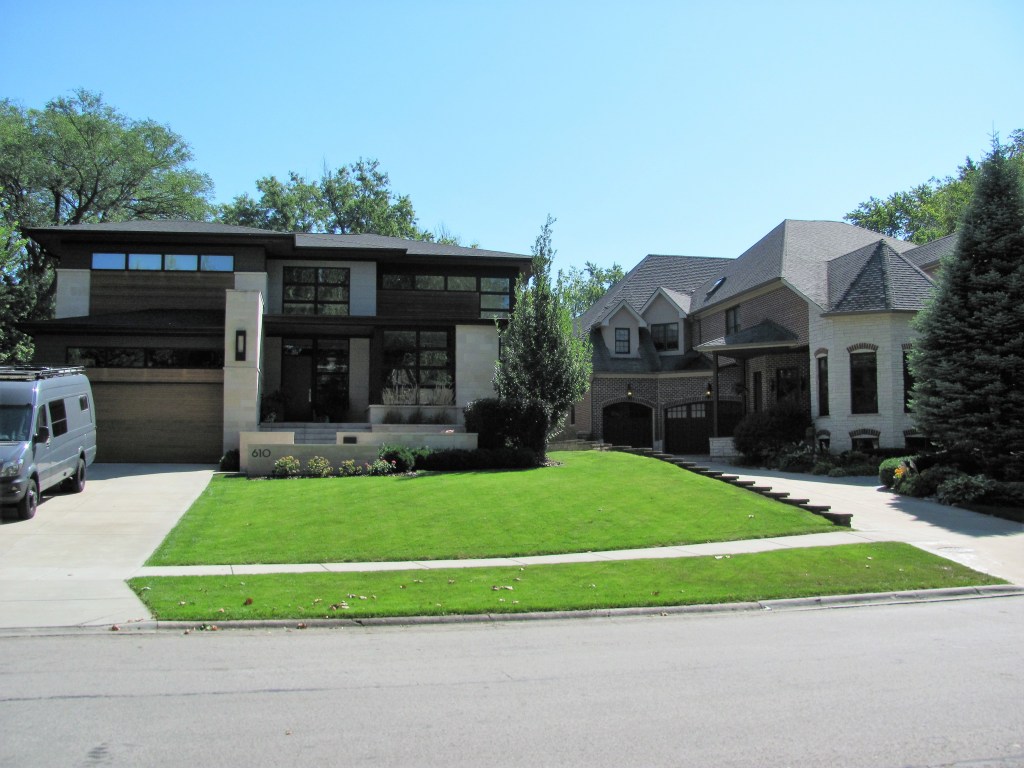
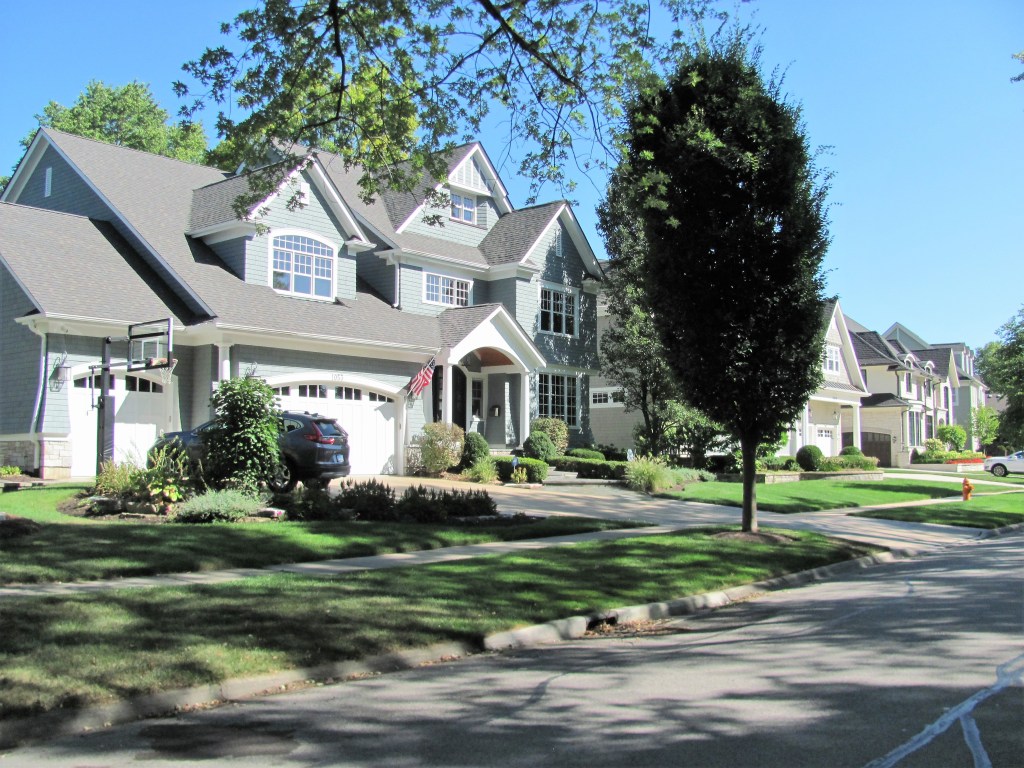
I recently published an article in the Journal of Urban Design (online first) analyzing several hundred teardowns in Naperville, Illinois. Here is the abstract (and several of the pictures I took for the study depicting recent teardowns):

Analyzing before and after images of 349 teardowns between 2008 and 2017 in the wealthy and sprawling suburb of Naperville, Illinois, shows patterns in aesthetic choices and their fit in older neighbourhoods. First, the teardowns are significantly larger and have different features including larger garages and more windows. Second, over 60% of the teardowns feature Victorian styling. Third, the teardowns are often next to other teardowns in desirable neighbourhoods near the suburb’s vibrant downtown. These visual findings show how teardowns that add to the housing stock often imitate common architectural styles yet exhibit disparate features compared to older neighbouring homes.

This project had several starting points.

First, I started studying the phenomenon of McMansions back in graduate school and eventually published a study looking at how the term was used in the New York Times and the Dallas Morning News. The idea of a McMansion has multiple dimensions – size, relative size, poor architecture and design, and a symbol for other issues including sprawl and conspicuous consumption – and the word can be used differently across locations.

Second, I started studying Naperville in graduate school as part of a larger project examining suburban growth and development. I published some of this research in two places: (1) examining consequential character moments in different suburbs, including Naperville, and (2) analyzing the surprising population growth in Naperville that helped take it from a small suburb to a thriving boomburb. Naperville is a unique suburban community with lots of teardown activity in recent decades.

Third, I am broadly interested in housing. This is particularly important for suburbs where owning and protecting single-family homes – and all that comes with it – are primary goals. Additionally, residential segregation based on housing is a powerful force in American society.

All three of these streams helped lead to this project. And there is a lot more that could be done in this area as teardowns affect numerous neighborhoods and communities in the United States.

The importance and consequences of separating single-family homes from other land uses in the United States

A foundational idea in American life is that single-family homes should be located near other single-family homes and away from other land uses, including denser residential units. While this might sometimes be sidelined to the more areas of planning and zoning, I would argue this is much bigger than just allocating physical space: it interacts with significant social, political, and cultural forces and has sizable effects on daily life. I will first describe how we got here before highlighting two examples I saw this week and then noting several important outcomes.

Photo by David McBee on Pexels.com

From at least the mid-1800s, Americans developed ideas about having separate single-family homes among nature. Scholar John Archer examines the idea of “the cottage in the woods” from its roots in English villa houses and into a rapidly urbanizing American landscape. As cities and then suburbs developed, the single-family home became a hallmark of suburban communities where residents had escaped hectic and dangerous urban life. As zoning developed in the early 1900s, it evolved to protect single-family homes from other nearby land uses that might threaten it. Many American leaders and organizations promoted homeownership. Suburban communities and residential neighborhoods became refuges for whiter and wealthier residents who then worked to keep others out. This all helped contribute to residential pockets separate from other land uses and protected by local zoning and land use policies.

This historical legacy and ongoing reality plays out consistently in certain areas. Two examples I ran across in just the last few days:

  1. Affordable housing in the suburbs. Can denser housing that is cheaper be anywhere near single-family homes? This particular project in the Chicago suburbs drew typical complains from nearby homeowners; noise, traffic, change in character for the neighborhood. The developer came back with changes to try to fit in better with the nearby homes but there are still concerns. This makes sense given the American logic of homes and space but this logic is not organic or inherent to the housing itself; it is created.
  2. Why do apartments have to be located on busier streets in American communities? This may have negative effects on the apartment residents and serves to maintain the distance between denser housing and single-family homes. Again, this makes sense given the established American logic but it is possible – and indeed done elsewhere – that you can have quieter residential streets lined with apartments.

Why does this all matter? This separation of housing serves to continue race/ethnicity and class divides, contributing to residential segregation. This changes social patterns as people in different neighborhoods may be less likely to interact, utilize the same civic (such as schools) and private services, and engage politically. Ultimately, it can both shape and be shaped cleavages in society. Location helps determine life chances and Americans start with the premise that homes should be separate.

A denser suburbia in California and the rest of the United States

The single-family home is the most important feature of American suburbs. What happens when conditions change and pressures lead to more multifamily housing units and denser housing in suburbia? From California:

Photo by Skylar Kang on Pexels.com

In June, as Ms. Coats told me about the house and the neighborhood from the doorstep of her bungalow, she gazed toward a fresh foundation that had entombed the back half of Lot 118 in concrete. Over the next few weeks, a construction crew erected a two-story building that filled in a green rectangle from the Clairemont Villas brochure. A few feet away, the original four-bedroom house was loudly gut-renovated into a pair of apartments.

When the workers head to their next job this month, they will leave what amounts to a triplex rental complex on the type of lot that in the seven decades since Ms. Coats’s family moved in had been reserved for single-family houses. It’s part of a push across California and the nation to encourage density in suburban neighborhoods by allowing people to subdivide single-family houses and build new units in their backyards…

In the vast zone between those poles lie existing single-family neighborhoods like Clairemont, which account for most of the urban landscape yet remain conspicuously untouched. The omission is the product of a political bargain that says sprawl can sprawl and downtowns can rise but single-family neighborhoods are sealed off from growth by the cudgel of zoning rules that dictate what can be built where. The deal is almost never stated so plainly, but it is the foundation of local politics in virtually every U.S. city and cuts to the core of the country’s deepest class and racial conflicts…

“It doesn’t fit.” “It’s adding people.” “We don’t want that here.” “There’s other places for that.” “We just want to keep our neighborhood like it is.” “They want to push us out and tear our houses down.” “Parking.” “Parking.” “Parking.”

Several quick thoughts on these changes in many suburban communities:

  1. Where exactly this density will happen will be fascinating to watch. Will it happen in wealthier suburban communities or will they be able to keep it at bay? Inner-ring suburbs are often already more familiar with such density but this is less common in suburbs further from the big city.
  2. The housing pressure is acute in California but is not so clear or as well publicized in many other locations. If this works in California, where else does it show up?
  3. The NIMBY concerns cited above will be vocally shared again and again. The appeal for many single-family home owners is the space between neighbors, relatively lots of room for parking, and not feeling like the neighborhood is crowded.
  4. How much are #1-3 above linked to another long-term pattern in suburbia: race and exclusion? Homeowners will say it is about protecting their properties – particularly their property values, which single-family home zoning is intended to do – but it is also about who is able to live in the neighborhood and community.
  5. The addition of units and people to existing single-family home neighborhoods is a different approach to denser suburbia than creating larger-scale “surban” projects that some would find desirable near suburban downtowns or in large-scale redevelopment.

A growing number of US suburbs contain a majority of renters

A new analysis suggests the number of suburbs with a majority of renters is increasing:

Photo by Marlene Leppu00e4nen on Pexels.com

Renters now make up the majority of residents in more than 100 suburbs around the U.S., according to a new analysis of Census Bureau data from Rent Cafe. Another 57 suburbs are on their way to becoming predominately renter territory over the next five years, the apartment search website also found…

Overall, roughly a quarter of the more than 1,100 suburbs near the nation’s 50 largest metro areas are renter-dominated, according to Rent Cafe. Some 21 million people rented their homes in the suburbs as of 2019, up from 17 million a decade ago.

Millennials and members of Generation Z account for most suburban renters, Census data show. Rent Cafe notes that 55% of suburban renters are younger than 45, with median household earnings of around $50,000.

Meanwhile, the pandemic is expected to further fuel the shift away from suburban homeownership in favor of renting. Remote work opportunities have generated more interest in suburban areas within striking distance of cities.

If this is indeed the case, it would be interesting to know if these suburbs share characteristics. Do they tend to be close to the city or further out? Do they have particular hosing stocks compared to other suburbs? Are middle-class and up suburbs still devoted to residents owning single-family homes as a status marker?

My guess is that a majority of suburban residents would still say that they desire to home at some point. But, if more suburbanites are now renters, is the pathway to homeownership in their own community or other suburbs much more restrictive? This is part of the larger affordable housing conversation; people need any decent housing to live in but because many Americans aspire to own a home, having affordable ownership options is important as well.

An interesting middle path in some communities could be having significant numbers of single-family homes with long-term renters. The appearance and status of homes is maintained while renting adjusting for current conditions. On the other hand, many have argued that renters do not care for their properties or communities in the same way and communities may not like this trend.

Bringing a South Side Chicago home to the middle of an entertainment spectacle

The listening party Kanye West hosted at Chicago’s Soldier Field last week featured at the center of the set a replica of the home of his mother on the city’s South Side:

As noted in the review, the addition of the cross to the front of the home helped it look like a church. However, outside of that, it looks like a fairly standard house: long and skinny to fit a city lot, a bay window in the front, a second story with pitched roofs all the way back, nondescript siding.

That the single-family house was at the center of a spectacle – slow moving vehicles, other music stars, people in masks and costumes on the front steps, thousands of people listening in the stands – hints at the role of the home in the creative process. How many important American cultural works emerge from such dwellings? Once stars are established, we do not associate them with such humble dwellings but rather with large Hollywood mansions or opulent condos in the biggest cities. Or, we might think of artists as connected to particular places, whether specific neighborhoods or cities or suburbia at large. Kanye has noted connections to Chicago but this home says less about Chicago as a place than it does about more private activity, home life, and the importance of West’s mother. Even as we are not invited to see inside the important home – imagine it being constructed in such a way to open for the audience with emphasis on certain rooms, activities, or symbols – we get the sense that the home mattered.

iBuyers look to ramp up home purchases

Several tech companies are looking to purchase more American homes:

Photo by RODNAE Productions on Pexels.com

“Our financial goal is to drive rapid growth at scale with sustained improvement in our profitability,” Opendoor, the industry pioneer, wrote in its letter to shareholders this week. After going public last year, Opendoor has now expanded into more than 40 markets and purchased 8,500 homes in the second quarter, more than any other quarter by almost 50%. The company, which is reportedly searching out a new $2 billion revolving credit facility, also announced this week that it is now willing to purchase the majority of homes in every one of its current markets.

Zillow announced similarly ambitious plans during its recent earnings call. While it bought only 3,800 homes in the second quarter, Zillow is gearing up to scale massively through the rest of 2021, saying that it expects its Homes division to bring in around $1.4-1.5 billion in revenue next quarter, roughly double what the division made this quarter…

iBuyers say that in exchange for money they offer convenience, quickly offering a number to homeowners who, if they accept, can then pick their exact move-out date, avoid showing their home, and use the money to immediately go house hunting. (Zillow says its goal is become a “housing market maker.”)…

Still, it’s difficult to deduce at this early moment whether adding high-tech firms to the real-estate market will be a net positive or negative for the typical American family, said Roberto G. Quercia, a professor of city and regional planning at the University of North Carolina at Chapel Hill. Residential real estate remains the dominant form of wealth for such families, making up roughly 70% of median household net worth, so the answer could have potentially enormous ramifications for the country.

The biggest factor seems to be the marriage of tech capabilities and money. There are other actors in the market who have plenty of cash to use. There are plenty of websites and apps for real estate. Does putting them together offer unparalleled convenience or particular knowledge through algorithms and real estate data?

There are multiple sets of consequences to figure out. As the article notes, it is not clear if these new home selling options benefit consumers. More options or more competition could be good. What do other actors like lenders, developers, and realtors think about this? Additionally, many communities might have concerns about institutional buyers who can leverage technology and scale but do not necessarily have local knowledge or concern about local markets. Could these actions drive up prices beyond what regular buyers could afford?