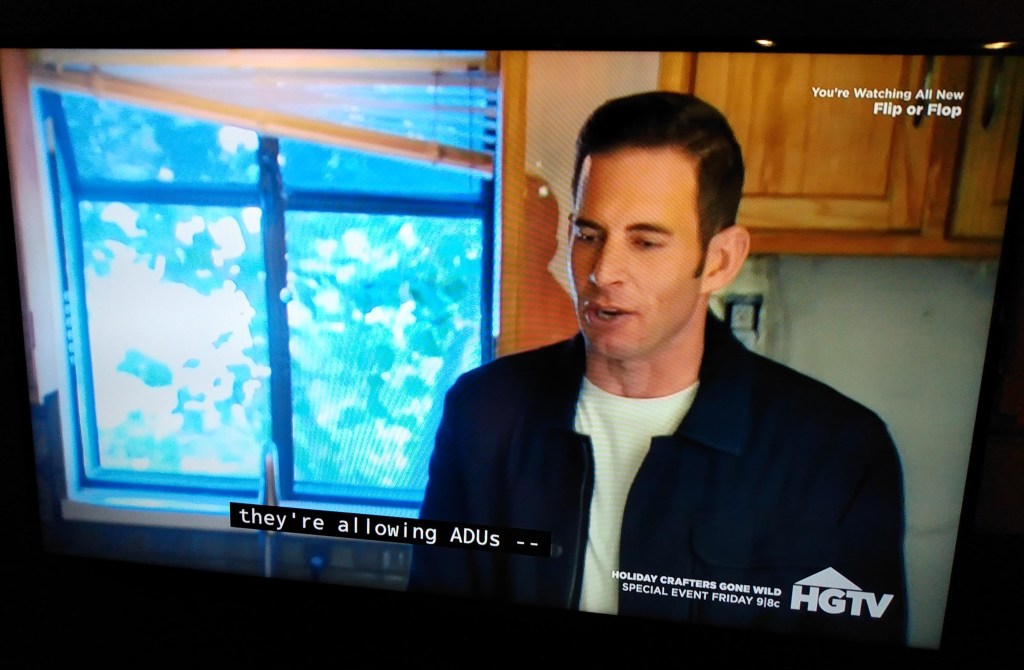
Last night’s new episode of Flip or Flop, Season 9 Episode 7, featured a home with an ADU (accessory dwelling unit). And this unique feature of the home offers a chance to make more money:
After Tarek and Christina realize the garage in the backyard is now a living space, Tarek lays out the argument: this is not just a studio space or a he/she-shed. It is possibly a rentable unit. This may make this property even more enticing.
This got me thinking. ADUs are supposed to help provide more housing units in more expensive markets like Portland and Los Angeles. Instead of building denser, taller housing in single-family home neighborhoods, ADUs take advantage of existing yard space, garages, or other buildings on residential properties.
But, while the ADUs might provide more housing, they may not necessarily provide housing that is that much cheaper. Take the example from Flip or Flop: with a home valued at over $1 million in North Hollywood, they estimated they could rent the studio ADU with a full bathroom and kitchen for $2,000 a month. How many people could afford this?
Further, such units could become a tool for residents and developers to generate more revenue. In such competitive markets, adding any kind of residential unit presents an opportunity. The ADU could enable a homeowner to generate money from their property. An investor interested in a single home or one with multiple homes could generate even more money with ADUs.
To truly provide housing that is more plentiful and at a reasonable price, it seems like a lot of ADUs are needed. They cannot provide as many units as large multifamily developments might. Yes, they do not disturb the existing character of a neighborhood much. But, if the ultimate goal is to broadly expand housing options, the occasional ADU in an expensive area might not be enough.
The vacant Sears store at the Fox Valley Mall could be razed early next year to make way for a three-building apartment development and kick off a new phase of life for the 45-year-old mall.
Aurora aldermen will vote next week on a request to rezone roughly 11 acres of the property along Route 59 side of the property to allow the buildings.
The buildings, each three stories tall, would have a total of 304 studio, one- and two-bedroom apartments…
A 2020 report for the city said that, including the closed Sears and Carson Pirie Scott department stores, 40% of the mall’s store space was vacant.
Adding residential units to shopping malls is a fairly common suggestion. With retailers in trouble, apartments fill the space more permanently, can address housing issues in communities, and could provide a ready population of potential customers for the nearby mall and other proprietors.
With the proposal working its way through local government, three things are worth watching regarding these apartments:
How, if at all, will the apartments be connected to the mall? If they are completely separate buildings and are not marketed as being right next to the mall, then they could be like any new apartments. But, perhaps the mall is a draw for those who might want to be close to shopping, an indoor walking site, and food options.
What kind of apartments will these be? Given their location, these will probably not be cheap apartments. In addition to being close to the mall, the apartments are near lots of other shopping and dining as well as potential employers, the location is just west of Naperville, and a busy Metra station is just to the north.
How much of the mall will survive within five or ten years? The apartments could help revive the mall area or help hasten its demise.
TikTok user @cyberexboyfriend is every realtor’s worst nightmare.
On his account, which boasts 32,000 followers and counting, he hosts a popular series in which he tears apart random McMansions he finds on Zillow.
It all started on Nov. 3, when @cyberexboyfriend posted a video captioned “roasting homes on Zillow.”…
Easily the funniest and most viral video in the series to date is the one in which @cyberexboyfriend critiques a $675,000 four-bedroom home, also located in Mckinney, Texas.
It is easy to criticize McMansions. They can have cartoonish features, ranging from turrets to garish facades to oversized garages to odd proportions. Much effort is put into their facades with less attention paid to other sides of the home. The interior may have some questionable choices. In an era of hot takes, social media, and concerns about housing and inequality, a quick skewering of a McMansion draws attention.
On the other hand, these real estate listings are for real homes. Numerous American communities, often wealthier suburbs, have McMansions. And at least a few people are willing to buy them.
Does this approach to McMansions help more people avoid purchasing such homes, either because the social stigma is potentially higher or because they are alerted to the problems with McMansions? Or, does it reinforce existing views people have about McMansions?
I have suggested before that if people had to choose between modernist homes and McMansions, they might choose McMansions. Those who criticize McMansions publicly are not likely to live in or near such homes. If you are against McMansions, you might also have concerns about sprawling suburbs and instead prefer denser suburban communities and cool styles like midcentury modern, interesting ranch homes, or older more traditional styles.
This may ultimately come down to taste in single-family homes based on social class, access to resources, and experiences with different kinds of communities. While political polarization in the suburbs is real, polarization by home style could be present alongside it.
While rents in San Jose have fallen 6 percent since January, tech havens in Santa Clara County — including Mountain View, Sunnyvale and the city of Santa Clara — have seen rents fall by at least 11 percent during the covid pandemic, according to a new study by Apartment List. Rents also declined in the East Bay.
The exodus of now working-from-home techies from the Bay Area has left openings and rent discounts at complexes near the tech giants. The uncertainty of the pandemic has driven renters back home, to spacey outer-suburbs or to remote towns and resort communities such as Lake Tahoe…
The demand for more living space and the shortage of homes for sale has driven up single family home prices in Silicon Valley, with suburban buyers pushing median prices to $1.33 million in Santa Clara County and $1.63 million in San Mateo County in September, according to CoreLogic data…
Popov said rent declines have generally decreased the farther away you get from San Francisco. Outer markets in Salinas and Sacramento, for example, have seen rents climb.
The effects of COVID-19 illustrate how housing prices within a region or within contiguous regions do not necessarily all follow the same patterns. Even as one area might experience less demand in one part of the market – rental units in particular neighborhoods communities, other portions of the market – such as single-family homes – may be more expensive.
In a market like this, those who can move around have some advantages. First, those with resources and particular occupations can move away from areas with more cases of COVID-19. This could have a direct effect on health. Some of these workers might return when COVID-19 is no longer a concern but for now they can be in less dense areas and work from home.
Second, some people are more able to move than others. Even if prices are going up in desirable locations, they can pay more. They have particular occupations that allow them to work from home, an option that is less possible certain job sectors. Perhaps their social networks and connections to local institutions are more fluid and accessible remotely.
This discussion occasionally comes up when people look at available jobs throughout the United States. The question will arise: how come more people do not move to go where the jobs are and take advantage of the economic opportunities? Moving is not a simple task. It involves more than just having a good job or not.
The same can be true of housing costs. The price of renting or buying a home can vary dramatically from place to place. Yet, a large number of people may not move one way or the other for a variety of reasons. And since jobs and housing prices are linked for many, it can be hard for many to simply leave the expensive Bay Area or move within the region to take advantage of lower rents or costs in some areas.
In the 2016 election, rural and nonmetropolitan America gave Donald Trump enough of a margin to beat Hillary Clinton in seven key states. Ahead of the 2020 election, Republicans worried that Trump would lose his rural edge, in light of reduced support there in the 2018 midterm elections. But this was not the case. Instead, Trump’s loss to Joe Biden was due mostly to voters in large metropolitan suburbs, especially in important battleground states…
However, large suburban areas in 2020 registered a net Democratic advantage for the first time since Barack Obama’s victory in 2008. This is significant because more voters reside there than in the other three categories. In terms of aggregate votes in these large suburban counties, there was a shift from a 1.2 million vote advantage for Trump in 2016 to (at last count) a 613,000 vote advantage for Biden—a nearly 2 million vote flip. In addition, Biden benefitted from more modest Republican margins in small metropolitan areas. These advantages for the President-elect were even greater in key battleground states…
The three northern battleground states of Michigan, Pennsylvania, and Wisconsin—which flipped to Trump in 2016—again entered the Democratic fold in 2020. Here, even more than in the national analysis, the 2016 to 2020 suburban shifts to either greater Democratic or smaller Republican support were instrumental in Biden’s victory…
Suburban voting patterns also made a difference in the Sun Belt, especially in large southern states where suburbanization has been rampant. The focus here is on two such states: Georgia, where Biden is ahead and a recount has been announced; and Texas, which Trump won, but where urban and suburban voting patterns closed the longtime Republican-Democratic gap.
While political analysis suggests middle suburbs are battleground areas, I wonder if this signals that these suburbs are also in the middle of all sorts of other trends including demographic changes, cultural tastes, and suburban inequality. To build on earlier posts, perhaps finding middle America right now involves going to a Walmart in a middle suburb or an emergency room in a middle suburb.
Many people have discussed the electoral college in recent years. Here is a crazier proposal based on more recent trends: instead of the electoral college by states, how about an electoral college by cities, suburbs, and rural areas? With concerns on either side that cities or rural areas are controlling political outcomes, could there be some way to weight the results such that all three geographies could influence the outcome? Grouping votes by states obliterates any distinctions between places.
The data above helps provides details on this population change. The net migration data shows the region gained nearly 200,000 residents via international migration. If you rank all of the MSAs over the decade, Chicago was #10 on the list of international migrants. Chicago continues to be an important center for immigrants (even as it lags behind New York, Miami, Los Angeles, Houston, Washington, Boston, Dallas, San Francisco, and Seattle).
This means that if the Chicago area had fewer international immigrants, it would have lost a lot more people. If international migration was more like San Diego or Tampa or Minneapolis, the region would have lost more than 50,000 people. While I suspect few in the Chicago region would like to lose any residents over a decade, the situation would be much worse without the city and region continuing to attract immigrants.
I recently finished the large tome Recording the Beatles. This is a very detailed book about the recording process the group went through with information on all of the equipment (from mixing boards to microphones to studio spaces to echo chambers to instruments and so on) and the recording studio staff and infrastructure the group had throughout their career.
There are a number of sociological connections to make based on this work. Here is the one that sticks out the most to me: the “art world” of The Beatles, which includes what this book describes as the equipment and the people at Abbey Road (with a few other studios thrown in at different times), both constrained and empowered The Beatles. The story of their music and the group would be incomplete without reckoning with this. Let me explain further what I mean.
In some ways, the structure of EMI and Abbey Road constrained the Beatles. EMI was already a successful company ahead of signing the Beatles in 1962 and had particular ways of going about things. The space and personnel had a particular structure. EMI made a lot of their own audio equipment and equipment from other manufacturers was often modified in house. There was a clear division of labor between the producer, engineer, and sound technicians (symbolized by the white coats worn in the studio).
Rock music was something new for EMI and the Abbey Road studios and it took some time to catch up to new music trends as well as to what the Beatles wanted to do. At the beginning, recording was more of a live affair where groups came in and recorded songs in a few takes. An album would take just a few days. For much of their career, the Beatles recorded on four-track boards and machines, limiting recording opportunities or making certain tasks more difficult. Getting access to new equipment required formal requests and testing. The Beatles producer, George Martin, was not trained as much in rock music. Much of the Beatles catalog was originally only made available in mono, rather than stereo, sound.
Despite these constraints, or, more accurately, partly because of these constraints, the Beatles became successful. The band had to work hard in the early days to hone their sound for the studio. They had to act professional in front of George Martin and the experienced staff. The equipment pushed them to be extra creative in getting new sounds and techniques to tape.
Indeed, the infrastructure was also empowering. With a team of professionals, the Beatles were guided in the early days and gradually took on more responsibility for producing their own music. George Martin’s training proved very useful in arranging music, adding orchestral or horn parts, and encouraging new ways of doing things. Even if the equipment was outdated or lacking, the professionalism of the staff was not in question and all labored to translate the increasing creativity of the group to records. Abbey Road had almost everything that was needed including cavernous studios to record large groups and multiple spaces where the group and staff could work. The weight of EMI with all of its resources could help support the most popular band on earth.
While a common story of the Beatles is that they grew to chafe at the restrictions of conventional recording, this infrastructure – this technical art world – helped make their music what it became. If Decca had signed the group when they had a chance and put the Beatles into their infrastructure, the outcome could have been different. And the Beatles story within EMI is one echoed by countless other groups who then took rock music more broadly into studios, produced songs and albums, and influenced cultural life and societies. This infrastructure still exists, as does a more individualized and mobile setup where artists can record themselves in home studios or on the road with impressive quality.
Ultimately, this is a reminder that the creation of cultural objects is often a collective affair. Music groups can have great ideas or amazing musical talent or a particular charisma but this is channeled through and operates within a broader artistic context. The Beatles are what they are because of John, Paul, George, and Ringo but also because of EMI and Abbey Road.
A big drop in rental prices appears to be luring new, younger renters back to the city, even as office workers and wealthy New Yorkers remain in the suburbs and more rural resort towns. New leases in Manhattan increased 33% in October, making it the best October in 12 years, according to a report from Douglas Elliman and Miller Samuel.
The typical rent paid for apartments including discounts, or the median net effective rent, fell 19% from a year ago to $2,868 — a record decline. Smaller apartments, which cater to younger renters, fell the most. The price of studio apartments was down 21%, and one-bedroom apartment prices dropped 19%.
“I think we’re at a tipping point where the consumer starts coming back to the city,” said Jonathan Miller, CEO of Miller Samuel. “Sellers are slowly recalibrating what the values are, and the lower pricing is beginning to bring more people in.”…
And with the average rental price for a one-bedroom apartment still over $3,200 — more than twice the national average — Manhattan is still far from affordable for many young renters. Still, experts say the October increases could begin a long, slow recovery for the nation’s largest real estate market.
Manhattan is an important real estate market. It is part of the leading city in the United States and one of the most important global cities in the world. Housing is desirable there for multiple reasons.
But, Manhattan’s prices are unusual. There is a limited amount of land. Few other places in the United States have a similar local economy and cultural scene. Prices will remain high because they have been high for a while. There is a lot of capital tied up in buildings and land.
Thus, it is hard to know what to do with an article like this in regards to housing. The suggestion is a 20% price drop may be enough to attract new renters who are interested in Manhattan and have the resources to move in. Most people, and perhaps even most residents of the New York City region, do not have the interest or the resources. At the least, this is a reminder that real estate is a very local affair.
But, at the same time, housing is a city-wide, region-wide, and a national concern. The Manhattan market has unique traits but many people face housing challenges, particularly during COVID-19. Manhattan may be a bellwether or it could be more of a curiosity of how a small slice of people think about housing. The bigger question from a story like this could be: have housing costs dropped elsewhere in the United States? Since few markets are like Manhattan, perhaps not. How does this affect people? What are the long-term housing price prospects across different kinds of markets and for more typical residents?
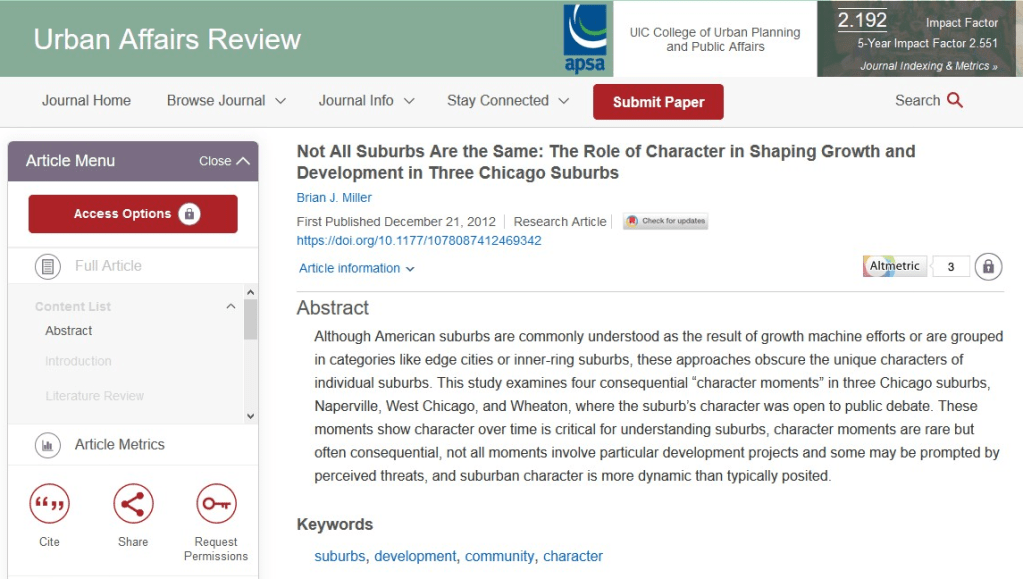
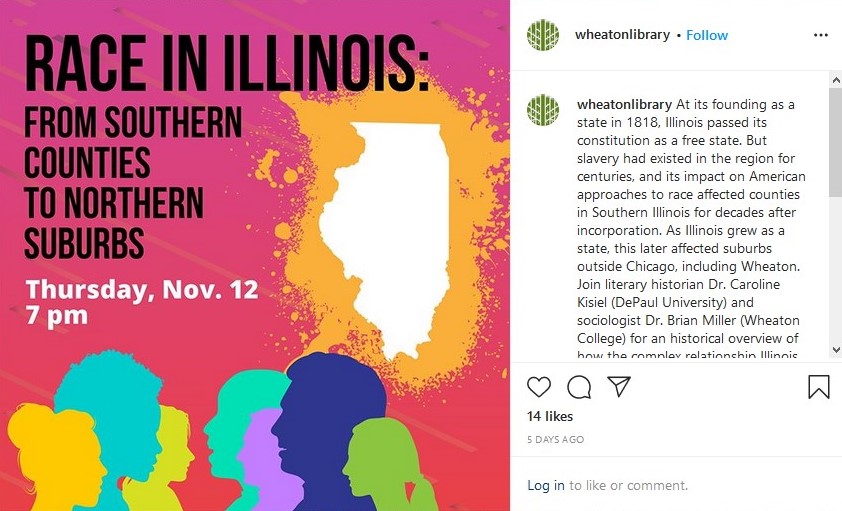
As I prepare to present research tonight on suburbs and race, specifically in Wheaton, Illinois, I reflected on my methodological approach. In sociology and the social sciences, we often seek data that is both generalizable and detailed. In my research, I have largely worked to study suburbs through comparisons with other suburbs. I believe this has some distinct advantages, even as it also presents limitations.
One approach to studying suburbs would consider them as a whole: suburbia. Even though there are thousands of suburbs, they share common characteristics. Suburbs are distinct from other settings and their geography, density, physical arrangements, and social and cultural life separate them from big cities and rural areas.
Instead of focusing on the whole, a study could go another direction: focus on one specific suburban community. Perhaps it is a suburb that exemplifies suburbs as a whole, perhaps it is a more unusual suburb. Studying the history and particulars in depth could provide rich details about suburban communities and life.
My research thus far has tried to take a middle approach. This involves finding a small set of suburban cases to compare and contrast. I studied each of these cases in a good amount of detail. The comparison between cases helps me assess whether patterns in one community are unusual or not. The detail I have about each community helps me know whether these suburbs fit broader patterns.
Selecting the right suburban cases can be difficult. Among all the suburbs, it is better to choose ones that share certain traits or better to find more different ones? All the detail about specific places may not be that useful if the cases cannot relate to suburbs.
Another downside of the historical/comparative method is the amount of time it requires. Gathering details on specific suburbs can take time. Going through the data and finding patterns can take time.
And, the study of American suburbs benefits from all of the approaches I mentioned above: broad patterns in all suburbs, case studies of particular communities, and historical/comparative work among sets of suburbs. Even as my initial study of suburbs took this middle approach, I have also written in the other veins considering suburbs as a whole and focusing in more on a specific community. With complex suburbia and many suburbs to consider, there is plenty to study from multiple angles.








 Legally Sociable