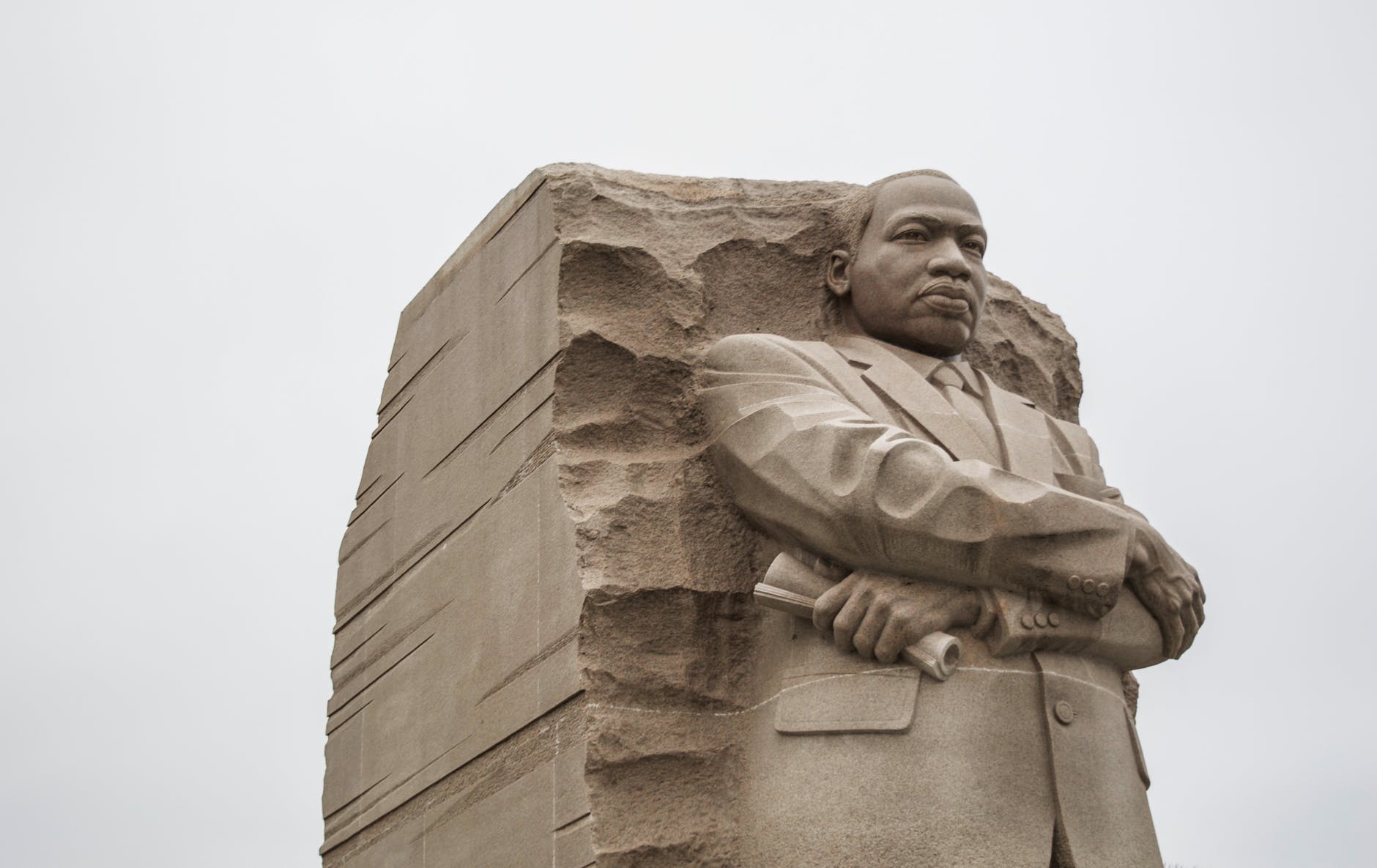
With the start of my Urban Sociology class this week, I spent a little time this weekend reflecting on the connections between Martin Luther King, Jr. and cities. Looking at just a few aspects of King’s life suggests he was shaped by cities and he shaped cities.
-King was born in Atlanta, his father was a pastor in Atlanta, he did most of his collegiate and graduate work in cities (Atlanta and Boston), and he was a pastor in Montgomery and Atlanta. King was assassinated in Memphis.
-Much of the Civil Rights Movement activity took place in major cities. The names are familiar: Montgomery, Selma, Birmingham, Washington. Other activity in cities may be less known today to the general public, such as the 1966 Chicago Freedom Movement or why King was in Memphis in 1968.
-The issues King addressed are associated by many Americans with cities: race, injustice, inequality, housing, access to public transportation, jobs. Of course, these issues are not exclusive to urban life but the demographic differences in many parts of the United States between cities and suburbs or rural areas and the ways Blacks were often restricted from certain locations (such as in sundown towns) highlighted the different conditions and realities across places.
With “WandaVision,” Feige said that he had wanted to honor the complexity of the title characters and Wanda’s reality-warping abilities but also to leaven the story with tributes to sitcom history…
The series finds Wanda and Vision — now somehow alive — residing in suburban bliss, not entirely sure of why they are cycling through various eras of television history and encountering veteran Marvel performers like Kat Dennings (as her “Thor” character, Darcy Lewis) and Randall Park (reprising his “Ant-Man and the Wasp” role of Jimmy Woo) as well as new additions to the roster, like Teyonah Parris (as Monica Rambeau) and Kathryn Hahn (playing a perplexingly nosy neighbor named Agnes)…
“You enter a sitcom episode with the understanding it’s going to make you feel good and it’s all going to be OK at the end,” said Schaeffer, who also worked on “Captain Marvel” and “Black Widow.”
What “WandaVision” adds to this formula, she said, is an element of “creepiness — the idea of shattering that safety in a calculated way.”
The suburban sitcoms of the 1950s are often portrayed as providing a common image: the white nuclear family living happily in a single-family home. The episodes revolve around relatively minor issues that are resolved at the end of the show.
By the 1960s, there were some twists to this theme. Lynn Spigel writes of new television characters who provide an edge to the typical suburban image. Think Samantha on Bewitched who with her magic powers and odd relatives provides a new angle to the suburban sitcom.
In the late 1990s, more shows looked to push the suburban sitcom in even further – and often darker – directions. Take The Sopranos: from the outside, the family has the look of a successful suburban family living in a large McMansion in an upscale community. But, of course, the secret is that the gains are ill-gotten and the attempts to find happiness in this suburban lifestyle never coalesce.
Indeed, this darker approach to the suburban sitcom has an extended history in other mediums as well with novels, films, and other narratives suggesting something similar: the suburbs are not what they seem. These products offer a critique of the the suburbs where the American Dream is not what it seems, where all the suburban striving does not amount to much or falls apart spectacularly.
While I have not seen WandaVision, the narrative arc may then fall into familiar territory: the suburban household with a twist or dark secret is already an established genre. These may be new characters in the suburbs and it may be an expansion of the Marvel Universe but it remains to be seen how much new suburban ground it really treads.
But, perhaps those who claim these four strategies are necessary would say that each point addresses something that holds the tiny house movement back. I would put these four into two broader categories that are worth exploring more.
The first category has to do with important local zoning regulations. Communities are prepared to handle single-family homes and many would be prepared to address multi-family housing. But, tiny houses are out of the ordinary and present unique challenges and opportunities. Should they be allowed on the same lot as an existing home? Do they go with micro-lots? Do they threaten the character of single-family homes? How many could be put on a regular residential plot of land? What are their water and services needs? Are these going to be cheaper or more luxury tiny homes? It would take some time to figure this out in many communities.
The second category involves the next three points. These are marketing and perception issues. Who are tiny houses for? What are they about? What social needs do they serve? The three points above try to answer these questions: tiny houses are for smaller households, they could be affordable housing, but they are not like RVs and camper vans. This puts them into an in-between category: not as permanent as a single-family house but not as mobile as an RV or camper van; cheaper than a typical house but there is still a cost (plus possible land costs); for some people but not others. Perhaps growing more quickly within a particular niche is what would help tiny houses as a whole become more popular.
There could be additional issues to address. If many more Americans wanted to order a tiny house in the next few weeks, could the orders be fulfilled relatively quickly? Do we have sufficient public and private spaces around tiny homes so that people can enjoy living in such a small space?
This is a lot to do. That can be okay; not all products have explosive growth and slow positive change could work out in the long run.
There is a word for love of a place: topophilia, popularized by the geographer Yi-Fu Tuan in 1974 as all of “the human being’s affective ties with the material environment.” In other words, it is the warm feelings you get from a place. It is a vivid, emotional, and personal experience, and it leads to unexplainable affections. One of my fellow Seattle natives made this point to me when he said he hated the rain in Boston but not Seattle. Why? “Only Seattle rain is nice.”
In his book A Reenchanted World, the sociologist James William Gibson defines topophilia as a spiritual connection, especially with nature. Oladele Ogunseitan, a microbiologist at the University of California at Irvine, demonstrates topophilia by showing that people are attracted to both objective and subjective—even unconscious—criteria. My friend’s affinity for the “Seattle rain” is probably fueled by what Ogunseitan calls “synesthetic tendency,” or the way particular, ordinary sensory perceptions affect our memory and emotions. If the smell of a fresh-cooked pie, the sound of a train whistle at night, or the feeling of a crisp autumn wind evokes a visceral memory of a particular place, you are experiencing a synesthetic tendency.
It is worth reflecting on your strongest positive synesthetic tendencies—and the place they remind you of. They are a good guide to your topophilic ideal, and thus an important factor to be aware of as you design a physical future in line with your happiness. It is notable that one of the world’s most famous happiness experts, Tal Ben-Shahar, left a teaching position at Harvard University several years ago, where he had created the university’s then-most-popular class, to return to his native Israel—because he felt the pull of his homeland…
You probably have your own Barcelona or Minnesota, somewhere that has a highly topophilic place in your heart. Perhaps you sometimes daydream about going back—but then you snap out of it. Moving is a huge commitment, and not one to be made on a synesthetic whim. The cost of a big move is prohibitive for many people who might like to find a new home. Even if work and family circumstances make it possible, the idea of starting a new job, making new friends, changing schools, facing the DMV—it’s too much for many.
This is more than an acknowledgment of the importance of places in our lives; this encompasses all of the senses. One quick example: there is a home near us that has a line of four or five of the same kind of trees along the sidewalk. When I run by there, the smell alone is enough to transport me to a familiar family vacation spot where that smell is more common.
The argument here helps push back against a more recent narrative in human history that suggests people can and should be mobile. While people not too long ago might have been anchored in a relatively small geographic area for a lifetime, people today are more used to moving for jobs and travel across longer distances. Of course, as is noted above, such mobility might lead to loving a new place or an unexpected place. But, if people form these attachments to places, how do they then respond to mobility? Perhaps mobility can reinforce topophilia; you do not know how much you like places until you are away from them.
This also highlights the material world in ways that we sometimes ignore. Our environments matter, even if we are in an age of screens, private spaces, and lots of driving. There can be a lot of focus on this within private spaces – think decluttering trends or an emphasis on layouts and design in homes – but less emphasis on public or community spaces. To put it in the terms of James Howard Kunstler, are our collective environments worth paying attention to?
Welch, an eight-year lawmaker from west suburban Hillside, ultimately won 70 votes in the 118-member Democratic-controlled House, 10 more than he needed for victory. The vote came after months of debate over whether Madigan and the baggage of bribery scandal that has circled him for months had become too heavy a burden for a diverse caucus to endure.
With notable events like this, the image of suburbs may slowly change. There is still not an evenness of groups across suburbs – could Illinois residents imagine a Black House Speaker from DuPage County or McHenry County? – but the suburbs of Chicago and many other big cities are not exactly as white as they once were.
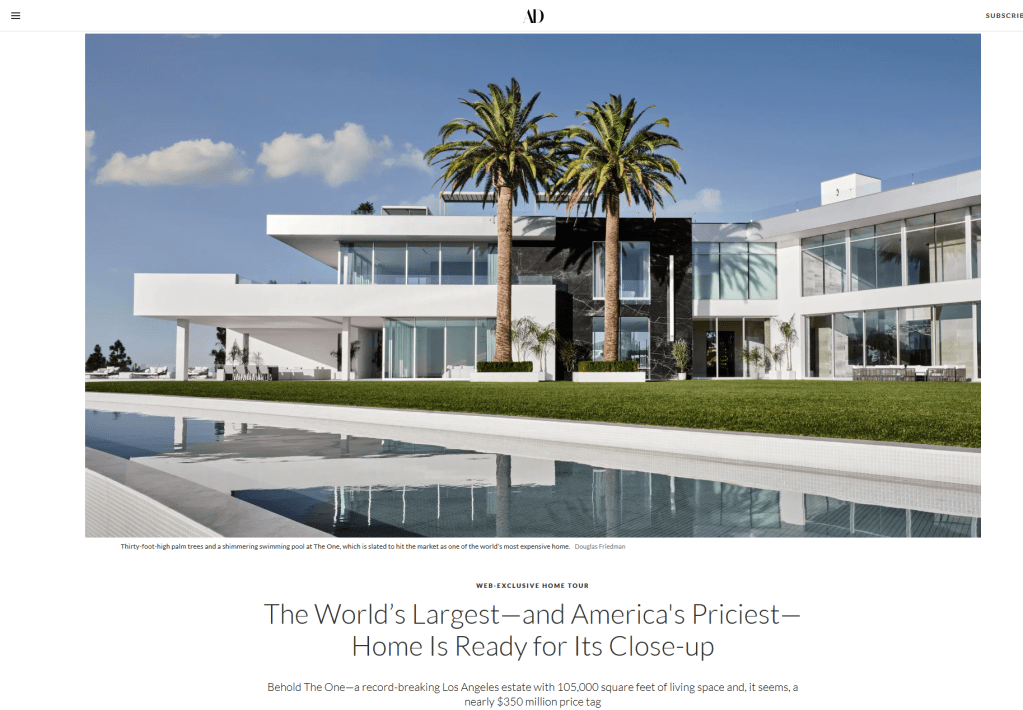
After nearly a decade of design and development work, what is being billed as “the world’s most expensive home” is finally ready for its close-up. Set on a five-acre parcel in the posh Los Angeles enclave of Bel Air—and aptly named The One—the 105,000-square-foot property’s interiors have remained a closely guarded secret. Until now. AD has been an exclusive look at what’s inside this record-setting property—and the design and aesthetic minds that made it happen.
Surrounded on three sides by a moat and a 400-foot-long jogging track, the estate appears to float above the city. Completed over eight years—and requiring 600 works to build—the home was designed by architect Paul McClean, who was enlisted by owner and developer Nile Niami to help it live up to its reported $340 million price tag…
Beyond the eye-catching design are the home’s equally jaw-dropping stats. There are 42 bathrooms, 21 bedrooms, a 5,500-square-foot master suite, a 30-car garage gallery with two car-display turntables, a four-lane bowling alley, a spa level, a 30-seat movie theater, a “philanthropy wing (with a capacity of 200) for charity galas with floating pods overlooking Los Angeles, a 10,000-square-foot sky deck, and five swimming pools…
Due to recently approved city ordinances, a house of this magnitude will never again be built in Los Angeles, which means The One will truly remain one of a kind. “This project has been such a long and educational journey for us all,” McClean notes. “It was approached with excitement and was thrilling to create, but I don’t think any of us realized just how much effort and time it would take to complete the project.”
Down the road, because of its size and price alone does this become a local or international landmark? Or, because it is a single-family home in an exclusive location, will this house rarely be seen? Some of this might depend on who the owner is. The next step in the news coverage is to figure out who purchases the home and what they do with it and then the legacy of the property will come later.
It would be interesting to compare this home to previous properties that claimed to be the most expensive or the largest. I recall an effort in Florida to construct a 75,000 foot home; a documentary about the home detailed some of the process and issues that arose.
And she’s not alone; in Chicago, rents dropped by almost 12% in December compared to December 2019, according to a new report from Apartment List, a website for apartment rentals. Average rent was $1,355 in Chicago a year ago; it fell to $1,193 in December.
Zillow data, too, marked the starkest plunge in year-over-year rental prices in the Chicago metropolitan area since it began analyzing national rents in 2014, with a decline starting in July and continuing through the latter half of the year.
Zillow reported a 2.2% decline in Chicago-area rents in November compared to a year earlier. When including the suburbs, Apartment List’s figures — which the service claims is more closely aligned to U.S. Census Bureau data — showed a similar decline of 6%, suggesting the suburban markets have not been as hard hit as the city.
Chicago was among the most severely impacted cities when it came to falling rents, said Rob Warnock, who co-authored the Apartment List study. Due to the pandemic, more expensive cities with competitive job markets saw rent decline — many for the first time in a decade.
It is good to see more data on the effects of COVID-19 on housing. As the article suggests, even a small drop in rents could be helpful for people in more uncertain economic times. This is not a big drop percentage-wise in Chicago, particularly compared to larger drops in Manhattan or San Francisco, but the Chicago market as not as overheated as some locations.
At the same time, it would be fascinating to see more detailed data addressing:
Within cities and metropolitan regions, where have rents dropped, stayed about the same, or risen? And how does this line up with other social patterns?
How much longer can renters and landlords continue on this path? How might this matter by location, different kinds of housing, and different landlords?
Does this do anything to help address long-standing affordable housing issues in Chicago or is it a slight blip?
Some of these will take time to resolve as will the question of whether rents will go back at some point. In the meantime, many people in many communities are affected by these changes.
Sean Skipworth and Jennifer Lawrence were vying to be the next mayor of Dickinson, but they each ended up with 1,010 votes after a runoff election last month and a recount earlier this week.
According to Texas law, a tie in a race for public office can be resolved by casting lots.
Skipworth became mayor after a ping pong ball with his name was pulled out of a hat during a ceremony Thursday that lasted about 10 minutes, the Galveston County Daily News reported…
Dickinson, located about 40 miles southeast of Houston, has more than 21,000 residents.
Second, Americans often feel better about their local politics – from their community through their representatives in Congress – compared to national politics. Perhaps people want to think better about those from their places or the stakes at the local level are lower (though local disagreements can get heated). The mayor of Dickinson, Texas may not be able to do much in the grand scheme of things but local officials are often non-partisan and say they are about getting things done.
Because this happened at a very local level, there is likely little from this particular solution – casting lots – to apply to the national level. Yet, the spirit and means of local politics may provide regular reminders of what is possible and how politics can be conducted.
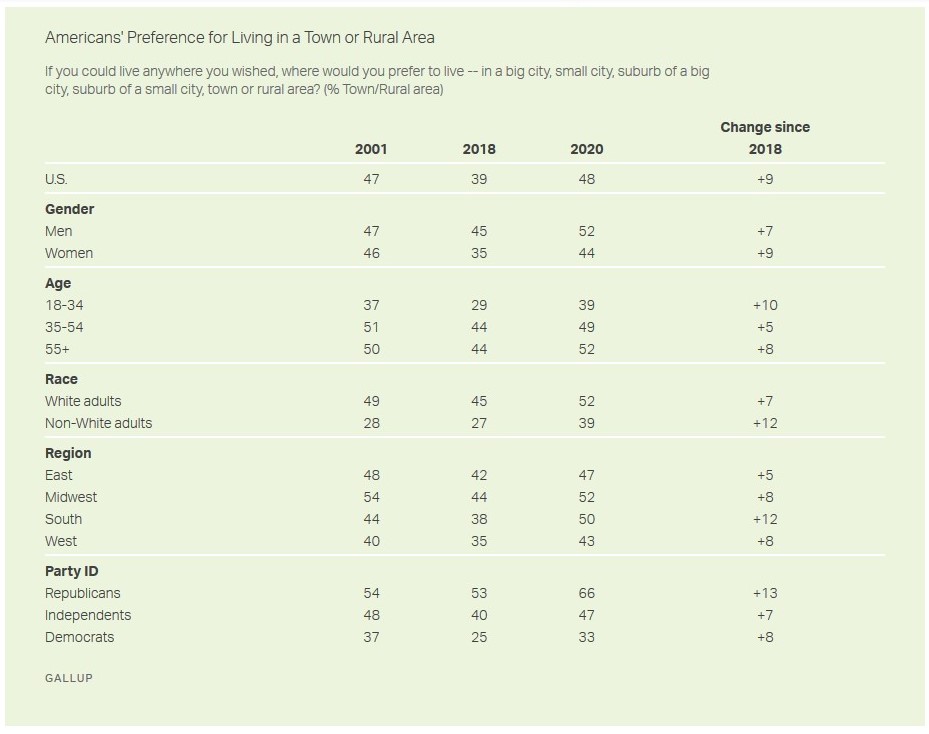
About half of Americans (48%) at the end of 2020 said that, if able to live anywhere they wished, they would choose a town (17%) or rural area (31%) rather than a city or suburb. This is a shift from 2018, when 39% thought a town or rural area would be ideal.
The recent increase in Americans’ penchant for country living — those choosing a town or rural area — has been accompanied by a decline in those preferring to live in a suburb, down six percentage points to 25%. The percentage favoring cities has been steadier, with 27% today — close to the 29% in 2018 — saying they would prefer living in a big (11%) or small (16%) city.
Current attitudes are similar to those recorded in October 2001, the only other time Gallup has asked Americans this question. That reading, like today’s but unlike the 2018 one, was taken during a time of great national upheaval — shortly after the 9/11 terrorist attacks, when the public was still on edge about the potential for more terrorism occurring in densely populated areas…
The preference for cities is greatest among non-White Americans (34%), adults 18 to 34 (33%), residents of the West (32%) and Democrats (36%).
There is a lot to consider here and it is too bad Gallup has only asked this three times. Here are some thoughts as someone who studies suburbs, cities, and places:
The shift from 2018 to 2020 is very interesting to consider in light of the shift in preferences away from small towns and rural locations between 2001 and 2018. What happened between 2018 and 2020? The analysis concludes by citing COVID-19 which likely plays a role. But, there could be other forces at work here including police brutality, protests, and depictions of particular locations or different factors could be at work with different groups who had larger shifts between 2018 and 2020.
One reminder: this is about preferences, not about where people choose to live when they have options.
The distinction in the categories in the question – big city, small city, suburb of a big city, suburb of a small city, town, or rural area – may not be as clear-cut as implied. From a researcher’s point of view, these are mutually exclusive categories of places. On the ground, some of these might blend together, particularly the distinction between suburbs and small towns. More toward the edge of metropolitan regions, do people think they live in the suburbs or a small town? Or, how many residents and leaders describe their suburb as a small town or as having small town charm (I have heard this in a suburb of over 140,000 people)? Can a small but exclusive suburb with big lots and quiet streets (say less than 5,000 people and median household incomes over $120,000) think of itself as a small town rather than a suburb? I say more about this in a 2016 article looking at how surveys involving religion measure place and a July 2020 post looking at responses when people were asked what kind of community they lived in.
On Friday, Alex Trebek’s last “Jeopardy!” episode will air, closing his remarkable run on the show. For future anthropologists, the beloved host’s historical contribution may not be his status as trivia icon, but rather his friendly role in the show’s awkward small-talk sessions. The real test of a contestant’s mettle on “Jeopardy!” often begins after the first commercial break, when competitors put down their buzzers and tell Trebek about themselves. Described as “the oddest 2 minutes of television” by Chad Mosher, the creator of a “Jeopardy!” stories Twitter account, the anecdotes can be captivatingly bland: what does the contestant who likes telling “dad jokes” have in common with the one who was once at an “incredibly cold football game” or the other who tried to jump-start a car, only to make the cables melt? Through their narratives, these contestants are engaged in what the sociologist Harvey Sacks called “doing ‘being ordinary.’ ” The verb “doing,” in this curious formulation, suggests the work that being ordinary takes, and points to the effort involved in constructing an agreeable and innocuous social façade.
Sacks was a “conversation analyst” and a university lecturer in California until his untimely death from a car crash in 1975. With sources ranging from Nathalie Sarraute’s writing to tape-recorded telephone chats, he set out to scrutinize the everyday stories that people tell and came to see that what is even more interesting are the non-stories we most often relate. Even when we describe supposedly exciting experiences like a recent date or a sunset, we go out of our way, Sacks noticed, to report only the commonness of what occurs. In his view, we are all constantly scanning situations for ways to affirm our normalcy: “What you look for is to see how any scene you are in can be made an ordinary scene,” because this is what society rewards.
Sacks asks us to imagine if, instead of being ordinary, we were to come home from work and describe “what the grass looked like along the freeway; that there were four noticeable shades of green, some of which just appeared yesterday because of the rain.” In this case, Sacks warned, “there may well be some tightening up on the part of your recipient.” If you were to make such unorthodox reportage a habit, you might lose friends, and people might find you strange or pretentious: “That is to say, you might want to check out the costs of venturing into making your life an epic.” Sacks argued that banal speech, far from unworthy of study, offered insight into the hidden structures of the social contract…
Though the interview segments offer a reprieve from the competition’s intensity, they extend the show’s question-and-answer format and also its performative pressures. When they don’t go off the rails, what they stage is the nail-biting feat of transforming a situation of extreme social pressure into forgettable television filler. There is probably no better theorist of the coup of seeming ordinary than the sociologist Erving Goffman, whose own studies of everyday talk referenced Sacks’s. Goffman is known for his dramaturgical analysis of social interaction in “The Presentation of Self in Everyday Life,” but as important as the theatrical analogy was to Goffman’s sociology, so was his view of conversation as a “game.” In his essay “Radio Talk,” Goffman argued that the seemingly benign small talk that fills our airwaves is actually composed of a series of calculated moves and countermoves in which the slightest stumble can result in an embarrassing loss of face. He maintained that mediatized interviews mimic the bouts of informal bandying that make up our everyday lives: “Catching in this way at what broadcasters do, and do not do, before a microphone catches at what we do, and do not do, before our friends. These little momentary changes in footing bespeak a trivial game, but our conversational life is spent playing it.” Bear this game in mind during your next Zoom meeting.
We all have these moments where we are asked to describe ourselves or share something interesting about ourselves. This happens in social media profiles, when we meet new people or groups in social interactions, and when we interview for jobs. Who are you? What makes you stand out (or not)?
We have fallbacks for this. Two quick examples. In many conversations with adults, the conversation either starts with or quickly gets to the jobs or occupation of each person. “What do you do?” is not a question about how you prefer to fill your time but rather a loaded question about what job you have. Then, that information is quickly judged with the listener(s) deciding what kind of value the occupation imparts, what it might mean about a person’s personality and experiences, and so on. An interesting answer can lead to a lot of conversation while an answer perceived as less interesting can pause a conversation.
Social media profiles have some common patterns. Think of the quick bio required for Twitter. What do you list first? Which five details are most important to communicate about you or your account? In some religious circles, this starts fairly regularly with some combination of these: husband or wife | father or mother to # children (or names) | Christian (or God follower or something similar). In contrast, it would be gauche to list your net worth here or that you have been married multiple times or an annoying habit you have. If people do try to be “out of the ordinary” or “quirky” in their descriptions, there are certain ways to do that too.
The first time I remember running into this myself was during middle school. Before a competition, I was asked to describe myself. This flustered me: what does one say when I preferred to read and follow sports? I eventually said something about doing well in school and was told I could think of something better. I do not remember what I came up with. I could do better now but I would also be following the scripts referenced above.
Jeopardy! has the extra element of having bright contestants. There are people who have knowledge, education. How does one fit into the ordinary when they are already on the show as a reward for knowing things?
As the article notes, these short interactions on one game show hint at the importance of small talk and the introductions in conversations. Small talk may seem banal and introductions can be moved past. Yet, our lives are full of these small snippets that help us form impressions of people and society – even if we are just watching game show contestants on television.