Does being named one of the unhappiest cities lead to more unhappiness in that place?

WalletHub has a new ranking of the happiest cities in the United States. Here are the top ranked and lowest ranked cities:

Fremont, Calif., took the top spot with Plano, Texas; San Jose, Calif.; Irvine, Calif., and Madison, Wis., rounding out the top five…

The unhappiest city on the list? That’d be Detroit, Mich., the report said, followed by Charleston, W. Va.; Toledo, Ohio; Huntington, W. Va., and Cleveland, Ohio.

While it is easy to get bogged down in how the rankings were made – and WalletHub describes their methodology – I have a different question this time. Not all rankings of places include the worst places or less desirable places. What is the purpose or outcome of showing all the locations?

One reason could be simply wanting to share all the data. If you calculate all the rankings, why not publish all the results? To see how the rankings worked out, people might expect to see everything. Contrast this with the approach of Money where they show the top 100 places to live. On this list, many places are left out while only the best are highlighted.

In terms of outcomes, what does this list do the cities at the bottom of the list? Three of the cities are in the Rust Belt and two others are in West Virginia which faces similar issues. I am not sure these rankings would be a surprise to the leaders of these cities but it still could be demoralizing.

Realistically, are there ways that cities toward the bottom of the list could enact changes that would significantly change the rankings over a short period? A rankings list could motivate places, leaders, and residents. Yet, it is difficult to make it up rankings list and turn around reputations that are well established.

I wonder if such lists simply serve to add to the shame or negative reputations of the places at the bottom. The data may be more complete but how does this help Detroit or the others at the bottom?

Paper suggesting Americans adopt sufficiency limits for the size of homes

A new study looks at what amount of space might be sufficient for American single-family homes:

Social scientists have extensively documented the strategies used over the past century to purposefully upsize the preferences of consumers in high-income countries (Collins 2000; Nickles 2002; Cohen 2003; Horowitz 2004; Clarke 2007; Jacobs 2015). These practices became increasingly prevalent during the years following World War II and have been revamped and augmented to encompass an ever-expanding array of products. The most notable example of this phenomenon – abetted by builders, architects, realtors, mortgage bankers, public-policy makers, and numerous others is housing which in particular has in the United States, Canada, and Australia approximately tripled in size in just a half-century. This process of residential upsizing is understandable as individuals and organizations were for the most part responding to prevalent social and economic incentives and investing a portion of the gains accruing from increasing productivity and rising incomes into more spacious accommodation. While the trend contributed to unambiguous improvements in standards of living, evidence is now emerging that the process of residential upsizing is not contributing to gains in “house satisfaction” (Bellet 2019).

However, the contemporary era, characterized by climate change, economic inequality, and deep social divisions, requires new priorities. Rather than looking to enlargement as a panacea for all manner of problems, the targets outlined in the Paris Agreement and the United Nations 2030 Agenda for Sustainable Development require high-income countries to pursue a sustainable consumption transition. The downscaling of home size, because of the substantial volumes of resources required to meet residential needs, will be a critical part of this undertaking. While the methodology to formulate a minimum social floor and a maximum biophysical ceiling is necessarily provisional, it provides a place from which to begin to consider this important issue.

And from a summary of the article:

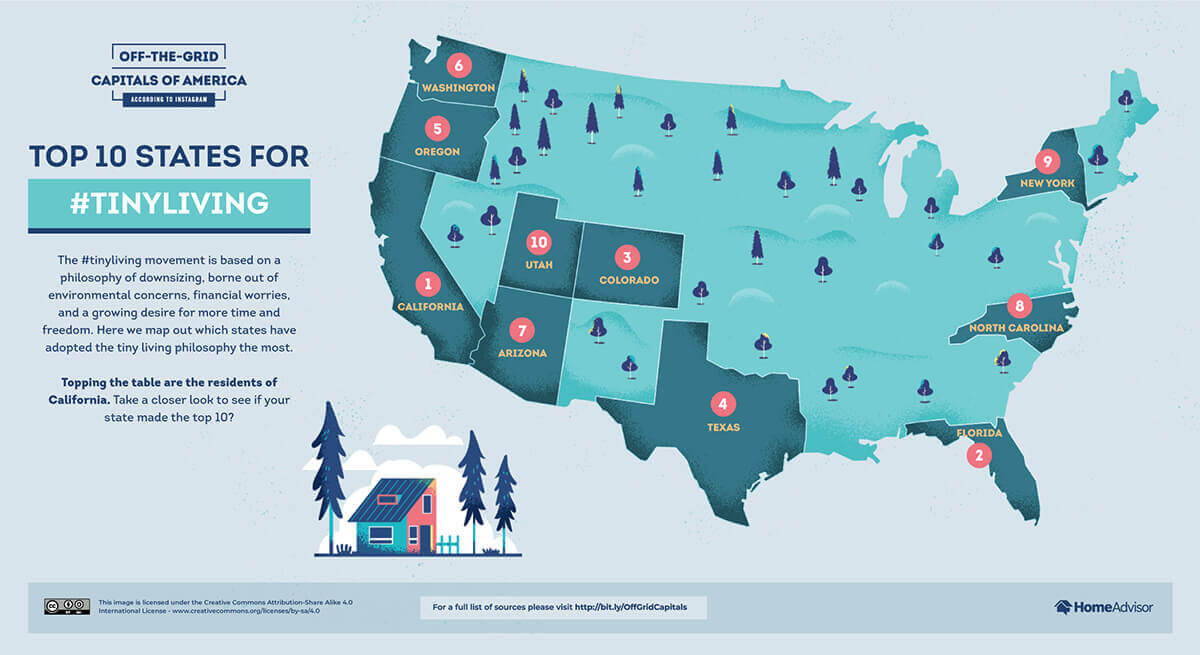
In the U.S., average floor space per person would need to be reduced from 754 square feet to 215 square feet, which perhaps surprisingly, is roughly comparable to the amount of space available during the baby boom of the 1950s.

While Cohen acknowledges the myriad political, commercial and cultural challenges of imparting such a sufficiency ceiling on current housing practices, he highlights five examples that he asserts point to shifting sensibilities: the tiny-house movement in the United States; the niche market for substantially smaller houses and apartments in the Nordic countries; the construction of accessory dwelling units in west coast cities of North America; the growing popularity of micro-apartments in New York City and San Francisco; and the emergence of co-living/co-working facilities in Europe.

Four quick thoughts:

  1. There are a lot of factors pushing Americans toward bigger houses in recent decades. Pushing against these factors would require a lot of time and energy. For example, reducing consumption might help people think about smaller spaces.
  2. Given the local nature of building and real estate, I have a hard time imagining this happening top-down. On the other hand, I could imagine some locales adopting such guidelines and then it spreading to similar locations or even the whole country. At the least, it could be popular in expensive real estate markets – think Bay Area or Seattle – though it would be interesting to see how wealthier homeowners deal with such guidelines. Perhaps if it was instituted for a housing units going forward, there would still be a supply of big homes for those that want them.
  3. Related to #2, I would guess more Americans would be motivated to pursue smaller homes because of cost and lifestyle preferences, not because of environmentalism and realizing that single-family homes make significant contributions to carbon emissions and require a lot of resources.
  4. How much of this is dependent on building a better public realm? People might be more willing to give up private space if they saw attractive alternatives like coffee shops, libraries, and other public settings where they could live their lives. Americans do not have developed public living spaces or many do not have regular patterns of spending important hours away from their private homes.

Keeping Boston buildings secured on wood pilings, fill

Parts of Boston rest on wood pilings on fill that reclaimed land from waterways. This has led to a lot of repairs:

Much of modern-day Boston was underwater when European settlers first arrived on the Shawmut Peninsula. From the late-1700s to the late-1800s, the city aggressively expanded, filling parts of Massachusetts Bay with soil, sand and gravel. Today, the city has about 5,250 acres of filled land, said Mr. Simonelli.

To build on the unstable surface, builders drove tree trunks into the fill until they hit firmer ground, then placed foundation stones on top of these wooden piles. This technique was used until the 1920s, when foundation-building technology changed, Mr. Simonelli said.

Wooden piles can remain intact for hundreds of years if covered by groundwater, as they were when first installed. As the city grew, construction of tunnels, sewers, basements and subways caused the groundwater level to drop in many areas, which exposed the tops of the pilings. Air causes the wood to rot, said Giuliana Zelada-Tumialan of the engineering firm Simpson Gumpertz & Heger. As the rotted wood crumbles, the foundation stones sink, and so do the structures they support…

Repair means an expensive process called “underpinning”—cutting off the rotten wood at the top of the piles and replacing it with steel. It usually involves hand-digging a series of pits in the basement floor, a laborious process that can cost more than $200,000, and another $100,000 to repair the brick damaged by settling, said Mr. Kempel of Pegasus Luxury Homes, who has bought, renovated and sold a number of Boston houses. That cost doesn’t include any repairs or renovations that would be required if that basement unit was living space, as many are in row houses.

This is a hidden dimension of many urban buildings. What exactly do they stand on? How solid is the land underneath large structures? What happens if the foundations underneath are threatened? I remember looking as a kid at diagrams of what was underground in New York City or Chicago and wondering how it all worked with subways, gas, water, and electric lines, and other items.

The focus of this article is on pretty expensive real estate in Boston, particularly residences. With this kind of money involved, property owners – who the article notes may not even know about the potential problems and/or bypass inspections – can afford to fix their foundations. What happens when this affects public buildings or property owners with fewer resources? Perhaps this has to do with the value of fill land; given its proximity to the water and the city center, such land might be more valuable on the whole across cities. But, I could also imagine where a sizable city would have to put together a significant effort to help out a range of property owners.


Need bigger garages and parking spaces for bigger vehicles

Americans’ interest in bigger vehicles means more space needs to be devoted to their storage:

Across America, the drive for bigger vehicles is bumping into physical limitations. SUVs and pickups are getting so large that they’re struggling to fit into some home and parking garages and public parking spaces.

Homeowners may need to think twice about purchasing larger vehicles, while parking lot operators are starting to charge oversize fees to accommodate behemoth SUVs and trucks…

“Nowadays, there’s people buying Dodge Rams, Ford pickups that don’t fit, and they’ll park them outside,” he said. “The difference here is this is an electric vehicle and … you need to plug it in. I’m not gonna spend $50,000, $60,000, $70,000, $80,000 on a vehicle and then have to run an extension cord outside the garage or an outside outlet.”…

While larger vehicles may pose some inconveniences, Americans don’t seem too bothered by it overall, at least if the vehicles being introduced by automakers are any indication.

This goes along with the idea that Americans should buy bigger houses to help store their stuff!

I first noticed this last year on a trip to New York City. In looking ahead of time for a parking garage, I saw that garages charged more for oversized vehicles. The article notes that this is largely confined to New York City but from other recent experiences seeing large vehicles in parking garages in the Chicago area, I would not be surprised if this idea spreads.

Another casualty to these large vehicles: lanes on roads and highways. A bigger vehicle means it takes up more of a lane, particularly on roadways with narrower lanes and tighter conditions. There is also less room for drifting from going straight ahead.

There is a focus in some places of reducing the number of parking spots as communities have long had generous numbers of spots compared to the average number of parkers. It would be interesting to see how a reduction in the number of parking spots might clash with a need to create bigger spots (which would take up more space per spot).

Separate places for home and work – even when you are working from home

The geographic and social distancing of home and work is a feature of modern, urbanized society. And it even matters when working from home:

Where you actually set up shop is entirely up to you. Maybe you have a dedicated office space with a desktop and a view. Sounds nice. If you don’t, that’s also fine; I usually work on my laptop at a kitchen counter. The point here is to clearly define the part of your house where work happens. That makes it more likely that you’ll actually get things done when you’re there, but just as importantly might help you disconnect when you’re not. Remember that when you work from home you’re always at home—but you’re also always at work. At all costs, you should avoid turning your entire house or apartment into an amorphous space where you’re always on the clock but also kind of not. It’s no way to live. (Full-time remote workers take note: You can also write off a few hundred square feet of in-home office space on your tax return.)…

Every few days I spend at least a few hours at a coffee shop. It’s a change of scenery, a good excuse to get some fresh air, and provides a tiny bit of human interaction that Slack conversations and Zoom meetings do not. Should that no longer be feasible for coronavirus reasons, at the very least see if you can walk around the block a couple of times a day. There’s no water cooler when you work from home, no snack table, no meetings down the block. It’s easy to stay locked in position all day. Don’t do it! Sitting is terrible for your health, and mind-numbing when you’re staring at the same wall or window all day…

I think what I miss the most about working in an office is the commute (I realize this may sound unhinged). Yes, traffic is terrible and subways are crowded and the weather is unpredictable. But it seems nice to have a clear separation between when you’re at work and when you’re not, and some time to decompress in between. That doesn’t exist when you work from home. It’s all on the same continuum.

I don’t have a great solution for this. Quitting out of Slack—or whatever your workplace uses—is probably a good start. People are less likely to ping you if your circle’s not green. Or maybe find a gym class or extracurricular that you have to leave the house for at a certain time every day and let that be your stopping point? In some ways it’s like figuring out how to ditch your shadow.

These tips hint at problems connected to the home-work divide Americans regularly encounter. A few examples from the paragraphs above:

  1. Creating a clear boundary between home and work is often seen as desirable or needed. This is harder to do when the same physical spaces do double duty.
  2. The need for interaction with coworkers or others is hard when working from home or even just with a clear work-home divide. There is a need for third places (and the coffee shop suggestion is a common, if problematic, solution). And with declining community life elsewhere, feeling disconnected from work might be a big loss.
  3. The Internet and other means that make it easier to connect to work or other workers from afar also threatens to pull people into never-ending work.
  4. Physical spaces actually matter for productivity, social interaction, and well-being. Simply being untethered from an office and the spaces there does not automatically lead to better outcomes. Single-family homes (or apartments, condos, townhomes, etc.) in the United States often emphasize private family space which may or may not be conducive to the kinds of work people do today.

All together, I am not convinced that people working from home or away from the office solves many of the problem of contemporary work places and social life. There are deeper issues at stake including how we design places (within buildings and across land uses), how we think about home and work (and additional places), and community and social life and what we desire for them to be.

Trying to kick the consumption habit while living in a tiny house

One scholar studying people who lived in tiny houses found that a smaller space did not necessarily mean to having less stuff:

Tiny houses are often put forward as a more sustainable housing option. They are certainly a potential check on the continued pursuit of bigger houses and greater consumption of energy, building materials and so forth. Yet reducing your environmental impact by going tiny is not as simple as some have claimed.

I came across several tiny households that were using external storage spaces for items that wouldn’t fit in the home, for example. Referred to as a “dirty secret” by one interviewee, another explained her desire to keep items from her previous home in case she changed her mind about tiny living.

Over half of my interviewees had a “one in, one out” mentality, where they would throw away or donate one item to make space for something new. As one dweller in her late 30s, who lives in a state-of-the-art home in a caravan park in rural New Hampshire, said, “I have a TJ Maxx addiction. I still go out every couple months and buy a bunch of stuff then come home and decide which things to get rid of.”

Regardless of how tiny living is marketed by the enthusiasts, sustainability was not a major driver for most of the participants in my study. Instead it was almost an afterthought. It seemingly takes more than changing the size of a home to change the mentality of the people who live inside.

One reason (among many) that Americans live in large houses is in order to store all their stuff. Having a smaller dwelling does not necessarily mean that the resident will get rid of all their stuff or reduce their consumption. Because there are so many options for storing stuff, it can be easy to keep all that stuff. (Side note: I could imagine future communities of tiny houses or tiny house living quarters surrounding larger community facilities like kitchens and entertaining spaces that include storage facilities or warehouses on site.)

Furthermore, the American economy needs people to buy things and American culture celebrates buying more (and buying bigger things). There are occasional calls to curb consumption – or at least pare down the number of things one has – yet they put limited dents in the overall patterns

Perhaps the bigger change will come over time. Imagine someone who has lived in a tiny house for a decade or more. Will they still keep their stuff in a storage unit wondering if they will move to a larger dwelling? Will they learn to live without all that stuff and get rid of it? Or, imagine a kid who grows up in a tiny house. Maybe they will be less inclined to have a lot of items around given their familiarity with smaller spaces and the reduced availability of items.

Bringing the City Council meeting to a (participatory) stage

I have read through decades of City Council and other local commission minutes for research projects. Thus, I was intrigued to find out a playwright had taken real City Council experiences and put them together into a participatory performance:

Inside a hushed theater, a voice on the loudspeaker instantly lets the audience know this isn’t your typical performance.

“By joining us tonight” a soft female voice says, “you’ll be standing in for someone who was actually part of a local government meeting somewhere in the U.S. in the last three years.”

The show, for the most part, doesn’t use actors. Instead, theater goers are asked to volunteer to play the role of city council members, the mayor, and regular citizens at a city council meeting. The performance is staged just as if it were a real meeting, with real people participating in a play that reflects the good, the bad, the ugly, and the sometimes nail-biting tediousness of participatory democracy…

“How do you take someone whose way of speaking or obvious demographic might be very different from yours and respectfully put it in the room?” Landsman asks. “How do you give voice to someone else’s language? For me it’s like walking a mile in their shoes – verbally.”

I would love to see this and to participate. The play takes something mundane to most people and provides an opportunity to see how things work and different people approach their community.

Here is why this has the potential to matter: Americans say that they like local government but their involvement is often limited (as exhibited by low turnout rates for local voting). And much of the time in local government boards, committees, and groups may involve arcane discussions of local ordinances, approval of paying bills, and odd local political or interpersonal disputes. Yet, these meetings help shape the character of communities. Even if there is a sizable public discussion about a development project or an annexation or a significant change, it is in the local government meeting that the vote actually takes place. These discussions and decisions can make a difference and set a community down a particular path for decades.

I would guess those who see this play do not immediately show up at all the local meetings eager to observe. However, at the least, it could help reveal some of the local processes that have the potential to impact all of our lives and communities.

Fox Business defines a McMansion, misses teardowns and broader social patterns

McMansions are still alive and well – or at least in public conversation – if news sources are still trying to define them. Here is a recent definition on the Fox Business web site:

McMansion is a term that refers to a large house — typically in a suburban neighborhood — that looks like every other house in the neighborhood. The style was popularized during the 1980s and 1990s.

Their structures typically follows a similar pattern, as noted by Curbed, including a central core with a multistory entryway, a side wing and a garage wing.

According to real estate website Trulia, they tend to range between 3,000 and 5,000 square feet, or 1.5 to 2.5 times larger than the median-sized new home in 2000…

The word is a play on McDonalds items, indicating the homes are generic and mass-produced.

The definition above cites a Curbed article but it should really point to the author of that piece, Kate Wagner, creator of McMansion Hell. From the beginning of that piece, here is Wagner’s one sentence definition:

The typical McMansion follows a formula: It’s large, cheaply constructed, and architecturally sloppy.

These definitions do indeed get at two traits of McMansions: their size, larger than normal, and their architecture and construction, generally poor quality and mass produced. But, I argue the definitions are missing two important traits:

  1. Some McMansions are teardowns, large homes on relatively small lots within neighborhoods with smaller homes. Here, the absolute size is less important than comparative size. And these kinds of homes could appear in urban, suburban, and more rural settings.
  2. McMansions are connected to broader issues or concerns about American society, including sprawl and excessive consumption. This means that a lot of homes that might not technically fit the definition of a McMansion or might not appear on McMansion Hell could be part of broader patterns of McMansion like homes.

McMansion is a broadly used term but does not necessarily mean or refer to the same thing when different actors use the term. Big house? Yes. But, not the biggest houses and big might be relative. Problematic architecture and construction? Yes. But, not the only homes that might suffer from this (depending on who is examining the homes) and connected to larger American issues.

5G over what percent of America? T-Mobile: covering over 5,000 cities and towns, 200 million Americans

T-Mobile is running a commercial touting their new 5G network. They claim it reaches 200 million Americans and over 5,000 cities and towns. What if we put those numbers in context?

On one hand, both figures sound impressive. Two hundred million people is a lot of people. This is a lot of text messages to send, TV shows and videos to stream, and social media and web pages to visit. This is a potential large market for T-Mobile. And 5,000 cities and towns sounds like a lot. I don’t know how many places Americans could name but many would probably struggle to name 5,000.

On the other hand, the figures suggest that the 5G coverage still does not reach a good portion of Americans or certain parts of the country. According to the Census Population Clock, the US population is over 329 million. So covering 200 million people comes to roughly 61% of Americans covered. This more than half, not quite two-thirds. Additionally, 5,000 cities and towns sounds like a lot. Some older data – 2007 – suggests the United States has over 19,000 municipal governments and the Census in 2012 also counted over 19,000. With these figures, 5G from T-Mobile covers a little more than one quarter of American communities.

Perhaps T-Mobile is doing the best the can with the coverage they have. The numbers are big ones and I would guess they could catch the attention of viewers. Maybe the numbers do not matter if they are trying to be first. However, just because the numbers are large does not necessarily mean the product is great. Significant segments of Americans will not have access, even with the big numbers. The numbers look good but they not be as good for some when they look into what they mean.

Trying to convince Illinois drivers to use zipper merges

New recommendations from the Illinois Department of Transportation mean drivers should expect to see more zipper merges:

Most people aren’t familiar with the zipper merge and have never even heard of it. But with construction season just a couple months away, the Illinois Department of Transportation wants drivers to use the zipper merge technique when approaching lane closures…

Experts believe that is the quickest way to get through construction sites and entrances on highways during busy season.

So much so that a new law for 2020 mandates the zipper merge be included in this year’s Illinois Rules of the Road handbook, following many other states that already use the technique like Minnesota, Missouri, North Carolina, Montana and Nevada, to name a few…

Not only is the zipper merge a safer and more efficient way to merge into traffic, it’s the law and carries a $164 fine, not including court costs and fees.

Changing decades of ingrained patterns is not an easy task. New drivers can be trained on this from the start but many drivers have been operating with different methods for decades. However, I would guess the presence of police and the use of tickets in situations where zipper merges will now be expected could help prompt people to follow the new guidelines. Or, imagine a campaign on public media where drivers who do not follow the guidelines are highlighted.

The one thing I do not get about resistance to zipper merges and the drivers who look to block traffic is that it is inefficient to not follow the zipper merge. Theoretically, everyone wants to to get where they need to go as quickly as possible. Hence, rampant speeding and other behavior intended to save time. Zipper merges are supposed to help with this which should be a win-win for everyone.