Open office arrangements may not work for getting work done

An evaluation of the implosion of The We Company highlights the importance of physical space for accomplishing tasks in the workplace:

Much will be written in the coming weeks about how WeWork failed investors and employees. But I want to spotlight another constituency. WeWork’s fundamental business idea — to cram as many people as possible into swank, high-dollar office space, and then shower them with snacks and foosball-type perks so they overlook the distraction-carnival of their desks — fails office workers, too.

The model fails you even if you don’t work at a WeWork, because WeWork’s underlying idea has been an inspiration for a range of workplaces, possibly even your own. As urban rents crept up and the economy reached full employment over the last decade, American offices got more and more stuffed. On average, workers now get about 194 square feet of office space per person, down about 8 percent since 2009, according to a report by the real estate firm Cushman & Wakefield. WeWork has been accelerating the trend. At its newest offices, the company can more than double the density of most other offices, giving each worker less than 50 square feet of space

But after chatting with colleagues, I realized it’s not just me, and not just the Times: Modern offices aren’t designed for deep work…

The scourge of open offices is not a new subject for ranting. Open offices were sold to workers as a boon to collaboration — liberated from barriers, stuffed in like sardines, people would chat more and, supposedly, come up with lots of brilliant new ideas. Yet study after study has shown open offices to foster seclusion more than innovation; in order to combat noise, the loss of privacy and the sense of being watched, people in an open office put on headphones, talk less, and feel terrible.

This moment might just a tipping point in the evolution of office space. Cubed suggests office layouts do change over time. What seems to be next is a mixing of older models and the open model: different spaces that range from very private (think soundproof booths or offices away from activity, sound, and eyes) to very open (think couches and play areas for activity). How exactly the imperative to save money or be efficient remains to be seen.

Hinted at in this opinion piece is another interesting idea: could truly private spaces only be available to certain classes of workers or certain people? The office has long been symbol of more power and/or responsibility. Imagine a workforce or a public where the majority of people operate in common spaces that are semi-private, with privacy usually obtained though the actions of individuals (headphones, focus on screens, etc.). In contrast, those with power and resources have access to distraction-free spaces.

Another big issue could be this: how much work these days is truly distraction-free and are we moving toward less deep work? Again, this might different by field or role. But, the rise of smartphones and the Internet means people are highly distractable from work, even in very private settings. American adults on average are consuming 11 hours of media a day, some of this which must happen at work for many.
Trump administration pushes housing deregulation

A look at the Trump administration’s approach to homelessness includes this summary of how they view housing more broadly:

Housing deregulation is probably the core of the report outlined by the Council Advisors. That lines up with the Trump administration’s overall position on housing—from Carson’s enthusiasm for breaking up exclusionary zoning to the housing plan that the Domestic Policy Council is drafting. Trump signed an executive order establishing a White House Council on Eliminating Regulatory Barriers to Affordable Housing in June.

While making it easier to build housing could ease the affordability crisis, it may be hard to achieve those reforms, Hanratty says. Several of the Democratic Party primary candidates have outlined housing plans with various strategies to promote new construction, but all of them would require sweeping new legislation. And in practice, deregulation might not produce housing that is affordable to very low-income families or people with substance-abuse or mental-health afflictions without subsidies.

This is a common conservative argument to make these days: the housing market needs to be a more free one with less interference from local governments as well as the federal government. Attempts at more explicit intervention – such as in public housing – have not proved popular. If the law of supply and demand could simply take over, the market would provide housing options for all.

However, this may not work as intended. The suburbs, a space seen as desirable by many Americans was not the result of free markets but rather the result of all sorts of social and government interventions. Would Houston’s growth without zoning look attractive for communities around the country? Without any regulations, developers and builders may have little incentive to build cheaper housing and instead pursue units that provide more profit.

Finding some middle ground where specific and limited interventions actually lead to more affordable housing will prove difficult. Without some negative consequences for communities and housing market actors who do not participate in providing cheaper housing, what can be done?

Alcohol and the gendered suburbs: suburban bros with beer versus suburban moms with wine

One writer argues alcohol makers and distributors have very gendered visions of the suburban life:

For decades, our televisions told us that men drank beer, women drank wine, and that’s just the way the world was. Beer commercials, even when they’re not overtly objectifying women, often still truck in mundane male fantasy: dudes sharing brews with their bros on game day, hanging out over the grill or golfing.

Wine, meanwhile, is often sold as Mommy Juice to stressed-out ladies who escape the suburban carpool grind with slugs from labels such as Little Black Dress and Skinnygirl.

And White Claw has a different approach:

There’s football — not on a bar TV but rather a co-ed game being played outdoors. Women might be shown in tightfitting clothes, but it’s athletic gear or just regular beachwear, and the models look strong and fit instead of seductive.

That’s entirely intentional, says Sanjiv Gajiwala, vice president of marketing for White Claw. When the brand launched in 2016, the idea behind it was that the traditional worlds depicted in beverage marketing had pretty much gone extinct. White Claw would be the drink of the new gender norms, of the kinds of “group hangs” that define young people’s social lives. “It wasn’t a world where guys got together in a basement and drank beer and women were off doing something else, drinking with their girlfriends,” Gajiwala said. “Whatever we put out creatively and how we positioned the brand really reflects that everyone hangs out together all the time.”

This gets at two issues:

  1. How products market themselves. On one hand, they can target particular segments of the consuming public. This can help drive sales. On the other hand, that specific approach could alienate other consumers who would not consider the product. This reminds me of a possibly apocryphal quote from Michael Jordan that “Republicans buy sneakers, too.” Pitch one product to men and a similar product to women for decades and there may not be much overlap in consumers.
  2. The gendered nature of suburban life. The stereotypes suggested above date back decades where men would participate in leisure activities, like grilling and golfing, with other men and women would stay inside, care for the children and home, and drink. The female dissatisfaction with suburbia helped kick off the women’s movement and even Marge Simpson ran into similar trouble.

If White Claw is appealing to a new generation and new norms, does this mean gendered life in the suburbs has changed? More men are drinking wine and women are grilling more? Or, are suburban gatherings all together different as suggested above: “group hangs” where friends and family mingle? (Or, are these “group hangs” more for single folk or kidless folk in urban or surban environments?)

Living close to work

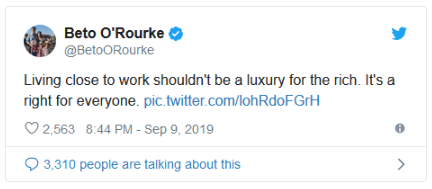
Presidential candidate Beto O’Rourke tweeted earlier this week about the ability of workers to live near their place of work:

https://twitter.com/BetoORourke/status/1171238016289034240

There is a lot to think about here. A little historical context: most workers lived very close to work up until the Industrial Revolution and the urbanization that came with it. The separation of home and work life is a relatively recent phenomenon for humans.

A little data on commute times. The 2017 American Community Survey showed the average commute time was 26.9 minutes. Commuting time can differ quite a bit across metropolitan regions:

McKenzie says the East Stroudsburg, Pa. metro area has among the longest average one-way travel time, clocking in at about 37.9 minutes. The U.S. Census Bureau contacted NPR with new information to include the New York-Newark-Jersey City metro area, which has a travel time of 37 minutes. Travel times for the two metro areas are not statistically different from one another.

Among the shortest average travel times, usually less than 20 minutes, were in Cheyenne, Wyo. and Grand Forks, N.D.

There is an academic term that addresses this issue: spatial mismatch. In this theory, jobs available to lower-income workers are located far from their residences. Imagine a typical well-off suburb: can the workers at the local Target or McDonald’s or gas station or hotel live in that community or nearby? Patterns of residential segregation and exclusionary zoning can mean that cheaper or affordable housing is not available close to certain jobs. This can be a more hidden form of inequality as longer trips to work mean less time for other activities.

This might get trickier for people with more resources and the options of where they want to live. A common American trade-off for the middle-class gets at this: should a homeowner move further out from work to purchase a larger home or live closer to work and job centers (which can include urban downtowns as well as suburban job centers dozens of miles away from urban downtowns)? Is a shorter commute worth having if it comes with paying more money for (possibly smaller) housing?

And perhaps the wealthy can truly live the closest to work if they so choose. Some of them might even locate their business or firm to where they are. Others might have multiple homes, including ones significant distances away where they can get to work by means not available to many such a private jets and helicopters.

So perhaps the issue here is not really living close to work but deeper issues involving mixed-income neighborhoods and moving away from resources (income and wealth) determining where people can life. O’Rourke gets into this a bit more, calling for smarter and denser cities that he says will lead to numerous positive outcomes – which could include shorter commutes.

How a bank could still make money offering negative interest rate mortgages

A bank in Denmark explains how they can make money by offering mortgages with interest rates below zero:

Jyske Bank has had to do a lot of clarifying; there’s a widespread misconception that the bank is actually paying borrowers to take their money. First of all, the bank is not actually paying anyone; it is simply forgiving part of the loan each time a payment is made. A mortgage borrower is likely to end up paying Jyske back a little more than they borrowed, factoring in fees and charges associated with arranging the mortgage loan.

And the bank can afford to do this without losing money because it borrows at negative interest rates as well…

Despite being in “historic remortgaging,” Høegh said the negative interest rates don’t actually make it any easier for home buyers to get a loan, but makes it easier to get a bigger loan – a lower rate means a higher disposable budget.

As long as the borrower is paying more in interest than the mortgage cost the bank, there is money to be made.

I might be showing my ignorance here but it leads to a few more questions:

1. Does this change how much volume in mortgages banks and lenders need to make in order to make money?

2. Would an extended period of such mortgages lead to inflated housing values because people can pay more for homes?

3. These changes might not be so bad in a fairly stable housing market but I wonder if there would be more issues in a high-demand or high-price market.

It looks like we would have a ways to go before negative rate mortgages come to the US but it would be interesting to see what happens if they do come.

Celebrating the labor of those who build McMansions?

The construction of single-family homes employs many Americans. When demand for homes drops, such as in the late 2000s with the burst housing bubble, many are out of work until the housing market heats up again.

Critics of McMansions would argue such homes should not be built. Instead, the land could be put to better use or developers and communities should focus on building other kinds of housing units that do not suffer from the same flaws.

But, the construction of McMansions employs people. Developers may build them to make more money than they could by building starter homes and communities may approve them in order to keep property values higher. And these homes provide work. Is this the case where a job is not worth it if the outcome is an undesirable product (in the eyes of McMansion critics)?

On this Labor Day, it would be interesting to consider how those who construct McMansions might be employed constructing other buildings. For many who construct McMansions, it could be hard to turn down the work if other opportunities are not present or the job pays okay. Should part of the fight against McMansions also include efforts to address labor issues?

Nostalgia for shopping malls amid decades of critique

Many shopping malls are in dire straits. The potential end of shopping malls can also induce nostalgia and good memories. Add to the decades-long critique of how shopping malls have harmed communities and societies and we have an odd moment: should we celebrate or lament the end of shopping malls?

A few reasons why there is nostalgia:

  1. The shopping mall was a prime social space, let alone a business space, for at least a generation or two. Hanging out at the mall as a teenager was a sign of independence for many and it is glorified by media narratives and images.
  2. The shopping mall is a marker of the past and those growing older can often lament the disappearance of what they knew. Perhaps they did not even like shopping malls or visit them very much but they are a marker for a particular era.
  3. The shopping mall was a significant shift in the shopping experience by providing a collection of chain stores in a single place surrounded by plentiful parking. While we have since moved to big box stores and now to online shopping, the shopping mall transformed retail.

But balance the nostalgia with the critiques:

  1. Shopping malls killed downtowns, from big cities to suburbs to small towns, across the country.
  2. Shopping malls are part of suburban sprawl that wastes resources and land (and contributes to more driving)
  3. They contributed to mass consumption and commercialization. As one quick example: would the commercial celebration of Christmas today be the same without the development of the mall?

How shopping malls end up in the collective memory down the road still remains to be seen. Once the generations that spent so much time in shopping malls is gone, what will their legacy be?


Briefly considering the factors behind less successful social media platforms

Social media may seem all powerful and present at this particular moment but it may be helpful to remember that numerous social media platforms did not succeed and for a variety of reasons:

By the New York Times’s and Abrams’s own account, though, hubris killed Friendster. A group of venture capitalists persuaded Abrams to turn down a $30 million offer from Google and then ran it into the ground with novel features rather than keeping the creaky site functioning smoothly. Pages just didn’t load…

In 2008, two years after reportedly surpassing Google as the most-visited website in the United States, Facebook eclipsed Myspace’s monthly user count. In 2011, when Myspace announced it was laying off half its staff, the New York Times attributed its decline to “fickle consumers and changing tastes”; a corporate “culture clash”; litter of celebrity promotion and pop-up ads; and Facebook’s standardized utilitarian interface–meaning that prefab profiles with names stylings like John Doe versus jdoe1234 were appealing to people. Forbes attributes Facebook’s generic design and its slow expansion through universities (with school email address verifications) and 13+ age policy to a perception that Facebook was a “safe space,” which would have incidentally coincided with a technopanic created by news reports of pedophilia. Social media scholar danah boyd performed an extensive study finding that racism also played a part, with upper-middle class white users deciding to wall off into exclusive groups…

The app for college students that quickly turned into a Black Mirror episode. Yik Yak, the anonymous messaging app designed by frat brothers Tyler Droll and Brooks Buffington with campuses in mind, allowed users to broadcast posts within a five-mile radius without creating a username. It soon became a scourge on 1,600 schools, terrorized by Yik Yak-borne threats: bomb threats which led to multiple lockdowns and evacuations, a threat of a “Virginia Tech 2.0,” threats by white students to kill black students, threats to rape and “euthanize” feminist students, and general cruelty and mockery encouraging suicide. Several schools banned it, subpoenas and court orders were issued, federal complaints were filed against schools, and Yik Yak had to disable the app near high schools and middle schools altogether…

Over the next decade, Orkut never took off in the US but was huge in Brazil and India, at one point, claiming 27 million members to Facebook’s 4.2 million. Orkut ostensibly fulfilled the same basic needs, but observers/analysts/users attributed Facebook’s dominance to a number of factors: Facebook had more games, the feed, the like button or notifications, a more “professional” look, mutual friends , and cultivated a following of international students and “professionals” who brought Facebook back to India.

These explanations have a tinge of post-hoc analysis made easier by comparisons to which platforms did succeed. But, a full explanation of what leads to success for some platforms and not others likely gets complicated by a variety of factors:

  1. Timing. When is the platform introduced, how much of a user base does it attract and at what speed, and how does it compare at the time to other options?
  2. Particular features offered.
  3. The user experience/interface.
  4. Organizational skills. Could the company effectively move forward or did it keep making problems for itself?
  5. Financial backing.
  6. Appeal to a narrower or broader audience.

That Facebook is viewed as a success does not necessarily mean that it had all the appealing features or a certain genius at its helm or simply arrived at the right time and in the right place. How fields develop like this is complex and littered with winners and losers, some more responsible for their own fate and others more influenced by the social forces around them. And developing the full story will likely take time as we assess how today’s winners fare and how social media itself as a form of technology evolves.

Bringing medical clinics to vacant shopping mall space

Filling emptying shopping malls can be a hard task. Add medical services to the list of possible replacement uses:

Mall of America in Minneapolis, America’s largest mall, announced plans last week to open a 2,300-square-foot walk-in clinic in November with medical exam rooms, a radiology room, lab space and a pharmacy dispensary service. Mall of America is teaming up with University of Minnesota physicians and a Minnesota-based health care system to operate the clinic…

While mall leases for clothing retailers declined by more than 10% since 2017, medical clinics at malls have risen by almost 60% during the same period, according to Drew Myers, real estate analyst at CoStar Group. The growth of medical clinic leases at malls has been the “strongest among all major retail sectors over the past five years,” he said.

Mall landlords are betting that when patients visit for a flu shot or eye exam, they’ll shop around for clothes or electronics. Adding medical clinics also makes sense for mall owners because they draw in doctors, nurses and technicians every day who may shop and eat at restaurants, according to a May research report by real estate firm JLL. Health care providers are also attractive tenants for mall landlords because they tend to have high credit ratings and sign longer leases compared with other retailers, JLL analysts noted.

On the provider and health insurer side, shopping malls give companies convenient locations to set up outpatient care posts and preventative care locations for patients. Providers are increasingly looking to these lower-cost clinics to help patients avoid expensive trips to the emergency room.

The medical offices can serve the new residents and commercial uses that are also now occupying shopping mall space in addition to blending shopping and medical trips (dubbed “medtail” in the article). Just wait until the new hospital takes over the mall and patients and visitors can walk out one door and into a clothing store down the hall.

More broadly, this hints at a blending of activity within single structures that suburbs are not used to. Suburbs are known for separating land uses, often with the goal of protecting single-family homes. Suburban downtowns, places where multiple uses might be found, are limited and now often seem geared more toward entertainment and cultural use. Could the shopping mall truly be a community center in the coming decades with more residential units, medical offices, and community spaces?

Mantra of the gig economy: “Experiences driving with Uber may vary”

A radio ad from Uber for drivers ends with this disclaimer: “Experiences driving with Uber may vary.”

Is this here for legal purposes? To accurately describe the variability in the position?

Jobs like these are often billed as easy ways for someone to earn some extra money: the drivers gets to pick when they want to work, they get to use their own vehicle, and the position could appeal who those who like to drive and/or meet people. This reminds me of Dave Ramsay’s common advice that those with debt should pick up a second job delivering pizzas to help bring in extra money. The flip side is that they may not be able to make that much money. They might have some unruly customers. The job puts wear and tear on their vehicle. The position may not last for very long or someone could be an Uber driver for years. Can someone make a decent living driving for Uber? Or, do they also need to deliver some Amazon packages, do freelance writing or web editing, complete some TaskRabbit jobs, and be a cashier somewhere to make ends meet?

Overall, the disclaimer strikes me as a pretty succinct way to summarize what supposedly is the wave of the future: workers taking on a variety of jobs as they so choose. I would guess Uber is not trying to engage in such metacommentary yet it can be hard to pin down many corporations on exactly how they view their employees or contractors.