CT suburb considering fines for “distracted walking”

The suburb of Stamford, Connecticut is considering penalizing those walking under the influence of phones:

Texting or even talking on an electronic device may soon be illegal in Stamford if a proposal to outlaw ‘distracted walking’ is approved…

“They’re oblivious to cars,” Stamford City representative, John Zelinsky said.

Zelinsky said the Pedestrian Safety Ordinance is modeled after one approved in Honolulu late last month, and would carry a $30 fine if police catch you in the act.

Such behavior can be dangerous for both users and others on the sidewalks and streets. Yet, legislating distractedness out of walking, bicycling, and driving is a tricky business. Does walking and talking with someone count as distracted walking? Is it okay to suddenly stop right in the middle of a busy sidewalk to take a phone call?

I have long wondered about implementing traffic regulations on busy sidewalks (see a story from England about this). Sidewalks are public spaces but also important conduits for foot traffic and some kinds of vehicles. Overcrowding can occur; see the recent example of Manhattan. And how people use the sidewalks can vary dramatically with use ranging from running and powerwalking to strolling to standing or sitting for conversation.

What it would take to approve Musk’s Northeast Corridor hyperloop

Elon Musk may have verbal approval for his underground hyperloop but there is much more work to be done to get the project underway:

“It means effectively nothing,” says Adie Tomer, who studies metropolitan infrastructure at the Brookings Institution. “The federal government owns some land, but they don’t own the Northeast corridor land, and they don’t own the right-of-way.” Sure, having presidential backing isn’t bad—but it is far, far from the ballgame…

First, you have to get the OK from all the states and cities and municipalities involved. This is essential because Musk promises this Northeast hyperloop will pass through city centers, so he’s counting on tunneling under places where lots of people live and work and play. Judging by the the official responses from local agencies and politicians along the proposed route, this process is not quite underway. “This is news to City Hall,” the press secretary for New York Mayor Bill de Blasio tweeted. Looks like the Boring Company has a lot of boring meetings with public officials ahead of it…

And then there’s the little problem of moolah. Just updating the current Northeast corridor railroad—you know, the one run by Amtrak—to high-speed rail standards would cost an estimated $123 billion. Tunneling will be even more expensive. Musk has promised his boring technology will speed up the construction and bring down costs. But boring will never be cheap, especially in populated areas. Carving less than two miles of tunnel under New York for the Second Avenue Subway took $4.5 billion. Even if this hyperloop were entirely privately financed, it would take lots of zeroes…

By law, projects need to be evaluated for the potential environmental consequences of their construction and operations, to create what’s called an Environmental Impact Statement. Federal agencies generally take a while to prepare these documents: One 2008 study found the average writeup took three and a half years, and some have taken as many as 18. They also cost a lot to prepare—millions and millions in government funds.

That is a lot to take on. I’ve seen suggestions in recent years that the United States is no longer able to tackle needed large infrastructure projects. In the past, large projects could be accomplished such as the intercontinental railroad or Hoover Dam. Today, American projects lean more toward interminable delays and huge cost overruns. In contrast, some other countries do not get bogged down in the same ways. Sure, some of that might require more authoritarian regimes – such as the new Silk Road railroad in China or the growth in Abu Dhabi in the United Arab Emirates – but things get done!

Moving forward, is there a way for a country like the United States to undertake large innovative projects without all the bureaucracy that slows it down? Can we still take risks? Musk’s hyperloop might be a perfect test case: the technology barely exists so it might be an incredible risk. But, the payoff could be tremendous (and not just necessarily for the intended purpose of a new transportation technology but the other helpful pieces that come along the way – including a way forward across multiple governments and requirements).

Facebook as a replacement for the community formerly found in church and Little League

In a recent speech in Chicago, Zuckerberg explained his vision for Facebook:

Mark Zuckerberg wants Facebook groups to play an important role that community groups like churches and Little League teams used to perform: Bringing communities together…

“It’s so striking that for decades, membership in all kinds of groups has declined as much as one-quarter,” he said during a rally for Facebook users who’ve built large community-support groups on the site. “That’s a lot of of people who now need to find a sense of purpose and support somewhere else.”

He added, “People who go to church are more likely to volunteer and give to charity — not just because they’re religious, but because they’re part of a community.”…

“A church doesn’t just come together. It has a pastor who cares for the well-being of their congregation, makes sure they have food and shelter. A little league team has a coach who motivates the kids and helps them hit better. Leaders set the culture, inspire us, give us a safety net, and look out for us.”

One of the best things about the Internet and social media is that it allows people with specific interests to find each other in ways that can be difficult offline. Yet, it is less clear that these online groups can be full substitutes for offline social groups. A few specific questions about this based on what Zuckerberg said:

  1. It can be interesting to ask about the purpose of religious groups: how much are they about religious activities versus social activities? The answer might depend on whether one is a person of faith or not or an insider or outsider to such groups.
  2. Religious groups are unique in that they are often focused on a transcendent being. Other social groups often have an external focus but not quite the same kind. Is a Facebook group focusing on the same kind of thing as a religious group?
  3. Zuckerberg is hinting at the need humans have for social and spiritual connection. Can such spiritual connection be filled in an online setting in the ways that it occurs offline?
  4. Zuckerberg is right about the decline in civic membership but can this trend be easily reversed? For example, Robert Putnam in Bowling Alone points to a whole host of factors (from suburbanization to television watching) that led to this. If people are willing to join online communities in large numbers, is this because these communities offer different requirements than civic groups?

A reminder: this is not a new development. Facebook founder Mark Zuckerberg has been clear from early on about his goals to use the platform to bring people together. See an earlier post about this here.

Americans fearful of driverless cars

Recent surveys suggest a majority of Americans don’t want to hand over their steering wheels yet:

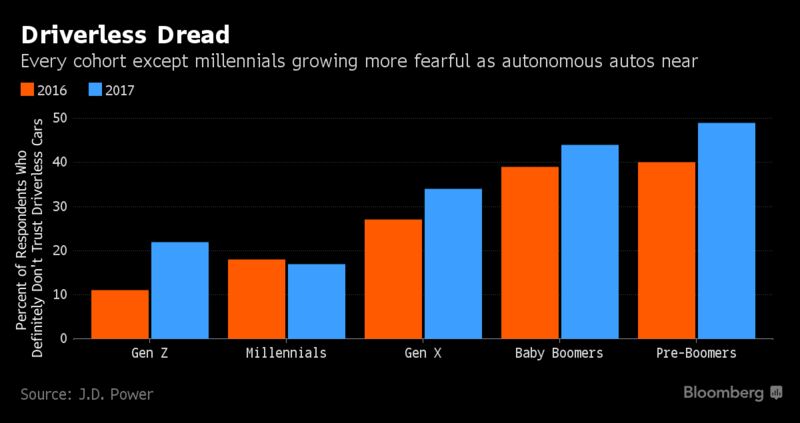
Autonomous autos are advancing so rapidly that companies like Uber Technologies Inc. and Alphabet Inc.’s Waymo are beginning to offer robot rides to everyday consumers. But it turns out the traveling public may not be ready. A recent survey by the American Automobile Association found that more than three-quarters of Americans are afraid to ride in a self-driving car. And it’s not just Baby Boomers growing increasingly fearful of giving up the wheel to a computer, a J.D. Power study shows — it’s almost every generation.

Consumers will only become comfortable with driverless cars after they ride in them, Mary Barra, the chief executive officer of General Motors Co., said this week. The largest U.S. automaker is testing 180 self-driving Chevrolet Bolts and ultimately plans to put them in ride-hailing fleets, though it won’t say when…

Dangerous as it may be to operate cars themselves, many drivers are anxious about autonomous technology because they associate it with the fragility of electronic devices. Laptops crash and calls drop with nagging regularity. The consequence of a computerized car crash is much greater.

Americans tend to like technology: we like progress and new and exciting options. Is the fear related to safety or also connected to how Americans view driving (despite all the hours spent commuting and stuck in traffic, Americans like the freedom it offers)?

I’m guessing this fear will drop within a few years as stories of mishaps become normal (and even the occasional mishap would be safer in the long run compared to the tens of thousands of Americans killed each year in vehicles) and the technology improves. Could we also imagine a scenario where governments impose self-driving vehicles because of their improved safety?

Measuring attitudes by search results rather than surveys?

An author suggests Google search result data gives us better indicators of attitudes toward insecurity, race, and sex than surveys:

I think there’s two. One is depressing and kind of horrifying. The book is called Everybody Lies, and I start the book with racism and how people were saying to surveys that they didn’t care that Barack Obama was black. But at the same time they were making horrible racist searches, and very clearly the data shows that many Americans were not voting for Obama precisely because he was black.

I started the book with that, because that is the ultimate lie. You might be saying that you don’t care that [someone is black or a woman], but that really is driving your behavior. People can say one thing and do something totally different. You see the darkness that is often hidden from polite society. That made me feel kind of worse about the world a little bit. It was a little bit frightening and horrifying.

But, I think the second thing that you see is a widespread insecurity, and that made me feel a little bit better. I think people put on a front, whether it’s to friends or on social media, of having things together and being sure of themselves and confident and polished. But we’re all anxious. We’re all neurotic.

That made me feel less alone, and it also made me more compassionate to people. I now assume that people are going through some sort of struggle, even if you wouldn’t know that from their Facebook posts.

We know surveys have flaws and there are multiple ways – from sampling, to bad questions, to nonresponse, to social desirability bias (the issue at hand here) – they can be skewed.

But, these flaws wouldn’t lead me to these options:

  1. Thinking that search results data provides better information. Who is doing the searching? Are they a representative population? How clear are the patterns? (It is common to see stories based on the data but that provide no numbers. “Illinois” might be the most misspelled word in the state, for example, but by a one search margin and with 486 to 485 searches).
  2. Thinking that surveys are worthless on the whole. They still tell us something, particularly if we know the responses to some questions might be skewed. In the example above, why would Americans tell pollsters they have more progressive racial attitudes that they do? They have indeed internalized something about race.
  3. That attitudes need to be measured as accurately as possible. People’s attitudes often don’t line up with their actions. Perhaps we need more measures of attitudes and behaviors rather than a single good one. The search result data cited above could supplement survey data and voting data to better inform us about how Americans think about race.

Argument: Apple’s new HQ is anti-city

Build a massive new headquarters in the suburbs surrounded by artificial berms and you may just open yourself to charges that you are anti-city:

You can’t understand a building without looking at what’s around it—its site, as the architects say. From that angle, Apple’s new HQ is a retrograde, literally inward-looking building with contempt for the city where it lives and cities in general. People rightly credit Apple for defining the look and feel of the future; its computers and phones seem like science fiction. But by building a mega-headquarters straight out of the middle of the last century, Apple has exacerbated the already serious problems endemic to 21st-century suburbs like Cupertino—transportation, housing, and economics. Apple Park is an anachronism wrapped in glass, tucked into a neighborhood…

Except when you have a statement building like the Spaceship, the circuit can’t complete. If Apple ever goes out of business, what would happen to the building? The same thing that happened to Union Carbide’s. That’s why nobody builds these things anymore. Successful buildings engage with their surroundings—and to be clear, Apple isn’t in some suburban arcadia. It’s in a real live city, across the street from houses and retail, near two freeway onramps….

In the early days of the project, reports suggest Apple wasn’t willing to participate in “community benefits,” financial or otherwise, and Cupertino’s city council didn’t seem too willing to push one of the city’s biggest employers and taxpayers. The mayor at the time tried to propose higher taxes on the company, but the city council didn’t support the move.

Over time, though, Apple committed to giving the city some money to help with traffic and parking. “We had to bring them into our world. They don’t do urban design. They don’t do planning. We needed to talk to each other,” Shrivastava says…

So what could Apple have built? Something taller, with mixed-use development around it? Cupertino would never have allowed it. But putting form factor aside, the best, smartest designers and architects in the world could have tried something new. Instead it produced a building roughly the shape of a navel, and then gazed into it.

This is an interesting juxtaposition to the steady stream of stories in recent years about how tech companies and other companies hip to the changing times are moving back to cities. Why would Apple construct such a structure and do so in the suburbs? I wonder if it has to do with control and secrecy. That may refer to the technology present – a building like this keeps it away from the public – but could also refer to providing employees with few reasons to go elsewhere. Facebook tried to do something like this by providing a Main Street all sorts of amenities so employees would want to stay (or wouldn’t have to leave). If you have your technology and employees wrapped up in one massive (and impressive) structure, you can exert a level of control few companies could dream of.

I also wonder if only a few companies could get away with this today. Apple is so prestigious and wealthy that it can do lots of things differently than others – such as trying to move back to the city to attract and retain younger workers – without much loss.

Finally, the article includes a quote calling structures like these “white elephants.” Imagine in ten years that Apple decides to move to a newly constructed skyscraper/megatructure in San Francisco. How could a suburban community deal with such a building? Many suburbs have a hard enough time with a vacant grocery store building, let alone a idiosyncratic large structure like this.

Geographic differences in venture capital, start ups

The race between cities to attract the tech industry is an uneven one as two graphics from a Wired story about a Denver startup illustrate:

*Combines San Francisco and San Jose metro areas. Sources: Apartment List, Brookings Institution, Pitchbook

Are efforts to replicate Silicon Valley in different places that much different than trying to copy the High Line? While it is popular to try to attract the tech industry and similar businesses – see Richard Florida’s work as an example – it is not an easy task. Even technology, with all its possibilities to span times and space, is often an embodied industry. Why would Apple pay so much attention to their new building? Why does the tech industry seem to develop in clusters like Silicon Valley and Route 128 outside of Boston?

More broadly, it takes times for communities to develop and often a series of decisions and events are required. Intentional efforts may or may not lead to a flourishing tech sector in a particular location as it is difficult to apply and carry out a particular formula. These developments are often contingent on a number of previous factors. For example, the tech industry seemed to rise up near research universities (Stanford in the Bay Area, multiple schools in the Boston area). It takes a lot (in both time and resources) to develop such educational settings. Success in developing a tech cluster should be measured in decades rather than years.


Why Google’s plan to scan every book in the world was halted

Google had plans to scan every book but the project hit some legal bumps along the way and now the company has “a database containing 25-million books and nobody is allowed to read them”:

Google thought that creating a card catalog was protected by “fair use,” the same doctrine of copyright law that lets a scholar excerpt someone’s else’s work in order to talk about it. “A key part of the line between what’s fair use and what’s not is transformation,” Google’s lawyer, David Drummond, has said. “Yes, we’re making a copy when we digitize. But surely the ability to find something because a term appears in a book is not the same thing as reading the book. That’s why Google Books is a different product from the book itself.”…

It’s been estimated that about half the books published between 1923 and 1963 are actually in the public domain—it’s just that no one knows which half. Copyrights back then had to be renewed, and often the rightsholder wouldn’t bother filing the paperwork; if they did, the paperwork could be lost. The cost of figuring out who owns the rights to a given book can end up being greater than the market value of the book itself. “To have people go and research each one of these titles,” Sarnoff said to me, “It’s not just Sisyphean—it’s an impossible task economically.” Most out-of-print books are therefore locked up, if not by copyright then by inconvenience…

What became known as the Google Books Search Amended Settlement Agreement came to 165 pages and more than a dozen appendices. It took two and a half years to hammer out the details. Sarnoff described the negotiations as “four-dimensional chess” between the authors, publishers, libraries, and Google. “Everyone involved,” he said to me, “and I mean everyone—on all sides of this issue—thought that if we were going to get this through, this would be the single most important thing they did in their careers.” Ultimately the deal put Google on the hook for about $125 million, including a one-time $45 million payout to the copyright holders of books it had scanned—something like $60 per book—along with $15.5 million in legal fees to the publishers, $30 million to the authors, and $34.5 million toward creating the Registry….

This objection got the attention of the Justice Department, in particular the Antitrust division, who began investigating the settlement. In a statement filed with the court, the DOJ argued that the settlement would give Google a de facto monopoly on out-of-print books. That’s because for Google’s competitors to get the same rights to those books, they’d basically have to go through the exact same bizarre process: scan them en masse, get sued in a class action, and try to settle. “Even if there were reason to think history could repeat itself in this unlikely fashion,” the DOJ wrote, “it would scarcely be sound policy to encourage deliberate copyright violations and additional litigation.”

Out-of-print books with uncertain copyright status scuttle what could be one of the great treasure troves of information? This suggests we still have a ways to go until we have legal structures that can deal with the information-rich and easily accessible online realm. If a deal could eventually be worked out for books, what about older music, art, and other cultural works?

A related thought: having all those books available might indeed change the academic enterprise in several ways. First, we could easily access more sources of data. Second, we could potentially cite many more sources.

Will smart cities necessarily be lonely cities?

This piece thinks about how smart cities might affect social relationships and the prognosis is not good:

By 2050, more than 66 percent of the world’s population will be living in so-called “smart cities.” These are metropolitan areas where everything will be digitally connected. Today, some people have “smart” thermostats, refrigerators, or smoke detectors. Tomorrow, we’ll have smart hospitals, farms, and highways, and it’s likely they’ll all talk to one another. Connected devices will monitor everything from air quality to energy usage and traffic congestion…

We can also expect more part-time work, distance working, and the blurring of our work and personal lives. Some worry that the rise of robots could force governments to legislate for quotas of human workers.

But city-dwellers will see incremental changes outside of their workspace, too. Thanks to self-service checkouts and home delivery services, technology is creating less of a need for us to actually interact with those around us. Message bots, like Google Assistant, Siri, and Amazon’s Alexa, will soon be able to suggest restaurants, hotels, and other local landmarks. This is already happening in places like Tel Aviv, where everyone over the age of 13 can receive personalized data, such as traffic information, and can access free municipal Wi-Fi in 80 public zones. Populations will be encouraged to make good use of these ever-personalized digital services, since this gives companies our precious data, which will be integral to smart cities…

But it’s doubtful that these interventions will be enough to counteract further encroachment of technology on cities’ infrastructure. Resistance needs to be on a grander scale. One solution may lie in the preservation of public spaces such as parks, community centers, cafes, and shops. “If cities are to remain viable places for people to develop the strong associational and social life fundamental to healthy human existence they must incorporate a range of public spaces and ‘third’ places outside of work and home, in which urban citizens can come together,” writes John Bingham-Hall, a researcher at London School of Economics and Political Science.

I’ll throw out two counterpoints that might lessen the concern:

  1. While new technology could move us toward more private lives, it doesn’t necessarily have to. We don’t have to end up in a futuristic setting and narrative as depicted in Her. Such claims have been made for centuries with the spread of industrialization and urbanization: new technologies would reduce the humanness of life. Think of the Luddites and their concerns about changes to manufacturing in the early 1800s. Marx was also worried about the alienation being brought about by the forces of industrialization and urbanization. At the same time, we could theoretically end up with more time for social interaction if these new technologies free us up. We’ve heard these promises for decades: people won’t have to work as much or take care of their possessions because it can be done for them. (Put it this way: what does it say about us that even though we have devices to help us reduce our labor, we continue to labor a lot? Are we trying to escape more social interaction?) I would ask: are we blaming the technology too much or should we think harder about how we could utilize what has been invented for our common good?
  2. Early sociologists were concerned about the individual being lost in the big cities of the modern world or noted that city life was a major change from small village life to which many in the world had grown accustomed. (See the work of Simmel, Durkheim, and Tonnies.) Yet, cities continue to attract people and social life continues – even if it has changed in certain ways. Still today, it seems that it might be important that people are around other people regularly (which commonly happens in dense cities), even if they don’t have strong relationships with many people. I would ask: is it really cities that are in danger of being lonely places or would the technology affect everyone in similar ways in coming decades?

Smart cities don’t have to be lonely cities. We could be lonely all over the place or we could make decisions about how to direct technology toward things we might want (such as increased or deeper social connections).

Which comes first on a mass scale: electric cars or driverless cars?

The car of the future could be quite different but what exactly it will be is still up in the air. Will it be an electric car? We need some significant infrastructure for that to work:

But here’s the thing. As a piece of new driving technology, the Bolt totally works. But the adoption curves and take-up rates of new technologies aren’t driven simply by the efficacy of the technology in and of itself. New innovations require infrastructure to reach their full market potential. Often that infrastructure has to be built by companies other than those who build the original products. And right now, electric cars remain hindered by a massive infrastructure gap…

Tesla has dealt with the infrastructure challenge by building its own network of proprietary superchargers—stations that only Tesla owners can use. But it’s a closed system, and it is part of what makes Tesla a luxury product. Non-Tesla users are out of luck. And while some of the big automakers are establishing partnerships with charging networks, none has taken it upon itself to build the dense, easily accessible, and highly functional network of charging stations that is needed. So it’s great that the Bolt feels like it belongs in everyone’s garage. But until that gaping infrastructure gap is bridged, it won’t be in nearly as many as it could be.

And working out all the kinks of driverless cars and then making them affordable to the mass market may take a while:

Despite technological advances, accidents like these reduce consumer trust and send companies back a few steps. A true autonomous future is perhaps as far away as 50 years, considering all that needs to happen to ensure safety and prepare the average driver.

While one will see the occasional driverless car zipping tech execs around Silicon Valley, new connected cars will still be out of reach for most families.

The internal combustion engine vehicle with a human driver may prove to have quite the staying power. How about we envision the electric self-driving vehicle for all several decades down the line?

Another thought: given all that would need to be done to completely switch over to either option, could the money and time be better spent on other problems?