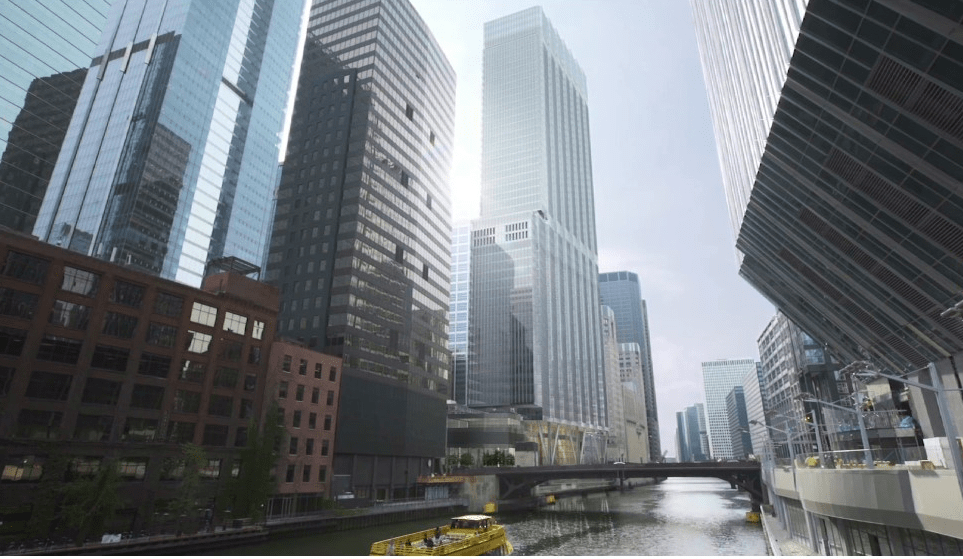
The lead tenant, Charlotte, N.C.-based Bank of America, expected to have more than 2,600 people working on its 17 floors of the 56-story tower. But fewer than 200 work there now, according to company spokeswoman Diane Wagner…
By drastically reducing the number of columns that come to the ground, this structural tour de force allows the tower’s caissons to reach bedrock without hitting the remaining caissons of the old Morton Salt building. It also opens up the riverwalk, which would have felt constricted had it been hidden behind a row of columns.
To some, the arrangement may appear unstable. But new section of riverwalk, with its long, curving benches and still-to-be-planted greenery, is among the strongest contributions the tower makes to the public realm. It will not become a windblown cavern, the architects assure…
With COVID-19 still a significant threat, the developers have put several safeguards in place, including walk-through temperature scanning in the lobby, antimicrobial cladding on the building’s entry doors and upgraded air filtration systems. Tenants can swipe their smartphones on high-tech turnstiles that call an elevator. There’s also none of the welcoming seating that animated other downtown office building lobbies before the pandemic struck.
It sounds like the pandemic has effects on two major features of the building:
The interior will not be functioning as it was designed for a while. This building has a lot of office space; will it ever be fully filled after COVID-19 passes and businesses reckon with shifts to working from home? We have not heard much about what it is like to work in such conditions – a relatively empty building – nor do we know how building owners and developers plan to use office space if they cannot attract firms.
The excerpt above describes how the building interacts with the surrounding environment. It sounds good. But, how does it look and/or function when the typical street life of the Loop is not present? Can aesthetics overcome a lack of social interaction? When will the building fully participate in regular urban life?
Since this is not the only large downtown building under construction in Chicago, let alone in large American cities, it will be fascinating to see what comes of these structures. Will they be regarded as the last of the big central office buildings in a decentralized work landscape or will they be brave attempts to do business as normal or do they represent a new wave of exciting buildings that mark a post COVID-19 era?
Can America in the 2020s turn itself around the way the America of the 1890s, or the Britain of the 1830s, did? Can we create a civic renaissance and a legislative revolution? I’m not so sure. If you think we’re going back to the America that used to be—with a single cohesive mainstream culture; with an agile, trusted central government; with a few mainstream media voices that police a coherent national conversation; with an interconnected, respected leadership class; with a set of dominant moral values based on mainline Protestantism or some other single ethic—then you’re not being realistic. I see no scenario in which we return to being the nation we were in 1965, with a cohesive national ethos, a clear national establishment, trusted central institutions, and a pop-culture landscape in which people overwhelmingly watch the same shows and talked about the same things. We’re too beaten up for that. The age of distrust has smashed the converging America and the converging globe—that great dream of the 1990s—and has left us with the reality that our only plausible future is decentralized pluralism.
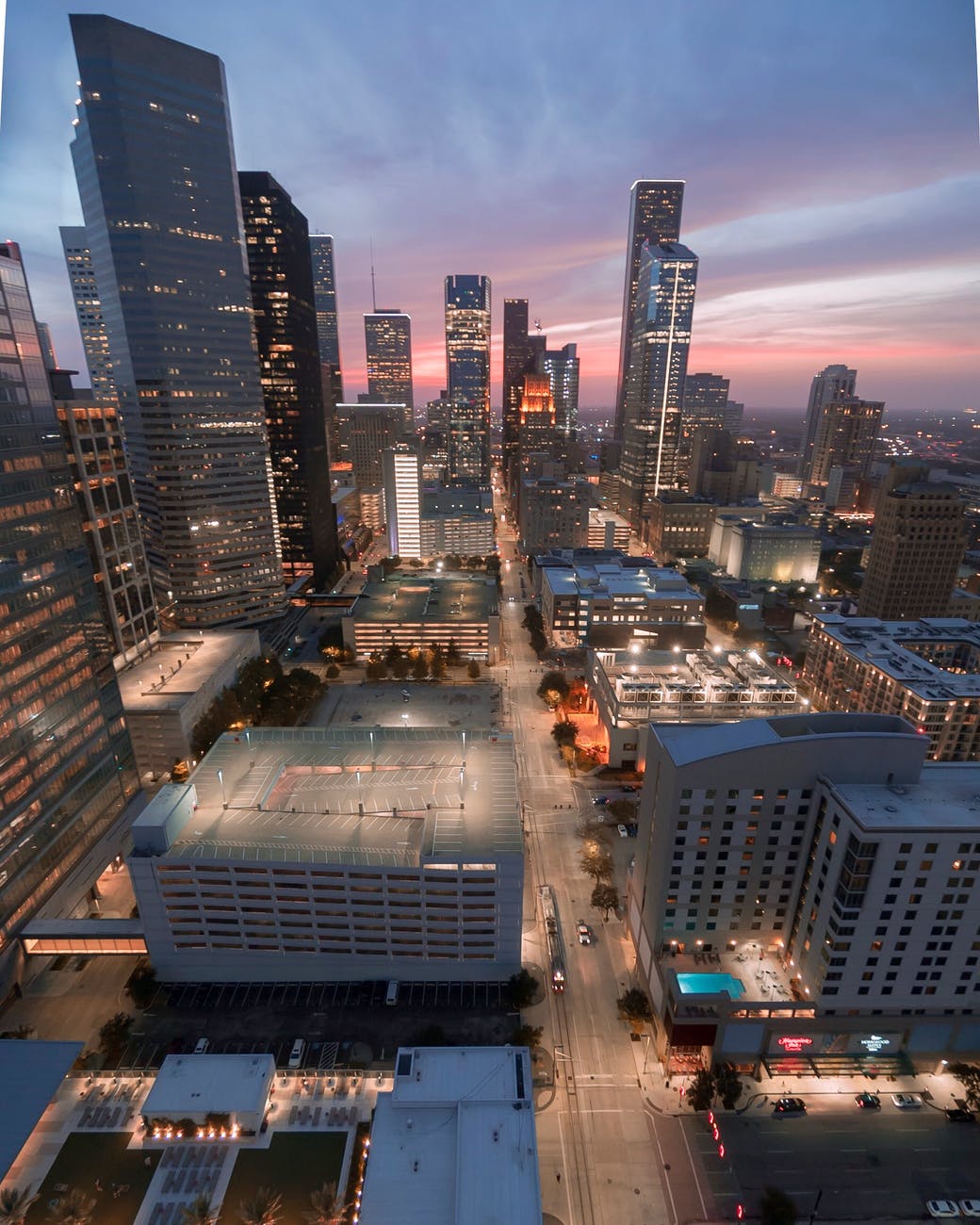
A model for that can be found in, of all places, Houston, Texas, one of the most diverse cities in America. At least 145 languages are spoken in the metro area. It has no real central downtown district, but, rather, a wide diversity of scattered downtowns and scattered economic and cultural hubs. As you drive across town you feel like you’re successively in Lagos, Hanoi, Mumbai, White Plains, Beverly Hills, Des Moines, and Mexico City. In each of these cultural zones, these islands of trust, there is a sense of vibrant activity and experimentation—and across the whole city there is an atmosphere of openness, and goodwill, and the American tendency to act and organize that Hofstadter discussed in The Age of Reform.
Not every place can or would want to be Houston—its cityscape is ugly, and I’m not a fan of its too-libertarian zoning policies—but in that rambling, scattershot city I see an image of how a hyper-diverse, and more trusting, American future might work.
The key to making decentralized pluralism work still comes down to one question: Do we have the energy to build new organizations that address our problems, the way the Brits did in the 1830s and Americans did in the 1890s? Personal trust can exist informally between two friends who rely on each other, but social trust is built within organizations in which people are bound together to do joint work, in which they struggle together long enough for trust to gradually develop, in which they develop shared understandings of what is expected of each other, in which they are enmeshed in rules and standards of behavior that keep them trustworthy when their commitments might otherwise falter. Social trust is built within the nitty-gritty work of organizational life: going to meetings, driving people places, planning events, sitting with the ailing, rejoicing with the joyous, showing up for the unfortunate. Over the past 60 years, we have given up on the Rotary Club and the American Legion and other civic organizations and replaced them with Twitter and Instagram. Ultimately, our ability to rebuild trust depends on our ability to join and stick to organizations.
Houston is a growing city – now the fourth largest American city – and is a unique city in the United States. Brooks notes three features above: sprawl and a decentralized landscape, a lack of zoning policies, and diverse residents.
A fourth factor could be worth adding that might undercut Brooks’ example. Sociologists Michael Emerson and Kevin Smiley examined people-oriented cities and market-oriented cities. One of their case studies is Houston, a paradigmatic market-oriented city. Heavily influenced by the oil industry, the city has prioritized business over people. Can such a setting foster more social trust? If so, would it primarily be based on economic interdependence and would that be enough to overcome the problems Brooks suggests Americans face? If not, how can places combat the tendencies for current systems to pit interested parties against each other?
Furthermore, it would be worth hearing more how “islands of trust” can cooperate together to pursue projects for the good of the whole city. In a decentralized landscape, wealthier private residents may have what they want – access to a home and yard, for example – but it is less clear what kinds of institutions successfully bring people together over an expansive metropolitan region. A limited number of regions have tried metropolitan wide initiatives – see Minneapolis for sharing revenues, building housing across the region – but these can be difficult to sell and implement (see, for example, trying to promote mass transit in the Nashville region).
The contrast to Houston would be more established cities in the Northeast and Midwest that have long-standing institutions and coherent neighborhoods. Yet, the fault lines in these places may be too entrenched for significant coming together to happen.
Is there a growing smaller sized city that could lead the way in building social trust amid the pressures of pluralism, disagreement, and limited social trust?
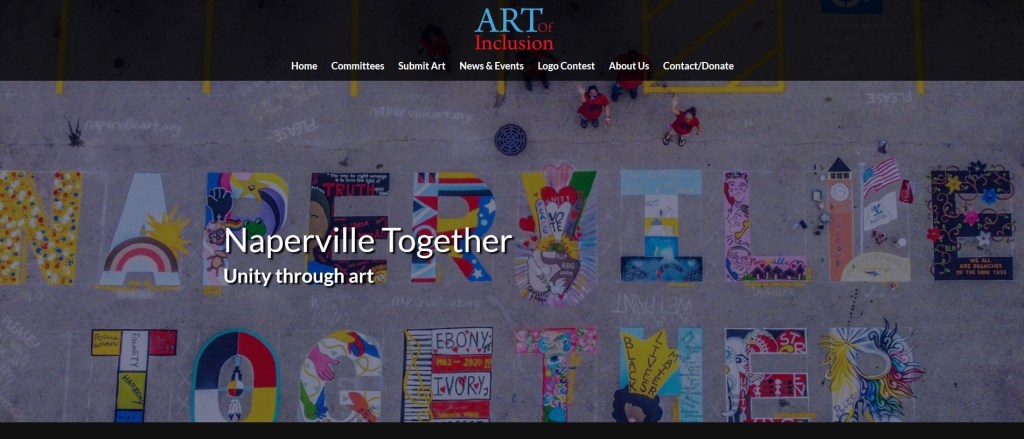
Using public art, an already accepted medium in downtown Naperville, to make a new statement seems like it could be effective. At the same time, having more art that promotes diversity in the community in more prominent locations also matters.
How much room is there in downtown Naperville to do different kinds of art? At this point, there are a number of murals, statues, and sculptures. How varied could future works in these formats be and what new formats might be included? More artistic freedom and new aesthetics – downtown Naperville generally has a red brick, several story building look – could also contribute to a sense of diversity.
The conversation about art gets at larger questions about race and ethnicity in Naperville. Although it is more diverse than in the past, is it welcoming to all people? Do all residents feel comfortable in the downtown and in other local institutions? How does the community tell its own history? What is the vision for the future?
I have made a number of trips to California, usually visiting family or for vacation. And while I do not typically seek out pools on my vacation, with the end of summer I was reminded of two pools I really enjoyed seeing.
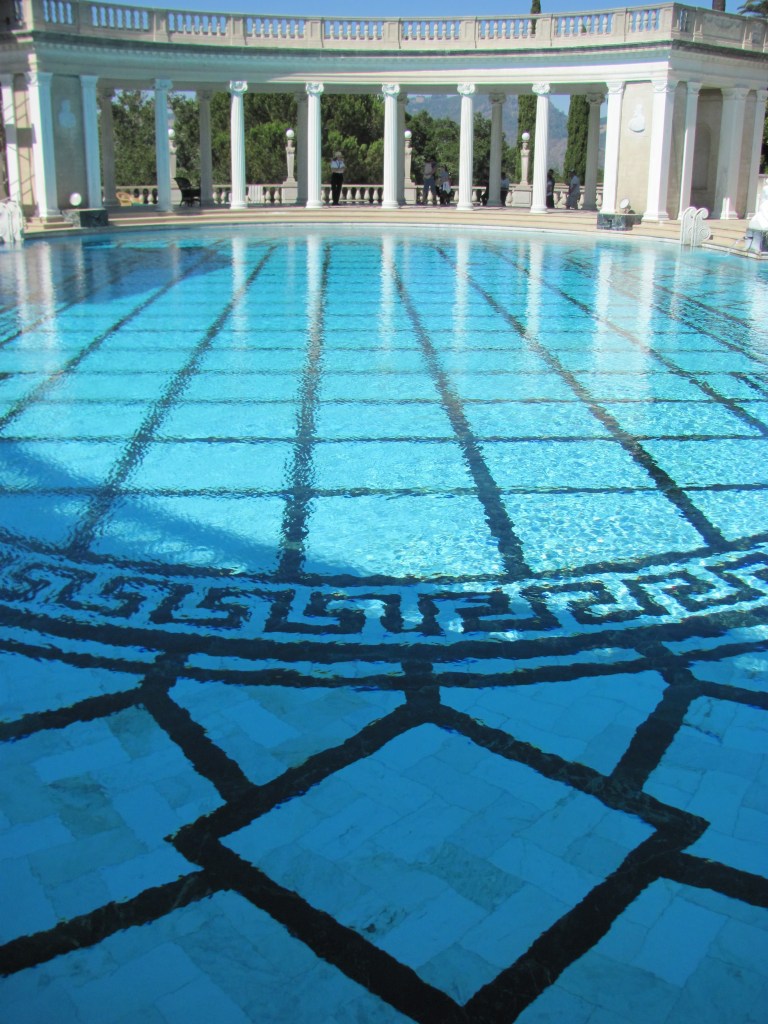
The first is at Hearst Castle. The house is fun to tour with its unique features and location up on a hill that offers great views all around. The indoor pool is impressive but the outside pool is even better:
Columns, large pool, a sunny day. Although it was the first thing on the property we saw on our tour, I could stopped there.
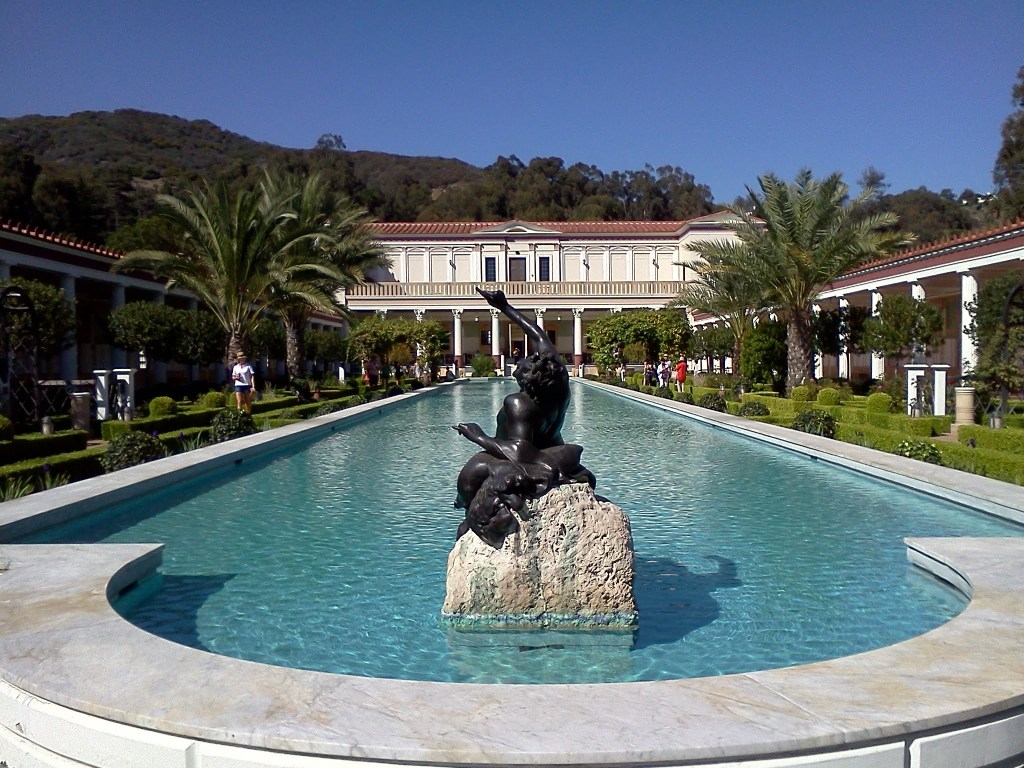
The second pool is further south at The Getty Villa. In what looks like a Roman villa filled with art, there is a long courtyard with this:
While this pool is only a few feet deep, I could still imagine floating around in this great setting surrounded by palm trees and art.
It may not be a coincidence that both pools are surrounded by classical columns. This is not just swimming, this is fun in the water surrounded by the aura of history (even if these buildings are relatively recent constructions that evoke tradition and opulence). The contrast here would be some of the ultra-modern skyscrapers topped with infinity pools; they sell a pool at the top of the urban world amid steel and glass.
Or, perhaps the lure of the pool knowing that visitors cannot swim in them helps make them attractive. They are part of the scenery – even as they likely cost quite a bit to maintain – that cannot be touched. And with visitors coming on a number of hot days, these pools look refreshing.
In the end, I would be happy to go back and sit by these pools. And if there is ever an event that allows people to use them, I would be interested.
As my family or I have owned a version of this atlas for many years, I have spent much time viewing this page. I can recall when new roads were added (like I-355). Here is what strikes me upon seeing the Chicago area in the 2021 version (not the more zoomed in regional map which can offer more detail):
The map cannot mention the names of all of the suburbs; there is not enough room. The ones listed appear to be the suburbs larger in population mixed in with some of the communities between those.
This particular map does not clearly mark the boundaries of Chicago. You can roughly see where Chicago’s edges are due to the positions of other communities. Yet, the edges of the suburbs are marked – see the orange areas versus white areas – though some of the non-suburban areas within the developed areas are oddly marked.
What non-municipal features are noted is interesting. Midway Airport has a label, O’Hare does not. Four universities along the lakefront are marked but DePaul and many others in Chicago and the region are not. There are some natural features and parks visible but not many (for example, it would be very difficult to know from this map all the forest preserves present in the counties in the region).
The lake is present and useful for the map because some of the labels can go off into the water rather than compete for space over land.
You might be able to get a sense that the road system in the Chicago area is both easy to understand and has a complicated history. The roads are fairly straight and the main highways largely radiate out of Chicago (I-94 north, I-90 northwest, I-88 west, I-55 southwest, I-57 south). But, then there are some shorter highways, two ring highways (I-294 and I-355) but not a third one to service outer development, and the toll/non-toll options blend together.
Making this map likely required a lot of decisions as to what to include and what would help make the map readable.
With the announcement yesterday that Chicago will embark on a new planning process for the local government to consider, one news report included this tidbit about previous planning processes:
When finished, the document would be submitted to the plan commission and the City Council for approval. Gorski said the last such citywide plan in 1966 had official status but never got formal approval.
“While Chicago may have pioneered citywide planning with the 1909 ‘Plan of Chicago,’ this is a rare opportunity to collectively address current and future issues with a collaborative and coordinated effort with other planning entities, businesses, institutions and the people of Chicago,” DPD Deputy Commissioner Kathleen Dickhut said.
This history would be worth exploring more. Here are a few questions/issues/thoughts which I am sure someone has answered and/or explored:
Why was the 1966 plan not formally approved?
The gap between 1966 and today seems like a long time to not have a different master plan. Chicago has changed a lot since then. Is it safe to assume there have been a lot of smaller (district, community areas, etc.) plans developed and acted upon since 1966?
Even if the new plan is not completed on time or is not approved or enacted, it can be a valuable process to engage numerous stakeholders from around the city to think about and discuss what they want the city to be about.
Balancing the larger vision with the important minutiae to decided at the local scale will be interesting to watch. Either job would be difficult on its own.
In putting together material for the upcoming semester, I found myself summarizing my work on studying the character of particular suburbs. Here is the slide that explains the process:
A quick explanation of the (simplified) process depicted on the slide:
Every community or neighborhood has characteristics and circumstances at its founding. These starting traits can prove influential down the road.
Once started, the community continues through inertia. People live their lives.
There are points in time – which I call “character moments” in a 2013 article – where the inertia of communities are disrupted. This often comes in the form of external forces that place pressure on a community. For example, my 2013 article looked at what happened when three suburbs felt suburbanization pressure in the Chicago region after World War II. This led to internal discussions in each suburb about how they wanted to respond and what they viewed as their future. One of the suburbs, Naperville, decided to lean into the growth: they annexed a lot of land, developed guidelines for growth, and experienced multiple decades of explosive growth (read more in my 2016 article on the difficulties explaining these changes in Naperville).
Different decisions in communities will lead to different future paths.
Then, the inertia, external forces, and internal discussions and decisions repeat as circumstances arise. These key decisions build on each other over time which leads communities to be different places and feel different. This is an iterative process and communities can change course.
The ways this plays out in unique communities can differ greatly even as the process looks similar.
In Chicago and in other cities with robust transit systems, people who have never owned cars before are suddenly buying them. In New York City, some are calling it “carmaggedon,” as residents there registered 40,000 new cars in July, the highest monthly total in years. Meanwhile, NYC subway ridership is still down more than 75% from last year.
The difference in what leads to carmageddon in each city is striking. In Los Angeles, closing a section of a major highway is a problem for the entire system. Because of the emphasis on driving and the various chokepoints in the road system, a single closure has ripple effects. In New York City, the opposite is the case: high mass transit use, particularly in Manhattan and denser parts of the city, is necessary. If something threatens the mass transit lines – here, it is an unwillingness to use mass transit when there is a pandemic – then too many cars may be on roads that cannot handle the increased volume.
Fortunately for Los Angeles and unfortunately for New York, the length of Carmageddon matters. Closing a major highway for just a few days is survivable. Indeed, Los Angeles got out ahead of the problem and enough drivers were able to make alternate plans. Decreased mass transit use due to COVID-19 is another story. How long will the virus be around? Will there be a point where residents return to mass transit even with the threat of the virus present? Carmageddon in New York might prove more lengthy and much more difficult to remedy.
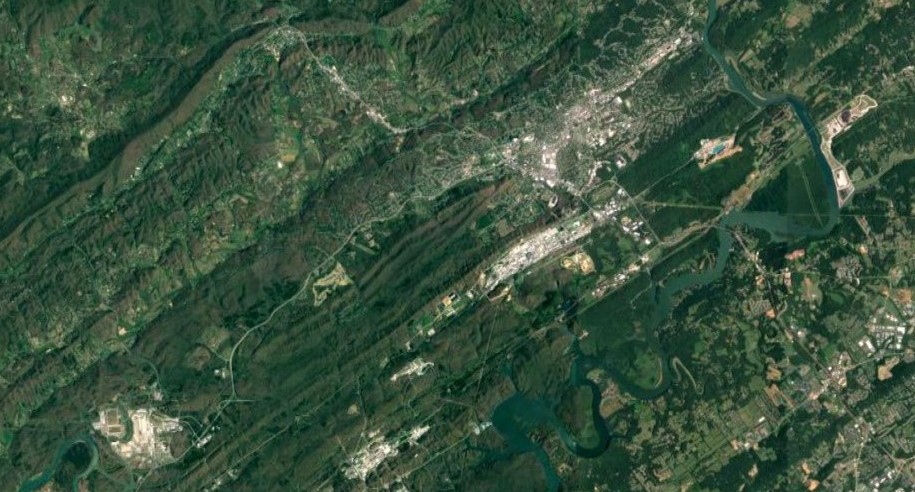
Aerial image of Oak Ridge, Tennessee (via Google Maps)
The decision had already been made that the atomic bomb would be manufactured in a rural stretch of eastern Tennessee. Designated “Site X,” it quickly became Oak Ridge, a city of 30,000 — designed and constructed under the strictest security. The architects of Chicago-based Skidmore, Owings & Merrill had to draft a master plan without knowing where it would be built. Oak Ridge’s curving roads, dotted with clusters of single-family homes, would become a template for the postwar suburban building boom.
The mobile home park concept was pioneered in the 1920s and 1930s, but the largest experiment with manufactured or prefabricated houses came in World War II. This 1945 aerial photograph was taken of a part of Oak Ridge, Tennessee, a community that not even existed in 1940. In the next few years as atomic workers poured into the area, more than 5,000 trailers supplemented 9,600 prefabricated houses and 16,000 barracks to provide temporary dwellings in this top-secret facility.
His Levittown wasn’t so very different from the utopian plan of Oak Ridge, Tennessee, designed during the way by the prestigious architectural firm of Skidmore, Owings, Merrill, a community itself modeled in part after the TVA communities of the Depression-era utopian Roosevelt planners.
One irony is that the development of the atomic bomb helped lead to existential fear in later suburbs even as the development process helped pave the way for more suburbia.
A connected thought: this is another way that World War II helped contribute to the subsequent decades of sprawling suburbs. In addition to Oak Ridge, World War II helped lead to new loans for returning veterans, pent-up demand for housing (add the war to the Great Depression and little had been built in roughly 16 years), the flowering of the American Dream as including a suburban home (already partly in place in the 1920s), and postwar prosperity with the United States emerging as a victor.
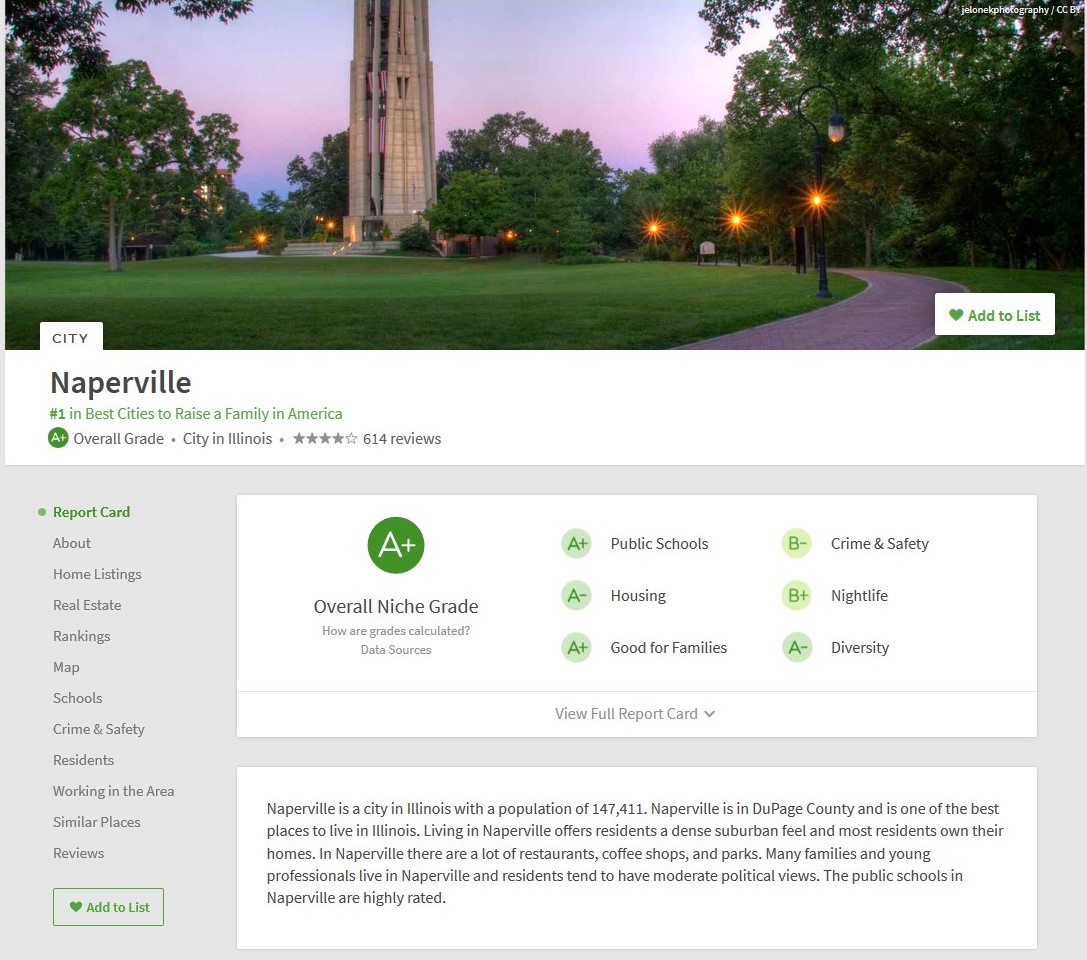
This is not an unusual plaudit for Naperville; a variety of publications have rated Naperville highly over the last two decades (previous posts here, here, and here). The community is wealthy, has a lot of amenities, and grew tremendously in the last few decades of the twentieth century.
Across rankings of communities, Naperville tends to do well. Whether it can maintain this reputation remains to be seen as city leaders and residents consider possible changes in future decades to a suburb that has little land remaining for single-family homes or low-density housing.