Involving public comment in a revision of the Manual for Uniform Traffic Control Devices

There is a federal government manual that guides decisions for transportation engineers regarding roads. While it is notable that it is going to be revised for the first time in eleven years, there is also a process for public comment:
Photo by Matheus Bertelli on Pexels.com

The Federal Highway Administration released a draft of proposed changes late last year. The last time the manual got an update, a few thousand people, mostly transportation professionals, submitted comments. This year, 26,000 comments poured in from all over the country.

Some arrived from big companies, including the ride-hail and mobility company Lyft, the Ford-owned scooter-share company Spin, and the Alphabet company Sidewalk Labs. Each asked for a major rewrite that would, as Sidewalk Labs put it, “more closely align with the equity, safety, and sustainability goals of American cities, as well as those of the Biden administration.”

Others came from individuals. “There’s a broader set of people who see that these streets don’t work, that there are too many people getting killed, that they’re too unpleasant. It’s not consistent with what a place or a community should be,” says Mike McGinn, a former mayor of Seattle and executive director of the group America Walks. He credits those everyday activists with the new interest in the design document—and his own group, which urged thousands of people to submit comments to the federal agency…

The last time the manual got an update, the process took more than a year; with the volume of comments this year, it may take longer. A spokesperson for the Federal Highway Administration says the agency “needs to carefully consider all comments before determining next steps and the timetable for updating the manual.” Given the interest, that might take a while.

One of the reasons Americans like local government is that it is easier to interact with the officials who are making the decisions. For example, in a small town to a moderately sized suburb, a resident who has feedback on a municipal decision can probably even convey this face-to-face or in a public meeting. As the size of the municipality grows, it becomes harder to meet with local officials.

At the federal level, some might feel that decisions are made by an abstract group of people in a place far away. This idea has been expressed regularly in recent years: Washington D.C. is out of touch with the rest of the country.

However, this process of public comment described above offers an opportunity for people around the United States to comment on federal guidelines for roads. In the age of the Internet and social media, this is even easier to do: people can hear about it through email or social media feeds and submit comments online.

How exactly the federal agencies in charge here work through all of these public comments would be interesting to examine. Assuming they are all read or analyzed, do they look for the most common themes? Or, are some comments weighted more than others? This sounds like an important qualitative research process in order to find the patterns in all of the comments, discuss, and then incorporate (or not) into a revised manual.

Los Angeles as a city state?

The idea of the global city and metropolis of today as a city state is not a new one. However, I was interested to see this discussion of how Los Angeles might really fit the bill:

Photo by Roberto Nickson on Pexels.com

Los Angeles fits the city-state frame well, certainly better than it does a lot of other possibilities—if we update the model a bit. In 2010, Forbes suggested that if the criteria for a place to be considered a city-state were modernized for the 21st century, certain global capitals might qualify thanks to a few key features: a big port to sustain trade; investors from overseas; money laundering; international museums worth visiting; multiple languages spoken in good restaurants serving alcohol; and an ambition to host the World Cup…

The city-state label rings true to me for hazier reasons as well. Los Angeles lacks the bedrock Americana that anchor towns like Chicago, New York, and Boston. In terms of identity, it doesn’t attach to the state of California the way that Houston and Dallas serve Texas. As for international ties, Miami has Latin America, Seattle has Canada and Asia, but Los Angeles, perhaps the city of globalism, has everybody. We’re Angelenos first, Californians second, Americans third or not at all.

“I absolutely think of Los Angeles as a city-state,” Mayor Eric Garcetti told me a few months ago. “The root of politics is the same as the root word in Greek for “city”: polis. People engage in politics because they came to a city and vice versa.” I wanted to point out that lots of citizens don’t engage with Greater L.A. in the way he described. If anything, civic life here often feels optional. Residents stay in the bounds of their neighborhood. Voters supported a $1.2 billion bond in 2016 to build supportive housing, but progress on the homeless problem is abysmal, stymied in part by NIMBYism. To borrow Garcetti’s measure, had life in the Greek city-states been as complacent, as mean, as L.A. often feels? “The man who took no interest in the affairs of state was not a man who minded his own business,” the ancient historian Thucydides wrote, “but a man who had no business being in Athens at all.”

My unspoken question for Garcetti was a nod to the fact that the city-state label can stretch only so far, at least until Los Angeles secedes from the United States. Angelenos may not always feel particularly American, but L.A. continues to receive policies and funding from Sacramento, which receives the nod—or not—from Washington. Our tap water flows from the Colorado River. A fifth of our power is from a coal plant in Utah. Los Angeles simply isn’t self-reliant. We have plenty of investment from abroad, but no local currency. The world’s largest jail system, but no independent military. Garcetti recently proposed a guaranteed-basic-income program that would be the country’s largest experiment of its kind—but that’s only even theoretically possible thanks to funding from President Joe Biden’s $1.9 trillion American Rescue Plan.

The main argument here seems to be that Los Angeles has the infrastructure, amenities, and identity needed to be a city state. On the other hand, the political fragmentation and reliance on other parts of the American federal system may be obstacles. However, I am not sure

  1. Political fragmentation comes through the sprawling and decentralized landscape. Who is in change? Whose opinions should hold sway? Going further, what is the relationship between the sprawling city and the sprawling suburbs? This would seem to be in tension with the identity as Angelenos. On which issues does the identity bring political unity and where do the fault lines emerge when fragmentation bests identity?
  2. A city state could make relationships with other entities. But, this might be a little different than having steady relationships within a system versus having to negotiate new relationships if Los Angeles became a city state. Take an example relevant to sprawling LA: could a city state of Los Angeles afford to fund all of the highways that right way get monies from the federal government? Or, would this then courage a LA city state to pursue more mass transit? Right now, the highways might be an amenity but
  3. If the mayor of Los Angeles operates now as if his city is a city state, what exactly does this mean? Is there an American city that is already more city state like and provides a model of how this might look in the future?

States that are losing Congressional seats did not necessarily lose population

With new Census data, the United States House of Representatives is going through reapportionment. Here is the breakdown of who is gaining and losing seats:

This could be an easy narrative to follow with the absolute number of seats: there are winners and losers and there are patterns to which states are winning or losing (Sun Belt and West versus Midwest and Northeast). This would fit with a prevalent American narrative that growth is good and states with growing populations are rewarded with more political representation.

But, there is a more complicated story behind these numbers. States did not necessarily lose population to lose a House seat. They might have just grown more slowly than other states. The overall growth rate for the United States over the decade was 7.4%:

At a Monday press conference, census officials said the U.S. population increased to nearly 331.5 million, a 7.4% growth rate over the past decade and the second-slowest pace since 1790. The growth rate dropped from the previous decade of 9.7% between 2000 and 2010.

More details from the Census:

The state that gained the most numerically since the 2010 Census was Texas (up 3,999,944 to 29,145,505).

The fastest-growing state since the 2010 Census was Utah (up 18.4% to 3,271,616).

For nearly 2 million more residents, Texas gets two more seats. Utah’s population was up over 18% but get no more seats. The apportioning of seats is based on relative populations between states:

The distribution must be rejiggered after every census to account for expansion or shrinkage of each state relative to the others. Even states that grow in population may still lose seats if their growth is less robust than that of other states.

The case of New York is illustrative. Yes, it is interesting that is was 89 seats short of holding on to that House seat but it is also interesting that the state’s population increased.

Census officials said that New York had a “negative net domestic migration,” but that its population grew overall because of immigration.

Population loss is a tricky topic in the United States. No city or state wants to admit that people are leaving or that population losses outweigh gains. Similarly, few would want to address a loss of political power. All of this adds to the competition for residents where more people is seen as a plus and population loss or not enough population growth compared to others is seen as failure.

Turnout for local Chicago area elections low again: under 20% in counties

Americans have regular opportunities to vote in local elections and Chicago area voters did not turn out in large numbers in this week’s election:

Photo by Polina Kovaleva on Pexels.com

At the county level, voter turnout mostly hovered in the low to midteens, typical for many counties in consolidated elections. On the lower end, McHenry County reported a voter turnout of 9.5%, and Kankakee County topped voter turnouts across the counties at 18.6%. The pandemic didn’t have a significant effect on voter turnout, according to county clerks’ offices, with sufficient alternative options for people to vote early or by mail instead of in person.

In Cook, DuPage and Lake counties, turnout was 14.7%, 15.6% and 13.7%, respectively.

In Will County, southwest of Chicago, 15.8% of voters cast a ballot Tuesday. That’s nearly 3 percentage points higher than the previous consolidated election in 2019, which had a voter turnout of 13.2%, said Charles Pelkie, chief of staff for the Will County clerk’s office…

Finding information on local candidates presents a challenge for voters, Pelkie said, confined mostly to mailed flyers and local radio or television ads. In general elections, Will County voter turnout can reach about 80%, Pelkie said, but local races don’t “inspire” voters in the same way as presidential or gubernatorial races.

I think this explanation is correct in that residents have to do a lot of work to find out about all the candidates and races. See my post on this yesterday.

But, there are other factors at work as well. As noted in the article, national races drive up turnout. I wonder if national politics has now completely overshadowed local and state politics through the last few presidential cycles. Americans often say they like local government but many eyes are now only turned to Washington.

Big issues in communities can drive up turnout. County level data can obscure higher levels of turnout for intriguing races. Yet, even interesting or important local issues might be drowned out by larger politics or the overwhelming number of choices.

A little thought experiment. Imagine a local government unit decided elections are no longer necessary or will not take place as frequently. They could cite the amount of money that is needed to run elections. Lots of energy is expended from both winning and losing candidates. I would guess there would be local protest; how can you have local government without regular elections? Would it prompt people to vote more often in local elections?

Or, could eliminating government bodies or consolidating such bodies in Illinois help? Reduce the number of candidates to choose from. Limit the number of taxing bodies that local funds go to. Focus some of the positions on broader issues rather than details of particular institutions. Again, this could be viewed as being anti-democratic but the current system does not seem to interest many voters.

The difficulty of keeping up with all the choices in local elections

I voted in the local elections held yesterday. I study suburbs and am aware of the fondness many Americans have for smaller and/or local governments. And I find it difficult to know who or what I am voting for in local elections.

In class yesterday, I started by talking about the importance of local elections. If residents care about their community, they can run for local offices or serve on volunteer committees. Without all of this important work that can require high levels of commitment for limited compensation, things would not get done. Because turnout can be low in local elections, candidates can be elected with relatively few votes.

Photo by cottonbro on Pexels.com

In certain elections, certain parts of the ballots stand out. Perhaps it is a development issue. Perhaps it is a referendum on a local tax increase to fund local schools. Perhaps it is a particular race, like a heated mayoral election or a pandemic facing members of the school board.

Beyond those more noteworthy circumstances, there are many choices. Forest Preserve commissioners. County Board members. Local judges. Township leaders. And so on. Sometimes, I know something that helps me make a choice. I read local news that helpfully presents local candidates. I watch some local forums where candidates talk. I am aware of some of the local concerns. I may know someone or know of someone. But, I cannot keep track of everything. Hence, the popularity of just voting a slate or a party for particular positions. Or, a set of endorsements from local media. This is all on top of what might be happening at the state of federal level.

This problem might be exacerbated by the number of units of local government Illinois has. However, I suspect this is a larger issue among Americans. Having many choices for many offices may help lead to lower turnout. Only some people have the motivation and wherewithal to find all of the information needed on local issues and candidates. People are disconnected from local groups and institutions through which they might hear about candidates and issues.

Americans like the idea of local elections but it is hard to keep up with all of the local government activity.

Searching for the perfect name for a slate of candidates in local elections

Keeping in mind regulations, non-partisan traditions, and what might appeal to voters, candidates running for local elections in the Chicago area come up with some clever names for their slate:

Photo by Element5 Digital on Pexels.com

A court ruled in 2017 that candidates in Illinois don’t need to be part of a slate to run under the banner of a political party. So Dubiel decided to create a party of which he would be the only member — LZ Thrive…

When the calendar turns to the spring municipal elections, political passions are no longer contained to Republicans and Democrats. In suburb after suburb, you’ll find parties with monikers like People Before Politics, We’re in This Together, You Are the Village’s Heart, the Common Sense Again Party, the United Party for Progress or, most expansive of all, the Party of the Past, Present and Future…

One way to avoid such complications is to change the party’s name for every election, thereby making it a brand-new entity that can control its slate. That has been a routine practice in Bolingbrook, which for more than three decades was run by former Mayor Roger Claar under a variety of party names…

Those included Citizens for Bolingbrook First, the Bolingbrook First Party, Bolingbrook First and, in its most recent iteration following Claar’s 2020 retirement, the First Party for Bolingbrook.

I imagine there is an art to this. What exactly can capture a particular local spirit? Many of the names quoted above emphasize a bright future or emphasize a collective community spirit. There is a sense of optimism or forward momentum. (There could be the occasional anti-growth or preserve the community slate names in there as well – just not quoted above.)

If many of these are in the suburbs, other names might fit with the broad themes of suburbia: Making the Best Suburb for Your Children! Boosting Your Property Values! Keeping Certain Land Uses (and People) Out! Maintaining Our Lead Over Other Nearby Suburbs! And so on.

What if this was possible at the national level? What could Democrats and Republicans come up with every two and/or four years to really emphasize their particular focus in that election? Since each party does reconfigure their platform each election to fit current priorities, perhaps this would make some sense. It could also help eliminate the confusion over long-term shifts where one party used to support something but now it is the other party that pushes it.

Residential segregation – by political party

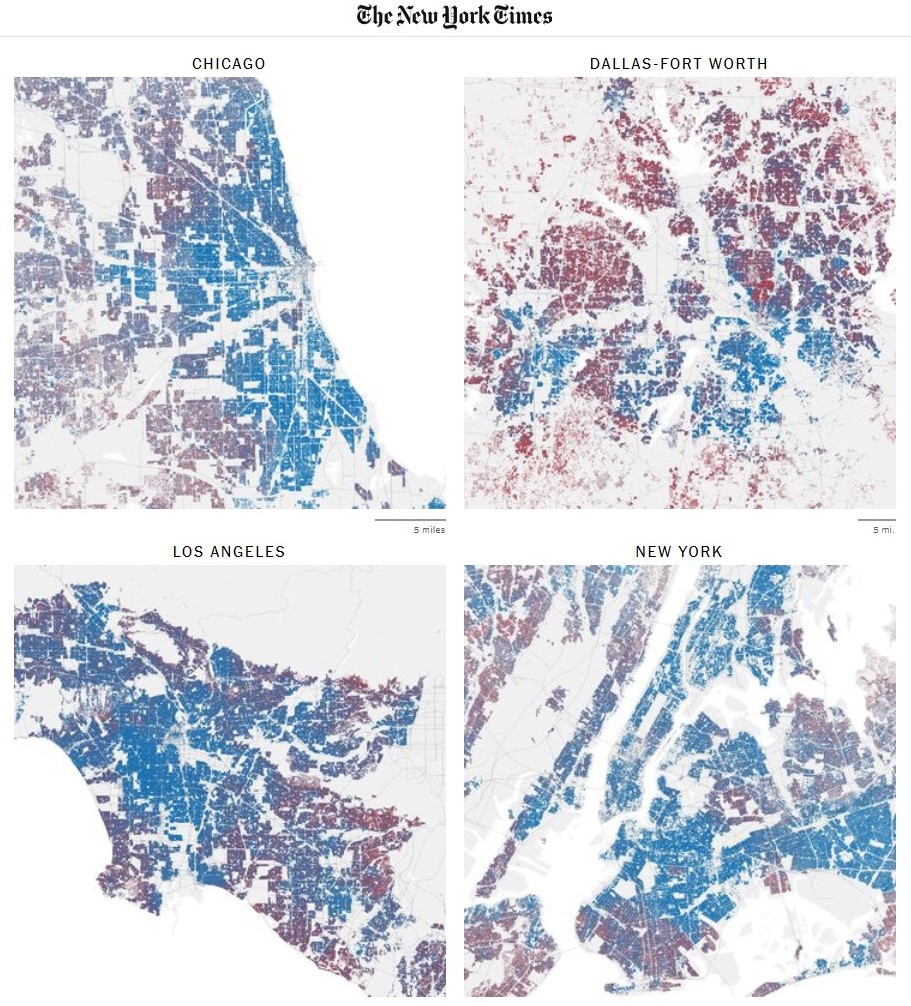
Residential segregation by race is a large issue and voting patterns in recent elections generally show Democrats winning in cities and close suburbs and Republicans winning in outer suburbs and rural areas. Put these two ideas together and you have residential segregation by political party.

https://www.nytimes.com/interactive/2021/03/17/upshot/partisan-segregation-maps.html

As new research has found, it’s not just that many voters live in neighborhoods with few members of the opposite party; it’s that nearly all American voters live in communities where they are less likely to encounter people with opposing politics than we’d expect. That means, for example, that in a neighborhood where Democrats make up 60 percent of the voters, only 50 percent of a Republican’s nearest neighbors might be Democrats.

Democrats and Republicans are effectively segregated from each other, to varying degrees by place, according to the Harvard researchers Jacob Brown and Ryan Enos. And at least over the past decade, they believe this partisan segregation has been growing more pronounced…

For each individual voter, tied to an address, the researchers looked at their thousand nearest voters, weighting those next door more heavily than those a mile away. Drawn this way, about 25 million voters — urban Democrats especially — live in residential circles where at most only one in 10 encounters is likely to be with someone from the opposite party. Democrats in parts of Columbus, Ohio, and Oklahoma City live this way. So do Republicans in the reddest parts of Birmingham, Ala., and Gillette, Wyo…

These studies together suggest that as places become more politically homogeneous, people there are more likely to conform and to publicly signal their partisanship. Maybe no one says, “I want to move here because of all these Biden yard signs.” But perhaps one neighbor is swayed by the people who put them up, and another neighbor concludes, “This isn’t the place for me.”

Lots of confounding variables to examine across a lot of locales. But, the underlying patterns are fascinating to consider: do geographic communities, even in an era of reduced neighborly contact and participation in local institutions, influence people’s political belief and behavior? With more focus in recent years on how online and social media behavior influences politics, this connection to geography has the opportunity to reinvigorate conversation about the power of local communities.

I would be interested to see how this plays out among local governments of communities with similar traits. Take a suburb closer to a big city that leans Democrat and a suburb further out that leans Republicans. Are the local decisions made that different? Do local elections look different?

Or, how often are there tipping points across communities and neighborhoods where a majority of voters are of one party or another? The patterns now show some stability but these have changed in the past and could change again in the future. What happens when they do change and does the character of the community change?

Abolish townships or worry about turning them blue (or keeping them red)?

Illinois has many taxing bodies and government units. Illinois moved to stop creating new government bodies and DuPage County resolved several years ago to work to reduce the number of government bodies. Townships are a common target; they exist above municipal governments and below counties so are they necessary?

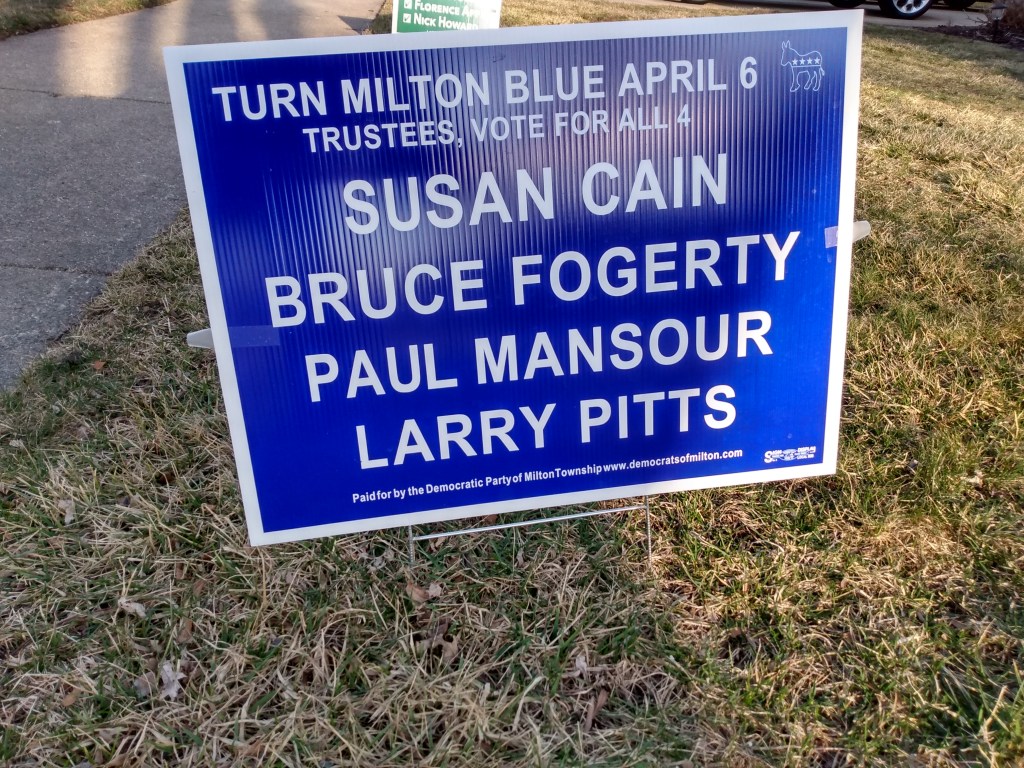
I thought of this recently with the lead-up to the upcoming local elections. On one side, I have seen signs urging voters to “Turn Milton Blue.”

This might be a strategy to boost local turnout and connect to broader political patterns. But, I do not know what these candidates want to do at the township level. What significant changes are needed?

On the other hand, I have seen campaign material for Republican candidates for Milton Township. This material listed all the things that the township does, presumably because of the Republicans there. For a party that at least talks sometimes about limited government, should they argue townships are unnecessary rather than fighting for political seats?

More broadly, how much do these township races benefit the people and communities of Illinois? In a time of budget deficits before COVID-19 plus further issues because of COVID-19, is it more important that one party or another holds the majority of seats in townships?

Functional religion in the form of American politics

I have seen some version of this argument several times recently. Here it is in The Atlantic: Americans have replaced religion and its associated features with politics.

Photo by Luis Quintero on Pexels.com

But if secularists hoped that declining religiosity would make for more rational politics, drained of faith’s inflaming passions, they are likely disappointed. As Christianity’s hold, in particular, has weakened, ideological intensity and fragmentation have risen. American faith, it turns out, is as fervent as ever; it’s just that what was once religious belief has now been channeled into political belief. Political debates over what America is supposed to mean have taken on the character of theological disputations. This is what religion without religion looks like.

Not so long ago, I could comfort American audiences with a contrast: Whereas in the Middle East, politics is war by other means—and sometimes is literal war—politics in America was less existentially fraught. During the Arab Spring, in countries like Egypt and Tunisia, debates weren’t about health care or taxes—they were, with sometimes frightening intensity, about foundational questions: What does it mean to be a nation? What is the purpose of the state? What is the role of religion in public life? American politics in the Obama years had its moments of ferment—the Tea Party and tan suits—but was still relatively boring.

We didn’t realize how lucky we were. Since the end of the Obama era, debates over what it means to be American have become suffused with a fervor that would be unimaginable in debates over, say, Belgian-ness or the “meaning” of Sweden. It’s rare to hear someone accused of being un-Swedish or un-British—but un-American is a common slur, slung by both left and right against the other. Being called un-American is like being called “un-Christian” or “un-Islamic,” a charge akin to heresy.

This is because America itself is “almost a religion,” as the Catholic philosopher Michael Novak once put it, particularly for immigrants who come to their new identity with the zeal of the converted. The American civic religion has its own founding myth, its prophets and processions, as well as its scripture—the Declaration of Independence, the Constitution, and The Federalist Papers. In his famous “I Have a Dream” speech, Martin Luther King Jr. wished that “one day this nation will rise up and live out the true meaning of its creed.” The very idea that a nation might have a creed—a word associated primarily with religion—illustrates the uniqueness of American identity as well as its predicament.

The particular form of religious activity and civil religion in the United States is unique. But, more broadly, this discussion gets at what religion is. Is it about belief in a transcendent being or a supernatural realm? Or, is it more about what religion does in terms of particular practices?

Such discussions remind me of the work of sociologist Emile Durkheim. In his work, religion serves a cohesive function in society. Here is an earlier post about how functional religion could explain devotion to Apple:

The argument is one that can be applied to many things that take on the functions of religion such as providing meaning (Apple vs. other corporations, beauty vs. functionality), participating in common rituals (buying new products), and uniting people around common symbols (talking with other Mac users).

Politics can do some of these same things. Politics provides meaning in particular beliefs, policy positions, activities, and group identities. Politics has its own set of common rituals and ceremonies, which could even extend to today’s patterns of reacting to political news via Twitter and other forms of social media. There are common symbols ranging from particular visual images to personas to slogans. Political camps can have their own sacred narratives about how the world works.

Durkheim also had ideas about religion giving way to other forms of cohesion. For example, an expanding division of labor would increase interdependence on each other. Science could help address particular issues that used to be addressed by religion. Is politics – particularly in the form right now in the United States that is marked by polarization – an advancement and a move away from religion?

Will turnout increase for upcoming local elections?

Election season is near in our area. Local elections often have really low turnoutsuburban municipal officials can be elected by just a small fraction of the population. But, perhaps this year will be different for a few reasons:

Photo by Element5 Digital on Pexels.com
  1. Local battles over COVID-19. With disagreement with and mistrust of national responses, local elections offer an opportunity to weight in on local responses. In particular, decisions about school reopenings are hot issues in elections for school boards. Add in debates about local businesses and eateries and voters might want to weigh in.
  2. Carryover from national elections and political polarization. Traditionally, local elections are non-partisan. Yet, the rancor at the higher levels could carry over. For example, I saw a large sign today looking to turn township positions blue. How much local officials might actually be able to do in regards to these debates is likely limited but it could help some voters and officials feel better.
  3. The activism of Black Lives Matter in suburbs plus responses to it could send more voters to the polls. How should communities address inequalities or disparities?
  4. Concern about municipal budgets. COVID-19 has created new problems and a number of communities already faced issues. How should money be spent and what could be done to bring in more revenue? The competition might just be heating up among suburbs to find government and tax revenues.

In other words, these are not typical local elections during good times. The local election turnout malaise might not be there. Since suburbanites tend to like local government, will they turn out this time when there are multiple pressing issues?