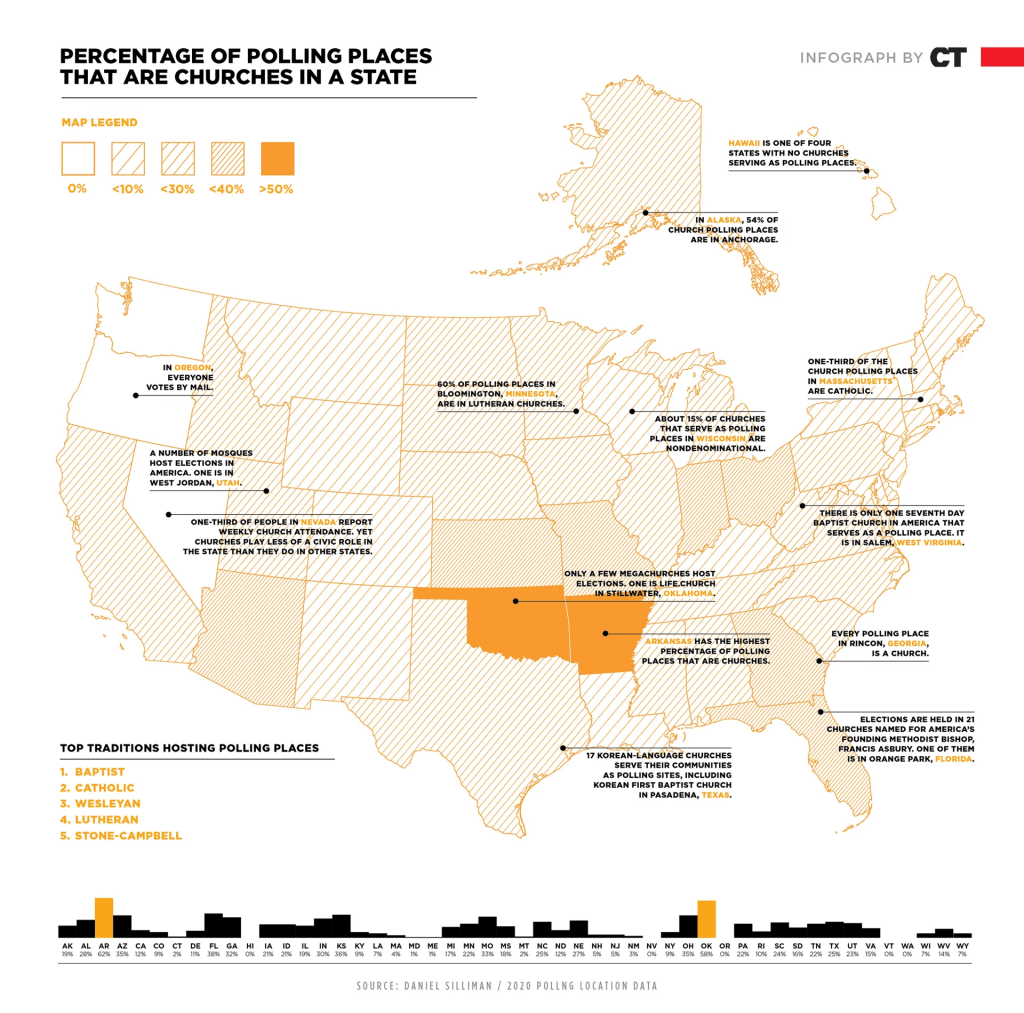
If I am reading this correctly, here are two patterns:
The percent of polling places that are churches can differ quite a bit from state to state. Generally, some of the Northwest and Northeast are less likely to have churches as polling place. The highest percentages are in more “heartland” states with some interesting exceptions (Arizona, Florida).
Which religious groups host the most polling places can differ as well. It would be interesting to see more fine-grained data/ do these patterns of particular traditions hold up across states or is it because certain states have higher concentrations of certain traditions?
I imagine there might be all sorts of additional factors to consider when examining this.
Given the current political sentiments regarding the role or involvement of religious groups in politics, do these figures go up or down significantly in the coming years? And among which groups and locations?
No matter where you venture along the northern fringe of metro Los Angeles, whether it’s the bustling suburbs of the Democratic-leaning San Fernando Valley or the more conservative towns that nestle in the russet-hued canyons to the north and east, you’ll find people who say they have good reason to sing the blues for their country.
They’re feeling weighed down by the onslaught of inflation, cultural conflicts and assaults on the electoral process. They fear that Americans — left, right and center — have given up trying to understand or sympathize with one another.
And they hold elected officials and political candidates responsible for sowing distrust among Americans and eroding faith in democratic institutions.
Who exactly will these suburbanites vote for at the national and local levels or will they choose not to vote? One poll suggests some change among white suburban women:
The GOP has seen a shift in its favor among several voter groups, including Latino voters and women, and particularly white suburban women. That group, which the pollsters said makes up 20% of the electorate, shifted 26 percentage points away from Democrats since the Journal’s August poll and now favors the GOP by 15 percentage points.
As in previous elections, suburbanites might sway the outcomes. Both parties have aimed their messages, at least in part, toward suburban voters who are both a sizable percentage of the electorate and where more voters might be open to shifting their votes.
WLIT-FM 93.9 will play only Christmas music round-the-clock beginning at 4 p.m. Tuesday.
It is the earliest date in the station’s 22 years of hosting the format that it is making the switch.
Why? Listeners love it…
“The reason stations switch in early November is so they can get a ratings boost for the final few weeks of the survey,” he wrote in an email.
Which comes first: the audience demand for the Christmas music or the supply of Christmas music? Would anyone play Christmas music this early if there was not such a direct payoff?
Such a question could be asked in all sorts of domains, ranging from other Christmas material – do stores put Christmas decorations and displays up right after Halloween to drive demand or is that demand already there? – to products of the culture industries. If such a question could be answered more predictably, there might be more hits – records, films, TV shows, etc. – and fewer flops.
In the meantime, Chicago radio listeners will later today have the option to hear Christmas music all the time. Even in an age of music streamable on demand plus all sorts of other music formats, at least a few will turn to WLIT because predictable Christmas music is available.
I have no intention of ever driving on Interstate 35W (also known as one of the worst death-trap highways in the state) to go grocery shopping.
In the future, I hope the company might consider North Main in the new Panther Island complex, the Hemphill corridor, Berry Street, Eighth Ave, South Main, Rosedale Street, University Drive or even Lancaster Avenue, to jump start that area.
I talked with a few of my friends, and they have told me, no way are they driving to the far north to buy some taters.
How exactly do companies decide where to locate their stores? Generally, I imagine locating near a major highway is a good thing. That road can help bring customers and suppliers to and from the location. The new location is right near an existing Kroger (as well as other big box stores). The highway might enable more access than if located in a neighborhood with smaller nearby roads.
At the same time, there might be other areas that also would like to have a grocery store. How about in a denser or walkable neighborhood? Bunching a lot of retail options near the highway might not be terribly accessible for some.
The second matter involves which community the new store is in. The official address is in Fort Worth. However, it is quite a ways north of the center of the city. It is a block or so away from the Alliance Town Center mall. This might technically be Fort Worth but it is a sprawling location. (There is also the matter of the planned community of Alliance which includes part of multiple municipalities.)
This hints at the sprawling nature of some cities in the United States, particularly in the Sunbelt. Fort Worth is surrounded by suburban neighborhoods and roadways. Just a short drive from this store location and one is in another municipality as the city sprawls northward.
Let us see how the potential grocery shoppers respond to this new store. This is a sizable investment for a company and I am guessing they imagine a good probability of success.
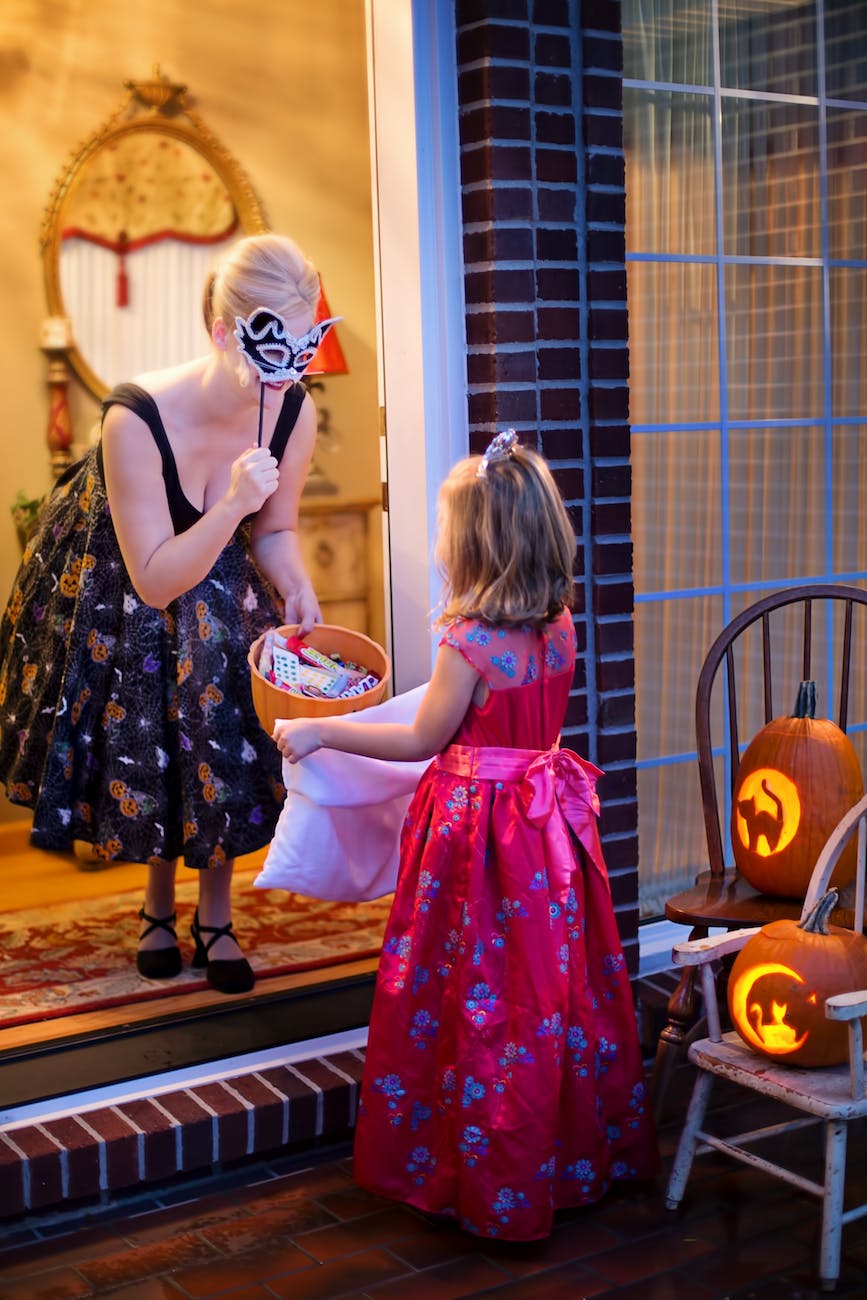
Certain neighborhoods just do Halloween better, drawing folks from ho-hum suburbs because the McMansion community three hidden-oaks-fox-glens over is the place to be.
In this consideration of social class and who is welcome to trick-or-treat in which neighborhoods, this might just be a throwaway example. Perhaps McMansions just quickly refers to homeowners with means.
But, it does raise a possible question: is Halloween celebrated in particular and better ways among McMansion owners? How would this be measured: more enthusiasm for the holiday? More and bigger decorations? Specific candy handed out? Lots of children on relatively quiet streets on Halloween?
I am guessing there are at least plenty of folk theories out there on what neighborhoods – in the abstract and specific locations within communities – are best at Halloween. I am not sure McMansion-lands would necessarily come out on top but they have some qualities that suggest they could be in the running.
By the Nielsen company’s count, 7.8 million people watched Amazon Prime’s coverage of last Thursday’s NFL game between New Orleans and Arizona. But Amazon says no, there were actually 8.9 million people watching…
Neither company is saying the other is wrong, but neither is backing down, either. The result is confusion, most notably for advertisers.
Nielsen, as it has for years, follows the viewing habits in a panel of homes across the country and, from that limited sample, derives an estimate of how many people watch a particular program. That number is currency in the media industry, meaning it is used to determine advertising rates.
Amazon, in the first year of an 11-year contract to stream Thursday night games, says it has an actual count of every one of its subscribers who streams it — not an estimate. The games are also televised in the local markets of the participating teams, about 9% of its total viewership each week, and Amazon uses Nielsen’s estimate for that portion of the total…
But with Netflix about to introduce advertising, that can all change very rapidly. And if other companies develop technology that can measure viewing more precisely, the precedent has now been set for publicly disputing Nielsen’s numbers.
There could be multiple methodological issues at play here. One involves who has a more accurate count. If Amazon can directly count all viewers, that could be the more accurate number. However, not all television providers have that ability. A second concern is how different providers might count viewership. Does Amazon reveal everything about its methods? Nielsen is an independent organization that theoretically has less self-interest in its work.
All of this has implications for advertisers, as noted above, but it also gets at understandings of how many people today view or consume particular cultural products. Much has been said about the fragmentation of culture industries with people having the ability to find all sorts of works. Accurate numbers help us make sense of the media landscape and uncover patterns. Would competing numbers or methods lead to very different narratives about our collective consumption and experiences?
These “heavy tweeters” account for less than 10% of monthly overall users but generate 90% of all tweets and half of global revenue. Heavy tweeters have been in “absolute decline” since the pandemic began, a Twitter researcher wrote in an internal document titled “Where did the Tweeters Go?”
A “heavy tweeter” is defined as someone who logs in to Twitter six or seven days a week and tweets about three to four times a week, the document said.
This echoes earlier analyses of power users on social media. Many members of social media platforms contribute relatively little while a small number do a lot.
I would be interested to hear more about social media platforms or online sites that are able to encourage broader participation. Is there a way to build broad-based online communities with more equitable contributions and influence?
I also wonder how much this matches offline communities that can also be marked by a small set of participants doing a lot. Is the online realm simply mirroring offline patterns or are there new dynamics here that are important?
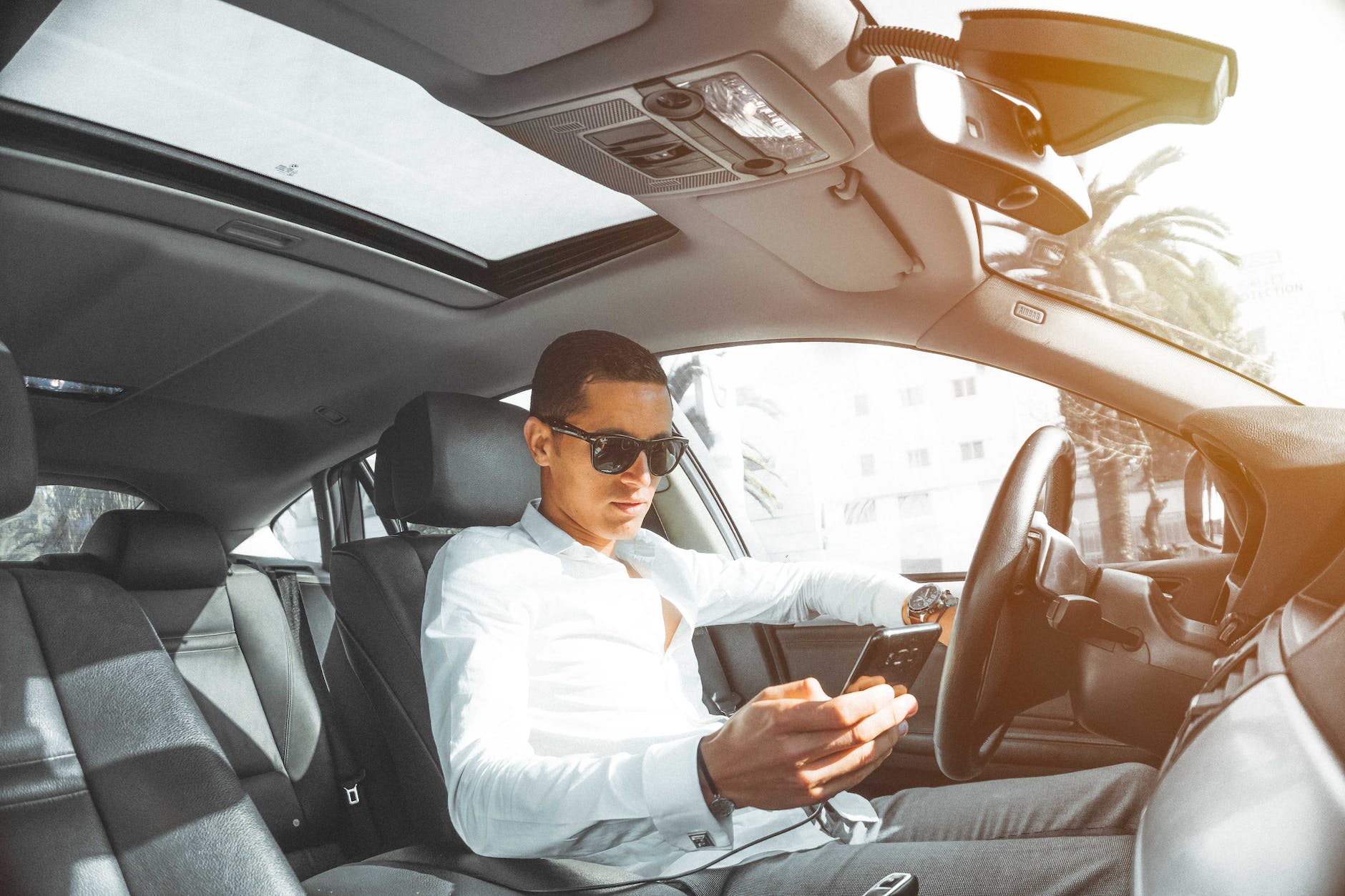
How often do you pull near another vehicle and take a quick look over? These days, you will often see a driver looking at their phone. Recognizing phone use while driving is relatively easy to spot: the driver’s head is tilted down, not looking at the road. There is a particular posture, as illustrated in the photo below:
This can occur while accelerating in leaving an intersection or driving at high speed down the highway. Many drivers appear unable to keep their eyes off their phone while their vehicle is in motion.
Perhaps this is just a sign of our era? Americans love driving and love smartphones. Even as deaths while driving increase, phone use continues. The acknowledgment of a public problem with phone use while driving from years ago seems to have faded away a bit.
From a driving norms perspective, is there a polite way to signal to another driver that you can see their phone use and request they pay attention to their safety and your safety?
From a social perspective, is the smartphone the new car in that we are willing to reorganize society around using smartphone use rather than fitting smartphones into our existing social order?
Palatine Township Elementary District 15 Superintendent Laurie Heinz said that if the special taxing mechanism is implemented — where property taxes above a certain level would be diverted away from schools, as well as other taxing bodies, and into the Bears’ proposed mixed-use project — the district would need financial assistance to add classroom space to schools in nearby Rolling Meadows, or potentially even build a new school within the 326-acre site…
The Bears’ preliminary site plan suggests a significant residential component, from higher-density, multifamily properties of four to eight stories closer to the Metra train station, to lower-density townhouses and multifamily units of two to four stories further south and east through the site.
Heinz said the housing could generate hundreds or even thousands of students.
“We want a seat at the table,” Heinz said at a recent community meeting. “We’re going to fight against it all being TIF’ed because we will need money.
The superintendent is saying that the school district will need money to serve the influx of students that would come through new residential units. Other school districts, residents, or leaders have gone further when considering other suburban projects: they do not necessarily want school students to live in new residential units. Fewer school-age children would save money for school districts and communities in the long run due to not having to provide educational services.
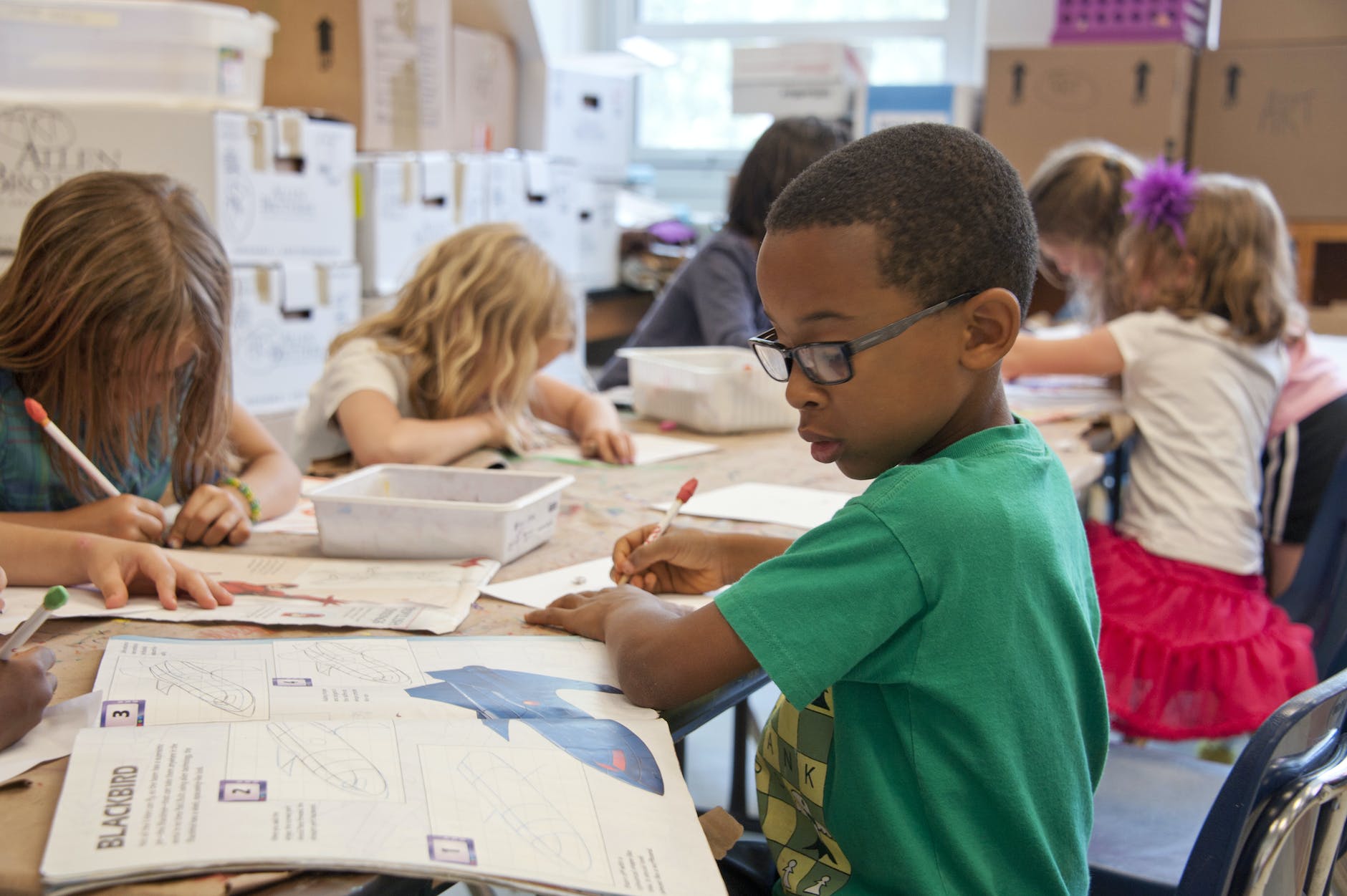
In some ways, this is an odd stance for suburban leaders and residents to take. Much of the suburban sprawl in the United States involved providing spaces and success for children. Property values and a sense of community status are often tied to the performance of local school districts.
But, this focus on children comes with costs. Particularly for mature suburbs, they can struggle to fund schools or residents and leaders push back against the costs of schooling compared to other preferred priorities (such as taxes not going up).
For this particular project, who will adjust: the city not provide a TIF? The developer change the residential units in ways that appeal to certain kinds of residents and not others? The school district finding ways to fit this into particular confines? Stay tuned.
Robert I. Toll, L’66, a former University Trustee, an emeritus member of the Carey Law School Board of Advisors, and the co-founder of transformative home construction company Toll Brothers, died on October 7 at home in Manhattan. He was 81.
Mr. Toll was born in Philadelphia suburb Elkins Park, Pennsylvania, to a father who was involved in Philadelphia real estate and who had successfully rebuilt his career after the Great Depression. Mr. Toll graduated from Cornell University in 1963 with a bachelor’s degree in political science, then graduated from Penn’s Law School three years later. He briefly worked at the Philadelphia law firm Wolf, Block, Schorr, and Solis-Cohen, but then founded Toll Brothers with his younger brother Bruce in 1967. To start out, “we built two homes,” Mr. Toll recalled. “Instead of selling them, we used them as samples for the lots we owned down the street.” These sample homes landed the brothers contracts to build 20 more homes, which each sold for $17,500. Robert, Bruce, and Alan Toll were among the first postwar housing developers to recognize how trends in highway construction would allow access to swaths of farmland for housing and shopping developments.
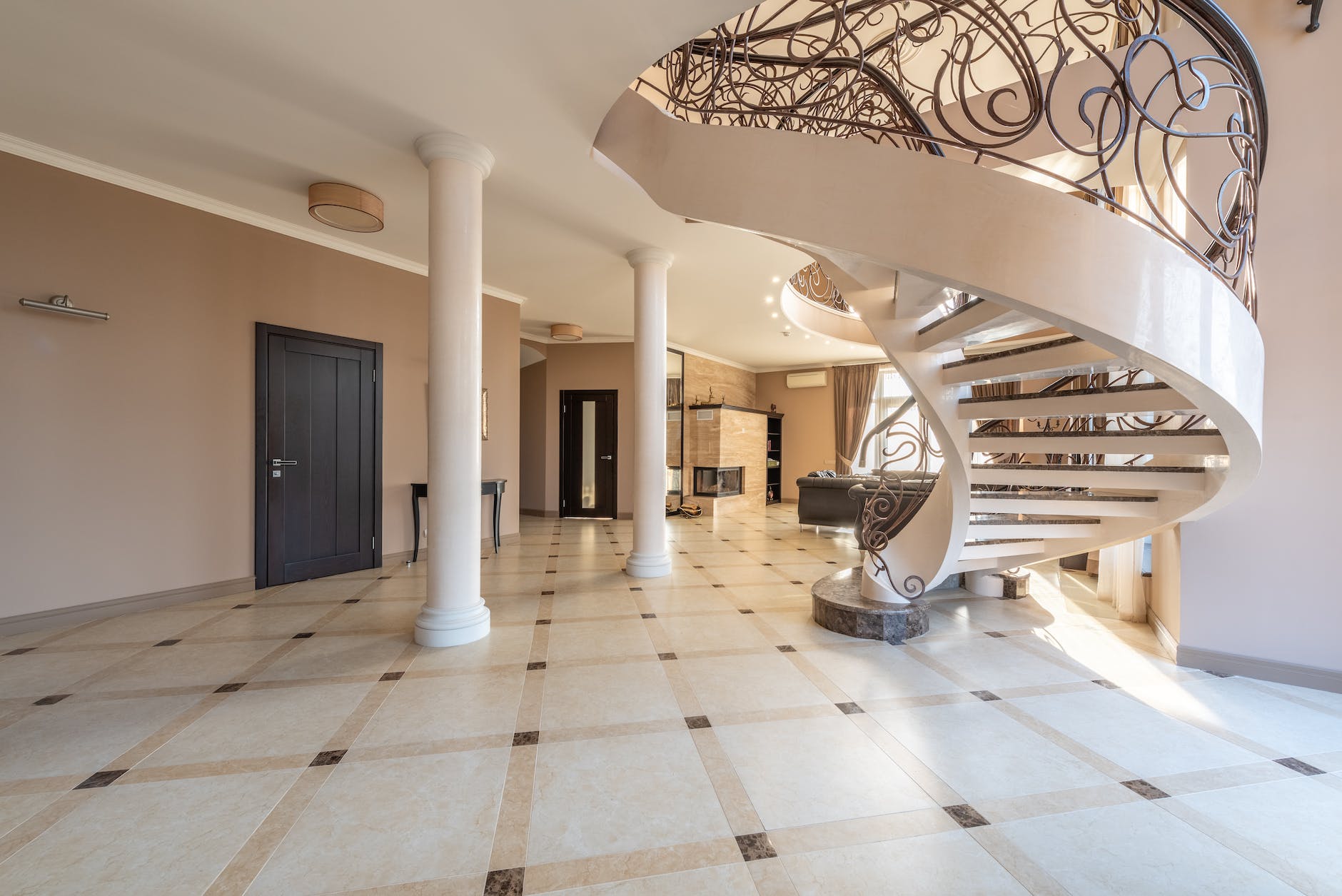
Over the next five decades, under Robert Toll’s leadership of the company as chair and CEO, Toll Brothers rapidly grew to become, as the company’s slogan boasts today, “America’s luxury home builder.” The company recognized shifting demographics in the U.S. during the 1970s and targeted baby boomers looking to trade upward. The Toll Brothers blueprint included targeted land purchases, appeals for quick zoning approval, and predesigned houses that allow room for personalized changes by buyers. Boosted by the proliferation of McMansions and the implementation by zoning boards of two-acre lot sizes in many American suburbs, Toll Brothers became a force in the American housing market. Today, over 150,000 American families in 24 states live in a Toll Brothers-built home. Toll Brothers appeared on the Fortune 500 list, and Robert Toll spearheaded several philanthropic initiatives, including Seeds of Peace, a summer camp in Maine for children from global conflict. His many professional honors included recognition as one of the world’s top 30 CEOs by Barron’s magazine in 2005 and as best CEO in the Homebuilders and Building Products Industry by Institutional Investor magazine in 2008 and 2009. The Wall Street Journal once called Mr. Toll “the best CEO in the housing business.”
Did Toll Brothers take advantage of an opportunity to sell luxury homes to a growing market or help create and establish a growing market? Would they call their luxury homes McMansions or is that a term applied by others?
No matter how these questions are answered, it is clear Toll Brothers contributed to the trend of larger and more expensive homes in the United States. Over 150,000 homes is a sizable number of dwellings. The shift to large-scale builders in the mid-twentieth century is an important factor in suburbanization and housing more broadly.
Additionally, what will happen to all of these luxury homes? Will they be updated and renovated for decades? I assume a good number are situated in neighborhoods and communities where they will not be near any cheaper or denser housing. Will some become teardowns? Will at least a few be preserved? There is still more of the Toll Brothers story to tell.





 Legally Sociable