More on the McMansions on Modern Family

Following up on yesterday’s post, here are some more details on the main residences featured on Modern Family and which one I think qualifies as the most McMansion-y. (This post draws on “Stalking from Los Angeles: Houses from Modern Family” – denoted as SfLA below, House Beautiful – denoted as HB below, and the Modern Family Wiki – denoted as Wiki below.)

  • Phil and Claire Dunphy’s house.

“Phil is the only one working in the Dunphy family and as a realtor he’s doing very well. The Dunphy house is worth almost $1.8 million, according to Zillow.com.” (SfLA)

“Phil and Claire’s house is a little more traditional, almost as if it’s ripped directly from an early 2000’s catalog. And that was exactly the goal: The space is supposed to be very comfortable and lived in, with a vibe that’s “Pottery Barn meets Restoration Hardware,” production designer Richard Berg told Architectural Digest back in 2012.” (HB)

“It is a detached, suburban home with two living rooms, kitchen/dining room, 2 bathrooms, 4 bedrooms, and a garage. Outside it has both a front and back garden with a trampoline.” (Wiki)

  • Jay and Gloria Pritchett’s house.

“According to Zillow.com Gloria and Jay’s house in Brentwood is currently worth more than $8 million. This 6,359 square foot (590 square meters) single family home has 5 bedrooms, 6 bathrooms and a pool.” (SfLA)

“Fun fact: That exterior is an actual, two-story house in Los Angeles’s Brentwood neighborhood, though most of the filming is done on a soundstage. The Modern Family production team had built “80 percent” of the set before finding the perfect house to serve as its exterior, so they had to go back and change its windows and layout to match, Berg said.” (HB)

“It seems to be the largest and grandest house of the three families, as Jay earns a lot of money from his job. Contains 2 floors, a living room, 1 kitchen, 3 bedrooms, 1 bathroom, and a garage…Outside there’s a front garden and a huge pool that is first seen in “The Incident“, and is frequently seen ever since…The real house is located in Brentwood, 15 minutes away from the house used for Mitch and Cam. There is a whole extra wing of the house that is not show in the shots of the house for the show.” (Wiki)

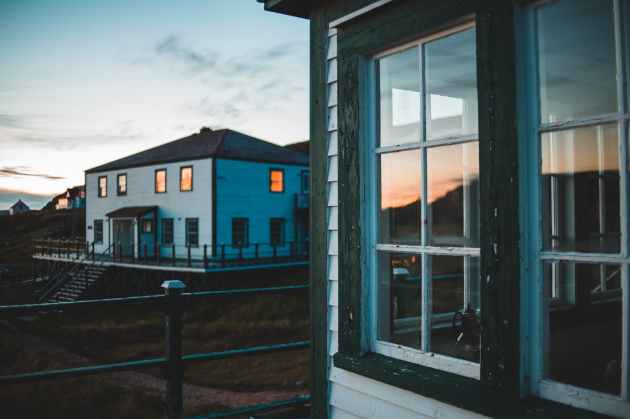
  • Mitch Prichett and Cam Tucker’s house.

“Cameron’s and Mitchell’s house is very near to the Dunphys (well, for L.A., of course). Their house has 4 bedrooms and 2 bathrooms. Its worth: $1.3 million (source: Zillow.com).” (SfLA)

“Mitchell and Cameron’s apartment, with its villa style and ivy snaking up the walls, definitely caught people’s attention. It’s a little more romantic, and even though their home would mean settling for less square footage (they live in the ground-floor apartment of the two-story, technically), their interiors tend to be a little more upscale and collected over time. “We saw the couple as being new to the parenthood plateau and fresh off the plane from years of travel and singledom,” Berg told the magazine.” (HB)

“Unlike The Dunphy House or The Pritchett House, it only has one floor, the upstairs is open for rental, revealed in Slow Down Your Neighbors. Their floor contains a living room, 1 kitchen, 1 bathroom, 2 bedrooms, and a garage. It is revealed in “Mistery Date“, that Lily’s bedroom was previously Mitchell’s home office, but they had to give it up for her room. Outside it has both a front and back garden..” (Wiki)

In summary:

The homes are all large and expensive, located near each other west of downtown Los Angeles, are meant to reflect the characters that live there, and have recognizable exteriors that are then recreated on sets where the interior scenes are shot.

Tomorrow, I will compare how the features of each home match up traits of McMansions. In other words, which Modern Family dwelling is the most McMansion-y?

Modern Family a successful TV show for taking place in McMansions

McMansions do not have a positive reputation yet they can serve as the primary setting for popular television shows. For example, Modern Family had a successful run and featured three large homes:

The path of the mockumentary series arcs from a trailer park in Nova Scotia to a McMansion in Los Angeles. In 2001, the Canadian cult comedy Trailer Park Boys inaugurated a soon-to-be-ubiquitous style of show: deliberately messy, handheld camera work paired with confessional interviews and presenting scripted fiction in the style of candid reportage. In 2020, the ABC megahit Modern Family wound down after 11 seasons and 22 increasingly aggravating Emmy wins. Between those two events lies the rise and fall of a genre that was not reality TV, but came up alongside it and echoed its conventions.

Since the rest of the article is more about mockumentaries as a genre than about the residences of main characters in such shows, I will go on the McMansion tangent regarding Modern Family. Here is what is unique about the McMansions on the show:

1. The McMansions are not objects of derision or mockery. The genre may lend itself to this but Modern Family sought to end episodes and story lines with feel-good family togetherness. The characters were portrayed as goofy or quirky suburbanites who otherwise lived normal lives. The McMansion is the center of family life and good things result for the family that lives there. (Compare this to many recent portrayals of troubled families that live in McMansions – see examples here and here. Or, consider the McMansion on The Sopranos.)

2. The homes are all clearly large and their architecture is unique in different ways: Cam and Mitchell’s home has a turret (and supposedly has an upstairs apartment), Jay and Gloria’s home is more modernist, and Phil and Claire’s home tried for a traditional look. In other words, the show displays the variety of McMansions.

3. These are not just large homes; they are expensive homes in an expensive housing market. The Dunphy home went on the market several ago with a price tag over $2 million. The homes are portrayed as normal yet the houses are not within the reach of many viewers.

4. There is little doubt that Modern Family was successful: 11 seasons? 22 Emmys? A long life in syndication? And it happened even with the consistent presence of McMansions, homes critics would say symbolize all sorts of large American problems. Did the show work in spite of the homes? Was it all just one big wink and nod about the characters and their homes?

Open offices might be pushed out by COVID-19

Open offices have provoked a lot of reactions. One CEO thinks COVID-19 might help them meet their demise:

Carol Bartz, who led the architectural and engineering software maker Autodesk Inc. for a decade before heading up Yahoo Inc. during a turbulent period that began with the last recession, is known for being direct and speaking her mind. In a recent telephone interview with MarketWatch from her home in Silicon Valley, Bartz described the current age of COVID-19 as a “new game,” with “new rules” for everyone, and made a few predictions about how she expects life to change, especially at work.

“I think office space is going to change, [and] we will go back to putting shields between people,” she said, adding that, while she realizes this in the grand scheme amounts to minutiae, this is one of the many kinds of changes that CEOs are going to have to address in the future, in what will be the new life of the CEO. “We have to take the fear away from people,” she said, noting that this will probably be the first time offices will have to be designed around health factors.

Instead of the old office cubicles separating desks, “They probably will be clear, you will not sit there in that big open space. I think people are going to want protection, plexiglass or whatever. There will also be more teleconferencing, absolutely less flying — you will teleconference with customers,” Bartz said. “Tthey don’t want to see you in person, and you don’t want to see them.”

Office spaces change in response to a variety of factors. With health as a concern going forward, it will be interesting to see how companies and leaders discuss the possible changes: how does health interact with wanting to promote collaboration or cutting costs by not having a lot of cubicles and private offices?

More broadly, this goes beyond just personal workspaces. How will employees gather together? The proverbial water cooler (or break room or coffee station) is an important feature of workspace, whether it provides a break or encourages conversation among employees. Is holding meetings in conference rooms also off the table if social distancing is required or helpful?

I would also imagine that whatever changes in physical office space occurs because of COVID-19 might need to be highly adaptable to future changing conditions. Cubicles or plexiglass might be needed for months but what happens after that point when people and organizations are less fearful? Cubicles tend to be modular and can be reconfigured. Just how many shifts can a typical organization go through?

Fitting COVID-19 into the cycles of American cities

Derek Thompson writes about how COVID-19’s effect on retail and restaurants will affect American cities:

The song of American urbanization plays on an accordion. Americans compressed themselves into urban areas in the early 20th century. By mid-century, many white families were fanning out into the suburbs. Then, in the early 21st century, young people rushed back into downtown areas. But in the past few years, American cities have begun to exhale many residents, who have moved to smaller metros and southern suburbs. As with so many other trends, the pandemic will accelerate that exodus. Empty storefronts will beget empty apartments on the floors above them.

The American cities waiting on the other side of this crisis will not be the same. They will be “safer” in almost every respect—healthier, blander, and more boring, with fewer tourists, less exciting food, and a desiccated nightlife. The urban obsession with well-being will extend from cycling and salads to mask design and social distancing. Many thousands of young people who might have giddily flocked to the most expensive downtown areas may assess the collapse in living standards and amenities and decide it’s not worth it. Census figures will show that the urban exodus went into hyperdrive in the COVID years. There will be headlines exclaiming the decline of the American city or, more punchy, “Americans to New York: ‘Drop Dead.’”

Then something interesting will happen. The accordion will constrict again and American cities will have a renaissance of affordability…

But the near death of the American city will also be its rebirth. When rents fall, mom-and-pop stores will rise again—America will need them. Immigrants will return in full force when a sensible administration recognizes that America needs them, too. Cheaper empty spaces will be incubators for stores that serve up ancient pleasures, like coffee and books, and novel combinations of health tech, fitness, and apparel. Eccentric chefs will return, and Americans will remember, if they ever forgot, the sacred joys of a private plate in a place that buzzes with strangers. From the ashes, something new will grow, and something better, too, if we build it right.

Several thoughts in response:

1. Thompson hints at one of the vital pieces that makes cities work: the density of people and activity. Restaurants and retailers are not just functional entities that provide jobs and revenue; they bring in extra people who want to visit, eat, browse, be around other people who are doing similar things. The kinds of everyday activity that make urban neighborhoods unique and attractive are difficult to maintain during COVID-19 when restrictions limit contact and social interaction.

2. After just reading The Death and Life of Great American Cities with one of my classes, I wonder: what would Jane Jacobs do in times of global pandemics?

3. Thompson describes populations moving in and out of American cities as conditions change. From a broader perspective, I am not sure I would agree with the accordion example: the longer-term trend in the United States since the early 1900s has been toward suburban growth and development. The percent of Americans living in cities has stayed relatively stable since the beginning of the postwar era while government policy, cultural ideology, and population shifts have swelled suburban populations. If American cities can gain and lose residents, it is a relatively small accordion compared to the tremendous suburban growth over the last century.

4. A problem with predicting future urban trends is that the patterns of the past may not happen again in the future. COVID-19 is the sort of event that is difficult to know the effects of, particularly years down the road. Will life return to normal or will the effects of a significant economic shutdown and shelter-in-place for many people change future behaviors? We do not know. At the same time, I do not think Thompson’s predictions are unreasonable. How exactly the affordability of land plays out could be an arduous process; land that was relatively overvalued before COVID-19 may not quickly become affordable and it may take time to clear significant debts or mortgages for numerous urban properties.

NYC plans to provide social distancing space for pedestrians by closing more streets to cars

Sidewalks may not provide enough room to keep distance from others so New York City is planning to close more roads to vehicles:

New York City will close 40 miles (64 kilometers) of streets to cars, mostly near parks, to expand the amount of space that pedestrians have to keep social distance, Mayor Bill de Blasio said.

The ultimate goal will be to have 100 miles of “open streets” during the coronavirus outbreak, de Blasio said Monday at a press briefing.

The mayor has been pressed by the City Council and bike advocates to open more streets to pedestrians and bikers, and to give more recreation possibilities to New Yorkers. De Blasio had resisted these proposals, saying they would create challenges for law enforcement. The mayor also said he was concerned that drivers might not obey the street closing, placing pedestrians and bikers in danger.

As a temporary measure, this seems like it makes some sense given the need for space to get outside within denser communities. It does raise other issues, such as delivering packages in certain areas or, as the article notes, law enforcement concerns.

Perhaps more interesting is the long-term consequences of such a move. In the last one hundred years or so, American cities and communities have often prioritized moving vehicles through cities. Manhattan already had a problem with crowded sidewalks before COVID-19. Pedestrian and bicyclist safety is already an issue. More cities were already considering closing streets to cars. Road closures might be motivated in the short-term by COVID-19 but this could also be part of a growing movement to provide for human-powered means of transportation.

When a billboard with a basketball player slowed down Chicago traffic

Along one of the most congested stretches of highway in the United States, a mural of NBA player Dennis Rodman led to even more traffic in early 1996:

In March 1996, men’s clothier Bigsby & Kruthers painted an image of Rodman on the side of a building just off the Kennedy Expressway. The 32-foot-high mural stared eastbound traffic in the eye, causing gapers delays in both directions that snarled traffic as badly as road construction.

An operations manager for a traffic-data company said the larger-than-life image added 20 to 30 minutes to morning commutes on the Kennedy and the Edens Expressway. And that was before Rodman’s hair was even on it.

“The 75-foot-wide advertisement included a color image of Michael Jordan looking down on traffic,” a March 26, 1996, Tribune story read. “But it’s the oversize Rodman who has taken the rush out of rush hour. His power glower is punctuated with three earrings and a nose ring; his arms are crossed, and his natty suit has the sleeves ripped out to reveal his collection of tattoos. He is even leaning forward, as if he just might want to butt heads.”

Standing just before the North Avenue exit, the painting was wider and taller than billboard laws normally would have allowed. But because the building was being used as a Bigsby & Kruthers warehouse, the advertising was not limited in size.

While most of the mural was black and white, the hair was in color — and changed as Rodman’s dye did, only adding to the traffic headaches.

Alas, the mural didn’t last. Bigsby & Kruthers covered it up a little more than two weeks after it first appeared in response to the concern of traffic officials.

A few quick thoughts:

  1. Cities have regular spots that come up on traffic reports and the Kennedy is typically on the list in Chicago (“from O’Hare to downtown”). These spots can be on the list for a variety of reasons: a chokepoint for traffic, an odd curve or different road design (such as narrowing of lanes), and/or regular accidents. Billboards probably are not common contributors to this.
  2. At the same time, certain billboards or advertisements can be become part of the urban highway experience. As commuters travel regular routes, they get used to seeing particular signs. New signs can also garner attention if they are a significant change or unusual. The other sports one that comes to mind from the Chicago region involved a series of Brian Urlacher balding treatment billboards along I-294 that popped up several years ago. I’m not sure if it caused any delays but it certainly caught people’s eyes as one of the city’s most recognizable recent sports stars suddenly had hair.
  3. The particular Rodman billboard came as part of a perfect storm. Take a regularly congested stretch of highway plus an incredible basketball team that set the record that year for most wins in a season plus a truly unique player on the billboard (and not one who fit the typical Chicago image). The billboard did not last long but it left a mark.

The factors leading to the states with the largest homes

New American single-family homes are the largest in the world. Here is how they rank in size by state, starting with the largest:

Utah has the highest average home size in the United States, at 2,305 square feet. Utah also boasts a whopping median of four bedrooms for the typical real estate listing. Despite the impressive average home size, the median home price in the state is a reasonable $219,900…

Near the top of the crop, Colorado has an average house size of 2,126 square feet, among the largest in the nation. From 1910 to 2020, the size of the average home in Colorado grew 67 percent. Several factors have contributed to the trend toward bigger homes across the nation, the foremost of which may be 20th century government policies that fueled the growth of suburbs…

The average home size in Wyoming is 2,052 square feet, the third largest average in the nation. The ample home sizes may well have something to do with the fact that Wyoming is the least populated state in the nation, which gives people plenty of room to spread out. As in most states, however, the median number of bedrooms is three…

The median size for homes within Bozeman city limits is about 1,790 square feet, just a bit over the national average, and a typical home includes three bedrooms and 2.5 baths. The statewide average, however, is much larger, reaching 2,040 square feet, which means Montana comes in fourth in home size among U.S. states. The median price for a Montana home is around $250,000.

Based on the rankings here and the states at the top, here are factors that likely influence home size across states:

1. The era of development. States in the West and Sunbelt have more recent development compared to the Northeast and Midwest.

2. Prices in local housing markets. People can build and buy bigger homes when prices are lower.

3. The size of land allows for bigger houses. Places with more open land for development have an edge compared to regions and communities that are already built up.

4. A local ethos that emphasizes home and lot size as opposed to other desirable traits (living in a denser neighborhood, access to mass transit and other amenities, etc.). This could come through buying preferences and local regulations.

Not surprisingly, Hawaii has the smallest homes. But, there are a bunch of states in the middle. Additionally, as is noted in the description for each state, the average home size can vary widely between contexts within states.

The relatively narrow sidewalks in both cities and suburbs

With fewer cars on the roads, Tom Vanderbilt considers the possible size and role of sidewalks:

Even in a place such as New York City, sidewalks, as the architect John Massengale documented, have been shrunk over the years to make more space for cars. In my own neighborhood, many stretches of sidewalk are the bare minimum of five feet wide. This, per long-standing research, accommodates two pedestrians at once, but begins to fall apart at anything beyond that: two pedestrians encountering one walking in the opposite direction; a kid on a scooter; people stopping to chat. Making matters worse are sidewalk-shrinking obstructions such as trees, light poles, or, most egregious, traffic signs. That same street meanwhile, will dedicate more than 10 feet to an active vehicle-travel lane, as well as two additional lanes of parked vehicles—each larger than the sidewalk itself.

The larger question that Vanderbilt and others address is this: are cities made for cars or people? Is the goal of urban planning to move as many cars as efficiently as possible or to encourage a vibrant streetlife and pedestrian activity?

This also applies to the many residential and suburban areas of the United States. In recent weeks, I have thought about this in my residential neighborhood. There is little room for multiple people. The difference is starker when comparing the sidewalk to the nearby roadway, which easily accommodates two cars passing at 30 mph. And with the size of the residential sidewalk, this forces walkers, runners, and bicyclists either into the grass or, more recently with COVID-19, into the street so that everyone has enough space.

SidewalkResidential

I am guessing various actors would throw up some roadblocks regarding wider sidewalks in residential neighborhoods: they would be more costly to put down, they would take away land from yards, a wider sidewalk is less necessary in normal times (and the rate of sidewalk use does seem up in my locale). But, the way to counter this might be to suggest the sidewalk could expand while the street could shrink. Do we really need such wide residential streets? Would we rather make our neighborhoods more pleasant for cars or people? The American suburbs are tied up with cars and driving but this does not have to always require sacrifice from those who want to walk, run, and bike.

Interpreting data: the COVID-19 deaths in the United States roughly match the population of my mid-sized suburb

Understanding big numbers can be difficult. This is particularly true in a large country like the United States – over 330,000,000 residents – with a variety of contexts. Debates over COVID-19 numbers have been sharp as different approaches appeal to different numbers. To some degree, many potential social problems or public issues face this issue: how to use numbers (and other evidence) to convince people that action needs to be taken.

This week, the number of deaths in the United States due to COVID-19 approached the population of my suburban community of just over 53,000 residents. We are a mid-sized suburb; this is the second largest community in our county, the most populous suburban county in the Chicago region outside of Cook County. The community covers just over 11 square miles. Imagining an entire mid-sized suburb of COVID-19 deaths gives one pause. I had heard the comparison a week or two ago to the deaths matching the size of a good-sized indoor arena; thinking of an entire sizable community helps make sense of the number of deaths across the country.

Of course, there are other numbers to cite. Our community has relatively few cases – less than hundred as of a few days ago. Considering the Chicago suburbs: “If the Chicago suburbs were a state, it would have the 11th-highest COVID-19 death toll in the nation.” The COVID-19 cases and deaths are scattered throughout the United States, with clear hotspots in some places like New York City and fewer cases in other places. And so on.

Perhaps all of this means that we need medical experts alongside data experts in times like these. We need people well-versed in statistics and their implications to help inform the public and policymakers. Numbers are interpreted and used as part of arguments. Having a handle on the broad range of data, the different ways it can be interpreted (including what comparisons are useful to make), connecting the numbers to particular actions and policies, and communicating all of this clearly is a valuable skill set that can serve communities well.


Marketing 101 example: equating pickup trucks to the American way of life

A look at declines in pickup sales for American automakers includes this description of what pickups represent:

“Pickups represent a rugged sense of individualism for many Americans. They are the very definition of America in that they are larger than life like America and can both work and play hard,” said Erich Merkle, U.S. Ford sales analyst.

This is both a concise and bold marketing statement: pickups are the American way of life! The statement ties to multiple big themes that run through American culture: individualism, larger than life, hard work and lots of play. And it is a vehicle that allows the owner to participate in the pervasive driving culture in the United States. And all this just for $35,000 to $50,000 for a new truck!

A truck, like many consumer goods, is not just about functionality but is also a statement about the owners and what they want to be. Buying smartphones, single-family homes, clothing, and more fall into the same process: marketing appeals to our want for what we own to match our personality and/or aspirations. A truck is not just a truck; it is a statement about the driver. It says, “I eat a Prius for lunch” or “I need to do important projects” or “I have the resources to buy a new truck” (among other possible messages).

Then I am reminded that it is just a pickup truck. Vehicles are necessary in many American communities in order to get from Point A to Point B. But, many vehicles may work in order to accomplish regular tasks. If the primary vehicle use is for commuting to work or regular errands such as buying groceries or dropping off and picking up kids, a truck is probably not needed. Some people need trucks for regularly hauling items or for work.

For now, this match between pickups and the American Dream “works.” There are numerous other products that would wish to tie themselves as closely as pickup trucks to the base values of the American Dream. It may not be this way in several decades; perhaps the rugged individualism and freedom will be attached to fleets of electric vehicles that are at everyone’s beck and call. Until something changes, expect to continue to see the marketing pitch that pickups equal the American way of life.