Chicago suburb to sponsor college bowl game

The competition between suburbs can be intense and Elk Grove Village has a new way to stand out: sponsor a college bowl game to be played in the Bahamas.

The village and ESPN announced Tuesday that Elk Grove will be the title sponsor of the Makers Wanted Bahamas Bowl, to be played Dec. 21 in Nassau, Bahamas, using the village’s business marketing tag line. The village is spending $300,000 to sponsor the game, which will air on ESPN. The game had previously been sponsored by Popeyes.

It marks the first time a non-tourist municipality has sponsored a bowl game, the village and ESPN say…

Johnson wanted a way to expand the reach of the village’s “Makers Wanted” campaign, which launched in 2015 to promote the village industrial park — at 6 square miles, the largest contiguous one in the country. The campaign has included a website, billboards, TV and radio commercials, and print ads…

The fee to sponsor the bowl game is part of a $400,000 increase the board approved in its contract with Lombard-based Red Caffeine, the marketing company that developed the Makers Wanted campaign. The other funds will pay for new Elk Grove TV commercials set to air regionally on cable news channels this fall.

It is not uncommon for states to mount such campaigns. For example, see efforts by Texas, Indiana, Florida, and isconsin to draw residents and businesses from Illinois. It is more rare for a single suburb to mount such a campaign on a national scale.

However, conspicuously missing from this article is any evidence that such campaigns work. Can the village conclusively show that the campaign started in 2015 has (1) increased the number of businesses in the community and (2) revenues have increased because of the moves?

This could also be about the status of the suburb. The Chicago area has scores of suburbs and communities often want to stand out. This is why they might seek to change a motto, a logo, or run campaigns to distinguish themselves from others. Such a marketing campaign can make a suburb feel better about itself and local leaders can show they are being proactive regarding growing their community (and growth is good).

It will be very interesting to see whether the football audience helps advance the goals of the suburb and if they are willing to renew their sponsorship for another year past the first. The mayor is claiming the news about the campaign has already helped the suburb (suggesting 95% of the value has already been realized) but the long-term prognosis will take some time to sort out.
American land uses in a number of interesting maps

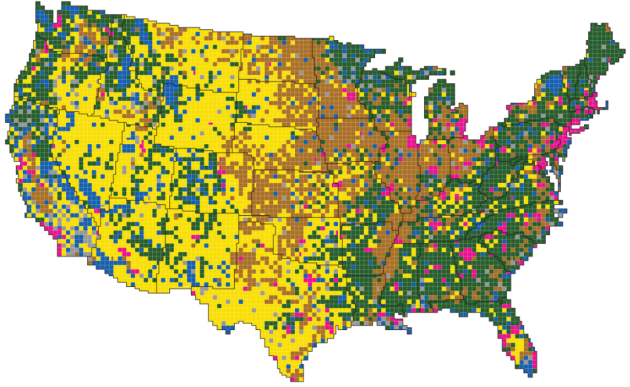
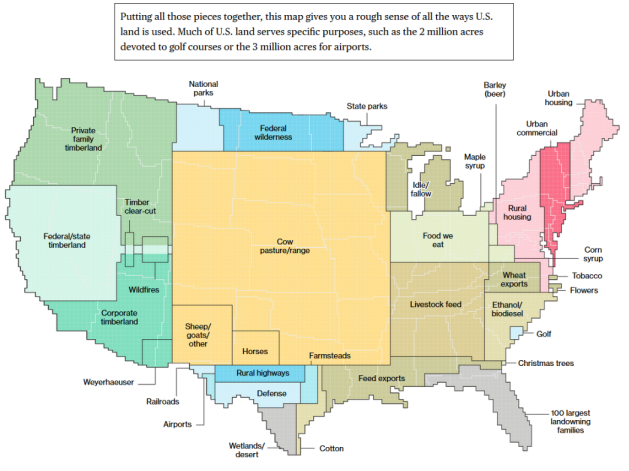
Bloomberg put together a set of graphics to illustrate how Americans use land. Here are a few of the maps interspersed with information. First, the general patterns of land use:

AmericanLandUseGeneral

The U.S. is becoming more urban—at an average rate of about 1 million additional acres a year. That’s the equivalent of adding new urban area the size of Los Angeles, Houston and Phoenix combined. U.S. urban areas have more than quadrupled since 1945…

AmericanLandUseComparative

More than one-third of U.S. land is used for pasture—by far the largest land-use type in the contiguous 48 states. And nearly 25 percent of that land is administered by the federal government, with most occurring in the West. That land is open to grazing for a fee.

There is some data here that could be viewed as conflicting: urban areas are the fastest growing land use – watch out for sprawl! – but the biggest land use overall is pasture and range – open land yet given over to creatures that are land and resource intensive!

One nice feature of these maps is that they are helpful for making comparisons between land uses. Given the size of the country plus the limited day-to-day experiences of many in different parts of the country, it can be hard to get a handle on all the land uses.

After looking this all over, I wonder what Americans and policymakers would say an ideal land use mix is for the entire country. This is a difficult question to answer, particularly since many people would not necessarily regularly encounter all the uses. If people want more protected land, what other land uses should be reduced and how would this affect individual lives as well as the American way of life?


McMansion owners as against preserving green space

A letter to the editor connects Mcmansion owners with an unwillingness to look toward the public good:

It seems that more often than not folks who live in huge McMansions on private estates, drawing big government pensions and other income streams, are the ones making the biggest noise about keeping things the same in the county (Letter to the Editor, “Snapshot of Rappahannock’s Future,” Demaris Miller, July 19).

Of course they would! They don’t need to worry about finding decent paying jobs or affordable housing without having to move out of the county as so many people here do. They’ve got plenty of fine space to take walks and entertain their grandkids.

The county has many choices for where to go — we could allow factories and warehouses, or suburban sprawl, or tourism with a NASCAR track, an amusement park, skate boarding and all. Or we could stick to a plan for growth that preserves our scenic rural character while encouraging people to visit and share that beauty and spend a little money here. A safe bike and walking path with gorgeous views of the Blue Ridge certainly fits in that category.

The McMansions cited here must have larger properties where owners can enjoy the outdoors. This would contrast with one possible trait of McMansions where they are the result of teardowns.

On the other hand, McMansions are linked here to sprawl. This is a common argument as McMansions are often part of an expanding suburbia where homes, roads, and development gobbles up open land, green space, and public space. Additionally, these are wealthy sprawling suburbanites who can take care of their own financial interests.

More broadly, this letter gets at broader issues involving McMansions and suburbs: just how much growth is desirable? How does a community weigh the construction of housing versus protecting natural space that residents and visitors can enjoy? Growth is generally good in suburban areas and even if certain spaces are protected, the general tenor of development can overwhelmingly change the character of a place from a more rural or open area to a denser one.


The social norm of calling the authorities regarding the mothering of others

Mothering is not an activity just left to individuals or families; it is a communal activity that occasionally veers into differences of opinions and the actions of authorities:

I was beginning to understand that it didn’t matter if what I’d done was dangerous; it only mattered if other parents felt it was dangerous. When it comes to kids’ safety, feelings are facts…

This has actually been confirmed by researchers. Barbara W. Sarnecka, a cognitive scientist at the University of California, Irvine, and her colleagues presented subjects with vignettes in which a parent left a child unattended, and participants estimated how much danger the child was in. Sometimes the subjects were told the child was left unintentionally (for example, the parent was hit by a car). In other instances, they were told the child was left unsupervised so the parent could work, volunteer, relax or meet a lover. The researchers found that the participants’ assessment of the child’s risk of harm varied depending on how morally offensive they found the parent’s reason for leaving…

It’s not about safety,” Dr. Sarnecka told me. “It’s about enforcing a social norm.”…

These women’s critics insist that it’s not mothers they hate; it’s just that kind of mother, the one who, because of affluence or poverty, education or ignorance, ambition or unemployment, allows her own needs to compromise (or appear to compromise) the needs of her child. We’re contemptuous of “lazy” poor mothers. We’re contemptuous of “distracted” working mothers. We’re contemptuous of “selfish” rich mothers. We’re contemptuous of mothers who have no choice but to work, but also of mothers who don’t need to work and still fail to fulfill an impossible ideal of selfless motherhood. You don’t have to look very hard to see the common denominator.

Social norms and expectations about roles are powerful parts of social life. Everyone has social guidelines to follow but the expectations can differ dramatically across groups. As the piece goes on to note, what individuals and society expect from fathers in similar situations differs.

This leads me to a few other thoughts:

  1. The appeal to third-party authorities rather than talking to the mother or just keeping an eye on the kids for a few minutes without alerting anyone reminds me of Baumgartner’s The Moral Order of a Suburb. She argues suburbanites help keep the peace by not interacting with each other. When they have problems, they may call the police or the city or some other party who can mediate in the situation. The same seems to be happening here.
  2. Part of the issue here is that these laws were enacted because there are situations where children can be helped. So, how exactly can the public be shaped to react when it is truly needed and ignore the situation when children are not really in danger? This is a big task and goes beyond the ability of laws and regulations to shape society. At the same time, I would not say that there is some zeitgeist that will just change. How people view mothering and the safety of children is dependent on numerous concrete actions and values.

Why Americans love suburbs #7: closer to nature

A consistent appeal of suburbia for many Americans is to be closer to nature and green space. While suburbanites appreciate their proximity to urban amenities without having to actually live in the big city, they also often appreciate more open space and closeness to nature. American suburbanites may be out of touch with nature and children may be exposed to less nature these days but the suburbs are viewed as offering access to nature just outside the single-family home.

As cities grew in the nineteenth century, they became dirty places. While this is an ongoing issue in many large cities still (think smog in Paris or air quality in Beijing), these growing cities had particular problems including how to construct sewers (Chicago’s efforts in battling excrement helped it grow), dealing with waste from all the horses, and soot (see pictures of Pittsburgh turned dark in the middle of the day). The suburbs offered some distance from the grime of the city and more proximity to pristine nature.

Exactly what kind of nature suburbanites experience is up for debate. As one critic of suburbia suggests, the suburbs often involve “nature band-aids.” Suburbanites may be interested in farms or “agrihoods” but the average suburban dweller has a small plot of land around their home. I am reminded of one situation I discovered in my research on suburban development where residents of a newer subdivision complained vociferously when the adjacent cornfield turned into a new development. This common process of suburban development – more agricultural or rural land or open space is turned into sprawl – can frustrate many residents.

One consistent experience involves using and caring for the lawns that surround many single-family homes. The green lawn is an important symbol of the owner’s social class as well as a space for outside recreation. Caring for the lawn is vitally important. Neighborhoods and communities exert pressure. Residents make sure their lawns are green in a variety of conditions ranging from watering during droughts, painting their lawns, and searching out the best seeds. They often have plenty of trees, prized by suburbanites for their foliage, functioning as key symbols of nature, and ability to define edges of properties and hide views of others.

Beyond lawns, suburbanites are often interested in parks, forest preserves, and green spaces. Theoretically, these uses limit the possibility that the green space can be turned into other uses. Even somewhat protected green space like a golf course can provoke concerns if it is turned into something else. Additionally, these spaces enhance property values of single-family homes, allow space for children to play, and can become sites of local social activity. Some of these places can offer more authentic nature (less controlled by humans) though many of these sites are carefully kept. Furthermore, even in these preserved spaces, it is difficult to truly escape the suburban noise and evidence of civilization.

Sometimes, nature can be perceived as the enemy of suburbanization. A great example is dealing with water. Flooding is a persistent issue. More housing alongside roadways and parking lots do not allow water to soak into the ground. Think the Houston area after a hurricane. In spaces with less human activity, flooding and waterways changing course do not have the devastating or annoying effects that they can in suburbia. Turning land into suburbia can have the effect of bulldozing over natural ways of dealing with water and instead trying to channel it or eliminate it around homes and other uses. This is not always successful and much money can be spent on the issue. For example, the Deep Tunnel project in the Chicago region is a massive civil engineering project born out of urban and suburban development.

Of course, the opposite can be true as well: suburbanization can be the enemy of nature. Rachel Carson’s influential work emerged by suburban settings. At the same time, nature itself can also adapt to suburbanization. The wildland-urban interface can move as creatures like coyotes, deer, baboons, and birds adapt to human activity.

While critics of suburbs may not understand why suburbanites cannot see the ugliness of sprawl, many Americans believe the suburbs offer a little more natural space in which to move and breathe.

Why Americans love suburbs #6: local government, local control

One of the unique features of the government of the United States is a federal system that distributes power between the federal government and more local bodies. Even if the federal government has grown dramatically in the last century, the suburbs offer residents a relatively small and responsive local government. Americans claim to prefer small town life and in such communities the distance between average resident and local leaders is reduced.

If the suburbs at their heart are about single-family homes and family life, a small local government can help protect the quality of life in the community. Local governments can exclude certain kinds of development. This then affects what kinds of residents can live in suburbs. See exclusionary zoning cases in DuPage County and Westchester County, two notoriously wealthy suburban counties, or more recent cases of religious groups facing opposition such as Muslims and Orthodox Jews in New Jersey. Homeowners can directly see and respond to how their tax dollars are spent. They may not like high property taxes (whether in the 1970s in southern California or more recently in northern Virginia) or decisions about TIF funds or but at least that money is spent in the community rather than shipped off to other centers of power. They may fight with each other about whether to raise local taxes for schools or fund regional transit initiatives or support affordable housing but at least they may know those they are arguing with and everyone does want their community to be attractive. Suburbanites are resistant to outsiders telling them what they should be doing, whether they are concerned about the federal government pushing denser housing (and perhaps even the UN) or state or court mandates about affordable housing (such as requirements passed in 2004 in Illinois or requirements in New Jersey due to the Mt. Laurel decisions).

While suburbanites may believe they have more access to suburban governments, these elected and appointed officials can have a significant impact on suburban development. The growth machine theory suggests local officials and business people push and pursue development because there is money to be made. Suburban growth is good because it can generate profits and it adds prestige. The growth has to end at some point (see cases like Naperville and Aurora) but officials, with some input from residents, can push suburbs in certain directions. Not all suburbs will make the same decisions about what to do with open land or with their downtowns but local leaders get to make these decisions that then influence residents decades later.

Local control then means that suburban communities can have distinct characters. While critics may suggest suburbia is an endless sprawling mass with very porous boundaries, local governments and development decisions alongside public involvement and civic projects can lead to long-standing and fiercely defended local understandings. The most typical image of an American suburb – bedroom community with postwar subdivisions filled with similar-looking homes – may not actually fit many suburbs in terms of appearance or perceived experience.

How exactly local decision-makers and suburban officials come into office can differ across locales. Voter turnout is low in many local elections so it may not take much effort to become a local official. On the other hand, local politics can sometimes turn very contentious because of particular significant issues or long-standing political factions. Americans tend to be more optimistic about their local conditions than about the country as a whole so suburban officials who do a decent job can retain their positions for a long time. Furthermore, suburbanites may be less interested in efficiencies across local governments, such as combining small police departments, compared to having their own local bodies.

Another aspect of this local control involves less democracy: the rise of homeowner’s associations. A good number of suburbanites are willing to turn over some decisions about their property and neighborhood to a board or management company that will ensure certain standards are upheld. Again, the distance between the average HOA homeowner and board is small; boards often need more people to volunteer to serve and neighborhood meetings allow homeowners to express concerns.

Of course, there are problems among suburban local government. They may not have the resources or expertise to deal with complicated issues (such as providing social services to address suburban poverty). There can be too many smaller units that have their own bureaucracies and abilities to tax residents (see Illinois as an example with numerous taxing bodies and debates about eliminating townships). Local officials can be corrupt (Cicero), incompetent (Harvey), or follow their own paths while remaining impervious to other opinions (Rosemont). Yet, many Americans might argue that even these problematic aspects of suburban governments are relatively easy to deal with compared to the behemoth in Washington.

Why Americans love suburbs #5: cars and driving

If the single-family home offers private space in suburbia, the car offers private mobile space. The home offers a base to which the owner can retreat, the car offers the chance to travel elsewhere. Even if the single-family home is the ultimate focus of suburbia, these homes are hard to imagine without cars in the garage or driveways (usually front-facing, sometimes in the rear) or without traveling to the suburban in something other than a car. Cars and homes are intimately connected in American society.

Americans love driving (and need convincing to instead use mass transit). The suburbs require driving. The sprawling nature of suburban communities are often ill-suited for mass transit. On one hand, driving offers freedom to go where you want when you want. It is a symbol of American individualism. On a global scale, Americans have one of the highest rates of car ownership. On the other hand, owning a car has numerous costs. It is not just the obvious costs of gas, insurance, and car maintenance (and even these add up for the average owner). Additionally, critics would argue cars are a drain on community life as people can build relationships and spend money wherever their car can take them, commuting via car can take a lot of time and can limit economic mobility, road networks are costly to maintain, have negative effects on the environment, contribute to health issues through limited walking and biking, and are a menace to pedestrians and bicyclists who want to be part of the streetscape as well as are a safety threat to drivers and passengers themselves. Even with these costs, Americans persist in driving. For example, rather than push back against highways and driving in the auto-dependent Los Angeles area, officials instead focused their efforts on getting more efficient cars. The thought of major highways closing for a few days in a sprawling region creates near panic and highways can become effective sites for protests because of the number of inconvenienced drivers.

Numerous aspects of suburbia emphasize the love of cars. The single-family home would be incomplete without a garage. As homes increased in size over the decades, so did garages. The pattern of driving out of the garage at the beginning of the day and back in at the end with minimal neighborhood interaction may not characterize every home but is common enough. Many suburban single-family home are located along residential streets that are plenty wide and can handle cars traveling at decent speeds. The fast food restaurant would not be possible without cars. What is more American than going through the McDonald’s drive-thru in the midst of another suburban trip? Think of the many commercial strips all around America with fast food restaurants and strip malls (they may even not be considered aesthetically appealing by some suburbs). Similarly, the big box store – Walmart, Costco, Ikea – and shopping malls would not be possible without cars. In these spaces, hundreds of separate drivers can congregate in massive parking lots for unparalleled choice and prices. Numerous industries, let alone the automobile industry, depend on cars, vehicles, and roads.

The suburban car is part status symbol, part lifeline to the outside world. What vehicle you have matters and judging from the vehicles around me, the suburban family life is impossible without an SUV or minivan. Not being able to drive is a huge problem (sorry teenagers and some seniors). The largest category of trips involves drives between suburbs, particularly for work as jobs are spread throughout suburban regions. Additionally, the image of soccer moms persists as kids need to get to all of their activities.

It is difficult to predict how exactly cars fit into the future of suburbs. Driverless cars may mean fewer people need to own their own vehicle (those garages can then be used to store more stuff!) but being able to relax or do work rather than drive may mean people could live even further from cities. Millennials have less interested in car ownership and driving. Numerous suburbs are pursuing denser developments, particularly along railroad or transit lines, and this could limit car use in those areas and create more walkable spaces. Yet, it is hard to imagine the American suburbs without many cars and the ability to travel from a single-family home to all sorts of places.

Why Americans love suburbs #4: middle-class utopia

If race and ethnicity in the suburbs has often served to keep residents out, the more inclusive message of the American suburbs is this: it is a place where the middle-class can live a good life. Of course, there are issues with this, including numerous exclusive wealthy communities as well as a lack of affordable housing or rental units for those who are not quite middle-class. Yet, the suburban life is held up as both attainable and ideal for the American middle-class.

It wasn’t always this way. Early suburbanites had to have the resources to make it back and forth to the city. This changed with the numerous transportation inventions (railroads, streetcars, electric lines) that steadily brought the costs of traveling in and out of the city down as well as led to the development of more land outside the city. With other developments, particularly the quick spread of cars and highways and mortgages with fewer upfront barriers, the suburbs became the space for the middle-class by the 1950s.

The key to the middle-class suburban dream is its affordability. The typical logic is that the farther a family moves from the big city, the cheaper and bigger the home can be. This explanation echoes the Chicago School and the concentric rings model developed by Burgess: land is more expensive in the city center and the progressively cheaper in zones further from the city. While moving further from the city has its costs (owning and maintaining a car is not cheap, the costs of providing city services in a sprawling location can be pricey), the goal is to get a sizable home.

This middle-class paradise has drawn its share of critics due to its mass-produced nature, lack of highbrow taste and sophistication, and façade of pleasantness that supposedly hides all sorts of sordid activity. Particularly in comparison to lively urban neighborhoods, the suburban middle-class life is often portrayed as dull if not outright oppressive. My favorite response to this is in sociologist Bennett Berger’s 1960 study of a working-class California suburb:

The critic waves the prophet’s long and accusing finger and warns: ‘You may think you’re happy, you smug and prosperous striver, but I tell you that the anxieties of status mobility are too much; they impoverish you psychologically, they alienate you from your family’; and so on. And the suburbanite looks at his new house, his new car, his new freezer, his lawn and patio, and, to be sure, his good credit, and scratches his head bewildered. (103)

Almost sixty years later, this rings true: many Americans still believe their suburban home full of stuff makes for a good life.

Protecting this middle-class land can be quite a task. Suburbanites are often opposed to new development near their homes, smaller housing, apartments, or affordable housing that could possibly lower their property values and threaten the middle-class character of the community. Some of the concern with people of difference races and ethnicities involves class. As anthropologist Rachel Heiman suggests, there is plenty of class-based anxiety in the suburbs, even in better-off ones. Open conflict should be avoided even as social control is desirable. The rise of homeowner’s associations to help police the actions of neighbors through a third party is one way to keep nearby residents in line.

For a society where the vast majority of citizens say they are middle-class (recent data here and here), the suburbs are the primary geographic and social space for middle-class lives. Obtaining a suburban single-family home still signals a middle-class life.

Why Americans love suburbs #3: race and exclusion

The most difficult choice in ranking the reasons Americans love suburbs came between this reason – which I ultimately put at #3 – and the #2 reason involving families and children. The reason this choice was so difficult is that race is a foundational factor in American life. I have argued before that race should be considered a factor until proven otherwise, rather than the other way around where it is easy to limit discussion of race to blatant racism or discrimination.

While the suburbs are a central feature of American life, they from the beginning reproduced one of the other central features of American life: the suburbs were primarily intended for white people. The segregation was more obvious and protected in the past. This included sundown towns, Levittown not allowing black residents, and restrictive covenants excluding a variety of racial and ethnic groups. Blacks did have separate suburbs. The separation between white and non-white residents, particularly whites and blacks, is still present today in suburbs through residential segregation. The more recent segregation is due to factors like a lack of affordable housing (often challenged by wealthier and whiter suburbanites – see examples here and here), exclusionary zoning, housing discrimination, and unequal lending practices such as predatory lending. This can be illustrated by one Chicago suburb that claimed to be “home to proud Americans,” words that hint at a largely whiter and wealthier population.

It is therefore not a coincidence that a factor that contributed to the postwar suburban boom in the United States was a phenomena known as white flight. As millions of blacks moved to Northern cities in The Great Migration, government policies (changing mortgage guidelines, redlining, the construction of interstate highways) and desires to avoid blacks led many white Americans to move to the suburbs.

But, this was not necessarily a new phenomena. As cities expanded in size in the late 1800s, fewer and fewer suburbanites wanted to be part of the big city. Until roughly the 1890s, many big cities annexed nearby suburbs (such as Chicago with Hyde Park, Boston with Roxbury, and New York City with Brooklyn) as there were still benefits to being part of the big city (such as tapping into sewer systems). However, this stopped around this time as suburbs could better afford their own public improvements and cities became less desirable. What were the urban problems that pushed suburbanites away? A combination of factors played a role including overcrowding and dirtiness but immigration and new groups moving to the city also mattered.

While all of this could also be couched in terms of Americans preferring small-town life (and there is plenty of evidence to suggest this is true), it is worth thinking about what that small-town feel is really about. Americans like urban amenities, even if they do not want to live near them, and the suburbs offer easy access to many amenities within metropolitan regions. Americans do not want to live in rural small towns – even if Americans are nostalgic for such places, over 80% of Americans live in urban areas. Yet, many suburbs are not small (even as large ones, such as Naperville, claim to still have a small town feel). I suspect part of the small-town feel is really about racial and ethnic homogeneity.

Throughout all of this, the American suburbs have recently become more racially and ethnically diverse. More blacks are moving to the suburbs, whether outside Chicago, Seattle, Kansas City, or elsewhere. Many new immigrants are moving directly to suburbs. But, it could be a long time before non-whites achieve parity of location in suburban areas.

(Of course, social class also plays a role in all of this as race/ethnicity and social class are intertwined throughout American history. Non-white suburbanites who are middle-class or upper-class may be more palatable to white suburbanites. For example, it is interesting to see responses to increasing suburban poverty: will more suburban communities address the issue, such as through offering social services, or will they try to limit lower-income residents?)

Why Americans love suburbs #2: family life and children

A consistent finding of researchers when studying day-to-day suburban life or asking people about their suburban aspirations is the belief that the suburban life benefits families and children. Living alone in the suburbs presents particular problems.

That the suburbs are preferable for family life had an early start in Anglo suburbs. Historian Robert Fishman argues early English evangelicals like William Wilberforce moved from London to Clapham to give their wives and children safer and purer spaces outside the city. While the men could commute to the city for work and other engagements, the women and children had their own domain in the suburbs.

This image of a safe suburbia for families perhaps reached its peak in the decades immediately following World War II. The birth rate jumped (hence, Baby Boomers) and families needed more space. The country and many major cities faced a severe housing shortage. The social scientists who wrote the ethnographic study Crestwood Heights, a study of a Toronto suburb in the postwar era, noted that suburban social life revolved around the children: “In Crestwood Heights the major institutional focus is upon child-rearing.” (4) Even as these new suburbs may have offered few opportunities for teenagers until they could drive (sociologist Herbert Gans said Levittown was “endsville” for teenagers), families flocked to new homes, more green space, and new schools. Television shows of the era depicting suburbia tended to show white nuclear families enjoying a comfortable suburban life (think Father Knows Best, Leave it to Beaver, and The Brady Bunch).

Today, many of these ideas about how much better suburbs are for children remain. The suburbs offer more green spaces. They are quieter. They have lower crime rates. There is less traffic. Kids get a more “typical” American upbringing (and the modal experience in recent generations is a suburban upbringing). Single-family homes in the suburbs allow a family to purchase more space for the entire family, acquiring separate bedrooms to extra rooms to larger yards.

One of the strongest indicators regarding the importance of families and children in suburbia involves the importance of school districts for the desirability of communities, property values, and helping determine where people move. Schools are important because they are viewed as the one sure thing that can propel children to greater heights: going to a good school district leads to a good college which leads to a good job and then a high income and a comfortable life. These school boundaries must be defended at all costs. Examples abound. This includes both the busing issues of the late 1960s and early 1970s as well as the recent case of students in the failing school district serving Ferguson, Missouri who for one year had a shot at a better education at a whiter and wealthier district until the law was changed. This includes a debate chronicled by anthropologist Rachel Heiman among New Jersey suburbs about which kids should go to which high schools (and the wealthier families were able to keep their kids in the better-performing schools and limit which other kids were able to come to their schools).

Whether suburban children always come out ahead compared to kids from cities or rural areas is less clear. Even if the suburbs can be exclusionary, some upward social mobility is possible, such as one study that suggested DuPage County offered more opportunities than other counties or programs from the federal government, such as the Gautreaux Program or the Moving to Opportunity program, that aimed to move kids from poorer urban contexts to wealthier suburban communities. Part of theexcitement about a return of Americans to cities involves the choices by some families to stay in major cities, such as the influx of families to Battery Park in Manhattan. But, many Americans associate the suburbs with kids playing in the yard, multiple institutions that help nurture children and family life, and successful family outcomes decades later.