Adding more context to Americans spending 7% of income on gas

AAA reports on how much Americans spend on gasoline:

Analysts say Americans are now spending 7% of their income on gas, a statistic that is up 1.5% from last year.

If you make $45,000 per year, you’re shelling out over $3,000 just to put gas in your vehicle.

The 7% figure may be interesting in itself but this is a statistic that begs for more background information. Is 7% a lot or a little? Should people be alarmed?

The story already includes two pieces of context:

  1. This is an increase from last year. Generally, people do not want to be paying significantly higher prices year after year. While 1.5% is a low number, drivers would probably not want this number to keep going up.
  2. A slightly lower than average income person or family – the median household income is a bit higher than this – spends over $3,000 on gas. People could read this figure and then think where else that $3,000 could be used.

But, there is more information that could be useful here.

  1. Historically, how much do Americans spend on gasoline? The article includes a one-year trend but how does this look over decades? Are gas prices going up the same way medical costs are going up?
  2. How does this 7% compare to other essential categories of spending such as food (and the groceries vs. eating out breakdown could be interesting) or housing?
  3. What are the total costs of car ownership? Gasoline adds up but vehicle owners also have to factor in maintenance and insurance.
  4. These are average figures for gasoline consumption: how much different will gas costs be for SUV and truck owners (and these are driving the car market) versus small car owners?
  5. How does this compare to gasoline costs in other countries? The rise to 7% may seem like a lot but gasoline costs more in some other industrialized countries and people in other countries drive less than Americans.

While this may be too much to ask for a short news story, gas costs, as well as most other social and economic statistics, are complicated. The numbers do not necessarily interpret themselves. Something going up or down or staying the same is as meaningful as its context and what we make of it.

The never-ending summer hum of lawn mowers, construction, ACs, pressure washers, and more

As soon as the weather started turning warmer, the summer drone began. Not crickets or the sounds of children playing baseball or swimming at the pool. Rather, it was the background noise of summer that seems unavoidable for months: in a suburban subdivision with numerous nearby subdivisions, there is always someone within a relatively short distance using a lawnmower, a weedwacker, a pressure washer, or construction equipment. The noise starts as early as 7:30 AM and stops around 8 PM.

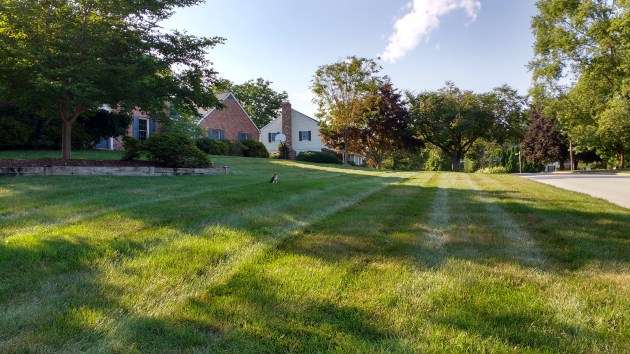
The typical idyllic summer looks something like this with green lawns, sunshine, and peaceful looking homes:

Lawn

But, this image fails to include the background noise that is ever present. That noise is often less than idyllic, particularly if it is close and/or persistent.

I know the expectation of having quiet is one that is not possible in many settings, particularly in urban areas. Many American residents have little exposure to true quiet (and may even find it unnerving). But, the early suburban ideal of the mid 1800s was to help urban residents get back to nature (or an altered environment that fit certain standards of “nature). That quiet of nature – rustling trees, bird calls, insects, stillness – is simply not possible in most suburban settings today either. Some of this is due to location and the need to locate near major roads or other land uses (such as commercial or industrial properties). Some is due to the rise of air conditioning which made development possible in certain climates. Yet, it also comes from all the maintenance required for single-family homes and their environment. Home upkeep to typical standards, such as a good looking lawn, is aided by noisy tools.

I thought recently about having noise free days in suburban neighborhoods. Could everyone in a certain portion of a community schedule their outdoor maintenance for two or three days a week? This would make it more difficult to schedule things but the trade-off could be less noise for everyone. This could work with homeowner’s associations since they already contract for regular lawn service that typically happens on the same day each week. Imagine residents could have at least one weekday in which they knew the only noise outside would be from vehicles – would it be a better experience?

The declining value of shopping mall real estate

The declining shopping mall has led to a drop in value for these properties:

“It’s a tough environment. I don’t think anybody really anticipated the decline of the department store to happen as quickly as it did,” said Joe Coradino, chief executive officer of Pennsylvania Real Estate Investment Trust, which owns 21 malls in the Mid-Atlantic region. “The sellers are clearly on their knees.”

The Philadelphia-based REIT has sold 17 bottom-tier malls since 2013. The last deal, completed in September, was a $33.2 million transaction for the Logan Valley Mall in Altoona, Pennsylvania, anchored by Macy’s, JCPenney and Sears stores. If those same properties were on the market today, prices would be substantially lower, Coradino said…

Not long ago, some of the biggest names in private equity, such as KKR & Co. and Barry Sternlicht’s Starwood Capital Group, were laying out substantial sums to snap up retail properties. In 2012 and 2013, Starwood purchased a combined $2.6 billion of malls from Westfield, followed less than a year later by a $1.4 billion deal to buy seven malls from Taubman Centers Inc. From 2012 to 2014, KKR bought four regional malls for about $502 million, Real Capital data show. That demand has all but evaporated as timing a wager on American malls becomes increasingly treacherous…

It’s easy to understand their reluctance to sell now. Prices for malls fell 14 percent in the past 12 months, even as values for other types of commercial properties, such as warehouses and office buildings, rose or held steady, according to Green Street Advisors LLC. At least four properties have been pulled from the market in recent months because the bids were too low, Dobrowski said.

Even with efforts to save some shopping malls, from adding restaurants and entertainment options, housing, and community spaces, a good number will simply not survive. They will not be desirable enough for retail activity nor prime spots for redevelopment. They may sit empty for much longer than communities desire or can bear. I suspect we will see a lot of potential creative solutions to these dead shopping malls as land owners, developers, and communities try to turn them into sites that again contribute to the surrounding area.

Perhaps the most interesting question here is how low prices will get before they interest someone who will buy them. Are we headed for the equivalent of $1 homes for shopping malls? Perhaps they will become subject to blight and renewal programs? Will the price be low enough for neighbors or communities to buy them simply to raze them? Perhaps they will be the dystopian spaces featured in films like Gone Girl?

Jane Jacobs, self-driving cars, and smartphone walking lanes

Fining distracted pedestrians who are paying attention to their smartphones is one option for communities. Here is another: a Chinese shopping center in Xi’an has a clearly marked lane for smartphone-using walkers.

Colorfully painted paths outside the Bairui Plaza shopping mall have been designated for walkers who cannot be bothered to look up from their devices…

Instead, messages painted along the lane cajole walkers to look up and pay attention.

“Please don’t look down for the rest of your life,” one message reads. “Path for the special use of the heads-down tribe,” another says…

Xi’an is not the first city to experiment with special areas for mobile phone use. In 2014, a street in the southwestern city of Chongqing was divided into two sections. On one side, phone use was prohibited, and on the other walkers were allowed to use their phones “at your own risk.”

The German city of Augsburg in 2016 embedded traffic lights on the surface of the street to prevent texting pedestrians from walking into traffic.

This will be a difficult issue to tackle for many communities. Here are two more additional ideas that may (or may not) help address these concerns:

  1. In reading multiple stories about distracted pedestrians on sidewalks, I am reminded of Jane Jacobs’ thoughts on lively sidewalk life. She argued that a lively street scene full of mixed uses will promote a thriving social scene. Could it be that sidewalks need to be more lively to keep the attention of pedestrians? If someone is walking down a bland block or through a shopping mall that does not really look any different than other shopping malls, it can be easier to pull out a smartphone. Of course, users might be so familiar with the walking area or their thoughts are elsewhere such that no level of liveliness would keep them from their smartphone.
  2. Perhaps some of the technology already being rolled out in cars and destined for significant use in driverless cars that helps cars sense other objects and respond accordingly could be implemented in cell phones. Imagine using your smartphone while walking and all of the sudden a radar screen pops up that indicates you are about to run into something. Or, perhaps it could have lights on different edges that could provide indications that objects are on that side. This is where Google Glass could be very useful: a display of nearby objects could always be within a user’s vision. Maybe technology will soon advance to a point where we have “bubbles” around us displaying information and nearby pedestrians or other objects could trigger some sort of alarm.

Separate walking lanes as well as punishments may not be enough. Given our reliance on technology to solve problems, I would not be surprised if new technology ends up as a substantial part of the solution proposed for problems posed by earlier technology. At the same time, this may be less about technology and more about the changing nature of public life.

If golf and football are dying sports, what would happen to that land?

I recently discussed NIMBY responses to redevelopment of golf courses but this had me thinking more broadly about land dedicated to sports and recreation: what happens to the land if the activity becomes less popular?

Golf was the sport cited in the CityLabs article:

Golf is dying, many experts say. According to one study by the golf industry group Pellucid Corp., the number of regular golfers fell from 30 to 20.9 million between 2002 and 2016. Ratings are down, equipment sales are lagging, and the number of rounds played annually has fallen.

Part of the bust can be blamed on the fallen fortunes of a single person: Tiger Woods. Golf boomed in the 1990s and early 2000s as the charismatic superstar raked in titles. Then, beginning in 2009, it faced a one-two punch of recession and bad press when its star golfer’s chronic infidelity came to light.

But the bigger story involves the sport’s aging demographics and the athletic tastes of Millennials, who just aren’t that into an expensive, poky sport that provides few health benefits. Unless the golf industry can change its ways, the decline will mean a lot of empty greens across the country. How that land is used—or isn’t—could reshape America’s suburbs for decades to come.

Beyond golf, the next sport that comes to mind is football. If youth leagues continue to see a decline in participation, less park and school land would be needed for football fields. What would then happen to that space? For a good number of high schools, that land is already shared with sports like soccer and lacrosse. Park space could simply become large fields again. But, some football facilities could be turned over to other uses (and cause NIMBY issues similar to those faced by golf course redevelopment).

What other sports could be next? Baseball still has a lot of young players but imagine that participation dries up in a few decades. Baseball fields can take up a lot of space. Could there be sports that arise and take up some of this space? Nice basketball courts would be welcomed in many places but neighbors and communities often have concerns about building these. I can think of several lesser known sports but cannot realistically imagine they would become so popular as to take up public park space or space at schools. But, perhaps parks in a few decades will include a much wider variety of sports fields and spaces to better serve a fragmented sports playing populace.

Sports spaces come and go over time. Bowling alleys thrived decades ago but now are more sparse. Skate parks started a few decades ago and now are found in many American community. Large cities have spent millions on helping to fund sports arenas but this could stop as communities realize who benefits from the stadiums. Is it too far-fetched to imagine that in a few decades very few people will play sports outdoors due to a combination of a lack of interest in physical activity, inside facilities, e-sports, and simulators that could provide similar experiences? Could parks and outdoor spaces become exclusively about “natural settings” and open land?


Seeing the real America at the ER Saturday at 10 PM and Walmart Sunday at 8 PM

I visited both of these locations in recent weeks and was intrigued to see the mix of people at each. I’ll make a quick case for why these locations could provide as good cross-section of America as any other location:

  1. Limited options. For the emergency room on a Saturday night, there are few other medical options available at that time. If anyone has a medical issue, they will end up here. As for Walmart on Sunday evening, there are limited brick and mortar shopping options and the work week is about to start.
  2. People need medical care and grocery/home items. Both locations have people trying to meet basic human needs. Even as online shopping may allow people to avoid other shoppers and online medical consultations are now available, there are inevitably moments where running out to a store or medical professional is necessary. It is hard to imagine either of these facilities disappearing completely (even if the number of retailers is severely reduced).
  3. Connected to #1 and #2 above, people of differences races, ethnicities, and social classes are at both locations. In many other locations, whether due to residential location, the location of jobs, ill will toward others, or access to resources, not all groups are represented. Sociologist Elijah Anderson wrote a book about such rare urban locations.

While these may not be the best locations in which to conduct research, they could offer insights into typical American life.

Redeveloping golf courses and incurring the wrath of neighbors

Turning land from a golf course to a housing development could be a bumpy process:

Consider that the average 18-hole golf course is 150 acres. At standard densities, that means that your average golf course can host at least 600 new single-family detached homes. Mix in townhouses and apartments, and a single shuttered course could provide housing for thousands of new residential units. This is land in desirable communities: Golf-centric subdivisions built in the 1990s and 2000s feature courses threaded among affluent McMansion-style developments, meaning that the new housing could go in areas with access to high-quality schools and work opportunities…

But the main variable blocking new housing on old golf courses might be old-fashioned NIMBYism. Golf courses, after all, are often interpreted as high-status amenities that raises the value of neighboring homes, despite evidence to the contrary. If golf courses are gone and not coming back, residents often ask, why can’t they turn into permanent parks? Indeed, converting former greens into open space, wetlands, and natural preserves is happening nationwide in places where local land trusts have been able to purchase the tracts.

This can be a more appealing option for neighbors—often much higher income than the average resident of their region—who push to block permits and rezonings that might allow for infill housing redevelopment on idle greens. Earlier this year, voters in Lynnfield, Massachusetts, an outer suburb of Boston with a six-figure median income, voted down a zoning change that would have allowed for a 154-unit senior housing facility on part of the struggling Sagamore Spring Golf Club. Voters in the Rochester suburb of Penfield, New York, meanwhile, recently passed a $3.65 million bond to buy out the golf course and turn it into a park…

Golf probably isn’t coming back, at least not at the kind of scale it once boasted. Whether or not this bust can be a boon or a wash for suburbs and cities will likely be decided by hundreds of small zoning fights like these over the next decade. If recent pushes to downzone and preserve golf courses are any indication, it will take some effort and forethought on the part of planners and policymakers to get former greens productively redeveloped. Once the physical embodiment of tony upper-crust seclusion, these silent driving ranges and ghostly sand traps can be an effective way for more people to find housing in exclusive suburbs—or another means of keeping newcomers out.

There are few things suburban homeowners like less than finding out that the open, green, or park land they moved next to is now going to be a new development. Sometimes this anger is misplaced: if you move into a new subdivision recently created out of farmland and it is next to more farmland, you can probably expect that more farmland is going to be developed. Parks, forest preserves, or land trusts appear to offer more certainty: a private group or local government has committed to that green space and it would take a lot to choose otherwise. It seems like a golf course then falls in between these two options as it looks like green space but it dependent on a steady stream of users. If the golf course does not have enough customers, it cannot remain a golf course forever.

Also taking into account the social class and status of those who might locate on or near a golf course, I imagine communities that try to convert golf courses to new development will have a significant fight on their hands.


Production housing in the suburbs and what Americans want out of homes

An architect describes how production housing helps build the American suburbs:

Its scale is enormous. During the building boom before 2008, production housing—the name for builder-constructed residential developments—accounted for the vast majority of single-family homes. During that time, 1.8 million homes were started in a single month nationwide. Recent figures for January 2018, though down from prerecession highs, indicate 886,000 new starts. By some accounts, architects are responsible for designing no more than 2 percent of those homes. As the architect Duo Dickinson has observed, this means that the profession has largely ceded the best opportunity to be relevant and useful to ordinary people.

Not only does production housing dominate the market; consumers also like its products. The major appeal is affordability, with the housing industry producing a range of prices from modest to high-end. A family of four with a moderate middle-class income can put down $8,120, plus closing costs, to buy a home for $232,000 with three to four bedrooms, two bathrooms, a garage, and a piece of ground for a front and backyard. At the high end, buyers spending over $1 million—who could afford an architect if they wanted one—instead often choose big, builder-designed homes they see as bargains preferable to custom designs.

A second attraction is the quality of housing stock. People sometimes think of production homes as “builder-grade,” made carelessly and on the cheap. But American housing is better built now than ever before, a result of market competition, stricter building codes, and better materials. Basic construction is more solid, but the housing industry also is constantly upgrading the technology and sustainability of its products. As soon as the industry could see that producing energy-efficient homes had marketing advantages, green building started becoming increasingly widespread. These homes are not the ultimate in energy efficiency, but they are continuously improving. And because of the wide reach of production homes, those improvements impact many people.

A third appeal is that the housing industry answers consumers’ needs. Through its trade organizations, research institutes, and publications, it conducts constant research between buyer and seller. The feedback loop includes marketing, professional magazines, and trade shows. For instance, canvasing of consumers indicated that a living room adjacent to the front door, a holdover of the Victorian parlor, was far less important than having more space in a great room. Without reconfiguring the outline of the building—changing slab designs is costly—the front parlor was transformed into a smaller office or guest bedroom. This design makes sense, as the front door is typically not used for entry these days, but as a marker of domesticity. With marketing information at hand, builders can make immediate adjustments to their offerings. The expansion of walk-in closets, great spaces, and open kitchens correlate directly with consumers’ desires.

This list of positives sounds impressive: large-scale production of suburban housing means many homes can be built in many parts of the country at reasonable costs, at decent quality levels, and all while providing what buyers want. Relying on architects and others to design and build homes might push costs up, create more variability, and take more time. If efficiency and predictably for the homeowner is what Americans want, production building seems to be the way to go.

The rest of the article then goes on to discuss various critiques that could be leveled at suburban housing and development. Of course, efficiency and predictability have downsides both for individual homeowners and communities. And more broadly, we could ask about cultural values surrounding houses in the United States: what ends should they serve?

  1. Broadly accessible to the majority of Americans in settings that have broad appeal. This is what production building offers.
  2. Customized to the needs of individual owners and families rather than the limited number of models in #1.
  3. The design and size of homes should be subservient to community goals for land use and social life.
  4. Houses should provide significant return on investment.

Number three may just be the hardest sell as it places a house within a larger context and suggests it (and its owners) need to be part of what others are doing. Number two has the advantage of appealing to the individuality many Americans desire but this likely comes at some cost. Holding the goal of making suburban housing as available to as many people as possible (and you can make a good argument that this has been an American policy goal for roughly 100 years with ongoing socialized mortgages) leads to number one.

Number four is perhaps the most recent idea as it developed in recent decades with rising housing values amid financial uncertainties. This might fit best with number one: if Americans can get a good deal on a home, they can then expect more in return when they sell.

Invoking (a different kind of) blight to take land for Foxconn

The term “blight” is more likely to conjure up images of slums and urban decay (example of Detroit) than farmland and single-family homes. Yet, the Wisconsin village of Mount Pleasant earlier this week invoked blight to take land for a planned Foxconn facility:

Trustees voted 6-1 to declare as a blighted area some 2,800 acres of open farmland and a few dozen homes, all of it earmarked for Foxconn and the development expected to spring up around the planned electronics factory. Trustee Gary Feest was the lone dissenter, and one of only two board members to speak before the vote…

Still, holdouts remain — people who believe the 140 percent of market value the village has offered is unfair when owners of larger tracts of farmland were paid several times the pre-Foxconn price such property was bringing…

As proponents have in the past, DeGroot emphasized not the eminent-domain power the blighted-area designation gives the village, but rather the financial advantages the measure confers. Communities with plans such as the one Mount Pleasant just approved can finance the redevelopment by issuing bonds exempt from both state and federal taxes, which DeGroot said could save the village millions of dollars…

In taking its action Monday, the village is using a section of state law that broadly defines blighted areas. Besides the commonly understood definitions of blight — dilapidated housing, overcrowding, high crime — the statute says an area can be deemed blighted if it is predominantly open and, for any reason, “substantially impairs or arrests the sound growth of the community.”

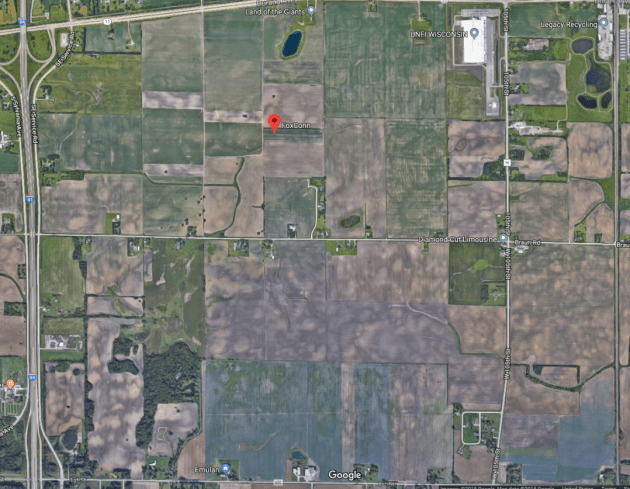
Here is the Google Maps satellite image of the Foxconn location (according to news reports). All the farmland is clearly visible.

Google Maps satellite image of Foxconn site

Taking land for a sizable or notable project like this is not always easy. The argument that this is good for the community will not strike all land owners as consonant with their property rights. And there may be some irony later in this story involving property rights. A Democratic gubernatorial candidate will be protesting the use of eminent domain as part of his larger concerns about the project. When Republicans are characterized as supporting both big business and property rights, which one wins? And are Democrats pro-property rights?

While Wisconsin has a slightly different definition of blight, this could be compared to urban renewal plans of the mid-twentieth century that used similar reasoning to mark certain properties as blighted. In both cases, officials and developers have a redevelopment plan for the land that is billed as an improvement for the community. In this case, the trade-off is largely open land for increased local tax revenue and a significant number of jobs. With the urban renewal plans of decades ago, history was not kind to some of the proposals as redevelopment could clear affordable housing units, target minority communities, and accelerate suburbanization (in the cases of highways constructed right through urban neighborhoods). Even without declaring some land as blighted, a project this size could be viewed by some as a significant change to the character of the community. “As many as 13,000 jobs” may sound good but this will affect local traffic, housing, and civic services. I would guess that following up with the community in five, ten, or twenty years could relay both intended and unintended changes if all or most goes as planned with the Foxconn facility.


Repealing a suburb’s English language resolution amid demographic change

The Chicago suburb of Carpentersville passed a resolution in 2007 saying English was the official language. The suburb continued to change and now officials have repealed the resolution:

Local officials say the English resolution caused nothing but controversy, and that progress came instead from targeting troublemakers, not Spanish speakers. Now, as one of the most diverse communities in the Chicago area, leaders hope to put the controversy behind them.

There’s also the demographic and political reality that Hispanics now account for slightly more than 50 percent of Carpentersville’s population of about 38,000, up from about 40 percent when the language measure was passed. Whites now make up about a third of the local populace, with most of the rest African- or Asian-American…

Still, it’s a touchy subject. When asked about the change in local law, Village President John Skillman, a lifelong resident, downplayed it. He said village documents and meetings will continue to be in English, and emphasized that the resolution made no concrete changes in the first place…

At the same time, efforts have been made to reach across ethnic boundaries. Last year, in addition to its Fourth of July fireworks, the village held a Mexican Independence Day celebration, and this year, its first Cinco de Mayo festival.

It is a relatively quick turnaround from a set of white candidates running for office and getting enough votes to join the Village Board and passing this resolution (and other measures aimed at undocumented immigrants) to repealing that same resolution eleven years later. At the least, it could suggest there is power of being part of local government: in a suburb of roughly 38,000 people, it may not take much to run for local office and campaign for particular issues. Regardless of what side of a political issue a resident is on, running for local office can make a difference.

The rest of the article hints at ways the suburb has come to terms with an increasing Latino population: Latino businesses in town, addressing gang activity, local festivals, and whether residents experienced discrimination. But, there is a lot more that could be addressed here. Did such a resolution significantly change day to day life? (The article suggests no.) How much do white, Latino, and black residents interact and participate in each other’s social networks? How does this play out in certain civic institutions like schools, religious groups, and community organizations? Resolutions or ordinances can certainly have a symbolic effect but there are a number of layers to community life and interactions in a suburb like Carpentersville.

(Side note: this is an apropos follow-up to yesterday’s post about how many Americans speak a language other than English at home. This affects more than just home life.)