Invasion of McMansions in Kirkwood, Missouri

Teardown McMansions have infiltrated an older neighborhood in a well-off St. Louis suburb:

Residents said not only are smaller historic homes getting wiped out in the process, but the large houses are causing problems for some of their next-door neighbors…

The one next door to her on Cleveland Avenue was erected last year and is nearly twice the size of the original home. It’s a four-bedroom home on the market for more than $800,000.

She said it’s created a real problem for her. The new home’s rain runoff has turned her driveway into a lake…

The city says the builders have followed all the community’s guidelines:

“…The new house on this site sits closer to the neighbor’s driveway, which may explain the confusion. Yes, the new home was built per permit specifications. The City requires the contractor to have the top of the foundation surveyed prior to beginning framing. The floor system is then verified to determine that the finished floor height is as allowed.

A follow-up story from several days later says the new McMansions are affecting more houses:

Since the homes were built around 2015, Reed said her mother’s basement has constantly been flooded and her backyard has turned into a swamp…

The ITeam recently discovered a Kirkwood ordinance that said new developments cannot cause water run-off problems for surrounding properties.

But attorney Paul G. Henry said getting the city to enforce it could be difficult…

We repeatedly asked Kirkwood officials about why they don’t appear to be enforcing their own ordinance but they declined to answer. Instead, they recommended that we file an information request.

Such issues could put a suburb in a sticky situation: should it protect the properties of elderly citizens who have lived in the community for a long time or allow new property owners to construct homes to their liking? Whose property rights prevail? There is probably some middle ground here where the teardowns can be regulated in such a way to provide a little protection to neighbors (whether this involves water issues or residents are concerned about the changing character of their neighborhoods) but these regulations could take some time to discuss and enact.
Earning more yearly from the growing value of your home than a minimum wage job?

Zillow suggests the growth in home values in about half of the United States’ largest cities is higher than working a full-time minimum wage job:

The typical U.S. home appreciated 7.6 percent over the past year, from a median value of $195,400 in February 2017 to $210,200 at the end of February 2018. That $14,800 bump in value translates to a gain in home equity of $7.09 for every hour the typical U.S. homeowner was at the office last year (assuming a standard 40-hour work week),[1] a shade less than the federal minimum wage of $7.25 per hour.

Overall, owners of the median-valued home in 24 of the nation’s 50 largest cities earned more in equity per hour over the past year than their local minimum wage.[2] But homeowners in a handful of U.S. cities made out a lot better than that – in some cases much, much better.

The median U.S. household earned roughly $60,000 in 2017 ($58,978 to be exact),[3] or a little more than $28 per hour. But in six U.S. cities – New York, San Diego, San Jose, San Francisco, Seattle and Oakland – owners of the median-valued local home gained more than that in home equity alone. And if earning a six-figure annual salary represents a certain amount of privilege, homeowners in San Francisco, San Jose and Seattle all made comfortably more than that simply by virtue of owning a local home…

A home is often a person’s biggest financial investment, and according to the 2017 Zillow Group Consumer Housing Trends Report, the typical American homeowner has 40 percent of their wealth tied up in their home. A recent Zillow survey found that 70 percent of Americans[4] view their home as a positive long-term investment.

This is both an interesting and weird comparison. For the interesting part: most people understand the abstract idea of working a minimum wage job. They should know that a full year of work at that rate does not generate much money. The reader is supposed to be surprised that simply owning a home could be a more profitable activity than working.

But, there are a number of weird features of this comparison. Here are four:

First, not all that many Americans work full-time minimum wage jobs. People understand the idea but tend to overestimate how many people work just for minimum wage.

Second, roughly half the cities on this list did not experience such an increase in housing values. Without comparisons over time, it is hard to know whether this information about 24 out of 50 cities is noteworthy or not.

Third, the comparison hints that a homeowner could choose to not work and instead reap the benefits of their home’s value. This question is posed in the first paragraph: “Why work a 9-5 slog, when you can sit back and collect substantial hourly home equity “earnings” instead?” Oddly, after the data is presented, there is a disclaimer section at the end where the difference between working a job and earning money through selling a home is explained.

Fourth, to purchase a home, particularly in the hottest markets cited, someone has to start with a good amount of capital. In other words, the people who would be working full-time minimum wage jobs for a full year are not likely to be the ones who would benefit from the growth in their home’s equity. It takes a certain amount of wealth to even own a home and then even more if someone wanted to profit from just owning homes.

Overall, I would give Zillow some credit for trying to compare the growth in home values to a known entity (a minimum wage job) but the comparison falls apart pretty quickly when one gets past the headline.

Living by “a week’s pay for a month’s rent” in the early suburbs

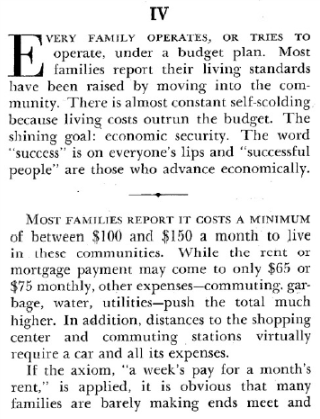
Within a set of observations in Harper’s in 1953 about the new way of life in six mass-produced suburbs, Harry Henderson discusses the financial situation of the new suburbanites:

Henderson1b

Henderson2

Three quick thoughts:

  1. If we still adhered to the guideline of one week’s pay to cover housing, a lot of suburbanites would be in trouble. That rule suggests 20-25% of earnings should be for housing, not 30% which was a more common guideline today. But, with the dearth of affordable housing in many metro areas plus a desire of many suburbanites to be in communities that will help them be successful (i.e. good housing values, high-performing school districts, middle- to upper-class neighbors, a community with a good reputation, etc.).
  2. The desire to achieve the American Dream of owning a home in the suburbs is a powerful one as these residents of mass suburbia were willing to stretch financially – taking on extra work, living with in-laws – to make it happen. I would guess that this is still the case today.
  3. The full article is both an interesting snapshot of suburban life at the beginning of mass suburbia as well as an odd read since it treats suburbia as the exotic. Henderson admits at the beginning that the notes are subjective but they both provide some interesting information as well as provide insights into how outsiders viewed these early suburbs.

Using comic strips to sell the suburbs to millennials

A suburb south of Chicago has a new marketing campaign intended to attract millennial residents:

“Think Homewood” ads, which debuted this month and will run through May, feature three comic strips that focus on affordability, schools, parks, community and creativity. The village, which is about 25 miles south of downtown Chicago, is spending $20,000 on the campaign focused on appealing to millennials…

In those comic panels, two moms stress over registering their kids for schools and park district activities. “I have an alarm set on my phone,” one mom cries when discussing her anxiety about plans to register for a gymnastics class. “If I’m late 30 seconds and miss the window to get a space, I’m so screwed.”

In the other Chicago strip, a dad driving from the grocery store with his wife and toddler shouts, “Frak!” after forgetting avocados for dinner. The couple decide they lack the fortitude to fight traffic and find a parking spot for a return trip to the store. “Goodbye, Taco Night,” an exasperated dad laments.

Those are contrasted with the relatively idyllic “Somewhere in Homewood” strips, where a return to the store for avocados is easy, and the park district has room for another kid in gymnastics even though classes start the next day.

Here is the first strip from ThinkHomewood.com:

https://i0.wp.com/thinkhomewood.com/wp-content/uploads/2018/04/CarCard_Homewood_Strip_1_FINAL-1.jpg

The comic strip seems to hit the right notes regarding one big reason many Americans head for the suburbs: they want a good place to raise a family. Emphasizing safety, lots of green space, good schools, and interesting activities fits into this category.

The strips also highlight a new dimension of suburbs: their growing popularity as cultural and entertainment centers in their own right. While a smaller suburb cannot compete with the restaurant or theater or sports scene in a major city, it can have more cultural amenities. These suburban pockets of fun help move communities past decades-old images of bedroom suburbs where everyone is inside by dinner and nightlife is non-existent. (Of course, most areas in suburbs are relatively quiet places and not every suburb can easily develop a thriving downtown like in Naperville.)

On the downside: many communities have such marketing campaigns. Do they really work? The article goes on to discuss several other Chicago suburbs that have mounted campaigns and the evidence seems thin about whether marketing really attracts people. It is difficult for a smaller suburb to stand out within a region like the Chicago area where there are hundreds of places to live. Would a comic strip be enough to convince people to look in Homewood rather than in dozens of other places?

Finally: do millennials read comic strips like this?

Collecting big data the slow way

One of the interesting side effects of the era of big data is finding out how much information is not actually automatically collected (or is at least not available to the general public or researchers without paying money). A quick example from the work of sociologist Matthew Desmond:

The new data, assembled from about 83 million court records going back to 2000, suggest that the most pervasive problems aren’t necessarily in the most expensive regions. Evictions are accumulating across Michigan and Indiana. And several factors build on one another in Richmond: It’s in the Southeast, where the poverty rates are high and the minimum wage is low; it’s in Virginia, which lacks some tenant rights available in other states; and it’s a city where many poor African-Americans live in low-quality housing with limited means of escaping it.

According to the Eviction Lab, here is how they collected the data:

First, we requested a bulk report of cases directly from courts. These reports included all recorded information related to eviction-related cases. Second, we conducted automated record collection from online portals, via web scraping and text parsing protocols. Third, we partnered with companies that carry out manual collection of records, going directly into the courts and extracting the relevant case information by hand.

In other words, it took a lot of work to put together such a database: various courts, websites, and companies had different pieces of information but a researcher to access all of that data and put them together.

Without a researcher or a company or government body explicitly starting to record or collect certain information, a big dataset on that particular topic will not happen. Someone or some institution, typically with resources at its disposal, needs to set a process into motion. And simply having the data is not enough; it needs to be cleaned up so it all works with the other pieces. Again, from the Eviction Lab:

To create the best estimates, all data we obtained underwent a rigorous cleaning protocol. This included formatting the data so that each observation represented a household; cleaning and standardizing the names and addresses; and dropping duplicate cases. The details of this process can be found in the Methodology Report (PDF).

This all can lead to a fascinating dataset of over 83 million records on an important topic.

We are probably still a ways off from a scenario where this information would automatically become part of a dataset. This data had a definite start and required much work. There are many other areas of social life that require similar efforts before researchers and the public have big data to examine and learn from.

Win political office with low turnout in municipal elections

Even large cities have problems with voter turnout in municipal elections:

Voter turnout in local elections has always been low, and it’s gotten worse in recent decades, studies of voting behavior in municipal elections have shown. In most of the biggest U.S. cities, fewer than one-third of eligible voters turned out in the most recent municipal elections. And according to data culled by researchers at Portland State University, those who do cast ballots in major cities tend to be significantly older than the general population, a factor that might weigh against women and candidates from diverse backgrounds.

My impression of elected officials in suburbs is that a good number get into local elections because they care deeply about an issue. With low turnout, relatively small communities, and a lack of formal political parties (many smaller municipal elections are supposedly non-partisan), it does not take a lot of resources to run for local office.

Of course, some of these variables are different at the big city level: often dominated by partisan politics, a larger need for significant sums of money, and a need to woo tens of thousands of voters. Still, it is notable that the leaders of some of the most important cities in the world can be voted in with votes from a relatively small number of citizens. These local leaders may not be able to easily move into national positions yet their decisions affect residents on a daily basis in a way that more abstract and further removed national politics cannot.

When bricks and mortar stores can’t make it even in Manhattan

Heart of one of the world’s leading global cities, Manhattan has its own struggles with keeping brick and mortar retailers in operation:

That’s right: On a nine-block stretch of what’s arguably the world’s most famous avenue, steps south of the bustling Time Warner Center and the planned new Nordstrom department store, lies a shopping wasteland.

Yes, there are bank branches, restaurants, fast-food outlets, theaters, Duane Reades, a vitamin shop and a few tourist-targeted “discount” stores. But mainly there are oodles of empty spaces covered with signs touting SUPERB CORNER RETAIL OPPORTUNITY.

The same crisis blights the rest of Manhattan. The people invested in storefront retailing — real-estate developers, landlords and retail companies themselves — tell us not to worry. It’s a “transitional” situation that will right itself over time. Authoritative-sounding surveys by real-estate and retail companies claim that Manhattan’s overall vacancy is only just 10 percent.

But they are all wrong. Bricks-and-mortar retail is shrinking so swiftly and on such a wide scale, it’s going to require big changes in how we plan our new buildings and our cities — although nobody wants to admit it.

This is an interesting argument to make: even with all of the tourists, wealth, and attention bestowed upon the borough, retail is disappearing from Manhattan. And if shopping disappears, with shopping being one of the favorite leisure activities of Americans, might this negatively affect the business and social life of a Manhattan used to ultra-busy sidewalks?

On the other hand, Manhattan may not be the best example. The median household income in Manhattan is not as high as one might expect, there is not much of a middle class, and the cost of living is high. Add in that Manhattan does have a lot of tourists, workers that arrive for the day and leave at night, and concentrations of residents in different parts of the island. The sheer density of people might suggest that retailers should be able to make it in Manhattan but it is a complicated place.

More broadly, what will tourist locations of the future look like if even more shopping is done online? For decades, the international tourist destination includes significant amounts of shopping. What would fill that space?

Pneumatic road tubes to count traffic, check speed

Here are the secrets of “those weird black tubes in the road”:

Here’s a good description of the actual operation of the tube setup from the U.S. Department of Transportation:

“Pneumatic road tube sensors send a burst of air pressure along a rubber tube when a vehicle’s tires pass over the tube. The pressure pulse closes an air switch, producing an electrical signal that is transmitted to a counter or analysis software. The pneumatic road tube sensor is portable, using lead-acid, gel, or other rechargeable batteries as a power source.”…

A single pneumatic road tube is most commonly used to simply count the number of cars on the road, as well as time the gaps between individual vehicles.

If two pneumatic road tubes are set up spaced slightly apart, the counter can track the number of axles a vehicle has to better determine each individual vehicle’s class, the direction of traffic and the speed at which vehicles are moving.

A relatively simple device to figure out how many vehicles are on the road. These traffic counts are then very helpful for additional decisions like traffic control, widening or adding to roads, and even thinking about new roadways.

What routes would Waze recommend that drivers would turn down?

The question in the title of this post is prompted by a 32% grade Los Angeles street to which Waze routes drivers:

But residents along Baxter Street in Los Angeles’ Echo Park neighborhood—reportedly one of the steepest streets in America (comprising two major hills)—are now banding together to try to change local traffic patterns. Neighbors have contacted city officials and Waze’s parent company, Google, to try to mitigate the problem…

The street, which dates back to 1872, has a 32-percent grade—more than double what current city law allows for today.

In 2003, the Times described the street this way: “Unsuspecting motorists gasp when they reach the crest and discover the roadway in front of them has dropped out of sight and there is nothing but empty space in front of their car’s hood.”

A decade later, Los Angeles magazine noted:

Baxter later became a proving ground for automobiles, as manufacturers staged elaborate stunts to demonstrate their vehicles’ power. In one such event in 1916, a four-wheel-drive truck loaded with 4,300 pounds of baled hay groaned its way up the grade, pausing twice for newspaper cameras. Nearly 100 years later, Baxter Street continues to bewilder uncertain drivers and confound elongated vehicles.

The appeal of apps like Waze is that drivers can avoid traffic by taking lesser-known routes. While residents may not like this, the more interesting question is how far drivers would let Waze take them. The apocryphal stories of drivers turning into lakes may make more sense when the story begins with a driver frustrated with the ridiculous or unpredictable traffic in many major American metropolitan areas. Would they drive through standing water? (The regular stories of drivers getting stuck on flooded roads suggest yes.) Would they be willing to go off pavement? Would they navigate through extremely tight places? Take a road with a severe and unblocked drop-off? Are there as willing to go through higher-crime areas? Apparently, a 32% grade is not enough so perhaps 40% would be too much?

I know this would not help Waze’s cause but I could imagine the company issuing some sort of award or recognition to users who are most willing to do something unusual to get around traffic.

Do suburbanites watch screeds about suburbia?

I recently read a review of a new documentary that addresses the housing issues and racism of the American suburbs. This led me to a question: do Americans in a largely suburban country watch films that directly criticize the suburbs?

I made a list of the first movies that came to mind as being known for their critique of suburban life. I have also included their box office earnings:

American Beauty – 1999 – $356 million

Far From Heaven – 2002 – $29 million

Pleasantville – 1998 – $49 million

Revolutionary Road – 2008 – $75 million

Stepford Wives – 1975 and 2004 – $4 million, $102 million

This is not an exhaustive list at all though it does quickly become tricky to determine whether a film is truly about suburbia and its way of life or the plot is simply set there.

Two quick thoughts:

  1. There is clearly an audience for such films. Not all of them were blockbusters but they made decent money.
  2. Some more data would be useful such as how much money was made on each film and how these box office figures compare to other films of their time.

Based on the research I have done on suburban-set popular television shows, I would guess television shows that try to critique suburbia do not tend to be popular.