The wildland urban interface often leads to stories about suburbanites encountering animals they might not expect. Recently in the Chicago region: a bison free in the northern suburbs.
One resident in Hawthorn Woods recently captured footage of a buffalo out and about, just walking around. Believe it or not, this isn’t the first time one has been spotted roaming the region.
Vince Clemens noticed the giant animal outside his home Friday, and his daughter, Michelle, captured video of the buffalo just minding its own business.
“I looked outside and saw the buffalo walking down the street,” Vince Clemens told NBC 5. “[She] broke free from a farm months ago, and is no stranger to people in the Northwest Suburbs…”
The wayward animal’s identity hasn’t been confirmed, but some wonder if its “Tyson the Bison.” Tyson escaped last September while being unloaded at her new home at a farm in unincorporated Wauconda.
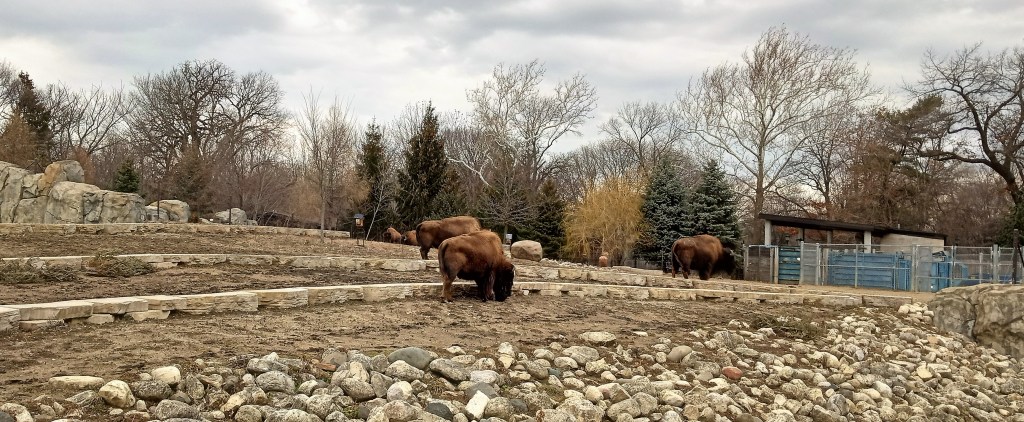
More Americans may be much more familiar with seeing bison in captivity, such as in the zoo as in the picture above. They do not expect them to wander through suburban yards.
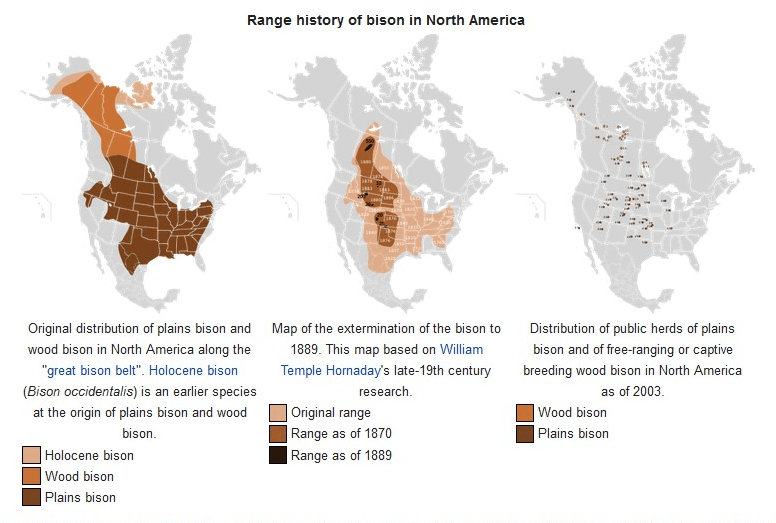
However, bison were regulars in the Chicago region prior to settlement by white Europeans. See these maps from Wikipedia (and the zoo has a similar map):
While bison will not be roaming the suburbs in large numbers anytime soon, suburbanites seem consistently surprised by coyotes and other animals that do not fit their suburban experiences or images. Yet, as the suburbs continue to mature – the Chicago area suburbs are over 150 years old – and nature continues to adapt, the suburban flora and fauna will change.
Without getting into the particular politics of Richard Irvin’s campaign for Illinois governor, it is worth noting the position from which he approaches his run: as mayor of Aurora, Illinois, the largest suburb in the Chicago region and the second largest city in Illinois. Some notes about Aurora and what leading that city might mean for leading Illinois:
-Aurora has unique history. With its location roughly 40 miles outside downtown Chicago, it has an industrial background with its location on the Fox River and its railroad connections. For Naperville residents at the turn of the 20th century, a trip to Aurora along the rail line was a big deal.
-The city experienced a renaissance in recent decades plus high population growth between 1980 and 2010 – going from over 81,000 residents to over 197,000 residents – before a slight downturn in the 2010s to a population of just over 180,000.
-That population growth means Aurora is now solidly the second largest city in Illinois.
-It is a racially diverse suburb with 2021 Census estimates putting the population at 42.7% Latino, 34.9% White alone, 10.5% Black, and 9.3% Asian.
-A relatively recent rebranding campaign took the city’s longtime motto of “The City of Lights” and updated it.
In advertisements, Irvin has highlighted his experience as a mayor of a decent sized city. A governor’s race between a politician identified with Chicago and another identified with the biggest suburb and second biggest city could present some interesting contrasts.
Plans were to raze the majority of the largely vacant mall to make way for 560 apartments and townhouses, a hotel, new restaurants and retail spaces along East Main Street…
“It’s a good plan but the question is, is this the best use of space?” 2nd Ward Alderman Ryan Bongard said at the meeting. “In speaking with constituents, they don’t want to see 500 apartments.”
On Friday, St. Charles Mayor Lora Vitek confirmed the developers have pulled out of the project. The partnership of S.R. Jacobson Development Corporation and Lormax Stern Development Company LLC had previously entered into a purchase agreement for the former Charlestowne Mall property with current owners The Krausz Companies LLC.
In December 2017, Krausz closed Charlestowne’s interior shops and enclosed mall space at the center. Anchors Von Maur and Classic Cinemas Charlestowne 18 remains…
“That’s the overwhelming comment that I have heard through the city council,” Vitek said. “And I do believe that we can try to accomplish that. We shouldn’t settle. We’ve got a lot going for us. We know there needs to be more people here and we’re going to bring residential, but there needs to be a balance over there, too. The east side is very important to our town, but we do want to see the right fit.”
On one hand, I can understand this common suburban concern: if you eliminate commercial property and rezone it for other uses, will you ever get the same amount of money in tax revenues from the property? A successful shopping mall or entertainment area brings in sales tax revenue in addition to paying property taxes.
If drivers have been reluctant to limit their car use and reduce mileage in the past, they now have two headline-making reasons to reconsider: painful prices at the pump and a sobering recent report on climate change.
Meeting both challenges means committing to conservation as individuals — and as a society…
Minimizing driving and maximizing the efficiency of our cars are vital tools in the battles to lower gas bills and protect our planet.
The Daily Herald covers news in the suburbs of Chicago and is based in Arlington Heights, a suburb with a denser downtown roughly 25 miles northwest of Chicago. In other words, they serve an area built on cars and driving. Their headquarters is primarily accessible by cars and is next to a major interstate.
In both cases, suburbanites might not be able to give up cars all together but a household might be able to go from two to one car with less driving. That would reduce pollution, traffic, and parking needs.
However, both of these shifts are significant ones. Denser suburban areas are not necessarily ones with single-family homes on big lots. Denser areas put people in closer proximity to each other. Working from home might be technologically feasible but might not be desirable by corporations and organizations or by communities who relied on commuters and workers. These might be options more available in some communities or some residents rather than to all suburbanites.
The two enclaves of roughly 30,000 people reflect how Black migration patterns in the 21st century are changing the makeup of metropolitan areas nationwide. For decades, Black residents have been leaving some of the nation’s largest cities while suburbs have seen an increase in their Black populations. Those two trends have now spread to even more areas of the country, according to the 2020 U.S. census.
The patterns echo the “white flight” that upended urban landscapes in the 20th century. Like those who left cities before them, Black residents often move because of worries about crime and a desire for reputable schools, affordable housing and amenities. But there are key differences: Leaving Black city neighborhoods that are starved for investment is often more of a necessity than a choice, and those who do settle into new suburban lives often find racial inequities there, too.
From 1990 to 2000, 13 of the United States’ biggest cities lost Black residents. By 2020, it was 23. According to the census, roughly 54% of Black residents within the 100 biggest American metro areas were suburbanites in 2020, up from 43% two decades ago, according to Bill Frey of the Brookings Institution.
While New York, Los Angeles and Philadelphia all lost Black residents from 2010 to 2020, the change was especially notable in Chicago, which gained population but lost 85,000 Black people, the highest number after Detroit, according to the 2020 census. Those numbers could vary slightly, as the Census Bureau reported last week that 3.3% of the Black population was undercounted in the 2020 census, a rate higher than in 2010.
To summarize from the data presented above: among Black residents in the largest metropolitan areas in the United States, the majority now live in the suburbs.
This also adds to the ongoing complexity of the suburbs where populations and communities are changing. The suburbs are not static even as they might as a whole adhere to similar ideals and ways of life.
I don’t know what to make of all this, and I doubt if there is anything to be made. But the behavior on display is, if nothing else, a product of a lack of sense. It’s the agitated, aimless buzzing of the type of crowd that gathers in the aftermath of some bewildering catastrophe. Social scientists have a name for this mode of chaos: They call it “milling.” We are all just chattering away in restless and confused excitement as we try to figure out how to think about what’s happening. We want to understand which outcomes are most likely, and whether we might be obligated to help—by giving money or vowing not to share misinformation or learning the entire history of global conflict so as to avoid saying the wrong thing. We are milling.
The word comes from the mid-20th-century American sociologist Herbert Blumer, who was interested in the process by which crowds converge, during moments of uncertainty and restlessness, on common attitudes and actions. As people mill about the public square, those nearby will be drawn into their behavior, Blumer wrote in 1939. “The primary effect of milling is to make the individuals more sensitive and responsive to one another, so that they become increasingly preoccupied with one another and decreasingly responsive to ordinary objects of stimulation.”
These days, we mill online. For a paper published in 2016, a team of researchers from the University of Washington looked at the spread of rumors and erratic chatter on Twitter about the Boston Marathon bombings in the hours after that event. They described this “milling” as “collective work to make sense of an uncertain space” by interpreting, speculating, theorizing, debating, or challenging presented information.
To apply the term to the current moment may be a little sloppy—for a sociologist, milling would be the precursor to meaningful group action—but it gets across, you know, the current mood. We’re emoting, lecturing, correcting, praising, and debunking. We’re offering up dumb stuff that immediately gets swatted down. (We’re getting “ratioed,” as it’s called on Twitter.) We’re being aimless and embarrassing and loud and responding to each other’s weird behavior. “People are kind of struggling to figure out appropriate ways of responding to this really uncertain situation,” Timothy Recuber, an assistant sociology professor at Smith College, told me. Recuber, who is also the author of Consuming Catastrophe: Mass Culture in America’s Decade of Disaster, is an expert on the role that media play in what he calls “unsettled times.” And in these unsettled times, he said, we’re engaged in something like what Blumer had in mind.
The wisdom of crowds as an emergent property in the midst of uncertainty?
I wonder how this milling has changed over time. Specifically, I am thinking about spatial changes in the United States over the last century or so. Milling could work better when people live either in denser areas or small towns. This could lead to having “the public square” described above for people to gather. In a more suburban setting, where a majority of Americans now live, where would milling take place? Walking outside their house or residence might put them in contact with some neighbors but it would take some driving for many to get to a location where people might gather. Go to the shopping mall? The local library? Walmart?
If suburbanization reduced public spaces for gathering and add to this fewer people going to work during COVID-19, the online sphere offers more opportunities. The physical geography matters less when people can enter an online public square from anywhere. Now, there are numerous public squares available online with certain platforms or sites offering different opportunities and population with which to interact.
How effective is this online milling as opposed to milling in a offline location? In the offline public square, there is an embodied experience with people. The online public square is different with fewer cues from other actors and someone has to say/do something to be recognized.
Bartlett, Bensenville, Elgin, Itasca, Hanover Park, Roselle, Wood Dale and Schaumburg formed the Coalition to Stop CPKC last week in a bid to convince the board that the merger would bring so many additional trains to the Milwaukee West Line that it would dramatically alter life in their communities…
The merger would create the first single-line rail network linking the U.S., Canada and Mexico. The railroads filed the merger application in October.
Each of the eight suburbs conducted evaluations and determined what mitigations would be needed to protect their residents and businesses from the increase in freight traffic. Pileski said Roselle alone would need at least $30 million to create pathways and modify roads to get around the freight trains.
The coalition filing says the potential price tag for mitigations in all eight suburbs could reach $9.5 billion, and negate any benefit to the railroads.
Railroad traffic in many suburbs is viewed negatively due to an increase in blocked crossings or waiting for trains, more noise and pollution, and a disruption to a quiet suburban life. On the other hand, rail traffic helps deliver a lot of goods, can be more efficient than other shipping options, and might limit traffic – train or on roads – elsewhere.
In the larger picture of the Surface Transportation Board, where do the concerns of these 8 suburbs fit with other concerns or advantages regarding this potential merger?
Griffith: There is no easy answer. There are different NIMBYs at play. There are “No wind turbines off my coastline!” NIMBYs. There are “No gas line running through my backyard!” NIMBYs. There are “I don’t like the look of solar cells!” NIMBYs. For those complaining about the view, I would remind them that a huge amount of land is already taken up by our energy-transmission systems. Millions of miles of dedicated coal rail lines and natural-gas pipelines are already strewn across the landscape. They only seem invisible because they’ve blended in over the past century.
Thompson: Okay, if there’s no easy answer, what’s the hard answer?
Griffith: I’m going to give you an answer that I’ve only been thinking about for a few weeks. I think the argument will be won on local economics. If you take a suburb with a thousand homes in it, those families might spend $3.5 million a year on gasoline. When those families fill their car with gas, the money immediately leaves the community and goes to Texas or Saudi Arabia. But if the cars are run on electricity that comes from their own rooftops and houses, then no money is leaving the community. You can take that $3.5 million and build new classrooms. That’s really exciting to me…
Griffith: Electricity literally is the network that connects every home. You are connected to everybody through this thing in your community. And it really might be the opportunity for community renewal that America needs. It might be the thing that binds us back together again. Because it saves us money and has a damn good chance of being bipartisan.
This does seem to be the trick: how to convince the majority of Americans that green energy benefits their daily lives. And if they actually gain money for their own households or for goods they want in their community, this would help. If individual homeowners do not want to take more responsibility for generating electricity (solar panels on the roof), it could devolve into arguing which less fortunate suburb should be home to the solar panels, wind turbines, etc.
“Woodside declared its entire suburban town a mountain lion sanctuary in a deliberate and transparent attempt to avoid complying with SB 9,” California Attorney General Rob Bonta wrote in a letter to notify the town that the move violates state law and must be amended.
After receiving a letter from the attorney general this weekend that threatened further legal action, the town ended its short jaunt into the world of conservation the next day. In a statement on Monday, the council said that the Department of Fish and Wildlife “had advised that the entire Town of Woodside cannot be considered habitat” and that “as such, the Town Council has instructed staff to immediately begin accepting SB 9 applications.”
Woodside is not alone in recent efforts:
Woodside is far from the only town that has attempted to come up with creative ways to block the statewide rezoning law. Since its introduction last year, local governments and homeowner groups have opposed the plan, claiming that it crushes single-family zoning.
There have been at least 40 cases in which towns attempted to block or limit SB 9 housing, according to affordable housing advocacy group Yes in My Back Yard Law.
I would not expect wealthier communities to just go along with new guidelines. The combination of local government authority over zoning plus wealth means that certain communities can delay and/or fight affordable housing or more housing. Or, state legislation or federal guidelines are written in such a way that communities escape scrutiny or any penalties (see the example of Illinois). Is the situation different now in California such that communities will not be able to delay any longer?
More broadly, how much do efforts to conserve open space in suburban areas really take place to protect wildlife and land versus limiting the amount of development? From my research in the Chicago suburbs, I recall numerous efforts to protect open land and expand Forest Preserves. These often occurred during mass suburbanization in the postwar area as open space quickly disappeared among new subdivisions and roads. Open space can help limit the number of nearby residences, reduce noise and traffic, and boost property values by limiting housing supply.
For the residents, it’s one of the most successful experiments ever undertaken in creating a community from scratch…
But critics say there’s something not quite right about The Villages, a sprawling suburb an hour’s drive north of Orlando in Florida…
She likened The Villages to Jim Carrey film The Truman Show about a flawless but ultimately fake town.
The filmmaker has now produced a documentary about the world of The Villages called The Bubble which has its Australian premiere at this month’s Sydney Antenna documentary film festival…
Days for its residents are crammed with exhausting rounds of golf, cardio drumming, belly dancing and cheerleading lessons, even synchronised golf cart displays. And day drinking – lots and lots of day drinking…
The company that runs The Villages were none too keen on Ms Blankenbyl and her film crew’s presence.
On one hand, this is a familiar suburban story told for decades: the suburbs present themselves as the place for happy and successful family life. They aim to be green, quiet, and friendly. But, are they really? When a crime is committed, this might be a crack in the facade. Or, family life is not what it seems. Or, the community is built on the basis of exclusion and who is not welcome and/or present. There are plenty of real-life examples of this plus numerous films, novels, and stories that explore these themes.
On the other hand, The Villages appears to have some unique features that might set it apart from typical suburban experiences. It is a 55+ community which changes the entire social structure. The American suburbs broadly are built around protecting children and providing them room to thrive and succeed. It is in Florida so there is warmth and sun in levels that many suburbs cannot match. It is relatively new with a limited history and set of traditions and practices plus a particular architectural and natural approach that still looks new.
Is it a bubble? Many middle to upper-class suburbs might be accused of this. Is it different than many suburbs? Just by its population composition, yes. I look forward to seeing this documentary and thinking about it more.







 Legally Sociable