Plopping a New Urbanist metroburb into the middle of sprawling suburbia

I recently discussed plans for a “metroburb” to replace a sizable AT&T office campus in Hoffman Estates. Reading more about the proposal, I wondered: does it really work to put a New Urbanist development right in the middle of suburbia?

Under Zucker’s plan, which would rename the former campus City Works, the four-level, 1.3 million-square-foot main building would house offices of varying sizes and shops. About 175 townhouses and 375 multifamily rental units would be constructed on the edges of the property. The estimated total cost is about $250 million. Unlike a typical suburban subdivision, the town homes would line straight streets and have alleys…

Zucker, 57, is a devotee of the New Urbanism, the urban planning movement that seeks to replace the car-oriented monotony of suburban sprawl with lively, mixed-use streetscapes that encourage walking and the formation of community.

Chicago suburbs like Arlington Heights have put New Urbanist thinking to use in greenlighting high-rise housing near train stations. That approach is called transit-oriented development, or TOD. Under Zucker’s plan, Hoffman Estates, which doesn’t have its own train station, would do a variation of transit-oriented development.

“Taking the TOD (elements) and putting them inside a building is really the novel part of this,” said Jim Norris, the suburb’s village manager.

While this may be a clever use of what is a large facility, the overall fit between the redevelopment and the surrounding area could be less than ideal. Here is why:

  1. They want to include transit-oriented development elements even though there is no mass transit nearby. Indeed, this office corridor owes much to roads and Interstate. This could represent an opportunity to push for mass transit to the area: rapid buses along major roads? light rail?
  2. It seems like much of the redevelopment is focused on orienting residents, customers, and workers to the original large facility. While this may be a good use of the existing space, how many people from outside of this development will come in? Will this just be a self-contained area?
  3. The new tissue intended to connect the redeveloped area – walkable streets, alleys, interesting places to go – may or may not connect with anything beyond this development. This happens sometimes with suburban New Urbanist developments; they look and feel great on the inside but then have little interaction with the terrain that surrounds them. In other words, it requires requires a car to get to these interesting New Urbanist areas.

In the long run, a redevelopment that has a more permeable edge as well as is situated in a community that truly wants more New Urbanist development overall rather than in just an isolated location could lead to better outcomes.
A lottery for limited affordable housing, part two

A story about a lottery for 95 affordable housing units in San Francisco discusses the technique of using a lottery to award limited goods and how the lottery happens:

Lotteries that allocate scarce resources are not set up to distinguish the neediest from the merely needy. Rather, they reward random chance, which is a distinctly different notion of what’s “fair.”…

For years, San Francisco conducted public lotteries in a bingo drum. But the raffle tickets were always getting stuck in the drum’s crevices. The city also tried a big box. People couldn’t see what was happening inside, however, and tickets got stuck under the lid.

This exercise — rolling the drum, shaking the box, inspecting for trapped tickets and repeating — lasted hours on a building the size of Natalie Gubb Commons. Ms. Torres would bus around town, picking up applications, dropping off applications. Lines would wrap around some developers’ offices on deadline day….

Last year, San Francisco moved the whole process online. Renters can now more easily apply, which means that more do, and the odds have grown longer. But the system is more humane. The parts of the process where it has been most awkwardly apparent that people in need are competing are now less visible. The city still holds public lotteries, but they are primarily pep talks.

Three things jumped out at me about the lottery process and how it is presented:

  1. On one hand, a lottery can seem fair in this situation. How else would would limited public goods be fairly split up? We know that in regular life, having more resources and better connections tends to lead to more opportunities. For people with fewer resources and fewer connections to powerful people, isn’t a lottery fair?
  2. On the other hand, having to go through a lottery for something as basic as an affordable place to live seems crazy. The documentary Waiting for “Superman” used the lottery for a good school very effectively in its plot. By starting and end with the image of honest American families simply trying to get a good education for their kids through a lottery, it all looks absurd. The lottery itself is an excellent argument for why more affordable housing is needed.
  3. The actual mechanics of lottery are intriguing. A public drawing has a lot of potential for drama, both with images of excitement and disappointment. (Again, Waiting for “Superman” played this up.) But, actually having a fair system of drawing names is more difficult than it looks. And how can the applicants be reassured that it is an effective process? The shift to online makes some sense and yet I could imagine the process now looks even less transparent. How do we know the online system isn’t rigged? Is it truly random? What if the algorithm is biased?

I know waiting lists are commonly used for housing spots – and this has the advantage that Americans often like that people should at least have to put effort into getting on the list – but a lottery has both strengths and weaknesses.

Saving 40 gallons a week in water when I pay low prices per 1000 gallons every two months

I recently used a body wash that said on the back: “Did you know by reducing your shower by 2 minutes you can save an average of 40 gallons of water/week?” Water conservation is a laudable goal. Yet, the way our water bill was structured in our previous homes – the prices plus the measurement of the water use – illustrates how it can be difficult to convince Americans to use less water.

In our former home, our bill was structured this way:

  • We paid every two months.
  • The water use was measured in 1000s of gallons. For a family of three, we regularly used 9,000-10,000 gallons.
  • We paid $1.50 for 1,000 gallons of water and $2.98 for 1,000 gallons of sewer usage.

Several features of this structure would make it more difficult to care about conservation:

  • A two month time period was too long to see real changes in the bill. A significant change in water usage, say from watering plants during a hot period or the presence of visitors, would not create that much change over two months.
  • Using 40 gallons less water per week would only lead to 320 less gallons over two months. This might affect a bill but only by one 1000 unit of water, if at all. This is too large of a unit for residents to think about. Our current water usage is measured in 100 cu feet of water, a unit that is very difficult to visualize or connect to everyday usage.
  • The water price was really cheap. If we used 3,000 more gallons over two months, the cost was minimal: $4.50 in added costs for water and $8.94 in added sewer costs. The financial incentive to save water is reduced at such cheap rates.

A number of scholars have argued that Americans pay too little for water. This has negative consequences, such as wealthier residents using more water and cities losing lots of water before it gets to users. These problems could be addressed, even without immediately jumping to higher prices. Some of these techniques are already in use with utility bills:

  • Bill users more frequently (monthly).
  • Provide ways to show real-time water use.
  • Compare users to other nearby users. This can help people who use a lot of water see “more normal” use.
  • Show the bill in smaller water units that make sense to people. What is 1,000 gallons?

Raising prices could help too.

A lottery for limited affordable housing housing, part one

Affordable housing is in short supply in numerous American cities and an example of a lottery for 95 affordable housing units in San Francisco illustrates the issue:

Subsidized housing is often rationed this way, by lottery. Many apply, few win, most are disappointed. The process is meant to be more fair than first-come, first-served. But lotteries make literal a deeper unfairness. For homeowners, the mortgage interest deduction is available to anyone who qualifies. For poor renters, there is never enough housing assistance to go around…

Amid all the wealth in this neighborhood, a one-bedroom at Natalie Gubb Commons would rent for around $1,000 to $1,200 a month, a three-bedroom up to $1,700. Apartments next door were three times as much.

That discount is possible through a mix of resources. Mercy Housing, the project’s nonprofit developer, effectively got the land free as part of a city requirement that the neighborhood’s redevelopment include affordable housing. The market-rate developer next door was subsidizing the project, along with city funds. Revenue from the state’s cap-and-trade emissions program helped. And Mercy used the backbone of nearly every affordable housing project in America, federal Low-Income Housing Tax Credits

But the tax bill’s implications for poor renters will be more profound. The odds are likely to grow worse than these: Last year, 53 households applied per each new affordable unit at The Meridian in Los Angeles; 84 for every home at Parcel 25 in Boston; 391 for each unit at Stargell Commons in Alameda, Calif.; 979 for every home at Our Lady of Lourdes Apartments in New York.

This is a reminder of both the acute need for affordable housing in more expensive cities as well as the limited approach to the issue from the federal government. Places that are often held out as the promise of America for their cultural diversity as well as their economic potential – such as San Francisco, New York, Los Angeles, etc. – are often difficult places for those who are middle-class and below.

Additionally, the federal government has never wholeheartedly committed to helping provide housing for all. As the article notes, American housing policy subsidizes single-family homes. This has been an intentional policy choice for decades, beginning before the post World War II suburban boom and then continuing through mass suburbanization as well as into the twenty-first century. It would be difficult to have a direct national political conversation about this since it tends to happen through elected representatives who rarely discuss housing and through various government agencies. Also, it is hard to know whether all those people who have moved to single-family homes in the suburbs have done so because that is what they truly wanted among numerous equal options or they were pushed to some degree by the political and cultural leanings in those directions.

There is another intriguing aspect of this article: both how the lottery is discussed as well as how the lottery is conducted. More on this in a post in a few days.

Fighting homelessness without building homes

A piece at McSweeney’s lists reasons residents do not want to build more housing near them:

Ending homelessness doesn’t mean building more homes because this town is full of homes already, especially mine, which is a single-family mini-mansion on an acre lot that I inherited from my parents and/or managed to purchase with the kind of job and bank terms and economic equality that don’t exist anymore for anyone and only ever really existed for well-educated white Americans. Either that or it’s a magnificent luxury condo with expansive views that I don’t want marred by more luxury condos or — god forbid — affordable housing.

Every room in my Instagram-worthy abode is either filled with clutter or rented out nightly to hipsters from another gentrified, monotone city also suffering from a homelessness crisis — this is a national epidemic, after all. I’m a good person, a generous person, and what made me the person I am is having to work hard for everything my parents gave me, and everything I will, in turn, give to my children.

Listen, I know that the unholy concentration of wealth in America is a big, big, problem, but so is having to constantly say no to people asking for change as I whizz into Whole Foods in my Tesla or Prius (depending on how my startup investments pan out). What’s the point of having all this money if I have to feel bad about it? Also, has anyone actually verified that the homeless people claiming to be veterans aren’t just pulling some elaborate fraud? I’ve never actually met a veteran and I forget for like, decades at a time that the military even exists because the bubble of privilege where I reside is literally impregnable, but I’m suspicious nonetheless.

I know we need more housing, but I was here first and I’m not giving up even one blade of grass on my water-guzzling, pesticide-leaching lawn or a single burner on my twelve-burner Viking range that I never actually use to house another human soul. Tough luck, homeless people. You and your allies can call me names but I won’t hear you over the lushness of my climate-inappropriate rose bushes and the stucco walls I’m paying some desperate immigrant under the table to build for me on the cheap before I low-key call ICE and have them deported.

I’m not sure this has to be tied to addressing homelessness; many communities and communities do not want to support cheaper or affordable housing. The public arguments may be couched a bit differently than what is listed above – such housing could affect the character of the community, lower property values – but one does wonder how much of what is written above is what is really behind the opposition.

Explaining why traffic deaths are up 46% since 2009

In 2016, 5,987 American pedestrians were killed. Why so many?

Distraction behind the wheel, texting while walking and even marijuana legalization have all been tagged as potential culprits in past research.

In addition, a new study released Tuesday by the Insurance Institute for Highway Safety shows an 81% increase in single-vehicle pedestrian fatalities involving SUVs between 2009 and 2016, based on federal records…

The USA Today Network is investigating the phenomenon of rising pedestrian fatalities, an urban problem primarily plaguing either cities with high poverty rates or warm-weather spots such as Florida and Arizona. Our analysis so far has found that African Americans are killed at a disproportionate rate compared with their population nationwide.

Nationally, more pedestrians die in collisions when they are jaywalking along busy arterial roads. More of those fatalities also occur at night and involve males. Many of these crashes also involve alcohol, though federal safety researchers say that does not explain the increase. In 2016, pedestrians accounted for 16% of traffic deaths; in 2007, that figure was just 11%, according to NHTSA.

I am a little surprised to see that increased driving is not cited here. While driving dipped during the economic crisis, it is up to record levels in recent years.

While the emphasis here is on the upward trend in recent years, the numbers overall are a reminder of the consequences of such a strong emphasis on driving in American society. Roadways are built primarily for cars. Even when there is infrastructure for pedestrians and other non motor vehicles, it can be daunting to not be a car. Countering this could require extensive marketing campaigns; this article discusses efforts in several large cities. But, a significant change in favor of non-vehicles would truly require not just publicity but redesign and the reshaping of lifestyles.


Could Americans be convinced to use buses by new technology?

Technological advances to buses might make them more attractive…or they might not. Here are the five new features:

Electrification

Autonomy

Minibus/trackless train

Seamless payment

Accessbility

Two things stand out to me from the argument:

  1. Newer technology tends to make things more attractive in society. This does appear to be a general pattern though I am not sure technology alone could overcome misgivings wealthier Americans have about buses.
  2. The shifts described here tend to reduce some of the features that might be less attractive about buses: they would not be as large and they would be less tied to particular routes. This makes them less like traditional buses and more like large vans that have flexibility.

One aspect of mass transit to which I’m surprised there is not more discussion of in this argument is whether these smaller and more flexible buses would be faster for users. If so, this could be a tremendous plus. One of the promises of self-driving vehicles is that traffic flow could be better coordinated and would not be affected by drivers slowing things down.

Testing play streets in Los Angeles

The city of Los Angeles, known for its highways and roads, is trying to turn some of its streets into areas for fun and community activity:

There are roughly 7,500 miles of streets in Los Angeles, and Fickett Street is only one of them. But in this predominantly Latino neighborhood where parks are scarce, residents and activists have begun a design intervention to reclaim streets for civic life, kibitzing and play. From London to Los Angeles, the play street concept, known as “playing out” in England, has become an international movement of sorts, especially in low-income communities that lack green space and other amenities.

The efforts in Boyle Heights, a 6 ½-mile area bisected by six freeways, is a collaboration between Union de Vecinos, a group of neighborhood leaders, and the Kounkuey Design Initiative, or KDI, a nonprofit public interest design firm that helps underserved communities realize ideas for productive public spaces.

The Los Angeles Department of Transportation has invested $300,000 on 15 KDI-designed pilot play streets this year in Boyle Heights and Koreatown, another heavily trafficked neighborhood. Seleta Reynolds, the general manager of the LADOT, first became aware of the concept while visiting Copenhagen…

On a recent Sunday, Kounkuey unveiled its “playground in a box.” Shade structures stretched across Fickett Street, affixed to loquat trees and no-parking signs, and the plastic “wobbles” created by KDI doubled as Tilt-a-Whirls, BarcaLoungers, and formidable hurdles for teenage skateboarders. Nine-year-old Amanda Alvarado built a McMansion. “Ava, lookit!” she exclaimed to her 4-year-old sidekick in pink pom-pom slippers.

This is a clever idea for two reasons. First, it transforms what is typically a thoroughfare for cars into a space for community life. Many American neighborhoods and communities are full of roads and planning that emphasizes the efficiency of getting vehicles from Point A to Point B. Even if the effort is temporary, the transformation can be a powerful symbol. Second, it does not require long-term investments into new spaces or architecture. The road already exists. Bringing in the equipment takes some work but it is portable and can also be used elsewhere.

At the same time, this seems like an incomplete concept. It feels like a small band-aid for larger issues. As the article goes on to talk about, in a neighborhood bisected by highways, lacking green space, and pushing back against gentrification, couldn’t more be done? How about permanent parks?

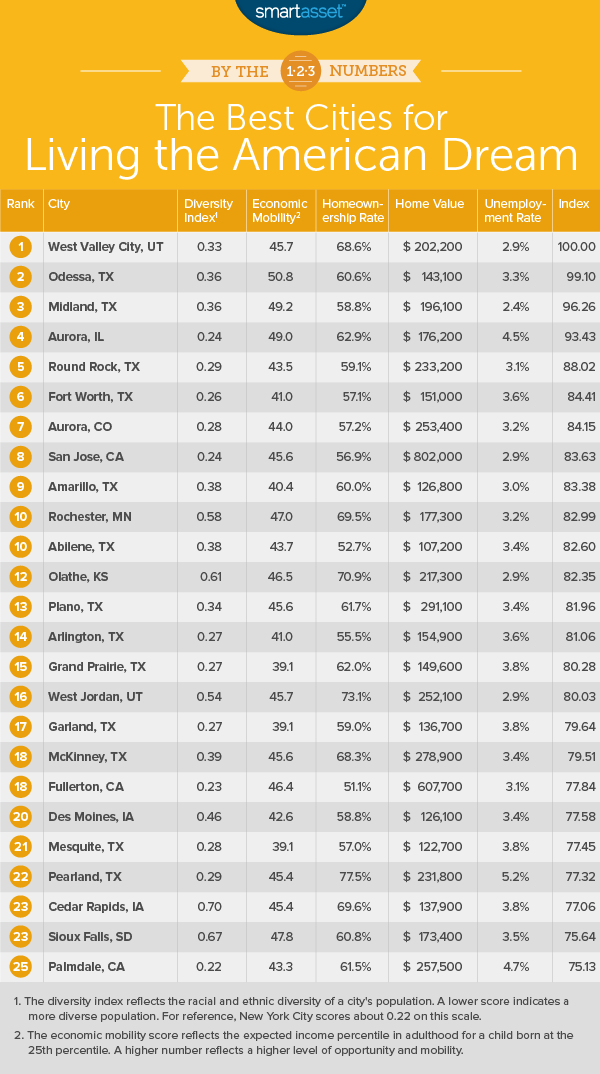
Five variables to determine “The Best Cities for Living the American Dream”

SmartAsset released their 2018 rankings for “The Best Cities for Living the American Dream.” Here are the top cities and the factors they used to develop the rankings:

Best Cities for Living the American Dream

Diversity score. To create this statistic, we looked at the population percentage of different racial and ethnic groups in each city. A lower number represents more diversity. Data comes from the U.S. Census Bureau’s 2016 1-year American Community Survey.

Economic mobility. This metric looks at generational change in economic position for families. A higher number shows greater mobility. Data comes from The Equality of Opportunity Project.

Homeownership rate. This is the percent of households who own their home. Data comes from the Census Bureau’s 2016 1-year American Community Survey.

Home value. This is the median home value in every city. For this study, a lower home value is considered better as we use it as a measure of affordability. Data comes from the Census Bureau’s 1-year American Community Survey.

Unemployment rate. This is the unemployment rate by county. Data comes from the Bureau of Labor Statistics and is for January 2018.

Several quick thoughts:

  1. The five measures seem to make sense. You could quibble with different aspects, such as measuring the unemployment rate at the county level rather than the city or metropolitan region.
  2. What would make sense to add to this list of five measures? There is no measure of educational achievement on this list and it might be interesting to consider the foreign-born population in each place (particularly since the foreign-born population is at a high in American history). Do lower taxes matter?
  3. The list is skewed away from two areas: (a) the East and West coasts and (b) the biggest American cities. I would imagine the coastal cities have difficulty with home values. However, it is less obvious to me why the biggest cities, particularly those in the South and Midwest, do not make the top of these rankings.
  4. How many Americans would give up where they currently live to move to one of these places that supposedly offers a better chance at finding the American Dream? Some experts suggest Americans should simply go where there are opportunities, whether these are jobs, cheaper housing, or less taxes. Yet, it is not necessarily easy to just pick and go, particularly to places like these that might not be very well known. (And, it could also be the case that a large influx of people to each of these top-ranked locations would influence these places.)

The number of dandelions in the yard as an indicator of social class

It is the time of year around here when dandelions are sprouting now that we have some warmer weather and rain. If you walk, bike, or drive around, it is not hard to spot stark differences between yards with no dandelions and those with a lot of dandelions. Here are some quick connections between the number of dandelions and social class:

  1. There are certain expectations in the United States, particularly in suburbs, about lawns. Americans are obsessed with lawns: it must be green (even under drought conditions), of a certain height (lest you violate local ordinances), and free of weeds. It is big business to help Americans keep their lawn looking good. Residents experience pressure from neighbors to keep their lawn nice. Even senators can be attacked for not keeping their lawn in a way that pleases the neighbors.
  2. Those with more money can more easily (a) pay for lawn care and treatments as well as (b) pay for lawn care products that they apply themselves. It is not necessarily cheap to keep a pristine lawn. It is not just a matter of avoiding dandelions but having lush greenery all around, consistency in the kind of grass, and a regularly manicured height.
  3. A nicer and larger lawn is connected to wealth and social class. It is a signal of the homeowner’s ability to tame and maintain nature. It supposedly shows they care about their property. It suggests they want to present a tidy image, which is always connected to property values.
  4. As a test of numbers 1-3 above, imagine trying to sell a decent priced house in a major metropolitan area where the yard is just covered in dandelions. Even if the house is in good shape, wouldn’t all those dandelions harm the image of the home? How many realtors would want to present an image of a lawn filled with dandelions to prospective buyers?
  5. Homeowner’s associations for townhouses, condos, apartments, and houses tend to do a good job of keeping dandelions in check. I assume this has to do with keeping up a positive appearance for the community. Fewer dandelions means a better image, more exclusivity, and higher rents or prices.
  6. The landscaping on our campus tends to look really good around graduation time when plenty of families and visitors are in town. The dandelions are largely in check.

In sum, I would suggest that the dandelion-free yard is yet another American status symbol. Just as people passing by might infer the social class of residents based on the size of the dwelling and the exterior appearance and the cars in the driveway, the number of dandelions may be used as a marker of social class.

(There certainly could additional factors that influence the number of dandelions in the yard. In addition to resources as noted above, addressing the dandelions requires time and physical ability which could be in short supply for a variety of reasons.)