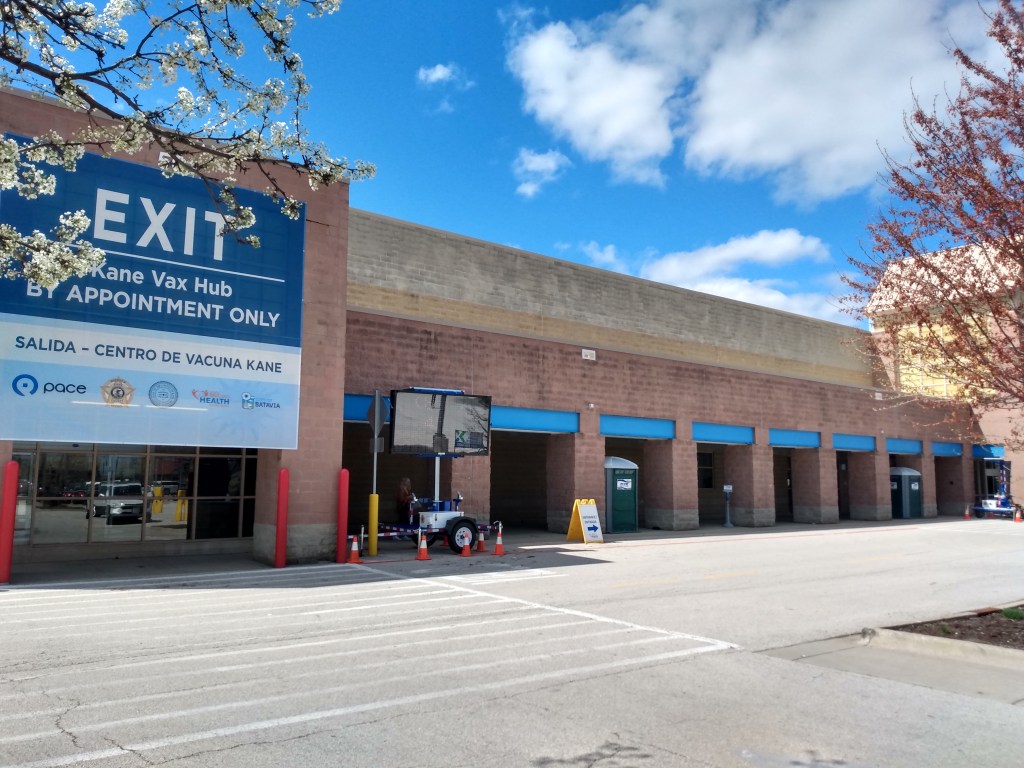
Suburbs do not like having vacant big box stores. Yet, in the time of COVID-19, they can be useful for vaccinating large numbers of people. Here is the former Sam’s Club where I received my vaccines:
This empty building sits within a busy strip of big box stores on a busy road. The Walmart next door is doing fine as is the Home Depot a little bit to the north. But, this facility can now serve hundreds of people a day. There is plenty of room for the various stations necessary to receive the vaccine including processing paperwork, getting the shot, and waiting afterward to see if there are any side effects. Indeed, there is room to spare as it appears roughly half of the floor space is unused.
Of course, this was not the intended use of the building. It was meant to be a place of commerce, specifically a site where people could buy cheap goods in large quantities inside spartan conditions. The store would have generated a good amount of sales tax money for the municipality and other governments, particularly on weekends when the number of shoppers would lead to busy aisles and checkout lines.
Spacious buildings, ample parking and easily accessible locations make vacant big-box stores good places to get shots in arms fast. That’s brought crowds back to some properties left empty even before the coronavirus pandemic heightened challenges for bricks-and-mortar retailers as people stayed home.
But vaccination sites are only a temporary fix for landlords trying to figure out how to reinvent spaces as retailers increasingly look to smaller stores and online sales.
Once the vaccinations are over – hopefully soon – the push will be back on to fill these spaces.
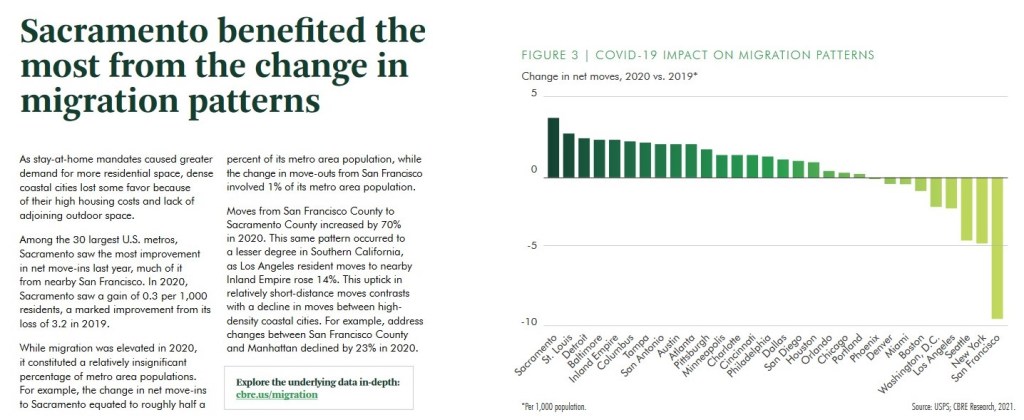
In this comparison of 2020 and 2019 migration data, several big cities fared the worst: San Francisco, New York, Seattle, Los Angeles, and Washington, D.C. Sacramento did well because of spillover effects from the Bay Area.
By analysing US Postal Service address changes over the last 12 months, the study reveals the greatest out-migration of people is, as expected, from Manhattan, with nine of the 10 zip codes with the largest outflows of residents in the city located in the borough…
In terms of hard numbers, the four zip codes in Manhattan from the Hudson to the East River between 42nd Street and 59th Street lost more than 12,000 residents in 2020. In 2019 that figure was less than 3,000…
The streets may have felt even emptier than the data implies, as the study only looked at permanent address changes – the total number of those who left the city for significant portions of the pandemic is likely much higher. Many more people temporarily left to stay with family or at seasonal rentals…
Talk of an exodus from New York may be a little exaggerated as 41 per cent of Manhattan residents who moved in 2020 stayed in the borough, presumably taking advantage of cheaper rents to upgrade their living space. Prior to Covid, this figure was just below 50 per cent.
The last part quoted above is important: the number of permanent address changes was smaller than it may have appeared. Plenty of people left Manhattan and other urban locations but they did not necessarily give up on their property and may return when COVID-19 fades away. Similarly, the impact on suburbs that took in new residents during COVID-19 may then also see population shifts after COVID-19 as people return to urban neighborhoods.
Próspera is the first project to gain approval from Honduras to start a privately governed charter city, under a national program started in 2013. It has its own constitution of sorts and a 3,500-page legal code with frameworks for political representation and the resolution of legal disputes, as well as minimum wage (higher than Honduras’s) and income taxes (lower in most cases). After nearly half a decade of development, the settlement will announce next week that it will begin considering applications from potential residents this summer.
The first colonists will be e-residents. Próspera doesn’t yet have housing ready to be occupied. But even after the site is built out, most constituents will never set foot on local soil, says Erick Brimen, its main proprietor. Instead, Brimen expects about two-thirds of Prósperans to sign up for residency in order to incorporate businesses there or take jobs with local employers while living elsewhere…
The idea behind charter cities, along with their predecessor seasteading, which sought to create independent nations floating in the ocean, is to compete for citizens through innovative, business-friendly governing systems. For some reason, the idea has long been linked to Honduras, an impoverished country whose governing system is classified as “partly free” by the human rights organization Freedom House. Paul Romer, an American economist who pioneered the idea of charter cities, tried to start one in the country a decade ago. It failed, but Honduras has spent much of the time since then writing a law to enable such cities, which are known in the country as Zedes, short for zonas de empleo y dessarollo económicos (employment and economic development zones).
But the prospect of creating pockets of prosperity that play by their own rules is controversial for obvious reasons. Próspera has drawn protests from local residents who see a lack of transparency and little to gain from its existence, and a group of local political leaders signed a letter of opposition in October. This month, an arm of the Technical University of Munich said it’s reevaluating its relationship with Próspera and that it generally withdraws from projects if there are indications of human rights violations. Representatives for TUM didn’t respond to requests to elaborate. A spokeswoman for Próspera says it has had a “great working relationship with TUM over the years.”
Although this city has been in the works for years, it seems appropriate that is will open for remote businesses in the COVID-19 era. Even without a physical presence in the city, corporations will be able to incorporate there and enjoy the benefits.
Down the road, it is interesting to imagine what a thriving or beleagured charter city could be like. For some reason, I am thinking of some of the more colorful communities from Star Wars where all sorts of characters come together to conduct their activities. How many people would come to live and work versus how many will access the city’s benefits from afar? What kinds of alterations to the regulations might be necessary? How many free market cities might this inspire elsewhere?
Local battles over COVID-19. With disagreement with and mistrust of national responses, local elections offer an opportunity to weight in on local responses. In particular, decisions about school reopenings are hot issues in elections for school boards. Add in debates about local businesses and eateries and voters might want to weigh in.
Carryover from national elections and political polarization. Traditionally, local elections are non-partisan. Yet, the rancor at the higher levels could carry over. For example, I saw a large sign today looking to turn township positions blue. How much local officials might actually be able to do in regards to these debates is likely limited but it could help some voters and officials feel better.
The activism of Black Lives Matter in suburbs plus responses to it could send more voters to the polls. How should communities address inequalities or disparities?
Concern about municipal budgets. COVID-19 has created new problems and a number of communities already faced issues. How should money be spent and what could be done to bring in more revenue? The competition might just be heating up among suburbs to find government and tax revenues.
In other words, these are not typical local elections during good times. The local election turnout malaise might not be there. Since suburbanites tend to like local government, will they turn out this time when there are multiple pressing issues?
Today, if you’re looking for one, you’re likely to see only about half as many homes for sale as were available last winter, according to data from Altos Research, a firm that tracks the market nationwide. That’s a record-shattering decline in inventory, following years of steady erosion…
There are lots of steps along the “property ladder,” as Professor Keys put it, that are hard to imagine people taking mid-pandemic: Who would move into an assisted living facility or nursing home right now (freeing up a longtime family home)? Who would commit to a “forever home” (freeing up their starter house) when it’s unclear what remote work will look like in six months?…
For more than a decade, less housing has been built relative to historical averages. The housing crash decimated the home building industry and pushed many construction workers into other jobs. Local building restrictions and neighbor objections have slowed new construction. President Trump’s strict immigration policies further restricted the labor supply in the industry, and his tariffs pushed up the price of building materials…
Right now, in a number of metro areas, home prices and rents aren’t just drifting apart; they’re moving in opposite directions. Prices are rising while rents are falling.
The article ends on a note of uncertainty: where might the housing market go from here? But, I wonder if it is worth digging more into the past to think about how we got here. Several things come to mind:
COVID-19 is a very unique situation. As the article notes, this seems to have affected rental and home prices in different ways as suddenly people were interested in homes in particular areas and not so interested in rental properties in other areas. Figuring out the long-term effects of this will take time; will people return back to work in big offices, whether in the city or suburban office parks? Is this a significant change or will markets return back to earlier patterns with more time removed from COVID-19?
That’s where I think [Victor] Turner [the cultural anthropologist who talks about “liminal spaces”] is so helpful. In the betwixt and between moments—these liminal moments—when the old rules don’t count anymore, and the communities the people belong to break down. That’s where we are now. We’re alone. We thought we identified with a certain kind of Americanness, and now, no. The communities we belonged to don’t make sense to us the way they did before. Organizations we belonged to we now see, well, that might’ve been a racist organization. Things are up for grabs. I saw that in May of 1968, and I see that now. That’s a moment of deep loneliness, and deep anguish. And I think we’re going to come out of this and really have an opportunity to create new kinds of bonds and new kinds of friendships and new kinds of affiliations. We’re so yearning for each other, and the boundaries that we usually put up with each other are much more permeable. And I think that there’s a possibility for very deep connection. That’s my good news story. I think when we emerge, we’re going to look at each other and say, “Well, what are we going to do next?”
The development of mass media, television, computers, the Internet, and social media have contributed to feeling alone. At the same time, trust in institutions has declined, people are engaged less in communities, individualism and autonomy are prized, and inequality is visible.
As Turkle asks, is the answer in more technology? Chat bots? Robots living among us? Friendlier social media? Or, a return to embodied interactions and engaging other humans? In her earlier work, Turkle describes the differences in interactions people have with technology opposed to people. She describes some of that again earlier in the interview:
He wanted my comment: Why are all of these people talking to Replika in the middle of the pandemic? They’re all using it as a friend, as a therapist, this thing where you’re talking to a machine. So, not to be a spoilsport, I decided to see what’s up. So I go online and I make a Replika. I make as nice a Replika as I can possibly make, and I said, “I want to talk to you about the thing that’s most on my mind.” It says, “Oh, absolutely.” So I say, “OK, well, I’m lonely. Can you talk to me about loneliness? I’m living here alone. I’m managing, but I’m lonely.” It says, “Oh, absolutely.” So I said, “OK, well, what do you know about loneliness?” And she says, “It’s warm and fuzzy.”
I thought, this is too stupid. This must be a bug. But I got back to the New York Times reporter and I said, look, if you want to talk about your problems, if you’re lonely, if you’re fearing death—you really have to talk to somebody who has a body. It has to be somebody with some skin in the game. Pretend empathy is not what people need right now. And pretend empathy is what it is. If we just give our children and ourselves pretend empathy, we’re in risk of losing our sensibility for how important the real thing is. I think that’s a big danger. That we get so enamored with what machines can do that we forget what only people can do.
COVID-19 presents an opportunity to reassess these patterns. And the common prediction seems to be that people will very much enjoy interaction again after COVID-19 fades away. But, how long will this last? Will we try to return to pre-COVID normal or dig deeper to restore human connections? In a society enamored with technology, it can be hard to imagine this path back even in the wake of a global pandemic.
Adding to the pressure has been the migration back to city centers of a segment of the country’s affluent people. But David Simon, son of the company’s founder and CEO, said on a conference call with Wall Street analysts Monday evening that trend had been overblown.
“All of the urbanization two, three, four years ago, the question was, Why are the suburbs going to exist? Everybody is going to live in urban environments, yada, yada, yada,” Simon said. “I’m telling you the suburbs are going to be hot, and our quality real estate is going to be where the action is.”
Putting aside data proving the rebirth of city centers over the last 20 years, even if there is a boom in the suburbs that are home to Simon malls, the bigger question is whether the developer can reinvent those properties adequately given retail’s changed landscape…
For now, Simon seems to be holding its own. After a difficult spring in which many of its tenants, notably Gap Inc., withheld rent while stores were closed for weeks on end, Simon has collected 90% of billed rent for the past three quarters. The company reported today that it has given tenants about $400 million in rent abatements and another $310 million in deferments.
It will be interesting to see how this plays out. Multiple issues need to be resolved:
Can the retail market steady or rebound? Will the problems of COVID-19 keep going or permanently push shoppers to online platforms?
Can malls both shift their focus from retail to other uses, including food, entertainment, community spaces, and residences, quickly enough even as they search for the magic formulas that will keep people coming in?
Will many malls face big problems while some in wealthier areas and with deeper pocketbooks survive?
Might a growing suburban population boost the chances of all malls?
Is the shopping mall a destination of the past? For a few decades they were an exciting place but now no longer have the same buzz.
Given all of this, I would not be so optimistic. Perhaps Simon has a big plan and thinks it can revive their malls. If people are interested in the suburbs again, there might be a glimmer of hope: make some strategic changes at certain malls, become a destination in a way that single-use suburban properties cannot easily match, and try to capitalize on land that could be valuable because of its location.
About 1,166 people died in motor vehicle crashes in Illinois in 2020, a nearly 16% increase over 2019, according to the Illinois Department of Transportation. That’s a provisional number, said IDOT spokesperson Guy Tridgell, since it takes the state agency 12-18 months to finalize annual data…
Speeding and traffic fatalities typically go down during recessions, according to an October study published by the National Highway Traffic Safety Administration. In Illinois, for example, deaths dipped sharply in 2008 and 2009 according to state data, though they’ve been up slightly since…
About 28,190 people died in crashes from January to September 2020, more than a thousand more fatalities than in the same period in 2019, the federal agency estimated. A full annual report is expected to be released in the late fall…
What’s more, traffic deaths nationally were down from March to May, but jumped back up after states began reopening in June, according to the agency’s estimates.
This suggests safety is not solely a function of the number of miles driven or trips taken. How people drive and the conditions matter quite a bit. In this case, the article hints at multiple possible reasons for this jump. This includes speeding, more impaired drivers, and less seat belt use among those hurt.
I wonder if there are several other factors at play. With many public and private locations shut down, did driving become an even more important escape for some Americans? With limited places to go, driving and doing so dangerously could be a kind of release not available elsewhere.
Second, is there a safety feature to a certain level of traffic? With fewer people out, does this encourage riskier driving compared to having to navigate more vehicles on the road? Too many cars likely leads to more accidents but what about too few compared to typical conditions?
“The digital divide in churches reflects the digital divide in American society more generally,” says Mark Chaves, a theologian at Duke University and director of the National Congregation Study, which has surveyed religious groups in the US since 1998. Churches with less of a digital presence tend to be located in rural areas. Their congregations are more likely to be older, lower-income, and Black. Those demographic groups are also less likely to have access to broadband, and they have been disproportionately affected by the pandemic, both in health and economic outcomes. Those realities have factored into church outcomes too. A survey from LifeWay Research, which focuses on Christian ministries, found that white pastors were the most likely to report offerings that were higher than expected in the past year. Black pastors, by contrast, were most likely to report that the pandemic economy was impacting their churches “very negatively.” Churches often run on tight margins, and those impacts can have long-term effects: LifeWay Research found that a small percentage of churches have had to cut down on outreach, suspend Sunday School or small group programs, or lay off staff members. Black pastors were more likely to say they cut staff pay or deleted a church position…
For the faith sector, the acceleration of new technologies could lead to massive changes. Other industries, like media and retail, have been transformed as they progressively moved online; money, influence, and attention now converge in a small pool of winners, often at the expense of smaller outfits. Some believe churches might experience something similar. “You’re going to have the top 40 preachers that everyone listens to, and the regular everyday preacher is not going to be able to compete,” says William Vanderbloemen, a former pastor and founder of the Vanderbloemen Search Group, an executive search firm for churches. That’s not to say more niche markets couldn’t also emerge. “People will still show up to hear a message from a pastor who knows their specific community on a micro-contextual level. Like, here’s what happened in our zip code this week, and here’s how it relates to how we think of our God.”…
Chaves, who runs the National Congregation Study, says it’s too soon to know whether this year will have a lasting impact on worship practices, and what that impact would be. “Church attendance has been declining slowly for decades,” he says. “Will we see a shift if online participation stays ubiquitous? Or will it mean that more people are participating?” Some early research suggests that churchgoers are eager to get back to in-person services and worshipping together with their community. While smaller congregations, like First Baptist Church Reeltown, are unlikely to continue broadcasting their sermons on Facebook Live, other churches may find value in a hybrid model, where some people come into Sunday services and others watch from their computers.
One way to think about this is to consider the marketplace of American religion. Because there is no state-sponsored religion and there is the free exercise of religion, religious traditions and congregations can compete for people. In this competition, innovation and flexibility can help lead to increased market share. The Internet and social media are additional tools in this competition. Want to appeal to those using those mediums? You have to have a presence. Or, perhaps a group can seek others who eschew digital worship.
Using the Internet for church is not new. But, COVID-19 may have accelerated this market competition. Could churches compete without going online? Just as businesses suffered, how many churches might close because of COVID-19? Who can provide a compelling church service and other activities in online forms? Can you easily translate online viewership to attendance or membership measures? Could certain churches flourish in certain platforms while others utilize other options?
And what this means for religiosity in America is hard to know. In addition to church attendance figures, does this push Americans further down the path of individualistic and voluntaristic faith? Is church via Internet or social media really church in the same way without embodied action and sacred spaces?
The rise of online real estate sites and apps. These have been around for years but between Zillow.com, Redfin.com. Realtor.com, Trulia.com, and more, potential sellers and buyers have a lot of easily accessible platforms. These options are now ubiquitous: people can search at any time from any location for any length of time. And now that some online listings have video tours and/or 3D models, viewers can get a good sense of what a property is like without ever getting near it.
COVID-19 adds much to existing patterns. With some people interested in moving out of cities and health risks making it more difficult to see homes, online viewing may be the primary option.
The SNL spoof targeted a particular age group – people in their late-30s – who might be in the middle of a housing dilemma. By this age, those interested in settling down somewhere may or may not have the resources (think school loans, unstable employment during COVID-19 and the last economic crisis in the late 2000s) to buy in the places they want. But, the browsing is free and all sorts of homes in all sorts of locations are available.
Americans also like to consume and compare their social status or possessions to others. With homes occupying such an important part of American mythology, these larger patterns carry over to these sectors. Browsing homes online allows for window shopping and comparisons on one of the most expensive investments. And homes are not just dwellings; they offer windows into lifestyles and neighborhoods.
Put all of these together and you get an SNL reflection on how home searching and purchasing happens today.