The suburbs have always been competitive political territory, but they have taken on a different significance with urban and rural voters spinning further and further away from one another. Last December, a top Democratic operative laid out for me one way of thinking about the party’s future: Had Democrats just rented the suburbs under Trump, or do they own them? The suburbs’ highly educated, middle-class, family-oriented, moderate, predominantly white, and (in terms of actual swing votes) mostly women voters may be ready to stick with the Democratic Party for the long haul. But just in case, McAuliffe and his fellow Democrats are doing their best to make sure that the former president is still a part of this year’s elections.
The battle for suburban voters continues (most recent posts on the topic here and here).
While Trump is the focus here, this seems to continue a pattern employed by both parties in recent years: tie local or state issues to who the parties think are disliked national figures. Democrats want to tie Republicans to Trump, Republicans want to tie Democrats to Nancy Pelosi. While these national figures might have some influence over more local contexts, there are also important local issues to consider.
The cleanliness of Tokyo, the diversity of New York and the social services of Stockholm: Billionaire Marc Lore has outlined his vision for a 5-million-person “new city in America” and appointed a world-famous architect to design it…
The former Walmart executive last week unveiled plans for Telosa, a sustainable metropolis that he hopes to create, from scratch, in the American desert. The ambitious 150,000-acre proposal promises eco-friendly architecture, sustainable energy production and a purportedly drought-resistant water system. A so-called “15-minute city design” will allow residents to access their workplaces, schools and amenities within a quarter-hour commute of their homes…
The first phase of construction, which would accommodate 50,000 residents across 1,500 acres, comes with an estimated cost of $25 billion. The whole project would be expected to exceed $400 billion, with the city reaching its target population of 5 million within 40 years…
On Telosa’s official website, Lore explains that he was inspired by American economist and social theorist Henry George. The investor cites capitalism’s “significant flaws,” attributing many of them to “the land ownership model that America was built on.”
From what I read here, I would say the odds are low that this comes close to the proposed population. Playing Simcity is one thing; building a large city from scratch and with such a master plan is difficult to pull off in the United States. At the same time, having a good plan and incorporating the latest ideas could help avoid problems later that cities face as they age (such as with infrastructure). Taking the best of older cities and adding more recent ideas could break through the problem of updating existing communities.
One factor I could see in favor of this plan is a significant public-private partnership developed with a state or a local government. The United States has a long history of public-private partnerships to address public goods. Imagine a state or county or public agency that is looking for a unique opportunity or a way to generate economic activity. Starting a new city with multiple funding sources could help provide jobs, residences, and a new sense of community. This could be the “garden city” of the twenty-first century on a grander scale compared to the smaller American efforts in the twentieth century.
But Chicago’s density is declining, and some of the city’s most prominent neighborhoods have actually started to lose residents. Lincoln Par, once home to 102,000 people, barely housed 70,000 in 2020. Lakeview, once holding 124,000, was at 103,050 around the same time. North Center had decreased from 48,000 to 35,114, and nearby community such as West Town and Bucktown had similar fallen in scale.
These neighborhoods are becoming more expensive, and much of this de-densification may be due to a “spreading out” of sorts; wealthier people are moving in and are able to afford more space.
But there’s more to it than that. Previously, when a neighborhood in Chicago was in demand, builders capitalized, and the housing stock swelled. Chicago’s zoning laws, however, have changed, and while they allow for high-rise development in various downtown areas, they prohibit this same approach in neighborhoods. One thing is for sure, though: No matter how strict the zoning ode is in residential areas, single-family homes are pretty much always allowed.
One theory, termed “The homevoter hypothesis,” speculates that this is due to the control that homeowners have on urban development. Their interests have the most influence on local aldermen and, therefore, residential development. The good of the community and the city is not a factor in their agenda, which instead focuses on home value growth, and how to wield zoning changes in order to achieve it.
The argument seems to make sense: those who want to live in more well-off Chicago neighborhoods bring resources and an interest in larger homes. This could mean converting structures to single-family homes or tearing down older structures and starting over from scratch. If there is indeed an increase in larger single-family homes in Chicago, there should be data to support this. Anecdotally, my occasional travels in some of these neighborhoods suggests a good number of new homes nestled between two-flats and three-flats.
Additionally, there may be other forces at work that could also be leading to de-densification in Chicago neighborhoods:
Chicago residents are leaving neighborhoods faster than people want to come in, regardless of what housing stock is available. The population is down in a number of neighborhoods across the city.
The demand for new housing is higher in locations in and around the Loop because of the concentration of jobs and cultural opportunities plus the activity of developers. While Chicago has been known as a city of neighborhoods for a long time, the neighborhoods might not be as hot as the center.
Developers and builders also want these new single-family homes because they can make a lot of money on each property.
Put all of this together and the new Chicago McMansions represent a change to numerous streets and neighborhoods.
In a sociological story, you can imagine yourself being almost anyone. Instead of terrible, evil character and good people, where you just identify with the good ones – which is the classic Hollywood narrative, which is also most of human narrative, you have the good one, the bad one – it’s more like a complicated mythology where you can imagine yourself being any one of those characters, even the ones that do the terrible things, you can see yourself doing it.
The second sign of a sociological story, for me, is when nobody has plot armor because it’s the setting that’s carrying the story, with lots of people, but it doesn’t rely on one person dying or not dying. For six seasons, you have a very institution sociology, very interesting. It’s like The Wire. People can die, but the story is still gripping because it’s sociological…
They took a great story that was going to be how power corrupts, which clearly was the story, and in the end, they made the dragon lady snap just because she heard the church bells or something. [laughs] That’s not a good sociological story.
The key to the explanation above seems to be that a institution or a social group or a particular moment is the focus of the story, not a particular character or two. By shifting the narrative away from the actions and/or thoughts of a certain person, the story can be about the social setting.
Since it is hard to imagine compelling stories without any focus on individual characters, perhaps this dichotomy between a psychological and sociological story is more like a continuum. On the psychological side, I could think of stories like Crime and Punishment where so much is about what is going on in one person’s head. On the sociological side is The Wire or War and Peace where the focus is more on the setting and the larger social and historical factors at play.
With this said, I would love to have a list of sociological stories in various genres and mediums. This could be useful to share with students and to explore on my own.
New York had its first climate-related wake-up call nine years ago, when Hurricane Sandy brought a storm surge that flooded low-lying areas and, yes, subway stations. Since then, the city has spent almost $20 million on climate-proofing the city, according to the Mayor’s Office of Resiliency. But some of that funding went to solving a different problem than the one presented by Ida: water coming from the rivers. This week, all the wet stuff fell from the sky, threatening even areas above sea level…
Now, after years of updates, 60 percent of New York City has a combined sewer system, which uses a single pipe to carry both wastewater and stormwater to treatment plants. During heavy rainstorms, the system can get quickly overwhelmed. The detritus of city living—trash, plants, general gunk—clogs drains, further gumming up the works. “So if you get a really big kahuna like this, I don’t think it really has a shot at draining that out fast enough to avoid flooding,” says Farnham.
The city has worked to separate those combined sewer systems and to clear clogged drains, especially when storms threaten. It has raised and in some cases eliminated subway grates, which were built to allow fresh air to flow down to dank underground spaces but which now look like holes to let more water in. In some places, the MTA constructed flood-proof doors, which can close when the water gets too close.
More generally, cities like New York can create more green infrastructure to help with their water problems—basically, less pavement and more dirt. You might, for instance, create roadside green spaces where water can percolate before moving into stormwater drains, removing trash and pollution in the process. Los Angeles has been doing this to catch rainwater. “This is a long-term thing,” says Horodniceanu. Retrofitting cities to deal with what’s coming, and what’s already come, will take gobs of one of the scarcest resources of all: much more funding.
As cities expand and change, fixing the infrastructure already there to incorporate new technologies and grow the capacity is a difficult task. How disruptive will the efforts be? How much will it cost? It could be much easier in the long run to anticipate these issues way ahead of time and proactively make changes rather than only act after a major issue is exposed.
Water is particularly destructive as much of modern life depends on the fact that water will be excluded from the system. Residences, businesses, mass transit, electronics must be dry to function well. If there is an overwhelming storm or a breach of the water defenses, water can quickly wreak havoc both in the short-term and long-term. Cities require a lot of things to go right to properly go about their business but water can quickly disrupt this operation.
The recent events in New York City and New Orleans also remind me of the planning that can go into highways and parking lots: they can be constructed with peak use in mind. The parking lot needs to be large enough to handle the biggest crowds, hence the shopping mall parking lots that can handle Thanksgiving weekend shopping but are not fully used throughout the rest of the year. Or, the highway that needs more and more lanes to handle rush hour traffic while there are many hours when that capacity is not needed. Sewers need to handle really big storms or events. But, in each case, can the largest need be forecast correctly? Adding lanes to roads can increase the traffic. Right-sizing parking lots can be tricky. And planning for the rare storm is hard, particularly if conditions are changing. Similarly, people will not be happy in these cases if there is not enough capacity and there will be calls to fix the problem afterward.
The 1971 pilot of All in the Familyincluded Michael, son-in-law of Archie Bunker and a college student, as a main character. After the first commercial break, Michael and Archie go at it about Michael’s study of sociology (with some input from Gloria, Michael’s wife and Archie’s daughter):
Michael: What do you want from me anyway? I don’t have time to do anything. I’m studying six hours, I’m in class six hours. You know it’s not easy going to college, it’s hard work.
Archie: For you it’s like building the pyramids. I’ll tell you it’s all that sociology and studying that welfare stuff. I don’t call that no hard work.
Gloria: Oh Daddy, leave him alone. I think it’s beautiful that Michael wants to help the underprivileged.
Archie: Listen, if he wants to help the underprivileged let him start with himself. He’s got no brains, he’s got no ambitions, if that ain’t underprivileged, I don’t know what is.
On one side, sociology is the discipline of a younger generation interested in social change and improving society. Sociology can help the disadvantaged and provide for the better distribution of resources.
On the other side, sociology is a waste of time. It is a liberal enterprise composed of people who should themselves focus on working hard and not stirring up trouble.
Fifty years later, are these two reactions to sociology common? Given that sociology does not always get much attention on television or among the general public, have we advanced much in our public understanding of sociology?
This is the focus of the opening stages of my Introduction to Sociology courses: how does sociology view the world? What are its methods and theories? What do we hope to see? This takes more time than television sitcoms can provide.
Highlights include transitioning to clean and renewable energy, incentivizing energy efficiency, developing a plan for electric vehicle infrastructure, increasing public transportation use and recycling efforts, and focusing on the maintenance of natural resources.
Other objectives include a 4% annual reduction in waste, energy use and vehicle miles driven in conjunction with an increase in tree planting to help decrease greenhouse gases by 4% each year.
One of the recent steps taken by the city was hiring Ben Mjolsness as Naperville’s first sustainability coordinator. Mjolsness on Tuesday talked about the many options and incentives residents have with energy efficiency and recycling.
Councilman Patrick Kelly said he looked forward to showcasing Naperville as a front-runner in sustainability.
Many communities will be pursuing such plans in coming years. But, the particular context of Naperville is interesting to consider for multiple reasons:
It is a large and wealthy suburb. It has the resources to pursue this.
Naperville likes to be a leader among suburbs and this may help further this status in coming years.
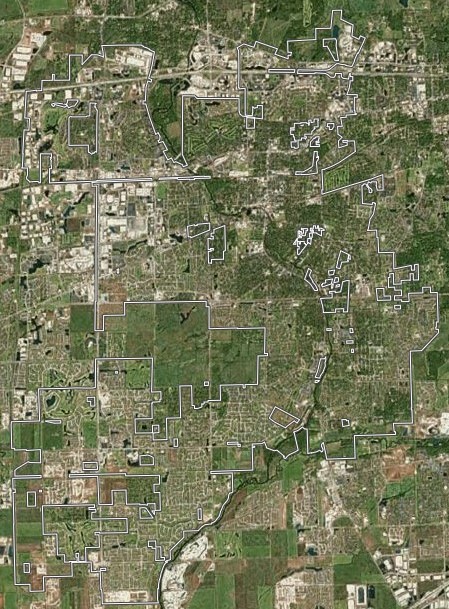
Sixty years ago or even forty years ago, Naperville was much smaller in population and had a smaller footprint in land use. Today, it has nearly 150,000 people and roughly 39 square miles of land with much of this involving single-family homes.
In one sense, the growth patterns that helped make the Naperville of today possible – explosive growth in the postwar era built around homes and driving – also make pursuing sustainability more difficult. Take the reducing the miles driven goal from above. Some residents of Naperville could do this but many are in subdivisions whose roads then feed to large arterial roads. This does not work as well for biking (and the weather in the area may not help). Additionally, the sprawl makes mass transit more difficult. In the past, Naperville has tried buses in the community but they do not get much use (even as the train stations are some of the busiest with commuters going toward Chicago). The best way for Naperville to achieve this goal may be to encourage local businesses to allow employees to work from home, thus limiting commuting needs.
Not mentioned in the news article above (it could be in the report) is the density of the community. One way to improve sustainability in the long run is to have denser housing, particularly near locations where other forms of transportation other than driving are possible. This could be in and around the downtown. It could be in different nodes around the community where there are jobs or where it would be possible to pursue transit-oriented development. As a bonus, denser housing might also provide more opportunities for affordable housing. Naperville has thought about these options in the past but they are not always popular given the single-family home character of the community.
As Naperville pursues sustainability, some actions will be relatively painless given what the community can do. Other conversations about long-term changes or how to address sprawl might take much longer for a consensus to emerge.
Before air conditioning really took off in the home, there was a really different sense of what we would call personal comfort, and something that I really argue in the book is that what we’ve come to think of as personal comfort, and specifically, thermal comfort, has changed. What I argue in the book is that it’s really in part a cultural construction.
Now, I want to be really careful that people don’t hear that I’m saying that it’s entirely a construction. Yes, when we get too hot or too cold, then we can die, for sure. But what’s really interesting to me is that there’s a lot of evidence to show that before air conditioning began at the beginning of the twentieth century, people weren’t really hungry for air conditioning.
There was this greater sense that you could deal with the heat. I put that really carefully, because I don’t want to say that they suffered through it. Certainly there were heat waves and summers that got too hot. But there was a real sense that you could manage the heat through analog ways, like sleeping outside, sleeping in parks, or designing buildings that incorporate passive cooling. The thing that really disturbed me was that through the twentieth century, we really kind of forgot all that, because we didn’t need that knowledge anymore because we had air conditioning. So modernist architecture began to kind of ignore the outside conditions, because you could construct whatever conditions you wanted inside.
I think the question that nobody really asked all along is, is this good for everyone? Should we have a homogenized standard of comfort? Nobody really asked that question. And there’s a lot of people that find that the kind of American model of an office or American model of comfort is not comfortable, both in the United States, and in other places.
But, as noted above, it does lead to new standards of comfort at the individual and collective level. How much heat is too much before air conditioning is needed? Is airflow an important factor when designing homes and buildings or does it not matter much because of what can be done with machines? Collectively, are we willing to pollute more because we have certain expectations about how we should feel?
The biggest backlash I have seen to this is the concerns expressed by many about temperatures within office buildings. Because different people experience the standard temperatures differently, there are expectations about how people should adjust to those standards, and most workers have no control over the temperature for everyone, these can be difficult situations. But, this does not generally lead to a call for no air conditioning whatsoever; it usually leads to a call for a different temperature.
If limiting air conditioning use is a goal, how would it work to move people to different comfort levels? Workplaces could be a good place to start as people can spend a good chunk of the day there.
Q. Not urban, not yet suburban: One of my best friends just informed me, after I called him out on avoiding me for weeks, that because I am moving from the city where we both live to suburbia, he is no longer “feeling the friendship” and wants to end it. The TL;DR is that he has an enormous fear of being abandoned, and I think proactively decided to abandon me so I couldn’t do it to him—except that I had no intention of abandoning him, and was caught completely off guard.
He is single; I’m married with a preschooler, who adores him, by the way, and will definitely notice the lack of his presence—and he talked about how now I could be a “suburban mom” and forget all about my city friends. He gaslit me, making it sound like I had told him I wouldn’t miss him, wouldn’t come visit the city ever again (I’m moving 20 miles and a direct train ride away; it’s hardly a hardship to come see friends!), and because he doesn’t have a car and can’t come see me, there was no point to staying friends at the same level we have been. I never said or even came close to any of this! I admit that I’ve been talking a lot about my move very positively—it really does feel like a fresh start to me, having a home and yard after living in 750 sq. ft. apartment for the pandemic with a toddler—but he claims I’m just too happy about leaving the city and he loves the city so much that we can’t be friends the same way.
I’m so angry at him right now that I can’t see past any of this to consider contacting him again, but to not contact him would mean that he’s right, I moved away and abandoned him. But…is this a friendship worth salvaging? And if so, how? This all feels like so much bull to me. We’re in our 40s, by the way!
A: I can very much imagine getting a letter here from a single man saying, “One of my best friends moved from the city to the suburbs and all she talks about is countertops and lawn care and finding a nanny and it’s so boring and I just don’t feel like we connect anymore and don’t know if we’ll ever see each other again.” I would probably tell him to make an effort to talk about things that interest him, to give you a little space to be excited about your new life, to be deliberate about making plans together, and to hold off on declaring the friendship dead until trying these things.
But instead, he just cut you off. To me, that’s a sign of being a bit immature, selfish, and inflexible—and that he only valued you for the way you fit into his current life rather than who you are. If you don’t feel like contacting him, don’t—after all, he’s basically ended the friendship without your input. But maybe, like you said, this is just a tantrum over feeling abandoned. If once you get settled, you decide you’re still thinking about him and want to be the bigger person (and the person who rides the train to meet for dinner), tell him you miss him and offer to meet up somewhere convenient to him. If he accepts, you can feel out whether you enjoy the new iteration of your friendship and what it takes to maintain it. If he declines, you have your answer and you can live your suburban life in peace.
There are multiple factors at work here:
Even in an era of social media, video calls, and the Internet, proximity matters for friendships and relationships. Being further away makes it more difficult to get together. Twenty miles from city to suburb is not insurmountable but it is not necessarily easy depending on transportation and traffic. People can often form relationships with neighbors, people at work, and others they see regularly at groups and places even as they have the option to date and meet people through apps.
Suburban life is often focused on different things than urban life. The priorities can be different. Here is my list of why Americans love suburbs: single-family homes, family life and children, race and exclusion, middle-class utopia, cars and driving, local government and local control, and closer to nature. This leads to an everyday experience centered on private homes and family lives, driving, limited diversity and cultural opportunities compared to many cities, and distance from the big city. This could be contrasted with what residents of cities often say they value: being close to activity and cultural opportunities, more people around, less driving, and more diverse populations. Life in the suburbs and cities can look very different, though some of the things people like in each kind of place can be found in the other.
Possibly losing a close friend is hard. Social media makes it possible to hang on to relationships for a long time without much interaction but that is not the same as regular, in-person interaction.
Individual preferences and actions. The letter above speaks to a particular situation between two people even as it hints at broader patterns (#1-3 in the factors above).
Can city/suburbs relationships work? Yes. Does it have particular obstacles? Maybe. Do people like it when their friends move away? No.
Now, as recall ballots are dropping in mailboxes, children are returning to school amid heated battles over mask mandates and skyrocketing cases of the highly transmissible Delta variant. Leaders of the effort to remove Newsom for office are confident that women, exasperated by the effect of Newsom’s policies on their children, are the reason they will prevail.
“It’s gas on the fire,” said Anne Hyde Dunsmore, campaign manager for Rescue California, one of the main recall groups. “The whole time, it’s probably the single biggest ingredient in the campaign, in our success.”
Newsom “didn’t understand mad moms, which are the same as soccer moms,” Dunsmore said, referring to the pivotal group of suburban female voters. “Don’t piss off mommy.”
Newsom and his allies agree that these women are critical, but they point to polling that shows that well over a majority of the state’s women approve Newsom’s handling of the pandemic. If these women turn out, they will be a major factor in helping the governor retain his job.
Multiple recent election cycles have included efforts to sway suburban women. These two labels seem particularly aimed at suburban women, not all women in California or the United States. The two major political parties both think they can convince enough suburban women to care about their priority issues under the right conditions (examples here and here) and the suburbs are the spaces where elections are won or lost.
The shift from the “soccer moms” label that goes back decades to “mad moms” in mid-2021 could be worth examining further. In the label itself, soccer moms referred to driving kids to and from local practices. They cared about the future of their children and their communities. Mad moms suggests women are fed up with what is happening and/or what the future might hold for their families and communities. Especially in 2021, anger can be a powerful mobilizing force in politics.
Presumably, the mad moms are conservative women who want different political outcomes. For the women of California who disagree with their perspective, what is an apt moniker for the other side?