Miming playing an instrument is not an easy task

My academic department recently put together a lip sync video of “Blue Christmas.” For part of my time, I played the alto saxophone.

I first took up the instrument in middle school and played regularly through college in band, marching band, and pep band. Even with this familiarity, miming playing a song was difficult. I did not know what key it was in. I could move my fingers to the music and go up or down when needed but this does not mean I was close to the right notes. As a musician, it felt strange. (Yes, if I had a little more time I could have figured out the key of the song and transposed for the saxophone.)

I have thought about this numerous times before with television shows and movies when they depict people playing instruments. Since I play piano and can strum a few guitar chords, these performances especially catch my attention. For piano, they often show separate shots of playing the keys and the person sitting at the piano with their hands hidden. For guitar, you can sometimes see which chords are being played or see the strumming patterns. But, this too can be hidden or obscured.

All of this reminds me that musicians like the Beatles sometimes had to mime playing their instruments on television because of particular rules. In these situations, I assume professional musicians with all of their training could play without sound. In music (and much of the rest of life), practice makes perfect, even if it is not a full performance.

Perhaps the normal viewer does not think about this much. This may matter more in films where music is at the heart of the story but if you do not watch too closely or the shots do not really show much, any issues may not be noticeable. The music generally sounds fine, regardless of what the musicians on screen is depicted as doing. And if people want to see musicians play, there are many fine music videos and recorded performances available for viewing. Still, this ended any dreams I might harbor of adding saxophone to numerous lip syncing videos – I will need to leave that to the professional musicians and cinematographers.

The Simpsons portrayed a (rare?) comfortable working-class family life

If television helps provide viewers reference groups to compare themselves with, The Simpsons suggests working-class Americans can have a decent life:

Photo by Jonathan Petersson on Pexels.com

The 1996 episode “Much Apu About Nothing” shows Homer’s paycheck. He grosses $479.60 per week, making his annual income about $25,000. My parents’ paychecks in the mid-’90s were similar. So were their educational backgrounds. My father had a two-year degree from the local community college, which he paid for while working nights; my mother had no education beyond high school. Until my parents’ divorce, we were a family of three living primarily on my mother’s salary as a physician’s receptionist, a working-class job like Homer’s…

The Simpsons started its 32nd season this past fall. Homer is still the family’s breadwinner. Although he’s had many jobs throughout the show’s run—he was even briefly a roadie for the Rolling Stones—he’s back at the power plant. Marge is still a stay-at-home parent, taking point on raising Bart, Lisa, and Maggie and maintaining the family’s suburban home. But their life no longer resembles reality for many American middle-class families.

Adjusted for inflation, Homer’s 1996 income of $25,000 would be roughly $42,000 today, about 60 percent of the 2019 median U.S. income. But salary aside, the world for someone like Homer Simpson is far less secure. Union membership, which protects wages and benefits for millions of workers in positions like Homer’s, dropped from 14.5 percent in 1996 to 10.3 percent today. With that decline came the loss of income security and many guaranteed benefits, including health insurance and pension plans. In 1993’s episode “Last Exit to Springfield,” Lisa needs braces at the same time that Homer’s dental plan evaporates. Unable to afford Lisa’s orthodontia without that insurance, Homer leads a strike. Mr. Burns, the boss, eventually capitulates to the union’s demand for dental coverage, resulting in shiny new braces for Lisa and one fewer financial headache for her parents. What would Homer have done today without the support of his union?

The purchasing power of Homer’s paycheck, moreover, has shrunk dramatically. The median house costs 2.4 times what it did in the mid-’90s. Health-care expenses for one person are three times what they were 25 years ago. The median tuition for a four-year college is 1.8 times what it was then. In today’s world, Marge would have to get a job too. But even then, they would struggle. Inflation and stagnant wages have led to a rise in two-income households, but to an erosion of economic stability for the people who occupy them.

This critique hints at broader patterns of how television depicts the working class. The 2005 documentary Class Dismissed: How TV Frames the Working Class discusses how television tends to minimize the difficulties of working class life. The Simpsons fits some of these patterns: Homer still somehow keeps working despite his mistakes and anti-intellectualism, the family does not really get ahead, and the family seems happy-go-lucky. Shows with working class characters rarely challenge the economic and social systems that constrain working class Americans.

Similarly, The Simpsons falls into the mold of many sitcoms in television history where there are happy endings and the characters end with good relationships. Despite all the controversy about the show in its early years, the show is at its heart a typical sitcom. While the show does poke fun at many people and aspects of American life, at its basis is a loving nuclear family living in a single-family home with Homer having a steady job. The Simpsons is not a critique of working class life in the United States. Perhaps the portrayal of Mr. Burns best critiques the systems that keep the Simpsons in place.

One place for wiggle room in this critique may be the location of Springfield. The show has been very careful to not reveal where Springfield is within the United States. Homer’s income might be meager but cost of living does differ by region.

Peytonville, the suburbs, and football

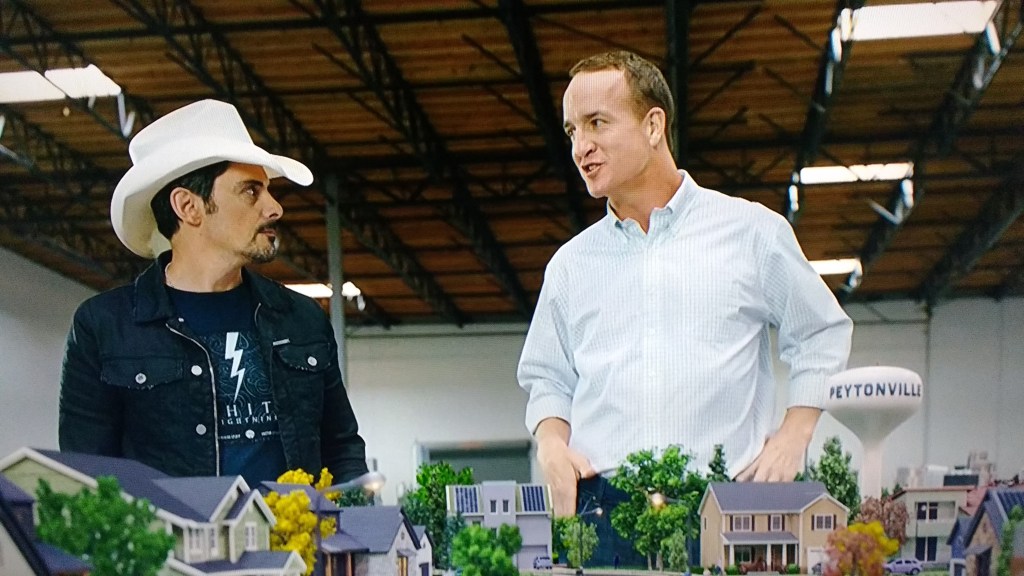
With the return to the airwaves of Peytonville ads from Nationwide, I noticed something in the commercials I had not thought about before (see Peytonville Parts 1, 2, 3, 4, and 5): the possible connection between suburbs and football. Notwithstanding a possible caveat that Nationwide might want to appeal to suburban customers, here are some ways the suburbs, football, and Peyton Manning might go together.

First, the majority of Americans live in suburbs. It is a slight majority but the percent in suburbs outnumbers the percent living in cities by a little more than 20%. Where is football played the most? Which communities have the most interest in football? The romanticized image of a football community might be a small town in the Heartland obsessing about football on fall Friday nights but much of the activity might be happening on suburban fields and on suburban television screens.

Second, the Peytonville commercials at least hint at college and pro football as well as suburban and urban life. For both college and pro football, where are the majority of fans? For college, perhaps the thousands of alumni for major football schools have largely settled in suburbs. With a college degree, people have the opportunity for higher-paying jobs and put those resources into suburban single-family homes. For pro teams, the majority of residents in a metropolitan region are suburbanites. Take Chicago as an example: there may be a lot of Bears fans in Chicago but there are over 6 million more residents in the suburbs than the city.

Third, the social and cultural life of the suburbs might lend itself to football (and other sports as well). With games on the weekend, many suburbanites are free to sit at home and watch or attend games. For kids, families have the resources to enroll them in activities and there are plenty of organizations ready to funnel kids into high school and college football.

Perhaps this is off yet certain sports are associated with certain places. Is football truly a suburban sport or does it belong to all of American places?

Videogames under the tree to sizable global industry

The flood of new gaming consoles and new game titles to Americans for the Christmas season hints at the size of the video gaming industry:

Photo by lalesh aldarwish on Pexels.com

Global videogame revenue is expected to surge 20% to $179.7 billion in 2020, according to IDC data, making the videogame industry a bigger moneymaker than the global movie and sports industries combined. The global film industry reached $100 billion in revenue for the first time in 2019, according to the Motion Picture Association, while PwC estimated global sports would bring in more than $75 billion in 2020

The videogame industry has boomed in recent years because of the variety of ways to play games. Gone are the days when all one had to track were console sales and games sold for their respective consoles and PCs. With the rise of digital-copy game sales, mobile games, in-app purchase freemium games, cross-platform games that aren’t limited to a specific console, streaming game services like Microsoft’s Game Pass, games-as-a-subscription models, and online distribution services like Steam, along with varying levels of transparency, anyone wanting to make apples-to-apples comparisons encounters an unwieldy fruit basket.

While console sales will get a boost from new versions, that’s not the biggest chunk of the industry, nor the fastest-growing. The biggest gain is expected to come from mobile gaming, with China playing a big role in smartphone and tablet gaming revenue, Ward said. Excluding in-game ad revenue, world-wide mobile gaming revenues are expected to surge 24% from a year ago, to $87.7 billion.

The gamification of the world is well underway.

Seriously, it is interesting to compare the status of videogames compared to the two industries mentioned in the article: movies and sports. These are established industries with prominent actors around the world. They have been established for decades. Videogames, on the other hand, are more recent – only several decades in the hands of the global public – and still have negative connotations for many (too violent, a waste of time, played only by a certain segment of the population, etc.). Since videogames are big business and part of their spread is due to the smartphone, which many have, will videogames have a different status in a few years?

Not hearing the same 20 Christmas songs over and over in public spaces this year

Part of the collective effervescence of Christmas activities involving other people is the music. If people are out shopping, eating, looking at lights, watching festivals and tree lighting and other Christmas and winter activities, they are likely to hear Christmas music. The sounds are unmistakable and are a key part of the holiday season.

Photo by Negative Space on Pexels.com

At the same time, many of these locations play the same songs – and even the same versions – of Christmas songs over and over again! How many times have you been shopping and heard “Holly, Jolly Christmas,” “Rockin’ Around the Christmas Tree,” and “All I Want for Christmas is You”? Or heard the same songs on the radio? Or on TV or in movies?

Why this happens makes some sense. Many of these Christmas favorites come from an era, the 1930s to the 1950s, that induces nostalgia. Music helps bond people together. The familiar can be comforting. When people think of Christmas, the music is part of it. The ritualistic nature of the holiday where patterns repeat year after year is part of the appeal of Christmas and rituals.

As sociologists argue there is “civil religion” in the United States, perhaps these popular songs reflect what we might call “civil Christmas.” The songs are generally about good cheer, parties, happy characters like Santa and Rudolph, getting together. The songs played in more public settings tend not to refer to the religious nature of Christmas but rather elements of the holidays that could appeal to many. The songs are about a lengthy celebration…and who is opposed to at least a month of cheery music and festivities right around the darkest days of the year?

Perhaps the Christmas public music canon will expand in the future. New songs might be added here and there while others let go (see the debate over “Baby It’s Cold Outside” in recent years). There is no shortage of songs to choose from or artists and styles for familiar songs. (I say this after working for years at Wheaton College Radio where we featured over 2,000 songs in our 24-hours-a-day Christmas music rotation. Listen to a reconstituted live stream of WETN Soundtrack for Christmas.) Regardless of whether the music stays the same or we all retreat to our headphones for our personal Christmas playlists, the music will continue to matter as we prepare for and celebrate Christmas.

Even Lucy Van Pelt knows the value of getting into real estate

To close a scene of A Charlie Brown Christmas, Lucy Van Pelt explains what she really wants for Christmas:

A Charlie Brown Christmas

Lucy: Don’t worry. I’ll be there to help you. I’ll meet you at the auditorium. Incidentally, I know how you feel about all this Christmas business. Getting depressed in all that. It happens to me every year. I never get what I really want. I always get a lot of stupid toys and a bicycle or clothes or something like that.

Charlie Brown: So what is it you want?

Lucy: Real estate.

In addition to the words of Lucy, I recently heard a famous person describe their interest in real estate this way: “they aren’t making any more of it.” I have heard some variation of this numerous times in life. Since there are limits on how much real estate can be had, this can push prices up in places where there is high demand and limited property. (Of course, humans are pretty good at finding ways to create more real estate – think in-fill in many coastal cities – or finding financial opportunities out of what exists.)

If you have resources, real estate can be a good investment. Not only might you be able to use the property while you own it or gain money from its particular use, its resale value could be good. But you have to start with real estate or have the capital to get into real estate to reap the rewards down the road. Not all real estate is desirable – see a recent overview of some such properties in the Chicago area – even as many Americans assume that purchasing a home will pay off in the end.

And perhaps this hints at Lucy’s frustration. She keeps getting Christmas gifts for kids when she really wants to get ahead. Real estate would be a unique but wealth-building present. Forgot those ads with a car in a bow in the driveway: Lucy wants a property deed under the tree.

When television shows help interpret history

What responsibility do television shows have to accurately depicting history? Take the case of The Crown:

Photo by John-Mark Smith on Pexels.com

Historical dramas might similarly warp our attitude toward history, encouraging us to expect that cause and effect are obvious, or that world events hinge on single decisions by identifiable individuals. Academics have been trying to demolish the great-man theory of history for more than a century; television dramas put it back together, brick by brick.

What matters here is that we are having the right arguments about these ethical and dramatic decisions, not lobbing grenades at each other from opposing trenches of the culture war. Reasonable people can disagree over artistic license and the writer’s duty of care to her or his subjects. And none of this would be an issue if so many people didn’t love The Crown. Dowden is right to argue that the show is so popular that its interpretation of history will become the definitive one for millions of viewers.

That is something Netflix could mitigate, if it wanted to. Not with a pointless disclaimer, but with an accompanying documentary, rounding out the stories told in the drama. (There is a Crown podcast, featuring Morgan, but I mean something packaged more obviously alongside the main series.) There is certainly an appetite for one: Three unrelated Diana documentaries now clog up my Netflix home screen, and newspapers have published multiple articles separating fact from fiction.

Ultimately, it is not illegitimate to create narratives out of real lives. In fact, a good historical drama has to do so. But when we talk about the monarchy, modern Britain, and the legacy of divisive politicians like Thatcher, The Crown should be the start of a conversation, not the last word.

Television, and mass media more broadly, has the potential to shape how people udnerstand the world. This is not only because people find it a compelling window to the world; the sheer amount of time Americans spend watching TV on a daily basis means that television depictions have at least some influence.

Given this, it is interesting to consider whether Netflix and other producers and distributors of television should do more to depict history accurately. How possible is this? Here are a few problems that might arise:

  1. Balancing a historical drama with an accompanying documentary might help. But, documentaries are also told from particular points of view. And how many viewers will watch all of both?
  2. History is an ongoing narrative. The Crown comes from a particular point of view in a particular time that may or may not with other depictions before and after. Imagine some time passes after Queen Elizabeth dies and another director with a different vision comes along – how different is the story in facts and tone?
  3. Other mediums could present different realities in different ways. History often requires working with a variety of sources, not just visuals. How about at least giving viewers additional resources to consult?
  4. How much should TV viewers know or be expected to know about particular phenomena they observe?

Public understandings of history, academic understandings of history, and other interpretations of history have the potential to interact with and shape each other. How exactly The Crown helps shape the ongoing conversation about the monarchy, Queen Elizabeth, and all the involved actors remains to be seen – and studied.

An ADU as an investment opportunity on HGTV’s Flip or Flop

Last night’s new episode of Flip or Flop, Season 9 Episode 7, featured a home with an ADU (accessory dwelling unit). And this unique feature of the home offers a chance to make more money:

After Tarek and Christina realize the garage in the backyard is now a living space, Tarek lays out the argument: this is not just a studio space or a he/she-shed. It is possibly a rentable unit. This may make this property even more enticing.

This got me thinking. ADUs are supposed to help provide more housing units in more expensive markets like Portland and Los Angeles. Instead of building denser, taller housing in single-family home neighborhoods, ADUs take advantage of existing yard space, garages, or other buildings on residential properties.

But, while the ADUs might provide more housing, they may not necessarily provide housing that is that much cheaper. Take the example from Flip or Flop: with a home valued at over $1 million in North Hollywood, they estimated they could rent the studio ADU with a full bathroom and kitchen for $2,000 a month. How many people could afford this?

Further, such units could become a tool for residents and developers to generate more revenue. In such competitive markets, adding any kind of residential unit presents an opportunity. The ADU could enable a homeowner to generate money from their property. An investor interested in a single home or one with multiple homes could generate even more money with ADUs.

To truly provide housing that is more plentiful and at a reasonable price, it seems like a lot of ADUs are needed. They cannot provide as many units as large multifamily developments might. Yes, they do not disturb the existing character of a neighborhood much. But, if the ultimate goal is to broadly expand housing options, the occasional ADU in an expensive area might not be enough.

Three Soc 101 concepts illustrated on Big Brother

Many television shows could (and have) been mined for sociological content. Big Brother is no different. Here are three concepts:

https://www.cbs.com/shows/big_brother/
  1. Houseguests talk about having “a social game.” This roughly means having good interactions with everyone. A more sociological term for this might be looking to accrue social capital. With so many players at the beginning, this might be hard: simply making connections, talking to a variety of people, discussing strategy, contribute positively to house life. But, this social capital can pay off as the numbers dwindle, people show their different capabilities, and the competition heats up. It could also be described as the ability to manipulate or coerce people without others hating you, particularly when it comes down to the jury selecting the winner among the final two.
  2. Connected to the importance of social capital are the numerous social networks that develop quickly and can carry players to the end. The social networks can be larger or smaller (ranging from two people up to 6 or more), some people are in multiple networks (more central) while others may be in just one or none (less central), and the ties within networks can be very strong or relatively weak. At some point in a season, the overlapping or competing networks come into conflict and houseguests have to make decisions about which network commitments to honor – or reject.
  3. There are plenty of instances where race, class, and gender and other social markers matter. A typical season has a mix of people. Relationships and alliances/networks can be built along certain lines. Competitions can highlight differences between people. The everyday interactions – or lack of interaction between certain people – can lead to harmony or tension. Some people may be more open about their backgrounds outside the house, others are quieter. With viewers selecting America’s Favorite Houseguest, there is also an opportunity to appeal to the public.

There is more that could be said here and in more depth. Indeed, a quick search of Google Scholar suggests a number of academics have studied the show. Yet, television shows are accessible to many and applying sociological concepts can be a good exercise for building up a sociological perspective. Even if the world does not operate like “Big Brother,” this does not mean that aspects of the show do not mirror social realities.

Constructing a New Urbanist movie town outside of Atlanta

Going up around a one-stop movie filming and production facility outside of Atlanta is a New Urbanist community named Trilith.

Google Maps

When the British film studio company Pinewood opened a production facility outside Atlanta in 2014, it framed the venture as a one-stop-shop alternative to the mature but spatially fragmented system in Hollywood. With a high-tech media center, soundstages, offices, prop houses, and set builders all colocated, Pinewood Atlanta was a turnkey space for filming. An early relationship with Marvel Studios led to a steady stream of big-budget superhero movies such as Ant Man and Captain America: Civil War, and Pinewood Atlanta quickly became a contender in the film business.

But some of its local investors wanted it to be more than just a production facility. They wanted the entire business to have a place at the studios, with development of new shows happening where they’d eventually be filmed, and local workers able to easily commute to jobs on the site, about 20 miles south of Atlanta. So they decided to build a town…

Pinewood recently left the project, amiably, and the studio and town are now fully in the hands of local founders, who have accelerated Trilith’s development, which broke ground two years ago. Planned with New Urbanist design principles, Trilith is a dense, pedestrian-oriented, mixed-use village, with a commercial town center, more than half of its area dedicated to green space and forest, and room for an eventual population of 5,000. About 500 people are currently living in the town, which is planned to have a total of 1,400 townhomes, apartments, cohousing units, and 500-square-foot “microhomes.” Housing is available to rent or buy, and Trilith’s developers say it’s luring residents from within the film industry as well as people from other walks of life…

Parker says the town was inspired by Seaside, a New Urbanist community in Florida famous for its use as the setting of The Truman Show. Trilith was designed by the Atlanta-based planning firm Lew Oliver, with homes designed and built by companies such as 1023 Construction and Brightwater Homes. Parker says the design was intended to appeal to young creatives, with an emphasis on wellness and access to the outdoors, but with the kinds of amenities people want in a town. The first of the town’s restaurants recently opened, and 11 more are in the works. A 60,000-square-foot fitness studio was recently completed, and a K-12 school is already open.

Three quick thoughts:

  1. It will be interesting to see how the relationship between the film industry and the town continues. On one hand, it could create a regular level of business and residents. On the other hand, not everyone in the community will be involved and interests could collide. Will this be like other suburbs and communities that rely heavily on one industry or sector (with both the advantages and disadvantages that come with this)?
  2. Later portions of the article discuss the diversity of residents in the community. Seaside looks good on film but has been more of a wealthy community than one that lives up to its New Urbanist principles of having mixed-income housing and residents. Will the desirability of such a community drive up housing costs? Will the connection to the film industry make it more difficult to others to move in?
  3. Does this provide a new model for numerous industries? For example, prior to COVID-19 big tech firms had constructed large, all-encompassing headquarters intended in part to help keep workers close. Or, large office buildings in central areas help consolidate workers and multiple sectors. But, perhaps this New Urbanist vision provides an alternative: more space in the suburbs, film facilities, other opportunities in the town outside of film.