How searching for houses online became sexy

With SNL poking fun at the ways people in their late 30s use Zillow to look at housing, what makes online home shopping such a current phenomena? I thought of the numerous factors that had to come together – here is an incomplete list:
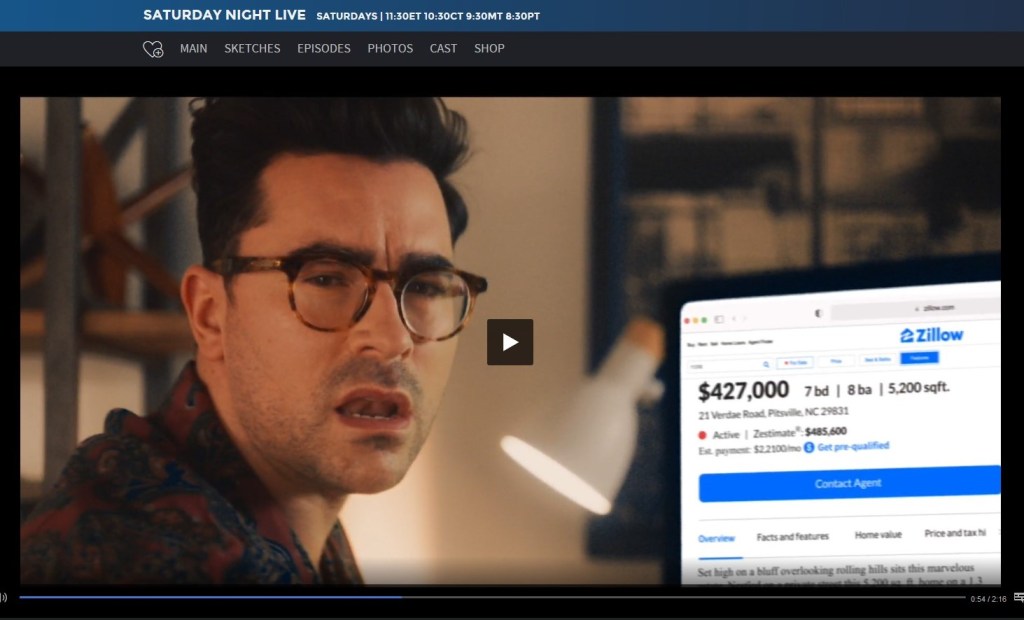
SNL “Zillow”
  1. The rise of online real estate sites and apps. These have been around for years but between Zillow.com, Redfin.com. Realtor.com, Trulia.com, and more, potential sellers and buyers have a lot of easily accessible platforms. These options are now ubiquitous: people can search at any time from any location for any length of time. And now that some online listings have video tours and/or 3D models, viewers can get a good sense of what a property is like without ever getting near it.
  2. COVID-19 adds much to existing patterns. With some people interested in moving out of cities and health risks making it more difficult to see homes, online viewing may be the primary option.
  3. The SNL spoof targeted a particular age group – people in their late-30s – who might be in the middle of a housing dilemma. By this age, those interested in settling down somewhere may or may not have the resources (think school loans, unstable employment during COVID-19 and the last economic crisis in the late 2000s) to buy in the places they want. But, the browsing is free and all sorts of homes in all sorts of locations are available.
  4. The single-family home has always been an important part of the American Dream. Today, this is true and in new ways. The home is a respite away from COVID-19 and political polarization. It is an important investment as buying the right home is not just about enjoying day-to-day life; it should pay off in the future when the homeowner wants to sell and housing values have continued to rise.
  5. Americans also like to consume and compare their social status or possessions to others. With homes occupying such an important part of American mythology, these larger patterns carry over to these sectors. Browsing homes online allows for window shopping and comparisons on one of the most expensive investments. And homes are not just dwellings; they offer windows into lifestyles and neighborhoods.

Put all of these together and you get an SNL reflection on how home searching and purchasing happens today.
An on-trend Amazon HQ2

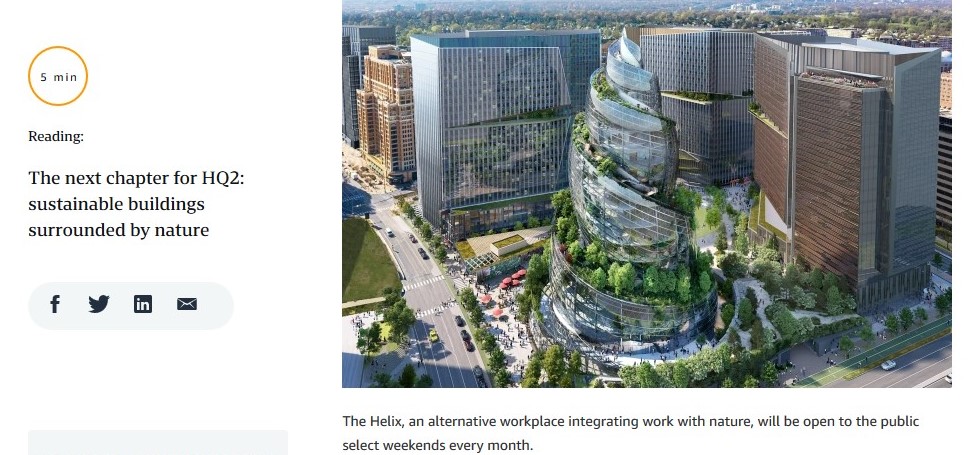
Many plans are made for large buildings in cities and metropolitan regions. Not all of them are built. But, when Amazon releases plans for their HQ2 in Arlington, Virginia, people take notice because of the company and the design.

AboutAmazon.com

The centerpiece will be the site’s fourth and tallest tower, a 350-foot structure dubbed the Helix because it will feature two spiraling outdoor walkways with trees and plants from Virginia that twist to the building’s top…

Amazon’s new campus is the latest in a growing line of outdoorsy office projects, as companies try harder to offer a pleasant work environment and appeal to eco-conscious employees.

The Helix “will be an opportunity for people to literally go on a hike in the city,” said Dale Alberda, a principal at architecture firm NBBJ, which is designing the development across the river from Washington, D.C.

Plans for inside of the building also call for plenty of greenery, along with meeting space, offices and studios for artist residency programs. “You feel like you’re in a lush garden in the middle of winter in D.C.,” Mr. Alberda said of the interior design.

As someone who teaches Urban Sociology, this is right on trend in multiple ways.

  1. It is just outside the central city of the region but within a business district. (The Washington D.C. region has some unique features due to the government buildings at the center but the multinode region is found throughout the United States.)
  2. The building has numerous green features, both visible (such as lots of trees) and invisible (planning for efficiency).
  3. The design is more whimsical and playful compared to the more common glass and steel box. The structure will certainly stand out and attract visitors just to see it.
  4. The architects and the company say it is designed with people and well-being in mind, not just efficiency or costs.

Perhaps the only trend missing is a mixed-use component where the office space is combined with residential and commercial space.

All of this is for a tech company – perhaps the tech company right now – within an industry that hundreds of American communities would love to attract. Does this building work in the same way if it is built by an insurance company or as a municipal structure?

It will also be interesting to see how this interacts with surrounding buildings – including the other planned Amazon towers – and the broader community. Amazon says the grounds will be open to the public yet how many community members will be able to take advantage.

Facebook’s greatest accomplishment may be a massive change in the scale of human interaction

Facebook certainly did at least one thing: it gave users connections to more individuals than humans have ever had before.

Photo by Pixabay on Pexels.com

The giants of the social web—Facebook and its subsidiary Instagram; Google and its subsidiary YouTube; and, to a lesser extent, Twitter—have achieved success by being dogmatically value-neutral in their pursuit of what I’ll call megascale. Somewhere along the way, Facebook decided that it needed not just a very large user base, but a tremendous one, unprecedented in size. That decision set Facebook on a path to escape velocity, to a tipping point where it can harm society just by existing…

The on-again, off-again Facebook executive Chris Cox once talked about the “magic number” for start-ups, and how after a company surpasses 150 employees, things go sideways. “I’ve talked to so many start-up CEOs that after they pass this number, weird stuff starts to happen,” he said at a conference in 2016. This idea comes from the anthropologist Robin Dunbar, who argued that 148 is the maximum number of stable social connections a person can maintain. If we were to apply that same logic to the stability of a social platform, what number would we find?

“I think the sweet spot is 20 to 20,000 people,” the writer and internet scholar Ethan Zuckerman, who has spent much of his adult life thinking about how to build a better web, told me. “It’s hard to have any degree of real connectivity after that.”

In other words, if the Dunbar number for running a company or maintaining a cohesive social life is 150 people; the magic number for a functional social platform is maybe 20,000 people. Facebook now has 2.7 billion monthly users.

For much of human history, social interaction included only a relatively small number of people. The interactions occurred in a small geographic space. Some exchange in terms of news, trade, and people happened but not on the fast, global scale of which we are accustomed to today.

Facebook and other social media companies allow users access to thousands, if not millions, of users. Even as users have some choice about these connections, the possibilities are unprecedented. If humans found it daunting in the nineteenth century to encounter growing big cities (and early sociologists looked to explain the massive social changes connected to urban society and interaction), how do we comprehend all of the possible interactions today?

Some research suggests that even if users could access all these connections, they do not necessarily do so. Do Facebook users or Twitter users or other social media users regularly interact with people they do not know or do they primarily stick to people they know and/or known sources? Actually stepping across boundaries may be easier in the social media realm but they are still boundaries.

Does this suggest that humans cannot interact with global communities? Or, is this interaction not possible on an individual level and instead needs to be mediated through institutions, such as mass media or governments or corporations? Facebook’s experiences may just be helping people think about how to broaden connections without overwhelming those involved.

Bringing McMansion critique to TikTok

McMansionHell was a web favorite when it launched. Now criticizing McMansions works on TikTok:

Photo by Tina Nord on Pexels.com

TikTok user @cyberexboyfriend is every realtor’s worst nightmare.

On his account, which boasts 32,000 followers and counting, he hosts a popular series in which he tears apart random McMansions he finds on Zillow.

It all started on Nov. 3, when @cyberexboyfriend posted a video captioned “roasting homes on Zillow.”…

Easily the funniest and most viral video in the series to date is the one in which @cyberexboyfriend critiques a $675,000 four-bedroom home, also located in Mckinney, Texas.

It is easy to criticize McMansions. They can have cartoonish features, ranging from turrets to garish facades to oversized garages to odd proportions. Much effort is put into their facades with less attention paid to other sides of the home. The interior may have some questionable choices. In an era of hot takes, social media, and concerns about housing and inequality, a quick skewering of a McMansion draws attention.

On the other hand, these real estate listings are for real homes. Numerous American communities, often wealthier suburbs, have McMansions. And at least a few people are willing to buy them.

Does this approach to McMansions help more people avoid purchasing such homes, either because the social stigma is potentially higher or because they are alerted to the problems with McMansions? Or, does it reinforce existing views people have about McMansions?

I have suggested before that if people had to choose between modernist homes and McMansions, they might choose McMansions. Those who criticize McMansions publicly are not likely to live in or near such homes. If you are against McMansions, you might also have concerns about sprawling suburbs and instead prefer denser suburban communities and cool styles like midcentury modern, interesting ranch homes, or older more traditional styles.

This may ultimately come down to taste in single-family homes based on social class, access to resources, and experiences with different kinds of communities. While political polarization in the suburbs is real, polarization by home style could be present alongside it.

64% of Americans “say social media have a mostly negative effect on the way things are going in the country” – but does this mean individual users will leave?

Pew Research recently released a new report on how Americans view social media’s effects on the country and politics. Here is one of the takeaways from the report:

This chart moves beyond many of the other takeaways which suggest majorities of Americans are skeptical about the intertwining of social media companies and politics. The responses to this particular question suggests the effect of social media is beyond politics: it affects “the way things are going in the country today.”

Since the other questions are about politics and government regulation, it is a little hard to know exactly what this means. Is it bad for young people? Families? Communities? Education? Public spaces? Physical health? It takes up a lot of time? Social media is too powerful compared to other institutions that should be leading the way?

All of these could be very interesting to explore. But, it is also worth examining how this question about social media and the direction of the country is related to the social media use of individual users. Does this mean that more people are not participating in social media? Are accounts being deactivated or deleted? Are people curtailing their time on social media? Is there interest in and movement toward more conversation outside of social media?

One finding of research I have conducted with sociologist Peter Mundey is that young adult social media users can articulate some of the problems with social media. And they modify their social media behavior to try to avoid negative interactions.

But, this does not necessarily mean that they drop out of social media or do not join in the first place. These young adults could also explain the advantages of social media, particularly the ability to maintain connections with people. Some of the connections may not always require effort but they are available. Other connections, say with family and close friends, are worth engaging in through social media. Plus, if they are not on social media, they might be missing out on social connections and events that are hard to access in other ways.

This might lead to a bit of an impasse. Americans think social media and politics is not a good mix. Social media could be bad for the country. But, withdrawing completely from social media might be a lot to ask. In many ways, it could work for individuals, particularly through providing connections to people and information.

Perhaps individual users will continue try to find ways to do both: engage with social media on a limited or focused basis. Or, avoid politics on social media. Maximize the good portions, minimize the negatives. Participate at arm’s length.

Only time will tell. Social media has had a meteoric rise but it is not guaranteed to last. Social media platforms can evolve. New opportunities can arise and social conditions are dynamic. We need to continue to look at how users engage social media. And if we see a steady trend of users leaving social media platforms, that will be worth noting.

Time travel to the words that arrived with McMansion in 1990

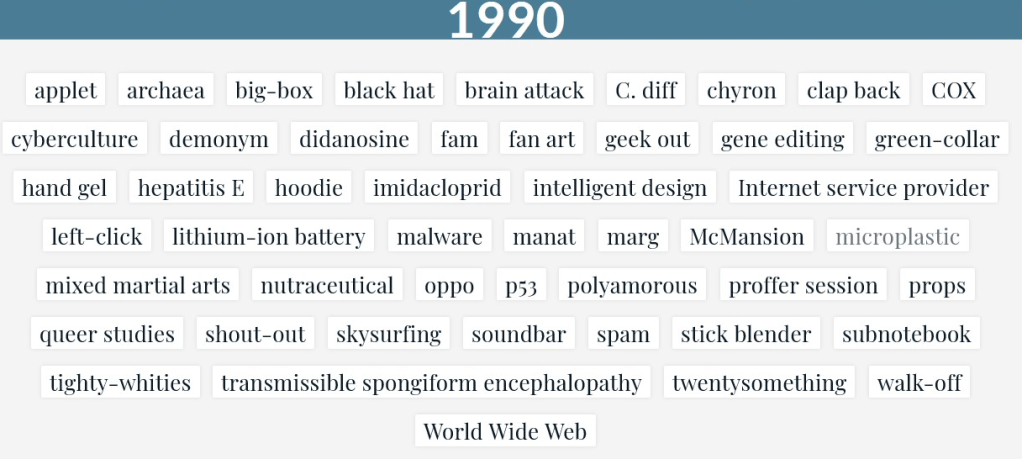
According to Merriam-Webster, the word McMansion first appeared in 1990. What words came with it? From the Time Traveler in 1990:

This is an interesting list of terms that have now existed for thirty years. Like the McMansion, these refer to newer phenomena that either did not exist prior to 1990 or did not have a reason to be named.

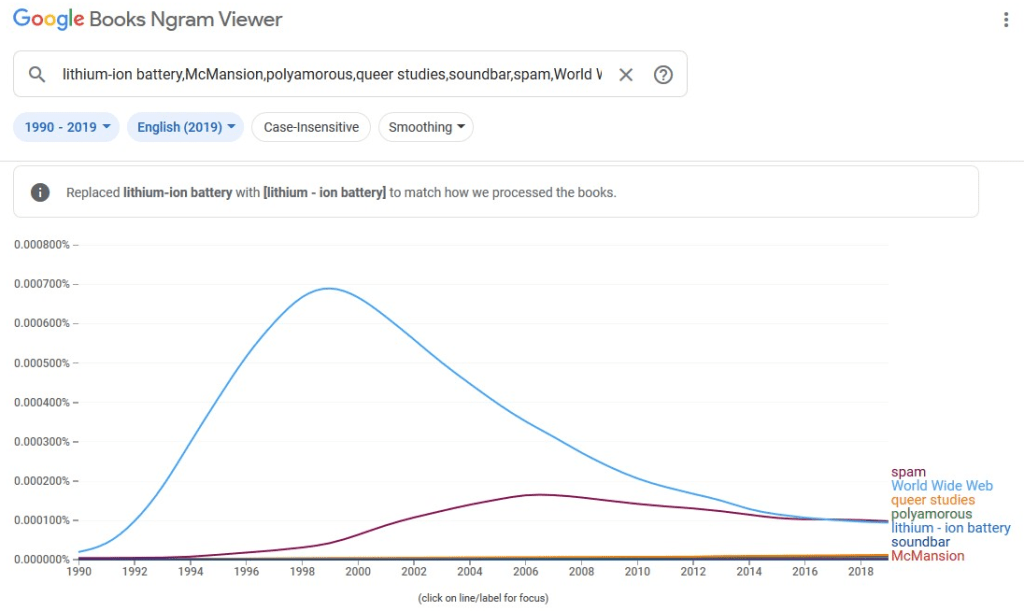
But, just because terms were introduced does not necessarily mean that they were used at the same rate over time. Using Google NGram Viewer, here are some of the terms in comparison:

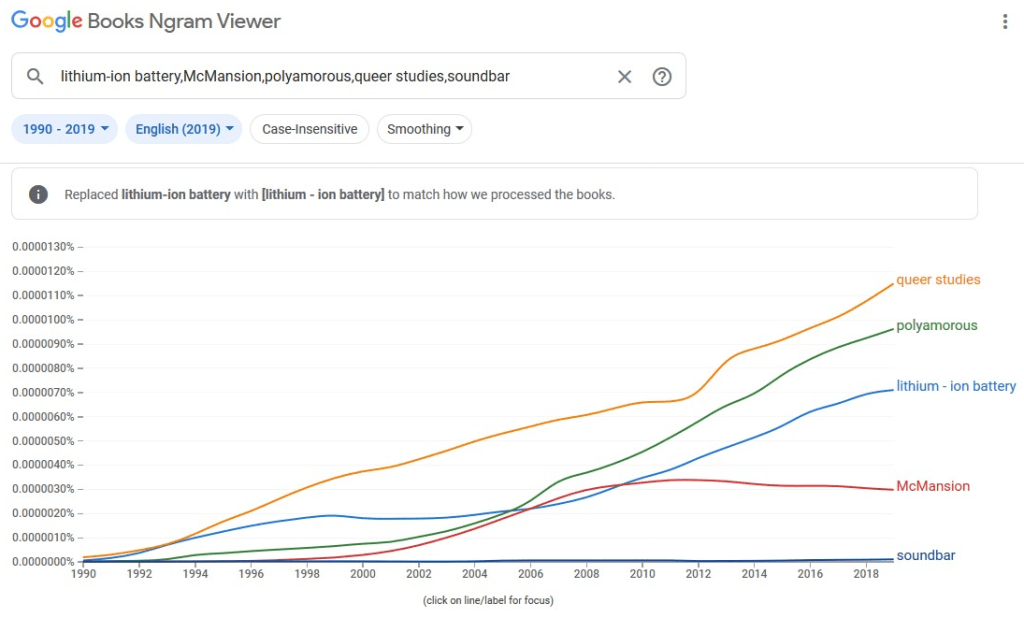
Take out the tech terms – World Wide Web and spam – and now some of the patterns regarding other social phenomena are more clear:

Since this covers books, there might be a lag compared to other sources. For example, my own analysis of the use of the term McMansion in the New York Times and Dallas Morning News found the term had higher rates of usage from roughly 2005 to 2008 (and then plateaus, just as it does with book usages several years later). But, it also takes some time for terms to be used widely. Indeed, three of the five terms above steadily rise in usage.

Given the time travel back to 1990, it might be hard for any new words to compete with computer or Internet related terms. The introduction and spread of the Internet shaped many aspects of society. At the same time, new understandings of sexuality and relationships are pretty influential as well. Perhaps thirty years is not enough to judge the impact of these words just yet.

Online real estate shift during COVID-19 reinforces the private nature of American homes

The ways in which COVID-19 has pushed more real estate activity online – virtual tours, making offers without physically seeing a home – doubles down on the private dimensions of residences in the United States. Here is my argument:

Photo by bongkarn thanyakij on Pexels.com

Already, Americans tend to see their homes as castles, refuges from the outside world, spaces where they can do what they want, settings in which they tend to their immediate family and consume a lot of media, financial investments for their future. Add this to suburbs devoted to homeownership and driving and the home is truly a private place.

The downside is this: there is often limited community and civic engagement. Neighbors get along by pleasantly or passively leaving each other alone. Private spaces are very distinct from public spaces and public spaces where a true diversity of people might actually mix, whether a shopping mall or a library, are relatively rare. Trust in institutions is low and participation in community groups has declined.

Putting homes for sale on the Internet just further reduces the community or neighborhood element of a residence. If you look at enough real estate pictures, you see some patterns: lots of interior shots but limited images of how the residence interacts with surrounding spaces or what may be just down the street. For example, you may get a shot of a backyard but it is often facing the rear of the house, not out into the neighborhood. Or, you might get a pleasant image of the downtown of a community or a local park or a common room within an apartment building without much sense of how those spaces are used.

This is similar to how HGTV often shows homes. There may be sweeping shots of a neighborhood or location but the focus is always on the single housing unit. The interior and its features are the focus. The neighborhood or surroundings do not matter unless it has to do with proximity to work or family or to note the character of surrounding buildings (which is often connected to property values and the perceived niceness of the location).

There are some tools that could help potential homebuyers check out the neighborhood and community. A virtual house tour could be followed by a Google Street View drive through the nearby blocks. Instead of just relying on walkability and school scores on real estate websites, a potential buyer could go to local websites or message boards to try to get a sense of community life. Yet, any of these Internet attempts pale to talking to people in the community and experiencing the surrounding area. People should make some efforts to get to know their community before they consider moving there.

Seeing homes and residences as commodities that can be evaluated solely through the Internet downplays civic life or at least pushes it into the background. Divorcing a home from its surroundings can be done but it is impoverishing in the long run for property owners and communities. When we emerge from a COVID-19 pandemic, I hope the online aspect of real estate does not hamper efforts to rebuild community and social life when such work is sorely needed.

Anticipating reading a heavy, expensive, detailed book

Having recently heard of Recording the Beatles: The Studio Equipment and Techniques Used to Create Their Classic Albums, I am now looking forward to reading the book.

Several thoughts on the book that at this point I have only flipped through quickly:

  1. Even working in academia where I am used to tracking down books and sources, this is an unusual book in several ways. It is heavy. It is an odd size. And it is expensive: copies on Amazon go for $600+.
  2. While the book is unusual, it has an impressive level of detail. Much has been written about the Beatles and I have read a number of these books. But, how many people are interested in the recording techniques and extensive information on equipment and actions in the studio? This appears to be a great source for those interested.
  3. This is the sort of text that is difficult to reproduce digitally. Sure, it could all be hyperlinked and the graphics could be made interactive or could be videos. But, to have a comprehensive source like this to hold and flip over provides a particular kind of experience.
  4. At the same time, popular and scholarly writing on The Beatles regularly cites their studio techniques as part of their magic. Not only did they write great songs and play together well; they harnessed and challenged the existing technology available at the time to do big things. While the technology and options may seem quaint now, it was a factor in their success.
  5. One of the enduring questions about The Beatles and other successful artists is what exactly came together in their work. Technology played a role but I assume this book will also offer insights into the human interactions and efforts. As many have noted, The Beatles were more than just four group members: there was a team around them that both helped and challenged them. Technology may have enabled or constrained but the group dynamics matter.

With USPS Informed Delivery, I can see my bills and junk mail sooner

I recently signed up for Informed Delivery with the United States Postal Service. In theory, this is a cool service as you can preview your mail and packages earlier in the day. Each morning, I get an email with scanned images of my coming mail.

Yet, my experience with it is not that fun. I get to see the pieces of mail I do not like – bills and junk mail – ahead of them arriving in my mailbox. Thus far, I have not seen an exciting piece of mail ahead of time. I can look forward to the latest politician who wants to send me a glossy flyer

This is not the fault of the USPS. I need to get involved in streams of more exciting mail. But, it also hints at what the mail is used for now: personal letters and cards can go via email, packages largely go through deliveries to doors rather than mailboxes, and what is left is largely less interesting.

“Zoom towns” better have good Internet capabilities

“Zoom towns” are areas of the United States that are gaining residents due to people trying to move away from COVID-19 cases:

Photo by Brett Sayles on Pexels.com

Like a lot of other vacation destinations — the Hamptons, Cape Cod, Aspen and so on — the Truckee housing market is booming during the coronavirus pandemic. It’s up over 23% since last year, according to data from Redfin, a real estate brokerage. Truckee is part of a trend that realtors and journalists are calling “Zoom towns,” places that are booming as remote work takes off.

There are numerous ways that these new full-time residents might transform their new communities, particularly if they are people with more resources.

But one issue for these growing communities involves infrastructure: how prepared are they to host more Internet traffic? Since March, much activity has moved online: work, school, social gatherings, public meetings, etc. Are there some places better equipped to handle all of this increased streaming? Are “zoom towns” the kinds of places that have robust Internet capacity? This might not be a big problem in suburbs of major cities (such as New Yorkers headed out to New Jersey) or for people who move from major city to major city (from San Francisco to Austin) but it could be for others who head to smaller communities or vacation towns.

What the COVID-19 pandemic could do is help remind Americans of the need to improve networks that enable computer, smartphone, and tablet activity. We do not just need to maintain what already exists; this pandemic has highlighted what was already going to happen: an increased need for streaming and conducting activity online. Without good infrastructure development in this area, future opportunities may not exist. Or, particular locations or kinds of places can be harmed or left behind, leading to or growing digital divides. From rural communities to poorer communities in and around cities, residents need decent Internet speeds to live during COVID and flourish afterward.