A recent suburban drive showed me the variety in the built suburban landscape – all within ten minutes. Here is the first residential neighborhood I drove through, right near a downtown:
Tree-lined streets, older homes, walkable, pleasant sidewalks for pedestrians, a two lane road.
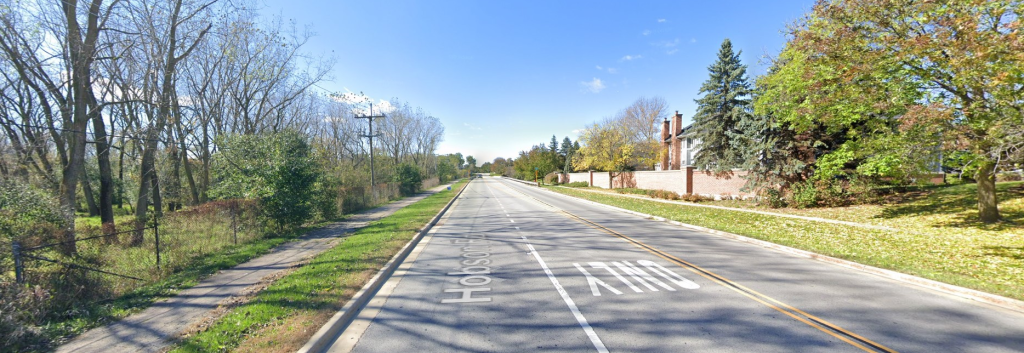
But, as I continued down this road, I soon found myself in a different suburban landscape:
Green space on one side, houses on the other side within subdivisions, fewer trees, a wider arterial road with a higher speed limit, power lines on one side.
The local context matters in this case: the first picture is near the downtown of a suburb where the land was first settled in the 1830s and the community was incorporated several decades later. In contrast, the second picture is land more in between suburbs where homes and subdivisions were constructed later. They are good illustrations of the different waves of suburban settlement as discussed by Dolores Hayden in Building Suburbia.
Though these are very different settings, they are now all grouped together as “suburbs.” They may even exist within the same suburban municipality; some suburbs are all sprawl, some are all denser areas, many have a combination of both. The interests of the homeowners in one setting may not match those in the other.
It was in Texas that self-storage originated, in the 1960s. The industry has flourished since then, and the United States now has 2.5 billion rentable square feet, at least 90 percent of such space in the world; over the same period, the average size of an American single-family home nearly doubled, and the average number of occupants fell by a quarter. This suggests that self-storage was not an inevitable convenience but something else, perhaps an indicator of national psychopathology…
Millennials, it is often reported, are uninterested in their boomer parents’ abundant accumulated possessions. Might this hurt the storage industry? They also have the highest storage use of any generation, with one fifth of households. (Millennials, and city dwellers, are also likeliest to choose the inscrutable survey response of having “personally experienced” “living in their units.”) Another idly theorized threat to the storage industry is the success of Marie Kondo’s book The Life-Changing Magic of Tidying Up. The idea seems dubious: consumer storage use recently reached 10 percent of U.S. households, and if anything threatens the business, it would be the pandemic, which appears to have spawned vacancies and depressed rents. It is plausible, however, that a number of Americans attempted a Kondo purge—getting rid of possessions that failed to spark joy, often thanking them for their service before relinquishing them—but wound up storing those things. Since Kondo’s sensibility derives from both Zen’s ideal of nonattachment and Shinto’s respect for the animate dignity of the “inanimate” world, it would be an acute irony for these objects to become imprisoned, like the diverse species of Japanese undead, in a state of irresolution.
Even as Americans have the largest new houses on average in the world and may purchase these homes to store their stuff, many need even more space. There are multiple reasons for this: an emphasis on consumerism; difficulty in parting with objects; lots of land for self-storage as well as relatively low costs for storage; disposable income. Kicking the acquisition cycle can be hard to do.
Two additional thoughts: some argue Americans consume to show off or display their status. But, using self-storage is truly a private act. If items are stored there, they cannot be at your home or in your yard or on hand to use.
The 2018 book Dream Hoardersconnects the actions of the top 20% in income to where they live and how they control who lives near them. Excerpts from the book:
The physical segregation of the upper middle class noted in chapter 2 is, for the most part, not the result of the free workings of the housing market. This inverse ghettoization is a product of a complex web of local rules and regulations regarding the use of land. The rise of “exclusionary zoning,” designed to protect the home values, schools, and neighborhoods of the affluent, has badly distorted the American property market. As Lee Anne Fennell points out, these rules have become “a central organizing feature in American metropolitan life.” (102)
Zoning ordinances, which began life as explicitly racist tools, have become important mechanisms for incorporating class divisions into urban physical geographies. This is not a partisan point. If anything, zoning is more exclusionary in liberal cities. (103)
So, those of us with high earnings are able to convert our income into wealth through the housing market, with assistance from the tax code. We then become highly defensive – almost paranoid – about the value of our property and turn to local policies, especially exclusionary zoning ordinances, to fend off any encroachment by lower-income citizens and even the slightest risk to the desirability of our neighborhoods. These exclusionary processes rarely require us to confront public criticism or judgment. They take place quietly and politely in municipal offices and usually simply require us to defend the status quo. (106)
There are numerous connections in this section to earlier posts. Here are a few:
In sum, it is hard to understand the life of wealthier Americans without also addressing how this wealth and the opportunities that come with it are closely connected to particular locations.
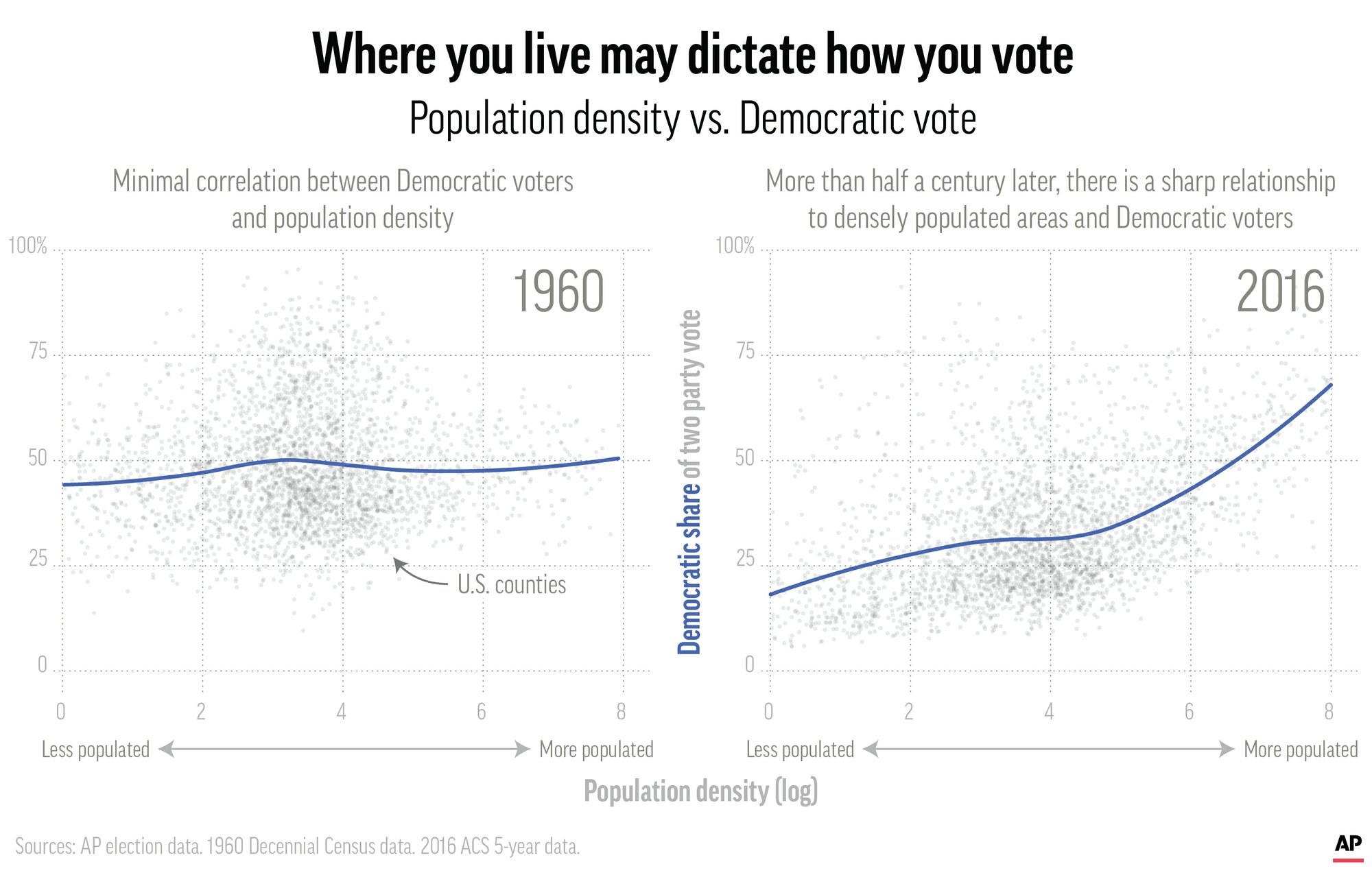
For decades, an area’s population per square mile has been a reliable indicator of its political tilt. Denser areas vote Democratic, less dense areas vote Republican. The correlation between density and voting has been getting stronger, as people began to sort themselves by ethnicity, education, personality, income and lifestyle.
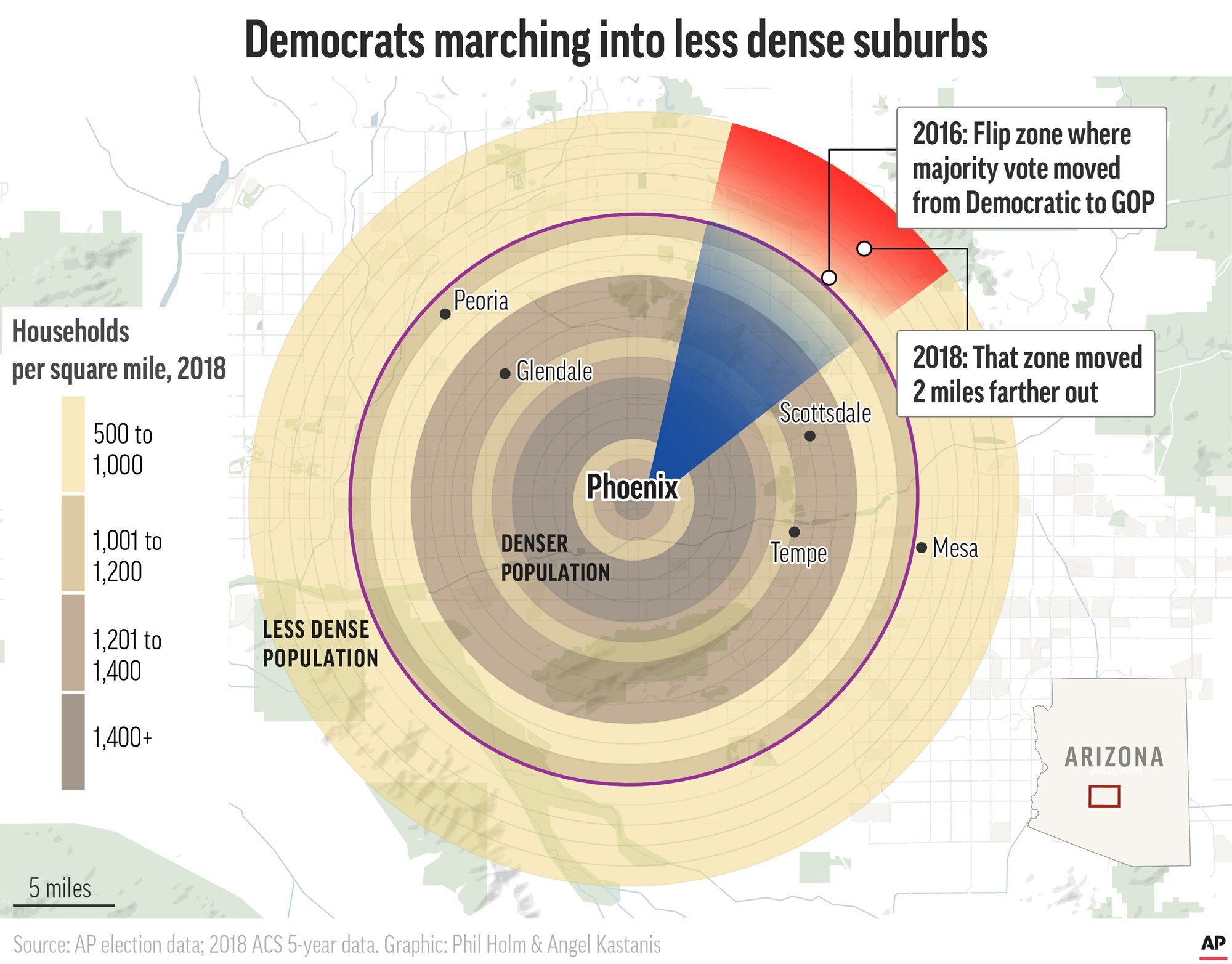
The pattern is so reliable it can quantified, averaged and applied to most American cities. At around 800 households per square mile, the blue of Democratic areas starts to bleed into red Republican neighborhoods.
A purple ring — call it the flip zone — emerges through the suburbs…
In Dallas, the purple ring through the suburbs was 18.7 miles in 2016 out from city hall, at an average of 714 households per square mile. The border runs close to AT&T Stadium in Arlington, where the Dallas Cowboys play. Arlington is a so-called boomburb that morphed through new construction from a suburb to a city of 400,000.
A few thoughts on the potential role of density. First, an additional graphic (see below) works with the last paragraph cited above to draw concentric circles a city. This, however, suggests density is linear as one moves further out from the city. In general, this may be true but it would be interesting to see how pockets of higher density suburbs at different distances from the city affect these patterns.
Second, Is it density that predicts these outcomes or factors related to density? A third chart in the story looks at the population demographics at different densities and shows differences. Does the density come first or the population changes? The analysis here suggests a relationship or correlation but it is not clear whether this analysis accounts for other possible factors.
In the larger picture, what do Americans think about having these “flip zones” or middle suburbs be the current political battleground? For example, one current argument about getting rid of the electoral college suggests certain parts of the country should not a disproportionate sway over other more populous parts of the country. Right now, these middle suburbanites, particularly in swing states, have the influence and both parties want their votes. Are the interests of these suburban voters the interests of the entire country?
Can America in the 2020s turn itself around the way the America of the 1890s, or the Britain of the 1830s, did? Can we create a civic renaissance and a legislative revolution? I’m not so sure. If you think we’re going back to the America that used to be—with a single cohesive mainstream culture; with an agile, trusted central government; with a few mainstream media voices that police a coherent national conversation; with an interconnected, respected leadership class; with a set of dominant moral values based on mainline Protestantism or some other single ethic—then you’re not being realistic. I see no scenario in which we return to being the nation we were in 1965, with a cohesive national ethos, a clear national establishment, trusted central institutions, and a pop-culture landscape in which people overwhelmingly watch the same shows and talked about the same things. We’re too beaten up for that. The age of distrust has smashed the converging America and the converging globe—that great dream of the 1990s—and has left us with the reality that our only plausible future is decentralized pluralism.
A model for that can be found in, of all places, Houston, Texas, one of the most diverse cities in America. At least 145 languages are spoken in the metro area. It has no real central downtown district, but, rather, a wide diversity of scattered downtowns and scattered economic and cultural hubs. As you drive across town you feel like you’re successively in Lagos, Hanoi, Mumbai, White Plains, Beverly Hills, Des Moines, and Mexico City. In each of these cultural zones, these islands of trust, there is a sense of vibrant activity and experimentation—and across the whole city there is an atmosphere of openness, and goodwill, and the American tendency to act and organize that Hofstadter discussed in The Age of Reform.
Not every place can or would want to be Houston—its cityscape is ugly, and I’m not a fan of its too-libertarian zoning policies—but in that rambling, scattershot city I see an image of how a hyper-diverse, and more trusting, American future might work.
The key to making decentralized pluralism work still comes down to one question: Do we have the energy to build new organizations that address our problems, the way the Brits did in the 1830s and Americans did in the 1890s? Personal trust can exist informally between two friends who rely on each other, but social trust is built within organizations in which people are bound together to do joint work, in which they struggle together long enough for trust to gradually develop, in which they develop shared understandings of what is expected of each other, in which they are enmeshed in rules and standards of behavior that keep them trustworthy when their commitments might otherwise falter. Social trust is built within the nitty-gritty work of organizational life: going to meetings, driving people places, planning events, sitting with the ailing, rejoicing with the joyous, showing up for the unfortunate. Over the past 60 years, we have given up on the Rotary Club and the American Legion and other civic organizations and replaced them with Twitter and Instagram. Ultimately, our ability to rebuild trust depends on our ability to join and stick to organizations.
Houston is a growing city – now the fourth largest American city – and is a unique city in the United States. Brooks notes three features above: sprawl and a decentralized landscape, a lack of zoning policies, and diverse residents.
A fourth factor could be worth adding that might undercut Brooks’ example. Sociologists Michael Emerson and Kevin Smiley examined people-oriented cities and market-oriented cities. One of their case studies is Houston, a paradigmatic market-oriented city. Heavily influenced by the oil industry, the city has prioritized business over people. Can such a setting foster more social trust? If so, would it primarily be based on economic interdependence and would that be enough to overcome the problems Brooks suggests Americans face? If not, how can places combat the tendencies for current systems to pit interested parties against each other?
Furthermore, it would be worth hearing more how “islands of trust” can cooperate together to pursue projects for the good of the whole city. In a decentralized landscape, wealthier private residents may have what they want – access to a home and yard, for example – but it is less clear what kinds of institutions successfully bring people together over an expansive metropolitan region. A limited number of regions have tried metropolitan wide initiatives – see Minneapolis for sharing revenues, building housing across the region – but these can be difficult to sell and implement (see, for example, trying to promote mass transit in the Nashville region).
The contrast to Houston would be more established cities in the Northeast and Midwest that have long-standing institutions and coherent neighborhoods. Yet, the fault lines in these places may be too entrenched for significant coming together to happen.
Is there a growing smaller sized city that could lead the way in building social trust amid the pressures of pluralism, disagreement, and limited social trust?
Suburban workers typically commute to downtown jobs…
Today’s suburbs are racially integrated…
E-commerce killed suburban malls.
There is a lot of overlap between these lists including commentary on class status, who suburban residents are, and what suburban communities are like. There are also differences in the lists: the 2011 list discusses the cool factor and the environmental impact of suburbs while the 2020 list highlights retail.
Even with the overlap, it is notable that myths about suburbia are still viable decades after suburban changes have been in motion. This hints that the image of suburbia is persistent and powerful: the single-family suburban home where a nuclear family pursues the American Dream can still be found in both reality and in cultural productions. But, there is also a another/newer side of suburbia that features new kinds of residents, alternative forms of housing, tougher lives and disillusionment in the supposed land of plenty, and changing everyday life. This sounds like complex suburbia: the suburbs are more varied than the typical image.
Furthermore, there are a number of actors interested in researching and discussing the suburbs of today. From books like Confronting Suburban Povertyto Radical Suburbs to videos, there is still plenty to analyze and learn about in a geographic domain that many think is relatively easy to understand. The suburbs may not appear as exciting as other dynamic locations but with a majority of Americans living in suburban settings, what happens in the suburbs has the potential to shape many lives.
I try to pay attention to housing changes in the suburban community in which I live. Here are some questions I ask as I observe both existing and new homes:
What existed here before this current residence?
What motivated the property owners to tear down the existing home and build these homes (and in these particular styles)?
How do existing and new homes interact with their surroundings?
What does the inside of the home look and feel like? The outside provides some clues but interiors can be quite different from house to house.
What happened at the community level (decisions, regulations, proposals, discussions, etc.) for these homes to exist in this form?
In the long run, will these changes be viewed positively in the community or negatively?
Who are the people who live in these homes (who is this housing for)? Are they the same or different kinds of people who are in the community?
We can measure features of old and new homes and look at the aggregate data. For example, we could try to look at the “average” home largely based on standardized traits. These figures are helpful but they also leave out other important traits of homes: what is their character? How are they experienced by the owners and the neighborhood and how do they shape social actors? How do they contribute to community life? What do they say about the priorities of the occupants and the community?
In sum, homes are not just part of the housing stock. Each house has the potential to shape and be shaped by people who interact with its material and symbolic presence. And when the housing changes, it can alter existing understandings.
Having recently heard of Recording the Beatles: The Studio Equipment and Techniques Used to Create Their Classic Albums, I am now looking forward to reading the book.
Several thoughts on the book that at this point I have only flipped through quickly:
Even working in academia where I am used to tracking down books and sources, this is an unusual book in several ways. It is heavy. It is an odd size. And it is expensive: copies on Amazon go for $600+.
While the book is unusual, it has an impressive level of detail. Much has been written about the Beatles and I have read a number of these books. But, how many people are interested in the recording techniques and extensive information on equipment and actions in the studio? This appears to be a great source for those interested.
This is the sort of text that is difficult to reproduce digitally. Sure, it could all be hyperlinked and the graphics could be made interactive or could be videos. But, to have a comprehensive source like this to hold and flip over provides a particular kind of experience.
At the same time, popular and scholarly writing on The Beatles regularly cites their studio techniques as part of their magic. Not only did they write great songs and play together well; they harnessed and challenged the existing technology available at the time to do big things. While the technology and options may seem quaint now, it was a factor in their success.
One of the enduring questions about The Beatles and other successful artists is what exactly came together in their work. Technology played a role but I assume this book will also offer insights into the human interactions and efforts. As many have noted, The Beatles were more than just four group members: there was a team around them that both helped and challenged them. Technology may have enabled or constrained but the group dynamics matter.
Although this article leads with recent survey results about what Americans know and think about the Holocaust, I’ll start with the summary of earlier surveys and move forward in time to the recent results:
Whether or not the assumptions in the Claims Conference survey are fair, and how to tell, is at the core of a decades long debate over Holocaust knowledge surveys, which are notoriously difficult to design. In 1994, Roper Starch Worldwide, which conducted a poll for the American Jewish Committee, admitted that its widely publicized Holocaust denial question was “flawed.” Initially, it appeared that 1 in 5, or 22 percent, of Americans thought it was possible the Holocaust never happened. But pollsters later determined that the question—“Does it seem possible or does it seem impossible to you that the Nazi extermination of the Jews never happened?”—was confusing and biased the sample. In a subsequent Gallup poll, when asked to explain their views on the Holocaust in their own words, “only about 4 percent [of Americans] have real doubts about the Holocaust; the others are just insecure about their historical knowledge or won’t believe anything they have not experienced themselves,” according to an Associated Press report at the time. More recently, the Anti-Defamation League was criticized for a 2014 worldwide study that asked respondents to rate 11 statements—“People hate Jews because of the way they behave, for example”—as “probably true” or “probably false.” If respondents said “probably true” to six or more of the statements, they were considered to harbor anti-Semitic views, a line that many experts said could not adequately represent real beliefs…
Just two years ago, the Claims Conference released another survey of Americans that found “Two-Thirds of Millennials Don’t Know What Auschwitz Is,” as a Washington Post headline summarized it. The New York Times reported on the numbers at the time as proof that the “Holocaust is fading from memory.” Lest it appear the group is singling out Americans, the Claims Conference also released surveys with “stunning” results from Canada, France, and Austria.
But a deeper look at the Claims Conference data, which was collected by the firm Schoen Cooperman Research, reveals methodological choices that conflate specific terms (the ability to ID Auschwitz) and figures (that 6 million Jews were murdered) about the Holocaust with general knowledge of it, and knowledge with attitudes or beliefs toward Jews and Judaism. This is not to discount the real issues of anti-Semitism in the United States. But it is an important reminder that the Claims Conference, which seeks restitution for the victims of Nazi persecution and also to “ensure that future generations learn the lessons of the Holocaust,” is doing its job: generating data and headlines that it hopes will support its worthy cause.
The new Claims Conference survey is actually divided into two, with one set of data from a 1,000-person national survey and another set from 50 state-by-state surveys of 200 people each. In both iterations, the pollsters aimed to assess Holocaust knowledge according to three foundational criteria: the ability to recognize the term the Holocaust, name a concentration camp, and state the number of Jews murdered. The results weren’t great—fully 12 percent of national survey respondents had not or did not think they had heard the term Holocaust—but some of the questions weren’t necessarily written to help respondents succeed. Only 44 percent were “familiar with Auschwitz,” according to the executive summary of the data, but that statistic was determined by an open-ended question: “Can you name any concentration camps, death camps, or ghettos you have heard of?” This type of active, as opposed to passive, recall is not necessarily indicative of real knowledge. The Claims Conference also emphasized that 36 percent of respondents “believe” 2 million or fewer Jews were killed in the Holocaust (the correct answer is 6 million), but respondents were actually given a multiple-choice question with seven options—25,000, 100,000, 1 million, 2 million, 6 million, 20 million, and “not sure”—four of which were lowball figures. (Six million was by far the most common answer, at 37 percent, followed by “not sure.”)
The first example above has made it into research methods textbooks regarding the importance of how survey questions are worded. The ongoing discussion in this article also could illustrate these textbook dialogues: how questions are asked and how the results are interpreted by the researchers are very important.
There are other actors in this process that can help or harm the data interpretation:
Funders/organizations behind the data. What do they do with the results?
How the media reports the information. Do they accurately represent the data? Do they report on how the data was collected and analyzed?
Does the public understand what the data means? Or, do they solely take their cues from the researchers and/or the media reports?
Other researchers who look at the data. Would they measure the topics in the same way and, if not, what might be gained by alternatives?
This all may be boring details to many but going from choosing research topics and developing questions to sharing results with the public and interpretation from others can be a process. The hope is that all of the actors involved can help get as close to what is actually happening – in this case, accurately measuring and reporting attitudes and beliefs.
More than 17% of the Federal Housing Administration’s almost 8 million home loans nationwide were delinquent in August, according to a new study from the American Enterprise Institute.
“Rising FHA delinquency rates threaten homeowners and neighborhoods in numerous other metro areas across the country,” American Enterprise Institute researchers said in the just released report. “It would be expected that these delinquency percentages will increase over time…
The increase in late FHA loan payments is even greater than the rise in the number of overall mortgage delinquencies since the start of the pandemic…
A new study by the Federal Reserve Bank of Dallas warns that highly indebted FHA borrowers are at risk of losing their homes when payment forbearance programs end.
More people falling significantly behind on their mortgages – plus other issues related to housing – could have ripple effects on a number of actors:
Americans who need housing. If you cannot afford your mortgage or rent, what viable options do you have?
Mortgage providers. If a lot of mortgages go into default or foreclosure, what does this mean for these large financial actors?
Local governments and communities. With larger numbers of people without housing and limited housing, what happens? What happens to local tax revenues?
Housing investors and people with resources. Does this mean they can take advantage of opportunities?
The memory of the burst housing bubble just over ten years ago lingers. While few predicted a worldwide pandemic and the resulting impact on housing, we could know within a few months whether this will lead to another housing crisis.