Coldwell Banker’s map of Chicago area locations missing parts of Chicago

A Coldwell Banker insert in the Chicago Tribune included a map and listing of all their Chicago area locations (zoomed in portion below):

ColdwellBankerChicagoMap060219.jpg

It is easy to see all of the suburban locations, particularly in the north and west suburbs. In contrast, check out the city map. From my count, there are seven Chicago Coldwell Banker agencies. Five of these are on the north side. Two are not: one in the West Loop and one in Hyde Park.

But, the Chicago map does not just show disparate locations. It is not an accurate map. The city is oddly shaped. Let me count the ways:

  1. It has an oddly drawn western edge that happens to make the south side much smaller.
  2. The west and south sides do not exist in their full form compared to the north side which looks like it has the biggest area.
  3. The West Loop location should be roughly in the center of the city – it is not. The size of the south side is diminished.
  4. The locations in Chicago have a weird relation to each other. Why are the West Loop and Hyde Park locations so close to each other? According to Google Maps, they are an over 8 mile drive away from each other. Yet, Google Maps suggests the West Loop and Lincoln Park locations are roughly 3 miles apart.

Perhaps this is a function of making a map with labels (the text all has to fit). Or, this may be about marketing: Coldwell Banker has particular clients and they want to highlight their proximity to those potential customers.

Yet, the map severely distorts Chicago. As noted above, the west and south sides do not fully exist. Recent Chicago maps aimed at particular audiences have done this before. This map also hints at the relationship between real estate practices and decades-long discrepancies in where people in the region live. Real estate professionals are not passive bystanders in residential segregation; they were active participants working alongside lenders and governments. Homeownership today is still not completely a free market and is more available to some Americans than others. Coldwell Banker does not have locations in certain places and this likely has ties to race, ethnicity, and class as well as practices and patterns developed over decades.

I am not asking that Coldwell Banker open locations in certain places. I am asking for an accurate map that clearly shows where Coldwell Banker is and where it is not.

(And for those who think I am reading too much into this, my starting position is this: I assume race is a causal factor in American social life until shown otherwise, not vice versa.)

Predatory contracts took $3-4 billion from blacks in Chicago

A recent study looked at the financial cost of contract buying for two decades for black homeowners in Chicago:

Black families in Chicago lost between $3 billion and $4 billion in wealth because of predatory housing contracts during the 1950s and 1960s, according to a new report released Thursday.

The Samuel DuBois Cook Center on Social Equity at Duke University and the Nathalie P. Voorhees Center at the University of Illinois-Chicago sought to calculate the amount of money extracted from black homeowners on the city’s South and West sides from home contract sales. The report is titled “The Plunder of Black Wealth in Chicago: New Findings on the Lasting Toll of Predatory Housing Contracts.”

Contract buying worked like this: A buyer put down a large down payment for a home and made monthly installments at high interest rates. But the buyer never gained ownership until the contract was paid in full and all conditions were met. Meanwhile, the contract seller held the deed and could evict the buyer. Contract buyers also accumulated no equity in their homes. No laws or regulations protected them.

Home contract sales were a ruthlessly exploitive means of extracting capital from African Americans with no better alternatives in their pursuit of homeownership, the report said. Contract loans were rampant all over the West Side — in East Garfield Park, West Garfield Park and North Lawndale — but also in Englewood on the South Side.

The key here is that wealth generated through homeownership is the sort of asset that gets passed down over time and helps build intergenerational wealth. Many Americans today rely on this same logic: owning a home is a significant investment to draw on later in life. That wealth then enables other possibilities, such as education or moving or acquiring other goods. This long-term wealth goes far beyond the benefits a homeownership has while living in that home; the wealth enables possibilities for future generations.

As one study puts it:

If public policy successfully eliminated racial disparities in homeownership rates, so that Blacks and Latinos were as likely as white households to own their homes, median Black wealth would grow $32,113 and the wealth gap between Black and white households would shrink 31 percent. Median Latino wealth would grow $29,213 and the wealth gap with white households would shrink 28 percent.

Earlier public policy decisions and social practices can have long-term consequences, even decades later.

Can American residents and leaders be convinced population stagnation or loss is not that bad?

Chicago continues to lose residents and Houston is coming up fast. A sociologist is cited as saying the population decrease is not that bad:

Christine Percheski, an associate professor of sociology at Northwestern University, cautioned that while it is significant to note that Chicago is losing people, “this does not necessarily reflect the health or the functioning of the city.”

An array of complicated factors are at play in population numbers, including changes to mortality, fertility and immigration rates, she noted.

I believe Percheski is right: the relatively small population loss in Chicago plus the city’s ability to avoid the larger population losses experienced by many Rust Belt cities means this is not a huge deal. Of course, getting passed by Houston in population will matter (though Toronto passing Chicago barely registered).

But, will residents and leaders ever be convinced that a lack of growth is not bad? Because growth is good and this argument is rarely challenged, population stagnation or loss set off an alarm bell. Why exactly this is the case is a bit harder to articulate but it likely involves a loss of status and a suggestion that the city has limited momentum heading into the future.

At this point, the United States does not have good models of cities and communities that have stalled out in population or even declined that are widely regarded as successful places. Chicago could be one of these models and perhaps it could work because it is so big and so storied. On the other hand, if Chicago has small population loss for decades, this adds up and will require Chicago leaders to work harder and harder to convince residents and businesses that the long-term story is not bad.

Strategies for renovating old downtown office buildings to compete with new towers

Pressure on office and residential space in Chicago’s Loop is coming from multiple angles, including the need for older buildings to adapt to modern office requirements:

Kamin said he expects more office buildings to find a second life as hotels or residential towers. “I don’t think there’s a successful path for some of these functionally obsolete buildings as offices,” Kamin said…

The high cost just to acquire a property presents relatively few opportunities for major overhauls, said developer Craig Golden of Blue Star Properties…

The venture took out a nearly $100 million construction loan in 2016, and converted the 20-story building into modern offices, branded as The National — a reference to the property’s 1907 opening as the home of Commercial National Bank.

The developers added the type of distinguishing feature that has helped properties thrive in recent years, creating the sprawling Revival Food Hall on the ground floor. The food hall brings in lunch crowds from throughout downtown, adding to the building’s vibrancy. Office tenants include co-working firm WeWork and the headquarters of Paper Source.

I have heard that it is often cheaper for companies to build a new big box store than to reuse and/or renovate one built by another company. Thus, problems with vacancies when companies close locations. Could the same be true for downtown office buildings – the cost of renovation is too high? I find this a little hard to believe given the difficult process that can ensue in order to construct a sizable building in a major city.

Similarly, the strategy of adding enticing dining options echoes what is happening with shopping malls expanding beyond retail to dining, residences, hotels, and a variety of entertainment establishments. The goal is to both promote multiple uses but also cross-traffic between organizations and business as people need to work, eat, enjoy life, and sleep.

Perhaps we will know there is really a problem when multiple older structures are torn down to make way for new buildings.

Measuring the success of a leader by the number of buildings and public amenities named after them

Chicago Tribune columnist Eric Zorn suggests the Chicago Riverwalk should be named after former Mayor Rahm Emanuel and also discusses the number of buildings named after prominent Chicago mayors:

In situations like this I usually invoke my “hall of fame” rule. That rule requires that, when faced with the urge to slap a politician’s name onto public property, we emulate how pro baseball and pro football halls of fame require players to have been inactive for at least five years before they can be considered for induction. (Hockey and basketball make their luminaries wait only three years.) The purpose is to prevent cheap sentiment and spasms of nostalgia from coloring the cool judgment of time.

For instance, the years have not been kind to Emanuel’s predecessor, Richard M. Daley. The further his six terms as mayor recede in memory, the more fiscally irresponsible and ultimately destructive Daley seems.

He dined on our seed corn — most notably by selling 75 years’ worth of parking meter revenue for a paltry $1.15 billion in 2008. He failed to make the painful decisions that would have kept local pension funds healthy. He left flaming piles of debt for the Chicago Public Schools and Chicago Transit Authority. I need not go on.

There’s a reason that a neighborhood branch library is still and perhaps forever the most significant public structure to bear Richard M. Daley’s name (compared with his exhaustively honored father, Richard J. Daley). By 2024, similarly harsh retrospective assessments may discourage us from putting the Emanuel name on the riverfront jewel he relentlessly championed.

Attaching names of prominent officials to buildings and other public structures (such as highways or an interchange) has a long history. Once a leader is out of office, they can fade from public memory. A prominent feature of the urban landscape with their name on it can help keep their name in public view for decades, perhaps even centuries.

Often, the name is attached to something they helped create. This is where putting Emanuel’s name on the Riverwalk makes sense: if he helped make it happen, his name reminds Chicagoans of at least one good important thing he did. His legacy will likely be mixed but who can deny the value of a nice public amenity?

But, the gesture can also seem vain, backfire in the long run, or . Self-application of a name probably would not work. Consider the fate of streets named after Martin Luther King Jr. in major American cities. Or, the numerous honorary streets in Chicago that few notice. Even worse may be names that few remember even as the name is regularly invoked (the fate of the Dan Ryan Expressway in Chicago).

It will be worth tracking (1) how many places in Chicago bear Emanuel’s name in the long run and (2) how these named places affect his legacy.

Rahm Emanuel on what divides people and how art can bring people together

Toward the end of an interview about the arts during his tenure as Chicago mayor, Rahm Emanuel briefly discussed factors that divide people and bring them together:

I think Lori and Amy know that the arts are the soul of a great city. Martin Luther King used to say the most segregated day in America is Sunday. The arts can make the other six days more integrated. Technology is balkanizing and dis-aggregating people. Only a government working with artists can create equity across shared experience.

According to this short quote, two factors work against community:

  1. Religion. Watch MLK make his 1960 statement about the most segregated hour in Christian America. So if religion in the US has tended to divide people by race (see Divided By Faith) and Chicago is one of the most segregated cities in America, Emanuel may have a point about this in Chicago.
  2. Technology. Emanuel could join a chorus of pundits and scholars who argue technology has detrimental effects on community life.

On the other hand, Emanuel cites two forces that encourage community:

  1. Art/the arts.
  2. Government helping to facilitate the work of artists.

There is little doubt that major cities in recent decades have used the arts and cultural experiences alongside public art to try to drive growth. Whether this truly enhances community in the long run, particularly when other forces at work – with Emanuel’s reference to equity, I can’t help but think of uneven development and capital investment in cities like Chicago – work against community, remains to be seen. In other words, can shared experiences overcome persistent social inequalities?

The legacy of Mayor Rahm Emanuel and Chicago as a global city

After weighing the highs and lows of Chicago mayor Rahm Emanuel’s eight years in office, a Chicago Tribune editorial ends with this:

Because in the end, Mayor Emanuel kept his word. He pushed Chicago to keep moving, to shuffle forward, to improve its rank as a global city.

Not many big-city mayors can say that.

Two quick thoughts on how this conclusion feeds ongoing narratives about cities and Chicago:

  1. “Keep moving” and “improve” are linked to the idea of continuous city growth. Chicago may be slowly losing residents – or at least losing ground to faster-growing cities close in population like Toronto and Houston – but Emanuel helped stem the tide. Imagine this legacy: Mayor Emanuel could not increase Chicago’s population but think how much worse it would have been without all those new buildings downtown and in wealthy neighborhoods!
  2. Emanuel himself had a goal of keeping Chicago as a major global city. Indeed, it is. But, Chicago also has a lingering fear that it is not considered a global city, particularly compared to places like New York City. The population loss is likely part of this but so may be a location in the Midwest away from the exciting coasts. Again, for Emanuel’s long-term legacy: Chicago stayed in the top 50 of global cities!

Finally, all of this conversation makes it sound as if the mayor was the only one with influence in the city. The mayor of Chicago may always have an outsized influence – I’m reminded of former mayor Richard M. Daley’s visit to campus in 2011. This big man theory of history covers up a lot of other processes, including the work (or rubber-stamping?) of the City Council, the flow of global capital into Chicago, the influence of developers and wealthy business leaders, and numerous changes taking place within disadvantaged neighborhoods.

The Chicago area’s net migration is not bad but it can’t attract new residents

The newest Census data suggests both Chicago and the Chicago region are losing residents. But, it may be less about people moving away and more about an inability to attract new residents:
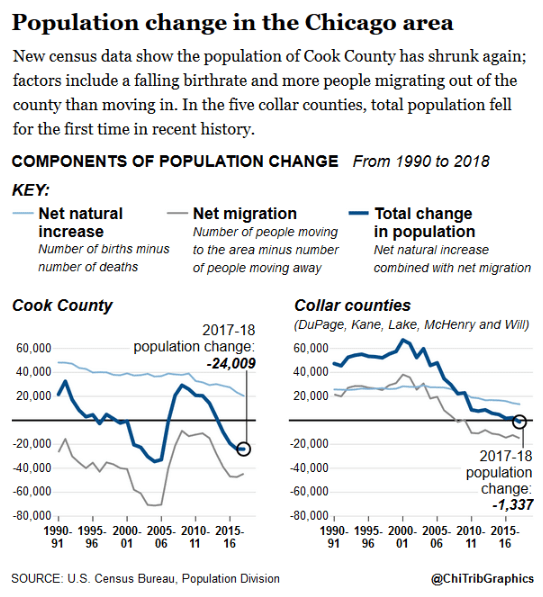
ChicagoAreaPopulationChange2019

Some experts note the metro region also isn’t attracting enough newcomers to make up for people who move away. Immigration from other countries also has long helped stem population loss, but in recent years this influx has been less robust, according to census estimates. Meanwhile, birthrates are slowing statewide, which means there are fewer new residents to make up for other losses…

“We don’t have a particularly high rate of just out-migration, but very few people come here relative to our population, compared to the rest of the country,” said Daniel Kay Hertz, research director at the Center for Tax and Budget Accountability.

Using numbers from the 2015 American Community Survey, conducted by the U.S. census, his agency found that Illinois ranked in the middle of the pack nationally on the rate of people leaving the state, but was third from the bottom on the rate of people coming in…

“The narratives around the state matter and can shape people’s decisions,” Hertz said. “And the ones in Illinois are really, really, really negative in ways that I think overstate some of the issues relative to other places.”

Any major metropolitan area is going to have some people moving out as they get new job opportunities, see greener pastures elsewhere, move for family reasons, and so on. The goal then is to also attract new residents even as some are moving out. Population increases come from new residents plus more births than deaths.

This one expert cited above hints at an interesting conundrum for any city or region beset with population loss or narratives of decline: how do you reverse the trend once it starts picking up steam? As noted, the narratives both within and outside the Chicago region and Illinois are not good: pension debts, inequality, corruption, social issues that have lasted decades, higher taxes, a lack of innovation, not a business-friendly climate, harsh winters, important but bottlenecked infrastructure. If Chicago was the exemplar American city at the turn of the twentieth century, that is no longer the case. Other cities are on the rise, particularly in the Sunbelt stretching from Washington D.C. (with the expansion of and attention paid to the federal government, perhaps now truly the second most important American city) to Houston (whose population keeps growing and may soon surpass Chicago).

It is hard to know exactly how much the larger narrative pushes people to avoid the Chicago area in favor of other places. At the same time, status matters. People and businesses want to go to places that are on the way up, that are gaining people, that have an energy moving toward the future. Chicago and its region still have a lot to offer. For example, millennials still like portions of Chicago for their thriving cultural scenes plus relatively cheap housing compared to other major cities. Perhaps Chicago’s long-term fate is to roughly stay the same at the center of the Midwest region, a significant portion of the country that may also be losing population and status.

Informing the public about delays in completing large public projects

The reasons for delayed Jane Byrne Interchange project in Chicago are only now trickling out to the public:

In January 2015 — just over a year into construction — university workers noticed the building had been sinking and shifting, leaving cracks in the foundation and making it impossible to shut some doors and windows, according to court records…

Over the next 1½ years, IDOT blamed engineering firms it had hired for missing the poor soil conditions that contributed to the problem. That led to a redesign of a key retaining wall that boosted costs by $12.5 million and dragged out that part of the project at least 18 more months…

IDOT’s Tridgell gave the Tribune a list of other reasons for delays. Among them: The city was leery of shutting down ramps and lanes on many weekends because of festivals and other events. And other local agencies required extra permits and reviews for work…

UIC’s Sriraj said public outreach is challenging on big projects, with no “gold standard” on how much is appropriate.

The public is likely not surprised that such a large project is behind schedule and over budget. This is common on major infrastructure projects. They just want the project done. (And I’m sure some of the cynical ones will note that even when the Byrne project is done, repaving of its surfaces will probably begin again very soon.)

Is this expectation of poor performance what then allows public agencies to not have to explain further delays and costs? Realistically, there is little the public can do whether they know about the delays and cost overruns or not: the construction keeps going until it does not. And the article hints that there is possibly little the state can do to compel contractors to do better work. So, because the news looks bad, is it just better to sit on the information?

I would prefer it work this way: given that such large projects affect many people and involve a lot of taxpayer dollars, the public should have access to clear timelines and explanations for delays. Many people won’t care, not matter how much information is available. But, in general, public life is valuable and information should be widely available and not hidden for fear of angering people or avoiding blame. At the least, knowing about delays and increased costs could theoretically help voters make better choices in the future about leaders who will guide these processes.

If a megaproject proposal doubles the number of onsite affordable housing units in a bid to get approval, doesn’t this mean the profits will be substantial?

The latest proposal for the Lincoln Yards project on Chicago’s north side will now include 600 on-site affordable housing units – 300 more than before:

It will be the largest on-site commitment in the 16-year history of Chicago’s affordable requirements ordinance, according to Ald. Brian Hopkins, 2nd. Hopkins will join the Chicago developer and affordable housing advocates to announce the revised plan in a news conference Tuesday morning at City Hall…

Sterling Bay wants to build about 15 million square feet of commercial and residential buildings on 54.5 acres of riverfront land along Lincoln Park and Bucktown. That includes 6,000 residential units on the sprawling site between North and Webster avenues…

Under the compromise unveiled Tuesday, Sterling Bay will provide 600 on-site affordable units, while the maximum number of off-site units it will provide within 3 miles decreases to 300, from a previous 600. The Affordable Housing Opportunity Fund payment remains unchanged.

Half of Sterling Bay’s $39 million fee will support construction of about 1,000 affordable units citywide, and the other half will support 15 years of rental subsidies for 130 very low-income families through the Chicago Low Income Housing Trust Fund, according to Hopkins.

Two quick responses:

1. If the developers can offer more onsite units, then Chicago should probably think hard about increasing its requirements. The developer is still very interested in the project even with providing more on-site units.

2. This project must really be projected to turn a nice profit if these last-minute adjustments can be made. Perhaps it is all about negotiating – offer a low figure and then it looks nice if you adjust up – but developers tend to want to get plenty of profit by the end.

On the whole, when these kinds of prime properties come up for development and/or a developer gets a big idea, there could be better ways to ensure there is more affordable housing included in what is eventually built rather than just settling for a relatively low figure. Even with more land devoted to affordable housing and parks, the plans still provides plenty of room for money to be made. Would Sterling Bay be scared off if the affordable housing requirements were higher and, if so, would other developers jump right in to develop such a property?