Zillow sought pricing predictability in the supposedly predictable market of Phoenix

With Zillow stopping its iBuyer initiative, here are more details about how the Phoenix housing market was key to the plan:

Photo by RODNAE Productions on Pexels.com

Tech firms chose the Phoenix area because of its preponderance of cookie-cutter homes. Unlike Boston or New York, the identikit streets make pricing properties easier. iBuyers’ market share in Phoenix grew from around 1 percent in 2015—when tech companies first entered the market—to 6 percent in 2018, says Tomasz Piskorski of Columbia Business School, who is also a member of the National Bureau of Economic Research. Piskorski believes iBuyers—Zillow included—have grown their share since, but are still involved in less than 10 percent of all transactions in the city…

Barton told analysts that the premise of Zillow’s iBuying business was being able to forecast the price of homes accurately three to six months in advance. That reflected the time to fix and sell homes Zillow had bought…

In Phoenix, the problem was particularly acute. Nine in 10 homes Zillow bought were put up for sale at a lower price than the company originally bought them, according to an October 2021 analysis by Insider. If each of those homes sold for Zillow’s asking price, the company would lose $6.3 million. “Put simply, our observed error rate has been far more volatile than we ever expected possible,” Barton admitted. “And makes us look far more like a leveraged housing trader than the market maker we set out to be.”…

To make the iBuying program profitable, however, Zillow believed its estimates had to be more precise, within just a few thousand dollars. Throw in the changes brought in by the pandemic, and the iBuying program was losing money. One such factor: In Phoenix and elsewhere, a shortage of contractors made it hard for Zillow to flip its homes as quickly as it hoped.

It sounds like the rapid sprawling growth of Phoenix in recent decades made it attractive for trying to estimate and predict prices. The story above highlights cookie-cutter subdivisions and homes – they are newer and similar to each other – and I imagine this is helpful for models compared to older cities where there is more variation within and across neighborhoods. Take that critics of suburban ticky-tacky houses and conformity!

But, when conditions change – COVID-19 hits which then changes the behavior of buyers and sellers, contractors and the building trades, and other actors in the housing industry – that uniformity in housing was not enough to easily profit.

As the end of the article suggests, the algorithms could be changed or improved and other institutional buyers are also interested. Is this just a matter of having more data and/or better modeling? Could it all work for these companies outside of really unusual times? Or, perhaps there really are US or housing markets around the globe that are more predictable than others?

If suburban areas and communities are the places where this really takes off, the historical patterns of people making money off what are often regarded as havens for families and the American Dream may continue. Sure, homeowners may profit as their housing values increase over time but the bigger actors including developers, lenders, and real estate tech companies may be the ones who really benefit.

Patterns among suburban voters in 2021 elections

With election results from Virginia, New Jersey, and other races coming in this week, a narrative about recent elections continue: suburban voters continue to sway elections. Here are the suburban patterns I have seen and heard observers discuss:

Photo by Altaf Shah on Pexels.com

-Enthusiasm among suburban Democrats was down in 2021 compared to 2020.

-Suburbanites were worried and/or angry about schools, whether that was for prolonged closures due to COVID-19 or concerns over curriculum and administrator control as opposed to parents.

-While Biden won over more suburban independent voters, enough tilted back to Republicans in these elections.

-This is a backlash involving race where white voters are exercising their influence.

As pundits, politicians, and academics sort out these multiple and possibly overlapping factors, this is a reminder of two things: (1) suburban voters continue to remain important in American elections (and both Democrats and Republicans are trying to appeal to them) and (2) the patterns and consequences of complex suburbia are not necessarily easy to predict.

Itasca the second suburb to reject an addiction treatment facility – where might it end up?

Last night, leaders of the suburb of Itasca unanimously voted against a proposal to convert a hotel to an addiction treatment facility:

Photo by cottonbro on Pexels.com

After more than 35 public hearings devoted to the Haymarket project, the decision seemed almost anticlimactic. It took barely 15 minutes for board members to cast their vote. Haymarket President and CEO Dan Lustig said he wasn’t surprised by the board’s verdict.

Only Pruyn and Trustee Ellen Leahy explained their opposition, framing the decision in mostly fiscal terms. Both agreed with opponents that the scale of the proposed treatment center was too much for a town of less than 10,000 people to absorb. “A facility this large belongs at the county seat or affiliated with a hospital where appropriate emergency medical services can be provided,” Leahy said.

However, the same organization already tried to open the facility in the county seat:

From nearly the start, Haymarket faced an uphill battle in its second attempt at offering treatment services within DuPage to help combat the scourge of opioid addiction. The county last year reported 112 opioid overdoses, a record high.

Almost four years ago, Haymarket, a Chicago-based nonprofit provider, was denied a bid to start a 16-bed satellite program in Wheaton.

Neither of these decisions are unusual in that suburbs often prefer land uses that they feel will enhance the single-family home character of the community. Other land uses, whether industrial and commercial properties or religious buildings or less desirable properties, need to be sufficiently far from homeowners.

While such decisions may be common, the larger effect is problematic. What DuPage County community would permit this land use? When there is a need to address opioid use, where could struggling local residents and families turn?

If each suburb follows in a similar logic, this contributes to uneven development patterns. Communities with resources and organized political movements can regularly keep less desirable land uses away from them. Other communities may not be able to do the same thing or feel like they have to take advantage of any opportunity that comes their way.

Where will this treatment facility end up? At this point, any effort to locate in DuPage County may be doomed as local residents have developed multiple successful lines of argument against the facility.

(See earlier posts on this saga including suburban opposition to drug treatment facilities and a march against the facility in Itasca.)

Communities moving to limit gas leaf blowers but leaving the leaves alone all together might be a hard sell

The movement to limit gas-powered leaf blowers appears to be picking up steam:

Photo by Pixabay on Pexels.com

More than 100 cities across the country have already passed regulations to ban or restrict gas-powered leaf blowers. For people committed to their manicured lawns, the good news is that powerful electric and battery-operated leaf blowers now exist, and they are quieter and greener and healthier than gasoline-powered blowers. Their market share is also growing rapidly; electric equipment now represents roughly 44 percent of lawn-care machinery sales.

But, would this movement extend to not doing anything about fallen leaves?

But the trouble with leaf blowers isn’t only their pollution-spewing health consequences. It’s also the damage they do to biodiversity. Fallen leaves provide protection for overwintering insects and the egg sacs of others. Leaf blowers, whether electric or gasoline-powered, dislodge the leaf litter that is so essential to insect life — the insect life that in turn is so essential to birds and other wildlife.

The ideal fertilizer and mulch can’t be found in your local garden center. They are available at no cost in the form of a tree’s own leaves. The best thing to do with fallen leaves is to mulch them with a lawn mower if your lawn consists of entirely of unvariegated turf grass (which it should not, given that turf grass requires immense amounts of water and poison to maintain). Our yard is a mixture of grasses and clovers and wildflowers, so we can safely let our leaves lie. If a high wind carries them away, it’s hard not to wail, “Wait! I was saving those!

And the leaves that fall across every inch of this wild half acre of suburbia are so much prettier than any unnaturally green lawn beaten into submission by stench-spewing machinery. All those golden sugar maple leaves hold onto the light, and for weeks it looks as though our whole yard is on fire, even in the rain. Who could be troubled by a blanket made of light? A blanket keeping all the little creatures safe from the cold?

A world without leaf blowers and/or all of the pieces of lawn equipment that sit within many suburban garages and sheds is hard to imagine. Suburbanites and lawn keepers in America can be very fastidious about what needs to be done: the lawn should be well-seeded, green, manicured, weed-free, and leaf-free. The lawn may even be “a window into your soul.” Simply leaving the leaves on the lawn…this would appear negligent, lazy, unkempt.

The argument above suggests the leaves are better for the lawn, creatures, and the environment more broadly. Perhaps this is the way to sell it: your lawn will be healthier if you leave the leaves. But, if the goal is a better relationship with nature, does this also mean other forms of lawn care should be undone as well? Once the leaves stay, what else about American lawn practices should be jettisoned?

The bigger question may not be about gas powered machines but about what a better suburban or single-family home relationship with nature might look like. Amid all of the sprawling land use and driving, how could the open space in individual lots better serve nature? Less emphasis on well-maintained grass could limit water use and provide more habitat space. Whether Americans could find this acceptable in appearance, for property values, and in connection to nature, is another matter.

The problem of loud noises in suburbia

Reading this story of Cold War air raid sirens going off in Sacramento reminded me of one problem that comes up consistently in suburbia: loud noises.

Photo by Pressmaster on Pexels.com

Suburbs are supposed to be quiet. Residents buy a home and yard with the idea that they can shut out the busy noise of the world or city and enjoy peace. Cities are noisy with sounds of traffic, emergency sirens, voices, and activity. Suburbs offer access to those cities but without all of that soundscape.

From my experiences in the suburbs and reading social media in the suburbs, here are some of the noises, known and unknown, that lead suburbanites to wonder or fume:

  1. A loud barking dog or animal somewhere. Sometimes this dog is not unknown but the loud animal from an unknown source is not what people want to hear.
  2. A loud bang or pop. If it is fireworks, this could be okay if it is part of a community celebration and it is less okay if it is some resident enjoying loud sounds and lights. Suburbanites speculate whether the noise could be gunshots or vehicle noises.
  3. Vehicle noises and/or crashes. A vehicle or motorcycle with a loud engine or muffler sounds much louder in the nighttime hours. A car crash might be mistaken for something else.
  4. Extra-loud music from a vehicle or residential unit. Many communities have ordinances about sound. Having too-loud music can be viewed as disturbing the peace.

Children’s noise is more acceptable, whether coming from a park – the sound of a ball game or kids playing in the neighborhood – or a school. Suburbs, after all, are about raising children. Nature noises are fine, including rain and thunderstorms. Suburbs are supposed to help residents get closer to nature.

How these concerns about noise get adjudicated probably varies. The number of people willing to go to social media to ask and/or complain about noise might be the outworking of “moral minimalism” in the suburbs. Many probably hope the noise simply goes away and does not intrude much on their private lives.

Arlington Heights and many other suburbs: looking for downtown redevelopment and independence from the big city

With the possibility of a Chicago Bears stadium in the suburb of Arlington Heights, Illinois, the Chicago Tribune profile of the community highlights changes in the suburb:

More than 150 years ago, the 19th-century farming community’s prosperity was inextricably tied to its proximity to the railroad line, which served as a trading hub bolstering the town’s agrarian economy. By the 1920s, the community would become home to professionals boarding commuter trains headed to and from the city.

Despite many of those residents working at home these days as a result of the pandemic, the Union Pacific Northwest line dissecting the village of 77,000 residents is still viewed as an economic engine. But Arlington Heights is no longer beholden to the fortunes of Chicago, making the prospect of a Bears stadium in town interesting, yet not essential…

Embracing change has been a recipe for success for the revitalization of downtown Arlington Heights, which like central business districts across the U.S., was languishing in the 1970s and ’80s after mom and pop businesses were devastated by shopping malls and big-box stores, said Charles Witherington-Perkins, the village’s director of planning and community development…

To build the Arlington Heights of today, crafting a new downtown master plan was only the first step. In order to execute the vision, officials needed to loosen building height and density restrictions — stringent regulations that were making it impossible to create an economically and aesthetically vibrant downtown, Witherington-Perkins said…

The contingent of new residents arriving in Arlington Heights — many of whom were commuters attracted to the complex’s proximity to the Metra station — ushered in a surge of downtown residential and retail development that has served as a model for neighboring communities along the Metra line.

Take out the name of Arlington Heights and a few other regional details, and this story might be told for dozens of suburbs in the Chicago region as well as dozens more outside of older American big cities. Here are a few of the common features:

  1. A founding before mass suburbanization. Communities were small, farming was a primary industry, and the railroad was very important for the initial mass of people at that spot.
  2. Mass suburbanization of the twentieth century brought many residents and changes.
  3. Revitalizing suburban downtowns became a priority in the last four decades as competition from shopping malls and strip malls moved business activity away.
  4. This revitalization included adding residential units in denser structures.
  5. As noted elsewhere in this article, these choices about downtown redevelopment often involved choosing more expensive housing units rather than affordable housing. Even when cases went to court (as one did in Arlington Heights), relatively few affordable housing units were created in these denser suburban areas. This leaves Arlington Heights as wealthy and whiter.
  6. This theoretically means the community is more independent from Chicago with its own ecosystem of residential and commercial life downtown and in the suburb.

Does all of this add up to a new state-of-the-art stadium with a multi-billion dollar price tag being constructed in the suburb? That may be a separate issue given how few stadiums are in even large metropolitan areas and the sizable available property at play here.

Is Arlington Heights now truly independent of Chicago and self-sufficient? I would prefer to consider metropolitan regions as a whole as the fate of particular suburbs are connected both to the health of the big city and the suburbs. While a Bears stadium in Arlington Heights will be discussed as a win for the suburb (mostly – as the article notes, some residents oppose it) and a loss for the city of Chicago, the team and the benefits that come with it are still in the region.

Yet, it is worth noting that how the changing suburb understands itself is important. No longer a small farming community, Arlington Heights likely views itself as ambitious and making choices today to help secure its future success. A denser downtown provides a different experience than a bedroom suburb strictly made up of single-family homes. A Bears stadium would put them on the map in a way that few other nearby suburbs could equal. What Arlington Heights is and will be depends on choices made and responses from all of the actors involved.

Can a “great novel” be set in the Chicago suburbs?

A new book from author Jonathan Franzen chronicles of lives of a family in the Chicago suburbs:

Q: Your novels are often set in the Midwest, but why set a trilogy in suburban Chicago?

A: I wanted it near a major metropolitan area in the Midwest. I wanted it big because my recollection of the early 1970s is strongest ‘73 onward. I was in suburban St. Louis and the stuff that was happening in suburban St. Louis was probably happening a year or two earlier in Chicago. For that reason, the book begins in late 1971. I could be more assured of getting the cultural references and spirit right. But also, gosh, the Midwest just recurs in my work, right? I was born in suburban Chicago, I knew Chicago starting from the mid-70s on. Both of my brothers moved to Chicago, and with a novel, it’s nice to feel like you know the streets in a place. It’s that extra research you don’t have to do.

This leads to two related questions:

  1. Can a great cultural work be set in the American suburbs of the postwar era? Can the space that is often criticized for sprawl, conformity, exclusion, and dullness serve as a compelling setting?
  2. Are the suburbs of a city like Chicago, set in the Midwest, a kind of shorthand for central or normal America?

Of course, the simpler answer may be what is above: Franzen is familiar with the Chicago suburbs and its ways of life. But, the questions above still stand: are there great cultural works set in the suburbs? In a country where a majority of the residents live in the suburbs, I would suggest those experiences have not necessarily translated into critically acclaimed or very popular cultural works.

See this earlier post on different kinds of cultural works involving the suburbs.

A denser suburbia in California and the rest of the United States

The single-family home is the most important feature of American suburbs. What happens when conditions change and pressures lead to more multifamily housing units and denser housing in suburbia? From California:

Photo by Skylar Kang on Pexels.com

In June, as Ms. Coats told me about the house and the neighborhood from the doorstep of her bungalow, she gazed toward a fresh foundation that had entombed the back half of Lot 118 in concrete. Over the next few weeks, a construction crew erected a two-story building that filled in a green rectangle from the Clairemont Villas brochure. A few feet away, the original four-bedroom house was loudly gut-renovated into a pair of apartments.

When the workers head to their next job this month, they will leave what amounts to a triplex rental complex on the type of lot that in the seven decades since Ms. Coats’s family moved in had been reserved for single-family houses. It’s part of a push across California and the nation to encourage density in suburban neighborhoods by allowing people to subdivide single-family houses and build new units in their backyards…

In the vast zone between those poles lie existing single-family neighborhoods like Clairemont, which account for most of the urban landscape yet remain conspicuously untouched. The omission is the product of a political bargain that says sprawl can sprawl and downtowns can rise but single-family neighborhoods are sealed off from growth by the cudgel of zoning rules that dictate what can be built where. The deal is almost never stated so plainly, but it is the foundation of local politics in virtually every U.S. city and cuts to the core of the country’s deepest class and racial conflicts…

“It doesn’t fit.” “It’s adding people.” “We don’t want that here.” “There’s other places for that.” “We just want to keep our neighborhood like it is.” “They want to push us out and tear our houses down.” “Parking.” “Parking.” “Parking.”

Several quick thoughts on these changes in many suburban communities:

  1. Where exactly this density will happen will be fascinating to watch. Will it happen in wealthier suburban communities or will they be able to keep it at bay? Inner-ring suburbs are often already more familiar with such density but this is less common in suburbs further from the big city.
  2. The housing pressure is acute in California but is not so clear or as well publicized in many other locations. If this works in California, where else does it show up?
  3. The NIMBY concerns cited above will be vocally shared again and again. The appeal for many single-family home owners is the space between neighbors, relatively lots of room for parking, and not feeling like the neighborhood is crowded.
  4. How much are #1-3 above linked to another long-term pattern in suburbia: race and exclusion? Homeowners will say it is about protecting their properties – particularly their property values, which single-family home zoning is intended to do – but it is also about who is able to live in the neighborhood and community.
  5. The addition of units and people to existing single-family home neighborhoods is a different approach to denser suburbia than creating larger-scale “surban” projects that some would find desirable near suburban downtowns or in large-scale redevelopment.

The relative concept of “the big city”

The United States has big cities of various sizes. For example, the Wikipedia list of the largest cities in the United States ranges from New York City to #326 on the list, Roanoke, Virginia, at just over 100,000 residents. By important measures, whether population size, density, or land size, some places are definitely bigger than others.

Photo by Cameron Casey on Pexels.com

But, a trip this week to Springfield, Illinois reminded me that these absolute measures obscure how different big cities function within their own regions or geographic areas. Take Illinois. The biggest city by far is Chicago and the majority of Illinois residents live within that metropolitan region. Yet, within Illinois there are numerous smaller big cities that anchor sizable areas as well as the big city of St. Louis just over the Mississippi River. If you are in Quincy, Illinois, with roughly 40,000 residents, Springfield at over 114,000 residents might be the big city over an hour away. Chicago is even further away both geographically, five hours by car or train, and culturally. Regional political, economic, cultural, infrastructure, and health systems revolve around these smaller big cities which then have links to the less common truly big cities.

This even happens within the Chicago area. Yes, the truly big city is close and can even be seen from different high points 25-30 miles away. But, in daily activity, many suburbanites do not travel to the big city. They may travel to a different suburb for work as jobs can be concentrated in suburban job centers,e they attend religious services or lessons for their kids in yet other suburbs, and they look for restaurants in entertainment in even more suburbs. The suburban lifestyle is dominant, even thought a world-leading global city is nearby.

Put these different experiences together and “the big city” can mean different things in different contexts. Is it the regional center an hour away, the truly large city with a major international airport several hours away, the sizable suburb nearby that offers some different options, the tourist magnet that many people visit, or the big city as it is depicted on television and movie screens?

An arboretum next to a parking lot for Amazon vehicles

The Morton Arboretum is no stranger to the juxtaposition of nature and suburban development. Founded in 1922 in Lisle, the Arboretum later adjusted to the construction and opening of the East-West Tollway (now I-88) on its edges:

1957

Construction of the East-West Tollway and widening of Illinois Route 53 changed the Arboretum landscape, resulting in new lakes, roads, and a staffed gatehouse.

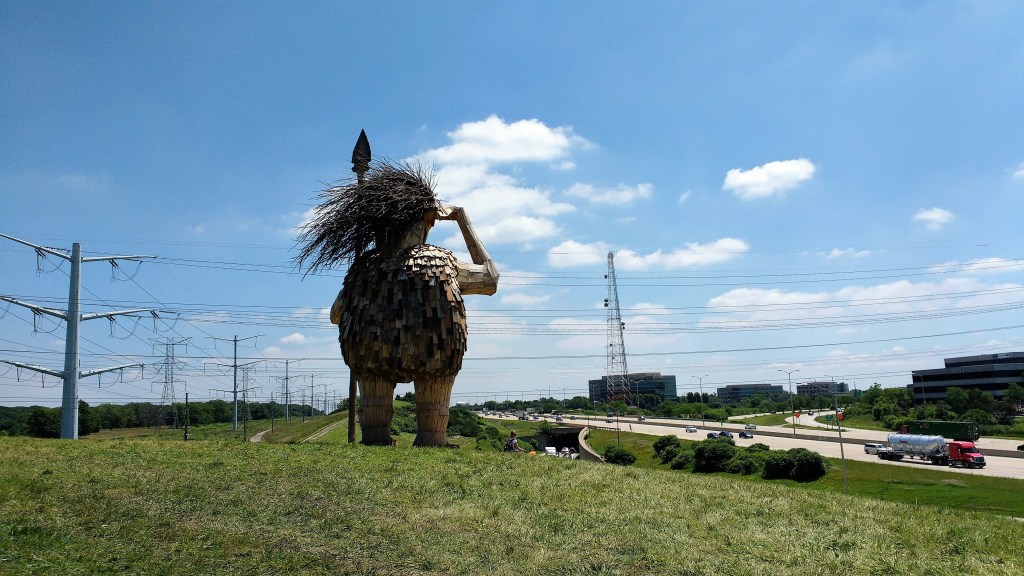
In a recent popular exhibit, the Arboretum even leaned into the nearby development with one installment looming over the highway:

Note the large power lines, the evidence of two major highways nearby (I-88 and I-355), and office buildings.

Recently, I drove around the east side of the property. This land has had a number of office and warehouse properties for years. This makes sense: the properties have access to multiple highways and there are plenty of residents/workers nearby.

However, I have noticed a more recent addition to this set of land uses: there is a parking lot just for Amazon trucks and vehicles. As far as I could see, there was no building next to the lot; just many spaces for vans and trucks. Looking at Google Maps, there is indeed a parking lot there among some other development and some undeveloped land. There is an Amazon facility nearby – one of many in the Chicago region – but it is not directly connected to the parking lot so drivers would have to exit to the main road and then turn back into the Amazon facility.

It is hard to completely escape development when in the Arboretum. Traffic noise can be heard, airplanes fly overhead, and houses and other signs of suburbia are visible from different vantage points. Yet, the presence of an Amazon parking lot reminded me of what nature is in the suburbs: present but often in-between roads, homes, and other buildings that speak to the ways that humans have and continue to transform natural features to their own particular suburban goals.