Argument: “the real civic religion of America, business at all costs”

Which values should guide decisions in a time of crisis? Here is one argument regarding how decisions are made in the United States:

These approaches are the horns of America’s corona-dilemma. Every society has reacted to COVID-19 according to its principles or, if no principles were to hand, its habits. It has been America’s misfortune that its principles and habits are ill-suited to managing an epidemic. The federal system, by functioning as it should, prevented the kind of nationwide shutdown that worked in smaller countries like Austria. The real civic religion of America, business at all costs, can accept the redirection of the economy by the Defense Production Act, but it cannot tolerate the suspension of all economic activity. Yet a powerful counter-impulse — averse to risk, trusting of authority, and hence likely to seek out niches in the economy which are immune to booms and busts — prefers to shelter in place.

It is hard to make sweeping claims about cultural values in the midst of significant social change. At the same time, understanding “patterns of meaning-making” (the definition of culture from sociologist Lyn Spillman) is invaluable for analyzing why certain actors respond as they do in such times.

This reminds me of two sociological works that get at the same issue:

1. Emerson and Smiley’s 2018 book Market Cities, People Cities examined cities around the United States and the world to see if they put markets or people first. On the whole, American cities privilege markets with their policies and rhetoric. In American communities, growth – usually measured as economic growth and/or population increases, is always good. (See an earlier post on this book here.)

2. Dobbin’s 1994 book Forging Industrial Policy suggests in the early decades of the railroad the United States pursued a public-private policy regarding develpoment compared to the laissez-faire approach of Britain and the top-down, centralized approach of France. Yet, in the last few decades, a growing chorus of voices argues the United States privileges the interests of corporations over the welfare of all residents.

There could be other contenders for the civic religion of Americans including individualism, the civil religion described by sociologist Robert Bellah, middle-class values, and the importance of private property and private spaces. But, in this particular situation, what exactly should be done regarding businesses and the economy is a particular hot point.

Reminder: do not get carried away making fancy charts and graphs

The Brewster Rockit: Space Guy! comic strip from last Sunday makes an important point about designing charts and graphs: don’t get carried away.

https://www.gocomics.com/brewsterrockit/2020/05/03

Brewster Rockit May 3, 2020

The goal of using a chart or graph is to distill the information behind it into an easy-to-read format for making a quick point. A reader’s eye is drawn to a chart or graph and it should be easy to figure out the point the graphic is making.

If the graph or chart is too complicated, it loses its potency. If it looks great or clever but cannot help the reader interpret the data correctly, it is not very useful. If the researcher spends a lot of time tweaking the graphic to really make it eye-popping, it may not be worth it compared to simply getting the point across.

In sum: graphs and charts can be fun. They can break up long text and data tables. They can focus attention on an important data point or relationship. At the same time, they can get too complicated and become a time suck both for the producer of the graphic and those trying to figure them out.

Changed suburban spending because of COVID-19, Naperville edition

While most public attention with COVID-19 has focused on big cities and countries, numerous suburbs will deal with the effects of the pandemic as well. Here is how Naperville, a large and well-off suburb, is planning to tackle a budget gap:

The city of Naperville is shaving nearly $25 million off its 2020 budget in the wake of the economic downturn caused by the coronavirus pandemic…

City Manager Doug Krieger said some of the projects were selected to be postponed because they’re considered “nice-to-haves” and aren’t expected to cost significantly more to be completed in future years. One major project, a $2.6 million plan to improve downtown streetscapes, was included on the list for deferment because “the downtown merchants did not want to proceed” with it in light of the pandemic, he said.

The moves will help the city offset anticipated declines in revenue sources — such as sales tax, food and beverage tax and motor fuel tax — as residents and businesses continue to follow the stay-at-home order…

Other work that will not take place this year includes $9 million in water meter-reading technology upgrades, a $7 million road widening project on North Aurora Road and $1.1 million of work toward a park at 430 S. Washington St. to be built in conjunction with North Central College, as well as smaller projects such as LED lighting conversion, tree planting, electric vehicle charging stations, flooring replacements and conference room IT and electric upgrades.

Suburbs and other municipalities can generate tax revenue through several sources (as noted above). Property taxes are affected by property values, which appear at this point appear to be holding firm during COVID-19. Sales taxes are generated by local businesses; this will certainly be down in communities (though the decline of retailers was already an issue). Food and beverage taxes will be down. And the number of people buying gasoline – feeding into the motor fuel tax – is down (and projections for the state’s funding through this suggest a big dip). In Illinois, we are near a third month of reduced business and social activity and this will make a big dent in municipal finances.

At the same time, based on the descriptions here, it sounds like an average resident of Naperville would not even notice that these improvements are not addressed this year. Of course, it could create a backlog for future years – pushing projects down the road means other planned projects might be delayed later – but the focus is on helping to address the current issues.

Naperville may be an unusual case compared to many other suburbs. It is a big community with a lot of successful businesses. The local government prides itself on being well-run and stable. It is not clear how long Naperville could continue to work through budget shortfalls but it is likely better prepared for this than many places.

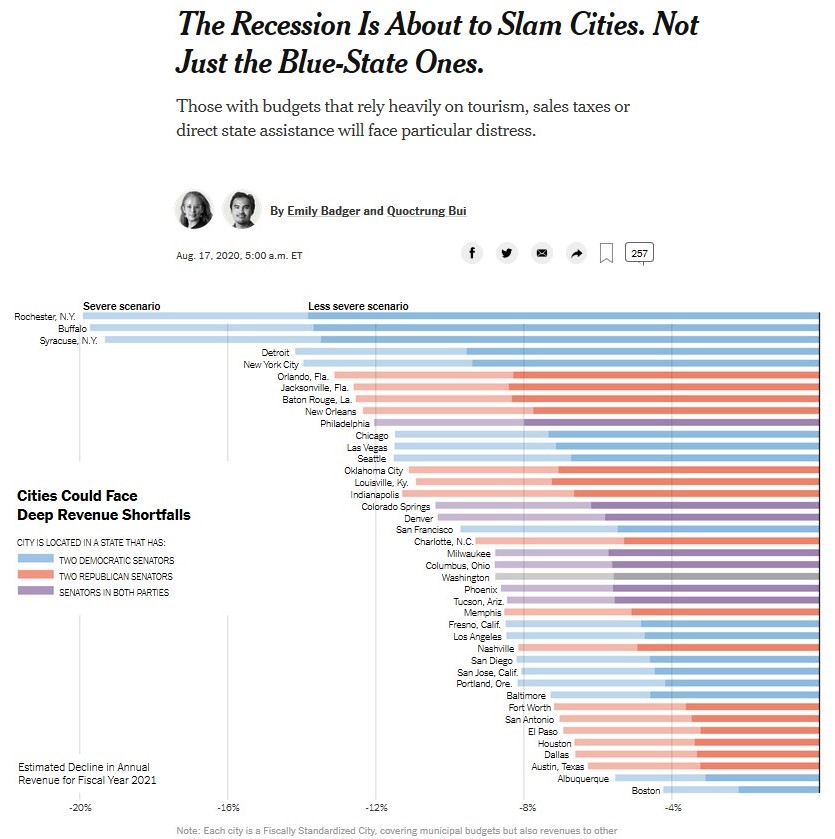
This means that many municipalities could be facing tough questions in the months ahead about local projects and local funding. If the federal government and states are struggling with missed revenues, this will certainly affect municipalities who have to address local budget issues.

Housing prices up during COVID-19

During COVID-19, few people are looking for homes – and even fewer are selling:

The median home price rose 8% year-over-year to $280,600 in March, according to the National Association of Realtors. While buyer demand has softened and sales fell 8.5% that month from the prior month, the supply of homes on the market is contracting even faster, recent preliminary data shows…

What’s more, many sellers have been reluctant to cut prices. Only about 4% of sellers cut their prices in the week ended April 25, down from 5.7% during the same week last year, according to Realtor.com. ( News Corp, parent of The Wall Street Journal, operates Realtor.com.)…

Total listings of homes for sale, meanwhile, have hit a five-year low, while the median listing price was up 1% from last year at $308,000, Redfin said.

The housing market has been undersupplied for years. During the pandemic it may get worse. There were 1.5 million units for sale at the end of March, NAR said, down 10.2% from a year earlier. Homeowners are waiting to list their houses, real-estate agents say, because they have decided not to move or they are worried about letting buyers into their homes during a pandemic.

It will be interesting to see how long this holds up given the rapid spike in unemployment. How many people will be in a position to buy or sell in the coming months? And how long will it take for housing markets to return back to pre-Covid levels of activity?

Beyond prices, which matter to many homeowners who want to do everything they can to keep property values going up, there are additional big issues at play. One is noted above: a lack of housing supply long-term, particularly in certain markets and in certain segments. Another is the possible effects on the mortgage industry. A third is what this does to the idea of housing when there have been two  major shocks to housing in the last fifteen years. A fourth is whether people decide they want to live in certain locations more because of health risks. Like other sectors of society, COVID-19 may expose or hasten problems with existing issues.

In other words, stay tuned.

The difficulties for public institutions and spaces after COVID-19

Reopening and repopulating public spaces during and after COVID-19 might provide difficult:

Yet can you reopen a society — particularly a republic built on openness and public interaction — without its physical institutions at full capacity, without public spaces available for congregation?…

Something else unites these places. In each, the woman on the next bench, the man ahead in the checkout line, the family down the pew are suddenly potential vectors — or potential victims. So we’re assessing the public realm in the way we assess a salad bar when we walk into a restaurant…

“Democracy depends to a surprising extent on the availability of physical, public space, even in our allegedly digital world,” John R. Parkinson writes in “Democracy and Public Space: The Physical Sites of Democratic Performance.”

“How do you define the ‘public realm’ when an enormous percentage of the American public spends the majority of its day in its pajamas?” Stilgoe says.

This piece raises great questions for a COVID-19 world. The emphasis on how architecture and design shapes public behavior as well as how others in those spaces can be trusted or not is right on. At the same time, there are several elements I would add to this analysis:

1. The definitions of “institution” and “spaces” are pretty broad. Some of the listed locations, like shopping malls, colleges, and grocery stores, are not public spaces. They are owned by private groups that can and do dictate how the space can be used. Some of the other locations, like parks and squares, are public spaces. Government buildings are generally more open to all. Americans privilege private space even though we need some of the private spaces – grocery stores, workplaces – to survive. But, the same rules or expectations do not apply in each of these spaces. We saw this in the Occupy Wall Street protests where gatherings in what looked like public spaces could be ended when they spaces were actually owned by private groups or the government pushed people out. We actually do not have that many public spaces where people regularly gather; many of our “public spaces” are actually privately owned and this matters. The private public spaces require both private groups and the public to cooperate – and they may not always do so.

2. Even before COVID-19, it is not clear that many Americans value public spaces or use them regularly. As noted in #1, Americans like their private spaces. Homes may be less attractive when you are trapped in them but we have a society where success is owning your own suburban single-family home. Add to this declining trust in numerous institutions and it may be hard to make the case that we should put more resources and effort into creating and maintaining public spaces.

3. More broadly, many would argue a thriving society and democracy depends on regular interaction between people. And face-to-face interaction provides benefits that online communication does not regarding communicating clearly and building relationships. Yet, again, this has been on a decline for a while now. Twitter is not a good approximation of public conversation nor a good medium (at least as currently constructed or experienced) for public conversation. Telecommuting may provide efficiencies and allow people more private lives but something will be lost. See my earlier thoughts on sociologist Eric Klinenberg’s Palaces for the People where he takes up these issues (Part One, Part Two, Part Three, Part Four).

From outlier to outlier in unemployment data

With the responses to COVID-19, unemployment is expected to approach or hit a record high among recorded data:

April’s employment report, to be released Friday, will almost certainly show that the coronavirus pandemic inflicted the largest one-month blow to the U.S. labor market on record.

Economists surveyed by The Wall Street Journal forecast the new report will show that unemployment rose to 16.1% in April and that employers shed 22 million nonfarm payroll jobs—the equivalent of eliminating every job created in the past decade.

The losses in jobs would produce the highest unemployment rate since records began in 1948, eclipsing the 10.8% rate touched in late 1982 at the end of the double-dip recession early in President Reagan’s first term. The monthly number of jobs lost would be the biggest in records going back to 1939—far steeper than the 1.96 million jobs eliminated in September 1945, at the end of World War II.

But, also noteworthy is what these rapid changes follow:

Combined with the rise in unemployment and the loss of jobs in March, the new figures will underscore the labor market’s sharp reversal since February, when joblessness was at a half-century low of 3.5% and the country notched a record 113 straight months of job creation.

In other words, the United States has experienced both a record low in unemployment and a record high within three months. A few thoughts connected to this:

1. Either outlier is noteworthy; having them occur so close to each other is more unusual.

2. Their close occurrence makes it more difficult to ascertain what is “normal” unemployment for this period of history. The fallout of COVID-19 is unusual. But the 3.5% unemployment can also be considered unusual compared to historical data.

3. Given these two outliers, it might be relatively easy to dismiss either as aberrations. Yet, while people are living through the situations and the fallout, they cannot simply be dismissed. If unemployment now is around 16%, this requires attention even if historically this is a very unusual period.

4. With these two outliers, predicting the future regarding unemployment (and other social measures) is very difficult. Will the economy quickly restart in the United States and around the world? Will COVID-19 be largely under control within a few months or will there be new outbreaks for a longer period of time (and will governments and people react in the same ways)?

In sum, dealing with extreme data – outliers – is a difficult task for everyone.

The most McMansiony residence on Modern Family

Adding to earlier posts on the details of the three primary residences on Modern Family and the way the show was successful even with three McMansions, this post considers which home is the most McMansiony.

https://www.housebeautiful.com/design-inspiration/house-tours/a23472261/abc-modern-family-house-design/

To make this decision, I am working with the four traits of McMansions I developed: size, relative size, poor architecture/design, and a symbol for other American problems.

The Pritchett House: this is the biggest home at over 6,000 square feet. The relative size is hard to judge since the neighboring homes are almost never seen (I cannot recall seeing them). The home is built in a modern style with big windows and some strange angles. There is a good-sized pool in the backyard. With its size and design, the home could definitely be considered for the wealthy and Jay Pritchett is a successful business owner.

The Pritchett=Tucker home is in a more Mediterranean style (title roof, stucco, balcony, some arched windows and an arched doorway). There is a round turret in the middle with the doorway. Cam and Mitchell have the least space (since they only occupy the first floor on the show). Again, we do not have much of a sense of the surrounding neighborhood since other homes are rarely shown. This is easy to select as the least McMansiony home, at least as presented on the show as a oe story dwelling.

The Dunphy home is nearly 3,000 square feet and built to look like a traditional home with its white picket fence, covered entryway, and front entrance that leads to a hallway as well as a staircase to the bedrooms upstairs. The home seems to fit in of what we see of the neighborhood; we see more of the Dunphy neighborhood than any of the other homes. Phil and Claire are portrayed as typical parents who with three kids are just trying to help their kids be successful and keep their sanity at the same time.

Based on my definition and what we see on the show, I think the home of Jay and Gloria Pritchett best fits the bill of a McMansion. It is large. All that space for a family of four. (When the whole family gathers there, it looks like they all fit easily.) It is the most expensive of the homes. It has newer features plus a pool. The architecture is unique though not necessarily garish – this could depend on one’s view of more modernist homes. As the patriarch with his second family, Jay clearly has plenty of resources (and there are other hints of this on the show as well).

Perhaps a more interesting question is whether the Dunphy home is really a McMansion. It is a larger than average home. It costs quite a bit, though this is due more to its metropolitan market and its location. The home does not look garish on the outside; the proportions may be off, the entryway covering is large, and there are multiple gables but it does not scream ostentatious. Furthermore, the show does not portray the family as evil or overly-wealthy McMansion owners; they are a typical sitcom family. Given all of this, I am on the fence about calling this home a McMansion even as a majority of Americans could not live in such a home in that real estate market.

More on the McMansions on Modern Family

Following up on yesterday’s post, here are some more details on the main residences featured on Modern Family and which one I think qualifies as the most McMansion-y. (This post draws on “Stalking from Los Angeles: Houses from Modern Family” – denoted as SfLA below, House Beautiful – denoted as HB below, and the Modern Family Wiki – denoted as Wiki below.)

  • Phil and Claire Dunphy’s house.

“Phil is the only one working in the Dunphy family and as a realtor he’s doing very well. The Dunphy house is worth almost $1.8 million, according to Zillow.com.” (SfLA)

“Phil and Claire’s house is a little more traditional, almost as if it’s ripped directly from an early 2000’s catalog. And that was exactly the goal: The space is supposed to be very comfortable and lived in, with a vibe that’s “Pottery Barn meets Restoration Hardware,” production designer Richard Berg told Architectural Digest back in 2012.” (HB)

“It is a detached, suburban home with two living rooms, kitchen/dining room, 2 bathrooms, 4 bedrooms, and a garage. Outside it has both a front and back garden with a trampoline.” (Wiki)

  • Jay and Gloria Pritchett’s house.

“According to Zillow.com Gloria and Jay’s house in Brentwood is currently worth more than $8 million. This 6,359 square foot (590 square meters) single family home has 5 bedrooms, 6 bathrooms and a pool.” (SfLA)

“Fun fact: That exterior is an actual, two-story house in Los Angeles’s Brentwood neighborhood, though most of the filming is done on a soundstage. The Modern Family production team had built “80 percent” of the set before finding the perfect house to serve as its exterior, so they had to go back and change its windows and layout to match, Berg said.” (HB)

“It seems to be the largest and grandest house of the three families, as Jay earns a lot of money from his job. Contains 2 floors, a living room, 1 kitchen, 3 bedrooms, 1 bathroom, and a garage…Outside there’s a front garden and a huge pool that is first seen in “The Incident“, and is frequently seen ever since…The real house is located in Brentwood, 15 minutes away from the house used for Mitch and Cam. There is a whole extra wing of the house that is not show in the shots of the house for the show.” (Wiki)

  • Mitch Prichett and Cam Tucker’s house.

“Cameron’s and Mitchell’s house is very near to the Dunphys (well, for L.A., of course). Their house has 4 bedrooms and 2 bathrooms. Its worth: $1.3 million (source: Zillow.com).” (SfLA)

“Mitchell and Cameron’s apartment, with its villa style and ivy snaking up the walls, definitely caught people’s attention. It’s a little more romantic, and even though their home would mean settling for less square footage (they live in the ground-floor apartment of the two-story, technically), their interiors tend to be a little more upscale and collected over time. “We saw the couple as being new to the parenthood plateau and fresh off the plane from years of travel and singledom,” Berg told the magazine.” (HB)

“Unlike The Dunphy House or The Pritchett House, it only has one floor, the upstairs is open for rental, revealed in Slow Down Your Neighbors. Their floor contains a living room, 1 kitchen, 1 bathroom, 2 bedrooms, and a garage. It is revealed in “Mistery Date“, that Lily’s bedroom was previously Mitchell’s home office, but they had to give it up for her room. Outside it has both a front and back garden..” (Wiki)

In summary:

The homes are all large and expensive, located near each other west of downtown Los Angeles, are meant to reflect the characters that live there, and have recognizable exteriors that are then recreated on sets where the interior scenes are shot.

Tomorrow, I will compare how the features of each home match up traits of McMansions. In other words, which Modern Family dwelling is the most McMansion-y?

Modern Family a successful TV show for taking place in McMansions

McMansions do not have a positive reputation yet they can serve as the primary setting for popular television shows. For example, Modern Family had a successful run and featured three large homes:

The path of the mockumentary series arcs from a trailer park in Nova Scotia to a McMansion in Los Angeles. In 2001, the Canadian cult comedy Trailer Park Boys inaugurated a soon-to-be-ubiquitous style of show: deliberately messy, handheld camera work paired with confessional interviews and presenting scripted fiction in the style of candid reportage. In 2020, the ABC megahit Modern Family wound down after 11 seasons and 22 increasingly aggravating Emmy wins. Between those two events lies the rise and fall of a genre that was not reality TV, but came up alongside it and echoed its conventions.

Since the rest of the article is more about mockumentaries as a genre than about the residences of main characters in such shows, I will go on the McMansion tangent regarding Modern Family. Here is what is unique about the McMansions on the show:

1. The McMansions are not objects of derision or mockery. The genre may lend itself to this but Modern Family sought to end episodes and story lines with feel-good family togetherness. The characters were portrayed as goofy or quirky suburbanites who otherwise lived normal lives. The McMansion is the center of family life and good things result for the family that lives there. (Compare this to many recent portrayals of troubled families that live in McMansions – see examples here and here. Or, consider the McMansion on The Sopranos.)

2. The homes are all clearly large and their architecture is unique in different ways: Cam and Mitchell’s home has a turret (and supposedly has an upstairs apartment), Jay and Gloria’s home is more modernist, and Phil and Claire’s home tried for a traditional look. In other words, the show displays the variety of McMansions.

3. These are not just large homes; they are expensive homes in an expensive housing market. The Dunphy home went on the market several ago with a price tag over $2 million. The homes are portrayed as normal yet the houses are not within the reach of many viewers.

4. There is little doubt that Modern Family was successful: 11 seasons? 22 Emmys? A long life in syndication? And it happened even with the consistent presence of McMansions, homes critics would say symbolize all sorts of large American problems. Did the show work in spite of the homes? Was it all just one big wink and nod about the characters and their homes?

Open offices might be pushed out by COVID-19

Open offices have provoked a lot of reactions. One CEO thinks COVID-19 might help them meet their demise:

Carol Bartz, who led the architectural and engineering software maker Autodesk Inc. for a decade before heading up Yahoo Inc. during a turbulent period that began with the last recession, is known for being direct and speaking her mind. In a recent telephone interview with MarketWatch from her home in Silicon Valley, Bartz described the current age of COVID-19 as a “new game,” with “new rules” for everyone, and made a few predictions about how she expects life to change, especially at work.

“I think office space is going to change, [and] we will go back to putting shields between people,” she said, adding that, while she realizes this in the grand scheme amounts to minutiae, this is one of the many kinds of changes that CEOs are going to have to address in the future, in what will be the new life of the CEO. “We have to take the fear away from people,” she said, noting that this will probably be the first time offices will have to be designed around health factors.

Instead of the old office cubicles separating desks, “They probably will be clear, you will not sit there in that big open space. I think people are going to want protection, plexiglass or whatever. There will also be more teleconferencing, absolutely less flying — you will teleconference with customers,” Bartz said. “Tthey don’t want to see you in person, and you don’t want to see them.”

Office spaces change in response to a variety of factors. With health as a concern going forward, it will be interesting to see how companies and leaders discuss the possible changes: how does health interact with wanting to promote collaboration or cutting costs by not having a lot of cubicles and private offices?

More broadly, this goes beyond just personal workspaces. How will employees gather together? The proverbial water cooler (or break room or coffee station) is an important feature of workspace, whether it provides a break or encourages conversation among employees. Is holding meetings in conference rooms also off the table if social distancing is required or helpful?

I would also imagine that whatever changes in physical office space occurs because of COVID-19 might need to be highly adaptable to future changing conditions. Cubicles or plexiglass might be needed for months but what happens after that point when people and organizations are less fearful? Cubicles tend to be modular and can be reconfigured. Just how many shifts can a typical organization go through?